
Knowledge
Can Andy Burnham Solve the Social Care Crisis?

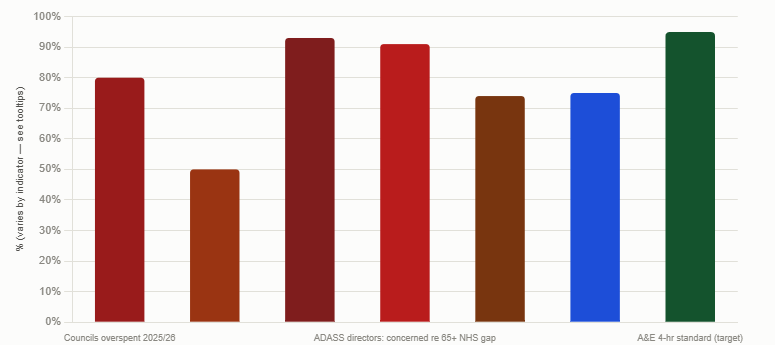
England spends £32 billion a year on adult social care. Councils are already overspending. 80% overspent in 2025/26. There are over 100,000 vacancies. Unpaid carers fill a gap valued at £184 billion annually. This is not a crisis approaching. It is a crisis in progress

The Scale of The Crisis.
Burnham's Reform Timeline
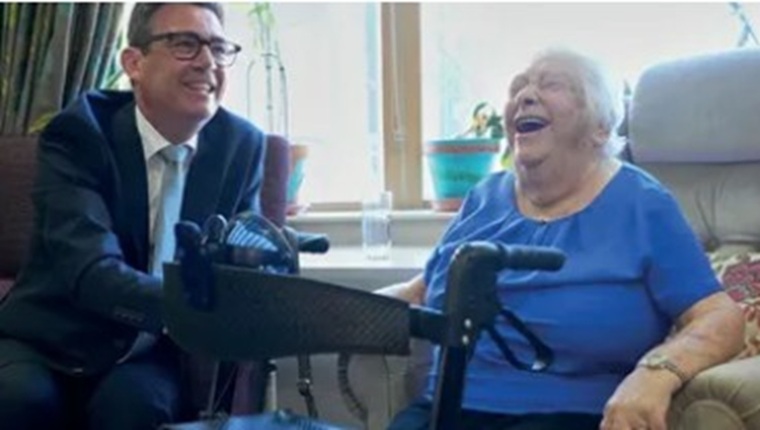
Andy Burnham arrived at Number 10 as Prime Minister in 2026 with more direct personal history with this problem than any of his predecessors. As Health Secretary in 2009, he attempted to introduce a national care funding scheme. As Mayor of Greater Manchester, he spent nearly a decade integrating health and social care, designing neighbourhood-based prevention, and demonstrating that housing, employment, and community were as important to health outcomes as clinical intervention. The question now is whether what worked in Manchester — a city region with a devolution deal, a political mandate, and a mayor’s direct authority — can be made to work for England.
The Numbers: England: £32bn annual social care spend. 80% of councils overspent 2025/26. £1.6bn gap between council home care rates and minimum provider cost. Over 100,000 vacancies. Unpaid carers valued at £184bn/year. Half of councils expect to need emergency government bailout within 3 years (LGA).
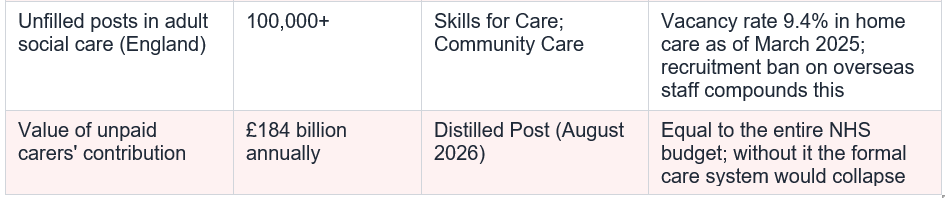
The Health Foundation’s analysis of government spending shows that although the Labour government has announced £3.7 billion for social care authorities in 2025/26 and a further £4.6 billion by 2028/29, spending power in 2025/26 is still approximately 9 percent lower than it was in 2010/11, in real terms. Much of the new funding relies on local authorities raising council tax and business rates locally — a mechanism that transfers fiscal pressure from central government to councils and ultimately to individual taxpayers, while offering no structural solution to the underlying funding gap.
The structural fault lines:
The scale of this informal workforce is extraordinary. The 2021 Census estimates 10 million unpaid carers in England and Wales, approximately 9 percent of the total population. Carers UK research suggests the true figure could be as high as 10.6 million. Parliament’s own health committee analysis notes that 1.5 million unpaid carers provide more than 50 hours of care per week — the equivalent of a full-time and half-time job, combined, performed without wages, often without training, and frequently without respite.
The consequences for carers themselves are significant and well-documented. Many withdraw partially or wholly from paid employment, reducing their lifetime earnings and pension entitlements. Many suffer adverse health outcomes of their own as a result of the physical and psychological demands of intensive caring. The King’s Fund’s Social Care 360 report notes that unpaid carers contribute the equivalent of four million paid care workers to the system. The formal social care workforce, by comparison, has 1.6 million filled posts.
Any credible reform of social care must reckon with this hidden subsidy. A transition to a more generously funded formal care system — one that provides more home care, more respite support, more professional provision — will require substantially more money precisely because it will be asking families and informal carers to provide less. The fiscal cost of genuine system reform is therefore substantially higher than the simple gap between current spending and current need.
Lady Casey (March 2026): The current system is held together by 'add-ons, workarounds, sticking plasters and glue.' An unavoidable demographic reckoning is approaching as the population ages.
What Burnham has committed to, as of August 2026:
The specific structural features of the Manchester approach that Burnham has sought to nationalise:
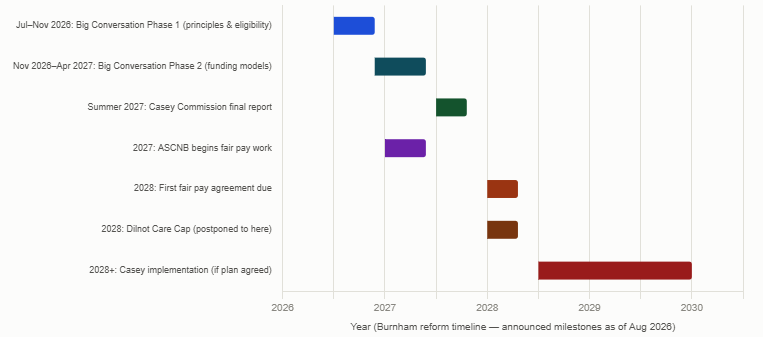
Burnham has now brought the final report forward to summer 2027. The second phase of the Big Conversation on Care, running to April 2027, is designed to feed public and stakeholder input into that report. Implementation beyond 2027, however, remains undefined.
The Obstacle: Charities and local authority directors have been explicit: a decade-long timeline from original commission to implementation treats an immediate collapse as a manageable long-term problem. The Distilled Post's August 2026 analysis quotes concerns that an initial report in 2026, a full review in 2027 (now), and implementation deferred to beyond 2028 continues a pattern in which structural reform is perpetually being prepared but never delivered. The system is not waiting for reform. It is deteriorating while reform is being planned.
The structural risk of commission-led reform in social care is well-documented. The Dilnot Report was published in 2011; it recommended a lifetime care cost cap. Parliament legislated it in 2014. The cap’s introduction was delayed by successive governments until it was eventually postponed again to 2028 by the Starmer administration. MoneyWeek notes that Burnham himself has been here before: as Health Secretary in 2009, he floated a national care funding scheme that was promptly branded a ‘death tax’ by the Conservative opposition. The label stuck, the policy died.
There are two ways to interpret this initiative. The charitable interpretation is that it reflects a genuine understanding of why social care reform has failed before: not primarily because of a lack of policy ideas, but because of a lack of political consensus and public buy-in for the inevitable trade-offs involved in funding a more comprehensive system. If the Big Conversation generates genuine public ownership of a funding settlement — whether through taxation, National Insurance, hypothecated levies, or another mechanism — it could provide the political insulation that previous reforms lacked.
The more sceptical interpretation is that public consultation on social care, no matter how well-designed, will surface the same structural tension it always does: people want better care, do not want to pay for it themselves, and do not want to vote for parties that ask them to pay more tax. The History Foundation’s analysis of previous consultations on care funding suggests that public support for reform exists in principle but evaporates when specific funding mechanisms are proposed. The 2022 Health and Care Levy — a National Insurance increase designed to fund NHS recovery and long-term care reform — was introduced and then repealed within 18 months.
The fair pay agreement introduced through the Employment Rights Act 2025 is the central workforce policy response. Burnham has been explicit that he considers this a priority that should not wait for the Casey Commission’s final report. But the timeline is problematic: the Adult Social Care Negotiating Body will not begin its work until 2027, the first pay agreement is not due until 2028, and no additional funding has been allocated to cover its costs when it arrives. The Local Government Association has stated clearly that the £500 million currently allocated for workforce improvements is insufficient to address the scale of the vacancy crisis.
Seventy-four percent of domiciliary care organisations report difficulty recruiting new care workers (Adult Social Care Workforce survey, April 2025). Average care worker pay remains significantly below the rates achievable in sectors with comparable skill requirements, creating persistent turnover and a cycle of recruitment cost that consumes resources that would otherwise fund care delivery. Without a material improvement in pay, conditions, and career progression for care workers, expanded provision — whatever model is adopted — will have no workforce to deliver it.
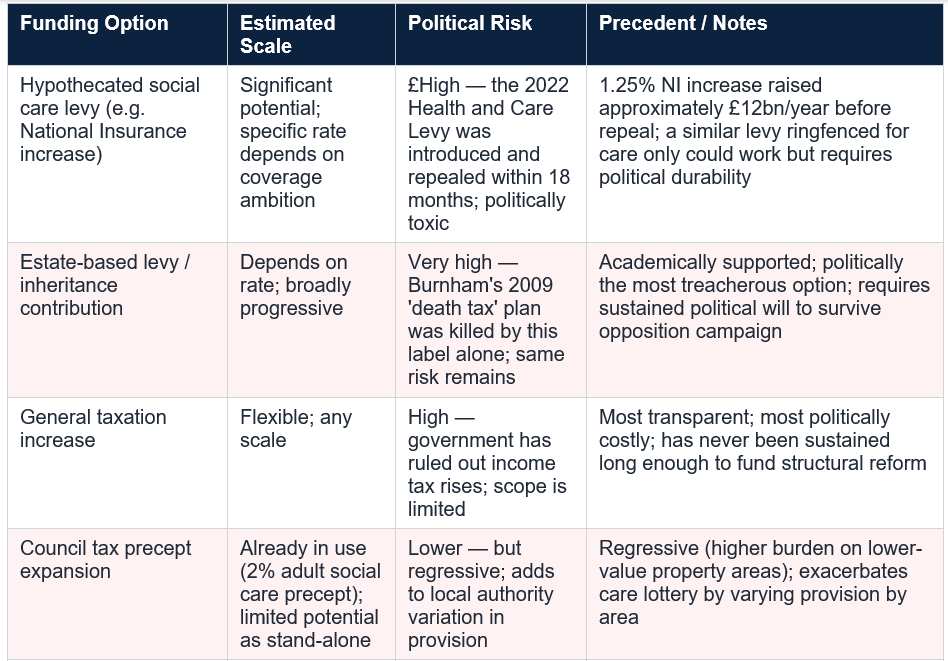
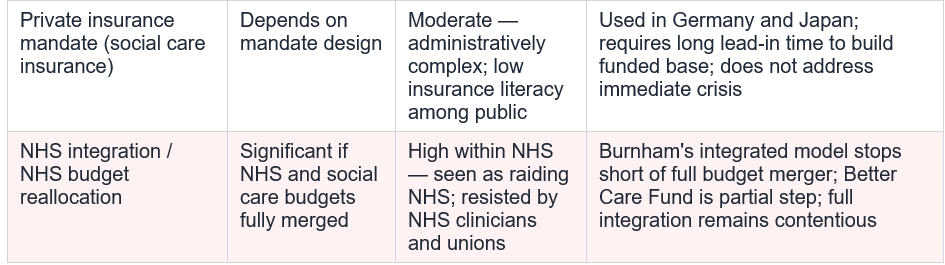
Independent estimates, cited by the Socialist Worker and others, suggest that making adult social care free at the point of need along NHS lines would cost approximately £17 billion per year in additional public funding — above the existing £32 billion base. This would require a funding source of that scale that is sustainable over decades, politically durable enough to survive changes in government, and structured in a way that does not generate the kind of ‘death tax’ framing that has derailed every previous attempt at serious reform.
But the system is not waiting. Eighty percent of councils overspent last year. The workforce vacancy rate, though improving, remains above 100,000. Councils are paying £8 per hour less than providers need to operate sustainably. Unpaid carers are providing £184 billion worth of support that the state does not pay for and cannot easily replace. A.&E. departments are meeting only 75 percent of their access target. And the implementation of any structural reform — even on the accelerated Casey timeline — will not arrive before 2028 at the earliest.
The honest answer to the question posed in this article’s title is: possibly, but not quickly, not cheaply, and not without a political fight that has defeated every Prime Minister who has attempted it before. Burnham brings the most relevant direct experience of any occupant of Number 10 in the modern era. Whether that experience is sufficient to overcome the structural obstacles that defeated his predecessors remains the defining public policy question of the second half of this decade.
The National Care Service (NCS) is Andy Burnham's stated ambition to create a publicly funded adult social care system in England that sits alongside the NHS and works in a highly integrated way with it. As described by the Prime Minister in statements reported by Community Care in July 2026, the NCS could be 'fully fledged' — meaning free at the point of use, as with the NHS — or 'a lesser version,' depending on the funding model ultimately adopted. As of August 2026, there is no fixed plan, no defined funding mechanism, and no clear implementation timeline beyond Baroness Casey's independent commission, which is due to report by summer 2027. MoneyWeek's July 2026 analysis describes the NCS as 'very much an aspiration' at this stage.
How much does adult social care cost in England and what is the funding gap?
England currently spends approximately £32 billion annually on adult social care via local authorities (House of Commons Library, July 2026; Distilled Post). The Health Foundation estimates an additional £8.3 billion will be needed by 2032/33 simply to keep pace with demographic demand — without expanding entitlements or improving quality. There is a specific £1.6 billion annual gap between what councils pay home care providers (averaging £24.10 per hour) and the minimum price required for sustainable provider operation (£32.14 per hour), according to the Homecare Association's August 2025 report. Independent estimates suggest making care free at the point of need would require approximately £17 billion in additional annual public funding above current spending.
Who is Baroness Casey and what is the Casey Commission?
Baroness Louise Casey is a cross-bench peer who leads the Independent Commission on Adult Social Care, established in 2025 under the Starmer government. The commission is tasked with designing the framework for a National Care Service that integrates with the NHS. The original timetable called for an initial report in 2026 and a full report by 2028, with implementation not expected until 2036. Prime Minister Burnham has brought the final report forward to summer 2027. In a March 2026 assessment, Baroness Casey described the current social care system as held together by 'add-ons, workarounds, sticking plasters and glue,' and warned of an unavoidable demographic reckoning as the population ages. The commission's expedited findings are expected to inform the 'Big Conversation on Care' public engagement process running to April 2027.
What is the scale of the care workforce crisis in England?
England has over 100,000 unfilled posts in adult social care. The vacancy rate in home care was 9.4% as of March 2025 — down from 11.9% the previous year but still representing a significant structural shortage. 74% of domiciliary care organisations report difficulty recruiting new care workers (Adult Social Care Workforce survey, April 2025). The government's decision to end international recruitment of overseas social care workers removes one of the sector's primary labour supply routes. A fair pay agreement is being developed through the Employment Rights Act 2025, but the Adult Social Care Negotiating Body will not begin work until 2027 and the first agreement is not expected until 2028. The Local Government Association has stated that the £500 million currently allocated for workforce improvements is insufficient to address the scale of the vacancy crisis (Distilled Post, 2026).
How is social care in England currently funded and who pays?
Social care in England is means-tested rather than free at the point of use. Individuals with assets above a capital threshold must fund their own care. Local authorities commission and fund care for those who meet both the needs and financial eligibility criteria. The government provides funding to councils through several streams including the Social Care Grant (£5.9 billion in 2025/26), the Better Care Fund (£2.64 billion), and the Market Sustainability and Improvement Fund (£1.05 billion), among others — plus an additional £880 million Social Care Grant (House of Commons Library, July 2026). Despite this, 80% of councils overspent in 2025/26. A significant hidden subsidy is provided by unpaid family carers, whose collective contribution has been valued at £184 billion annually (Distilled Post, 2026) — more than the entire NHS budget. Without this informal labour, the formal system would require substantially more funding.
Has England tried to reform social care before, and what happened?
Multiple attempts have been made at reforming social care funding in England, and all have either failed or been deferred. The Dilnot Report (2011) recommended a lifetime care cost cap; this was legislated in 2014, delayed repeatedly, and most recently postponed again until 2028 by the Starmer administration. Andy Burnham himself proposed a national care funding scheme in 2009 when he was Health Secretary; the Conservative opposition branded it a 'death tax' and the policy died. The 2022 Health and Care Levy — a National Insurance increase to fund both NHS recovery and long-term care — was introduced by the Johnson government and repealed by Truss within months. The consistent pattern is: reform is proposed, a political attack frame is found, and the political will evaporates. The Casey Commission and the Big Conversation are designed, in part, to build the broad public and cross-party consensus that previous reforms lacked.
Table of Contents
- A Crisis Long in the Making
- The Scale of the Problem: What the Numbers Show
- How England’s Social Care System Works — and Why It Is Failing
- The Hidden Subsidy: Unpaid Carers and the £184 Billion Question
- What Andy Burnham Has Promised: The National Care Service Vision
- The Manchester Model: What He Did in Greater Manchester
- The Casey Commission: Timeline, Scope, and the Risk of Delay
- The Big Conversation on Care: Public Engagement or Political Cover?
- Workforce: The Vacancy Crisis That Predates the Political One
- Funding Options: What Could Actually Pay for Reform?
- The Obstacles: What Previous Prime Ministers Discovered
- The Verdict: Reasons for Optimism and Reasons for Caution
- Conclusion: The Right Person, at the Right Time — But Is There Enough Time?
- Frequently Asked Questions
The Scale of The Crisis.
Burnham's Reform Timeline
A Crisis Long in the Making
A parliamentary committee once described England’s adult social care system as ‘unfair, confusing, demeaning and frightening.’ That description, cited in a recent MoneyWeek analysis of the current political moment, remains accurate. England spends £32 billion a year on adult social care through local authorities. Councils are already overspending that allocation. Eighty percent overspent in 2025/26. There are over 100,000 unfilled posts in the sector. Unpaid family carers fill a gap officially valued at £184 billion annually. And on NHS targets, just 75 percent of patients were seen within four hours in A&E in June 2026, against a standard of 95 percent — a direct consequence of a social care system that cannot discharge patients who have nowhere to safely go.Andy Burnham arrived at Number 10 as Prime Minister in 2026 with more direct personal history with this problem than any of his predecessors. As Health Secretary in 2009, he attempted to introduce a national care funding scheme. As Mayor of Greater Manchester, he spent nearly a decade integrating health and social care, designing neighbourhood-based prevention, and demonstrating that housing, employment, and community were as important to health outcomes as clinical intervention. The question now is whether what worked in Manchester — a city region with a devolution deal, a political mandate, and a mayor’s direct authority — can be made to work for England.
The Numbers: England: £32bn annual social care spend. 80% of councils overspent 2025/26. £1.6bn gap between council home care rates and minimum provider cost. Over 100,000 vacancies. Unpaid carers valued at £184bn/year. Half of councils expect to need emergency government bailout within 3 years (LGA).
The Scale of the Problem: What the Numbers Show
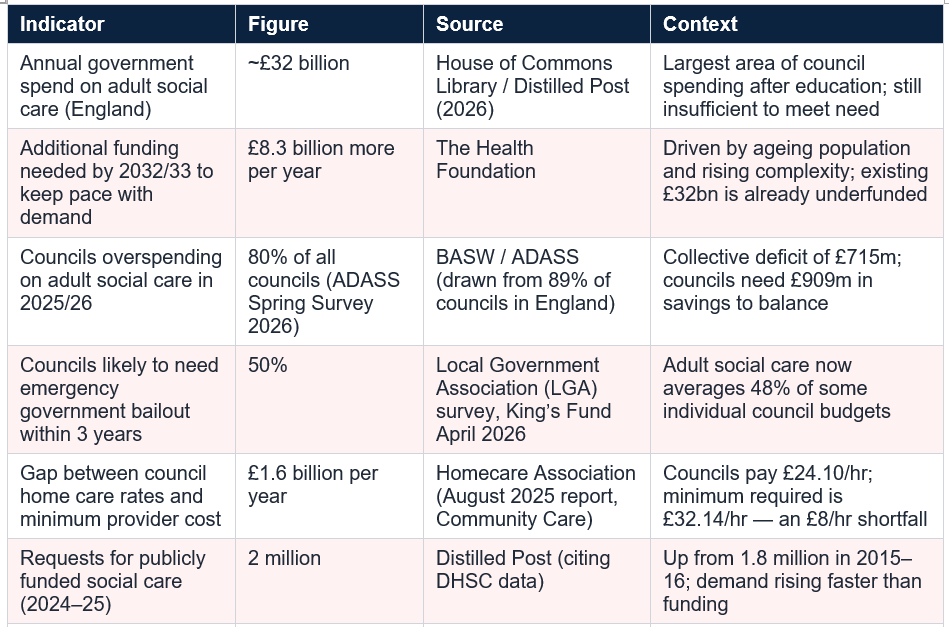
The data on England’s adult social care system presents a picture of sustained underinvestment colliding with accelerating demographic demand. The key figures from the most recent authoritative surveys and parliamentary analyses:The Health Foundation’s analysis of government spending shows that although the Labour government has announced £3.7 billion for social care authorities in 2025/26 and a further £4.6 billion by 2028/29, spending power in 2025/26 is still approximately 9 percent lower than it was in 2010/11, in real terms. Much of the new funding relies on local authorities raising council tax and business rates locally — a mechanism that transfers fiscal pressure from central government to councils and ultimately to individual taxpayers, while offering no structural solution to the underlying funding gap.
How England’s Social Care System Works — and Why It Is Failing
England’s adult social care system is characterised by what MoneyWeek and the Local Government Lawyer have both termed a ‘care lottery’: a patchwork of funding rules, means tests, local-authority decisions, and private providers that produces profoundly different outcomes for identical care needs depending on where someone lives, how much they own, and how informed they are about what they are entitled to.The structural fault lines:
- • Means testing: unlike the NHS, social care is not free at the point of use. Individuals with assets above a threshold must pay for their own care. The planned Dilnot Cap — which would have limited any individual’s lifetime care costs — was postponed by the previous Starmer administration until 2028, continuing a decades-long pattern of deferral.
- • The two-tier market: because local authorities can only afford to commission care at relatively low rates, a pronounced two-tier market has taken hold. Self-funding individuals are routinely charged higher rates by care homes and home care agencies, effectively cross-subsidising state-funded residents in the same facilities. The Distilled Post notes that this imbalance ‘distorts both pricing and quality across the sector.’
- • Fragmentation: health and social care operate in separate silos — different funding streams, different accountability structures, different commissioning processes — even when they serve the same person for the same underlying need. This fragmentation produces delayed discharges from NHS hospitals, duplication of assessment, and gaps in the support available at night, at weekends, and in rural areas.
- • Employer cost pressures: the 6.7 percent increase to the National Living Wage in 2025/26 added approximately £1.85 billion to the sector’s cost base (Nuffield Trust, cited by House of Commons Library July 2026), while the increase in employer National Insurance contributions from 13.8 to 15 percent compounded the pressure further.
The Hidden Subsidy: Unpaid Carers and the £184 Billion Question
The most important number in the social care debate is not £32 billion. It is £184 billion. That is the value attributed to the annual contribution of unpaid carers in England — friends, family members, and neighbours who provide care outside the formal system, for no pay, and with very little state support. The Distilled Post’s August 2026 analysis states directly: ‘Without that informal labour, the system would require considerably more formal provision than currently exists.’The scale of this informal workforce is extraordinary. The 2021 Census estimates 10 million unpaid carers in England and Wales, approximately 9 percent of the total population. Carers UK research suggests the true figure could be as high as 10.6 million. Parliament’s own health committee analysis notes that 1.5 million unpaid carers provide more than 50 hours of care per week — the equivalent of a full-time and half-time job, combined, performed without wages, often without training, and frequently without respite.
The consequences for carers themselves are significant and well-documented. Many withdraw partially or wholly from paid employment, reducing their lifetime earnings and pension entitlements. Many suffer adverse health outcomes of their own as a result of the physical and psychological demands of intensive caring. The King’s Fund’s Social Care 360 report notes that unpaid carers contribute the equivalent of four million paid care workers to the system. The formal social care workforce, by comparison, has 1.6 million filled posts.
Any credible reform of social care must reckon with this hidden subsidy. A transition to a more generously funded formal care system — one that provides more home care, more respite support, more professional provision — will require substantially more money precisely because it will be asking families and informal carers to provide less. The fiscal cost of genuine system reform is therefore substantially higher than the simple gap between current spending and current need.
Lady Casey (March 2026): The current system is held together by 'add-ons, workarounds, sticking plasters and glue.' An unavoidable demographic reckoning is approaching as the population ages.
What Andy Burnham Has Promised: The National Care Service Vision
Andy Burnham entered government having reconfirmed Labour’s pledge to create a National Care Service (NCS) — a standing ambition that has been part of Labour policy for years but that has never been backed by a fixed plan, a defined funding model, or a clear picture of what the service would actually look like in practice. MoneyWeek’s July 2026 analysis, published two days before this article’s date, describes it plainly as ‘very much an aspiration, with no fixed plan.’What Burnham has committed to, as of August 2026:
- • A National Care Service that ‘sits alongside the NHS, works in a similar way, and is highly integrated with the health service’ (Community Care, July 2026). Burnham said the NCS could be ‘fully fledged’ — a reference to services free at the point of use, as with the NHS — or ‘a lesser version,’ acknowledging the range of politically and fiscally possible outcomes.
- • Acceleration of the Casey Commission’s timetable: Burnham has asked Baroness Casey to bring forward delivery of her final report from 2028 to summer 2027, though it is not yet clear whether she will also produce an interim report in 2026 (Community Care, July 2026).
- • The ‘Big Conversation on Care’: a public engagement initiative running from July 2026, designed to build popular support for whatever funding model is ultimately proposed. The first phase (July to November 2026) focuses on principles and eligibility; the second (to April 2027) addresses funding models and delivery.
- • Workforce action that will not wait for Casey’s report: Burnham referenced positively the Employment Rights Act 2025’s establishment of fair pay agreements for adult social care. The Adult Social Care Negotiating Body (ASCNB) will begin work in 2027, with the first pay agreement expected in 2028.
- • Cross-party talks: Burnham has opened discussions across party lines, acknowledging that a durable settlement for social care must command broader political support than any single party can deliver.
The Manchester Model: What He Did in Greater Manchester
Burnham’s credentials for this role rest largely on his decade as Mayor of Greater Manchester, during which he oversaw the most significant attempt at health and social care integration in England. The Local Government Lawyer’s analysis from two weeks before this article’s date describes the Manchester model as one that brought ‘health and social care, housing agencies, and employment support’ onto a single strategic track, insisting that these domains were interconnected rather than separate.The specific structural features of the Manchester approach that Burnham has sought to nationalise:
- Neighbourhood working: care designed around communities rather than institutions, with GPs, social workers, community nurses, housing officers, and voluntary sector organisations working from shared premises and shared patient records.
- Prevention as a financial strategy: investment in early intervention to prevent higher-cost acute care needs from developing, based on the principle that keeping people well in their communities is cheaper than treating them in hospitals.
- Housing as a health intervention: Burnham’s insistence, from his first day as Mayor, that ‘everything starts with a good home.’ In August 2026, his government announced £10 billion in affordable housing investment nationally, with Greater Manchester benefiting from a £1.8 billion share of the Social and Affordable Homes Programme.
- Integration of commissioning: bringing NHS and local authority commissioning functions into a single strategic framework, reducing the duplication and fragmentation that produces worse outcomes and higher costs in siloed systems.
The Casey Commission: Timeline, Scope, and the Risk of Delay
The Casey Commission — formally the Independent Commission on Adult Social Care, led by cross-bench peer Baroness Louise Casey — is the central mechanism through which the Burnham government has chosen to develop its National Care Service proposals. It was established under Keir Starmer in 2025 with an original timeline for a full report by 2028 and implementation not expected until 2036.Burnham has now brought the final report forward to summer 2027. The second phase of the Big Conversation on Care, running to April 2027, is designed to feed public and stakeholder input into that report. Implementation beyond 2027, however, remains undefined.
The Obstacle: Charities and local authority directors have been explicit: a decade-long timeline from original commission to implementation treats an immediate collapse as a manageable long-term problem. The Distilled Post's August 2026 analysis quotes concerns that an initial report in 2026, a full review in 2027 (now), and implementation deferred to beyond 2028 continues a pattern in which structural reform is perpetually being prepared but never delivered. The system is not waiting for reform. It is deteriorating while reform is being planned.
The structural risk of commission-led reform in social care is well-documented. The Dilnot Report was published in 2011; it recommended a lifetime care cost cap. Parliament legislated it in 2014. The cap’s introduction was delayed by successive governments until it was eventually postponed again to 2028 by the Starmer administration. MoneyWeek notes that Burnham himself has been here before: as Health Secretary in 2009, he floated a national care funding scheme that was promptly branded a ‘death tax’ by the Conservative opposition. The label stuck, the policy died.
The Big Conversation on Care: Public Engagement or Political Cover?
The ‘Big Conversation on Care’ launched by the Burnham government in July 2026 is a two-phase public engagement exercise that will run through to April 2027. The government’s stated purpose is to build public consensus around the principles of a National Care Service before locking in a specific funding model, in order to generate the political durability that previous attempts at reform have lacked.There are two ways to interpret this initiative. The charitable interpretation is that it reflects a genuine understanding of why social care reform has failed before: not primarily because of a lack of policy ideas, but because of a lack of political consensus and public buy-in for the inevitable trade-offs involved in funding a more comprehensive system. If the Big Conversation generates genuine public ownership of a funding settlement — whether through taxation, National Insurance, hypothecated levies, or another mechanism — it could provide the political insulation that previous reforms lacked.
The more sceptical interpretation is that public consultation on social care, no matter how well-designed, will surface the same structural tension it always does: people want better care, do not want to pay for it themselves, and do not want to vote for parties that ask them to pay more tax. The History Foundation’s analysis of previous consultations on care funding suggests that public support for reform exists in principle but evaporates when specific funding mechanisms are proposed. The 2022 Health and Care Levy — a National Insurance increase designed to fund NHS recovery and long-term care reform — was introduced and then repealed within 18 months.
Workforce: The Vacancy Crisis That Predates the Political One
Any plan to expand adult social care provision must confront the workforce problem directly. England has a vacancy rate of 9.4 percent in home care as of March 2025 (Skills for Care; Community Care), representing over 100,000 unfilled posts, even after a partial recovery from a peak of 11.9 percent. The government’s decision to end the international recruitment of overseas care staff — part of a broader immigration policy shift — removes one of the sector’s primary recent labour supply mechanisms at precisely the moment when demand is accelerating.The fair pay agreement introduced through the Employment Rights Act 2025 is the central workforce policy response. Burnham has been explicit that he considers this a priority that should not wait for the Casey Commission’s final report. But the timeline is problematic: the Adult Social Care Negotiating Body will not begin its work until 2027, the first pay agreement is not due until 2028, and no additional funding has been allocated to cover its costs when it arrives. The Local Government Association has stated clearly that the £500 million currently allocated for workforce improvements is insufficient to address the scale of the vacancy crisis.
Seventy-four percent of domiciliary care organisations report difficulty recruiting new care workers (Adult Social Care Workforce survey, April 2025). Average care worker pay remains significantly below the rates achievable in sectors with comparable skill requirements, creating persistent turnover and a cycle of recruitment cost that consumes resources that would otherwise fund care delivery. Without a material improvement in pay, conditions, and career progression for care workers, expanded provision — whatever model is adopted — will have no workforce to deliver it.
Funding Options: What Could Actually Pay for Reform?
The central unresolved question in the National Care Service debate is how it would be funded. The options, along with their political and fiscal profiles:Independent estimates, cited by the Socialist Worker and others, suggest that making adult social care free at the point of need along NHS lines would cost approximately £17 billion per year in additional public funding — above the existing £32 billion base. This would require a funding source of that scale that is sustainable over decades, politically durable enough to survive changes in government, and structured in a way that does not generate the kind of ‘death tax’ framing that has derailed every previous attempt at serious reform.
The Obstacles: What Previous Prime Ministers Discovered
No Prime Minister in the modern era has successfully reformed social care funding. The reasons form a consistent pattern:- The funding gap is large: the gap between what social care currently receives and what it would need to be comprehensive and free at the point of use is measured in tens of billions of pounds annually. No government has been willing to commit a revenue-raising mechanism of that scale to social care specifically.
- The political framing is hostile: any funding mechanism that involves general taxation, National Insurance, estate contributions, or insurance premiums can be framed as a tax on illness, death, or old age. The Conservative opposition’s 2009 ‘death tax’ campaign against Burnham’s own proposal demonstrated how quickly a technically sound idea can be politically destroyed.
- The beneficiary group is diffuse and future-oriented: unlike the NHS, which most people expect to use at some point in their lives, only around one in five people will have significant social care needs in old age. This makes it harder to build the political coalition that sustains NHS funding. People are not paying for a service they expect to use; they are being asked to insure against a risk they may not face.
- The timeline is always long: every reform process — Dilnot (2011), Care Act (2014), cap delays (2015, 2017, 2019, 2022, 2023) — has produced either no implementation or implementation so late that the political costs of introducing the change fall on a different government from the one that made the promise. The Casey Commission’s summer 2027 final report, with implementation beyond that, continues this pattern.
- Local government is the wrong delivery vehicle: social care is commissioned and delivered through 151 English local authorities with wildly varying financial health, political priorities, and commissioning capacity. Delivering a national standard through local government requires either much more money, much more central control, or both.
The Verdict: Reasons for Optimism and Reasons for Caution
Reasons for Optimism
Andy Burnham is the first Prime Minister to arrive at the job with a direct, personal, decade-long engagement with health and social care integration. He is not approaching this as a policy brief. He is approaching it as a practitioner. The Greater Manchester model, though not directly replicable at national scale, demonstrates that integration — of services, budgets, and commissioning — can produce better outcomes and lower acute costs when it is properly resourced and led. The acceleration of Casey’s timetable to 2027, rather than 2028, suggests genuine political urgency rather than managed deferral. Cross-party talks, if genuine, could produce the durability that previous uni-party reform attempts have lacked. And the Big Conversation, if it surfaces authentic public appetite for a funded National Care Service, could provide political insulation for the fiscal commitment required.Reasons for Caution
The gap between aspiration and funded plan remains very wide. MoneyWeek’s July 2026 analysis is frank: there is currently ‘no fixed plan on how to achieve’ the National Care Service, ‘nor a clear picture of what that service will look like.’ The system is deteriorating in real time: 80 percent of councils overspent in 2025/26; 50 percent expect to need emergency government support within three years; Lady Casey described the current state as ‘sticking plasters and glue.’ The workforce crisis will not be solved by a pay agreement that does not take effect until 2028. And the history of social care reform in England is, without exception, a history of promises that met the same political and fiscal walls and broke against them.Conclusion
Andy Burnham occupies a genuinely unusual position. He has both the political commitment and the personal experience to understand what a reformed social care system could look like in practice. He is Prime Minister at a moment when the system is visibly failing, which provides political permission for bold action that it is harder to find when the failure is slower and less visible. And he has initiated the structural processes — the Casey Commission, the Big Conversation, the workforce negotiating body — that could, if they run their course, produce a durable settlement.But the system is not waiting. Eighty percent of councils overspent last year. The workforce vacancy rate, though improving, remains above 100,000. Councils are paying £8 per hour less than providers need to operate sustainably. Unpaid carers are providing £184 billion worth of support that the state does not pay for and cannot easily replace. A.&E. departments are meeting only 75 percent of their access target. And the implementation of any structural reform — even on the accelerated Casey timeline — will not arrive before 2028 at the earliest.
The honest answer to the question posed in this article’s title is: possibly, but not quickly, not cheaply, and not without a political fight that has defeated every Prime Minister who has attempted it before. Burnham brings the most relevant direct experience of any occupant of Number 10 in the modern era. Whether that experience is sufficient to overcome the structural obstacles that defeated his predecessors remains the defining public policy question of the second half of this decade.
Frequently Asked Questions
What is the National Care Service that Andy Burnham has proposed?The National Care Service (NCS) is Andy Burnham's stated ambition to create a publicly funded adult social care system in England that sits alongside the NHS and works in a highly integrated way with it. As described by the Prime Minister in statements reported by Community Care in July 2026, the NCS could be 'fully fledged' — meaning free at the point of use, as with the NHS — or 'a lesser version,' depending on the funding model ultimately adopted. As of August 2026, there is no fixed plan, no defined funding mechanism, and no clear implementation timeline beyond Baroness Casey's independent commission, which is due to report by summer 2027. MoneyWeek's July 2026 analysis describes the NCS as 'very much an aspiration' at this stage.
How much does adult social care cost in England and what is the funding gap?
England currently spends approximately £32 billion annually on adult social care via local authorities (House of Commons Library, July 2026; Distilled Post). The Health Foundation estimates an additional £8.3 billion will be needed by 2032/33 simply to keep pace with demographic demand — without expanding entitlements or improving quality. There is a specific £1.6 billion annual gap between what councils pay home care providers (averaging £24.10 per hour) and the minimum price required for sustainable provider operation (£32.14 per hour), according to the Homecare Association's August 2025 report. Independent estimates suggest making care free at the point of need would require approximately £17 billion in additional annual public funding above current spending.
Who is Baroness Casey and what is the Casey Commission?
Baroness Louise Casey is a cross-bench peer who leads the Independent Commission on Adult Social Care, established in 2025 under the Starmer government. The commission is tasked with designing the framework for a National Care Service that integrates with the NHS. The original timetable called for an initial report in 2026 and a full report by 2028, with implementation not expected until 2036. Prime Minister Burnham has brought the final report forward to summer 2027. In a March 2026 assessment, Baroness Casey described the current social care system as held together by 'add-ons, workarounds, sticking plasters and glue,' and warned of an unavoidable demographic reckoning as the population ages. The commission's expedited findings are expected to inform the 'Big Conversation on Care' public engagement process running to April 2027.
What is the scale of the care workforce crisis in England?
England has over 100,000 unfilled posts in adult social care. The vacancy rate in home care was 9.4% as of March 2025 — down from 11.9% the previous year but still representing a significant structural shortage. 74% of domiciliary care organisations report difficulty recruiting new care workers (Adult Social Care Workforce survey, April 2025). The government's decision to end international recruitment of overseas social care workers removes one of the sector's primary labour supply routes. A fair pay agreement is being developed through the Employment Rights Act 2025, but the Adult Social Care Negotiating Body will not begin work until 2027 and the first agreement is not expected until 2028. The Local Government Association has stated that the £500 million currently allocated for workforce improvements is insufficient to address the scale of the vacancy crisis (Distilled Post, 2026).
How is social care in England currently funded and who pays?
Social care in England is means-tested rather than free at the point of use. Individuals with assets above a capital threshold must fund their own care. Local authorities commission and fund care for those who meet both the needs and financial eligibility criteria. The government provides funding to councils through several streams including the Social Care Grant (£5.9 billion in 2025/26), the Better Care Fund (£2.64 billion), and the Market Sustainability and Improvement Fund (£1.05 billion), among others — plus an additional £880 million Social Care Grant (House of Commons Library, July 2026). Despite this, 80% of councils overspent in 2025/26. A significant hidden subsidy is provided by unpaid family carers, whose collective contribution has been valued at £184 billion annually (Distilled Post, 2026) — more than the entire NHS budget. Without this informal labour, the formal system would require substantially more funding.
Has England tried to reform social care before, and what happened?
Multiple attempts have been made at reforming social care funding in England, and all have either failed or been deferred. The Dilnot Report (2011) recommended a lifetime care cost cap; this was legislated in 2014, delayed repeatedly, and most recently postponed again until 2028 by the Starmer administration. Andy Burnham himself proposed a national care funding scheme in 2009 when he was Health Secretary; the Conservative opposition branded it a 'death tax' and the policy died. The 2022 Health and Care Levy — a National Insurance increase to fund both NHS recovery and long-term care — was introduced by the Johnson government and repealed by Truss within months. The consistent pattern is: reform is proposed, a political attack frame is found, and the political will evaporates. The Casey Commission and the Big Conversation are designed, in part, to build the broad public and cross-party consensus that previous reforms lacked.
0 Comments
Be the first to share your thoughts on this article.