

Sports
Champions League 2026/27 Winner: Full Prediction

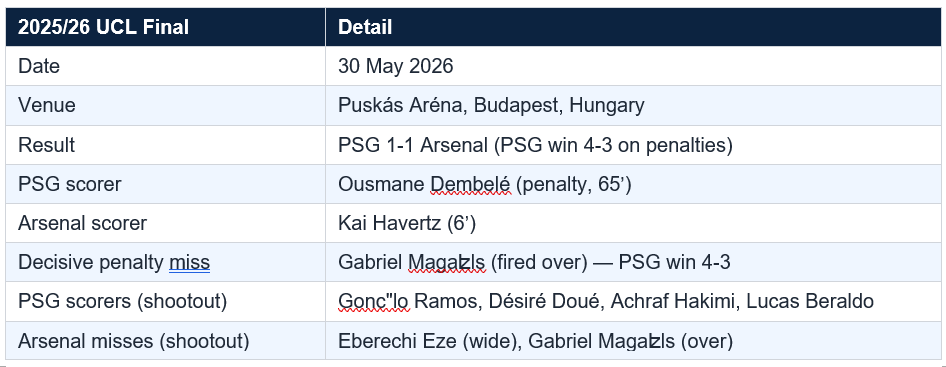
Key Facts & Season Data (August 2026): 2025/26 Champions League winners: PSG — beat Arsenal 1-1 (4-3 on penalties) in the final at Puskás Aréna, Budapest, 30 May 2026. This was PSG’s second consecutive title. PSG’s first title came in 2024/25 with a 5-0 win over Inter Milan. Luis Enrique won the CL for the third time as a manager (also FC Barcelona 2015). PSG’s goals: Dembelé penalty (65’). Arsenal’s goal: Havertz (6’). Penalty shootout: Gabriel Maga’s miss was decisive (4-3 PSG). PSG brushed aside Chelsea and Liverpool en route to the final. Ballon d’Or winner: Ousmane Dembelé. 2026/27 UCL draw: 27 August 2026. League phase starts: 8 September 2026. Final venue: Metropolitano Stadium, Madrid, 5 June 2027. Qualified teams from England: Arsenal, Man City, Man Utd, Aston Villa, Liverpool. 2026/27 odds: PSG +500/+650 (two-time defending champions), Bayern Munich +600/+650, Arsenal +600/+650, Man City and Barcelona also in the conversation. PSG are the first club since Real Madrid (2016–2018) to defend the Champions League title. Historic context: No club has ever won three consecutive Champions League titles since Real Madrid (1966, 1998 runners-up). Real Madrid 2016-18 is the only three-peat in the modern era.
It was Luis Enrique’s third Champions League as a manager, following his win with Barcelona in 2015. It was Ousmane Dembélé’s finest hour as Ballon d’Or winner, equalising with a penalty and driving his team through the chaos of extra time and a shootout. And it left the entire continent asking a question that nobody has managed to answer with a yes since Zinedine Zidane’s Real Madrid did it between 2016 and 2018: can the champions do it again?
The 2026/27 Champions League is defined by that question, and by the extraordinary depth of the field chasing the answer. Arsenal carry the memory of heartbreak and the motivation of unfinished business. Bayern Munich, eliminated in the semi-finals last season, arrive with revenge on their minds. Barcelona have the most exciting player in the world and a domestic form that makes them a serious European threat. Real Madrid, under the unpredictable authority of José Mourinho, have a front three that can win any match in any competition. The 2026/27 Champions League may be the most open competition in years.
Disclaimer: This article is for entertainment and informational purposes only. All predictions, odds, and analysis are opinions based on publicly available information as of August 2026. Football outcomes are inherently unpredictable. Odds change frequently. This is not gambling advice.
Then Dembelé. A penalty awarded after Khvicha Kvaratskhelia was fouled, and the reigning Ballon d’Or winner sent David Raya the wrong way. The game became chaotic — Kvaratskhelia hit the post, Bradley Barcola hit the side-netting in the seventh minute of added time, Arsenal had a penalty appeal dismissed that sent Declan Rice and Mikel Arteta to the yellow card. Extra time came and went. Then penalties.
Declan Rice, post-match (30 May 2026): It’s gutting. It’s devastating to lose a Champions League final on penalties. But we try to take a lot of perspective from how far we’ve come as a group. An incredible season. Given it absolutely everything up until this point. We took the game to penalties. It’s a lottery.
PSG had won their last five penalty shootouts entering the final. Arsenal blinked first: Eberechi Eze dragged his spot-kick wide. Raya saved from Nuno Mendes to keep it level. At 3-3, Lucas Beraldo scored for PSG. Gabriel stepped up, needing to convert to stay alive, and blazed over the bar. PSG were champions of Europe for the second year running. The first club to retain the trophy since Real Madrid completed their hat-trick in 2018.

The specific advantages PSG carry into 2026/27:
Paris Saint-Germain: PRE-SEASON FAVOURITE. The most battle-tested squad in the competition. Luis Enrique’s managerial genius and proven knockout-round mentality make them the team to beat. Our primary pick.
The case for Arsenal going one step further in 2026/27:
Bayern’s Champions League credentials are unimpeachable. Six titles, the most recent in 2020. A squad consistently ranked among Europe’s best in quality and depth. Their domestic form in the Bundesliga has given them the platform of Champions League football in consecutive seasons. Harry Kane, now in his prime at Bayern, has not yet won the Champions League. The motivation of the world’s most prolific striker chasing his biggest remaining trophy is a significant narrative thread.
At +600 to +650 in the market — the same odds as Arsenal, just behind PSG — Bayern represent arguably the most historically reliable Champions League club in this odds bracket. They have the squad depth for a long European campaign, the Bundesliga platform to maintain domestic form, and the institutional experience of winning on the biggest European nights.
Bayern Munich: HISTORY SAYS WATCH THEM. Six titles. Semi-finalist in 2025/26. Harry Kane hungry for his first CL winner’s medal. Equal odds to Arsenal in the market. If PSG stumble in the league phase, Bayern could be the beneficiary. Our third pick.
The case for Barcelona on the European stage:
Mourinho’s Champions League record is specific and significant. He won it with Porto (2004) and Inter Milan (2010). He has reached the final with both clubs. His tactical systems are specifically designed for the knockout football that the Champions League ultimately demands — the ability to control a match from a defensive position, use the counter-attack with elite finishers, and manage games across two legs is precisely what Mourinho has done at the highest level.
The specific UCL advantage Real Madrid possess: no club has a deeper historical understanding of the Champions League. The institutional knowledge within the players, the fans, the stadium atmosphere, and even the psychological frame of the club is built around the expectation of winning in Europe. Mbappé has never won the Champions League. He moved to Real Madrid to win it. That motivation, directed by Mourinho’s structure, into a Bernabéu crowd that considers European nights the most important dates in the calendar, is a combination that produces results even when logic suggests otherwise.
Real Madrid: THE CHAMPIONS LEAGUE SPECIALISTS. 15 titles. Mourinho’s proven knockout expertise. Mbappé hungry for his first. The Bernabéu mystique in European nights. Dangerous at every stage of the competition. Could win it. Probably won’t in Mourinho’s first season back.
The specific uncertainty about City in 2026/27 is the same as in the Premier League: a new manager at one of the world’s most demanding clubs needs time to embed his system fully. Champions League knockout football in February, March, and April of 2026/27 may arrive before Maresca has had sufficient time to adapt his tactical approach to specific European challenges.
Erling Haaland’s continued presence — the Pichichi winner with 27 goals in La Liga despite playing for a Spanish club, rather 25 goals in the Premier League last season — means City’s goal output remains elite. If Maresca’s system can replicate for European football what Pep Guardiola built over a decade, City are a genuine contender. That is a significant conditional.
Manchester City: TRANSITION UNCERTAINTY. Elite squad. New manager. Haaland’s goals give them a floor. The Champions League may come a season too early for Maresca to maximise the squad’s potential. Realistic quarter-finalist; semi-final would be excellent.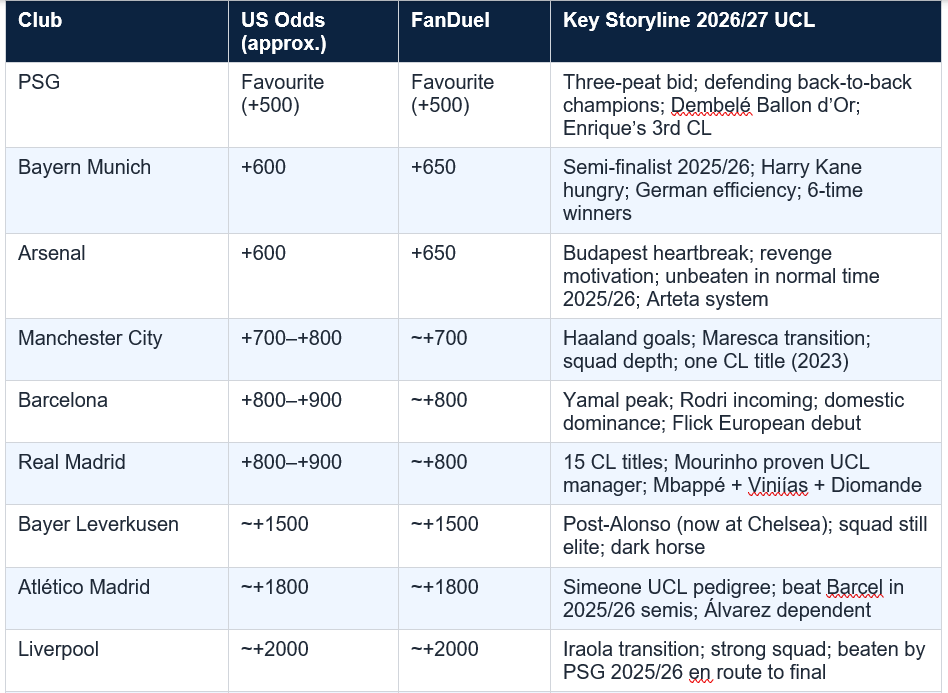

OUR PREDICTION: Arsenal to win the 2026/27 Champions League Our pick is Arsenal to finally lift the Champions League trophy at the Metropolitano in Madrid on 5 June 2027. The motivational force of Budapest’s penalty heartbreak, combined with the tactical maturity Arteta’s side has accumulated over three consecutive deep European campaigns, makes them our choice for the breakthrough moment. We see PSG going deep but falling short of the three-peat — potentially in the semi-finals — with Arsenal defeating Bayern Munich or Barcelona in the final.
Our reasoning in detail:
Our pick is Arsenal. Not because the argument is overwhelming — it is not. PSG at +500 are legitimately the most probable winner on form, managerial quality, and recent European track record. But football is not decided by probability. It is decided by penalty kicks at the Puskás Aréna that sail over the crossbar, and by Gabriel’s face as the cup went to Paris again.
Arsenal have unfinished business. The 2026/27 Champions League has the Metropolitano as its final venue. And the best stories in football are the ones where the heartbreak of one June evening becomes the redemption arc of the next. June 5, 2027, in Madrid. That is our date. That is our pick.
Paris Saint-Germain won the 2025/26 Champions League, defeating Arsenal 1-1 (4-3 on penalties) in the final at the Puskás Aréna in Budapest, Hungary, on 30 May 2026. Kai Havertz gave Arsenal the lead after six minutes, but Ousmane Dembelé equalised from the penalty spot in the 65th minute. After extra time failed to separate the teams, Gabriel Magaʫls’ decisive penalty miss in the shootout sealed PSG’s second consecutive Champions League title. Luis Enrique became just the third manager to win the Champions League three times.
Who are the favourites to win the Champions League 2026/27?
PSG are the pre-season favourites at +500 to complete a historic three-peat. Bayern Munich and Arsenal are joint second in the market at +600 to +650. Manchester City, Barcelona, and Real Madrid follow at longer odds. The draw takes place on 27 August 2026, with the league phase starting 8 September 2026 and the final at the Metropolitano in Madrid on 5 June 2027.
Has any club ever won three consecutive Champions Leagues?
In the modern era (since 1992), only Real Madrid has won three consecutive Champions Leagues, achieving the feat between 2016 and 2018 under Zinedine Zidane. Before the rebranding, Real Madrid won five consecutive European Cups (1956-1960) and Ajax won three in a row (1971-1973). PSG’s bid for a third consecutive title in 2026/27 would be only the second time a club has achieved this in the modern era.
What was the key moment of the 2025/26 Champions League final?
The defining moment was Gabriel Magaʫls’ decisive penalty miss in the shootout that handed PSG the trophy. Arsenal had led 1-0 after Kai Havertz’s sixth-minute goal and were arguably the better team through much of normal time, recording only 26% possession but smothering PSG’s attack for an hour. Dembelé’s equalising penalty changed the match’s dynamic, and after extra time failed to produce a winner, PSG’s proven shootout mentality — they had won five consecutive shootouts — proved decisive.
Where is the 2026/27 Champions League final?
The 2026/27 Champions League final will be held at the Estadio Metropolitano in Madrid, Spain, on 5 June 2027. The Metropolitano is the home stadium of Atletico Madrid, giving the final a specific geographical significance if either of Madrid’s two clubs — Real Madrid or Atletico — were to reach the final and effectively play a home match.
Which English clubs are in the 2026/27 Champions League?
Five English clubs have qualified: Arsenal (Premier League champions), Manchester City, Manchester United, Aston Villa, and Liverpool. This is the maximum English representation under the current Champions League qualification structure. Arsenal and Manchester City are the strongest English contenders for a deep tournament run; Arsenal in particular carry the extra motivation of the 2025/26 final defeat.
What is the Champions League format in 2026/27?
The 2026/27 Champions League continues with the reformed 36-team league phase format introduced in 2024/25. All 36 clubs play eight matches against different opponents in a single league. The top eight advance directly to the Round of 16; clubs finishing 9th to 24th enter a knockout playoff for the remaining Round of 16 spots; and clubs finishing 25th to 36th are eliminated. From the Round of 16 onwards, it is standard single-elimination knockout football through to the final.
Table of Contents
- The Three-Peat Challenge
- The 2025/26 Final: How PSG Retained the Trophy
- The 2026/27 Format and Key Dates
- The Qualifying Teams: Who Is In?
- Contender 1: PSG — Can Luis Enrique Make History?
- Contender 2: Arsenal — Revenge and Redemption
- Contender 3: Bayern Munich — The Fallen Giant Reawakens
- Contender 4: Barcelona — Yamal and the European Dream
- Contender 5: Real Madrid — Mourinho and the Galactic Attack
- Contender 6: Manchester City — Maresca’s European Debut
- The Dark Horses: Who Could Spring a Surprise?
- Pre-Season Odds: What the Market Tells Us
- The Three-Peat in Historical Context
- Key Storylines to Follow
- Our Prediction: Who Lifts the Trophy in Madrid?
- Conclusion: The Final Is Already Written in Our Minds
- Frequently Asked Questions
The Three-Peat Challenge
There is a reason PSG are odds-on favourites to win the 2026/27 Champions League before a single ball has been kicked in the tournament. On 30 May 2026, in the Puskás Aréna in Budapest, they did what only Real Madrid had done in the modern era: they defended the Champions League. A 1-1 draw with Arsenal after extra time, settled 4-3 on penalties when Gabriel Magaʫls blasted the decisive spot-kick over Matvey Safonov’s crossbar, confirmed Paris Saint-Germain as back-to-back European champions.It was Luis Enrique’s third Champions League as a manager, following his win with Barcelona in 2015. It was Ousmane Dembélé’s finest hour as Ballon d’Or winner, equalising with a penalty and driving his team through the chaos of extra time and a shootout. And it left the entire continent asking a question that nobody has managed to answer with a yes since Zinedine Zidane’s Real Madrid did it between 2016 and 2018: can the champions do it again?
The 2026/27 Champions League is defined by that question, and by the extraordinary depth of the field chasing the answer. Arsenal carry the memory of heartbreak and the motivation of unfinished business. Bayern Munich, eliminated in the semi-finals last season, arrive with revenge on their minds. Barcelona have the most exciting player in the world and a domestic form that makes them a serious European threat. Real Madrid, under the unpredictable authority of José Mourinho, have a front three that can win any match in any competition. The 2026/27 Champions League may be the most open competition in years.
Disclaimer: This article is for entertainment and informational purposes only. All predictions, odds, and analysis are opinions based on publicly available information as of August 2026. Football outcomes are inherently unpredictable. Odds change frequently. This is not gambling advice.
The 2025/26 Final: How PSG Retained the Trophy
Understanding how PSG won in Budapest illuminates everything about what they are and why they are so difficult to beat on the biggest occasions. Arsenal were the better team for large portions of the final. They led after six minutes through Kai Havertz’s clinical finish. They held only 26 percent possession — the lowest for any Champions League finalist since records began in 2004, according to Opta — yet smothered PSG’s usually irresistible attack for an hour.Then Dembelé. A penalty awarded after Khvicha Kvaratskhelia was fouled, and the reigning Ballon d’Or winner sent David Raya the wrong way. The game became chaotic — Kvaratskhelia hit the post, Bradley Barcola hit the side-netting in the seventh minute of added time, Arsenal had a penalty appeal dismissed that sent Declan Rice and Mikel Arteta to the yellow card. Extra time came and went. Then penalties.
Declan Rice, post-match (30 May 2026): It’s gutting. It’s devastating to lose a Champions League final on penalties. But we try to take a lot of perspective from how far we’ve come as a group. An incredible season. Given it absolutely everything up until this point. We took the game to penalties. It’s a lottery.
PSG had won their last five penalty shootouts entering the final. Arsenal blinked first: Eberechi Eze dragged his spot-kick wide. Raya saved from Nuno Mendes to keep it level. At 3-3, Lucas Beraldo scored for PSG. Gabriel stepped up, needing to convert to stay alive, and blazed over the bar. PSG were champions of Europe for the second year running. The first club to retain the trophy since Real Madrid completed their hat-trick in 2018.
The 2026/27 Format and Key Dates
The 2026/27 Champions League continues with the reformed format introduced in 2024/25. The key structural features:- 36-team league phase: all 36 qualified clubs participate in a single league phase, each facing eight different opponents. This replaced the traditional group stage format.
- Top 8 advance directly: the top eight finishers in the league phase qualify automatically for the Round of 16.
- 9th to 24th enter a playoff round: the next 16 clubs face a two-legged knockout playoff for the remaining eight places in the Round of 16.
- Bottom 12 eliminated: clubs finishing 25th to 36th are eliminated from European competition.
- Standard knockout from Round of 16: single-elimination through quarterfinals, semifinals, and the final.
- Draw: 27 August 2026
- League phase starts: 8 September 2026
- League phase ends: 27 January 2027
- Knockout playoffs: February 2027
- Quarterfinals: March/April 2027
- Semifinals: April/May 2027
- Final: 5 June 2027 — Estadio Metropolitano, Madrid, Spain
The Qualifying Teams: Who Is In?
England has its strongest Champions League representation in years, with five clubs qualifying for 2026/27. The qualified field from major leagues:From England
Arsenal (Premier League champions), Manchester City, Manchester United, Aston Villa, Liverpool. This is the maximum English representation under the multi-pathway qualification system. Squawka confirms: ‘There is plenty of English interest in the competition this season. Arsenal, Man City, Man Utd, Aston Villa and Liverpool have all qualified.’From Spain
Barcelona (La Liga champions), Real Madrid, Atlético Madrid, Villarreal. The Spanish representatives carry the historical weight of the country with the most Champions League victories in history: Real Madrid alone have won 15.From Germany, France and Italy
Bayern Munich, Borussia Dortmund, Bayer Leverkusen (Germany). PSG (as defending champions plus Ligue 1 qualification). Inter Milan, Juventus, Napoli, and other Serie A qualifiers. The full draw will be completed on 27 August 2026.Contender 1: PSG — Can Luis Enrique Make History?
The case for PSG completing the historic three-peat is, frankly, compelling. They have won the last two Champions League finals. They have beaten Chelsea, Liverpool, and Arsenal in the knockout rounds over those two seasons. Luis Enrique’s tactical system — fluid, pressing, unpredictable in formation, built around individual brilliance within a coherent team structure — has proven adaptable to every challenge encountered on the European road.The specific advantages PSG carry into 2026/27:
- Proven shootout mentality: PSG won five consecutive penalty shootouts across 2024/25 and 2025/26, including the final. In the highest-pressure moments of European football, their nerve has been demonstrably superior to every opponent.
- Dembelé at peak Ballon d’Or level: the French winger’s form — which earned him the Ballon d’Or — makes him the most dangerous attacker in European club football on current form. His combination of speed, technical quality, and decisive big-game mentality is a European-final-winning combination.
- Luis Enrique’s Champions League expertise: three titles as a manager is a distinction shared with only a handful of coaches in history. His ability to manage squad rotation across a long season, to adapt tactically for specific opponents, and to maintain competitive intensity in the league phase and knockout stages simultaneously is proven.
- Kvaratskhelia and Goncʺlo Ramos as supporting cast: the Georgian’s creativity and the Portuguese striker’s goals from the 2025/26 campaign provide depth that goes beyond Dembelé alone.
Paris Saint-Germain: PRE-SEASON FAVOURITE. The most battle-tested squad in the competition. Luis Enrique’s managerial genius and proven knockout-round mentality make them the team to beat. Our primary pick.
Contender 2: Arsenal — Revenge and Redemption
Arsenal went the furthest of any English club in 2025/26 — to the Champions League final — and lost on penalties in Budapest. They won the Premier League in the same season. They finished their European campaign without losing a single match in normal time. The penalty shootout defeat is, in Declan Rice’s framing, a lottery. But for the players, coaches, and fans who experienced Budapest, it is the unfinished business that will define the 2026/27 European campaign.The case for Arsenal going one step further in 2026/27:
- They were arguably the better team in the 2025/26 final: 26% possession, yet they led for the majority of normal time, had a strong penalty shout dismissed, and lost to a shootout. The performance demonstrated that Arteta’s Arsenal can compete with the best in Europe at the final stage.
- Unbeaten run into the final: Arsenal’s Champions League record in 2025/26, excluding the penalty shootout, was completely unblemished. The cumulative experience of a full European campaign at the highest level makes 2026/27 a more informed and more confident version of the same squad.
- Premier League stability: Arsenal enter the European campaign as domestic champions, with a squad that is settled, well-funded, and psychologically robust. The distraction of a title race is absent; the focus is Europe.
- Arteta’s tactical evolution: the 26% possession final in Budapest was a specific tactical choice — absorb PSG’s pressure and counter. Arteta has shown the ability to adapt his system to specific opponents in a way that keeps him competitive against the best managers in the game.
Contender 3: Bayern Munich — The Fallen Giant Reawakens
Bayern Munich were eliminated in the 2025/26 Champions League semi-finals by PSG — the same club that went on to win the trophy. The margin between them and the European summit is one knockout match. The hunger to convert that proximity into a title makes them one of the most dangerous clubs in the 2026/27 field.Bayern’s Champions League credentials are unimpeachable. Six titles, the most recent in 2020. A squad consistently ranked among Europe’s best in quality and depth. Their domestic form in the Bundesliga has given them the platform of Champions League football in consecutive seasons. Harry Kane, now in his prime at Bayern, has not yet won the Champions League. The motivation of the world’s most prolific striker chasing his biggest remaining trophy is a significant narrative thread.
At +600 to +650 in the market — the same odds as Arsenal, just behind PSG — Bayern represent arguably the most historically reliable Champions League club in this odds bracket. They have the squad depth for a long European campaign, the Bundesliga platform to maintain domestic form, and the institutional experience of winning on the biggest European nights.
Bayern Munich: HISTORY SAYS WATCH THEM. Six titles. Semi-finalist in 2025/26. Harry Kane hungry for his first CL winner’s medal. Equal odds to Arsenal in the market. If PSG stumble in the league phase, Bayern could be the beneficiary. Our third pick.
Contender 4: Barcelona — Yamal and the European Dream
Barcelona’s 2026/27 Champions League campaign arrives in the context of their domestic dominance under Hansi Flick, the potential arrival of Rodri to the midfield, and the extraordinary form of Lamine Yamal. They are La Liga champions going into a competition they last won in 2015 — Luis Enrique’s year.The case for Barcelona on the European stage:
- Yamal is the most exciting player in world football on current form. Champions League knockout matches decided by individual brilliance historically favour the team with the best individual. Yamal has demonstrated across two La Liga title-winning campaigns that he can produce decisive performances in the highest-pressure matches.
- Rodri’s reported arrival transforms the midfield engine: if the World Cup Golden Ball winner completes his move from Manchester City, Barcelona’s midfield triangle would be among the best in European football. Champions League campaigns are built on midfield control across 90-minute blocks repeated over six months.
- Atlético Madrid eliminated them in 2025/26: the Champions League semi-final exit to Atlético is the wound that drives Barcelona’s European motivation in 2026/27. Flick’s squad is aware that their domestic dominance has not yet converted to European success under his management.
- The counter-argument: Barcelona’s Champions League record in recent years has been characterised by spectacular group/league phase performances followed by unexpectedly early knockout eliminations. The team that wins La Liga by 7 to 10 points sometimes finds the concentrated single-match intensity of European knockouts harder than the accumulated domestic campaign.
Contender 5: Real Madrid — Mourinho and the Galactic Attack
Real Madrid enter the 2026/27 Champions League as 15-time winners, the most decorated club in the competition’s history, with José Mourinho in the dugout and a front three of Kylian Mbappé, Viniías Júnior, and 19-year-old Yan Diomande that may be the most talented attacking trident in Europe.Mourinho’s Champions League record is specific and significant. He won it with Porto (2004) and Inter Milan (2010). He has reached the final with both clubs. His tactical systems are specifically designed for the knockout football that the Champions League ultimately demands — the ability to control a match from a defensive position, use the counter-attack with elite finishers, and manage games across two legs is precisely what Mourinho has done at the highest level.
The specific UCL advantage Real Madrid possess: no club has a deeper historical understanding of the Champions League. The institutional knowledge within the players, the fans, the stadium atmosphere, and even the psychological frame of the club is built around the expectation of winning in Europe. Mbappé has never won the Champions League. He moved to Real Madrid to win it. That motivation, directed by Mourinho’s structure, into a Bernabéu crowd that considers European nights the most important dates in the calendar, is a combination that produces results even when logic suggests otherwise.
Real Madrid: THE CHAMPIONS LEAGUE SPECIALISTS. 15 titles. Mourinho’s proven knockout expertise. Mbappé hungry for his first. The Bernabéu mystique in European nights. Dangerous at every stage of the competition. Could win it. Probably won’t in Mourinho’s first season back.
Contender 6: Manchester City — Maresca’s European Debut
Manchester City enter the 2026/27 Champions League in transition. Enzo Maresca, new to the Etihad as manager, inherits one of the deepest squads in world football alongside the institutional expertise of a club that has been a European power for a decade. City’s Champions League win in 2023 was their first. The infrastructure — in players, in backroom staff, in tactical sophistication — to compete at the highest European level remains intact.The specific uncertainty about City in 2026/27 is the same as in the Premier League: a new manager at one of the world’s most demanding clubs needs time to embed his system fully. Champions League knockout football in February, March, and April of 2026/27 may arrive before Maresca has had sufficient time to adapt his tactical approach to specific European challenges.
Erling Haaland’s continued presence — the Pichichi winner with 27 goals in La Liga despite playing for a Spanish club, rather 25 goals in the Premier League last season — means City’s goal output remains elite. If Maresca’s system can replicate for European football what Pep Guardiola built over a decade, City are a genuine contender. That is a significant conditional.
Manchester City: TRANSITION UNCERTAINTY. Elite squad. New manager. Haaland’s goals give them a floor. The Champions League may come a season too early for Maresca to maximise the squad’s potential. Realistic quarter-finalist; semi-final would be excellent.
The Dark Horses: Who Could Spring a Surprise?
Bayer Leverkusen
Under Xabi Alonso’s previous tenure (he is now at Chelsea), Leverkusen produced the Bundesliga’s most storied unbeaten run. Whoever now manages the club carries the inheritance of a squad still largely intact and a playing identity that remains one of European football’s most admired. The loss of Alonso to Chelsea changes the managerial dynamic, but the squad quality remains.Atletico Madrid
Diego Simeone’s Atletico eliminated Barcelona in the 2025/26 Champions League semi-finals. Nobody at European level should underestimate a team managed by Simeone in the knockout stages of a competition his side has twice reached the final of in the past decade. If Julyán Álvarez stays — resisting Barcelona’s reported interest — Atletico are a genuine dark horse for a deep run.Liverpool (under Andoni Iraola)
PSG beat Liverpool en route to the 2025/26 final. The new Anfield management of Andoni Iraola faces the challenge of implementing a new system while competing in Europe’s most demanding competition. Liverpool’s squad quality ensures they are competitive in the league phase. A surprise knockout-round run is possible.Pre-Season Odds: What the Market Tells Us
The Three-Peat in Historical Context
PSG’s bid for a third consecutive Champions League title is one of the most historically significant storylines in European football. The context:- The only club to win three consecutive Champions League/European Cups in the modern era (since 1992): Real Madrid, 2016-2017-2018, under Zidane.
- Before 1992, Real Madrid won five consecutive European Cups (1956-1960) and Ajax won three in a row (1971-1973).
- PSG became the first team since Real Madrid (2016-2018) to defend the Champions League title in 2025/26. The second consecutive win was already historically extraordinary.
- A third consecutive title would establish PSG alongside Real Madrid’s 2016-2018 side as the only club to achieve a hat-trick of Champions League titles in the modern format.
- The psychological weight of this historical awareness works in two directions: it motivates PSG to chase something unprecedented. It simultaneously motivates every other club in the competition to be the ones who stop them.
14. Key Storylines to Follow
- The PSG penalty shootout streak: PSG’s ability to win shootouts — five consecutive going into 2026/27 — is a specific statistical anomaly. Will it continue? And do other clubs specifically prepare for this in their preparation?
- Dembelé’s form as Ballon d’Or holder: great individual players sometimes find the year after their Ballon d’Or season a challenge. If Dembelé’s form dips from 2025/26’s peak, PSG’s entire competitive structure is affected.
- Arsenal’s penalty shootout redemption: Budapest was defined by two Arsenal penalty misses. The psychological work of overcoming that specific trauma — and whether it manifests in a future shootout situation — will be one of the competition’s most watched storylines.
- Mourinho vs. Luis Enrique in a potential semi-final or final: the two most distinctive tactical personalities in European football, potentially meeting at the knockout stage. The tactical chess match between Mourinho’s defensive structure and Enrique’s pressing system would be one of the great games of the decade.
- Mbappé’s Champions League quest: the French superstar has never won the competition despite being arguably the best player in the world at his peak. His entire Real Madrid move was built around the Champions League. Whether Mourinho’s system unlocks his European potential is the defining subplot of Real Madrid’s campaign.
- The Metropolitano final venue: the final is at Atletico Madrid’s ground. If Atletico or Real Madrid reach the final, one of them would be playing what amounts to a home match. The partisan Metropolitano atmosphere in a Champions League final would be unprecedented.
15. Our Prediction: Who Lifts the Trophy in Madrid?
Having analysed the contenders, the historical context, the odds, the storylines, and the format, here is our prediction for the 2026/27 Champions League:OUR PREDICTION: Arsenal to win the 2026/27 Champions League Our pick is Arsenal to finally lift the Champions League trophy at the Metropolitano in Madrid on 5 June 2027. The motivational force of Budapest’s penalty heartbreak, combined with the tactical maturity Arteta’s side has accumulated over three consecutive deep European campaigns, makes them our choice for the breakthrough moment. We see PSG going deep but falling short of the three-peat — potentially in the semi-finals — with Arsenal defeating Bayern Munich or Barcelona in the final.
Our reasoning in detail:
- • Budapest was Arsenal’s to lose: they were unbeaten in the competition in normal time. They led in the final. The gap between them and European glory was two penalty kicks. That gap is the specific kind of experience gap that tends to close, not widen, in the following season.
- • PSG face the three-peat wall: every piece of historical evidence suggests that the third consecutive Champions League win is the most difficult achievement in club football. No team since Real Madrid’s generational side of 2016-2018 has managed it. PSG are excellent. They are not yet at that level of sustained excellence.
- • Arsenal’s domestic stability removes distractions: as Premier League champions, Arsenal are not fighting a title race in 2026/27. Their energy and squad depth can be directed more fully at the European campaign than in any previous season.
- • The Metropolitano final: playing the final in Madrid adds a specific psychological challenge for PSG (road final) that is marginally less significant for Arsenal (also away, but less psychologically loaded than a Madrid club’s perceived home advantage).
Conclusion
The 2026/27 Champions League begins on 8 September with a field that contains as much quality and as many compelling storylines as any edition in recent memory. PSG, the defending double-champions, chasing something only Real Madrid’s greatest side has achieved. Arsenal, the penalty-heartbreak side, carrying 140 years of European hurt into one more season. Bayern Munich, the great fallen giant, needing only the final step. Barcelona with Lamine Yamal and Rodri incoming. Real Madrid with Mbappé, Viniías, and Mourinho’s championship pedigree.Our pick is Arsenal. Not because the argument is overwhelming — it is not. PSG at +500 are legitimately the most probable winner on form, managerial quality, and recent European track record. But football is not decided by probability. It is decided by penalty kicks at the Puskás Aréna that sail over the crossbar, and by Gabriel’s face as the cup went to Paris again.
Arsenal have unfinished business. The 2026/27 Champions League has the Metropolitano as its final venue. And the best stories in football are the ones where the heartbreak of one June evening becomes the redemption arc of the next. June 5, 2027, in Madrid. That is our date. That is our pick.
Frequently Asked Questions
Who won the Champions League in 2025/26?Paris Saint-Germain won the 2025/26 Champions League, defeating Arsenal 1-1 (4-3 on penalties) in the final at the Puskás Aréna in Budapest, Hungary, on 30 May 2026. Kai Havertz gave Arsenal the lead after six minutes, but Ousmane Dembelé equalised from the penalty spot in the 65th minute. After extra time failed to separate the teams, Gabriel Magaʫls’ decisive penalty miss in the shootout sealed PSG’s second consecutive Champions League title. Luis Enrique became just the third manager to win the Champions League three times.
Who are the favourites to win the Champions League 2026/27?
PSG are the pre-season favourites at +500 to complete a historic three-peat. Bayern Munich and Arsenal are joint second in the market at +600 to +650. Manchester City, Barcelona, and Real Madrid follow at longer odds. The draw takes place on 27 August 2026, with the league phase starting 8 September 2026 and the final at the Metropolitano in Madrid on 5 June 2027.
Has any club ever won three consecutive Champions Leagues?
In the modern era (since 1992), only Real Madrid has won three consecutive Champions Leagues, achieving the feat between 2016 and 2018 under Zinedine Zidane. Before the rebranding, Real Madrid won five consecutive European Cups (1956-1960) and Ajax won three in a row (1971-1973). PSG’s bid for a third consecutive title in 2026/27 would be only the second time a club has achieved this in the modern era.
What was the key moment of the 2025/26 Champions League final?
The defining moment was Gabriel Magaʫls’ decisive penalty miss in the shootout that handed PSG the trophy. Arsenal had led 1-0 after Kai Havertz’s sixth-minute goal and were arguably the better team through much of normal time, recording only 26% possession but smothering PSG’s attack for an hour. Dembelé’s equalising penalty changed the match’s dynamic, and after extra time failed to produce a winner, PSG’s proven shootout mentality — they had won five consecutive shootouts — proved decisive.
Where is the 2026/27 Champions League final?
The 2026/27 Champions League final will be held at the Estadio Metropolitano in Madrid, Spain, on 5 June 2027. The Metropolitano is the home stadium of Atletico Madrid, giving the final a specific geographical significance if either of Madrid’s two clubs — Real Madrid or Atletico — were to reach the final and effectively play a home match.
Which English clubs are in the 2026/27 Champions League?
Five English clubs have qualified: Arsenal (Premier League champions), Manchester City, Manchester United, Aston Villa, and Liverpool. This is the maximum English representation under the current Champions League qualification structure. Arsenal and Manchester City are the strongest English contenders for a deep tournament run; Arsenal in particular carry the extra motivation of the 2025/26 final defeat.
What is the Champions League format in 2026/27?
The 2026/27 Champions League continues with the reformed 36-team league phase format introduced in 2024/25. All 36 clubs play eight matches against different opponents in a single league. The top eight advance directly to the Round of 16; clubs finishing 9th to 24th enter a knockout playoff for the remaining Round of 16 spots; and clubs finishing 25th to 36th are eliminated. From the Round of 16 onwards, it is standard single-elimination knockout football through to the final.
0 Comments
Be the first to share your thoughts on this article.