

Vehicles & Cars
Should You Buy, Lease or Finance a Car: What’s Best?

Key Statistics: Average monthly lease payment Q1 2026: $614 (subprime, 501–600 score) to $626 (super-prime, 781–850) (Experian). Average new car loan payment Q1 2026: $753 (super-prime) to $792 (subprime) (Experian). Average used car loan payment Q1 2026: $529 (super-prime) to $551 (subprime). Leasing saves average of ~$127/month vs new car loan (historical Experian average). 2026 YTD average lease buyout APR: 9.03%, down from February 2025 high of 9.70% (Lease End 2026 Annual Report). Lease buyout equity: average $5,500 in positive vehicle equity per transaction (Lease End, 2025). Drivers who bought out leases in 2025 collectively saved over $73 million vs returning. Ram 1500 is now the most bought-out leased vehicle (2025), overtaking the Honda Civic. Millennials and Gen Z now represent 47% of all lease buyouts. Federal $7,500 EV tax credit expired September 2025. New car prices remain high in 2026 (Consumer Reports, March 2026). Financing rates projected to gradually decline through 2026 (KBB). New car sticker prices: average $47,000–48,000 (2026 data). Used cars now a stronger value proposition than any time since 2021.
The three options available to car shoppers — paying cash outright, financing with an auto loan, or leasing — are fundamentally different financial arrangements. Each has a different monthly cost, a different long-term cost, a different impact on your flexibility and your balance sheet, and a different set of circumstances in which it makes the most sense. None of them is universally right or universally wrong.
This guide uses Q1 2026 data from Experian’s State of the Auto Finance Market, the Lease End 2026 Annual Lease Buyout Report, Consumer Reports’ March 2026 analysis, and other current sources to explain exactly what each option means, what it costs in 2026, and who each one is best suited for. By the end, you will have the framework to make the right choice for your specific situation.
At the end of the loan term, you own the car outright. Unlike a lease, every payment you make builds equity in a tangible asset that you own, can sell, or can continue to drive payment-free. Consumer Reports’ March 2026 analysis puts it clearly: buying remains the better long-term financial move for most drivers. While the monthly payments are higher, you are investing in a tangible asset. Once the loan is paid off, the years of payment-free driving let you save money, unlike leasing where you always have a payment.
The 2026 YTD average APR for lease buyout loans stood at 9.03%, down from a February 2025 high of 9.70%, per Lease End’s 2026 Annual Report. Standard new and used car loan APRs track in a similar range, with the best-qualified borrowers accessing rates in the 6 to 8% range from credit unions and online lenders, and subprime borrowers facing rates of 12% or higher from some dealers.
Bankrate, April 2026: When you know the type of car you want, crunch the numbers with a lease versus buy calculator. Also, shop around for financing and compare your rates to ensure you make the best financial move. The difference between the best and worst auto loan rates for the same borrower can be several percentage points.
Leasing is fundamentally different from financing in one critical respect: at the end of a lease, assuming you return the car, you have no asset. You have paid for three years of use and have nothing to show for it. This is the core financial critique of leasing. The counter-argument is that you have also had three years of driving a new vehicle under full warranty, with predictable monthly costs and no exposure to repair bills or trade-in depreciation losses.
Leasing saves approximately $127/month on average compared to financing the same new vehicle (historical Experian data). On a 36-month lease, this is approximately $4,572 in lower payments. The cost is that you have nothing at the end.
Example: a $45,000 car leased for 36 months with a 55% residual value ($24,750) and a money factor of 0.00280 (approximately 6.7% APR). Depreciation: ($45,000 minus $24,750) divided by 36 equals $562.50 per month. Finance charge: ($45,000 plus $24,750) multiplied by 0.00280 equals $195.30 per month. Before taxes: $757.80 per month.
Best For: People who want to drive a new car every 2–3 years, drive fewer than 12,000–15,000 miles per year, want predictable costs with warranty coverage throughout, or need the lower monthly payment of a lease to fit their budget. NOT recommended for high-mileage drivers, people who want to build equity, or those with highly variable income.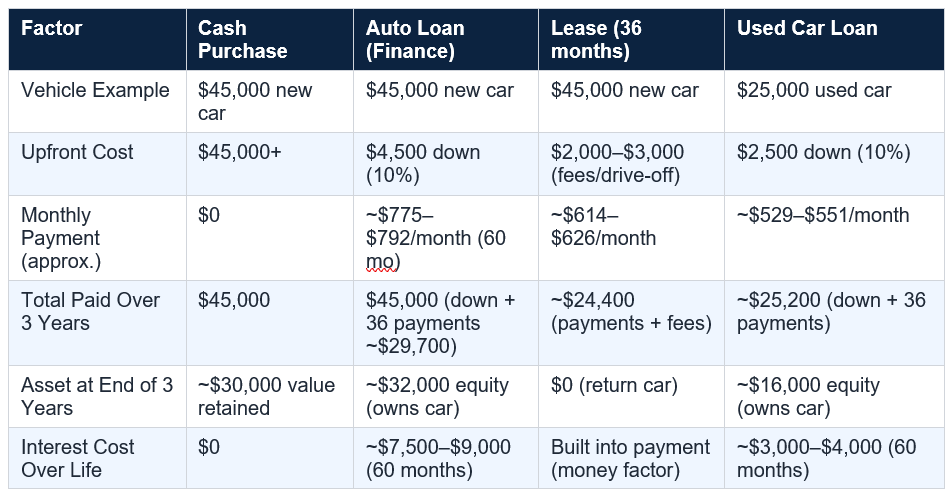

The comparison reveals an important truth: the lowest monthly payment (used car loan) does not always mean the lowest total cost, and the highest monthly payment (new car loan) is not always the worst financial outcome when asset accumulation is considered. The right comparison is total cost of ownership over your expected holding period, not monthly payment alone.
The mathematics of the lease buyout opportunity in the current market:
Best For: Almost everyone who is not specifically benefiting from a manufacturer’s new car incentive (0% financing, large cash-back). The total cost of used car ownership over 5 years is typically significantly lower than new car ownership, even when repair costs are factored in.
Under the now-expired credit structure, dealers could apply the EV tax credit to leased vehicles (through the commercial clean vehicle credit) even when buyers did not qualify for the consumer credit, making leases significantly cheaper. With the consumer credit expired, this advantage has diminished.
Current EV considerations in 2026: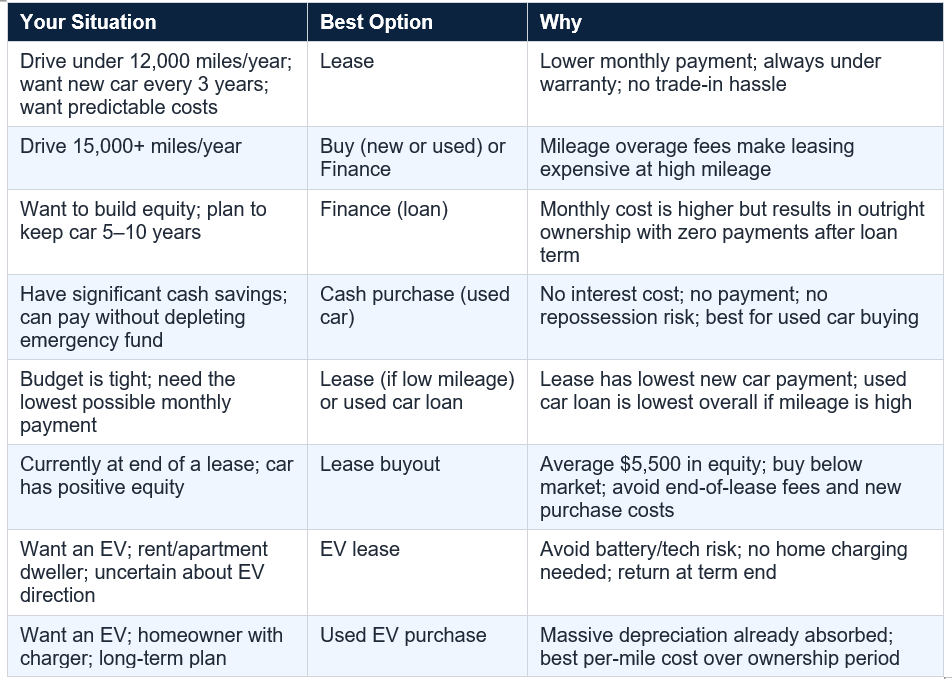
What the 2026 data makes clear: Consumer Reports is right that buying — particularly a used car — is the better long-term financial move for most drivers. The years of payment-free driving after a loan is paid off are a genuine and significant financial benefit that leasing never provides. But Bankrate is also right that leasing’s lower monthly payments serve specific needs and specific circumstances that buying does not.
The single most actionable piece of guidance for 2026: do not shop for a monthly payment. Shop for a total cost. Know what a vehicle is worth on the used market. Know your credit score before you walk in. Get a loan pre-approval before you hear the dealer’s financing offer. And if you are at the end of a lease right now, check whether your vehicle has positive equity before returning it — $5,500 in average equity is real money that too many drivers hand back at the end of their lease without realising it was theirs.
For most drivers, buying — especially a used car — is the better long-term financial decision. Consumer Reports' March 2026 analysis confirms that buying involves higher monthly costs but results in ownership of a tangible asset, and the years of payment-free driving after a loan is paid off provide real financial benefit. Leasing is better for drivers who want a new car every 2–3 years, drive fewer than 12,000–15,000 miles per year, want predictable warranty-covered costs, and prioritise lower monthly payments over building equity.
What are the average car payments in 2026?
According to Experian’s Q1 2026 State of the Auto Finance Market: new car loan payments range from $753/month (super-prime, 781–850 credit score) to $792/month (subprime, 501–600). Used car loan payments range from $529/month (super-prime) to $551/month (subprime). Average lease payments range from $614/month (subprime) to $626/month (super-prime) — a notably smaller spread than loans, reflecting leasing’s different risk and payment structure.
How does car leasing work?
A lease is a long-term rental agreement. You pay to use the car for a defined period (typically 24–39 months), covering the car’s depreciation during that period plus interest (the money factor) and fees. At lease end, you return the car, buy it at the pre-set residual price (a lease buyout), or start a new lease. Monthly payments are lower than loan payments because you are only paying for depreciation, not the full vehicle value. Key restrictions include mileage limits (typically 10,000–15,000 miles/year) and condition requirements at return.
What is a lease buyout and should I consider it?
A lease buyout is purchasing your leased vehicle at the end of the lease term at the pre-set residual price, rather than returning it. The Lease End 2026 Annual Report found that buyers who completed lease buyouts in 2025 benefited from an average of $5,500 in positive vehicle equity — meaning the car was worth $5,500 more on the open market than the residual price. Drivers who bought out leases collectively saved over $73 million versus returning them. If you are approaching the end of a lease, compare the residual price to current market value before deciding whether to return or buy.
Does your credit score affect car lease or loan terms?
Yes, significantly for loans, and moderately for leases. For loans, subprime borrowers (501–600) pay $792/month on average for new cars vs. $753 for super-prime borrowers (781–850) — a $39/month difference that compounds to $2,340 over 60 months. For leases, the spread is smaller ($614 vs. $626/month) because lease payments depend more on the vehicle’s depreciation and money factor than the borrower’s credit profile. Scores below 620–660 may prevent access to the most attractive advertised lease deals.
Are used cars a good deal in 2026?
Yes, more so than they were in 2021–2023 when used car prices were inflated by supply chain shortages. Used cars in 2026 represent strong value, particularly for buyers who finance: the average used car loan payment of $529–$551/month compares favourably with new car payments of $753–$792/month, while Certified Pre-Owned programmes provide warranty coverage that addresses the repair risk concern. Consumer Reports specifically recommends buying a used car for savings upfront and in the long term. The main caveat: used car loan rates do not qualify for manufacturer-subsidised financing that can make some new car loans very competitive.
What happened to EV lease deals in 2026?
The federal $7,500 EV consumer tax credit expired in September 2025 (Kelley Blue Book, December 2025). Previously, dealers could apply this credit to lease transactions through the commercial clean vehicle credit, making EV leases significantly cheaper. With the credit’s expiry, this advantage has diminished. Used EVs are increasingly compelling in 2026 as values have depreciated significantly from post-pandemic peaks, often 40–50% from original price. Technology risk (rapid EV advancement) still argues for leasing new EVs rather than buying them outright, except for drivers with home charging and a long-term vehicle plan.
Table of Contents
- Buying a Car Outright (Cash Purchase)
- Option 2: Financing a Car (Auto Loan)
- How Car Financing Actually Works in 2026
- Option 3: Leasing a Car
- How Car Leasing Actually Works in 2026
- The Money Comparison: Lease vs. Finance on the Same Car
- The Hidden Costs Nobody Talks About
- The Lease Buyout: The Middle-Ground Option
- What About Used Cars?
- Special Situation: Electric Vehicles in 2026
- The Ultimate Decision Framework
- The 5 Questions That Determine Your Best Option
- Conclusion: There Is No Universally Right Answer
- Frequently Asked Questions
One of the Biggest Financial Decisions You Make
For most American households, a car is the second-largest financial commitment after housing. In 2026, with new car prices averaging $47,000 to $48,000 and financing rates remaining elevated after several years of restrictive monetary policy, the decision between buying, leasing, and financing has never carried more financial weight. Get it right and you save thousands over the life of the vehicle. Get it wrong and you could be locked into monthly payments that strain your budget for years or find yourself with no asset to show for it.The three options available to car shoppers — paying cash outright, financing with an auto loan, or leasing — are fundamentally different financial arrangements. Each has a different monthly cost, a different long-term cost, a different impact on your flexibility and your balance sheet, and a different set of circumstances in which it makes the most sense. None of them is universally right or universally wrong.
This guide uses Q1 2026 data from Experian’s State of the Auto Finance Market, the Lease End 2026 Annual Lease Buyout Report, Consumer Reports’ March 2026 analysis, and other current sources to explain exactly what each option means, what it costs in 2026, and who each one is best suited for. By the end, you will have the framework to make the right choice for your specific situation.
2. First: Understanding the Vocabulary
Before comparing the three options, it is worth establishing precise definitions of the terms that appear throughout every car purchase discussion:- MSRP (Manufacturer’s Suggested Retail Price): the sticker price the manufacturer recommends. Almost nobody pays this. It is the starting point for negotiation, not the end point.
- Money factor: the lease equivalent of an interest rate. Multiply the money factor by 2,400 to convert it to an approximate APR. A money factor of 0.00300 equals approximately 7.2% APR.
- Residual value: the estimated value of a leased car at the end of the lease term. The higher the residual value, the lower the lease payment, because you are only paying for the depreciation during the lease period.
- Cap cost (Capitalised Cost): the negotiated price of the car in a lease agreement. Like the selling price in a purchase, this is negotiable. A lower cap cost means lower monthly lease payments.
- Cap cost reduction: a down payment in a lease. It reduces the cap cost and therefore the monthly payment, but unlike a purchase down payment, it does not build equity.
- APR (Annual Percentage Rate): the effective annual interest rate on a loan, including fees. Compare APRs, not just interest rates, when shopping for auto loans.
- LTV (Loan-to-Value): the ratio of the loan amount to the vehicle’s market value. A $40,000 loan on a $50,000 car is 80% LTV. Lenders prefer lower LTVs.
- Mileage allowance: the maximum annual mileage permitted under a lease, typically 10,000 to 15,000 miles per year. Excess miles are charged at $0.15 to $0.30 per mile at lease end.
Option 1: Buying a Car Outright (Cash Purchase)
Paying cash for a car is the most financially straightforward transaction available. You pay the full purchase price — negotiated from the MSRP — plus taxes, registration, and dealer fees, and you drive away as the outright owner with no ongoing payment obligation.The Advantages of Paying Cash
- No monthly payment: once the transaction is complete, there is no recurring financial obligation. Your monthly budget is not encumbered by a car payment.
- No interest cost: a cash purchase incurs no financing costs. On a $40,000 car financed at 7% over 60 months, the total interest paid is approximately $7,500. Cash buyers save this entirely.
- Full ownership from day one: you can sell, modify, or trade in the car at any time without lender approval or early payoff penalties.
- Stronger negotiating position: cash buyers are often able to negotiate better purchase prices because the dealer’s finance department does not benefit from the transaction. This advantage has diminished somewhat as dealers have moved to more transparent pricing models.
- No repossession risk: a car that is fully owned cannot be repossessed. It remains yours regardless of any future financial difficulty.
The Disadvantages of Paying Cash
- Large upfront capital outlay: $40,000 to $48,000 in cash deployed on a depreciating asset represents a significant opportunity cost. That capital could alternatively be invested in a diversified portfolio earning 7% or more annually.
- Depletes liquid reserves: if the cash purchase significantly reduces your liquid savings, you may find yourself without an emergency fund at precisely the time you are also absorbing the ongoing costs of vehicle ownership.
Option 2: Financing a Car (Auto Loan)
Financing a car with an auto loan is the most common method of car acquisition in the United States. You make a down payment, borrow the balance from a lender (a bank, credit union, or dealer finance arm), and repay the loan in equal monthly instalments over a term of 24 to 84 months, with interest.At the end of the loan term, you own the car outright. Unlike a lease, every payment you make builds equity in a tangible asset that you own, can sell, or can continue to drive payment-free. Consumer Reports’ March 2026 analysis puts it clearly: buying remains the better long-term financial move for most drivers. While the monthly payments are higher, you are investing in a tangible asset. Once the loan is paid off, the years of payment-free driving let you save money, unlike leasing where you always have a payment.
Current Q1 2026 Auto Loan Payment Data (Experian)
According to Experian’s Q1 2026 State of the Auto Finance Market report, average new car loan payments in 2026 are:- Super-prime borrowers (781–850 credit score): $753/month
- Prime borrowers (661–780): approximately $770–$785/month
- Subprime borrowers (501–600): $792/month
The 2026 YTD average APR for lease buyout loans stood at 9.03%, down from a February 2025 high of 9.70%, per Lease End’s 2026 Annual Report. Standard new and used car loan APRs track in a similar range, with the best-qualified borrowers accessing rates in the 6 to 8% range from credit unions and online lenders, and subprime borrowers facing rates of 12% or higher from some dealers.
How Car Financing Actually Works in 2026
The auto financing process in 2026 involves several steps that the most prepared buyers address before walking into a dealership:Step 1: Know Your Credit Score
Your credit score is the single most important factor in determining your auto loan APR. The difference between a 680 credit score and a 760 credit score on a $40,000 loan over 60 months can be $30 to $50 per month — or $1,800 to $3,000 over the loan term. Check your score at AnnualCreditReport.com before shopping.Step 2: Get Pre-Approved Before Visiting the Dealer
Apply for auto loan pre-approval from your bank, a credit union, or an online lender (LightStream, PenFed, Capital One Auto) before visiting any dealer. A pre-approval gives you a known interest rate to compare against any dealer financing offer and removes the negotiation leverage the dealer gains when you do not know what financing you qualify for.Step 3: Negotiate the Purchase Price Separately from Financing
The most common mistake buyers make is agreeing on a monthly payment rather than a purchase price. Dealers can manipulate monthly payments by extending the loan term while keeping the total price high. Agree on the purchase price first, then discuss financing.Step 4: Compare the Dealer’s Finance Offer to Your Pre-Approval
If the dealer offers a lower APR than your pre-approval (sometimes possible through manufacturer-subsidised finance rates), take the dealer’s financing. If not, use your pre-approved loan.Bankrate, April 2026: When you know the type of car you want, crunch the numbers with a lease versus buy calculator. Also, shop around for financing and compare your rates to ensure you make the best financial move. The difference between the best and worst auto loan rates for the same borrower can be several percentage points.
Option 3: Leasing a Car
A car lease is a long-term rental agreement. You do not buy the car. You pay to use it for a defined period — typically 24 to 39 months — covering the vehicle’s depreciation during that period plus interest (the money factor) and fees. At the end of the lease, you return the car, buy it at a pre-set residual price, or lease a new vehicle.Leasing is fundamentally different from financing in one critical respect: at the end of a lease, assuming you return the car, you have no asset. You have paid for three years of use and have nothing to show for it. This is the core financial critique of leasing. The counter-argument is that you have also had three years of driving a new vehicle under full warranty, with predictable monthly costs and no exposure to repair bills or trade-in depreciation losses.
Current Q1 2026 Lease Payment Data (Experian)
According to Experian’s Q1 2026 State of the Auto Finance Market:- Average lease payment for subprime borrowers (501–600): $614/month
- Average lease payment for super-prime borrowers (781–850): $626/month
Leasing saves approximately $127/month on average compared to financing the same new vehicle (historical Experian data). On a 36-month lease, this is approximately $4,572 in lower payments. The cost is that you have nothing at the end.
How Car Leasing Actually Works in 2026
Understanding the mechanics of leasing allows you to negotiate and evaluate lease deals far more effectively:The Lease Payment Formula
Monthly lease payment = (Depreciation per month) + (Finance charge per month) + taxes. Depreciation per month equals (Cap Cost minus Residual Value) divided by the number of months. Finance charge per month equals (Cap Cost plus Residual Value) multiplied by the money factor.Example: a $45,000 car leased for 36 months with a 55% residual value ($24,750) and a money factor of 0.00280 (approximately 6.7% APR). Depreciation: ($45,000 minus $24,750) divided by 36 equals $562.50 per month. Finance charge: ($45,000 plus $24,750) multiplied by 0.00280 equals $195.30 per month. Before taxes: $757.80 per month.
What Is Negotiable in a Lease
The cap cost (selling price), down payment, and lease term are negotiable. The residual value and money factor are typically set by the manufacturer’s captive finance arm and are not negotiable — though money factor markup by dealers is possible and should be questioned. Always ask the dealer for the buy rate (manufacturer’s base money factor) and compare it to what you are being offered.Mileage Limits and Excess Charges
Standard leases allow 10,000 to 15,000 miles per year. Excess miles are charged at $0.15 to $0.30 per mile at lease return. A driver who exceeds the limit by 5,000 miles at $0.25 per mile owes $1,250 at lease end. If you drive more than 15,000 miles per year, leasing may be more expensive than financing.Best For: People who want to drive a new car every 2–3 years, drive fewer than 12,000–15,000 miles per year, want predictable costs with warranty coverage throughout, or need the lower monthly payment of a lease to fit their budget. NOT recommended for high-mileage drivers, people who want to build equity, or those with highly variable income.
The Money Comparison: Lease vs. Finance on the Same Car
The comparison reveals an important truth: the lowest monthly payment (used car loan) does not always mean the lowest total cost, and the highest monthly payment (new car loan) is not always the worst financial outcome when asset accumulation is considered. The right comparison is total cost of ownership over your expected holding period, not monthly payment alone.
The Hidden Costs Nobody Talks About
Every option carries costs beyond the payment or purchase price that are frequently underestimated:For Cash Buyers and Loan Borrowers
- Depreciation: a new car loses approximately 15 to 20 percent of its value in the first year and 50 percent over the first five years. This is the largest cost of new car ownership and it applies regardless of whether you bought with cash or a loan.
- Insurance: lenders require comprehensive and collision coverage on financed vehicles. New cars typically cost $1,500 to $2,500 per year to insure, depending on location, driver, and vehicle.
- Maintenance and repairs: while under manufacturer warranty (typically 3 years/36,000 miles), repair costs are minimal. After warranty expiry, repair exposure begins. The older the vehicle, the higher the expected repair cost.
- Registration, taxes, and dealer fees: these vary by state but add $1,000 to $3,000 to the effective purchase price. In high-tax states like California, sales tax on a $45,000 car adds approximately $4,000.
For Lease Holders
- Disposition fee: when returning a leased car at end of term, most manufacturers charge a disposition fee of $300 to $500.
- Excess wear and tear: subjective assessments of vehicle condition at return can result in charges for scratches, dents, interior damage, or worn tyres.
- Early termination penalties: exiting a lease early is expensive. Penalties are typically several thousand dollars. Unlike a financed car, you cannot simply sell a leased car to exit the obligation.
- Gap insurance: if a leased car is totalled, your standard auto insurance pays market value, which may be less than the remaining lease obligation. Gap insurance covers this difference and is typically required or strongly recommended in leases.
The Lease Buyout: The Middle-Ground Option
One of the most financially significant trends in 2026 is the rise of the lease buyout — the decision to purchase your leased vehicle at the end of the lease term rather than returning it. The Lease End 2026 Annual Lease Buyout Report, based on data from 19,287 transactions, found that drivers who bought out their leases in 2025 collectively saved over $73 million versus returning the vehicles.The mathematics of the lease buyout opportunity in the current market:
- Average positive equity per transaction: $5,500 above the residual price. This means the vehicle is worth $5,500 more on the open market than the residual price set three years earlier when the lease began.
- Average lease buyout APR in 2026: 9.03%, down from the February 2025 high of 9.70%. This is the most favourable financing condition for buyouts in over a year.
- The Ram 1500 overtook the Honda Civic as the most bought-out vehicle in 2025, reflecting higher truck values and residual prices set before the truck market’s appreciation.
- Millennials and Gen Z now represent 47% of all lease buyouts, with the average buyer age falling to 47 (down from 50 in 2022).
What About Used Cars?
The used car market in 2026 deserves specific attention because it fundamentally changes the buy-or-lease calculation for many buyers. Consumer Reports’ March 2026 analysis recommends buying a used car for buyers who want the best combination of savings upfront and long-term financial value. Upbeat Wealth’s March 2026 guide confirms: while buying used no longer seems like a slam-dunk strategy, there is still an opportunity to get a great deal.The case for used cars in 2026:
- • Lower purchase price: a three-year-old car with 35,000 miles that originally sold for $45,000 may now be available for $25,000 to $30,000 — representing the bulk of a new car’s depreciation absorbed by the first owner.
- • Lower loan amounts: a $25,000 used car loan at 7.5% over 60 months costs approximately $501 per month. A $45,000 new car loan at the same rate costs approximately $900 per month.
- • Certified Pre-Owned (CPO) programmes: manufacturer-backed CPO programmes provide multi-year warranty extensions, thorough inspection processes, and roadside assistance on used vehicles, addressing the repair risk concern.
- • Lower insurance costs: a used car costs significantly less to insure than its new counterpart.
Best For: Almost everyone who is not specifically benefiting from a manufacturer’s new car incentive (0% financing, large cash-back). The total cost of used car ownership over 5 years is typically significantly lower than new car ownership, even when repair costs are factored in.
Special Situation: Electric Vehicles in 2026
Electric vehicles present a specific lease-versus-buy consideration that does not apply to conventional vehicles. Kelley Blue Book’s December 2025 analysis notes that the federal $7,500 EV tax credit expired in September 2025, changing the calculus that had previously made leasing more favourable for EVs.Under the now-expired credit structure, dealers could apply the EV tax credit to leased vehicles (through the commercial clean vehicle credit) even when buyers did not qualify for the consumer credit, making leases significantly cheaper. With the consumer credit expired, this advantage has diminished.
Current EV considerations in 2026:
- • Used EV ownership is increasingly compelling: used EVs have depreciated significantly from their post-pandemic peaks. A 2022 or 2023 EV with 30,000 miles may be available at 40 to 50% of its original price — a dramatically better value proposition than the same vehicle new.
- • Technology risk: EV technology is advancing rapidly, which argues for leasing (always driving recent tech, no obsolescence risk) rather than buying (locked into technology that may be superseded).
- • Home charging infrastructure: buyers who own their home and have established charging infrastructure are better positioned for EV ownership than renters or apartment dwellers who depend on public charging.
- • Battery longevity: modern EV batteries carry 8-year/100,000-mile warranties from most manufacturers, which reduces the long-term battery replacement risk for buyers.
The Ultimate Decision Framework
The 5 Questions That Determine Your Best Option
Before you walk into a dealership or click apply on a lease, answer these five questions:- Question 1: How many miles do I drive per year? If the answer is above 15,000, leasing becomes significantly more expensive than its headline payment suggests. If below 12,000, leasing may be the right fit. The annual mileage question is the most binary differentiator between lease and buy.
- Question 2: How long do I plan to keep the vehicle? If you replace cars every 2 to 3 years, you are implicitly leasing anyway when you buy and trade in — you are just doing so with more complexity and less certainty about the future value. If you keep cars for 7 to 10 years, buying and financing delivers the most value through the years of payment-free driving after the loan term ends.
- Question 3: Is a payment flexibility essential? Leases are inflexible. Exiting early costs thousands. Financed vehicles can be sold at any time — subject to paying off the loan. Cash-purchased vehicles are the most flexible of all. If your life circumstances are likely to change — job change, growing family, relocation — flexibility has real financial value.
- Question 4: Am I comparing total cost or monthly payment? Monthly payment comparisons favour leasing. Total cost of ownership comparisons favour buying (particularly used). The right comparison period is your realistic holding period, not a standardised three-year window.
- Question 5: What is my credit score? Both leasing and financing are heavily influenced by credit. Know your score before shopping. With a score below 660, lease deals that appear attractive in advertising may not be available to you at the advertised rate. A credit union pre-approval before any dealership visit gives you the data you need.
Conclusion: There Is No Universally Right Answer
The honest conclusion to the buy, lease, or finance question is the one that most personal finance decisions reach: it depends. It depends on your mileage. It depends on how long you keep cars. It depends on your credit score and your access to financing. It depends on whether you prioritise the lowest monthly payment, the lowest total cost, the maximum flexibility, or the psychological satisfaction of outright ownership.What the 2026 data makes clear: Consumer Reports is right that buying — particularly a used car — is the better long-term financial move for most drivers. The years of payment-free driving after a loan is paid off are a genuine and significant financial benefit that leasing never provides. But Bankrate is also right that leasing’s lower monthly payments serve specific needs and specific circumstances that buying does not.
The single most actionable piece of guidance for 2026: do not shop for a monthly payment. Shop for a total cost. Know what a vehicle is worth on the used market. Know your credit score before you walk in. Get a loan pre-approval before you hear the dealer’s financing offer. And if you are at the end of a lease right now, check whether your vehicle has positive equity before returning it — $5,500 in average equity is real money that too many drivers hand back at the end of their lease without realising it was theirs.
Frequently Asked Questions
Is it better to buy or lease a car in 2026?For most drivers, buying — especially a used car — is the better long-term financial decision. Consumer Reports' March 2026 analysis confirms that buying involves higher monthly costs but results in ownership of a tangible asset, and the years of payment-free driving after a loan is paid off provide real financial benefit. Leasing is better for drivers who want a new car every 2–3 years, drive fewer than 12,000–15,000 miles per year, want predictable warranty-covered costs, and prioritise lower monthly payments over building equity.
What are the average car payments in 2026?
According to Experian’s Q1 2026 State of the Auto Finance Market: new car loan payments range from $753/month (super-prime, 781–850 credit score) to $792/month (subprime, 501–600). Used car loan payments range from $529/month (super-prime) to $551/month (subprime). Average lease payments range from $614/month (subprime) to $626/month (super-prime) — a notably smaller spread than loans, reflecting leasing’s different risk and payment structure.
How does car leasing work?
A lease is a long-term rental agreement. You pay to use the car for a defined period (typically 24–39 months), covering the car’s depreciation during that period plus interest (the money factor) and fees. At lease end, you return the car, buy it at the pre-set residual price (a lease buyout), or start a new lease. Monthly payments are lower than loan payments because you are only paying for depreciation, not the full vehicle value. Key restrictions include mileage limits (typically 10,000–15,000 miles/year) and condition requirements at return.
What is a lease buyout and should I consider it?
A lease buyout is purchasing your leased vehicle at the end of the lease term at the pre-set residual price, rather than returning it. The Lease End 2026 Annual Report found that buyers who completed lease buyouts in 2025 benefited from an average of $5,500 in positive vehicle equity — meaning the car was worth $5,500 more on the open market than the residual price. Drivers who bought out leases collectively saved over $73 million versus returning them. If you are approaching the end of a lease, compare the residual price to current market value before deciding whether to return or buy.
Does your credit score affect car lease or loan terms?
Yes, significantly for loans, and moderately for leases. For loans, subprime borrowers (501–600) pay $792/month on average for new cars vs. $753 for super-prime borrowers (781–850) — a $39/month difference that compounds to $2,340 over 60 months. For leases, the spread is smaller ($614 vs. $626/month) because lease payments depend more on the vehicle’s depreciation and money factor than the borrower’s credit profile. Scores below 620–660 may prevent access to the most attractive advertised lease deals.
Are used cars a good deal in 2026?
Yes, more so than they were in 2021–2023 when used car prices were inflated by supply chain shortages. Used cars in 2026 represent strong value, particularly for buyers who finance: the average used car loan payment of $529–$551/month compares favourably with new car payments of $753–$792/month, while Certified Pre-Owned programmes provide warranty coverage that addresses the repair risk concern. Consumer Reports specifically recommends buying a used car for savings upfront and in the long term. The main caveat: used car loan rates do not qualify for manufacturer-subsidised financing that can make some new car loans very competitive.
What happened to EV lease deals in 2026?
The federal $7,500 EV consumer tax credit expired in September 2025 (Kelley Blue Book, December 2025). Previously, dealers could apply this credit to lease transactions through the commercial clean vehicle credit, making EV leases significantly cheaper. With the credit’s expiry, this advantage has diminished. Used EVs are increasingly compelling in 2026 as values have depreciated significantly from post-pandemic peaks, often 40–50% from original price. Technology risk (rapid EV advancement) still argues for leasing new EVs rather than buying them outright, except for drivers with home charging and a long-term vehicle plan.
0 Comments
Be the first to share your thoughts on this article.