
Vehicles & Cars
How to Claim for Potholes in Your Postcode Area UK: Complete Guide

Table of Contents
- The Scale of the UK Pothole Problem: The 2026 Statistics
- Step 1: Identify Who Is Responsible for the Road
- Step 2: Gather Evidence Immediately — This Is Where Claims Are Won or Lost
- The Essential Evidence Checklist
- Step 3: Report the Pothole and Submit Your Claim
- Report First, Claim Second
- The Fast Claim Process
- What to Include in Your Claim Letter
- The Section 58 Defence: Why Most Claims Fail and How to Overcome It
- Insurance vs Council Claim: Which Route Is Better?
- Conclusion
- Frequently Asked Questions (FAQ)
- External References

Potholes cost UK drivers an estimated £645 million in vehicle damage in 2025, according to analysis published by Treadfirst. Twenty-two percent of drivers needed pothole-related repairs at least once in the past year. The underlying cause is well-documented: the Asphalt Industry Alliance has identified a record £18 billion backlog of road repairs across England and Wales, representing decades of under-investment in road maintenance that no single government funding announcement can resolve quickly. For individual drivers who hit a pothole and suffer a blown tyre, a buckled alloy wheel, or suspension damage, the question is not why UK roads are in this condition — it is what to do about the repair bill that follows.
The answer, in many cases, is to claim compensation from the highway authority responsible for the road where the damage occurred. Councils have a legal duty under Section 41 of the Highways Act 1980 to maintain public roads to a safe and reasonable standard. When they fail in that duty — by allowing a pothole that should have been identified and repaired to remain dangerous — they can be held financially liable for the damage that results. RAC Freedom of Information data from January 2026 shows that 53,015 pothole damage claims were submitted to councils across England, Scotland and Wales in 2024, up 91% from 2021, with councils paying out on approximately 26% of all claims submitted.
That 26% success rate — and the detailed postcode-level variation behind it, ranging from Oxfordshire's 20% payout rate to Hampshire's 1.4% — is the honest starting point for any guide to pothole claims. This is a difficult, evidence-intensive process with a genuine majority of claims rejected, primarily because councils successfully invoke the Section 58 statutory defence. But success stories are real: MoneySavingExpert readers have reported claim payouts of £2,500 and £735. The difference between a successful claim and a rejected one is almost always the quality of the evidence gathered at the scene and the steps taken immediately after the incident.
The Scale of the UK Pothole Problem: The 2026 Statistics
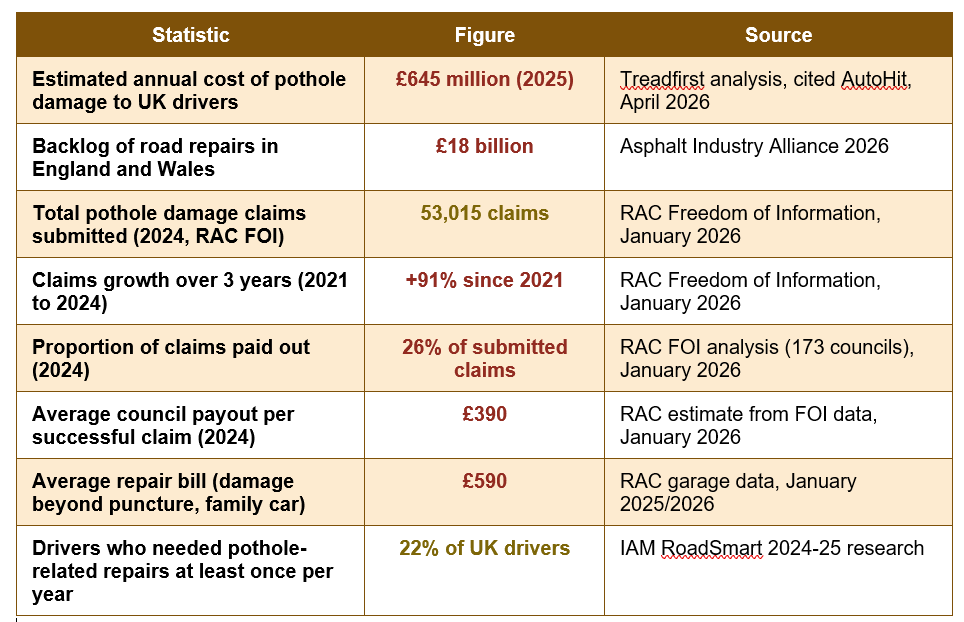
Regional variation in claim success rates: Hampshire paid 1.4% of claim values; Oxfordshire paid 20% — RAC FOI data shows dramatic regional variation in payout rates — Hampshire received more than £5.3 million in claims and paid less than £76,000 (1.4%); Oxfordshire paid out £156,700 against £763,700 claimed (20%). Checking your council's DfT rating can help set realistic expectations before claiming (RAC, January 2026).
Step 1: Identify Who Is Responsible for the Road
Before submitting any claim, you must identify the correct highway authority for the road where the damage occurred. Claiming from the wrong organisation will simply result in your claim being redirected or rejected. The responsible authority depends on the type of road: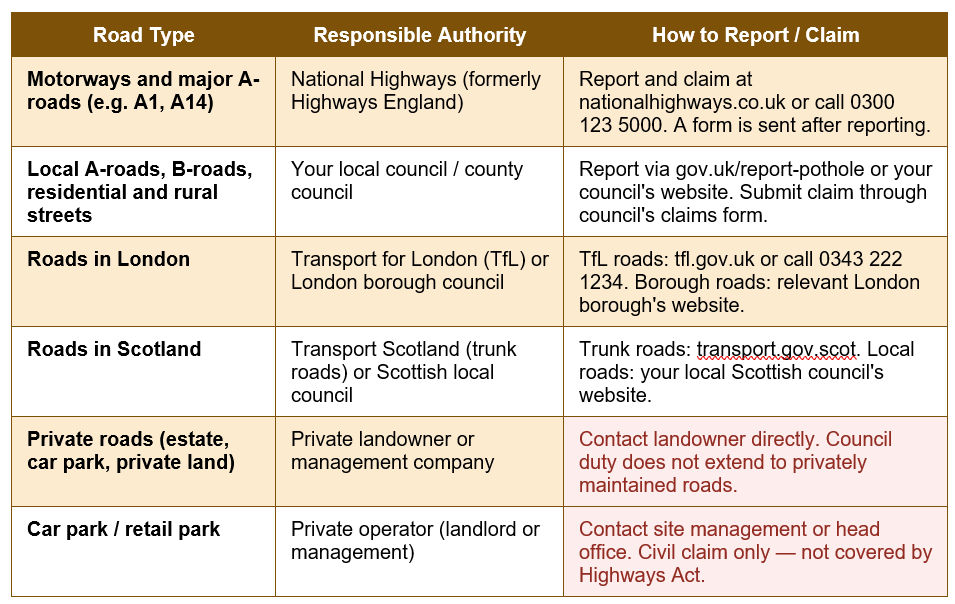
For most drivers in England and Wales, the relevant authority is your local council — specifically the highways department of your county council or unitary authority, which is responsible for most local roads, residential streets, and smaller A-roads. The easiest way to confirm which council is responsible for a specific road is to use the gov.uk pothole reporting tool at www.gov.uk/report-pothole, which automatically identifies the correct authority based on the road's location. The DfT's 2025-26 road ratings system, which assigns green, amber, or red ratings to 154 local highway authorities (LHAs) based on road conditions and investment, is also a useful tool: as of 2025-26, only 16 of 154 LHAs rated green (including Leeds, Portsmouth, and Worcestershire), 13 rated red (including Greenwich, Derbyshire, and Suffolk), and the majority rated amber.
Step 2: Gather Evidence Immediately — This Is Where Claims Are Won or Lost
The single most important factor in the outcome of any pothole compensation claim is the evidence gathered at the scene immediately after the incident. Most rejected claims fail not because the driver was not entitled to compensation but because the evidence submitted was insufficient to overcome the council's Section 58 statutory defence. The following evidence checklist, if completed promptly, gives your claim the strongest possible foundation:The Essential Evidence Checklist
- Photograph the pothole with a scale reference: Take multiple clear photos of the pothole from several angles. Place a coin, a pen, or a bottle next to it to provide scale — this is specifically noted in RAC and Quotezone guidance as a technique adjudicators and council reviewers respond to positively. Use your phone's timestamp feature to ensure all photos are date and time stamped. Crucially: photograph the pothole before it is repaired. Once councils know a claim is incoming, they sometimes repair the pothole quickly — which, while good for road safety, removes your evidence.
- Measure the pothole's depth and width: A pothole must be at least 4cm deep to meet the standard legal definition for compensation purposes. Measure depth with a ruler or pen and photograph the measurement. Also note the approximate width. If the pothole is shallower than 4cm, a claim is unlikely to succeed regardless of other evidence.
- Record the precise location: Use the What3Words app (which divides the world into 3-metre squares and provides a unique three-word address for any location) to pinpoint the exact spot. Alternatively, note the GPS coordinates from your phone's maps app, or record nearby landmarks — a specific building number, a named junction, or a church or school — that allow the location to be precisely identified. A vague description like 'on the high street near the shops' is insufficient for a formal claim.
- Photograph the damage to your vehicle: Take photos of any visible damage immediately after the incident — a flat tyre, wheel damage, suspension components if accessible. The damage should be photographed before any repairs are carried out.
- Get a professional, itemised repair quote or invoice: When you take your vehicle to a mechanic or tyre centre, ask specifically for an itemised invoice that clearly describes each repair, its cost, and the date. Ask the mechanic to note in writing that the damage is consistent with pothole impact. An official invoice or quote from a qualified mechanic carries far more weight than a self-described repair cost.
- Note witness details and check for previous reports: If anyone witnessed the incident or can confirm the pothole had been present for some time, note their contact details. Check whether the pothole has already been reported — use the gov.uk reporting tool or your council's website to see if there is an existing report for the location, which significantly strengthens your claim by demonstrating the council was or should have been aware of the hazard.
The 4cm rule and the 'previously reported' advantage: Two facts consistently make the difference between a successful and unsuccessful claim. First, the pothole must be at least 4cm deep to be legally defined as a pothole for compensation purposes — if you cannot demonstrate this, councils will reject the claim. Second, if you can show the pothole had been previously reported to the council and not repaired within a reasonable time, this substantially weakens the Section 58 defence that would otherwise protect them. Use the FixMyStreet.com platform and your council's online reporting history to check whether the specific pothole had a prior report on record.
Step 3: Report the Pothole and Submit Your Claim
Report First, Claim Second
Before or simultaneously with making a compensation claim, always file an official pothole report with the relevant highway authority. This is important for two reasons: it creates an official record of the pothole's existence at the time of your incident, which forms part of your evidence; and it is the first required step in most councils' fast-claim processes, which allow you to request a claim form at the same time as filing the report.Use gov.uk/report-pothole for local council roads in England, or the equivalent reporting tools for Scotland, Wales, Transport for London, and National Highways. The report will be date-stamped and logged in the council's system, providing an independent record that supports your claim timeline.
The Fast Claim Process
Many councils offer a 'fast claim' process — a simplified claim form sent to you after you report the pothole that allows you to submit your claim quickly and directly without going through a longer formal process. When you report the pothole, specifically ask whether a fast claim form is available. Some councils will email or post the form immediately; others do not operate fast claims and will require a full formal claim submission through their insurance team or a third-party claims handler.For Transport for London roads, TfL typically sends a claim form after you report a pothole. If it has not arrived within a few days, call 0343 222 1234. For National Highways motorways and major A-roads, similarly, a form is sent on reporting. For local council roads where no fast claim exists, you will need to write formally to the council's highway authority or insurance team, including all your evidence and your repair invoice.
What to Include in Your Claim Letter
Whether through a fast claim form or a formal written claim, your submission should include:- Your full name and contact details.
- Vehicle registration number, make, model, and colour.
- The precise date, time, and location of the incident (using What3Words or GPS coordinates where possible).
- A clear description of what happened — which direction you were travelling, whether you could see the pothole in advance, and what damage occurred.
- Photographs of the pothole with scale reference (date-stamped), photographs of your vehicle damage, and the full repair invoice or quote.
- Any evidence that the pothole had been previously reported or was known to the council (FOI or FixMyStreet records).
- A clear statement of the total amount you are claiming and what it covers.
The Section 58 Defence: Why Most Claims Fail and How to Overcome It
The primary legal tool councils use to reject pothole damage claims is the Section 58 defence, found in the Highways Act 1980. Section 58 allows a council to escape liability for pothole damage if it can demonstrate that it had a 'reasonable system of road inspection' in place and that the defect was not known and could not reasonably have been known before the incident. This defence is the reason that fewer than one in ten claims are paid out at many councils, according to the March 2026 AutoHit analysis.Understanding Section 58 allows you to structure your claim to specifically undermine it. There are three effective approaches:
- Show the pothole was previously reported: If the pothole appears in your council's own reporting system, or on FixMyStreet.com, before the date of your incident — and was not repaired within a reasonable period — this directly demonstrates that the council was aware of the defect and failed to act. This is the strongest possible argument against a Section 58 defence.
- Show the council's inspection frequency was inadequate: Under the national Well-managed Highway Infrastructure Code of Practice, different categories of road require different inspection frequencies — a busy A-road may require monthly inspection, while a quiet rural lane requires annual. If you can demonstrate through a Freedom of Information request that the road in question was due for inspection and had not been inspected for longer than the applicable period, this weakens the Section 58 defence independently of whether the specific pothole had been reported.
- Use your council's DfT rating: If the road's local highway authority is rated red by the Department for Transport's 2025-26 assessment — meaning it is 'not meeting expected standards' in road maintenance — this is relevant context that you can legitimately include in your claim and which suggests systemic maintenance failures rather than isolated incidents.
The Quotezone FOI finding: £666,700 paid of £10.2 million claimed in England (2024-25) — councils across England approved less than 7% of the total value claimed between March 2024 and April 2025, according to Quotezone's Freedom of Information research — a figure that underscores both how hard council claims are to win and how important the right evidence and approach are to being among the minority that succeed (Quotezone / Regit, January 2026).
Insurance vs Council Claim: Which Route Is Better?
When you suffer pothole damage, you have two potential routes to recovering the cost: claiming against the council as described in this guide, or claiming through your own car insurance. Each has significant implications worth understanding before you decide:- Claiming on your insurance: Faster and simpler in process terms, but carries a significant financial consequence. Unless you have Protected No-Claims Bonus (NCB), a claim on your own policy for pothole damage is typically treated as an at-fault claim — because there is no third-party vehicle from which your insurer can recover the cost. This means your premium is likely to increase at renewal, and you will lose some or all of your NCB. Quotezone founder Greg Wilson describes this as a 'double-edged sword' that effectively means you pay for the damage twice — once through the excess, and again through higher premiums.
- Claiming from the council: Slower (typically 4-12 weeks), requires significant evidence effort, and has a lower success rate — but carries no impact on your insurance premium or NCB if successful. For damage valued at less than £500 and clearly evidenced with a well-documented incident, a direct council claim is almost always the better route. For damage above £1,000, particularly if your evidence is strong, consider seeking legal advice from a solicitor who specialises in road traffic and highways claims, as the complexity of the Section 58 defence and the negotiation involved may benefit from professional support.
Conclusion
Pothole damage costs UK drivers £645 million annually, yet fewer than three in ten claims submitted to councils result in a payout — and in some regions, the rate is as low as one in a hundred. The gap between what is owed and what is paid is not primarily a legal gap. Councils have a clear statutory duty under Section 41 of the Highways Act 1980. The gap is an evidence gap: most claims fail because the motorist did not gather sufficient evidence at the time of the incident to overcome the Section 58 defence that councils routinely use to protect themselves from liability.This guide exists to close that gap. The 4cm depth threshold, the date-stamped photographs with scale reference, the precise What3Words location, the professional itemised repair invoice, the check for prior reports on FixMyStreet or the council's own system, and the awareness of your LHA's DfT performance rating — these are not complex steps, but they are the difference between the 26% of claims that succeed and the 74% that do not. The motorists who receive payouts of £735 or £2,500 are not exceptional lawyers; they are people who were prepared.
The broader picture matters too. With 53,015 claims submitted in 2024 — up 91% in three years — the volume of claims is increasingly putting pressure on councils to prioritise road maintenance to avoid the financial and administrative cost of claim management. The Highways Act exists because Parliament recognised that road users deserve safe infrastructure maintained at public expense. When a council fails in that duty and damages your vehicle, claiming compensation is a legitimate, lawful exercise of rights that also serves a public interest function. The evidence is the key. Gather it on the day. Submit it in full. And check your postcode's local highway authority rating before you decide how hard to push.
Frequently Asked Questions (FAQ)
How deep does a pothole have to be before I can claim?
A pothole must typically be at least 4cm (40mm) deep to be classified as a pothole for compensation purposes under UK highways law. If the defect is shallower than 4cm, councils will generally reject a claim on the grounds that the defect did not meet the threshold to be classified as a dangerous pothole requiring urgent repair. Measuring the depth at the time of the incident and photographing the measurement is therefore one of the most important pieces of evidence you can gather on the day. You should also record the approximate width, as councils and adjudicators consider both dimensions when assessing the severity of a defect.How do I find out which council is responsible for the road where I was damaged?
Use the gov.uk pothole reporting tool at www.gov.uk/report-pothole, which automatically identifies the correct local highway authority for any road based on its location. For motorways and major A-roads (such as the A1 or A14), National Highways is responsible, and claims should be submitted through nationalhighways.co.uk. For roads in London, check whether the road is a TfL-managed road (e.g. the North Circular or Embankment) or a London borough road — TfL's road network is listed on tfl.gov.uk. For Scotland, transport.gov.scot covers trunk roads, while local councils manage most other roads.What is the Section 58 defence and how do I overcome it?
Section 58 of the Highways Act 1980 allows a council to escape liability for pothole damage if it can demonstrate it had a reasonable road inspection system in place and that the defect was not known — and could not reasonably have been known — at the time of the incident. The most effective ways to overcome this defence are: (1) showing the specific pothole had been previously reported to the council and not repaired within a reasonable time — check FixMyStreet.com and your council's own reporting records; (2) demonstrating through a Freedom of Information request that the road was overdue for inspection according to its required frequency under the Well-managed Highway Infrastructure Code of Practice; (3) referencing your local highway authority's DfT performance rating if it is amber or red, suggesting systemic maintenance failures.What if my claim is rejected?
If your claim is rejected, first ask the council to provide their road inspection records for the road in question for the period leading up to the incident. This is a legitimate request and the council is obliged to provide it — the records may reveal that inspections were overdue or that the defect was recorded but not repaired within the required timeframe, both of which give grounds for a formal appeal or escalation. You can also escalate through the council's formal complaints procedure, and in cases involving significant damage amounts, seek advice from a solicitor specialising in highways claims. Citizens Advice can provide initial guidance on your rights free of charge.Should I report the pothole even if I do not intend to claim?
Yes — reporting a pothole benefits other road users regardless of your intention to claim. Each official report creates a record that the council is aware of the defect, which both triggers their obligation to inspect and repair and, importantly, strengthens the position of any future claimant whose vehicle is damaged at the same location. Use gov.uk/report-pothole or FixMyStreet.com (which forwards reports to the relevant authority and maintains a public record of reports and their resolution status). Reporting takes two minutes, is entirely free, and contributes to the pressure on councils to maintain roads to the standard the law requires.External References
The following authoritative sources were used in researching this article and are recommended for further reading:1. RAC — Council Pothole Claims Rise by 90% in Three Years (January 2026)
https://www.rac.co.uk/drive/news/motoring-news/council-pothole-claims-rise-by-90percent-in-three-years/
2. Regit — How to Claim for Pothole Damage: Why 9 in 10 Drivers Fail (January 2026)
https://www.regit.cars/car-news/how-to-claim-for-pothole-damage-why-9-in-10-drivers-fail
3. GOV.UK — Report a Pothole (Official Government Tool)
https://www.gov.uk/report-pothole
4. GOV.UK — Local Road Maintenance Performance Dashboard (DfT 2025-26 Ratings)
https://www.gov.uk/government/publications/local-road-maintenance-performance-dashboard
5. Lyons Davidson Solicitors — Damaged by a Pothole: Understanding Your Right to Claim (February 2026)
https://www.lyonsdavidson.co.uk/damaged-by-a-pothole-understanding-your-right-to-claim-against-the-council/
6. FixMyStreet — Report and Track Road Repairs in Your Area
https://www.fixmystreet.com/
7. Citizens Advice — Claiming Compensation for Pothole Damage
https://www.citizensadvice.org.uk/
0 Comments
Be the first to share your thoughts on this article.