
Vehicles & Cars
UK Parking Ticket Appeals 2026: Win Your Challenge

Table of Contents
- The Scale of UK Parking Enforcement: What the Data Shows
- Step 1: Identify Your Ticket Type — This Changes Everything
- The Strongest Grounds for Appeal — and Their Success Rates
- Factual or Procedural Errors (70–80% success rate)
- Unclear, Missing, or Misleading Signage
- Grace Period Not Applied
- Genuine Emergency or Compelling Circumstances
- Pay-and-Display Machine or App Failure
- The Step-by-Step Appeal Process
- For Council PCNs
- For Private Parking Charges
- Critical Deadlines: What Happens If You Miss Them
- Conclusion
- Frequently Asked Questions (FAQ)
- External References & Further Reading

Fewer than one in twenty people who receive a parking ticket in the UK appeal it. This is not because their tickets are justified — it is because most people assume parking fines are final, that the process is complicated, or that paying the 50% discounted rate and moving on is the rational choice. The data says otherwise. At the Traffic Penalty Tribunal, which handles council parking appeals across England outside London and Wales, 64% of cases decided by independent adjudicators are found in the motorist's favour. At London Tribunals, nearly half succeed. At POPLA, the independent adjudicator for private parking charges, 50.4% of formal appeals are upheld, and a further 40,000 cases per year are dropped by the parking operator the moment a POPLA appeal is lodged — without even requiring a formal decision.
Private parking companies issue approximately 2,000 tickets every hour in the UK — around 15.9 million in 2025 alone, representing a potential £5 million in daily charges. Council parking enforcement generates millions more Penalty Charge Notices each year, particularly in London where the volume of PCNs is the highest of any region. The overwhelming majority of all these tickets go unchallenged, not because the recipients have no grounds, but because the process is not as well understood as it should be.
This guide explains the complete UK parking ticket appeal system in 2026: how to identify what type of ticket you have received, the specific grounds that produce the highest success rates, the step-by-step process for both council and private appeals, all the key deadlines and discount rules, and the one most important thing most people do not know — that your 50% early payment discount is legally preserved while you challenge the ticket, meaning there is genuinely no downside to trying.
The Scale of UK Parking Enforcement: What the Data Shows
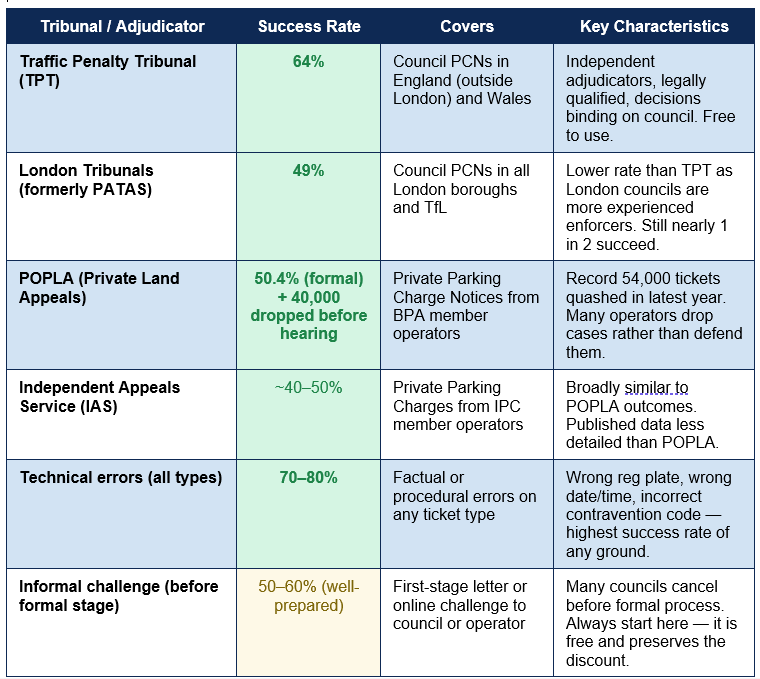
Fewer than 1 in 20 recipients appeal: despite a 50–64% success rate at tribunal level — the single largest driver of unpaid parking tickets in the UK is not the absence of grounds but the absence of awareness — most drivers do not know that an independent tribunal exists, that it is free, that decisions are binding on councils and operators, and that their discount is preserved while they challenge (AppealAFine, March 2026).
The 'stop the clock' rule — the most important thing most people don't know: When you make an informal challenge to a council parking ticket within the discount period, the BPA's 'stop the clock' rule means the 50% early payment discount is legally paused. Your discount does not expire while the council is considering your challenge. If the council rejects your informal challenge, they must either re-offer the discount or you can pay the reduced amount within a specified period stated in their rejection letter. For private parking tickets, the 50% discount period similarly pauses during an appeal. This means appealing a parking ticket carries no financial risk from losing the discount — the worst-case outcome of an unsuccessful appeal is paying the same amount you would have paid by not appealing at all.
Step 1: Identify Your Ticket Type — This Changes Everything
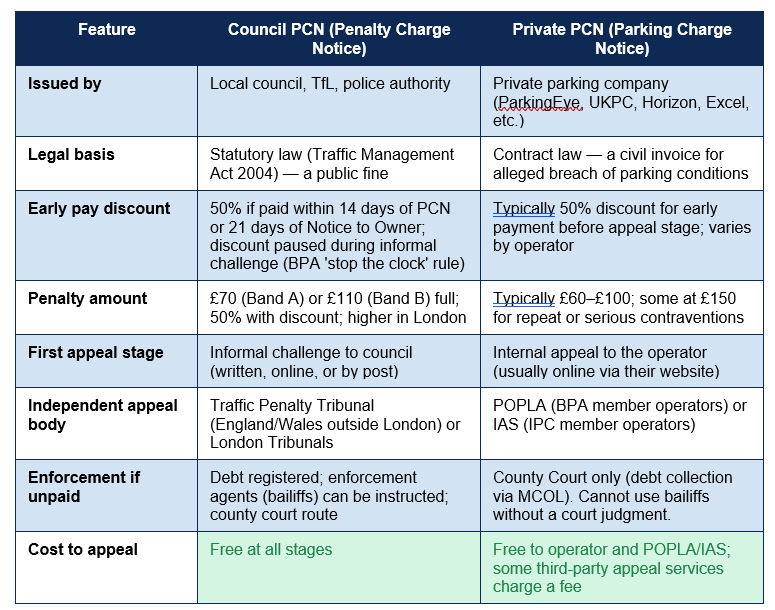
The most important thing to do the moment you find a parking ticket is establish what type it is, because council and private tickets have different legal bases, different enforcement powers, different appeal routes, and different financial consequences for ignoring them. The distinction is not always obvious at first glance — both are often referred to informally as 'parking tickets' or 'PCNs', but they are legally completely different documents.The terminology on the ticket tells you everything you need to know:
- Penalty Charge Notice (PCN): This is an official council or TfL parking ticket, a public law fine issued by a local authority or traffic enforcement officer. The word 'Penalty' is the key identifier. It will name the issuing council or TfL, not a private company. This type of ticket has statutory enforcement powers — unpaid and escalated council PCNs can eventually result in enforcement agents (bailiffs) being instructed to recover the debt without requiring a court judgment.
- Parking Charge Notice (also abbreviated PCN): Despite the identical acronym, this is a private invoice for an alleged breach of parking conditions on private land — it is a civil contractual claim, not a public fine. It will carry the name of a private company (ParkingEye, UKPC, Horizon, Excel Parking, Euro Car Parks, and others). It has no direct enforcement powers without a county court judgment. Some companies do pursue drivers through the Small Claims Court under the Protection of Freedoms Act 2012, but they must obtain a judgment before any enforcement can occur.
The Strongest Grounds for Appeal — and Their Success Rates
Not all appeals succeed on the same grounds. Understanding which defences produce the highest success rates helps you identify whether you have a strong case before committing to the appeal process, and how to frame your argument most effectively. The following are the grounds that produce the highest success rates across both council and private appeals, ordered from strongest to more situational:Factual or Procedural Errors (70–80% success rate)
Any factual error on the ticket itself — the wrong vehicle registration number, the wrong contravention code, an incorrect date or time, the wrong location address — can be grounds to cancel the ticket entirely. These are the strongest grounds available because they go to the validity of the notice itself rather than to the merits of the parking situation. Carefully check every detail on your ticket against what you know to be true about your vehicle and when you parked.Procedural errors — where the council or operator has failed to follow the correct statutory or code of practice process — are similarly powerful. For council PCNs, the Traffic Management Act 2004 and associated regulations set out very specific requirements for how a PCN must be issued, served, and escalated. A departure from those requirements can invalidate the ticket regardless of whether you were technically in contravention when it was issued.
Unclear, Missing, or Misleading Signage
For both council and private parking appeals, inadequate signage is one of the most consistently cited grounds for success. For private parking tickets, this is particularly powerful because the entire basis of a private parking charge is a contractual relationship between the driver and the operator, formed through the signage at the entrance and around the car park. If the signs were obscured by vegetation, too high to be easily read, contradictory between entrance and interior, or missing essential terms, the contract itself is invalid — and without a valid contract, there is no basis for the charge.The key evidence to gather immediately when you discover this is the ground: photograph the signs, including any that are obscured or confusing, from the perspective of a driver entering the car park. Photograph the entrance sign and any signs visible from where you parked. If you return to the location later and the signs have been modified or improved since the date of the alleged contravention, note this separately — the state of the signs on the date of the ticket is what matters, not their current state.
Grace Period Not Applied
Under the British Parking Association (BPA) Code of Practice, private car parks are required to allow a minimum 10-minute grace period after a valid parking session expires before issuing a ticket. Many councils also apply a 5-10 minute grace period in their own car parks and for on-street enforcement. If your ticket was issued within this grace period — for example, within 10 minutes of your paid session ending, or immediately after your free period in a retail car park — this is valid grounds for appeal, provided you can demonstrate the timing through your exit time from ANPR evidence, a parking receipt, or bank transaction records.Genuine Emergency or Compelling Circumstances
A genuine emergency that prevented you from returning to or moving your vehicle can be grounds for cancellation at the informal stage, though this is more discretionary than technical defences. A medical emergency with supporting documentation (hospital attendance records, a letter from a GP or paramedic), a road traffic accident, or a verifiable vehicle breakdown are the most commonly accepted circumstances. Councils and operators have discretion to cancel on these grounds even if they would otherwise be entitled to enforce the ticket, and well-documented emergency circumstances are often successful at the informal stage.Pay-and-Display Machine or App Failure
If you attempted to pay for parking but the pay-and-display machine was faulty or out of service, or if the parking app failed through no fault of your own, this is grounds for appeal. The key is evidence: take a photograph of the faulty machine showing the error or 'out of service' notice, note the time and your vehicle registration, and check whether there was an alternative payment method available that you were not made aware of. Many councils and car park operators are now required to provide multiple payment methods (machine, app, telephone) and failure to ensure at least one functional method represents a failure of their own obligations.The Step-by-Step Appeal Process
For Council PCNs
- Informal challenge (Stage 1): If the PCN was placed on your windscreen, you can make an informal challenge before you receive the Notice to Owner. Write to the council (most have an online form) within 14 days explaining why you believe the ticket should be cancelled, and include any supporting evidence. The 50% discount is paused while the council considers your challenge. If the council accepts your challenge, the ticket is cancelled and nothing is owed. If they reject it, they will issue a Notice to Owner and you move to Stage 2.
- Formal representations (Stage 2): Once you receive a Notice to Owner (NtO), you have 28 days to make formal representations to the council, setting out your grounds in writing with evidence. The council must consider these and respond with either a full acceptance (ticket cancelled), a partial acceptance, or a Notice of Rejection of Representations (NoR).
- Independent tribunal appeal (Stage 3): If the council rejects your representations, the NoR must explain why and provide details of your right to appeal to the Traffic Penalty Tribunal (outside London) or London Tribunals (London). You have 28 days from receiving the NoR to lodge your tribunal appeal. The appeal is free, conducted primarily online, and the adjudicator's decision is binding on the council. At the TPT, 64% of cases are decided in the motorist's favour.
For Private Parking Charges
- Internal operator appeal (Stage 1): Appeal directly to the private parking company through their website or by post, within the deadline stated on the ticket (typically 28 days). State your grounds clearly with evidence. The operator will respond with either a cancellation or a rejection. At this stage, many operators reject as a matter of course without meaningful review — a rejection here does not mean your case lacks merit.
- POPLA or IAS appeal (Stage 2): If rejected, you can appeal to POPLA (for BPA member companies) or the Independent Appeals Service (for IPC member companies) — the operator's membership is stated in the rejection letter. The appeal is free, typically submitted online, takes 6-8 weeks, and the adjudicator's decision is binding on the operator. As Regit reported in May 2026, 40,000 cases per year are dropped by operators at this stage without reaching a decision — often because they cannot or will not produce the required evidence.
The evidence rule for every appeal: At every stage of both council and private appeals, specific, evidence-backed arguments succeed and vague complaints fail. Adjudicators and council reviewers respond to facts and evidence, not to frustration or indignation. The single most effective improvement to any appeal letter is accompanying it with photographs — of signs, of your parking ticket, of a faulty machine, of the space you parked in relative to bay markings, of anything relevant to your grounds. Send copies of any receipts, bank statements showing attempted payment, or correspondence relating to the ticket. Physical evidence consistently produces better outcomes than written argument alone.
Critical Deadlines: What Happens If You Miss Them
Parking ticket appeal deadlines are strict and the consequences of missing them can be significant. The following deadlines apply to council PCNs specifically, though private ticket timelines are broadly similar:- 14 days from PCN issue: Pay at the 50% discounted rate (if the ticket was placed on the windscreen), OR submit an informal challenge to the council — both preserve your options. If neither action is taken within 14 days, the discount may be lost and a Notice to Owner will be issued for the full amount.
- 28 days from receiving the Notice to Owner: Make formal representations to the council. Miss this deadline and the council can register the debt and escalate to enforcement without further opportunity for you to challenge.
- 28 days from the Notice of Rejection of Representations: Lodge your appeal to the Traffic Penalty Tribunal or London Tribunals. This is the final stage where an independent adjudicator reviews the case. Miss this deadline and the council can immediately move to enforcement.
- For private tickets — typically 28 days from issue: Submit your internal operator appeal. Different operators may specify shorter or longer periods, so check the specific deadline stated on your ticket and any subsequent correspondence.
Conclusion
The UK parking ticket appeal system is significantly more accessible, more fair, and more likely to produce a successful outcome than most drivers realise. At the Traffic Penalty Tribunal, which handles council PCNs across England outside London and Wales, 64% of cases brought by motorists are decided in their favour. At POPLA, which handles private parking charges, more than half of all formal appeals succeed — and 40,000 cases per year are abandoned by the parking operator before a decision is even needed. These are not marginal, lottery-style odds; they are majority outcomes in the motorist's favour for anyone who makes the effort to challenge.The single most underused protection available to UK drivers is the 'stop the clock' rule that preserves the 50% discount during an informal challenge. This eliminates the financial risk that the discount creates by encouraging quick payment — there is no longer any penalty for taking the time to challenge a ticket properly, because your discount waits for you regardless of how long the council or operator takes to respond. Combined with a free appeal process, independent adjudicators whose decisions are binding on councils and operators, and success rates that exceed 50% at every stage of the system, the rational response to almost any UK parking ticket that feels unfair is to challenge it rather than pay it.
The process takes 10-15 minutes to set up online at the informal stage. It costs nothing at any stage. And the statistics — gathered from official Traffic Penalty Tribunal data, POPLA annual reports, and London Councils figures — consistently confirm what individual drivers who have successfully appealed already know: parking ticket enforcement in the UK relies heavily on the majority of recipients not knowing their rights. Reading this guide is the first step toward being among the minority who do.
Frequently Asked Questions (FAQ)
What are the chances my parking ticket appeal will succeed?
Your chances depend on the type of ticket and which stage of the process you are at. At the independent tribunal stage, 64% of council PCN appeals in England outside London and Wales succeed at the Traffic Penalty Tribunal, and 49% succeed at London Tribunals. For private parking charges taken to POPLA, 50.4% of formal appeals succeed, and an additional 40,000 cases per year are dropped by operators before a formal decision is needed. At the informal challenge stage, success rates vary more widely, but well-prepared appeals with clear evidence succeed in 50-60% of cases according to AppealAFine's analysis of published data.Will I lose my 50% discount if I appeal?
No — and this is the most important point in this guide. The BPA's 'stop the clock' rule legally pauses your 50% early payment discount while your informal challenge is being considered by the council. If the council rejects your informal challenge, they must either re-offer the discount in their rejection letter or state a period within which you can pay the discounted rate. For private parking tickets, the discount period similarly pauses during the appeal process. This means appealing carries no financial risk from losing your discount — the worst-case outcome of an unsuccessful appeal at the informal stage is the same cost as not appealing at all.What is the difference between a council PCN and a private parking ticket?
The terminology distinguishes them: a Penalty Charge Notice (with the word 'Penalty') is an official council or TfL ticket backed by public law, issued by a local authority enforcement officer. A Parking Charge Notice (no 'Penalty') is a private invoice from a parking company, based on contract law. Council PCNs have statutory enforcement powers; private charges require a county court judgment before any enforcement can occur. Both types can be appealed through free independent adjudicators — the Traffic Penalty Tribunal or London Tribunals for council tickets, and POPLA or IAS for private tickets.What if I ignore a private parking ticket?
Ignoring a private parking ticket is not the same as ignoring a council PCN. A private parking company cannot instruct bailiffs or register a debt without first obtaining a county court judgment. However, many companies do pursue unpaid tickets through the county court small claims process, and a county court judgment against you can affect your credit record for six years. The more effective approach is to assess whether you have grounds to appeal, and if so, to use the free POPLA or IAS process rather than simply ignoring the ticket — a successful appeal costs nothing and eliminates the debt entirely.How do I appeal a parking ticket online?
For council PCNs: identify your council from the ticket and visit their website — most councils have an online appeal form accessible from their parking enforcement pages. For London PCNs: use the London Tribunals online portal at londontribunals.gov.uk. For England and Wales council PCNs outside London: use the Traffic Penalty Tribunal online appeal service at trafficpenaltytribunal.gov.uk. For private parking charges: identify whether the operator is a BPA or IPC member from the ticket, then appeal via popla.org.uk (BPA) or theias.org.uk (IPC). All these services are free. Citizens Advice also provides free guidance and template appeal letters for all ticket types.
External References
The following authoritative sources were used in researching this article and are recommended for further reading:1. Traffic Penalty Tribunal — Official Independent Adjudicator for England (Outside London) and Wales
https://www.trafficpenaltytribunal.gov.uk/
2. POPLA — Parking on Private Land Appeals: Official Independent Service
https://www.popla.co.uk/
3. AppealAFine — Parking Fine Appeal Success Rates 2026: Real Data (March 2026)
https://www.appealafine.co.uk/blog/parking-fine-appeal-success-rates-2026
4. Regit — Private Parking Appeals UK: Record 54,000 Tickets Quashed (May 2026)
https://www.regit.cars/car-news/private-parking-appeals-uk-record-54000-tickets-quashed
5. PCN Beater — How to Appeal a Parking Ticket in London 2026
https://www.pcnbeater.co.uk/blog/appeal-parking-ticket-london
6. Citizens Advice — Challenge a Parking Fine on Private Land
https://www.citizensadvice.org.uk/consumer/parking/challenge-a-parking-fine-on-private-land/
7. Citizens Advice — Challenge a Penalty Charge Notice for Parking on a Public Road
https://www.citizensadvice.org.uk/consumer/parking/challenge-a-penalty-charge-notice-for-parking-on-a-public-road/
8. MoneySavingExpert — Parking Tickets: Fight the Fine
https://www.moneysavingexpert.com/reclaim/parking-tickets/
0 Comments
Be the first to share your thoughts on this article.