

Vehicles & Cars
Car Rental Cost: UK vs US Compared — Accountant's Guide


Table of Contents
- The Price You See Is Not the Price You Pay
- How Much Does It Cost to Rent a Car in the UK in 2026?
- How Much Does It Cost to Rent a Car in the US in 2026?
- UK vs US Car Rental: Side-by-Side Rate Comparison 2026
- The Hidden Fees: What the Accountant Actually Sees on the Invoice
- The Young Driver Surcharge: The Most Expensive UK-Specific Cost
- Accountant's Worked Examples: Real Total Cost Calculations
- Example 1 — UK Adult Driver, 7-Day Economy Hire (Off-Airport)
- Example 2 — US Airport Hire, 7 Days, Chicago O'Hare, Summer
- Example 3 — US Airport Hire, 7 Days, Chicago O'Hare, Summer (SMART)
- Key Structural Differences Between UK and US Car Hire Markets
- Conclusion
- Frequently Asked Questions (FAQ)
The Price You See Is Not the Price You Pay
Renting a car in the UK or the United States appears straightforward until you collect the keys. The advertised daily rate — the bold number at the top of the comparison website — is a starting point, not a total cost. Between that number and what actually appears on your final bill sits a collection of additions that can double, and in some cases nearly triple, the base rate: insurance waivers, airport surcharges, young driver penalties, fuel policy charges, additional driver fees, child seat hire, GPS rental, taxes, and security deposit holds. A UK survey cited by VIPCars found that 70% of UK car hire travellers feel misled by extra costs that appear at the rental counter — costs they had not anticipated from the advertised rate.As an accountant, I have reviewed the full cost breakdown across both markets — the base rates, the standard add-ons, the unavoidable taxes, and the fees that smart planning can entirely eliminate. The headline finding: the base rental rates in the UK and US are remarkably similar at the market average level (both averaging approximately £43/$43 per day for all-category averages according to KAYAK's aggregate data). But the total cost experience diverges significantly due to two market-specific differences: in the US, taxes and mandatory fees can represent up to 50% of the total bill according to the Tax Foundation's May 2026 analysis; in the UK, the young driver surcharge — up to £37.70 per day — can nearly double the cost of a rental for under-25s, and the excess insurance pressure at the counter traps 70% of hirers into paying far more than they need to.
This guide provides the complete accountant's breakdown of what car rental actually costs in the UK and the US in 2026 — the base rates by vehicle category, the hidden fee itemisation, the city-by-city price variation, the specific arithmetic of the most expensive scenarios (young drivers, airport pick-ups, US high-tax states), and the ten strategies that consistently reduce the total cost of a car hire in both markets. Whether you are a UK resident planning a US road trip, an American travelling to Britain, or simply trying to understand what a car hire should actually cost before you reach the counter, this is the complete cost picture.
How Much Does It Cost to Rent a Car in the UK in 2026?
Booking.com's UK car hire data provides the clearest current market picture: the average daily cost to rent a car in the UK across all vehicle categories is approximately £43 per day. For a standard week-long hire, that translates to approximately £302 for a medium car — the most popular category among UK renters, followed by premium and SUV. Breaking the headline rate down by category:- Economy and small cars: £21–£25 per day — the entry point of the market, generally suitable for city driving and one or two passengers with minimal luggage.
- Medium cars (most popular): approximately £39 per day — the sweet spot that offers adequate space for families or couples on longer trips at a reasonable rate.
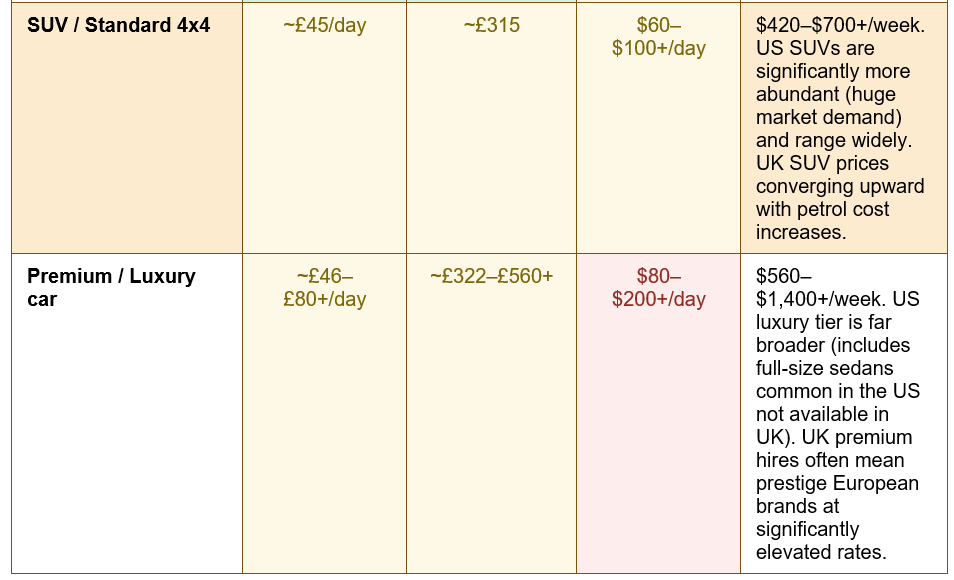
- SUV and 4x4: approximately £45 per day — increasingly popular for families and for driving in rural Scotland or Wales where road conditions vary.
- Premium and luxury cars: £46 to £80+ per day — a wide range depending on whether 'premium' means a higher-spec family car or a prestige marque.
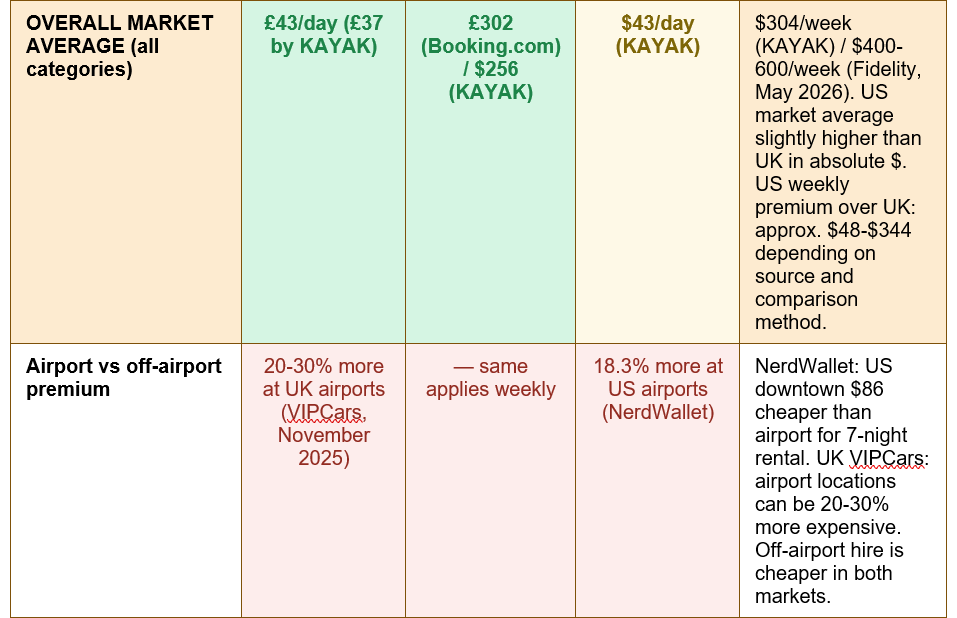
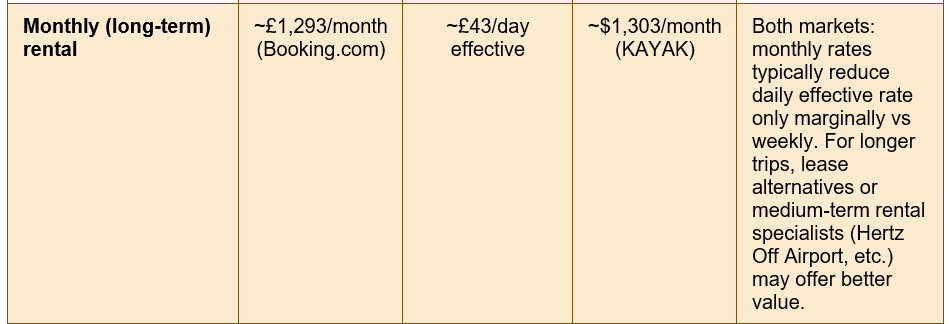
KAYAK's aggregate UK data produces a slightly lower average of £37 per day (approximately $37 at current rates), with a monthly rate averaging £1,293. The divergence between Booking.com's £43 and KAYAK's £37 reflects different inventory mixes and the timing of data capture — aggregate platform averages include both budget deals and premium options, and their weighting varies by platform. For planning purposes, budgeting £40–£45 per day for a standard UK car hire represents a reliable central estimate.
Significant regional and seasonal variation exists within the UK market. London and major airports attract the highest rates — and the highest surcharges. Skyscanner's UK car hire guide notes that economy cars start from as low as £21-£25 per day at off-airport locations, but rates at Heathrow or Gatwick are materially higher. Scotland, where driving is necessary to access many tourist destinations, often commands premium rates during summer (July and August) when international tourist demand peaks alongside domestic holiday demand.
UK-specific cost factor: the congestion charge. If you are renting in London and your trip includes driving in Central London on weekdays, budget for the congestion charge of £15 per day, Monday to Friday between 7am and 6pm. This is not charged by the rental company — you pay it directly — but rental companies may charge an administration fee of £5-£15 per day if they receive a fine on your behalf for non-payment. Set up an online account or use the TfL website to pay directly to avoid the administration surcharge. KAYAK's UK guide specifically flags this: 'If you'll be driving through central London, note that there's a congestion charge for anyone who drives or parks their car in this area on weekdays.'
How Much Does It Cost to Rent a Car in the US in 2026?
The US car rental market is larger, more competitive, and — crucially for budget planning — more variable than the UK market. Fidelity's May 2026 car rental cost guide provides the most current market overview: 'The average cost of renting a car from one of the 8 major rental brands in the US ranges from between $400 and $600 per week, depending on location, timing, and vehicle type.' KAYAK's aggregate data produces a lower average of $43 per day ($304 per week), reflecting the inclusion of budget brands and lower-cost markets. Skyscanner's 2025 data for economy cars specifically found a range from $12 to $86 per day — a sevenfold variation from cheapest to most expensive within the same vehicle category, illustrating just how dependent US rental pricing is on location and timing.The city-by-city variation in the US is far more dramatic than in the UK. NerdWallet's pricing analysis of the major US markets produced these standout findings: Miami is the only major city where average weekly rental costs fall below $400, making it the cheapest large US car hire market. Chicago O'Hare Airport carries the highest average weekly rental prices of any major US airport — over $700 for a seven-night rental. Chicago's O'Hare economy car average was $54.94 per day in May 2025, while the same category at Los Angeles International Airport averaged $39.36 per day. The $15.58 per day difference between two major airports represents over $109 on a week-long rental for the identical vehicle category.
One of NerdWallet's most counterintuitive findings about the US market: booking a car rental closer to the travel date is often cheaper, not more expensive. The average weekly rental price for cars booked 91 days in advance was $555. For cars booked just seven days before travel, the average was $481 — a 13% discount for last-minute booking. This reverses the conventional travel booking wisdom and reflects the specific dynamics of car rental supply and demand, where last-minute inventory at off-peak times can be cheaper to clear than inventory held for months.
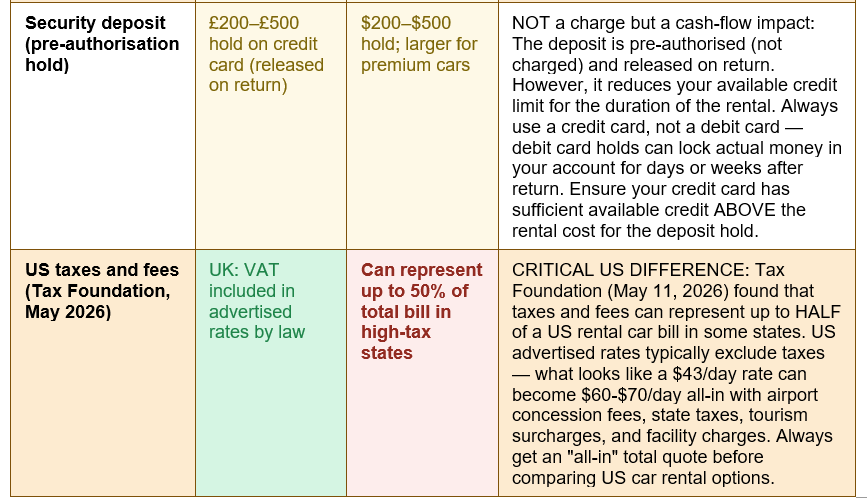
The US tax shock — Tax Foundation May 2026: Taxes and fees can represent up to 50% of the total US rental car bill in some states — Tax Foundation's analysis (Adam Hoffer and Jacob Macumber-Rosin, May 11, 2026): 'Renting a Car? Half Your Bill May Be Taxes and Fees.' US rental car taxes include state and local sales taxes, airport concession fees, facility charges, vehicle licensing fees, and tourism surcharges — none of which typically appear in advertised rates. A $43/day base rate in a high-tax US city can become $60-$70/day all-in. Always request a total cost breakdown including all taxes and fees before committing to a US car hire booking
UK vs US Car Rental: Side-by-Side Rate Comparison 2026
The table below maps the key headline rental rates across both markets by vehicle category, using the most current 2026 platform aggregate data from KAYAK, Booking.com, NerdWallet, Fidelity, and Skyscanner: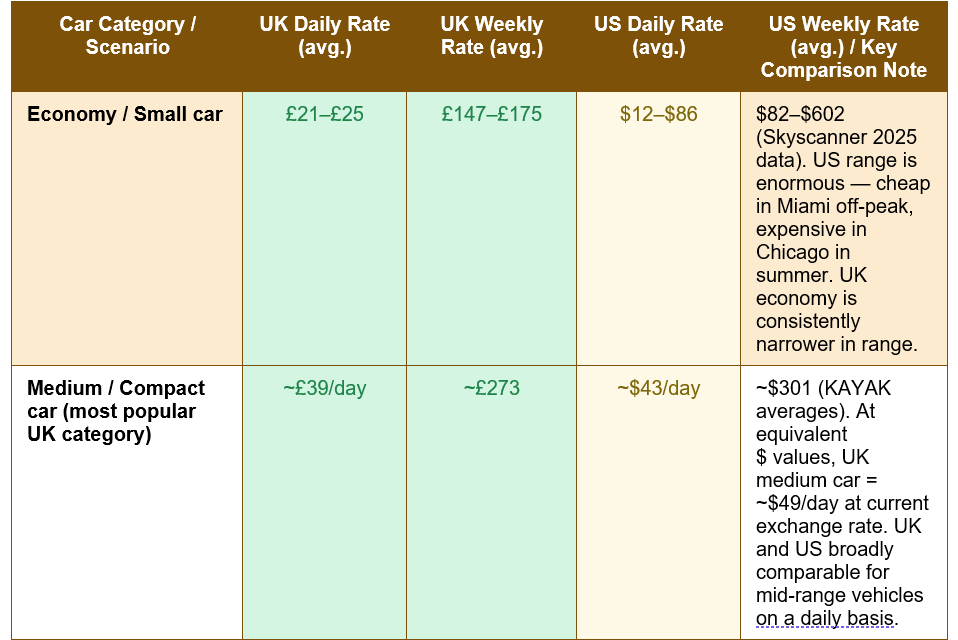
The Hidden Fees: What the Accountant Actually Sees on the Invoice
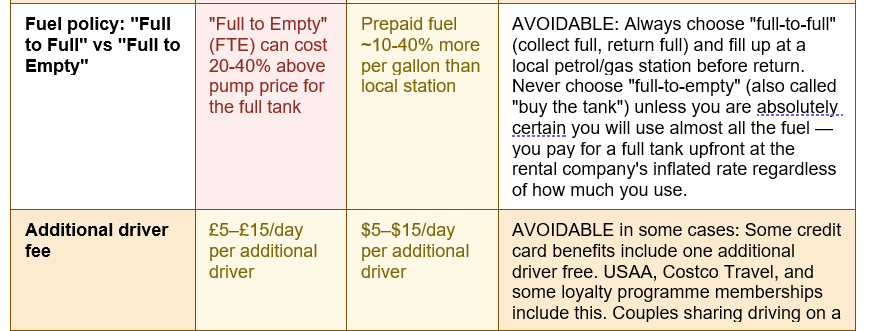
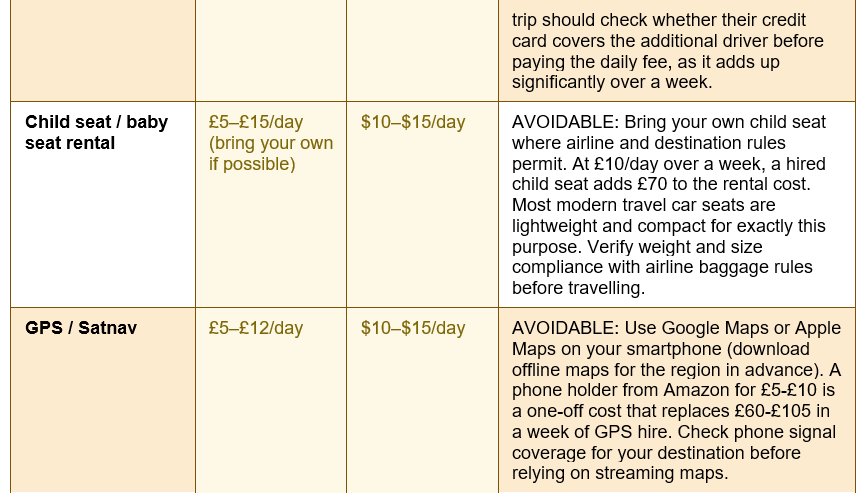
The base rental rate is only the beginning. What an accountant sees when auditing a car hire invoice reveals a systematic layer of additions that transform the advertised price into the actual cost. Over 70% of UK car hire travellers report feeling misled by costs that appear at the counter — costs that were technically disclosed in the small print but were not visible in the comparison site headline rate. The table below maps every significant add-on with the typical UK and US cost and an accountant's frank assessment of whether each is essential, optional, or entirely avoidable: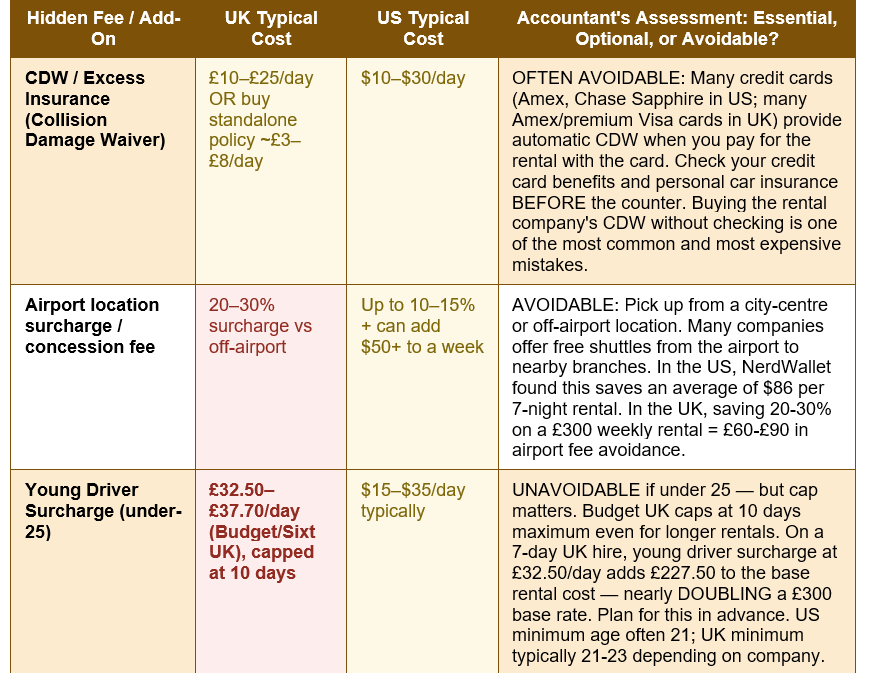
The Young Driver Surcharge: The Most Expensive UK-Specific Cost
The young driver surcharge is the single largest hidden cost in UK car hire for travellers under 25. Unlike most other car rental fees, it is genuinely unavoidable — it reflects the actuarially higher accident risk of younger drivers and is applied universally across the UK market, though rates and caps vary by provider. Understanding exactly what this costs and how it is structured is essential for any under-25 planning a UK car hire.Budget UK's young driver surcharge is £32.50 per day at standard locations and £37.70 per day at premium locations, capped at a maximum of 10 days regardless of how long the rental lasts. Sixt UK charges £36 per day for under-25 drivers. These surcharges apply on top of the base rental rate, not instead of it. The practical arithmetic is significant:
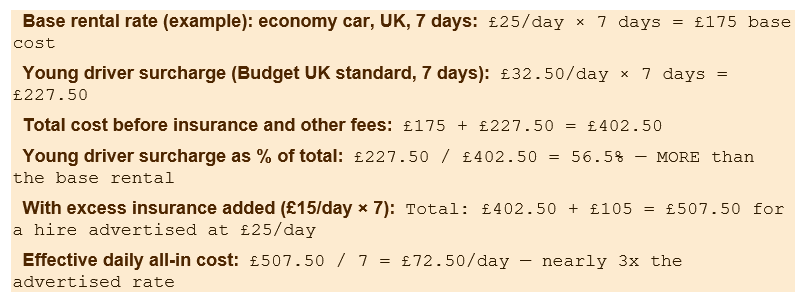
The cap at 10 days means that for rentals of 10 days or longer, the surcharge stops accumulating after day 10 — providing some relief for longer-term hires. Minimum rental ages also apply: Budget UK requires drivers to be at least 23, not 21. Most UK companies restrict premium and larger vehicles to drivers 25 and above regardless of surcharge payment. For under-25 UK hirers, choosing the cheapest available economy car at an off-airport location, buying standalone excess insurance before arrival, and maximising rental duration to trigger the 10-day cap are the only effective cost-reduction strategies available within the constrained market.
Accountant's Worked Examples: Real Total Cost Calculations
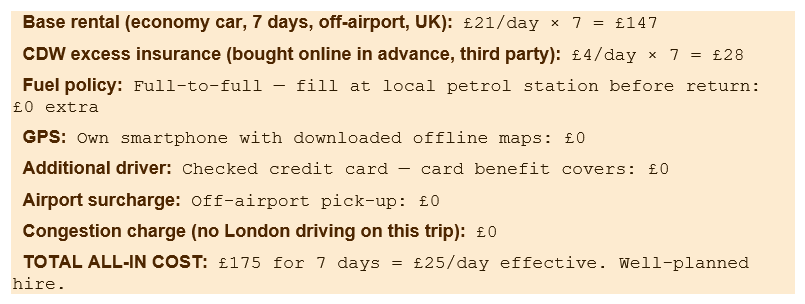
Example 1 — UK Adult Driver, 7-Day Economy Hire (Off-Airport)
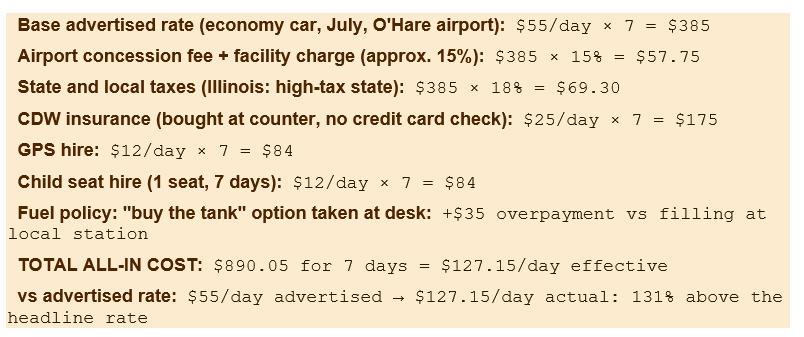
Example 2 — US Airport Hire, 7 Days, Chicago O'Hare, Summer
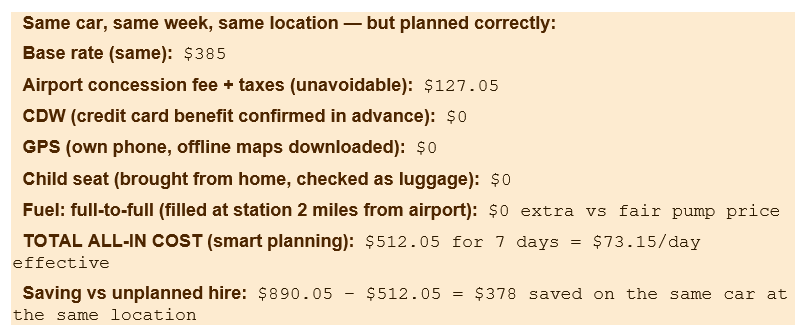
Example 3 — US Airport Hire, 7 Days, Chicago O'Hare, Summer (SMART)
THE ACCOUNTANT'S MONEY-SAVING RULES FOR CAR HIRE: Seven consistently effective strategies backed by the data in this guide: (1) Check your credit card CDW cover BEFORE booking — many premium credit cards provide this free. (2) Buy third-party excess insurance online before arrival — typically 60-80% cheaper than the counter price. (3) Always pick up from an off-airport location when practical — saves 18-30% in both markets. (4) Choose full-to-full fuel policy and fill up at a local station within 2 miles of the return point. (5) Download offline maps to your phone to eliminate GPS hire entirely. (6) In the US, always request the total all-in cost including all taxes and fees before comparing rental options — never compare headline rates only. (7) For US rentals, last-minute booking (within 7 days) is often cheaper than early booking — NerdWallet found 13% average saving for 7-day advance vs 91-day advance.
Key Structural Differences Between UK and US Car Hire Markets
Beyond the headline rate comparison, several structural differences between the UK and US markets significantly affect the total cost and experience:- Manual vs automatic transmission: In the UK, manual (stick-shift) cars are standard and significantly cheaper to hire than automatics. US rental fleets are almost exclusively automatic, eliminating the manual/automatic price differential entirely. UK travellers hiring in the US should note that if they are only licensed for manual in the UK, they can legally drive a US automatic on a UK licence — there is no restriction. UK hirers who prefer automatic in the UK will find the US fleet entirely automatic and typically at no premium for this feature.
- Driving side: The UK drives on the left; the US drives on the right. UK travellers in the US (and vice versa) must adapt to the opposite driving side. This is relevant for insurance purposes: some credit card CDW policies have exclusions for non-resident drivers unfamiliar with local road conventions. Check the policy terms.
- Fuel cost per fill-up: US petrol (gasoline) costs significantly less than UK petrol — roughly $3.00–$3.50/gallon ($0.79–$0.92/litre) in the US versus approximately £1.40–£1.55/litre in the UK (2026 averages). This means the running cost of a rental (beyond the hire fee) is materially lower in the US for identical mileage. A 7-day US road trip covering 1,000 miles in a 30mpg car costs approximately $100–$117 in fuel. The same mileage in the UK would cost approximately £170–£190 — roughly 60-80% more for the same distance driven.
- Insurance structure: UK car hire typically includes third-party liability insurance as a minimum legal requirement — the driver is legally covered to drive on UK roads. The CDW (Collision Damage Waiver) that the hire company offers covers damage to the hire car itself, not third-party liability. In the US, minimum liability is typically included but varies by state. US CDW (Loss Damage Waiver/LDW) operates similarly. Credit card CDW coverage is more standardised and better understood in the US market — American travellers are more likely to know about it in advance.
- London Congestion Charge and ULEZ: London's Congestion Charge (£15/day, weekdays 7am-6pm, Central London) and the ULEZ (Ultra Low Emission Zone) charge (£12.50/day for non-compliant vehicles) are unique to the UK market and have no direct US equivalent. Most modern rental cars in the UK meet ULEZ standards, but older or diesel vehicles may trigger the ULEZ charge. Rental companies charge administration fees on top if a fine is incurred — always confirm whether your rental car meets ULEZ standards if driving in London.
Conclusion
The headline car rental rates in the UK and US are strikingly similar at the aggregate market average: approximately £43/day in the UK (Booking.com) and $43/day in the US (KAYAK), with weekly averages of around £302 in the UK and $304-$600 in the US depending on market and source. The apparent similarity at the base rate level masks significant divergence in the total cost experience once all the layers are added. In the US, the Tax Foundation's May 2026 analysis found that taxes and fees can represent up to half of the total rental bill in high-tax states and cities — a $43/day car can become $60-$70/day all-in before a single optional extra is added. In the UK, the young driver surcharge for under-25s (up to £37.70/day at Budget, capped at 10 days) can add more to the total cost than the base rental itself on a week-long hire.The accountant's worked examples illustrate the practical scale of the difference between an unplanned and a planned car hire: for an identical summer week at Chicago O'Hare, the difference between picking up without preparation and arriving with credit card CDW confirmed, offline maps downloaded, and a child seat in the luggage is $378 on a single rental. Over a family's annual travel budget, consistent smart planning on car hire generates savings that compound meaningfully.
The seven core strategies that deliver the largest cost reductions in both markets — check credit card CDW cover, buy third-party excess insurance online, pick up off-airport where practical, use full-to-full fuel policy, download offline maps, always compare all-in costs in the US, and consider last-minute booking for US rentals — are all free, require only advance preparation, and are available to any renter regardless of income, loyalty programme membership, or travel frequency. The price you see on the comparison website is a starting point. The price you actually pay is determined by how much you know before you reach the counter.
0 Comments
Be the first to share your thoughts on this article.