

Professional & Career Development
Changing Jobs? The Financial Checklist for Every Stage

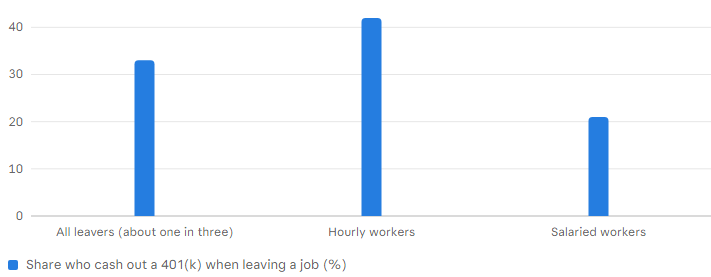
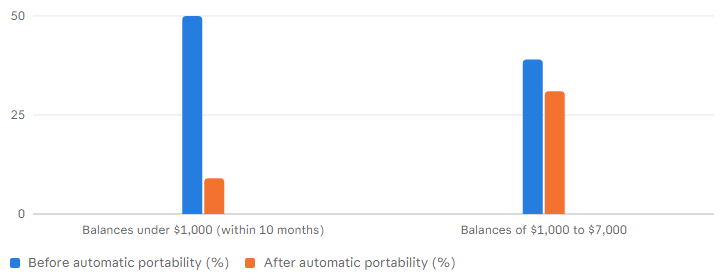
About one in three people who leave a job cash out their 401(k) (Vanguard); 42% of hourly workers versus 21% of salaried workers; for balances under $1,000, cash-outs fell from about 50% to 9% under automatic portability; 84% of workers have changed employers at least once and 27% five or more times. The 2026 limits: 401(k) $24,500 (plus $8,000 at 50+; $11,250 at 60–63; $72,000 combined with employer money); IRA $7,500; HSA $4,400 self-only and $8,750 family; FSA $3,400; plans can generally keep accounts above $7,000. My illustrations: cashing out $30,000 at a 24% bracket nets about $19,800 (before state tax) versus about $228,000 if rolled over and grown at 7% for 30 years; leaving 2 months before a 3-year vesting cliff forfeits about $17,000 of a $6,000-a-year match; an indirect rollover of $30,000 delivers $24,000 and requires $6,000 of your own money within 60 days; 18 months of COBRA on a $900 premium costs about $16,500.
Job changes are also common: in an Empower study, 84% of workers have changed employers at least once, 53% three or more times and 27% five or more, so you will probably use this checklist repeatedly. This guide walks through each stage, from deciding to leave through your first 90 days, with 2026 limits and worked examples. Confirm specifics with your employer’s HR team and a professional.
Treat a job change as a sequence with dates. Before you resign, list what you stand to forfeit and when it is earned: bonus, vesting, equity, purchase plans and paid time off. While negotiating, ask the new employer to make up what you will lose and to confirm when benefits start. When you leave, roll your 401(k) directly rather than cashing it out, line up health coverage so there is no gap and use or move any health savings or flexible spending accounts; in your first 90 days, enroll on time and capture the new match. The biggest-dollar mistakes are usually timing errors, not investment errors.
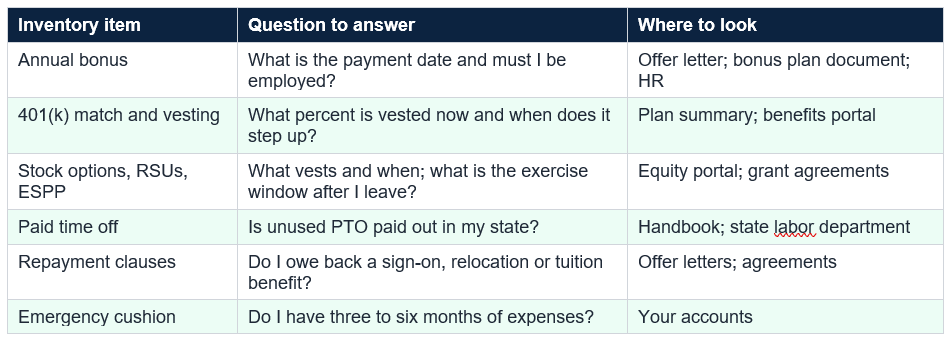
Do this while you still have access to your plan documents and benefits portal. Also note your emergency cushion: Bankrate found only 46% of Americans could cover three months of expenses, and a job change adds the risk of a gap between paychecks. In my illustration, six months of $4,000 monthly expenses is $24,000, which a top savings account paying about 4.35% would earn about $1,040 a year on. A cushion also gives you leverage to negotiate.
Also ask about the start date: starting a few weeks later can let you collect a bonus, reach a vesting date or arrange coverage. If the salary is lower, check the total picture, since a richer match and a better health plan may make up the difference. Get everything in writing before you resign.
Bonuses and equity work the same way. A $20,000 bonus paid on March 31 may be lost if you leave on March 15; a stock purchase plan may buy shares on a set date at a discount; and unvested restricted stock units usually disappear when you leave. Options often must be exercised within about 90 days of leaving (common, but plan-specific), which can require cash and create a tax bill. Weigh a delay of a few weeks against the new start date, and ask the new employer if it can wait or compensate.
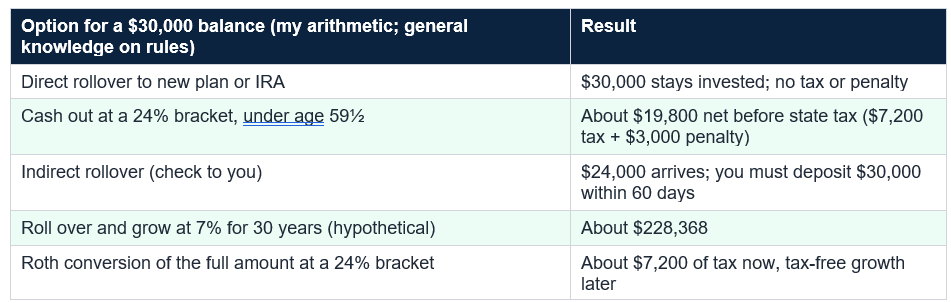
The numbers: Hypothetical: a $6,000-a-year match at month 34 of a 3-year cliff means about $17,000 at risk; a graded 20%-a-year schedule would forfeit about $13,600. A $30,000 401(k) cashed out at a 24% bracket nets about $19,800 (before state tax); rolled over, it could grow to about $228,000 at 7% over 30 years.
Confirm your final paycheck and any unused paid time off, which some states require employers to pay and others leave to company policy. Download pay stubs, benefit summaries, tax forms and plan statements before you lose portal access. Review life and disability insurance, since employer coverage often ends when you leave: check whether you can convert or buy a stopgap. Update beneficiaries on accounts that stay behind, and get written confirmation of your last day, final pay and benefit end dates.
A direct rollover avoids both taxes and the penalty, because the money moves from plan to plan. An indirect rollover, where the check is made out to you, can go wrong: the plan generally withholds 20%, so $30,000 arrives as $24,000 and you must deposit the full $30,000 within 60 days, adding $6,000 of your own money, or the missing part is taxed. Compare fees and investment choices among the plans and an IRA, and check that the new plan accepts rollovers. Vanguard found that automatic portability cut cash-outs of balances under $1,000 from about 50% to 9%, but only 6% of those accounts had reached a new employer plan.
Mid-year changes also affect contributions. The 2026 employee limit of $24,500 applies to you across all your plans (plus $8,000 at 50 or older, or $11,250 at 60 to 63; $72,000 including employer money), so if you put $15,000 into the old plan you can add up to $9,500 at the new one. Also check how the new plan calculates your match, since some match per paycheck and front-loading contributions can cost you matching dollars.
The goal is a seamless bridge. If your new plan starts on day one you may not need COBRA; if it has a waiting period, COBRA for one or two months may be worth the cost (about $1,836 for two months in my example), and coverage is generally retroactive once elected. A spouse’s plan or a marketplace plan are alternatives. Do not skip coverage entirely, since one unexpected hospital stay could cost far more, and check that your doctors and prescriptions are covered in the new network.
This is also the time to finish any rollover, rebuild any cushion you used and check your budget against the new pay. At year-end expect two W-2s, and remember that your 401(k) deferral limit applies to the total. If both employers withheld Social Security tax above the annual wage base ($184,500 for 2026), the excess can generally be recovered on your tax return (general knowledge).
Open a note with five dates: your bonus payment date, your next vesting date, your last day, your health coverage end date and your new benefits start date. Then compare them before you give notice.
Cash flow is the priority: cut non-essential spending, notify lenders if you expect trouble and keep your emergency fund in an accessible account. Do not rush into the first offer without checking the benefits, and consider professional help if you hold stock options or a large 401(k) balance. The principle holds: protect retirement savings and avoid gaps in coverage.
Common mistakes include resigning just before a bonus or vesting date, cashing out a 401(k), missing the 60-day rollover deadline or the COBRA election window, forgetting an FSA, letting stock options lapse, assuming benefits start on day one, missing new-job enrollment and not getting key promises in writing. Most can be avoided with a calendar and a few questions to HR.
The fix is a checklist with dates: inventory what you would forfeit, negotiate the new package, time your notice, use or move your FSA and HSA, roll over your 401(k) directly, bridge health coverage and enroll on time at the new job. The 2026 limits, $24,500 for a 401(k) and $7,500 for an IRA, leave room to keep saving through the change. Confirm the details with HR and a professional.
Check dates that could cost you money: when your annual bonus is paid and what you must do to earn it, when your 401(k) match or equity vests, when your employee stock purchase plan buys shares, and whether unused vacation is paid out in your state. Also check your benefits end date, since health coverage often ends on the last day of the month you leave. Get these in writing from HR before you give notice.
Should I roll over my 401(k) when I change jobs?
Usually you have four choices: leave it in the old plan if the balance allows, roll it directly into the new employer’s plan, roll it into an IRA or cash it out. Cashing out typically triggers income tax and, under age 59½, a 10% penalty. A direct rollover, where the money goes straight from plan to plan, avoids both. Compare fees, investment choices and loan options. About one in three job leavers cashes out, per Vanguard. This is general education, not personal advice.
What happens to my health insurance between jobs?
Employer coverage often ends on your last day or the end of that month. You can usually continue it through COBRA, but you typically pay the full premium plus up to 2%, in my general knowledge, and you generally have 60 days to elect it. A new employer may impose a waiting period of up to 90 days. Options include COBRA, a spouse’s plan or a marketplace plan. Plan the overlap so there is no gap.
Can I contribute to a 401(k) at both jobs in the same year?
Yes, but the 2026 limit of $24,500 applies to you, not to each plan, across all your 401(k), 403(b) and most 457(b) deferrals, plus $8,000 if you are 50 or older, or $11,250 at ages 60 to 63. If you contributed $15,000 at the old job, you could contribute up to $9,500 more at the new one. Employer matching is separate, with a combined limit of $72,000.
What are the biggest financial mistakes when changing jobs?
Common ones are leaving just before a bonus or vesting date, cashing out a 401(k), missing the 60-day COBRA election window, forgetting to use a flexible spending account, letting stock options expire and failing to enroll in new benefits on time. Each can cost thousands of dollars, and most are avoidable with a calendar and a few questions to HR.
Table of Contents
- Why the Details Matter
- The Short Answer
- Stage 1: Before You Decide
- Stage 2: Negotiating the Offer
- Stage 3: Before You Give Notice
- Stage 4: Your Last Weeks
- Stage 5: The 401(k) Decision
- Stage 6: Health Coverage Between Jobs
- Stage 7: Your First 90 Days
- If You Are Laid Off Instead
- Common Mistakes
- Conclusion
- Frequently Asked Questions
The leak: share of job leavers who cash out their 401(k) (%)
Share who cash out (%) by Vanguard, How America Saves 2025, as reported by Pension Policy International and Yahoo Finance; cash-outs are often of the full balance and trigger income tax plus a 10% penalty before age 59
Small balances are the most at risk: cash-out rates before and after automatic portability (%)
Share who cashed out (%) by Vanguard research reported by CNBC and InvestmentNews (Oct 2026), based on 83 Vanguard-administered plans that adopted the system; only about 6% of transferred accounts had reached a new employer plan
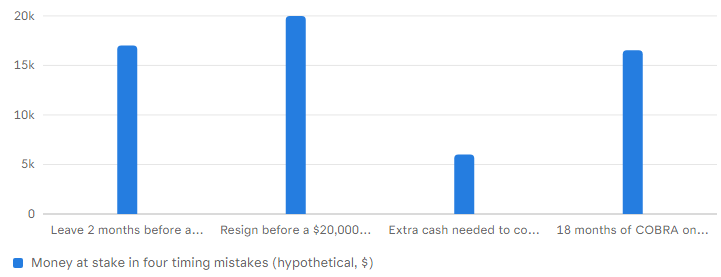
Timing mistakes cost real money: four hypothetical examples ($)
Dollars ($) by Author's illustrations with stated assumptions: match accrued over 34 months = $17,000; the $6,000 is the withheld 20% you must replace within 60 days; COBRA rules (60-day election, up to 102% of the
Why the Details Matter
Most people spend weeks weighing a new job’s salary and title and about ten minutes on what they are leaving behind. That is where money disappears: a bonus paid two weeks after you resign, a match that vests two months after your last day, a health plan that ends on your last day or a retirement account cashed out and taxed. These are ordinary rules that reward people who read their plan documents and punish those who do not.Job changes are also common: in an Empower study, 84% of workers have changed employers at least once, 53% three or more times and 27% five or more, so you will probably use this checklist repeatedly. This guide walks through each stage, from deciding to leave through your first 90 days, with 2026 limits and worked examples. Confirm specifics with your employer’s HR team and a professional.
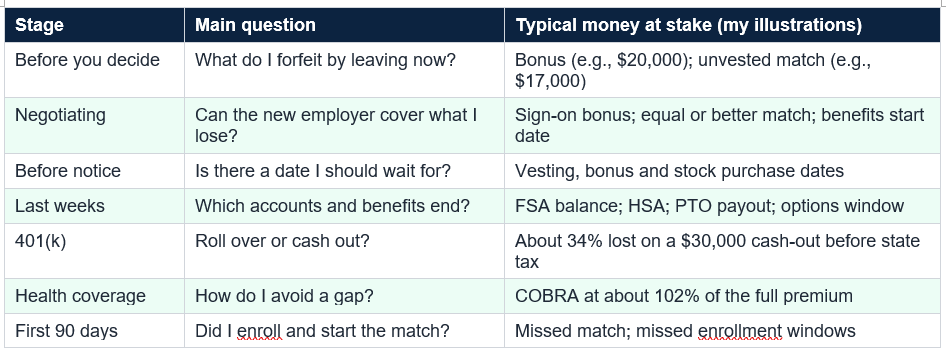
Treat a job change as a sequence with dates. Before you resign, list what you stand to forfeit and when it is earned: bonus, vesting, equity, purchase plans and paid time off. While negotiating, ask the new employer to make up what you will lose and to confirm when benefits start. When you leave, roll your 401(k) directly rather than cashing it out, line up health coverage so there is no gap and use or move any health savings or flexible spending accounts; in your first 90 days, enroll on time and capture the new match. The biggest-dollar mistakes are usually timing errors, not investment errors.
Stage 1: Before You Decide
Before you commit, build an inventory of what you would leave behind and when each item becomes yours. Start with cash: the annual bonus, commissions and retention payments, and what you must do to earn them, since many plans require you to be employed on the payment date. Next, your 401(k) match and its vesting schedule, since employer contributions often vest over time; then equity (options, restricted stock units, any employee stock purchase plan) with vesting and exercise dates; finally paid time off, health claims and any tuition or relocation repayment obligations.Do this while you still have access to your plan documents and benefits portal. Also note your emergency cushion: Bankrate found only 46% of Americans could cover three months of expenses, and a job change adds the risk of a gap between paychecks. In my illustration, six months of $4,000 monthly expenses is $24,000, which a top savings account paying about 4.35% would earn about $1,040 a year on. A cushion also gives you leverage to negotiate.
Stage 2: Negotiating the Offer
An offer is a package, not a salary. Ask whether the new employer will offer a sign-on bonus to cover a bonus or vesting you will forfeit, with a specific amount and date. Compare retirement plans (match formula, vesting schedule, eligibility waiting periods, Roth option) and health plans (premiums, deductibles, networks, HSA). And ask when benefits start, since a waiting period of up to 90 days is allowed, in my general knowledge, which can mean a gap in coverage.Also ask about the start date: starting a few weeks later can let you collect a bonus, reach a vesting date or arrange coverage. If the salary is lower, check the total picture, since a richer match and a better health plan may make up the difference. Get everything in writing before you resign.
Stage 3: Before You Give Notice
Notice is the moment to check the calendar twice, and vesting is the clearest example. As I understand federal law, employer 401(k) contributions can vest on a cliff, fully after up to three years, or gradually over up to six; your own contributions are always yours. Say your employer matches $6,000 a year and you have been there 34 months: under a three-year cliff you would forfeit about $17,000 of match by leaving two months early, and under a six-year graded schedule vesting 20% a year from year two you would keep about $3,400 and forfeit about $13,600.Bonuses and equity work the same way. A $20,000 bonus paid on March 31 may be lost if you leave on March 15; a stock purchase plan may buy shares on a set date at a discount; and unvested restricted stock units usually disappear when you leave. Options often must be exercised within about 90 days of leaving (common, but plan-specific), which can require cash and create a tax bill. Weigh a delay of a few weeks against the new start date, and ask the new employer if it can wait or compensate.
The numbers: Hypothetical: a $6,000-a-year match at month 34 of a 3-year cliff means about $17,000 at risk; a graded 20%-a-year schedule would forfeit about $13,600. A $30,000 401(k) cashed out at a 24% bracket nets about $19,800 (before state tax); rolled over, it could grow to about $228,000 at 7% over 30 years.
Stage 4: Your Last Weeks
In the final weeks, tackle the accounts and benefits that end or change. Flexible spending accounts are the classic trap: unused money is often forfeited when you leave unless the plan allows spending on expenses incurred before your last day, so schedule appointments and buy eligible items (the 2026 FSA limit is $3,400). An HSA is different: it belongs to you and goes with you, with 2026 limits of $4,400 for self-only and $8,750 for family coverage, plus $1,000 at 55 or older, if you have a qualifying high-deductible plan. You may want to move the balance to a provider with lower fees.Confirm your final paycheck and any unused paid time off, which some states require employers to pay and others leave to company policy. Download pay stubs, benefit summaries, tax forms and plan statements before you lose portal access. Review life and disability insurance, since employer coverage often ends when you leave: check whether you can convert or buy a stopgap. Update beneficiaries on accounts that stay behind, and get written confirmation of your last day, final pay and benefit end dates.
Stage 5: The 401(k) Decision
Your 401(k) is often your largest account, and this is where the most expensive mistakes happen. You typically have four options: leave it in the old plan (often allowed above $7,000, general knowledge), roll it into the new employer’s plan, roll it into an IRA or cash it out. Cashing out is the one to avoid, yet about one in three people who leave a job do it, per Vanguard (42% of hourly workers against 21% of salaried workers). In my example, cashing out $30,000 at a 24% bracket costs about $7,200 of federal tax and $3,000 of penalty, netting about $19,800 before state tax.A direct rollover avoids both taxes and the penalty, because the money moves from plan to plan. An indirect rollover, where the check is made out to you, can go wrong: the plan generally withholds 20%, so $30,000 arrives as $24,000 and you must deposit the full $30,000 within 60 days, adding $6,000 of your own money, or the missing part is taxed. Compare fees and investment choices among the plans and an IRA, and check that the new plan accepts rollovers. Vanguard found that automatic portability cut cash-outs of balances under $1,000 from about 50% to 9%, but only 6% of those accounts had reached a new employer plan.
Mid-year changes also affect contributions. The 2026 employee limit of $24,500 applies to you across all your plans (plus $8,000 at 50 or older, or $11,250 at 60 to 63; $72,000 including employer money), so if you put $15,000 into the old plan you can add up to $9,500 at the new one. Also check how the new plan calculates your match, since some match per paycheck and front-loading contributions can cost you matching dollars.
Stage 6: Health Coverage Between Jobs
Health insurance is the item people most often leave to chance. Employer coverage commonly ends on your last day or at the end of that month. You may continue it through COBRA, which in my general knowledge you must elect within 60 days and which usually costs the full premium plus up to 2%. If the plan’s total premium is $900 a month and you pay $200, COBRA would be about $918, more than four times your share, and 18 months would cost about $16,524. Only about 9% of laid-off workers take up COBRA, per one secondary source.The goal is a seamless bridge. If your new plan starts on day one you may not need COBRA; if it has a waiting period, COBRA for one or two months may be worth the cost (about $1,836 for two months in my example), and coverage is generally retroactive once elected. A spouse’s plan or a marketplace plan are alternatives. Do not skip coverage entirely, since one unexpected hospital stay could cost far more, and check that your doctors and prescriptions are covered in the new network.
Stage 7: Your First 90 Days
Once you start, the checklist shifts to enrollment. Many employers give only about 30 days to choose health plans and other benefits (general knowledge), and missing the deadline can mean waiting until the next open enrollment. Enroll in the 401(k) at the level needed to capture the full match, update your W-4 and direct deposit, set up an HSA or FSA if offered and name beneficiaries. Confirm when you become eligible for the match and how it vests.This is also the time to finish any rollover, rebuild any cushion you used and check your budget against the new pay. At year-end expect two W-2s, and remember that your 401(k) deferral limit applies to the total. If both employers withheld Social Security tax above the annual wage base ($184,500 for 2026), the excess can generally be recovered on your tax return (general knowledge).
Open a note with five dates: your bonus payment date, your next vesting date, your last day, your health coverage end date and your new benefits start date. Then compare them before you give notice.
If You Are Laid Off Instead
If the job change is not your choice, the same checklist applies with extra steps. Review any severance offer carefully before signing, including its length, health coverage and release terms (one secondary source puts the average at about 19 weeks, which I could not verify). File for unemployment benefits promptly, since one source puts the average spell at about 23 weeks, and elect COBRA or find alternative coverage within the deadline. Protect your retirement money: Vanguard found hourly and lower-income workers are more likely to cash out, partly because of income volatility, so look at other options first.Cash flow is the priority: cut non-essential spending, notify lenders if you expect trouble and keep your emergency fund in an accessible account. Do not rush into the first offer without checking the benefits, and consider professional help if you hold stock options or a large 401(k) balance. The principle holds: protect retirement savings and avoid gaps in coverage.
Common mistakes include resigning just before a bonus or vesting date, cashing out a 401(k), missing the 60-day rollover deadline or the COBRA election window, forgetting an FSA, letting stock options lapse, assuming benefits start on day one, missing new-job enrollment and not getting key promises in writing. Most can be avoided with a calendar and a few questions to HR.
Conclusion
A job change is a financial event as much as a career one. The biggest costs are timing errors: leaving two months before a vesting cliff can forfeit about $17,000 in my example, a $20,000 bonus can disappear if you leave before the payment date and a $30,000 401(k) cashed out nets about $19,800 before state tax. About one in three job leavers cash out their 401(k), according to Vanguard, and COBRA can cost about 102% of the full health premium, so a gap in coverage or a careless rollover can be expensive.The fix is a checklist with dates: inventory what you would forfeit, negotiate the new package, time your notice, use or move your FSA and HSA, roll over your 401(k) directly, bridge health coverage and enroll on time at the new job. The 2026 limits, $24,500 for a 401(k) and $7,500 for an IRA, leave room to keep saving through the change. Confirm the details with HR and a professional.
Frequently Asked Questions
What should I check before I resign?Check dates that could cost you money: when your annual bonus is paid and what you must do to earn it, when your 401(k) match or equity vests, when your employee stock purchase plan buys shares, and whether unused vacation is paid out in your state. Also check your benefits end date, since health coverage often ends on the last day of the month you leave. Get these in writing from HR before you give notice.
Should I roll over my 401(k) when I change jobs?
Usually you have four choices: leave it in the old plan if the balance allows, roll it directly into the new employer’s plan, roll it into an IRA or cash it out. Cashing out typically triggers income tax and, under age 59½, a 10% penalty. A direct rollover, where the money goes straight from plan to plan, avoids both. Compare fees, investment choices and loan options. About one in three job leavers cashes out, per Vanguard. This is general education, not personal advice.
What happens to my health insurance between jobs?
Employer coverage often ends on your last day or the end of that month. You can usually continue it through COBRA, but you typically pay the full premium plus up to 2%, in my general knowledge, and you generally have 60 days to elect it. A new employer may impose a waiting period of up to 90 days. Options include COBRA, a spouse’s plan or a marketplace plan. Plan the overlap so there is no gap.
Can I contribute to a 401(k) at both jobs in the same year?
Yes, but the 2026 limit of $24,500 applies to you, not to each plan, across all your 401(k), 403(b) and most 457(b) deferrals, plus $8,000 if you are 50 or older, or $11,250 at ages 60 to 63. If you contributed $15,000 at the old job, you could contribute up to $9,500 more at the new one. Employer matching is separate, with a combined limit of $72,000.
What are the biggest financial mistakes when changing jobs?
Common ones are leaving just before a bonus or vesting date, cashing out a 401(k), missing the 60-day COBRA election window, forgetting to use a flexible spending account, letting stock options expire and failing to enroll in new benefits on time. Each can cost thousands of dollars, and most are avoidable with a calendar and a few questions to HR.
0 Comments
Be the first to share your thoughts on this article.