

Retirement
Coast FI Explained: The Retirement Formula Gen Z Loves

Gen Z started saving for retirement at 22 — six years earlier than millennials and ten years earlier than Gen X. Their IRA contributions grew 65% year-over-year in Q1 2026. And the formula driving their strategy is not complicated: save aggressively until you hit a specific number, then let compound interest finish the job. It’s called Coast FI, and it may be the most important retirement concept most people have never heard of.

The concept driving much of this energy is one that most financial advisers and mainstream personal finance sources have only recently begun to cover: Coast FI, also written as Coast FIRE (though the ‘retire early’ framing is technically a misnomer, as we will explain). It has spread rapidly through personal finance communities, Reddit threads, and financial TikTok precisely because its core logic is both elegant and motivating: save aggressively until you hit a specific number, then stop. From that point on, compound interest does the rest. You can work less, earn less, choose more, and your retirement is still funded.
This guide explains exactly how Coast FI works, the formula and how to use it, worked examples at three different ages, the current state of young Americans’ retirement savings relative to the target, the real risks in the strategy, and whether it is right for you.
Gen Z avg retirement savings start age: 22 (vs 28 millennials, 32 Gen X). Gen Z target retirement age: 61 (vs 64 millennials, 67 Gen X). Gen Z IRA contributions: +65% year-over-year Q1 2026 (Fidelity). 21.4% of Gen Z participants contribute to Roth 401(k). Total savings rate: 14.4% in Q1 2026 — all-time high (Fidelity). Northwestern Mutual 2026 Planning & Progress Study.
The name describes what happens after you reach the milestone. You are ‘coasting’ — still working, still earning, still covering your living expenses from income — but no longer needing to save aggressively for retirement because the maths is already locked in. The heavy lifting has been done. Compound interest is doing the rest.
ChooseFI.com, one of the longest-running and most comprehensive resources on the FIRE movement (with over 750 podcast episodes), describes Coast FI this way: ‘It’s not about retiring tomorrow — it’s about reaching the point where you’ve already done the heavy lifting, and compound growth handles the rest.’ Nick Wolny’s August 2026 comprehensive explainer for a large personal finance audience adds precision: ‘Coast FIRE means you’ve already invested enough that compounding alone will grow your portfolio to full financial independence by traditional retirement age, without contributing another dollar.’
The significance of this milestone is what it enables — not what it is. Once you hit Coast FI, you have options that were not available before:
The formula:

Breaking down the variables:
The 4% rule has two practical implications:
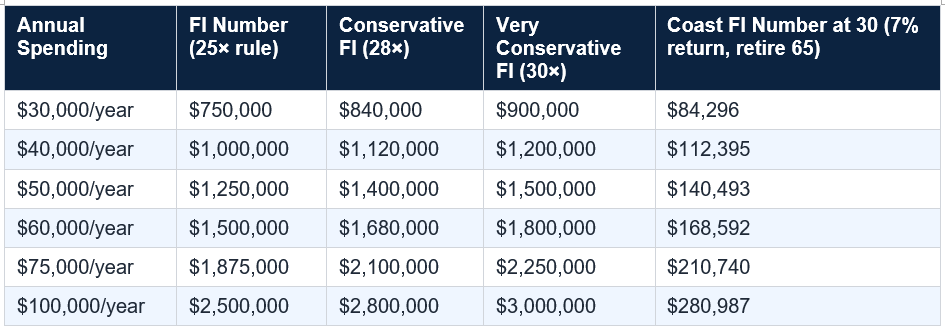
Coast FI numbers in the final column above use the formula: FI number (25×) ÷ (1.07)^35, reflecting a 30-year-old targeting retirement at 65 with a 7% real return. These are illustrative calculations — actual outcomes depend on market returns, spending changes, and individual circumstances.
Example: Maya, 25 years old. Annual spending: $40,000. FI Number: $40,000 × 25 = $1,000,000. Years to retirement: 40. Coast FI Formula: $1,000,000 ÷ (1.07)^40 = $1,000,000 ÷ 14.97 = $66,803. Maya's Coast FI number is approximately $66,803. If she has $66,803 invested today and contributes nothing more, it will grow to approximately $1,000,000 by age 65 at 7% per year. She is 25 years old and needs only $66,803 invested to secure her retirement. If she saves aggressively for the next 3–4 years and hits this number, she can work in any way she chooses for the rest of her career without worrying about retirement contributions.
Example: James, 30 years old. Annual spending: $50,000. FI Number: $50,000 × 25 = $1,250,000. Years to retirement: 35. Coast FI Formula: $1,250,000 ÷ (1.07)^35 = $1,250,000 ÷ 10.68 = $117,009. James's Coast FI number is approximately $117,009. At 30 with $117K invested and no further contributions, James's portfolio grows to $1.25 million by 65. The average Fidelity millennial 401(k) balance is $82,600–$94,300 in mid-2026 — so a millennial in the upper quartile may already be at or near Coast FI, depending on their spending needs.
Example: Sarah, 35 years old. Annual spending: $60,000. FI Number: $60,000 × 25 = $1,500,000. Years to retirement: 30. Coast FI Formula: $1,500,000 ÷ (1.07)^30 = $1,500,000 ÷ 7.61 = $197,108. Sarah's Coast FI number is approximately $197,000. The average Gen X 401(k) balance (ages 35–44 range) is approximately $215,600 — meaning many Gen X savers at the average may already be at Coast FI if their spending is $60,000 or less per year. Sarah needs roughly $197K invested today and nothing more to retire at 65.
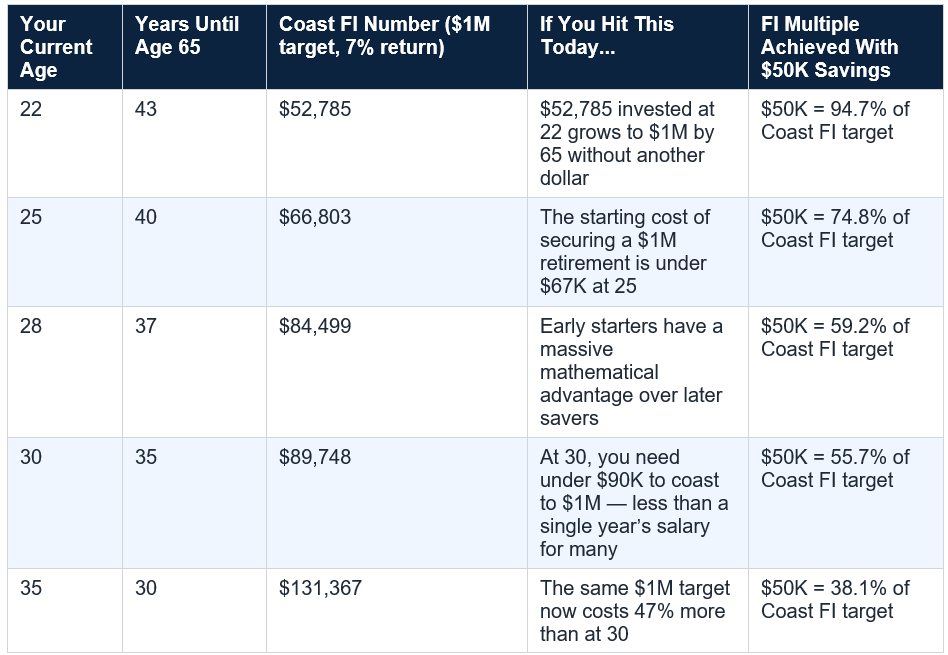
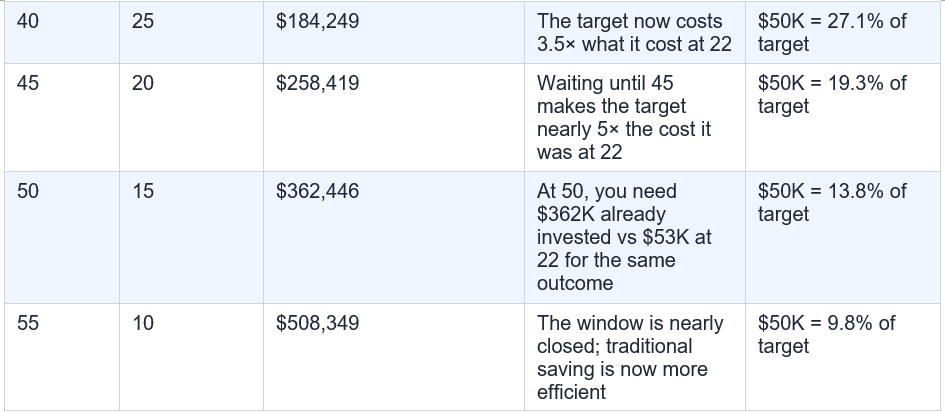
All figures are illustrative using present-value formula: $1,000,000 ÷ (1.07)^(years to 65). Actual outcomes depend on market returns, contribution levels, and individual circumstances. Not financial advice.
Moneywise’s June 2026 feature on Coast FIRE among young investors captures the specific appeal: ‘The FIRE movement’s most intense version requires someone to save or invest the majority of their income, as well as doing things like finding new streams of income or delaying life milestones. The plan is, of course, deeply restrictive and has paved the way for a newer retirement savings plan called Coast FIRE.’
Coast FI is not FIRE for the risk-averse. It is FIRE for people who want to live now and retire comfortably later — without sacrificing either ambition. The specific groups that find it most resonant include:
After hitting Coast FI, the investor has three broad options:
Coast FI is not retirement. It is a release from one specific financial obligation — the pressure to save aggressively for retirement — while all other financial responsibilities remain. The freedom it creates is freedom to choose your work, not freedom from work. That distinction is important: it is also precisely why so many people find it a more achievable and more liveable target than full FIRE.
Average 401(k) balance (Vanguard, end 2025): $167,970 (all-time high, +13% YoY). Median 401(k) balance (Vanguard, end 2025): $44,115 (also all-time high). Fidelity Q1 2026: Gen Z avg $18K–$20.8K; millennial $82.6K–$94.3K; Gen X $215.6K–$240.7K; boomer $260.3K–$283.2K. Total savings rate Q1 2026: 14.4% (all-time high, Fidelity). Only 29% of workers aged 18–24 have any retirement account (Federal Reserve 2025).
This is why Coast FI resonates specifically with Gen Z. A 22-year-old who has been working for two years and has managed to save $50,000 is already 95% of the way to Coast FI for a $1 million retirement target. A few more years of aggressive saving, and they are done. For the rest of their career, they work for choice rather than obligation. The mathematics of early starting is not just a retirement planning principle — in the Coast FI framework, it becomes a freedom strategy.
For Gen Z, who started saving at 22 and want to retire at 61, Coast FI is a genuinely achievable milestone — often reachable in their late 20s or early 30s with disciplined saving for five to eight years. For older millennials who have been contributing consistently to retirement accounts, the Coast FI checkpoint may already have been crossed without them realising it. For Gen X approaching 40 or 45 with meaningful accumulated savings, it is still reachable, though the window for the most dramatic benefit is narrowing.
The most important contribution Coast FI makes to personal finance thinking is not mathematical — it is conceptual. It changes the question from ‘how much more do I need to save?’ to ‘have I saved enough that the rest is already handled?’ For many people, the answer arrives earlier than they expected. And when it does, the nature of every work and life decision changes. That shift — from obligation to choice — is the formula’s real return.
Full FIRE (Financial Independence, Retire Early) means your investment portfolio is large enough to fund your entire life from withdrawals, indefinitely, without needing to work for income at all. Your portfolio equals or exceeds 25 times your annual spending (the 4% rule). Coast FI is an earlier milestone: your portfolio is not yet large enough to fund retirement withdrawals, but it is large enough that compound growth alone will carry it to your full FI number by your target retirement age, without any further contributions. The key distinction: full FIRE allows immediate retirement from all paid work; Coast FI allows you to stop saving for retirement but requires you to continue earning enough for current living expenses.
What is a good Coast FI number?
Your Coast FI number depends on three personal variables: your expected annual spending in retirement (which determines your FI number = spending × 25), your target retirement age, and your assumed investment return. There is no universally 'good' number. The formula is: Coast FI number = FI number ÷ (1 + annual return)^(years until retirement). At 7% real return, a 30-year-old with $50,000 annual spending targeting retirement at 65 needs approximately $117,000 invested today. A 25-year-old with $40,000 annual spending needs approximately $67,000. The number that matters is yours — calculate it using your specific spending and timeline rather than benchmarking against someone else's.
Is 7% a realistic return assumption for Coast FI calculations?
7% is the long-run real (inflation-adjusted) historical return of the S&P 500 from 1926 through 2025, and it is the standard assumption in most Coast FI calculators. However, it is a historical average across a period that included extremely high returns alongside severe recessions. Critics note that if the market delivers only 2–3% real returns in the first decade after you stop contributing, your portfolio may significantly underperform the Coast FI projection, because there are no fresh contributions to dollar-cost-average through the downturn (Moneywise, June 2026). Many financial planners recommend also modelling at 5% or even 3% real return to understand your downside scenario before deciding to stop contributions. If you still comfortably coast at 5%, the strategy is more robust.
Can I reach Coast FI with an average income?
Yes, particularly if you start early. The mathematical reality is that time, not income, is the dominant variable in Coast FI. A 22-year-old who earns $55,000 per year and saves aggressively (contributing the maximum to a Roth IRA at $7,500 and 10% of salary to a 401(k)) can accumulate $50,000–$70,000 within 3–5 years, which may be close to or at Coast FI for a $1 million retirement target at 65. Average income is sufficient if the saving starts early enough. The challenge is that only 29% of US workers aged 18–24 currently have any retirement account at all (Federal Reserve Economic Well-Being 2025), which means the most powerful years of compound growth are lost before the savings habit is even established.
What happens if I hit Coast FI at 30 and the market crashes?
This is the central risk scenario for Coast FI practitioners. If a significant market decline occurs shortly after you stop contributing, the compounding base is reduced and cannot be rebuilt without either resuming contributions or extending your planned retirement date. The most robust response to this scenario is: (1) model your Coast FI number at a conservative return rate (5% rather than 7%) before deciding to stop contributions; (2) maintain a cash buffer of six to twelve months of expenses so that you do not need to sell investments during a downturn; and (3) be prepared to resume contributions for a year or two if a sustained market decline materially reduces your projected retirement balance. Coast FI is not irreversible — it is a milestone that can be revisited if circumstances change significantly.
Should I contribute to Roth or traditional accounts for Coast FI?
For most young savers pursuing Coast FI, Roth accounts (Roth IRA and Roth 401(k)) have significant advantages: withdrawals in retirement are tax-free, there are no required minimum distributions (Roth IRA), and the tax-free growth is permanent. This aligns with the Coast FI strategy of investing now and letting compounding work for decades. Fidelity's Q1 2026 data shows that 21.4% of Gen Z participants already contribute to a Roth 401(k), and Gen Z and millennial Roth IRA adoption is at record highs. Traditional 401(k) contributions are still valuable for capturing employer matches and for high earners who benefit significantly from the current-year deduction. The standard guidance: capture the full employer match in the traditional 401(k) first, then max the Roth IRA ($7,500 in 2026), then return to the traditional 401(k) or Roth 401(k) for additional contributions. Consult a tax adviser for personalised guidance.
Table of Contents
- The Retirement Formula Going Viral With Young Savers
- What Is Coast FI? The Core Concept in Plain English
- The Formula: How to Calculate Your Coast FI Number
- The Four-Rule and the FIRE Number: The Starting Point
- Three Worked Examples: Coast FI at Age 25, 30, and 35
- The Coast FI Number by Age: A Quick Reference Table
- Why Young People Are Obsessed With Coast FI
- What Happens After You Hit Coast FI?
- The Variants: Barista FIRE, Lean FIRE, and How Coast FI Fits In
- The Real State of Young Americans’ Retirement Savings in 2026
- The Power of Starting Early: The Number That Changes Everything
- The Risks and Limitations of Coast FI
- Is Coast FI Right for You? A Self-Assessment
- Conclusion: The Formula That Changes How You Think About Work
- Frequently Asked Questions
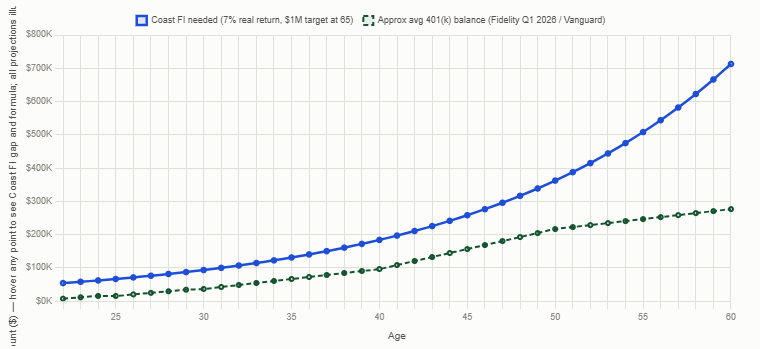
Coast FI Number By Age vs Actual (401)k Balance
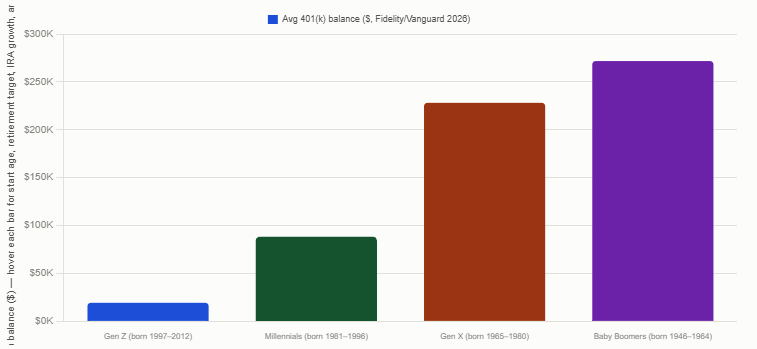
Gen Z Retirement Savings Surge: The Generational Comparison
The Retirement Formula Going Viral With Young Savers
Something is changing in how young Americans think about retirement. According to Northwestern Mutual’s 2026 Planning & Progress Study, Gen Z started saving for retirement at an average age of 22 — compared with 28 for millennials and 32 for Gen X. Their ambition is equally striking: they want to retire by 61, three years earlier than millennials and six years earlier than Gen X. Fidelity’s Q1 2026 retirement data shows that Gen Z’s IRA contributions grew 65% year-over-year — the highest growth rate of any generation. More than one in five Gen Z participants contributed to a Roth 401(k) in Q1 2026.The concept driving much of this energy is one that most financial advisers and mainstream personal finance sources have only recently begun to cover: Coast FI, also written as Coast FIRE (though the ‘retire early’ framing is technically a misnomer, as we will explain). It has spread rapidly through personal finance communities, Reddit threads, and financial TikTok precisely because its core logic is both elegant and motivating: save aggressively until you hit a specific number, then stop. From that point on, compound interest does the rest. You can work less, earn less, choose more, and your retirement is still funded.
This guide explains exactly how Coast FI works, the formula and how to use it, worked examples at three different ages, the current state of young Americans’ retirement savings relative to the target, the real risks in the strategy, and whether it is right for you.
Gen Z avg retirement savings start age: 22 (vs 28 millennials, 32 Gen X). Gen Z target retirement age: 61 (vs 64 millennials, 67 Gen X). Gen Z IRA contributions: +65% year-over-year Q1 2026 (Fidelity). 21.4% of Gen Z participants contribute to Roth 401(k). Total savings rate: 14.4% in Q1 2026 — all-time high (Fidelity). Northwestern Mutual 2026 Planning & Progress Study.
What Is Coast FI? The Core Concept in Plain English
Coast FI (or Coast FIRE) is a financial independence milestone defined by a single condition: you have already saved enough in your investment accounts that, even if you never contribute another dollar, compound growth alone will carry your portfolio to your full Financial Independence (FI) number by your target retirement age.The name describes what happens after you reach the milestone. You are ‘coasting’ — still working, still earning, still covering your living expenses from income — but no longer needing to save aggressively for retirement because the maths is already locked in. The heavy lifting has been done. Compound interest is doing the rest.
ChooseFI.com, one of the longest-running and most comprehensive resources on the FIRE movement (with over 750 podcast episodes), describes Coast FI this way: ‘It’s not about retiring tomorrow — it’s about reaching the point where you’ve already done the heavy lifting, and compound growth handles the rest.’ Nick Wolny’s August 2026 comprehensive explainer for a large personal finance audience adds precision: ‘Coast FIRE means you’ve already invested enough that compounding alone will grow your portfolio to full financial independence by traditional retirement age, without contributing another dollar.’
The significance of this milestone is what it enables — not what it is. Once you hit Coast FI, you have options that were not available before:
- Switch to a lower-paying but more meaningful career without derailing your retirement.
- Reduce to part-time work and spend more time with family, on creative projects, or on travel.
- Take an extended sabbatical, move abroad, or start a business without the financial consequences of stopping retirement contributions.
- Remove the psychological pressure of needing to maximise every investment decision, because the fundamental outcome is already secured.
The Formula: How to Calculate Your Coast FI Number
The Coast FI calculation is a present-value formula applied to your retirement target. It answers the question: how much do I need invested right now for it to grow to my full FI number by retirement, without any additional contributions?The formula:
Breaking down the variables:
- FI Number (the retirement target): the total investment portfolio you need to fund retirement indefinitely using a 4% annual withdrawal rate. Calculated as: annual spending × 25. If you spend $50,000 per year, your FI number is $1,250,000. If you spend $40,000, it is $1,000,000.
- Annual return: the expected long-run real rate of return on your investments. The standard assumption is 7%, reflecting the long-run inflation-adjusted return of the S&P 500 from 1926 through 2025 (8Figures.com, July 2026). Some sources use a more conservative 5% real return to account for sequence-of-returns risk and uncertainty.
- Years until retirement: the number of years between now and your target retirement age. If you are 30 and want to retire at 65, this is 35.
The Four-Rule and the FIRE Number: The Starting Point
The FIRE number — the destination that Coast FI is working backward from — is derived from the 4% rule, one of the most well-established principles in retirement finance. The 4% rule emerged from the Trinity Study, a 1998 analysis of historical market data, and suggests that a retiree can safely withdraw 4% of their portfolio annually (adjusted for inflation each year) with a high probability of the portfolio lasting 30 years.The 4% rule has two practical implications:
- Your FI number is 25 times your annual spending (annual spending ÷ 0.04 = 25 × annual spending).
- Once your portfolio equals 25 times your annual spending, you can theoretically stop working and live on portfolio withdrawals indefinitely.
Coast FI numbers in the final column above use the formula: FI number (25×) ÷ (1.07)^35, reflecting a 30-year-old targeting retirement at 65 with a 7% real return. These are illustrative calculations — actual outcomes depend on market returns, spending changes, and individual circumstances.
Three Worked Examples: Coast FI at Age 25, 30, and 35
The following three examples illustrate how the formula works in practice across different starting ages and spending levels. All use a 7% real annual return and target retirement at 65. These are illustrative projections only — not personalised financial advice.Example: Maya, 25 years old. Annual spending: $40,000. FI Number: $40,000 × 25 = $1,000,000. Years to retirement: 40. Coast FI Formula: $1,000,000 ÷ (1.07)^40 = $1,000,000 ÷ 14.97 = $66,803. Maya's Coast FI number is approximately $66,803. If she has $66,803 invested today and contributes nothing more, it will grow to approximately $1,000,000 by age 65 at 7% per year. She is 25 years old and needs only $66,803 invested to secure her retirement. If she saves aggressively for the next 3–4 years and hits this number, she can work in any way she chooses for the rest of her career without worrying about retirement contributions.
Example: James, 30 years old. Annual spending: $50,000. FI Number: $50,000 × 25 = $1,250,000. Years to retirement: 35. Coast FI Formula: $1,250,000 ÷ (1.07)^35 = $1,250,000 ÷ 10.68 = $117,009. James's Coast FI number is approximately $117,009. At 30 with $117K invested and no further contributions, James's portfolio grows to $1.25 million by 65. The average Fidelity millennial 401(k) balance is $82,600–$94,300 in mid-2026 — so a millennial in the upper quartile may already be at or near Coast FI, depending on their spending needs.
Example: Sarah, 35 years old. Annual spending: $60,000. FI Number: $60,000 × 25 = $1,500,000. Years to retirement: 30. Coast FI Formula: $1,500,000 ÷ (1.07)^30 = $1,500,000 ÷ 7.61 = $197,108. Sarah's Coast FI number is approximately $197,000. The average Gen X 401(k) balance (ages 35–44 range) is approximately $215,600 — meaning many Gen X savers at the average may already be at Coast FI if their spending is $60,000 or less per year. Sarah needs roughly $197K invested today and nothing more to retire at 65.
The Coast FI Number by Age: A Quick Reference Table
The following table shows Coast FI numbers for different ages, targeting a $1,000,000 retirement portfolio at age 65, using a 7% real annual return. Adjust proportionally for different FI targets (e.g. if your FI number is $1,500,000, multiply by 1.5).All figures are illustrative using present-value formula: $1,000,000 ÷ (1.07)^(years to 65). Actual outcomes depend on market returns, contribution levels, and individual circumstances. Not financial advice.
Why Young People Are Obsessed With Coast FI
The appeal of Coast FI to Gen Z and younger millennials is easy to understand when you look at the numbers from Northwestern Mutual’s 2026 Planning & Progress Study: they are starting earlier, setting more ambitious targets, and already experiencing the tension between aggressive saving and the desire to live a full life before traditional retirement age. Coast FI resolves that tension with a mathematical answer: save to X, and then you are free.Moneywise’s June 2026 feature on Coast FIRE among young investors captures the specific appeal: ‘The FIRE movement’s most intense version requires someone to save or invest the majority of their income, as well as doing things like finding new streams of income or delaying life milestones. The plan is, of course, deeply restrictive and has paved the way for a newer retirement savings plan called Coast FIRE.’
Coast FI is not FIRE for the risk-averse. It is FIRE for people who want to live now and retire comfortably later — without sacrificing either ambition. The specific groups that find it most resonant include:
- High earners in demanding careers who want permission to downshift without financial guilt. They can hit a Coast FI number in their late 20s or early 30s while earning a high salary, then take a lower-stress, lower-paying role.
- Parents with young children who want to reduce working hours during the years their children are young, without derailing retirement.
- Career changers who want to move into lower-paying but more meaningful work — teaching, creative fields, non-profit, entrepreneurship — without the fear that the income reduction will cost them their retirement.
- Freelancers and gig workers who experience income volatility and want a baseline level of retirement security before accepting the uncertainty of irregular earnings.
What Happens After You Hit Coast FI?
This is the question that the Coast FI concept’s name answers literally: you coast. But the practical implications require more specificity.After hitting Coast FI, the investor has three broad options:
- Continue working and saving (traditional path): contributions after Coast FI reduce the time to full FI or increase the eventual portfolio size. Every dollar contributed after Coast FI is pure acceleration on an already-secure baseline.
- Stop retirement contributions and maintain spending from income (the coast): work for current income only, without any further retirement saving. The investment portfolio compounds undisturbed. This is the defining Coast FI move: it does not mean stopping work or becoming financially independent immediately; it means having the option to work in whatever way works for you, without retirement savings pressure.
- Transition to a different work structure: reduce hours, change careers, take a sabbatical, start a business. The retirement security is locked in; all current career decisions can be made on other criteria.
Coast FI is not retirement. It is a release from one specific financial obligation — the pressure to save aggressively for retirement — while all other financial responsibilities remain. The freedom it creates is freedom to choose your work, not freedom from work. That distinction is important: it is also precisely why so many people find it a more achievable and more liveable target than full FIRE.
The Variants: Barista FIRE, Lean FIRE, and How Coast FI Fits In
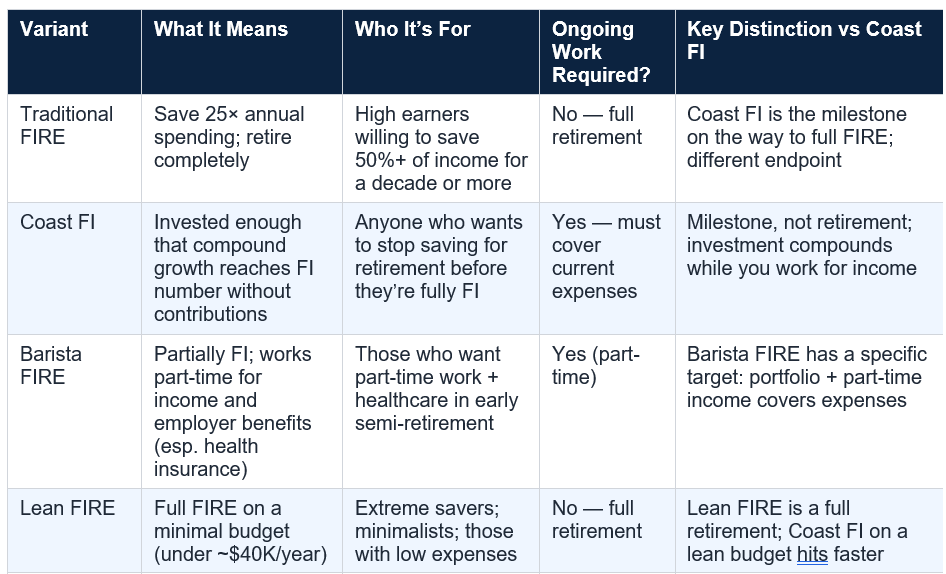
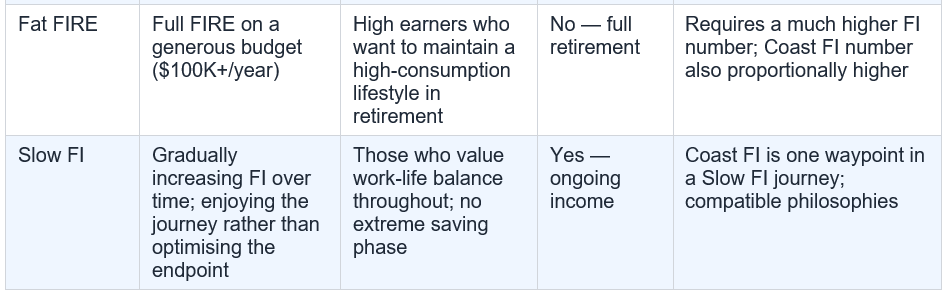
Coast FI sits within a broader ecosystem of FIRE variants that have emerged as people adapted the core FIRE concept to different life situations and preferences. Understanding the landscape helps clarify what Coast FI uniquely offers:
The Real State of Young Americans’ Retirement Savings in 2026
Against the Coast FI framework, the current state of young Americans’ retirement savings produces a clarifying picture. Using Fidelity’s Q1 2026 and Vanguard’s How America Saves 2026 data alongside the Coast FI formula for a $1.25 million target at age 65 (7% real return):- Gen Z (average 401(k): $18,000–$20,800): at 22–25, the Coast FI number is approximately $53,000–$67,000. The average Gen Z balance is approximately 30–40% of the Coast FI target. Encouraging: they are not far off. Discouraging: only 29% of workers aged 18–24 have any retirement account at all (Federal Reserve Economic Well-Being 2025).
- Millennials (average 401(k): $82,600–$94,300): at 29–44, the Coast FI target range is approximately $90,000–$200,000+. The average millennial is near the Coast FI threshold for a $1 million target at moderate spending, and may be there already for $40,000/year spending.
- Gen X (average 401(k): $215,600–$240,700): at 44–59, the Coast FI target for a $1.25 million goal at 65 ranges from approximately $190,000 to $600,000+. Many Gen X savers at average balances are at or past Coast FI for moderate spending levels.
Average 401(k) balance (Vanguard, end 2025): $167,970 (all-time high, +13% YoY). Median 401(k) balance (Vanguard, end 2025): $44,115 (also all-time high). Fidelity Q1 2026: Gen Z avg $18K–$20.8K; millennial $82.6K–$94.3K; Gen X $215.6K–$240.7K; boomer $260.3K–$283.2K. Total savings rate Q1 2026: 14.4% (all-time high, Fidelity). Only 29% of workers aged 18–24 have any retirement account (Federal Reserve 2025).
The Power of Starting Early: The Number That Changes Everything
The Coast FI framework makes vivid what is often stated abstractly in retirement planning: starting early is not just better, it is transformationally better. The numbers from the quick reference table in Section 6 make the mathematical reality impossible to avoid:- At 22, reaching a $1 million retirement goal requires $52,785 invested today.
- At 30, the same goal requires $89,748 — 70% more.
- At 40, it requires $184,249 — 3.5× more than at 22.
- At 50, it requires $362,446 — 6.9× more than at 22.
This is why Coast FI resonates specifically with Gen Z. A 22-year-old who has been working for two years and has managed to save $50,000 is already 95% of the way to Coast FI for a $1 million retirement target. A few more years of aggressive saving, and they are done. For the rest of their career, they work for choice rather than obligation. The mathematics of early starting is not just a retirement planning principle — in the Coast FI framework, it becomes a freedom strategy.
The Risks and Limitations of Coast FI
The Coast FI concept is compelling. Its risks are real and deserve explicit attention before any decision to stop retirement contributions is made.- Sequence-of-returns risk: the biggest structural vulnerability in Coast FI is what happens if the market delivers poor returns in the first decade after you stop contributing. Moneywise (June 2026) describes it precisely: ‘A Coast FIRE number that pencils out to $1 million at 65 with a 5% real return drops to closer to $700,000 if the decade right after you stop contributing delivers only 2% real return instead of 5%, because the compounding base never recovers, because there are no fresh contributions to dollar-cost-average through the dip.’ Without ongoing contributions, there is no mechanism for buying additional units at depressed prices during a downturn. The portfolio is entirely dependent on recovery.
- Inflation underestimation: the 7% real return used in most Coast FI calculators is already inflation-adjusted. But inflation affects not just returns but spending. A $50,000 annual expense today may be $80,000 or $100,000 at retirement age in real terms if personal inflation (healthcare, housing) runs above general CPI. Moneywise flags inflation as the most overlooked future expense in Coast FI planning.
- Underestimating future expenses: Coast FI calculations use current spending as the basis for the FI number. Major future expenses — healthcare in retirement (which can be substantial in the US outside of Medicare), caregiving responsibilities, housing changes, children’s education costs — are often not incorporated into the calculation at the time it is made.
- Loss of employer match: if stopping retirement contributions means forfeiting an employer 401(k) match, the effective return on those lost contributions is immediately 50% to 100% (the match rate). Forfeiting the match to ‘coast’ is almost never mathematically justified.
- Social Security uncertainty: the 2026 Social Security Trustees Report projects that the OASI trust fund will be depleted by 2032, at which point approximately 78% of scheduled benefits would be payable (Richify.ai, citing the Trustees Report released 9 June 2026). Retirement plans built on full Social Security benefits should incorporate this uncertainty.
Is Coast FI Right for You? A Self-Assessment
Coast FI is not the right strategy for everyone, and reaching the mathematical milestone does not automatically make it the right decision. Before stopping or reducing retirement contributions, work through the following questions:- Have I accounted for all future major expenses in my FI number? Healthcare, potential caregiving, housing changes, and family costs should be explicitly modelled, not assumed away.
- Have I captured the full employer 401(k) match? If your employer matches contributions up to 6% of salary, and you stop contributing at 6%, stopping contributions below the match threshold is an immediate financial mistake. Coast FI should never mean forfeiting free money.
- What is my downside scenario? Model your Coast FI number growing at 4% and 3% real return as well as 7%. If a realistic bad-case scenario leaves you significantly short of your FI number at retirement age, coasting now is premature.
- Do I have adequate current income to cover expenses without retirement savings? Coast FI requires covering current living costs from income. If reducing retirement contributions creates budget pressure that leads to consumer debt, the strategy is counterproductive.
- Have I considered tax diversification? Stopping contributions to a traditional 401(k) eliminates the current-year tax deduction. For high earners, this deduction has significant value. Roth contributions (after-tax) may be a better vehicle for ‘coasting’ — continuing smaller contributions that do not reduce current-year take-home pay by as much.
- Am I in a geographic and financial context where the formula applies? Coast FI calculators assume US retirement timelines and return expectations. Currency, healthcare system, and pension differences mean the formula needs adjustment for non-US residents.
Conclusion
Coast FI is not a loophole. It is not a shortcut. It is a precise mathematical description of a real phenomenon: the point at which compound interest becomes a more powerful retirement savings engine than additional contributions, because the time horizon is long enough for exponential growth to dominate.For Gen Z, who started saving at 22 and want to retire at 61, Coast FI is a genuinely achievable milestone — often reachable in their late 20s or early 30s with disciplined saving for five to eight years. For older millennials who have been contributing consistently to retirement accounts, the Coast FI checkpoint may already have been crossed without them realising it. For Gen X approaching 40 or 45 with meaningful accumulated savings, it is still reachable, though the window for the most dramatic benefit is narrowing.
The most important contribution Coast FI makes to personal finance thinking is not mathematical — it is conceptual. It changes the question from ‘how much more do I need to save?’ to ‘have I saved enough that the rest is already handled?’ For many people, the answer arrives earlier than they expected. And when it does, the nature of every work and life decision changes. That shift — from obligation to choice — is the formula’s real return.
Frequently Asked Questions
What is the difference between Coast FI and full FIRE?Full FIRE (Financial Independence, Retire Early) means your investment portfolio is large enough to fund your entire life from withdrawals, indefinitely, without needing to work for income at all. Your portfolio equals or exceeds 25 times your annual spending (the 4% rule). Coast FI is an earlier milestone: your portfolio is not yet large enough to fund retirement withdrawals, but it is large enough that compound growth alone will carry it to your full FI number by your target retirement age, without any further contributions. The key distinction: full FIRE allows immediate retirement from all paid work; Coast FI allows you to stop saving for retirement but requires you to continue earning enough for current living expenses.
What is a good Coast FI number?
Your Coast FI number depends on three personal variables: your expected annual spending in retirement (which determines your FI number = spending × 25), your target retirement age, and your assumed investment return. There is no universally 'good' number. The formula is: Coast FI number = FI number ÷ (1 + annual return)^(years until retirement). At 7% real return, a 30-year-old with $50,000 annual spending targeting retirement at 65 needs approximately $117,000 invested today. A 25-year-old with $40,000 annual spending needs approximately $67,000. The number that matters is yours — calculate it using your specific spending and timeline rather than benchmarking against someone else's.
Is 7% a realistic return assumption for Coast FI calculations?
7% is the long-run real (inflation-adjusted) historical return of the S&P 500 from 1926 through 2025, and it is the standard assumption in most Coast FI calculators. However, it is a historical average across a period that included extremely high returns alongside severe recessions. Critics note that if the market delivers only 2–3% real returns in the first decade after you stop contributing, your portfolio may significantly underperform the Coast FI projection, because there are no fresh contributions to dollar-cost-average through the downturn (Moneywise, June 2026). Many financial planners recommend also modelling at 5% or even 3% real return to understand your downside scenario before deciding to stop contributions. If you still comfortably coast at 5%, the strategy is more robust.
Can I reach Coast FI with an average income?
Yes, particularly if you start early. The mathematical reality is that time, not income, is the dominant variable in Coast FI. A 22-year-old who earns $55,000 per year and saves aggressively (contributing the maximum to a Roth IRA at $7,500 and 10% of salary to a 401(k)) can accumulate $50,000–$70,000 within 3–5 years, which may be close to or at Coast FI for a $1 million retirement target at 65. Average income is sufficient if the saving starts early enough. The challenge is that only 29% of US workers aged 18–24 currently have any retirement account at all (Federal Reserve Economic Well-Being 2025), which means the most powerful years of compound growth are lost before the savings habit is even established.
What happens if I hit Coast FI at 30 and the market crashes?
This is the central risk scenario for Coast FI practitioners. If a significant market decline occurs shortly after you stop contributing, the compounding base is reduced and cannot be rebuilt without either resuming contributions or extending your planned retirement date. The most robust response to this scenario is: (1) model your Coast FI number at a conservative return rate (5% rather than 7%) before deciding to stop contributions; (2) maintain a cash buffer of six to twelve months of expenses so that you do not need to sell investments during a downturn; and (3) be prepared to resume contributions for a year or two if a sustained market decline materially reduces your projected retirement balance. Coast FI is not irreversible — it is a milestone that can be revisited if circumstances change significantly.
Should I contribute to Roth or traditional accounts for Coast FI?
For most young savers pursuing Coast FI, Roth accounts (Roth IRA and Roth 401(k)) have significant advantages: withdrawals in retirement are tax-free, there are no required minimum distributions (Roth IRA), and the tax-free growth is permanent. This aligns with the Coast FI strategy of investing now and letting compounding work for decades. Fidelity's Q1 2026 data shows that 21.4% of Gen Z participants already contribute to a Roth 401(k), and Gen Z and millennial Roth IRA adoption is at record highs. Traditional 401(k) contributions are still valuable for capturing employer matches and for high earners who benefit significantly from the current-year deduction. The standard guidance: capture the full employer match in the traditional 401(k) first, then max the Roth IRA ($7,500 in 2026), then return to the traditional 401(k) or Roth 401(k) for additional contributions. Consult a tax adviser for personalised guidance.
0 Comments
Be the first to share your thoughts on this article.