

Common Mistakes New Options Traders Make

Table of Contents
- Why Most Options Traders Lose Money
- The Data Behind the Losses: What the Research Shows
- Mistake #1: Buying Far Out-of-the-Money Options as Lottery Tickets
- Mistake #2: Ignoring Theta — Letting Time Work Against You
- Mistake #3: Trading Into Earnings Without Understanding IV Crush
- Mistake #4: No Exit Strategy Before Entering the Trade
- Mistake #5: Catastrophic Position Sizing
- Mistake #6: Confusing Win Rate With Profitability
- Mistake #7: Trading Too Many Tickers Too Thin
- Mistake #8: Ignoring Liquidity — Wide Spreads as a Hidden Tax
- Mistake #9: Never Using Paper Trading to Test Strategies
- Mistake #10: Letting Emotions Override the Trading Plan
- The Mistakes at a Glance: Reference Table
- Conclusion: The Math Works Against the Undisciplined
- Frequently Asked Questions
- External References and Further Reading
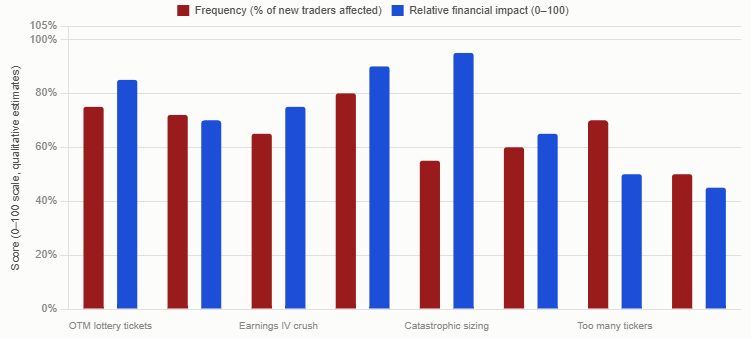
Mistake Frequency & Imapct
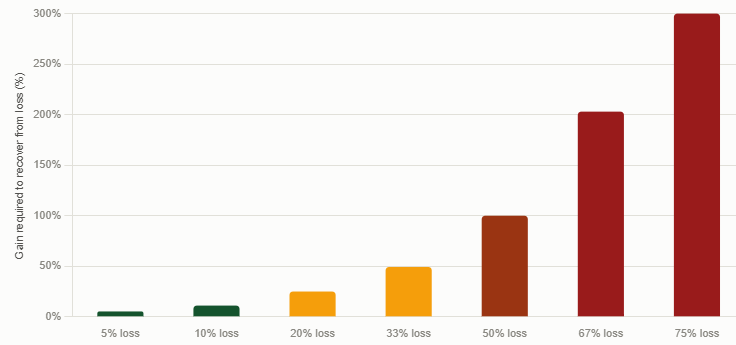
Loss Recovery Math
Why Most Options Traders Lose Money
Options trading has never been more accessible. Retail participation in options markets is at an all-time high, with total options volume exceeding records set in 2021 according to CBOE 2024 market statistics. Commission-free platforms, social media trading communities, and an explosion of educational content have made it possible to place your first options trade within hours of deciding to try. None of this has improved outcomes for new traders. It has, if anything, accelerated the rate at which new traders make expensive, well-documented, entirely avoidable mistakes.
The statistics are stark. Approximately 85 to 90 percent of options traders lose money, according to Lambda Finance’s April 2026 report, which compiled data from MIT Sloan research, London Business School studies, Fidelity, Charles Schwab, and CBOE market statistics. The average retail options trader loses 67 percent of initial capital within the first year. A 2025 FINRA study found that seven specific mistakes account for 89 percent of retail options trading losses.
These are not random outcomes. They are the predictable results of predictable errors — errors that are well-documented, widely studied, and entirely learnable from in advance. This guide identifies the ten most costly and most common mistakes that new options traders make, with the specific data behind each one and the exact correction that separates traders who survive from those whose accounts do not.
The Data: 85–90% of options traders lose money (Lambda Finance, April 2026). Average retail trader loses 67% of initial capital in year one. 2025 FINRA study: 7 mistakes account for 89% of retail options losses (LedgerMind, March 2026). CBOE: options volume at all-time high in 2024.
The Data Behind the Losses: What the Research Shows
OptionScout AI’s July 2026 retail options trader report draws on multiple datasets to identify the patterns that account for most retail losses. The report’s framing is the most important starting point for any new options trader: these are not opinions. They are patterns visible across multiple datasets and confirmed by academic research. The five recurring mistakes the report identifies account for the majority of retail options losses — and they are the same mistakes that Fidelity, Charles Schwab, Ally Invest, and Interactive Brokers have been documenting in their educational materials for years.
What makes options uniquely dangerous for new traders is not leverage per se — it is the combination of leverage with the time-value decay that is built into every options contract. A trader who is wrong about a stock loses money proportional to how wrong they were. A trader who is wrong about an option can lose 100 percent of their investment even when they are partially right about the direction of the move, if the timing is wrong or the volatility environment shifts. This is the fundamental misunderstanding that explains most first-year options losses.
OptionScout AI (July 2026): These are not opinions — they are patterns visible across multiple datasets and confirmed by academic research. The data points to five recurring mistakes that account for the majority of retail options losses.
Mistake #1: Buying Far Out-of-the-Money Options as Lottery Tickets
The most common single error among new options traders, documented by the widest range of sources, is the purchase of far out-of-the-money (OTM) options with very low deltas as speculative bets on large, sudden price movements. The appeal is obvious: a contract that costs $0.15 and could theoretically become $5.00 represents a 3,233 percent return. The problem is that the probability of this outcome is vanishingly small, and the options market prices that probability in.
The Data: OCC data: options with deltas below 0.10 expire worthless more than 90% of the time (OptionScout AI, July 2026). 0–7 DTE options have an 82% loss rate for buyers (OCC analysis, LedgerMind, March 2026). 43% of all retail options volume is in 0–7 DTE options despite this dramatically elevated loss rate (OCC).
The options market is not inefficient in the way many new traders assume. The low price of a far-OTM option reflects a low probability of profit, not an overlooked opportunity. LedgerMind’s March 2026 guide is blunt: lottery-ticket buyers are mathematically donating premium to market makers. The expected value of buying low-delta OTM options as a primary strategy is deeply negative over any meaningful sample size.
The misunderstanding that drives this behaviour is the conflation of cheap price with good value. A $0.15 option is not cheap. It is cheap relative to the contract size, but it is priced at approximately fair value given the probability distribution of the underlying asset’s movement. What looks like a lottery ticket actually has the expected value of a lottery ticket.
The Fix: Focus on options with deltas of 0.30 to 0.70 (closer to at-the-money) if buying options. These contracts have a higher probability of profit, benefit more from directional moves, and provide a more honest test of whether your market thesis is correct. If you want to use OTM options for leverage, understand that you are making a very high-probability bet that you will lose the entire premium paid.
Mistake #2: Ignoring Theta — Letting Time Work Against You
Theta is the rate at which an option loses value simply through the passage of time, assuming all other factors remain constant. Every day that passes, a long options position loses some of its time value, and this erosion accelerates as the option approaches expiration. New traders who understand this fact intellectually frequently fail to understand it in practice when managing their positions.
LedgerMind’s March 2026 guide documents the specific pattern: buying options that expire in less than 30 days without understanding that theta decay accelerates dramatically in the final two weeks. The final 7 days before expiration are particularly brutal: time value evaporates rapidly, requiring immediate and significant price movement simply for the position to avoid a large loss. OCC data cited by LedgerMind shows that options expiring in 7 days or less represented 43 percent of all retail options volume — meaning the average new trader is systematically trading in the highest-theta zone.
The Math: Theta decay illustration: buy a call option with 30 DTE (days to expiration) at $1.00. At 15 DTE, if the stock has not moved, the option might be worth $0.60 (losing 40%). At 7 DTE, it might be worth $0.30. At 1 DTE, it could be worth $0.05. The loss is not from the stock moving against you — it is from time passing. Time works for option sellers and against option buyers, always.
The Fix: If you buy options, give your thesis time to work: choose expiration dates at least 45 to 60 days out (DTE), which gives the underlying asset time to make the move you anticipate and reduces the daily theta drag. Avoid holding long options into the final two weeks of expiration unless the position is already profitable and you are managing it actively.
Mistake #3: Trading Into Earnings Without Understanding IV Crush
Implied volatility (IV) is the market’s forward-looking estimate of how much an underlying asset will move. It is embedded in the price of every option contract and rises before binary events (earnings announcements, FDA approvals, economic data releases) as the market anticipates a large move. After the binary event resolves, implied volatility collapses dramatically — a phenomenon known as IV crush — and options bought before the event lose significant value even when the trader correctly predicted the direction of the move.
The Data: A 2025 study of retail earnings plays: long option positions held through earnings lost money 58% of the time, even when the trader correctly predicted the direction of the move (OptionScout AI, July 2026). Example from LedgerMind: Tesla Q4 2025 earnings — implied volatility spiked to 95th percentile pre-announcement. Tesla moved 8%, but straddles lost money as IV collapsed 40% post-earnings.
The Tesla example from LedgerMind’s March 2026 guide is illustrative and instructive. Many new traders buy options before earnings announcements because they have a high-conviction view on whether a company will beat or miss expectations. They are often right about the direction. They still lose money because the option they bought was priced to reflect a large expected move — and if the actual move is smaller than what the option priced in, the decline in implied volatility destroys the option’s value.
The Fix: Before trading options through any binary event, check the IV Rank or IV Percentile of the underlying (most brokers display this in the options chain). IV Percentile above 70% means premiums are expensive (favour selling strategies). IV Percentile below 30% means premiums are relatively cheap (favour buying strategies). Never buy options when IV is at elevated levels without explicitly pricing in the IV crush that will follow.
Mistake #4: No Exit Strategy Before Entering the Trade
Entering an options trade without a predefined exit strategy — both for profit-taking and loss-cutting — is one of the most consistently documented causes of avoidable loss. EBC Financial Group’s June 2025 guide, Ally Invest’s options education materials, Charles Schwab’s pitfalls guide, and the LedgerMind 2026 report all cite this as a primary contributor to retail losses. The reason is behavioural: without a plan, position management defaults to emotion, and emotional decision-making in options trading is reliably expensive.
The specific pattern that plays out: a new trader buys a call option and watches it appreciate. Rather than taking profit at a predetermined level, they hold for more. The position reverses. Now they are holding a losing position and face a choice between taking a manageable loss and hoping for a recovery that may not come before expiration. Most new traders hold. Most of those holding positions lose their entire premium.
Best Stock Strategy’s July 2026 guide on closing losing positions early makes the mathematical case explicit:
The Math: Loss recovery math: A 5% loss requires a 5.3% gain to recover. A 20% loss requires a 25% gain. A 50% loss requires a 100% gain. A 75% loss requires a 300% gain. The deeper the drawdown, the harder — and often the longer — the recovery. Closing losses at 20–25% is significantly less catastrophic than closing at 50 or 75%.
The Fix: Write your exit rules before entering any position: (1) if the option gains X%, I take profit; (2) if the option loses Y%, I close the trade. Many experienced options traders use 50% profit targets and 100% stop-losses (meaning they close when the option doubles or loses all its value). The specific percentages matter less than having them defined before the emotion of a live position affects your judgment.
Mistake #5: Catastrophic Position Sizing
Options leverage creates a temptation that destroys many new traders’ accounts: because each contract controls 100 shares and costs a fraction of that notional value, it is easy to put a large percentage of a trading account into a single options position. LedgerMind’s March 2026 data point is alarming: new traders regularly use 50 to 80 percent of their account on a single options trade because the potential return looks compelling.
Fidelity’s options education guide identifies the root cause: most position sizing errors stem from two common emotions, fear or greed. The greed version produces positions that are too large for the account; the fear version produces positions so small they cannot generate a material return. The correct approach is neither.
The standard risk management framework for options trading, cited across Fidelity, Charles Schwab, and multiple institutional education sources, is to risk no more than 1 to 5 percent of total trading capital on any single position. TradingView’s educational framework suggests a maximum of 1 to 2 percent per trade. At 2 percent risk per trade, a trader can lose 10 consecutive trades and still retain 80 percent of their account, which is recoverable. At 50 percent risk per trade, a single losing position is catastrophic.
The Fix: Apply a maximum position size rule before every trade: no single options position should represent more than 2 to 5 percent of your total trading account. For new traders, start at the lower end of this range (1 to 2 percent). Define ‘total account’ as the full capital allocated to options trading, not just what is in the options account. This rule is not negotiable regardless of how high-conviction the trade feels.
Mistake #6: Confusing Win Rate With Profitability
Win rate — the percentage of trades that are profitable — is the metric most new traders optimise for, and it is one of the least meaningful metrics in options trading. OptionScout AI’s July 2026 report describes this as potentially the most insidious error because it feels counterintuitive: a strategy that wins 70 percent of the time but loses three dollars for every dollar gained will bleed money consistently over time.
The math is simple. A 70 percent win rate with a 3:1 loss-to-gain ratio means: 70 winning trades at $1.00 each = $70 in gains; 30 losing trades at $3.00 each = $90 in losses. Net result: a $20 loss despite winning 70 percent of trades. This is not a hypothetical. It is the structural problem with many new traders’ strategies: they take profits too quickly on winners (keeping the average gain small) and hold losers too long (allowing the average loss to grow large).
The Math: The win rate illusion: 70% win rate with 3:1 loss-to-gain ratio = net negative over 100 trades. A 40% win rate with a 3:1 gain-to-loss ratio is far more profitable over the same sample. What matters is the expected value of each trade, not the percentage that happen to close in the green.
The Fix: Track your average gain on winning trades and your average loss on losing trades separately. The ratio of these two numbers — your reward-to-risk ratio — is more important than your win rate. A viable options strategy requires either a high win rate (above 60%) with a reasonable loss-to-gain ratio, or a lower win rate (40 to 50%) with a substantially favourable reward-to-risk ratio. Most beginner strategies have neither.
Mistake #7: Trading Too Many Tickers Too Thin
Best Stock Strategy’s July 2026 guide to options trading for beginners identifies spreading attention across too many underlying assets as the number one mistake new options traders make: ‘You cannot meaningfully analyse 50 stocks. You can deeply understand 5 to 10. The traders who win build small, focused watchlists of high-quality underlyings and ignore everything else.’
The specific problem is not just attention dilution. Each underlying asset has its own options characteristics: its typical implied volatility levels and ranges, its earnings calendar, its sector catalysts, its historical price behaviour around key levels. Understanding these characteristics takes time and observation. A trader who is spread across 30 tickers knows none of them well. A trader who focuses on 5 to 8 consistently develops genuine edge from pattern recognition and familiarity.
The Fix: Build a focused watchlist of 5 to 8 high-liquidity underlyings with active options markets (large-cap stocks and major ETFs such as SPY, QQQ, AAPL, TSLA, NVDA are the most commonly recommended starting points). Trade only from this list for at least three to six months. The goal is to know how each of these assets typically behaves, not to catch every opportunity in every market.
Mistake #8: Ignoring Liquidity — Wide Spreads as a Hidden Tax
Options liquidity is measured by the bid-ask spread — the difference between what a buyer will pay and what a seller will accept. In illiquid options markets, this spread can be $0.50 or more on a contract worth $1.50 — meaning the trader is immediately 33 percent underwater the moment they enter the position, before the underlying asset has moved at all. Ally Invest’s options education materials and Charles Schwab’s pitfalls guide both identify this as a significant but frequently overlooked cost.
New traders gravitate toward options in small-cap stocks, sector ETFs, and individual names with lower options volume precisely because these contracts seem to offer higher potential returns. They do offer higher potential returns — but the cost of entry via wide bid-ask spreads is a hidden tax that the trader pays on every trade. In liquid options (SPY, QQQ, large-cap individual stocks), spreads of $0.01 to $0.05 are common. In illiquid options, spreads of $0.50 to $2.00 are not unusual.
The Fix: Before entering any options position, check the bid-ask spread relative to the option’s price. A rule of thumb: avoid options where the bid-ask spread is more than 5 to 10 percent of the option’s mid-price. Stick to options with high open interest (OI) and daily volume as indicators of liquidity. The most liquid options market in the world is SPY, and most beginners would be better served learning on SPY than on thinly traded individual stocks.
Mistake #9: Never Using Paper Trading to Test Strategies
Paper trading — simulated trading with fake money using real market prices — is available for free on most major options platforms (thinkorswim, Interactive Brokers, tastytrade, TradeStation). Best Stock Strategy’s July 2026 guide recommends using paper trading to get comfortable with order entry, options chain navigation, and position management before risking real capital. Despite its availability, many new traders skip this step, impatient to generate returns.
The cost of skipping paper trading is paying tuition in real money. Every mechanical mistake — placing the wrong order type, entering the wrong expiration, misunderstanding the difference between buying and selling options — happens to a new trader. The only question is whether those mistakes happen in a paper account (cost: zero) or a real account (cost: the full position size). There is no rational argument for paying these tuition costs with real capital.
Best Stock Strategy’s guide adds an important caveat: do not paper trade forever. The psychology of risking real money is fundamentally different, and traders must eventually face it. Paper trading teaches mechanics and strategy; it does not teach the emotional management of real losses. The recommended sequence: paper trade until you have a positive expectation from a strategy across at least 50 to 100 simulated trades, then transition to real capital at very small position sizes.
The Fix: Paper trade for a minimum of 60 days before placing your first real options trade. Track not just your paper P&L but your decision-making process: which trades did you enter emotionally? Which did you exit too early or too late? The value of paper trading is not the simulated money. It is the documented pattern of your decision-making under simulated conditions.
Mistake #10: Letting Emotions Override the Trading Plan
Interactive Brokers’ Campus educational article and TradeGenie’s July 2026 options strategy guide both identify emotional trading as the meta-mistake that enables most of the specific mistakes listed above. Revenge trading after a loss — immediately entering a new position to try to recover the loss from the previous one — is one of the most reliably destructive behaviours in retail trading. So is the fear of missing out on a move that causes a trader to enter a position without the usual analysis. So is the hope that a losing position will reverse, preventing closure at a manageable level.
The discipline of following a trading plan is the single most important determinant of whether a new options trader’s experience is educational and manageable, or catastrophic and demoralising. EBC Financial Group’s June 2025 guide is explicit: without a strategy, traders often make impulsive decisions, leading to inconsistent results and avoidable losses. The plan does not need to be complex. It needs to exist, and it needs to be followed.
The Fix: Maintain a written trading journal that records, for every trade: why you entered, what your profit target was, what your stop-loss was, and what actually happened. Review it weekly. The patterns in a trading journal — which mistakes recur, which emotional triggers precede the worst decisions — are the most valuable information a new options trader can collect. The journal turns experience into learning rather than just into losses.
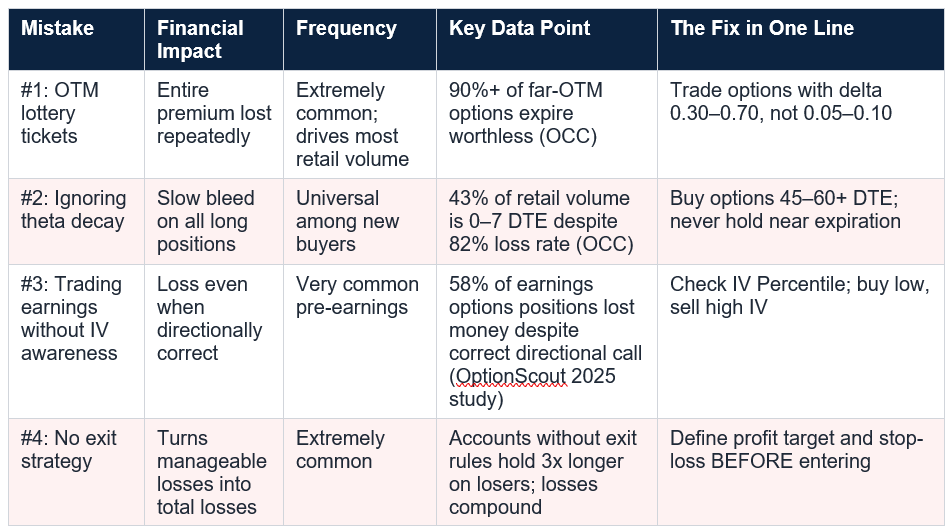
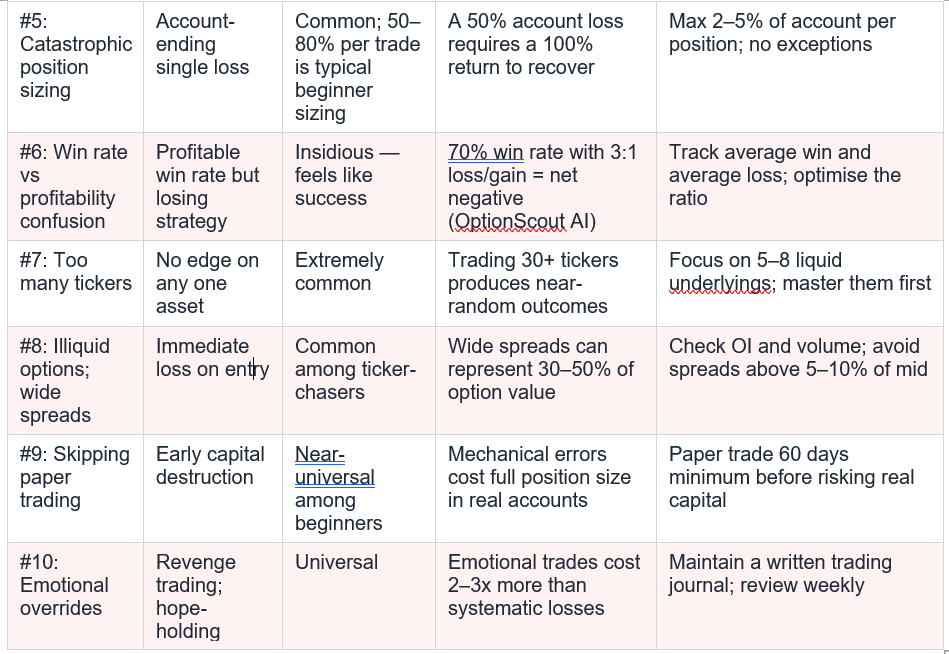
The Mistakes at a Glance: Reference Table
Conclusion
Eighty-five to ninety percent of options traders lose money. The average retail trader loses 67 percent of initial capital in the first year. These are not outcomes that happen because the options market is unfair, or because the deck is stacked against retail participants. They happen because the ten mistakes documented in this guide are predictable, avoidable, and almost universally made by new traders who skip the educational foundation and go directly to placing bets.
Options trading is not inherently more dangerous than other forms of investment. It is more complex, and that complexity punishes ignorance at a speed and magnitude that more forgiving asset classes do not. The trader who buys the wrong stock and holds it can wait for recovery. The trader who buys the wrong option can lose 100 percent of their capital before the stock has even moved, simply because time decay and implied volatility worked against them in ways they did not model.
The path forward is available and well-documented: understand the mechanics of options before risking capital; paper trade until you have a positive expectation from your strategy; size positions so that no single trade can meaningfully damage the account; define exit rules before entering positions; build a focused watchlist rather than spreading attention across dozens of tickers; and keep a trading journal that converts experience into learning. The 10 to 15 percent of options traders who are consistently profitable did not discover a secret. They avoided the mistakes the other 85 to 90 percent kept making.
1Frequently Asked Questions
What percentage of options traders lose money?
Approximately 85 to 90 percent of options traders lose money, according to Lambda Finance’s April 2026 report, which compiled data from MIT Sloan research, London Business School studies, Fidelity, Charles Schwab, CBOE market statistics, and practitioner analytics platforms. The average retail options trader loses 67 percent of initial capital within the first year. A 2025 FINRA study found that seven specific mistakes account for 89 percent of retail options trading losses.
What is the biggest mistake new options traders make?
According to data from the OCC, OptionScout AI, and multiple practitioner sources, the single most common and costly mistake is buying far out-of-the-money (OTM) options with very low deltas as speculative bets. OCC data shows that options with deltas below 0.10 expire worthless more than 90% of the time. OTM options in the 0 to 7 days to expiration window have an 82% loss rate for buyers. Despite this data, these contracts represent 43% of all retail options volume.
What is IV crush and why does it matter for options traders?
Implied volatility (IV) crush is the sharp decline in implied volatility that occurs immediately after a binary event (earnings announcement, FDA approval, economic data release) is resolved. Before such events, IV is elevated because the market anticipates a large move; after the event, regardless of what happens, the uncertainty is resolved and IV collapses. Options that were purchased at elevated IV levels lose a significant portion of their value immediately after the event, even if the trader correctly predicted the direction of the underlying’s move. A 2025 study found that long option positions held through earnings announcements lost money 58% of the time, even when the direction was correctly predicted.
How much of my account should I risk on a single options trade?
The standard risk management framework across institutional education sources including Fidelity, Charles Schwab, and Interactive Brokers is to risk no more than 1 to 5 percent of total trading capital on any single position. For new traders, the lower end of this range (1 to 2 percent) is recommended. This position sizing allows a trader to absorb a long run of consecutive losses while keeping the account recoverable. Using 50 to 80 percent of an account on a single options trade — which is unfortunately common among beginners — means a single losing position can be account-ending.
Should I paper trade before trading options with real money?
Yes, and most institutional education sources (Fidelity, Interactive Brokers, Best Stock Strategy July 2026) strongly recommend it. Paper trading with simulated money on a real platform (thinkorswim, Interactive Brokers, tastytrade all offer free paper trading) allows you to learn mechanics, test strategies, and identify decision-making errors before they cost real capital. The recommended minimum paper trading period is 60 days, with a positive expectation across at least 50 to 100 simulated trades before transitioning to real capital — initially at very small position sizes.
Why can I have a high win rate but still lose money trading options?
Win rate is an incomplete measure of profitability because it does not account for the size of wins versus losses. A strategy that wins 70% of the time but loses three dollars for every dollar gained produces a net loss over 100 trades: 70 winning trades at $1 each = $70 in gains; 30 losing trades at $3 each = $90 in losses; net result = -$20. This is the win rate illusion documented by OptionScout AI in their July 2026 retail options trader report. Profitable options trading requires tracking both win rate and the reward-to-risk ratio simultaneously.
0 Comments
Be the first to share your thoughts on this article.