

Finance
Europe's Cost of Living Crisis and Inflation: How to Survive

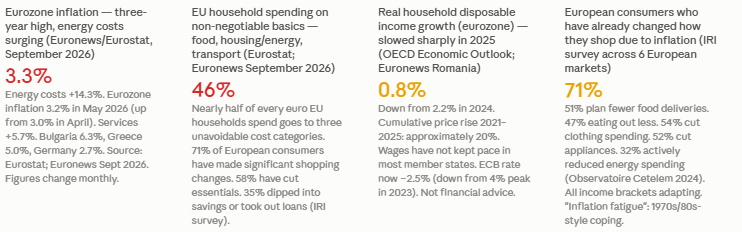
Nearly half of every euro spent by EU households goes to food, energy, housing, and transport. Eurozone inflation hit a three-year high of 3.3% in 2026 with energy costs surging 14.3%. Bulgaria is at 6.3%, Greece at 5%, Germany at 2.7% — Europe is not one crisis, it is many, layered on top of four years of cumulative price increases that have quietly eroded the purchasing power of wages across the continent. 71% of European consumers have already changed how they shop. 58% have cut essentials. 35% have dipped into savings or taken out loans just to pay bills. This article does not offer false comfort. It offers the data, the country-by-country picture, and concrete, evidence-based strategies for surviving what is still one of the most sustained periods of household cost pressure in four decades.
The third layer is the one that made the crisis structurally persistent: the price level did not fall after the peaks. When energy prices eased from their 2022 highs, the prices of food, services, housing, and transport — all of which had risen in response to higher energy input costs — did not follow them back down. From 2021 to 2025, the cumulative price level increase across the eurozone was approximately 20%. Wages grew, but more slowly, and unevenly: in most member states real wages were lower in 2024 than in 2020, before the inflation cycle began.
By 2026 a fourth layer has been added: geopolitical tensions in the Hormuz Strait drove oil prices above $100 per barrel in March 2026, triggering emergency meetings of eurozone finance ministers and a fresh wave of energy cost increases. Eurozone energy inflation stood at 10.9% annually in May 2026. The cumulative weight of four inflation waves, hitting households with squeezed real incomes and minimal savings buffers, is why 71% of European consumers have already changed how they shop and 35% have dipped into savings or taken out loans just to pay bills. Not financial advice.
Eurozone inflation: 3.2% in May 2026 (3-year high); 3.3% most recent (Euronews/Eurostat September 2026). Energy inflation (eurozone): 10.9% annually May 2026; overall energy costs +14.3% (Euronews Sept 2026). 46% of all EU household spending goes to food, housing/energy and transport (Eurostat; Euronews September 4, 2026). Real household disposable income growth slowed to 0.8% in 2025 (OECD; Euronews Romania). Sources: Eurostat flash estimates; thepressproject.gr May 2026; Euronews September 2026; OECD Economic Outlook.
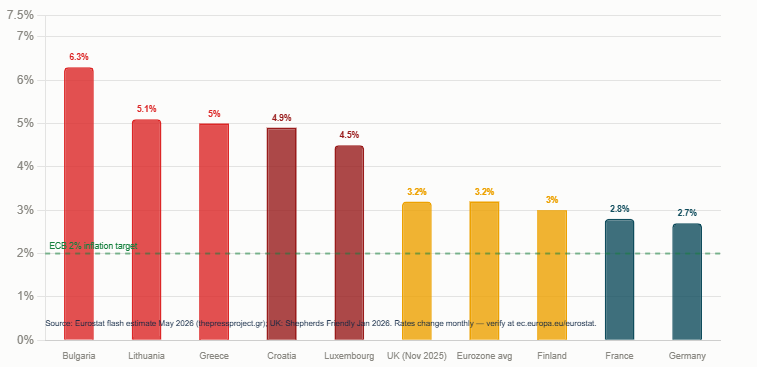
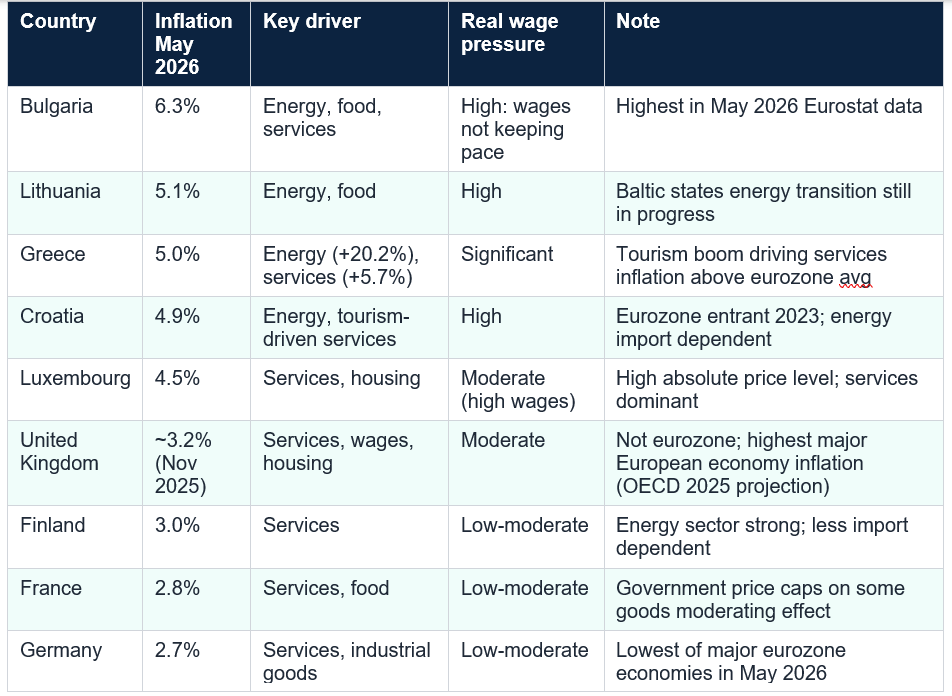
As of May 2026, Bulgaria leads the eurozone with 6.3% annual inflation; Lithuania follows at 5.1%; Greece at 5.0%; Croatia at 4.9%; Luxembourg at 4.5%. These are countries where energy import dependency is high, domestic production is constrained, and wage growth has not kept pace. At the other end: Germany at 2.7%, France at 2.8%, Finland at 3.0%. The lowest-inflation economies tend to have stronger manufacturing export sectors, higher-efficiency energy infrastructure, and more powerful consumer price regulation frameworks.
In Greece, energy prices rose 20.2% annually in May 2026 — the highest energy inflation in the Eurostat dataset. The country’s services sector added a further 5.7% inflation component in May 2026, reflecting booming tourism demand driving up prices in hospitality and transport. In the UK (not in the eurozone but closely tracked), November 2025 inflation was 3.2%, and the OECD projected the UK to have the highest inflation among major European economies in 2025 at 3.1%, partly due to minimum wage increases and higher National Insurance contributions pushing business costs through to prices.
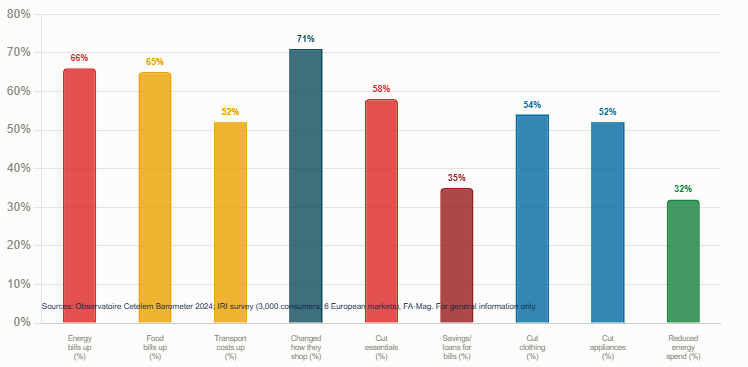
The Observatoire Cetelem Barometer 2024 — one of the most comprehensive pan-European consumer surveys — found that more than half of Europeans reported their energy spending (66%), food bills (65%), and transport costs (52%) had increased over the prior twelve months. The UK experienced the sharpest food budget squeeze (74% reporting an increase) alongside Romania (71%). Energy bills rose most sharply in the UK (76%), Romania (74%), and France (72%). These are not perceptions: they are confirmed by Eurostat HICP (Harmonised Index of Consumer Prices) data for the respective periods.
The cascading effect operates through the entire economy. When energy costs rise, they push up the cost of food production, food processing, food transportation, and food retail. When food costs rise, workers demand higher wages. When wages rise, services prices rise. The European Central Bank’s core concern from 2023 to 2025 was precisely this ‘second-round effect’: wage growth embedding inflation permanently into the services sector, which is exactly what happened. Services inflation was running at 5.7% in the eurozone in May 2026. Not financial advice.
The Observatoire Cetelem Barometer 2024 found two dominant coping strategies. The first was quantity reduction: buying less of what was previously bought. The second was quality substitution: switching to cheaper equivalents (own-brand, economy lines, smaller portions). 54% had cut clothing and footwear spending; 52% had reduced spending on furniture, household appliances, TVs, and smartphones. These are classic inflation-crisis behavioural responses: delay big-ticket purchases, cut discretionary spending first, protect essentials last.
But Euronews’ September 2026 analysis of Eurostat data reveals an important nuance: even as the squeeze tightened, European consumers became ‘surgical’ rather than uniformly frugal. They did not cut everything — they cut strategically, protecting spending on culture, dining, and well-being while reducing information and communication budgets and delaying big-ticket goods. This ‘surgical’ approach is the empirical baseline for the survival strategies below. Not financial advice.
The most widely cited strategy in European consumer surveys (Deloitte/Statista, July 2025; Observatoire Cetelem 2024) is the switch to own-brand or supermarket-own-label products.
In the UK, own-brand products from major supermarkets typically cost 20–40% less than branded equivalents while meeting identical nutritional standards. French ‘marque de distributeur’ (MDD) products, German ‘Eigenmarken,’ and Polish private label ranges follow the same principle. The Observatoire Cetelem Barometer found that this switch was adopted across income brackets — not just among the lowest earners but across all European consumers, because the quality gap between branded and own-label products has narrowed substantially.
The second major strategy is meal planning: preparing a weekly food plan before shopping, buying only what is on the list, and reducing food waste. The EU estimates that European households waste approximately 30% of food purchased — meaning 30 cents of every euro spent on food is discarded. Eliminating even half of that waste (to 15%) generates a 15% reduction in the effective food cost with zero change in quality. Batch cooking — preparing larger quantities of staple meals (soups, stews, curries) that can be refrigerated or frozen — reduces both unit food cost and energy consumed per meal.
Food bill action plan: (1) Switch at least 50% of regular branded purchases to own-brand equivalents. (2) Plan meals for the week before the shopping trip. (3) Use a shopping list strictly; avoid impulse buying which adds an estimated 20-30% to the average bill. (4) Batch-cook 2-3 meals per week; freeze portions. (5) Buy proteins that are on offer and use them as the anchor for weekly meal planning rather than planning meals first and buying proteins second. (6) Use the 'reduced to clear' section of supermarkets for same-day use. (7) Compare unit prices (price per 100g/litre) rather than pack prices, which can mislead. Not financial advice.
The most immediate action is tariff comparison and switching. Across most European markets, multiple energy suppliers compete for household customers, and the difference between the most and least expensive tariff for identical consumption can be 20–40% annually. In the UK, Ofgem’s price cap framework constrains the ceiling; in Germany and France, regulated and open-market tariffs coexist. Energy price comparison services exist in most EU member states. The 32% of European households that have actively reduced energy spending (Observatoire Cetelem 2024) are overwhelmingly using some combination of tariff switching and consumption reduction.
Behavioural changes have a compound effect on energy bills. Reducing the home thermostat by 1°C reduces heating energy consumption by approximately 5–8% (European Commission energy efficiency guidance). Switching to LED lighting reduces lighting electricity consumption by 80% compared to traditional bulbs. A full replacement of an older fridge-freezer with an A+++ rated equivalent can reduce appliance electricity consumption by 50–60%. For those on fixed incomes where capital investment in insulation or new appliances is not immediately feasible, the behavioural changes — thermostat, lighting habits, full-load dishwasher and washing machine cycles, standby appliance elimination — can reduce energy bills by 10–20% at zero cost. Not financial advice.
Energy bill action plan: (1) Compare energy tariffs immediately at comparison sites (UK: Ofgem-accredited comparators; Germany: Verivox, Check24; France: Energie-Info; Spain: CNMC comparador). (2) Check eligibility for government energy support programmes (see Section 11). (3) Reduce thermostat by 1°C: saves approximately 5-8% on heating. (4) Switch to LED bulbs where not already done. (5) Eliminate standby modes on all appliances. (6) Wash clothes at 30°C rather than 40°C or 60°C: saves approximately 35-40% on washing energy. (7) Fix any draughts around doors and windows. (8) Check if you qualify for free or subsidised home insulation or boiler replacement grants (ECO4 in UK; similar programmes in France, Germany, Italy). Not financial or legal advice.
Energy debt trap: if you are already behind on energy bills, do not ignore the arrears. Contact your energy supplier immediately. EU rules require energy suppliers to offer vulnerable customers payment plans; suppliers cannot disconnect vulnerable customers in winter in most member states. Check with your national energy regulator for protections specific to your country. UK: Citizen's Advice (citizensadvice.org.uk) and the Energy Ombudsman for disputes. Not legal advice.
For renters, the key first step is understanding rent increase protections in their jurisdiction. The EU does not regulate rents centrally, but many member states have significant tenant protections. France limits annual rent increases to the IRL (Indice de Référence des Loyers) index. Spain implemented an emergency rent freeze during the inflation crisis period and has since introduced new protections under the 2023 Housing Law. Germany’s Mietpreisbremse (rent brake) limits increases in tightly defined ‘pressured markets.’ The Netherlands, Ireland, and Portugal have all introduced various rent control measures. Knowing what your local protections are is the first defence against rent increases that exceed what is legally permissible.
For variable-rate mortgage holders in the eurozone, the trajectory of ECB interest rates is the central issue. The ECB raised its deposit rate from 0% in 2022 to a peak of 4% in 2023, then cut it during 2024–2025. As of 2026, the ECB deposit rate stands at approximately 2.5%. If your mortgage is on a variable rate that tracks the ECB base rate, your monthly payment has already fallen from its 2023–2024 peak. The most cost-effective move for variable-rate borrowers who expect rates to rise again (as the energy shock of 2026 may prompt) is to lock in a fixed rate while rates are below the 2023 peak. Not financial advice; consult a mortgage adviser.
(1) Renters: check your jurisdiction's rent protection rules before accepting any rent increase. (2) Variable-rate mortgage holders: use a mortgage broker to model the cost of fixing at current rates vs remaining variable. (3) Consider house-sharing or a lodger if you have spare rooms: in the UK, the Rent-a-Room scheme allows up to £7,500/year tax-free income from letting a room in your home. (4) Review council tax/property tax liability annually: many local authorities have discretionary reduction schemes for low-income households. Not legal or financial advice.
The most impactful transport saving is the elimination or reduction of private car use where public transport alternatives exist. European public transport systems — particularly in Germany, France, Austria, the Netherlands, and the Nordic states — offer competitive monthly passes that can be substantially cheaper than the equivalent car cost (fuel, insurance, parking, servicing, depreciation). Germany’s €49 Deutschlandticket, which allowed unlimited local and regional public transport use for €49/month, became a widely adopted benchmark for affordable transport access.
For those who must use private vehicles, the most impactful cost strategies are: consolidating journeys (combining multiple errands into single trips rather than making separate short trips, which are particularly inefficient); maintaining correct tyre pressure (under-inflated tyres increase fuel consumption by 3–5%); switching to supermarket petrol stations (typically 3–6p or €0.04–0.06/litre cheaper than branded forecourts); and reviewing car insurance annually rather than allowing automatic renewal at a premium uplift.
Transport action plan: (1) Calculate the full annual cost of your car (fuel, insurance, road tax, MOT/service, depreciation): most drivers significantly underestimate the total. (2) Compare the annual cost of a public transport pass for your commute route. (3) If a second car is owned: model whether car-sharing/car-club membership (Zipcar, E-Car Club, Flinkster in Germany) is cheaper for occasional-use journeys. (4) Ensure tyres are at correct pressure. (5) Consider a hybrid or EV for the next vehicle purchase, particularly if annual mileage is above 10,000 miles (16,000 km): running costs are substantially lower than petrol equivalents. (6) Switch car insurance and breakdown cover annually using comparison sites. Not financial advice.
The most immediate income action for employed workers is to check whether their salary has kept pace with inflation. In most European countries, collective wage agreements have produced nominal wage increases of 4–6% in 2023–2024. But not all workers are covered by collective agreements, and not all employers pass through inflation-adjusting increases automatically. If your salary has not increased by at least the cumulative CPI increase over the past two years, a structured conversation with your employer about a cost-of-living adjustment is financially justified. Many employers have introduced one-off inflation payments or targeted cost-of-living supplements specifically because of the current crisis.
For self-employed, freelance, and gig economy workers, the equivalent action is pricing review: have your rates been adjusted to reflect the input cost increases of the past three years? A freelancer charging the same rates in 2026 as in 2021 has effectively accepted a 20% real terms pay cut, because every purchase they make with that income now costs 20% more. For savings: with ECB rates at approximately 2.5% and some European high-yield savings accounts now offering rates of 2–3.5% annually (up from near-zero pre-2022), moving cash savings out of current accounts and into interest-bearing accounts generates real income at zero effort. Not financial advice.
The prioritisation principle: high-interest consumer debt (credit cards, personal loans above 10% APR) should be prioritised for elimination above almost any other financial objective except maintaining essential monthly payments. The guaranteed after-tax return of eliminating 20% APR credit card debt exceeds the return of any savings account or investment available in the current European market. The IRI survey finding that 35% of Europeans took out loans to pay bills — often at higher interest rates than the bills themselves — illustrates the debt trap that the cost of living crisis creates.
For households already in financial difficulty, all EU member states have insolvency protection mechanisms and debt advice services. In the UK: StepChange Debt Charity (stepchange.org) provides free debt advice and has managed billions in debt on behalf of clients. In Germany: Schuldnerberatung (debt counselling) services are available through local Caritas and Diakonisches Werk centres. In France: the surendettement (over-indebtedness) procedure through the Banque de France provides formal protection. Ignoring debt does not make it smaller. Not financial or legal advice.
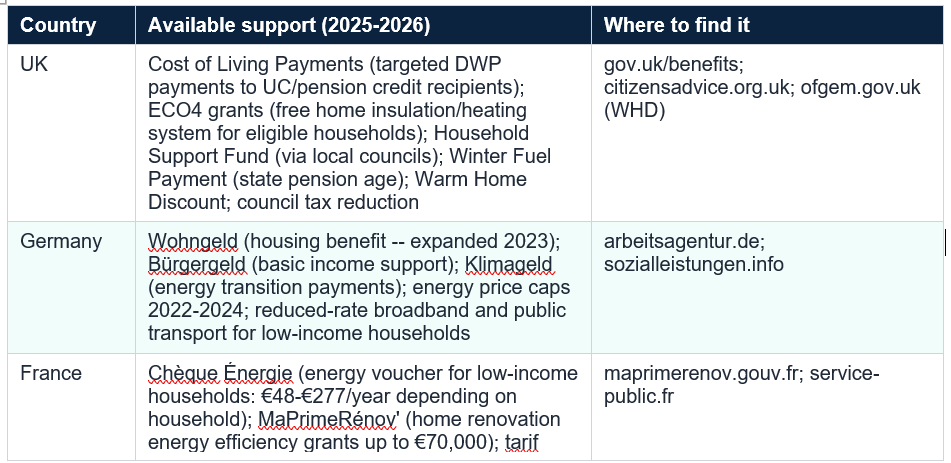
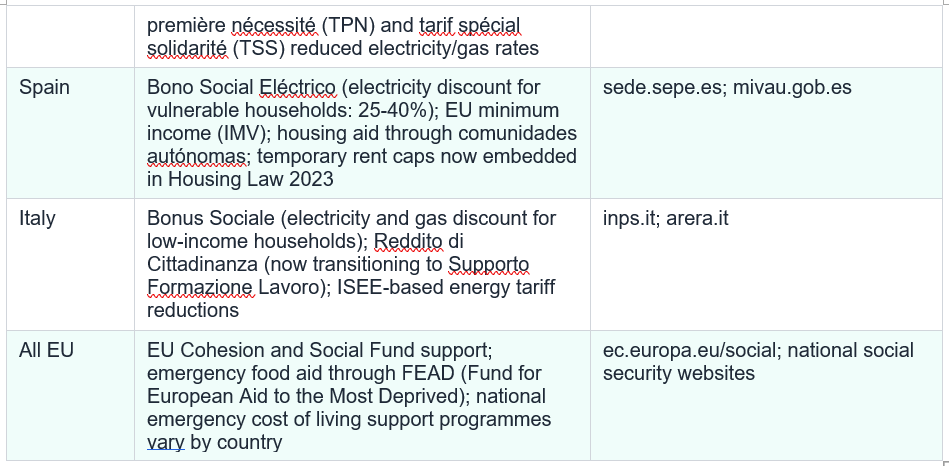
Note: government support programmes change frequently. Always verify current eligibility and application details from official national sources. Benefits rules, income thresholds, and available programmes change with each annual budget cycle. Not legal or benefits advice.
What the data does allow is a structural assessment. The cumulative 20% price rise from 2021 to 2025 will not reverse. Prices do not fall to pre-crisis levels when inflation eases — they simply rise more slowly. The ‘1.6% inflation’ scenario of the ECB’s optimistic 2026 forecast means prices rising 1.6% on top of an already-elevated level, not prices returning to 2020 levels. European households need to build household finance strategies that work at the current, elevated price level — not wait for a return to 2019 conditions.
The Euronews September 2026 analysis of Eurostat data offers a more optimistic counter-signal: even as inflation remained elevated, European consumers were becoming more sophisticated and ‘surgical’ in their responses — cutting where it hurt least while protecting what they valued most. The crisis is changing European consumer behaviour in ways that may persist beyond the inflation episode itself: more own-brand purchasing, less food waste, more energy awareness, more comparison shopping. These are permanent improvements to household financial resilience. Not financial advice.
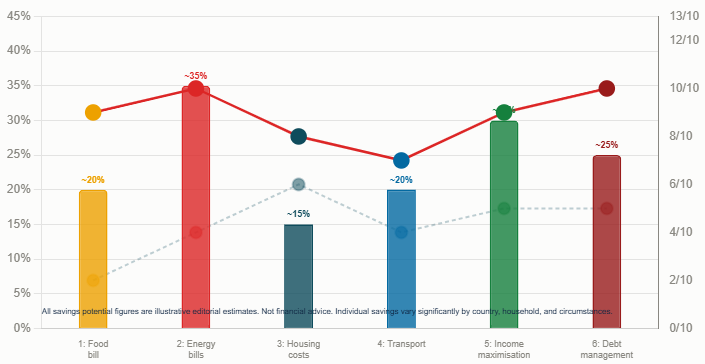
The six strategies in this article — food cost reduction, energy bill management, housing cost protection, transport optimisation, income maximisation, and debt management — are drawn from the behavioural evidence of what 71% of European consumers are already doing. They are not aspirational lifestyle changes. They are the practical actions that the available data shows produce the largest reductions in the cost of living at the lowest cost in time and capital.
The key insight from Euronews’ September 2026 Eurostat analysis stands as the right framework: be surgical, not panicked. The European consumer who understands exactly where their money goes, cuts where the impact on wellbeing is lowest, and protects what matters most, is better positioned than one who makes random cuts or cuts nothing at all. The crisis demands active management. The data shows what that looks like.
Based on Eurostat's preliminary estimate for May 2026 (cited thepressproject.gr, May 2026): the highest inflation rates in the eurozone were Bulgaria at 6.3%, Lithuania at 5.1%, Greece at 5.0%, Croatia at 4.9%, and Luxembourg at 4.5%. Energy prices are the dominant driver in the higher-inflation member states: in Greece, energy prices rose 20.2% annually in May 2026. The lowest rates in May 2026 were Germany at 2.7%, France at 2.8%, and Finland at 3.0%. The broader EU (including non-eurozone members) showed 2.5% inflation in October 2025 (Eurostat). These figures change monthly; for current data check ec.europa.eu/eurostat.
What is the ECB doing about inflation in Europe?
The European Central Bank raised its deposit rate from 0% in mid-2022 to a peak of 4% in 2023 in response to the inflation surge. Through 2024 and 2025, the ECB cut rates as inflation eased. As of 2026, the ECB deposit rate stands at approximately 2.5%. The ECB's 2% inflation target has not been consistently met: the Hormuz crisis of early 2026 pushed energy prices and overall eurozone inflation back above 3%. The ECB's mandate is price stability (2% inflation) and it uses interest rates as its primary tool; it cannot directly address food prices, housing costs, or energy market disruptions, which is why governments have deployed separate fiscal measures (energy vouchers, housing support, etc.) alongside monetary policy.
How much have European household budgets been squeezed by inflation?
The cumulative squeeze is significant. From 2021 to 2025, the cumulative price level increase across the eurozone was approximately 20%. Real household disposable income growth in the eurozone slowed to an estimated 0.8% in 2025 -- far below the pace of price increases (OECD Economic Outlook; Euronews Romania). 46% of all EU household spending goes to the non-negotiable basics: food, housing/energy, and transport (Eurostat; Euronews September 2026). More than half of Europeans report their energy bills (66%), food bills (65%), and transport costs (52%) have all increased in the past year (Observatoire Cetelem Barometer 2024). 71% of European consumers have made significant changes to how they shop; 58% have cut essentials; 35% have dipped into savings or taken out loans to pay bills (IRI/FA-Mag survey).
What are the most effective ways to reduce energy bills in Europe?
Based on European Commission energy efficiency data and European consumer behaviour research: (1) Compare energy tariffs and switch supplier if a better rate is available (can save 20-40% annually in liberalised markets). (2) Reduce thermostat by 1°C: saves approximately 5-8% on heating costs. (3) Switch to LED lighting throughout: saves approximately 80% on lighting electricity vs traditional bulbs. (4) Eliminate all appliance standby modes: saves approximately 10% on household electricity. (5) Wash clothes at 30°C (vs 60°C): saves approximately 35-40% on washing energy. (6) Check eligibility for government insulation or heating system grants (ECO4 in UK; MaPrimeRénov' in France; similar programmes across EU). (7) Fix draughts around doors and windows: a draught-proofed home requires less heating. 32% of European households have already actively reduced energy spending through some combination of these approaches (Observatoire Cetelem 2024). Not financial advice.
Are prices in Europe going to come down?
The price level is not expected to fall to pre-2021 levels. Disinflation (inflation falling) is different from deflation (prices actually decreasing): what the ECB's projections describe is prices rising more slowly, not prices returning to previous levels. The cumulative 20% price rise from 2021 to 2025 is permanent. The ECB's June 2025 projection estimated 2% inflation for 2025 and 1.6% for 2026, but the Hormuz crisis of early 2026 disrupted these projections, with eurozone inflation back at 3.2% in May 2026. The OECD projects no European country (except Turkey) will exceed 3.7% in 2026. For households: the practical implication is that financial planning should be done at current price levels, not in anticipation of a return to 2019 prices. The adaptation strategies described in this article are appropriate for the current, elevated price environment regardless of the inflation trajectory from here.
Table of Contents
- How We Got Here: The Making of a Multi-Year Cost Squeeze
- Where Europe Stands Now: Inflation by Country (2025–2026)
- The Household Budget Under Pressure: What It Costs to Live in Europe
- What Europeans Are Already Doing: The Coping Behaviours
- Strategy 1 — The Food Bill: Cutting Cost Without Cutting Nutrition
- Strategy 2 — Energy Bills: The Biggest Lever for Household Savings
- Strategy 3 — Housing Costs: Rents, Mortgages, and the Housing Squeeze
- Strategy 4 — Transport: The Third-Largest Budget Category
- Strategy 5 — Income Maximisation: Making the Most of What Comes In
- Strategy 6 — Debt Management: Protecting Your Financial Floor
- Government Support and Benefits: What Is Available Across Europe
- The Longer View: How Long Will the Cost of Living Crisis Last?
- Conclusion: Surgical, Not Panicked
- Frequently Asked Questions
Inflation by country — eurozone divergence May 2026
The household squeeze — what Europeans are cutting
6 survival strategies — savings potential and urgency
How We Got Here: The Making of a Multi-Year Cost Squeeze
The European cost of living crisis did not arrive in a single event. It accumulated in layers. The first layer was laid in 2021–2022, when supply chain disruption from the pandemic caused shortages in goods, semiconductors, shipping capacity, and raw materials. Inflation, dormant across Europe for more than a decade, woke up. The second layer arrived with Russia’s invasion of Ukraine in February 2022 and the severing of Russian gas supplies to Europe. Gas prices tripled. Electricity prices followed. The energy crisis of 2022–2023 added the equivalent of a significant income tax on every European household that heated a home or ran a business.The third layer is the one that made the crisis structurally persistent: the price level did not fall after the peaks. When energy prices eased from their 2022 highs, the prices of food, services, housing, and transport — all of which had risen in response to higher energy input costs — did not follow them back down. From 2021 to 2025, the cumulative price level increase across the eurozone was approximately 20%. Wages grew, but more slowly, and unevenly: in most member states real wages were lower in 2024 than in 2020, before the inflation cycle began.
By 2026 a fourth layer has been added: geopolitical tensions in the Hormuz Strait drove oil prices above $100 per barrel in March 2026, triggering emergency meetings of eurozone finance ministers and a fresh wave of energy cost increases. Eurozone energy inflation stood at 10.9% annually in May 2026. The cumulative weight of four inflation waves, hitting households with squeezed real incomes and minimal savings buffers, is why 71% of European consumers have already changed how they shop and 35% have dipped into savings or taken out loans just to pay bills. Not financial advice.
Eurozone inflation: 3.2% in May 2026 (3-year high); 3.3% most recent (Euronews/Eurostat September 2026). Energy inflation (eurozone): 10.9% annually May 2026; overall energy costs +14.3% (Euronews Sept 2026). 46% of all EU household spending goes to food, housing/energy and transport (Eurostat; Euronews September 4, 2026). Real household disposable income growth slowed to 0.8% in 2025 (OECD; Euronews Romania). Sources: Eurostat flash estimates; thepressproject.gr May 2026; Euronews September 2026; OECD Economic Outlook.
Where Europe Stands Now: Inflation by Country (2025–2026)
The eurozone is not a single inflation experience. It is 20 member states with shared monetary policy but very different structural economic conditions, energy import dependencies, wage negotiation systems, and government fiscal responses. The country-level divergence in inflation is striking.As of May 2026, Bulgaria leads the eurozone with 6.3% annual inflation; Lithuania follows at 5.1%; Greece at 5.0%; Croatia at 4.9%; Luxembourg at 4.5%. These are countries where energy import dependency is high, domestic production is constrained, and wage growth has not kept pace. At the other end: Germany at 2.7%, France at 2.8%, Finland at 3.0%. The lowest-inflation economies tend to have stronger manufacturing export sectors, higher-efficiency energy infrastructure, and more powerful consumer price regulation frameworks.
In Greece, energy prices rose 20.2% annually in May 2026 — the highest energy inflation in the Eurostat dataset. The country’s services sector added a further 5.7% inflation component in May 2026, reflecting booming tourism demand driving up prices in hospitality and transport. In the UK (not in the eurozone but closely tracked), November 2025 inflation was 3.2%, and the OECD projected the UK to have the highest inflation among major European economies in 2025 at 3.1%, partly due to minimum wage increases and higher National Insurance contributions pushing business costs through to prices.
The Household Budget Under Pressure: What It Costs to Live in Europe
The structural weight of the cost of living crisis is visible in where household money goes. Eurostat data, analysed by Euronews (September 4, 2026), shows that nearly half (approximately 46%) of all money spent by EU households flows to just three categories: food, housing and energy, and transport. These are not discretionary categories. They are the floor of modern life in Europe: the minimum required to eat, stay warm, and get to work.The Observatoire Cetelem Barometer 2024 — one of the most comprehensive pan-European consumer surveys — found that more than half of Europeans reported their energy spending (66%), food bills (65%), and transport costs (52%) had increased over the prior twelve months. The UK experienced the sharpest food budget squeeze (74% reporting an increase) alongside Romania (71%). Energy bills rose most sharply in the UK (76%), Romania (74%), and France (72%). These are not perceptions: they are confirmed by Eurostat HICP (Harmonised Index of Consumer Prices) data for the respective periods.
The cascading effect operates through the entire economy. When energy costs rise, they push up the cost of food production, food processing, food transportation, and food retail. When food costs rise, workers demand higher wages. When wages rise, services prices rise. The European Central Bank’s core concern from 2023 to 2025 was precisely this ‘second-round effect’: wage growth embedding inflation permanently into the services sector, which is exactly what happened. Services inflation was running at 5.7% in the eurozone in May 2026. Not financial advice.
What Europeans Are Already Doing: The Coping Behaviours
The IRI/FA-Mag research, surveying 3,000 consumers across six European markets at the height of the inflation crisis, described the resulting shift as ‘inflation fatigue’ driving coping behaviours not seen since the austere 1970s and 1980s. 71% of European consumers had already made significant changes to how they shop. 58% had cut down on essentials. 35% had dipped into personal savings or taken out loans to pay bills.The Observatoire Cetelem Barometer 2024 found two dominant coping strategies. The first was quantity reduction: buying less of what was previously bought. The second was quality substitution: switching to cheaper equivalents (own-brand, economy lines, smaller portions). 54% had cut clothing and footwear spending; 52% had reduced spending on furniture, household appliances, TVs, and smartphones. These are classic inflation-crisis behavioural responses: delay big-ticket purchases, cut discretionary spending first, protect essentials last.
But Euronews’ September 2026 analysis of Eurostat data reveals an important nuance: even as the squeeze tightened, European consumers became ‘surgical’ rather than uniformly frugal. They did not cut everything — they cut strategically, protecting spending on culture, dining, and well-being while reducing information and communication budgets and delaying big-ticket goods. This ‘surgical’ approach is the empirical baseline for the survival strategies below. Not financial advice.
Strategy 1: The Food Bill: Cutting Cost Without Cutting Nutrition
Food represents one of the largest single components of household spending and one of the most responsive to behavioural change. Unlike energy (where reduction requires capital investment in insulation or new appliances) or housing (where costs are relatively fixed by contract), food spending can be reduced significantly within days through purchasing changes.The most widely cited strategy in European consumer surveys (Deloitte/Statista, July 2025; Observatoire Cetelem 2024) is the switch to own-brand or supermarket-own-label products.
In the UK, own-brand products from major supermarkets typically cost 20–40% less than branded equivalents while meeting identical nutritional standards. French ‘marque de distributeur’ (MDD) products, German ‘Eigenmarken,’ and Polish private label ranges follow the same principle. The Observatoire Cetelem Barometer found that this switch was adopted across income brackets — not just among the lowest earners but across all European consumers, because the quality gap between branded and own-label products has narrowed substantially.
The second major strategy is meal planning: preparing a weekly food plan before shopping, buying only what is on the list, and reducing food waste. The EU estimates that European households waste approximately 30% of food purchased — meaning 30 cents of every euro spent on food is discarded. Eliminating even half of that waste (to 15%) generates a 15% reduction in the effective food cost with zero change in quality. Batch cooking — preparing larger quantities of staple meals (soups, stews, curries) that can be refrigerated or frozen — reduces both unit food cost and energy consumed per meal.
Food bill action plan: (1) Switch at least 50% of regular branded purchases to own-brand equivalents. (2) Plan meals for the week before the shopping trip. (3) Use a shopping list strictly; avoid impulse buying which adds an estimated 20-30% to the average bill. (4) Batch-cook 2-3 meals per week; freeze portions. (5) Buy proteins that are on offer and use them as the anchor for weekly meal planning rather than planning meals first and buying proteins second. (6) Use the 'reduced to clear' section of supermarkets for same-day use. (7) Compare unit prices (price per 100g/litre) rather than pack prices, which can mislead. Not financial advice.
Strategy 2: Energy Bills: The Biggest Lever for Household Savings
Energy is the most structurally expensive component of the European cost of living crisis. With eurozone energy costs up 14.3% in the most recent Eurostat data and Greece experiencing a 20.2% annual energy price rise in May 2026, this is the category where the numbers are both largest and most painful. It is also, for homeowners and renters with some flexibility, where the largest absolute savings are available.The most immediate action is tariff comparison and switching. Across most European markets, multiple energy suppliers compete for household customers, and the difference between the most and least expensive tariff for identical consumption can be 20–40% annually. In the UK, Ofgem’s price cap framework constrains the ceiling; in Germany and France, regulated and open-market tariffs coexist. Energy price comparison services exist in most EU member states. The 32% of European households that have actively reduced energy spending (Observatoire Cetelem 2024) are overwhelmingly using some combination of tariff switching and consumption reduction.
Behavioural changes have a compound effect on energy bills. Reducing the home thermostat by 1°C reduces heating energy consumption by approximately 5–8% (European Commission energy efficiency guidance). Switching to LED lighting reduces lighting electricity consumption by 80% compared to traditional bulbs. A full replacement of an older fridge-freezer with an A+++ rated equivalent can reduce appliance electricity consumption by 50–60%. For those on fixed incomes where capital investment in insulation or new appliances is not immediately feasible, the behavioural changes — thermostat, lighting habits, full-load dishwasher and washing machine cycles, standby appliance elimination — can reduce energy bills by 10–20% at zero cost. Not financial advice.
Energy bill action plan: (1) Compare energy tariffs immediately at comparison sites (UK: Ofgem-accredited comparators; Germany: Verivox, Check24; France: Energie-Info; Spain: CNMC comparador). (2) Check eligibility for government energy support programmes (see Section 11). (3) Reduce thermostat by 1°C: saves approximately 5-8% on heating. (4) Switch to LED bulbs where not already done. (5) Eliminate standby modes on all appliances. (6) Wash clothes at 30°C rather than 40°C or 60°C: saves approximately 35-40% on washing energy. (7) Fix any draughts around doors and windows. (8) Check if you qualify for free or subsidised home insulation or boiler replacement grants (ECO4 in UK; similar programmes in France, Germany, Italy). Not financial or legal advice.
Energy debt trap: if you are already behind on energy bills, do not ignore the arrears. Contact your energy supplier immediately. EU rules require energy suppliers to offer vulnerable customers payment plans; suppliers cannot disconnect vulnerable customers in winter in most member states. Check with your national energy regulator for protections specific to your country. UK: Citizen's Advice (citizensadvice.org.uk) and the Energy Ombudsman for disputes. Not legal advice.
Strategy 3: Housing Costs: Rents, Mortgages, and the Housing Squeeze
Housing is the largest single category of household spending in most European countries and the one where individual households have the least short-term flexibility. A landlord’s ability to raise rents, or the impact of rising mortgage rates on variable-rate homeowners, operates on timescales of months to years — not the immediate timescale of a food shopping trip. Nevertheless, there are meaningful actions available.For renters, the key first step is understanding rent increase protections in their jurisdiction. The EU does not regulate rents centrally, but many member states have significant tenant protections. France limits annual rent increases to the IRL (Indice de Référence des Loyers) index. Spain implemented an emergency rent freeze during the inflation crisis period and has since introduced new protections under the 2023 Housing Law. Germany’s Mietpreisbremse (rent brake) limits increases in tightly defined ‘pressured markets.’ The Netherlands, Ireland, and Portugal have all introduced various rent control measures. Knowing what your local protections are is the first defence against rent increases that exceed what is legally permissible.
For variable-rate mortgage holders in the eurozone, the trajectory of ECB interest rates is the central issue. The ECB raised its deposit rate from 0% in 2022 to a peak of 4% in 2023, then cut it during 2024–2025. As of 2026, the ECB deposit rate stands at approximately 2.5%. If your mortgage is on a variable rate that tracks the ECB base rate, your monthly payment has already fallen from its 2023–2024 peak. The most cost-effective move for variable-rate borrowers who expect rates to rise again (as the energy shock of 2026 may prompt) is to lock in a fixed rate while rates are below the 2023 peak. Not financial advice; consult a mortgage adviser.
(1) Renters: check your jurisdiction's rent protection rules before accepting any rent increase. (2) Variable-rate mortgage holders: use a mortgage broker to model the cost of fixing at current rates vs remaining variable. (3) Consider house-sharing or a lodger if you have spare rooms: in the UK, the Rent-a-Room scheme allows up to £7,500/year tax-free income from letting a room in your home. (4) Review council tax/property tax liability annually: many local authorities have discretionary reduction schemes for low-income households. Not legal or financial advice.
Strategy 4: Transport: The Third-Largest Budget Category
Transport accounts for approximately 13% of average EU household spending and represents the third-largest mandatory cost category alongside food and housing. With fuel prices remaining elevated (diesel and petrol costs are partly driven by the same oil market dynamics that are pushing energy inflation), the transport bill has become a significant battleground for household savings across Europe.The most impactful transport saving is the elimination or reduction of private car use where public transport alternatives exist. European public transport systems — particularly in Germany, France, Austria, the Netherlands, and the Nordic states — offer competitive monthly passes that can be substantially cheaper than the equivalent car cost (fuel, insurance, parking, servicing, depreciation). Germany’s €49 Deutschlandticket, which allowed unlimited local and regional public transport use for €49/month, became a widely adopted benchmark for affordable transport access.
For those who must use private vehicles, the most impactful cost strategies are: consolidating journeys (combining multiple errands into single trips rather than making separate short trips, which are particularly inefficient); maintaining correct tyre pressure (under-inflated tyres increase fuel consumption by 3–5%); switching to supermarket petrol stations (typically 3–6p or €0.04–0.06/litre cheaper than branded forecourts); and reviewing car insurance annually rather than allowing automatic renewal at a premium uplift.
Transport action plan: (1) Calculate the full annual cost of your car (fuel, insurance, road tax, MOT/service, depreciation): most drivers significantly underestimate the total. (2) Compare the annual cost of a public transport pass for your commute route. (3) If a second car is owned: model whether car-sharing/car-club membership (Zipcar, E-Car Club, Flinkster in Germany) is cheaper for occasional-use journeys. (4) Ensure tyres are at correct pressure. (5) Consider a hybrid or EV for the next vehicle purchase, particularly if annual mileage is above 10,000 miles (16,000 km): running costs are substantially lower than petrol equivalents. (6) Switch car insurance and breakdown cover annually using comparison sites. Not financial advice.
Strategy 5: Income Maximisation: Making the Most of What Comes In
The survival strategies above focus primarily on reducing outgoings. The parallel dimension is income — ensuring that every legitimate income source is being captured, and that income grows at least as fast as the prices that household spending is exposed to.The most immediate income action for employed workers is to check whether their salary has kept pace with inflation. In most European countries, collective wage agreements have produced nominal wage increases of 4–6% in 2023–2024. But not all workers are covered by collective agreements, and not all employers pass through inflation-adjusting increases automatically. If your salary has not increased by at least the cumulative CPI increase over the past two years, a structured conversation with your employer about a cost-of-living adjustment is financially justified. Many employers have introduced one-off inflation payments or targeted cost-of-living supplements specifically because of the current crisis.
For self-employed, freelance, and gig economy workers, the equivalent action is pricing review: have your rates been adjusted to reflect the input cost increases of the past three years? A freelancer charging the same rates in 2026 as in 2021 has effectively accepted a 20% real terms pay cut, because every purchase they make with that income now costs 20% more. For savings: with ECB rates at approximately 2.5% and some European high-yield savings accounts now offering rates of 2–3.5% annually (up from near-zero pre-2022), moving cash savings out of current accounts and into interest-bearing accounts generates real income at zero effort. Not financial advice.
Strategy 6: Debt Management: Protecting Your Financial Floor
The cost of living crisis interacts dangerously with debt. The 35% of European consumers who dipped into personal savings or took out loans to pay bills (IRI survey) have added a debt service obligation to an already stretched budget. In an environment where ECB rates peaked at 4% and consumer credit rates remain elevated (typically 8–20% APR on personal loans and credit cards across EU member states), carrying consumer debt during the cost of living crisis compounds the financial pressure.The prioritisation principle: high-interest consumer debt (credit cards, personal loans above 10% APR) should be prioritised for elimination above almost any other financial objective except maintaining essential monthly payments. The guaranteed after-tax return of eliminating 20% APR credit card debt exceeds the return of any savings account or investment available in the current European market. The IRI survey finding that 35% of Europeans took out loans to pay bills — often at higher interest rates than the bills themselves — illustrates the debt trap that the cost of living crisis creates.
For households already in financial difficulty, all EU member states have insolvency protection mechanisms and debt advice services. In the UK: StepChange Debt Charity (stepchange.org) provides free debt advice and has managed billions in debt on behalf of clients. In Germany: Schuldnerberatung (debt counselling) services are available through local Caritas and Diakonisches Werk centres. In France: the surendettement (over-indebtedness) procedure through the Banque de France provides formal protection. Ignoring debt does not make it smaller. Not financial or legal advice.
Government Support and Benefits: What Is Available Across Europe
One of the most consistent findings from European consumer research is that households leave significant government support unclaimed — either because they are unaware of its existence, believe they do not qualify, or find the application process difficult. In an environment where every household is under pressure, checking for unclaimed entitlements is one of the highest-return actions available.Note: government support programmes change frequently. Always verify current eligibility and application details from official national sources. Benefits rules, income thresholds, and available programmes change with each annual budget cycle. Not legal or benefits advice.
The Longer View: How Long Will the Cost of Living Crisis Last?
The ECB’s June 2025 projection estimated inflation would fall to 2% in 2025 and 1.6% in 2026 — but that projection was made before the Hormuz crisis of early 2026 drove oil above $100/barrel and pushed eurozone inflation back to 3.2–3.3%. The honest answer is that the duration of the cost of living crisis in Europe depends on factors that no institution can reliably predict: geopolitical developments, weather patterns (affecting food production and heating demand), and central bank policy decisions.What the data does allow is a structural assessment. The cumulative 20% price rise from 2021 to 2025 will not reverse. Prices do not fall to pre-crisis levels when inflation eases — they simply rise more slowly. The ‘1.6% inflation’ scenario of the ECB’s optimistic 2026 forecast means prices rising 1.6% on top of an already-elevated level, not prices returning to 2020 levels. European households need to build household finance strategies that work at the current, elevated price level — not wait for a return to 2019 conditions.
The Euronews September 2026 analysis of Eurostat data offers a more optimistic counter-signal: even as inflation remained elevated, European consumers were becoming more sophisticated and ‘surgical’ in their responses — cutting where it hurt least while protecting what they valued most. The crisis is changing European consumer behaviour in ways that may persist beyond the inflation episode itself: more own-brand purchasing, less food waste, more energy awareness, more comparison shopping. These are permanent improvements to household financial resilience. Not financial advice.
Conclusion
The cost of living crisis in Europe is real, it is uneven, and it is not over. Eurozone inflation at 3.3% with energy costs up 14.3%, country-level rates from 2.7% (Germany) to 6.3% (Bulgaria), and a cumulative 20% price level increase since 2021 that wages have not fully recovered from — these are the coordinates of the crisis, and they require a clear-eyed response, not paralysis.The six strategies in this article — food cost reduction, energy bill management, housing cost protection, transport optimisation, income maximisation, and debt management — are drawn from the behavioural evidence of what 71% of European consumers are already doing. They are not aspirational lifestyle changes. They are the practical actions that the available data shows produce the largest reductions in the cost of living at the lowest cost in time and capital.
The key insight from Euronews’ September 2026 Eurostat analysis stands as the right framework: be surgical, not panicked. The European consumer who understands exactly where their money goes, cuts where the impact on wellbeing is lowest, and protects what matters most, is better positioned than one who makes random cuts or cuts nothing at all. The crisis demands active management. The data shows what that looks like.
Frequently Asked Questions
Which European country has the highest inflation in 2026?Based on Eurostat's preliminary estimate for May 2026 (cited thepressproject.gr, May 2026): the highest inflation rates in the eurozone were Bulgaria at 6.3%, Lithuania at 5.1%, Greece at 5.0%, Croatia at 4.9%, and Luxembourg at 4.5%. Energy prices are the dominant driver in the higher-inflation member states: in Greece, energy prices rose 20.2% annually in May 2026. The lowest rates in May 2026 were Germany at 2.7%, France at 2.8%, and Finland at 3.0%. The broader EU (including non-eurozone members) showed 2.5% inflation in October 2025 (Eurostat). These figures change monthly; for current data check ec.europa.eu/eurostat.
What is the ECB doing about inflation in Europe?
The European Central Bank raised its deposit rate from 0% in mid-2022 to a peak of 4% in 2023 in response to the inflation surge. Through 2024 and 2025, the ECB cut rates as inflation eased. As of 2026, the ECB deposit rate stands at approximately 2.5%. The ECB's 2% inflation target has not been consistently met: the Hormuz crisis of early 2026 pushed energy prices and overall eurozone inflation back above 3%. The ECB's mandate is price stability (2% inflation) and it uses interest rates as its primary tool; it cannot directly address food prices, housing costs, or energy market disruptions, which is why governments have deployed separate fiscal measures (energy vouchers, housing support, etc.) alongside monetary policy.
How much have European household budgets been squeezed by inflation?
The cumulative squeeze is significant. From 2021 to 2025, the cumulative price level increase across the eurozone was approximately 20%. Real household disposable income growth in the eurozone slowed to an estimated 0.8% in 2025 -- far below the pace of price increases (OECD Economic Outlook; Euronews Romania). 46% of all EU household spending goes to the non-negotiable basics: food, housing/energy, and transport (Eurostat; Euronews September 2026). More than half of Europeans report their energy bills (66%), food bills (65%), and transport costs (52%) have all increased in the past year (Observatoire Cetelem Barometer 2024). 71% of European consumers have made significant changes to how they shop; 58% have cut essentials; 35% have dipped into savings or taken out loans to pay bills (IRI/FA-Mag survey).
What are the most effective ways to reduce energy bills in Europe?
Based on European Commission energy efficiency data and European consumer behaviour research: (1) Compare energy tariffs and switch supplier if a better rate is available (can save 20-40% annually in liberalised markets). (2) Reduce thermostat by 1°C: saves approximately 5-8% on heating costs. (3) Switch to LED lighting throughout: saves approximately 80% on lighting electricity vs traditional bulbs. (4) Eliminate all appliance standby modes: saves approximately 10% on household electricity. (5) Wash clothes at 30°C (vs 60°C): saves approximately 35-40% on washing energy. (6) Check eligibility for government insulation or heating system grants (ECO4 in UK; MaPrimeRénov' in France; similar programmes across EU). (7) Fix draughts around doors and windows: a draught-proofed home requires less heating. 32% of European households have already actively reduced energy spending through some combination of these approaches (Observatoire Cetelem 2024). Not financial advice.
Are prices in Europe going to come down?
The price level is not expected to fall to pre-2021 levels. Disinflation (inflation falling) is different from deflation (prices actually decreasing): what the ECB's projections describe is prices rising more slowly, not prices returning to previous levels. The cumulative 20% price rise from 2021 to 2025 is permanent. The ECB's June 2025 projection estimated 2% inflation for 2025 and 1.6% for 2026, but the Hormuz crisis of early 2026 disrupted these projections, with eurozone inflation back at 3.2% in May 2026. The OECD projects no European country (except Turkey) will exceed 3.7% in 2026. For households: the practical implication is that financial planning should be done at current price levels, not in anticipation of a return to 2019 prices. The adaptation strategies described in this article are appropriate for the current, elevated price environment regardless of the inflation trajectory from here.
0 Comments
Be the first to share your thoughts on this article.