
Sports
Fake NFL Player Scammed 26 Women Out of $1.3 Million
Custom helmets. Prop money. A fake contract signing. A teenage ‘financial adviser’. An app that fabricated a $30 million bank balance. Daejon Labrayae Love allegedly spent four years pretending to be a San Francisco 49ers wide receiver to defraud at least 26 women of $1.3 million. He was arrested on 24 August 2026. Here is exactly how the scheme allegedly worked — and what it teaches about the $1.48 billion romance scam epidemic.

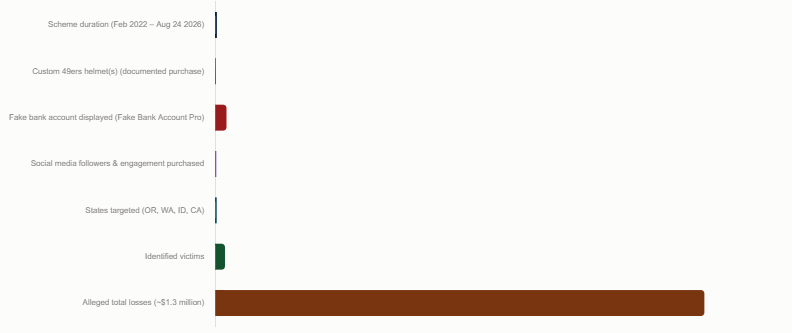
Custom football helmets. Purchases from a prop-money company. An app called Fake Bank Account Pro used to display fictitious bank balances, including one purportedly showing more than $30 million. Staged workout videos borrowing footage from real NFL players’ social media accounts. A fake contract-signing ceremony filmed in 49ers gear. An 18-year-old co-conspirator posing as his financial adviser on three-way FaceTime calls with prospective ‘investors.’
The case of Daejon Labrayae Love, arrested at Boise Airport on 24 August 2026 alongside Taylor Jamie Chan, has torn through both the sports media and consumer protection landscape in the days since. It is a case study in the mechanics of romance fraud, the psychology of trust-building, and the way that social media, AI tools, and the accessibility of digital props have lowered the barrier to executing a sophisticated financial crime. It is also, as this guide explains, far from an isolated incident.
26 identified victims. ~$1.3 million total losses. 4+ years of alleged operation (February 2022 – August 24, 2026). Arrested: Boise Airport, August 24, 2026. Charges: conspiracy to commit wire fraud and wire fraud (DOJ, August 25, 2026). FBI believes more than 26 victims may exist. Court: US District Court, District of Oregon. Both defendants presumed innocent.
The NFL and the San Francisco 49ers confirmed to investigators that Love had never been employed by either organisation. Love’s actual background is not described in publicly available court documents in detail, but the criminal complaint notes that the alleged scheme ran from at least February 2022 through March 2026 — and prosecutors say it continued up to the moment of his arrest in late August 2026. The FBI also noted a belief that there may be more than the 26 identified victims already discovered.
Love used multiple aliases across the scheme: Jon Love, Daejon Love, Avril Lyto Love, and Jordan Love, according to the FBI affidavit. The use of multiple identities is consistent with the need to operate across different platforms and victim networks without any single online profile becoming too visible or cross-referenced. He also sometimes presented himself not as an NFL player but as a wealthy Swiss real estate developer — an alternative cover story that served the same function: establishing wealth, status, and the credibility to invite investment.
Key elements of the alleged NFL persona (per court documents and published reports):
Financial records examined by federal investigators document the following purchases attributed to Love (per FBI affidavit; LawCommentary.com; OutKick):
The geographic scope of the alleged victims spans four states — Oregon, Washington, Idaho, and California — which suggests Love was active across a wide geographic area either through travel or through purely online relationships conducted at distance. The Pacific Northwest appears to be the primary operating region, consistent with the Oregon federal filing and the Boise, Idaho arrest.
The affidavit’s account of the scheme’s first documented instance is illustrative of the timeline: within days of meeting a woman on a dating app in February 2022, Love allegedly told her to invest $10,000 with Chan. The speed of the financial ask — days, not months — is notable and consistent with the pattern the FBI has identified in romance-investment hybrid schemes more broadly: the romantic relationship and the financial proposition are run simultaneously from the beginning rather than sequentially.
The San Francisco Chronicle’s reporting, based on conversations with people familiar with the victims’ experiences, notes something important about why the scheme worked even on a sceptical level: ‘The scam didn’t work simply because of the image Love created. It worked because the women saw him. They met him. When they looked him up, Google searches and artificial intelligence tools sometimes appeared to validate his supposed connection to the 49ers.’ Physical presence and real-world meeting, which might be expected to expose a fraud, instead added an additional layer of credibility.
26 identified victims across Oregon, Washington, Idaho, and California. Platforms: Tinder, Bumble, Hinge, Facebook Dating, Instagram. The FBI believes more victims may exist. First documented incident: Feb 2022 — financial ask within days of initial dating app contact. Average implied loss per victim: ~$50,000. Scheme continued until arrest on Aug 24, 2026.
Prosecutors allege Chan’s role was to pose as Love’s personal financial adviser. This involved:
The sequence alleged in the affidavit follows a consistent pattern across multiple victims:
This represents a new and genuinely alarming dimension of online fraud. For decades, the standard consumer protection advice has been: if you are unsure about someone you met online, search for them. Verify their claims. Look for external validation. What the Love case demonstrates is that, at sufficient scale of social media deception — enough fake followers, enough content, enough activity across enough platforms — an individual can engineer their own false search results, and AI tools trained on that content will reflect the fiction back as apparent fact.
Harris County Sheriff Ed Gonzalez, quoted by KHOU.com in his public warning following the Love charges, made this explicit: ‘Artificial intelligence is making it easier to create convincing fake photos, voices and videos.’ The Love case did not require AI-generated deepfakes — the tools used were more prosaic (bought followers, borrowed footage, a prop helmet). But the AI aggregation of false content into apparently verified search results is a genuinely new risk factor that traditional verification advice does not address.
The Love case reveals a critical gap in standard romance scam protection advice. 'Look them up' — the most widely recommended verification step — becomes unreliable when the scammer has invested enough in their false online presence that search engines and AI tools validate the fabrication. Victim responsibility framing is unhelpful here: sophisticated fraud exploits systems, not just individuals.
Several factors contributed to the scheme’s longevity, based on the publicly available case materials:
When agents arrested Love, he was reportedly wearing 49ers apparel. A subsequent search of an Airbnb associated with Love turned up $3,000 in cash and 49ers gear, including the custom helmet that had featured so prominently in his social media presence. The in-character nature of the arrest — still wearing the team gear at the moment of apprehension — quickly became the most-shared detail in sports media coverage of the case.
In a separate Idaho filing, prosecutors asked a judge to detain Love pending his transfer to Oregon to face the federal charges. The case was filed in the US District Court for the District of Oregon, consistent with the significant concentration of alleged victims in that state.
Both defendants are presumed innocent and have not yet entered formal pleas as of the publication of this article. The charges represent the government’s allegations; the facts will be tested in court proceedings.
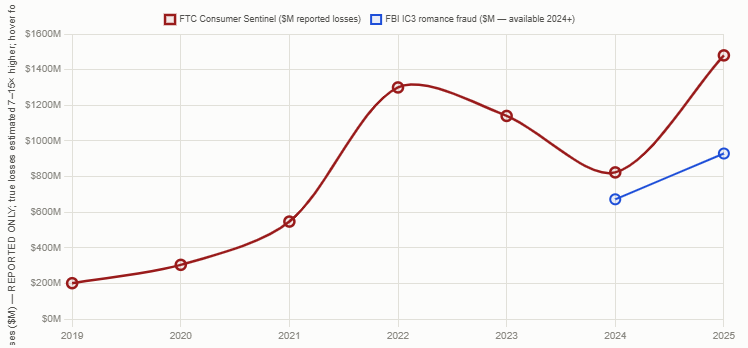
According to the FBI’s Internet Crime Complaint Center (IC3) 2025 Internet Crime Report, published in April 2026:
Critically, every published estimate of romance scam losses is a floor, not a ceiling. Only an estimated 7 to 15 percent of victims report to authorities. The National Endowment for Financial Education and consumer finance researchers consistently note that shame — particularly the shame of having been deceived in a romantic context — is the primary barrier to reporting. The true annual loss to romance fraud in the United States is almost certainly several times the billion-dollar figures in official data.
Romance scam losses 2025: $1.48bn (FTC) / $929.3m (FBI IC3, +38% year-over-year). Only 7–15% of victims report. $40,126: average FBI romance fraud loss per complaint in 2025. 63% of FBI romance losses from victims aged 60+. Nearly 60% of scams originate on social media (FTC April 2026). 80% of victims experience clinical stress or anxiety. 1 in 10 reports thoughts of self-harm.
What is remarkable is that 26 women collectively sent approximately $1.3 million to someone they met on a dating app, because that person had invested in a production apparatus — custom helmets, prop money, a fake bank account app, an 18-year-old co-conspirator, borrowed NFL footage, purchased social media followers — sufficient to make the story feel true across multiple layers of apparent verification. And what is more remarkable still is that this is not an unusual case. It is a case study in a fraud category that cost American consumers $1.48 billion in 2025 alone, growing at 22% per year, with only 7 to 15 percent of victims ever reporting.
The lesson of the Love case is not that the victims were naive. It is that the fraud was sophisticated. It exploited the specific trust-building mechanisms that human beings use to evaluate romantic partners — physical presence, emotional investment, social proof, third-party validation — and it engineered false versions of all of them simultaneously. The protective response is not more scepticism about people. It is a specific rule: money and investment tied to any romantic relationship, from any online-initiated contact, must be independently verified through institutional channels before a single dollar moves. That rule, applied consistently, stops the scheme at step three.
No. As of September 2026, Love and Taylor Chan have been charged with conspiracy to commit wire fraud and wire fraud by the US Department of Justice. Both are presumed innocent until proven guilty in a court of law. The charges were announced on 25 August 2026 following their arrest at Boise Airport on 24 August 2026. The case has been filed in the US District Court for the District of Oregon. Court proceedings including any formal plea, pretrial motions, and any trial will occur after the publication of this article. Readers seeking current case status should check the PACER federal court records system or follow reporting from national legal and sports media outlets.
Did Love actually play for the San Francisco 49ers?
No. The NFL and the San Francisco 49ers both confirmed to federal investigators that Daejon Love had never been employed by either organisation. Love was not a player, practice squad member, or employee of the NFL or any of its teams. Love's alleged NFL persona was entirely fabricated using social media content (including footage borrowed from real players), a custom-purchased helmet, staged workout videos, and other props. The fact that he was able to maintain this persona convincingly for more than four years — including having search engines and AI tools return results describing him as an NFL receiver — is a function of the scale of the false social media presence he allegedly constructed, not of any genuine athletic career.
How did the FBI identify the victims?
The FBI affidavit prepared by Special Agent Tyler Esswein does not detail all the investigative steps that led to the identification of the 26 victims, but publicly available information suggests the investigation involved examination of Love's iCloud account (which yielded evidence including videos of Love wearing 49ers gear and messages directing Chan to create false account documents), financial records (which revealed the helmet purchases, prop money company payments, and social media inflation services), and, presumably, reports from one or more victims. The FBI has stated it believes there are more victims beyond the 26 identified to date, and has implicitly invited additional victims to come forward.
What is wire fraud and what are the penalties?
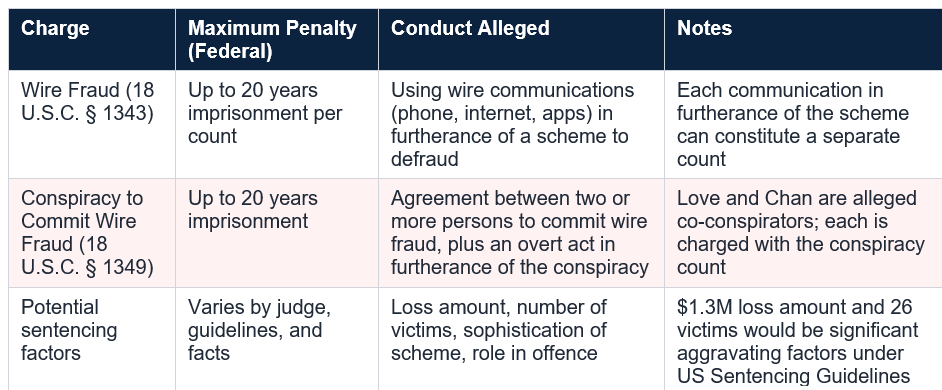
Wire fraud under 18 U.S.C. § 1343 is the use of wire communications — phone, internet, email, apps, electronic fund transfers — to execute a scheme to defraud. The maximum federal penalty for a single wire fraud conviction is 20 years imprisonment; this maximum applies per count, and multiple counts can be charged in a single indictment. The conspiracy to commit wire fraud charge carries the same maximum penalty. Actual sentencing in federal cases is guided by the US Sentencing Guidelines, which factor in the total loss amount, the number of victims, the sophistication of the scheme, the defendant's role, and prior criminal history. A $1.3 million fraud with 26 victims and an elaborate multi-year operation would be significant aggravating factors under the guidelines. Neither defendant has entered a plea as of publication.
What is 'pig butchering' and how does it relate to this case?
Pig butchering (or 'sha zhu pan' in Chinese) is a specific hybrid of romance fraud and investment fraud in which the romantic relationship is established first, then used as the delivery mechanism for a fraudulent investment proposition. The name refers to the practice of fattening a pig before slaughter — the extended trust-building period before the financial extraction. The Love case shares this structure: romantic relationship first, investment pitch second, money transfer third. The main difference from the most-reported pig butchering schemes (which tend to involve cryptocurrency platforms and are predominantly operated by organised crime networks in Southeast Asia) is that the Love scheme involved direct wire transfers rather than crypto, and used a manufactured physical celebrity identity rather than a purely online persona. The FBI recorded $394.8 million in cryptocurrency-related romance fraud losses in 2025 alone, but romance-investment schemes using non-crypto payment methods (such as the Love case) are not separately disaggregated in FBI reporting.
Where can I report a romance scam in the US?
FBI Internet Crime Complaint Center: IC3.gov (accepts reports from victims of internet crime including romance fraud, regardless of whether the victim is certain a crime has been committed). Federal Trade Commission: ReportFraud.ftc.gov (FTC consumer fraud reporting, used to build the national dataset and to take action against fraud operations). AARP Fraud Watch Network: aarp.org/fraudwatchnetwork (particularly helpful resources for older adults; free helpline: 1-877-908-3360). Your state attorney general's office also accepts fraud complaints and may have jurisdiction over state-level fraud charges. If you are in immediate financial distress or fear following a romance scam, contact the National Foundation for Credit Counseling (NFCC) at 1-800-388-2227 for financial guidance, or the Samaritans (1-800-273-8255) if you are experiencing emotional distress.
Table of Contents
- The Scale of the Alleged Scheme
- Who Is Daejon Labrayae Love?
- The Fake NFL Persona: Building the 49ers Lie
- The Props: Helmets, Prop Money and a Fake $30 Million Bank Account
- The Dating App Strategy: How Victims Were Found
- The Co-Conspirator: Taylor Jamie Chan, Age 18
- The Investment Hook: How Romantic Trust Became Financial Fraud
- When AI and Search Engines Validated a Lie
- How Long Did It Last — And Why Did It Work?
- The Arrest: Boise Airport, August 24, 2026
- The Charges: Wire Fraud and Conspiracy
- The Broader Picture: America’s Romance Scam Epidemic
- Romance Scam Red Flags: Lessons from the Love Case
- What to Do If You Think You’re Being Scammed
- Conclusion: The $1.48 Billion Fraud Nobody Talks About Enough
- Frequently Asked Questions
The Love Case: Alleged Scheme Timeline and Props
US Romance Scam Losses 2019 - 2015. the Epidemic in Numbers
The Scale of the Alleged Scheme
On 25 August 2026, the United States Department of Justice announced charges against a 35-year-old man from the Pacific Northwest who allegedly spent more than four years pretending to be a San Francisco 49ers wide receiver in order to defraud women he met on dating apps. The scale of what federal prosecutors allege is remarkable not just for the money involved — approximately $1.3 million taken from 26 identified victims — but for the production effort allegedly invested in maintaining the fiction.Custom football helmets. Purchases from a prop-money company. An app called Fake Bank Account Pro used to display fictitious bank balances, including one purportedly showing more than $30 million. Staged workout videos borrowing footage from real NFL players’ social media accounts. A fake contract-signing ceremony filmed in 49ers gear. An 18-year-old co-conspirator posing as his financial adviser on three-way FaceTime calls with prospective ‘investors.’
The case of Daejon Labrayae Love, arrested at Boise Airport on 24 August 2026 alongside Taylor Jamie Chan, has torn through both the sports media and consumer protection landscape in the days since. It is a case study in the mechanics of romance fraud, the psychology of trust-building, and the way that social media, AI tools, and the accessibility of digital props have lowered the barrier to executing a sophisticated financial crime. It is also, as this guide explains, far from an isolated incident.
26 identified victims. ~$1.3 million total losses. 4+ years of alleged operation (February 2022 – August 24, 2026). Arrested: Boise Airport, August 24, 2026. Charges: conspiracy to commit wire fraud and wire fraud (DOJ, August 25, 2026). FBI believes more than 26 victims may exist. Court: US District Court, District of Oregon. Both defendants presumed innocent.
Who Is Daejon Labrayae Love?
Daejon Labrayae Love, 35, is described in federal court documents as the architect of an elaborate, multi-year romance and investment fraud scheme. The FBI affidavit prepared by Special Agent Tyler Esswein details a persona constructed with considerable effort: Love was not simply claiming to be an NFL player in text messages. He was physically performing the role.The NFL and the San Francisco 49ers confirmed to investigators that Love had never been employed by either organisation. Love’s actual background is not described in publicly available court documents in detail, but the criminal complaint notes that the alleged scheme ran from at least February 2022 through March 2026 — and prosecutors say it continued up to the moment of his arrest in late August 2026. The FBI also noted a belief that there may be more than the 26 identified victims already discovered.
Love used multiple aliases across the scheme: Jon Love, Daejon Love, Avril Lyto Love, and Jordan Love, according to the FBI affidavit. The use of multiple identities is consistent with the need to operate across different platforms and victim networks without any single online profile becoming too visible or cross-referenced. He also sometimes presented himself not as an NFL player but as a wealthy Swiss real estate developer — an alternative cover story that served the same function: establishing wealth, status, and the credibility to invite investment.
The Fake NFL Persona: Building the 49ers Lie
The construction of a false NFL identity requires more than simply claiming to play for a team. Love’s alleged approach, as described in the FBI affidavit and subsequent reporting by OutKick, Revolt.TV, and the San Francisco Chronicle, was essentially that of a film production: he built a set, gathered props, created content, and distributed it on the platforms where his targets would be most likely to verify it.Key elements of the alleged NFL persona (per court documents and published reports):
- Social media presence: Love created and maintained social media accounts filled with 49ers imagery, training content, and lifestyle content consistent with that of an affluent professional athlete. He purchased social media followers, likes, and views to increase the apparent credibility and reach of these accounts. The accounts were convincing enough that, as of January 2026, searching ‘Daejon Love 49ers’ on a search engine returned a LinkedIn profile describing him as an NFL receiver.
- Training videos: Love allegedly borrowed footage from real NFL players’ social media highlights, screen-recording and sharing their content as if it were his own. He also staged his own workout sessions, including running routes on a beach while wearing 49ers gear. A San Francisco Chronicle report notes that when the 49ers appeared in the Super Bowl in 2024, Love reposted behind-the-scenes clips shared by real players as if he were the one recording them.
- Fake contract-signing ceremony: Love was filmed appearing to sign what he represented as an NFL contract, wearing 49ers gear and jewellery. In the video (obtained by OutKick), when asked which team he was joining, Love responded ‘Niners.’
- NFL player name-dropping: Love claimed friendships with current and former NFL players including Tyreek Hill, Antonio Brown, and John Brown, using these purported relationships to explain how he had received tryout invitations and team opportunities.
The Props: Helmets, Prop Money and a Fake $30 Million Bank Account
The most striking detail in the federal affidavit — and the one that captured the most public attention in the week following the charges — is that Love brought his custom-made San Francisco 49ers helmet to a restaurant for dinner. Social media images showed Love at a table, in regular clothing, with the helmet placed beside him. The image became a viral meme. It also illustrates a critical aspect of how the scheme allegedly worked: the props were not just for photographs. They were physical objects used to create real-world moments that seemed to validate the fiction.Financial records examined by federal investigators document the following purchases attributed to Love (per FBI affidavit; LawCommentary.com; OutKick):
- Custom football helmet seller: more than $1,160 in documented purchases. The helmet was found by investigators inside an Airbnb associated with Love following the August 24 arrests, along with $3,000 in cash and additional 49ers gear.
- Prop money company: Love made documented purchases from a company selling realistic-looking fake currency. The prop money was used in photographs and videos apparently designed to display personal wealth.
- Fake Bank Account Pro app: investigators say Love used this application to create fictitious banking interfaces displaying enormous balances. One purported account showed more than $30 million. On at least two documented occasions, Love directed Chan to create false account displays: a $3.4 million account balance in January 2024 and a stock account appearing to be worth $11 million in February 2024.
- Social media inflation services: documented payments to services selling social media followers, likes, and views. These purchases gave Love’s accounts a veneer of organic popularity and professional credibility.
The Dating App Strategy: How Victims Were Found
Love allegedly met the majority of his victims through online dating platforms. Court documents identify Tinder, Bumble, Hinge, and Facebook Dating as the primary apps used to make initial contact. Instagram and other social media platforms were also used.The geographic scope of the alleged victims spans four states — Oregon, Washington, Idaho, and California — which suggests Love was active across a wide geographic area either through travel or through purely online relationships conducted at distance. The Pacific Northwest appears to be the primary operating region, consistent with the Oregon federal filing and the Boise, Idaho arrest.
The affidavit’s account of the scheme’s first documented instance is illustrative of the timeline: within days of meeting a woman on a dating app in February 2022, Love allegedly told her to invest $10,000 with Chan. The speed of the financial ask — days, not months — is notable and consistent with the pattern the FBI has identified in romance-investment hybrid schemes more broadly: the romantic relationship and the financial proposition are run simultaneously from the beginning rather than sequentially.
The San Francisco Chronicle’s reporting, based on conversations with people familiar with the victims’ experiences, notes something important about why the scheme worked even on a sceptical level: ‘The scam didn’t work simply because of the image Love created. It worked because the women saw him. They met him. When they looked him up, Google searches and artificial intelligence tools sometimes appeared to validate his supposed connection to the 49ers.’ Physical presence and real-world meeting, which might be expected to expose a fraud, instead added an additional layer of credibility.
26 identified victims across Oregon, Washington, Idaho, and California. Platforms: Tinder, Bumble, Hinge, Facebook Dating, Instagram. The FBI believes more victims may exist. First documented incident: Feb 2022 — financial ask within days of initial dating app contact. Average implied loss per victim: ~$50,000. Scheme continued until arrest on Aug 24, 2026.
The Co-Conspirator: Taylor Jamie Chan, Age 18
One of the most unusual details of the case is the involvement of Taylor Jamie Chan, 18, who is charged alongside Love with conspiracy to commit wire fraud and wire fraud. The affidavit notes that Chan was 18 at time of arrest in August 2026, but that the alleged offense window begins in February 2022 — which means Chan would have been approximately 13 or 14 years old when the scheme allegedly began.Prosecutors allege Chan’s role was to pose as Love’s personal financial adviser. This involved:
- Joining three-way FaceTime calls with victims in which Chan performed the role of a professional financial adviser, displaying purported investment gains to make the opportunity appear legitimate and supervised.
- Creating fictitious investment account statements and balance displays at Love’s direction. iCloud messages recovered by investigators showed Love directing Chan to generate specific false account values: a $3.4 million account in January 2024 and an $11 million stock account in February 2024.
- Communicating with victims about fictitious investment opportunities to build confidence in the returns they were supposedly receiving.
The Investment Hook: How Romantic Trust Became Financial Fraud
The structure of the Love-Chan scheme combines two established fraud categories: romance fraud and investment fraud. This combination — increasingly known as ‘pig butchering’ in its more organised, cryptocurrency-focused form — is now the highest-damage variant of online financial fraud, precisely because it uses the emotional foundations of a romantic relationship to bypass the scepticism that most people would otherwise apply to investment propositions.The sequence alleged in the affidavit follows a consistent pattern across multiple victims:
- Step 1 — Initial romantic contact: Love meets the victim on a dating app, establishes regular communication, builds emotional connection, and creates the impression of a sincere romantic relationship. The FBI affidavit states that Love ‘convinced many of his victims that they were in sincere romantic relationships with him and that he was financially savvy and successful to gain their trust.’
- Step 2 — Wealth establishment: Love presents his NFL persona, lifestyle props (luxury cars, designer goods, the helmet), and fabricated financial accounts to establish the impression of exceptional wealth and financial sophistication.
- Step 3 — Investment opportunity: Love tells the victim he wants to ‘build more wealth together.’ He introduces Chan as his trusted financial adviser. Chan creates fictitious investment accounts and joins calls to validate the opportunity.
- Step 4 — Money transfer: the victim sends money, believing she is investing alongside a wealthy, successful professional partner who has her financial interests at heart.
- Step 5 — False returns: Chan displays fabricated investment gains on FaceTime calls. The victim sees her ‘portfolio’ growing. This generates further investment and delays any concern about the legitimacy of the scheme.
When AI and Search Engines Validated a Lie
One of the most significant details in the San Francisco Chronicle’s reporting on the Love case is what happened when victims independently tried to verify Love’s NFL identity. When investigators searched ‘Daejon Love 49ers’ in January 2026, they found a LinkedIn profile describing him as an NFL receiver. The SF Chronicle notes that ‘Google searches and artificial intelligence tools sometimes appeared to validate his supposed connection to the 49ers’ — with investigators attributing the errors to AI and search systems aggregating Love’s own false social media representations.This represents a new and genuinely alarming dimension of online fraud. For decades, the standard consumer protection advice has been: if you are unsure about someone you met online, search for them. Verify their claims. Look for external validation. What the Love case demonstrates is that, at sufficient scale of social media deception — enough fake followers, enough content, enough activity across enough platforms — an individual can engineer their own false search results, and AI tools trained on that content will reflect the fiction back as apparent fact.
Harris County Sheriff Ed Gonzalez, quoted by KHOU.com in his public warning following the Love charges, made this explicit: ‘Artificial intelligence is making it easier to create convincing fake photos, voices and videos.’ The Love case did not require AI-generated deepfakes — the tools used were more prosaic (bought followers, borrowed footage, a prop helmet). But the AI aggregation of false content into apparently verified search results is a genuinely new risk factor that traditional verification advice does not address.
The Love case reveals a critical gap in standard romance scam protection advice. 'Look them up' — the most widely recommended verification step — becomes unreliable when the scammer has invested enough in their false online presence that search engines and AI tools validate the fabrication. Victim responsibility framing is unhelpful here: sophisticated fraud exploits systems, not just individuals.
How Long Did It Last — And Why Did It Work?
The alleged scheme ran from February 2022 to August 24, 2026 — approximately four and a half years. That is a remarkably long operational window for a fraud of this specificity, involving a named, photographed, physically present individual operating in relatively constrained geographic markets (Oregon, Washington, Idaho, California). Understanding why it was sustained for so long is as important as understanding how it was structured.Several factors contributed to the scheme’s longevity, based on the publicly available case materials:
- Physical meetings: Love allegedly met many victims in person. The physical reality of meeting someone, seeing them, spending time with them, creates a psychological reality that is very difficult to reconcile with the idea that they are deceiving you. Most online fraud operates entirely at digital distance; physical presence makes scepticism feel like paranoia.
- Emotional investment: by the time the financial proposition arrived, victims had already invested emotional energy in the relationship. Cognitive dissonance — the discomfort of holding incompatible beliefs simultaneously — makes it psychologically easier to believe the investment is real than to accept that the entire relationship was constructed.
- Under-reporting: romance fraud is among the most under-reported crime categories. Estimates suggest only 7 to 15 percent of victims report to authorities, primarily because of the shame and embarrassment attached to having been deceived in a romantic context. Victims who did not report enabled the scheme to continue targeting new victims on the same platforms.
- Compartmentalisation: with victims across four states and multiple platforms, there was no mechanism for victims to compare notes and discover that others had experienced the identical approach. The geographic and platform spread that maximised the victim pool also minimised the risk of exposure through victim communication.
The Arrest: Boise Airport, August 24, 2026
Love and Chan were arrested together on Monday, 24 August 2026, at Boise Airport in Idaho. The timing of the arrest at a transport hub is consistent with investigators apprehending individuals who may have been in transit or who were attempting to leave the area. The specific circumstances of what led investigators to the Boise Airport on that date have not been detailed in publicly available filings.When agents arrested Love, he was reportedly wearing 49ers apparel. A subsequent search of an Airbnb associated with Love turned up $3,000 in cash and 49ers gear, including the custom helmet that had featured so prominently in his social media presence. The in-character nature of the arrest — still wearing the team gear at the moment of apprehension — quickly became the most-shared detail in sports media coverage of the case.
In a separate Idaho filing, prosecutors asked a judge to detain Love pending his transfer to Oregon to face the federal charges. The case was filed in the US District Court for the District of Oregon, consistent with the significant concentration of alleged victims in that state.
The Charges: Wire Fraud and Conspiracy
Both Love and Chan face identical federal charges: conspiracy to commit wire fraud and wire fraud. The charges were announced by the US Department of Justice on 25 August 2026 — the day after the Boise Airport arrests.Both defendants are presumed innocent and have not yet entered formal pleas as of the publication of this article. The charges represent the government’s allegations; the facts will be tested in court proceedings.
The Broader Picture: America’s Romance Scam Epidemic
The Love case is exceptional in its detail and production quality. The scale of the romance fraud problem it sits within is not exceptional at all. It is, if anything, accelerating.According to the FBI’s Internet Crime Complaint Center (IC3) 2025 Internet Crime Report, published in April 2026:
- 23,159 complaints of confidence fraud and romance scams were recorded in 2025, with losses totalling $929.3 million — a 38% increase in a single year (after $672 million in 2024 and $652.5 million in 2023).
- Victims aged 60 and older accounted for $584 million of those losses — 63% of the total — despite representing a minority of internet users.
- Cryptocurrency was involved in 5,925 romance fraud complaints, representing $394.8 million in losses (42% of all romance fraud losses by value).
- 626 romance fraud complaints in 2025 had a documented AI component, representing $19 million in losses — a figure expected to grow substantially as AI tools become cheaper and more accessible.
Critically, every published estimate of romance scam losses is a floor, not a ceiling. Only an estimated 7 to 15 percent of victims report to authorities. The National Endowment for Financial Education and consumer finance researchers consistently note that shame — particularly the shame of having been deceived in a romantic context — is the primary barrier to reporting. The true annual loss to romance fraud in the United States is almost certainly several times the billion-dollar figures in official data.
Romance scam losses 2025: $1.48bn (FTC) / $929.3m (FBI IC3, +38% year-over-year). Only 7–15% of victims report. $40,126: average FBI romance fraud loss per complaint in 2025. 63% of FBI romance losses from victims aged 60+. Nearly 60% of scams originate on social media (FTC April 2026). 80% of victims experience clinical stress or anxiety. 1 in 10 reports thoughts of self-harm.
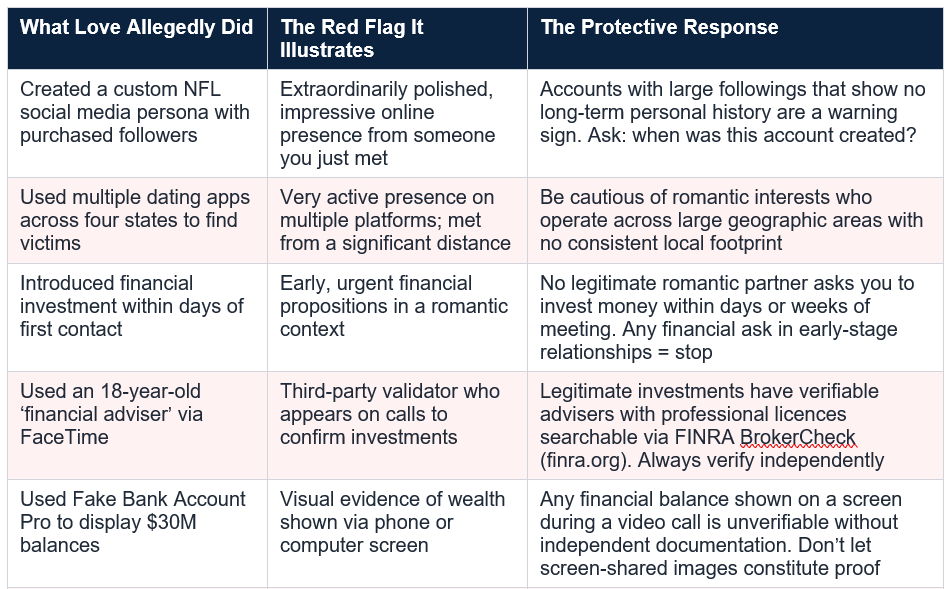
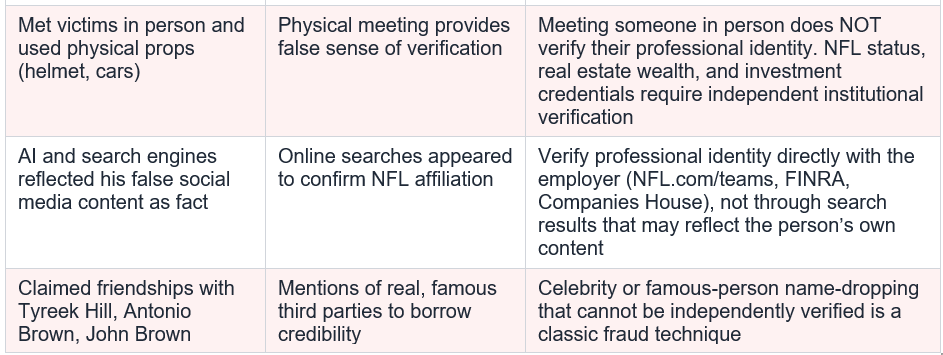
Romance Scam Red Flags: Lessons from the Love Case
The Love case illustrates, with unusual clarity, the specific elements that romance fraud uses to establish credibility. Each element has a corresponding warning sign:
What to Do If You Think You’re Being Scammed
If you are in a situation that shares characteristics with the Love case — a romantic interest asking for money or investment, an online relationship with someone who has never been verifiable through institutional channels, or a financial proposition tied to a romantic context — the following steps are recommended:- Do not send any more money. Do not invest any additional funds. Even if you have already sent money, stopping further losses is the immediate priority.
- Independently verify the person’s professional identity directly with the institution they claim to represent. For NFL player claims: the NFL and each team have official rosters at NFL.com. For financial adviser claims: FINRA BrokerCheck (brokercheck.finra.org) lists all licensed investment advisers and any disciplinary history. For real estate developer claims: company registration can be verified through official company registries.
- Do not rely on social media, search engine results, or AI responses as verification. As the Love case demonstrates, sufficiently manipulated online content can generate false search results and AI validation.
- Report to the FBI Internet Crime Complaint Center (IC3) at IC3.gov. Even if you are not certain a crime has been committed, reporting provides investigators with pattern data that may help identify and stop active schemes.
- Report to the FTC at ReportFraud.ftc.gov.
- If you have suffered financial losses, contact your bank or financial institution immediately. Wire transfers and card payments have limited reversal windows, but early reporting maximises the possibility of recovery.
- If you are experiencing distress as a result of a romance fraud, contact the National Romance Fraud Helpline or speak to your GP. 80% of victims experience clinical levels of stress or anxiety, and 1 in 10 reports thoughts of self-harm. These are recognised and treated conditions, and support is available.
Conclusion
The story of Daejon Labrayae Love has generated significant media coverage in the week since his August 24, 2026 arrest, mostly focused on the absurdist details: the restaurant dinner with the helmet on the table, the viral mug shot, the internet’s response. These details are genuinely remarkable. They should not distract from what is actually remarkable about the case.What is remarkable is that 26 women collectively sent approximately $1.3 million to someone they met on a dating app, because that person had invested in a production apparatus — custom helmets, prop money, a fake bank account app, an 18-year-old co-conspirator, borrowed NFL footage, purchased social media followers — sufficient to make the story feel true across multiple layers of apparent verification. And what is more remarkable still is that this is not an unusual case. It is a case study in a fraud category that cost American consumers $1.48 billion in 2025 alone, growing at 22% per year, with only 7 to 15 percent of victims ever reporting.
The lesson of the Love case is not that the victims were naive. It is that the fraud was sophisticated. It exploited the specific trust-building mechanisms that human beings use to evaluate romantic partners — physical presence, emotional investment, social proof, third-party validation — and it engineered false versions of all of them simultaneously. The protective response is not more scepticism about people. It is a specific rule: money and investment tied to any romantic relationship, from any online-initiated contact, must be independently verified through institutional channels before a single dollar moves. That rule, applied consistently, stops the scheme at step three.
Frequently Asked Questions
Has Daejon Love been convicted?No. As of September 2026, Love and Taylor Chan have been charged with conspiracy to commit wire fraud and wire fraud by the US Department of Justice. Both are presumed innocent until proven guilty in a court of law. The charges were announced on 25 August 2026 following their arrest at Boise Airport on 24 August 2026. The case has been filed in the US District Court for the District of Oregon. Court proceedings including any formal plea, pretrial motions, and any trial will occur after the publication of this article. Readers seeking current case status should check the PACER federal court records system or follow reporting from national legal and sports media outlets.
Did Love actually play for the San Francisco 49ers?
No. The NFL and the San Francisco 49ers both confirmed to federal investigators that Daejon Love had never been employed by either organisation. Love was not a player, practice squad member, or employee of the NFL or any of its teams. Love's alleged NFL persona was entirely fabricated using social media content (including footage borrowed from real players), a custom-purchased helmet, staged workout videos, and other props. The fact that he was able to maintain this persona convincingly for more than four years — including having search engines and AI tools return results describing him as an NFL receiver — is a function of the scale of the false social media presence he allegedly constructed, not of any genuine athletic career.
How did the FBI identify the victims?
The FBI affidavit prepared by Special Agent Tyler Esswein does not detail all the investigative steps that led to the identification of the 26 victims, but publicly available information suggests the investigation involved examination of Love's iCloud account (which yielded evidence including videos of Love wearing 49ers gear and messages directing Chan to create false account documents), financial records (which revealed the helmet purchases, prop money company payments, and social media inflation services), and, presumably, reports from one or more victims. The FBI has stated it believes there are more victims beyond the 26 identified to date, and has implicitly invited additional victims to come forward.
What is wire fraud and what are the penalties?
Wire fraud under 18 U.S.C. § 1343 is the use of wire communications — phone, internet, email, apps, electronic fund transfers — to execute a scheme to defraud. The maximum federal penalty for a single wire fraud conviction is 20 years imprisonment; this maximum applies per count, and multiple counts can be charged in a single indictment. The conspiracy to commit wire fraud charge carries the same maximum penalty. Actual sentencing in federal cases is guided by the US Sentencing Guidelines, which factor in the total loss amount, the number of victims, the sophistication of the scheme, the defendant's role, and prior criminal history. A $1.3 million fraud with 26 victims and an elaborate multi-year operation would be significant aggravating factors under the guidelines. Neither defendant has entered a plea as of publication.
What is 'pig butchering' and how does it relate to this case?
Pig butchering (or 'sha zhu pan' in Chinese) is a specific hybrid of romance fraud and investment fraud in which the romantic relationship is established first, then used as the delivery mechanism for a fraudulent investment proposition. The name refers to the practice of fattening a pig before slaughter — the extended trust-building period before the financial extraction. The Love case shares this structure: romantic relationship first, investment pitch second, money transfer third. The main difference from the most-reported pig butchering schemes (which tend to involve cryptocurrency platforms and are predominantly operated by organised crime networks in Southeast Asia) is that the Love scheme involved direct wire transfers rather than crypto, and used a manufactured physical celebrity identity rather than a purely online persona. The FBI recorded $394.8 million in cryptocurrency-related romance fraud losses in 2025 alone, but romance-investment schemes using non-crypto payment methods (such as the Love case) are not separately disaggregated in FBI reporting.
Where can I report a romance scam in the US?
FBI Internet Crime Complaint Center: IC3.gov (accepts reports from victims of internet crime including romance fraud, regardless of whether the victim is certain a crime has been committed). Federal Trade Commission: ReportFraud.ftc.gov (FTC consumer fraud reporting, used to build the national dataset and to take action against fraud operations). AARP Fraud Watch Network: aarp.org/fraudwatchnetwork (particularly helpful resources for older adults; free helpline: 1-877-908-3360). Your state attorney general's office also accepts fraud complaints and may have jurisdiction over state-level fraud charges. If you are in immediate financial distress or fear following a romance scam, contact the National Foundation for Credit Counseling (NFCC) at 1-800-388-2227 for financial guidance, or the Samaritans (1-800-273-8255) if you are experiencing emotional distress.

0 Comments Comments