

Real Estate
Fixed-Rate vs. Variable-Rate HELOC: Which Is Better?

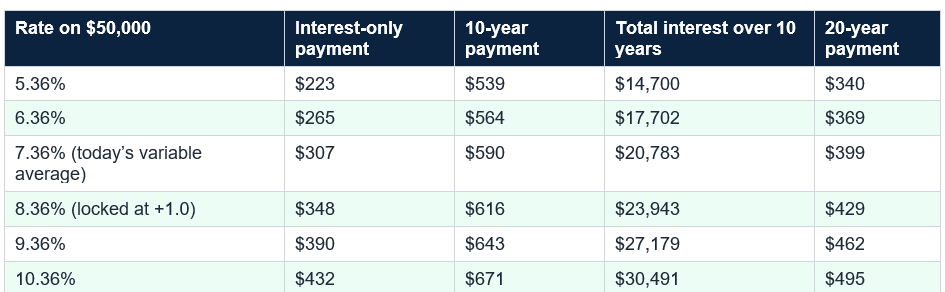
Average HELOC 7.34%–7.36% (Bankrate); 7.54%–7.67% (Curinos); 10-year fixed home equity loan 8.70% (Bankrate) vs 7.50%–7.76% (Curinos); prime rate 7.00% after the September 16 Fed hike; early-2025 HELOC average near 9%. Fixed-rate lock premium: about 0.50%–1.25% above the variable rate (industry guide). 30-year mortgage 7.40%; credit cards about 21%. My illustration on $50,000 (10-year payoff): about $20,783 of interest at a flat 7.36% variable rate vs $23,943 at a locked 8.36%; the variable wins unless rates rise about 1 point or more early on. Interest-only payment: $307 a month at 7.36%, plus about $42 for each 1 point.
Mortgage rates are also high, 7.40% in mid-October, and many homeowners hold much cheaper first mortgages they do not want to give up, which makes borrowing against equity attractive. This guide explains how both kinds of HELOC work, shows the payment math in dollars and helps you decide which fits.
Most HELOCs carry a variable rate tied to the prime rate plus a margin, roughly 0.50% to 1% above prime in some sources and prime plus 0% to 2% in another, depending on credit and loan-to-value. Because prime moves with the Fed, your rate can change after each Fed decision. Many lenders also allow you to lock some or all of your balance at a fixed rate for a set term.
What explains it? Different borrower profiles and methods: better credit and more equity earn lower rates, and fixed rates reflect longer-term Treasury yields. Do not rely on national averages; get quotes for your own credit and equity and compare fixed and variable directly. For context, HELOC averages were closer to 9% at the start of 2025, according to Experian, and hit a 2026 low of 7.09% in early October before rising again.
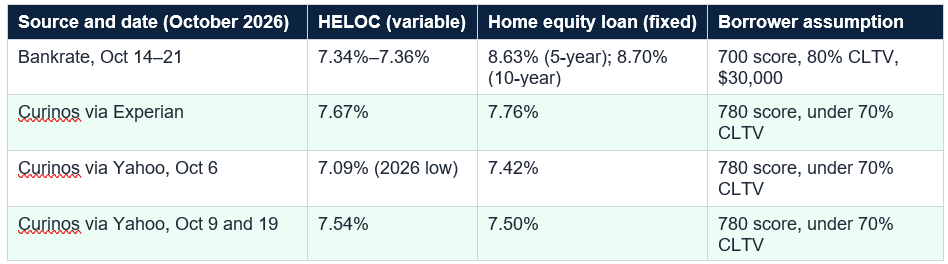
Prime rate 7.00% after the September 16 Fed hike. Average HELOC: 7.34%–7.36% (Bankrate) to 7.54%–7.67% (Curinos). Fixed home equity loan: 7.50%–7.76% (Curinos) to 8.63%–8.70% (Bankrate). Early 2025: HELOCs near 9%.
The case against is exposure to rising rates and payment shock. Each one-point rise adds about $42 a month in interest-only payments on a $50,000 balance, and the end of the draw period can push the payment up even if rates stand still. Check the lifetime rate cap in your agreement; lenders must disclose it, and it may be far above today’s rate.
The trade-offs are cost and flexibility. You usually pay a higher rate, may pay lock or conversion fees and often cannot re-borrow the locked amount until it is repaid. With a home equity loan, you borrow the full amount on day one and pay interest on all of it, but your payment cannot rise. For a large expense repaid over many years, that predictability can be worth the premium.
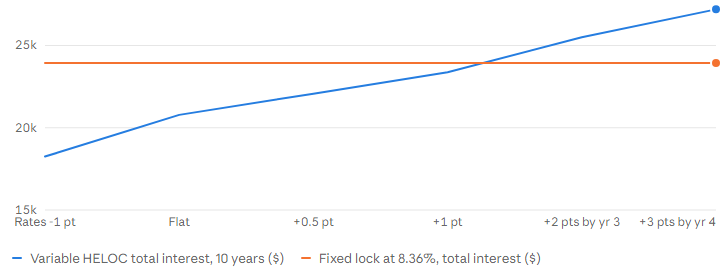
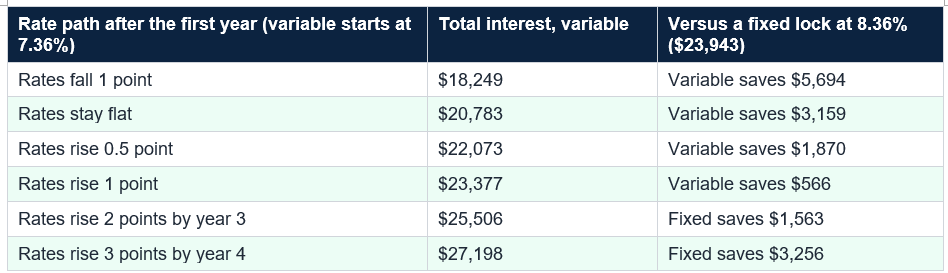
Now compare paths, assuming a lock at 8.36%, one point above the variable rate. If rates stay flat, the variable line costs about $3,159 less in interest over ten years; if they fall a point, about $5,694 less. If they rise half a point after year one, the variable still saves about $1,870, and a full point still leaves it $566 ahead. The fixed lock wins if rates rise about two points by year three (saving about $1,563) or three points by year four (about $3,256). The variable rate wins unless rates rise meaningfully and early.
This is an illustration with simplified assumptions: a $50,000 balance, ten-year amortization, annual rate resets and a lock premium of one point. Real HELOCs have different draw schedules, caps and fees. The point is the shape: variable is cheaper unless rates climb meaningfully, and fixed is insurance against that.
Ask your lender: What is my margin over prime, and what is the lifetime cap? Can I lock part of the balance, and at what rate premium and fee? What is the minimum lock amount and term? Can I re-borrow after repaying a locked portion? What are all the fees, and what happens when the draw period ends?
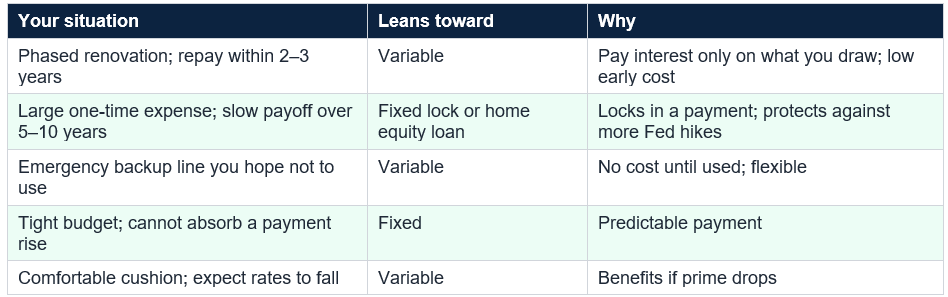
Match the rate to the job. Use variable for short, phased borrowing you can repay quickly. Use fixed, or a lock on the core balance, for large amounts you will carry for years, or if a payment increase would strain your budget. Shop around, compare quotes for your own credit and equity, read the fine print and remember that your home is the collateral. This is general education, not personalized advice, and a qualified adviser can help you decide.
It depends on how much you borrow, how fast you will repay and how much payment change you can absorb. A variable rate is usually cheaper at the start, and Bankrate’s survey average was 7.34% to 7.36% in mid-October. But the Fed raised rates in September and another hike is possible, so a fixed rate protects you from further increases on a large balance you will carry for years.
How does a fixed-rate HELOC work?
Most HELOCs are variable, but many lenders let you lock all or part of your balance at a fixed rate for a set term, often with a fee and a rate premium. One 2026 industry guide puts a locked portion at about 0.50% to 1.25% above the variable rate. The locked amount is typically repaid on a schedule, so the payment is predictable.
What is the HELOC rate based on?
Usually the prime rate plus a margin set by the lender. The prime rate is 7.00% after the Fed’s September increase, since prime moves with the federal funds target. Other sources describe margins of roughly half a point to a point or two above prime, depending on your credit and equity.
Is a home equity loan better than a HELOC?
A home equity loan gives you a lump sum at a fixed rate with fixed payments, which suits a single large expense. A HELOC is a revolving line you can draw from as needed, usually at a variable rate. Surveys disagree on the gap: Bankrate’s survey shows a 10-year home equity loan at 8.70% versus a 7.34% HELOC, while Curinos data show them nearly tied at about 7.50%.
What are the main risks of a HELOC?
Your home is the collateral, so missing payments can put it at risk. Variable payments can rise, interest-only periods end with a larger payment, and lenders can freeze or reduce a line in some circumstances. Fees, caps and conversion terms differ, so read the agreement. This is general education, not personalized advice.
Table of Contents
- A Decision With Real Money on the Line
- The Short Answer
- How a HELOC Works
- Where Rates Stand Today
- The Variable-Rate HELOC
- The Fixed-Rate Option
- The Math on $50,000
- Who Should Choose Which
- The Hybrid Approach
- Alternatives Worth Comparing
- The Fine Print
- Questions to Ask Yourself
- Mistakes to Avoid
- Conclusion
- Frequently Asked Questions
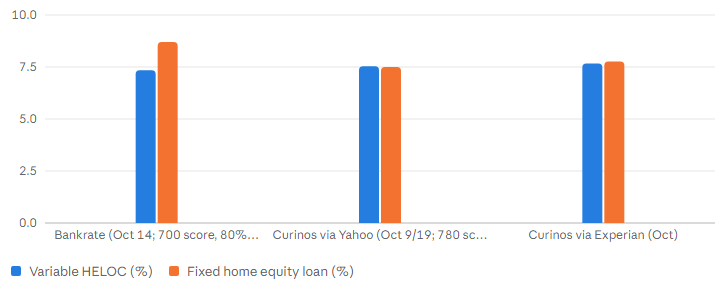
Surveys disagree: average HELOC vs. fixed home equity loan rate, Oct 2026 (%)
Average rate (%) by Gap depends on borrower profile and survey method; get quotes for your own credit and equity
Variable vs. fixed lock: total interest on $50,000 over 10 years, by rate path ($)
Total interest paid ($) by Author's illustration: variable starts at 7.36%, lock at 8.36%, annual resets; fixed wins only if rates rise about 2 points
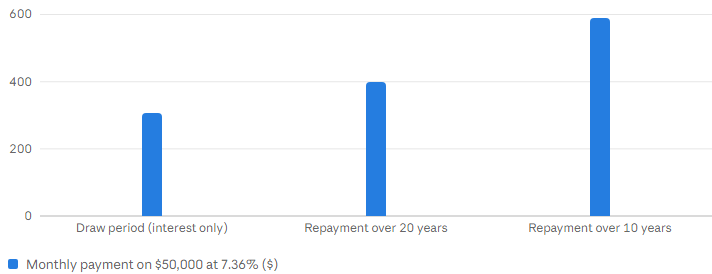
Payment shock when the draw period ends: $50,000 at 7.36% ($ a month)
A Decision With Real Money on the Line
You have equity in your home, a project that needs funding and a lender asking a question that sounds technical but is really about your nerves: fixed rate or variable? In 2026 it carries extra weight. The Federal Reserve raised its target range to 3.75%–4.00% on September 16, Reuters reported in mid-October that another hike was back on the table and the prime rate that most HELOCs follow rose to 7.00%.Mortgage rates are also high, 7.40% in mid-October, and many homeowners hold much cheaper first mortgages they do not want to give up, which makes borrowing against equity attractive. This guide explains how both kinds of HELOC work, shows the payment math in dollars and helps you decide which fits.
The Short Answer
A variable-rate HELOC is usually cheaper at the start and works best if you will borrow in stages and repay within a few years. A fixed rate, through a lock on part of the balance or a home equity loan, costs more upfront but protects you from increases and suits a large amount you will carry for years. In my $50,000 illustration, the variable rate wins unless rates rise about a point soon after you borrow. What matters is how much payment change you can absorb.How a HELOC Works
A home equity line of credit is a revolving line secured by your home, usually with two phases. During the draw period, commonly around ten years, you borrow as needed and often pay only interest. Then comes the repayment period, often 10 to 20 years, when you can no longer draw and must repay principal and interest. That switch can bring a big jump in the monthly payment.Most HELOCs carry a variable rate tied to the prime rate plus a margin, roughly 0.50% to 1% above prime in some sources and prime plus 0% to 2% in another, depending on credit and loan-to-value. Because prime moves with the Fed, your rate can change after each Fed decision. Many lenders also allow you to lock some or all of your balance at a fixed rate for a set term.
Where Rates Stand Today
Surveys give different numbers, and the difference is itself useful. Bankrate’s survey put the average HELOC rate at 7.34% on October 14 and 7.36% on October 21, based on a $30,000 line, a 700 credit score and 80% combined loan-to-value. At the same time, Bankrate had a 5-year home equity loan at 8.63% and a 10-year at 8.70%, a gap of about 1.3 points. Curinos data, which Experian and Yahoo Finance report, show an average HELOC at 7.54% to 7.67% and a fixed home equity loan at 7.50% to 7.76%, essentially a tie. Curinos uses borrowers with a 780 score and under 70% combined loan-to-value.What explains it? Different borrower profiles and methods: better credit and more equity earn lower rates, and fixed rates reflect longer-term Treasury yields. Do not rely on national averages; get quotes for your own credit and equity and compare fixed and variable directly. For context, HELOC averages were closer to 9% at the start of 2025, according to Experian, and hit a 2026 low of 7.09% in early October before rising again.
Prime rate 7.00% after the September 16 Fed hike. Average HELOC: 7.34%–7.36% (Bankrate) to 7.54%–7.67% (Curinos). Fixed home equity loan: 7.50%–7.76% (Curinos) to 8.63%–8.70% (Bankrate). Early 2025: HELOCs near 9%.
The Variable-Rate HELOC
The case for variable is simple: it is usually the cheapest way in and rewards short, flexible borrowing. You pay interest only on what you draw, so a line used for a phased renovation costs little until the money is spent. If rates fall, your payment falls automatically, and you can repay and re-borrow during the draw period.The case against is exposure to rising rates and payment shock. Each one-point rise adds about $42 a month in interest-only payments on a $50,000 balance, and the end of the draw period can push the payment up even if rates stand still. Check the lifetime rate cap in your agreement; lenders must disclose it, and it may be far above today’s rate.
The Fixed-Rate Option
A fixed rate gives you what a variable rate cannot: certainty. One route is a fixed-rate lock or conversion on a HELOC, where you convert all or part of a drawn balance to a fixed rate and repayment schedule; one 2026 industry guide puts the locked portion around 0.50% to 1.25% above the variable rate. The other is a home equity loan, a lump sum at a fixed rate with fixed payments. Experian’s example shows $50,000 at 7.76% over ten years costs $600.32 a month and $22,038 in total interest.The trade-offs are cost and flexibility. You usually pay a higher rate, may pay lock or conversion fees and often cannot re-borrow the locked amount until it is repaid. With a home equity loan, you borrow the full amount on day one and pay interest on all of it, but your payment cannot rise. For a large expense repaid over many years, that predictability can be worth the premium.
The Math on $50,000
Here is my own illustration. Suppose you owe $50,000 and plan to repay it over ten years. At a variable rate of 7.36%, the interest-only payment is about $307 a month and a ten-year amortizing payment about $590, with about $20,783 of interest if the rate never changes. Each additional point adds about $42 a month to the interest-only payment and about $26 to the amortizing payment.Now compare paths, assuming a lock at 8.36%, one point above the variable rate. If rates stay flat, the variable line costs about $3,159 less in interest over ten years; if they fall a point, about $5,694 less. If they rise half a point after year one, the variable still saves about $1,870, and a full point still leaves it $566 ahead. The fixed lock wins if rates rise about two points by year three (saving about $1,563) or three points by year four (about $3,256). The variable rate wins unless rates rise meaningfully and early.
This is an illustration with simplified assumptions: a $50,000 balance, ten-year amortization, annual rate resets and a lock premium of one point. Real HELOCs have different draw schedules, caps and fees. The point is the shape: variable is cheaper unless rates climb meaningfully, and fixed is insurance against that.
Who Should Choose Which
Choose variable if you will draw in stages, such as a multi-month renovation, repay within a few years, want a flexible line for uncertain expenses and can absorb a payment increase of $40 to $100 a month on $50,000. Choose fixed if you are borrowing a large amount for a one-time purpose, such as consolidating debt or paying tuition, plan to carry the balance for five to ten years or more, run a tight budget or simply value certainty.
The Hybrid Approach
You do not have to choose one. Many lenders let you keep a variable line and lock a portion at a fixed rate. You might draw $50,000, lock $30,000 you plan to repay slowly and leave $20,000 variable to pay down quickly. That gives certainty on the core balance and flexibility on the rest. Ask how many locks are allowed, the minimum amount, the fee, the term and what happens to your available credit.Alternatives Worth Comparing
A HELOC is not the only way to tap equity. A cash-out refinance replaces your first mortgage, and with the average 30-year rate at 7.40%, it could mean swapping a much cheaper loan. A home equity loan offers fixed payments without touching the first mortgage. A personal loan avoids using your house as collateral but typically costs more. And if you carry credit card debt near 21%, a HELOC at 7% to 8% could save a lot of interest, though it converts unsecured debt into debt secured by your home.The Fine Print
Read the agreement for costs beyond the rate: appraisal, application or closing fees, annual fees, inactivity fees and early-closure charges. Check the draw and repayment periods, the minimum payment during the draw, whether the lender can freeze or reduce your line and the lifetime rate cap. On taxes, interest on home equity debt is generally deductible only when the money is used to buy, build or substantially improve the home that secures it, subject to limits, per the IRS; confirm with a tax professional.Ask your lender: What is my margin over prime, and what is the lifetime cap? Can I lock part of the balance, and at what rate premium and fee? What is the minimum lock amount and term? Can I re-borrow after repaying a locked portion? What are all the fees, and what happens when the draw period ends?
Questions to Ask Yourself
Before you sign, ask yourself: How long will I realistically carry this balance? What is the highest payment I could handle if rates rose two points? Could I pay off the line quickly if I had to? Is the purpose worth putting my home at risk? What is my plan if my income drops? If the answers make you uneasy, choose a smaller amount, a fixed rate or neither. Do not look only at the starting rate: a low teaser can reset, and the end of the draw period can raise your payment. Do not borrow the maximum just because it is available. Do not ignore the cap, the fees or the lender’s right to freeze the line. And do not assume today’s rate will last: a variable rate is a bet on the Fed, which can go either way.Conclusion
So, which is better? A variable rate is usually cheaper and more flexible, with averages near 7.3% to 7.7% in October, while a fixed rate costs more, often 0.50 to 1.25 points more on a locked portion, and buys certainty. In my $50,000 illustration, the variable wins unless rates rise a point or more soon after you borrow, and the fixed lock pays off only if rates climb two or three points. With the Fed having just hiked, the risk is real but not certain.Match the rate to the job. Use variable for short, phased borrowing you can repay quickly. Use fixed, or a lock on the core balance, for large amounts you will carry for years, or if a payment increase would strain your budget. Shop around, compare quotes for your own credit and equity, read the fine print and remember that your home is the collateral. This is general education, not personalized advice, and a qualified adviser can help you decide.
Frequently Asked Questions
Is a fixed-rate or variable-rate HELOC better right now?It depends on how much you borrow, how fast you will repay and how much payment change you can absorb. A variable rate is usually cheaper at the start, and Bankrate’s survey average was 7.34% to 7.36% in mid-October. But the Fed raised rates in September and another hike is possible, so a fixed rate protects you from further increases on a large balance you will carry for years.
How does a fixed-rate HELOC work?
Most HELOCs are variable, but many lenders let you lock all or part of your balance at a fixed rate for a set term, often with a fee and a rate premium. One 2026 industry guide puts a locked portion at about 0.50% to 1.25% above the variable rate. The locked amount is typically repaid on a schedule, so the payment is predictable.
What is the HELOC rate based on?
Usually the prime rate plus a margin set by the lender. The prime rate is 7.00% after the Fed’s September increase, since prime moves with the federal funds target. Other sources describe margins of roughly half a point to a point or two above prime, depending on your credit and equity.
Is a home equity loan better than a HELOC?
A home equity loan gives you a lump sum at a fixed rate with fixed payments, which suits a single large expense. A HELOC is a revolving line you can draw from as needed, usually at a variable rate. Surveys disagree on the gap: Bankrate’s survey shows a 10-year home equity loan at 8.70% versus a 7.34% HELOC, while Curinos data show them nearly tied at about 7.50%.
What are the main risks of a HELOC?
Your home is the collateral, so missing payments can put it at risk. Variable payments can rise, interest-only periods end with a larger payment, and lenders can freeze or reduce a line in some circumstances. Fees, caps and conversion terms differ, so read the agreement. This is general education, not personalized advice.
0 Comments
Be the first to share your thoughts on this article.