

Professional & Career Development
Gen Z Jobs Fastest Path to a High Paycheck

47% of trade workers now out-earn the median bachelor’s degree holder. Youth unemployment hit 9.5% in 2026. An electrician who starts a union apprenticeship at 18 arrives at 30 approximately $250,000 ahead of a business graduate who started at the same age. The traditional four-year-degree-to-career route is not the only path — and for a growing share of Gen Z, it is not the fastest. Here are the jobs offering the most direct route from starting point to solid, sustainable income.

Americans now owe more than $1.77 trillion in student loan debt across approximately 43 million borrowers. The average bachelor’s degree holder leaves school owing around $39,000 before interest (Education Data Initiative, cited TradeColleges.org, May 2026). Youth unemployment hit 9.5% in 2026, meaning a significant proportion of young adults who followed the prescribed path are discovering the credential does not automatically produce the career. Meanwhile, 47% of workers with trade credentials now out-earn the median bachelor’s degree holder — up from approximately 30% a decade ago (CampusROI.com, April 2026).
The fastest path to a solid, sustainable income for Gen Z in 2026 is not one path. It is several — and they diverge significantly from each other in cost, time, and outcome. This guide maps the most direct of those routes: the skilled trades that pay $60,000 to over $100,000 with two years of training; the technology certifications that produce six-figure starting salaries in months; and the healthcare careers that combine job security with genuine earning power. The traditional four-year degree route is included where it genuinely offers the best return. The goal is accuracy, not inspiration.
$1.77 trillion in US student loan debt (Education Data Initiative). 47% of trade credential holders out-earn the median bachelor's graduate (CampusROI.com April 2026). Youth unemployment: 9.5% in 2026. Trade school enrollment surged 48% since 2021. Gen Z = 31% of new apprenticeship enrolments (Blue Collar Recruiter, July 2026).
CampusROI.com’s April 2026 analysis models three scenarios with 2026 costs and wages. An electrician starting a union apprenticeship at 18 earns approximately $20,000 per year during training, reaches $48,000 by age 20, and earns $65,000+ by age 30 — arriving at 30 with cumulative net earnings approximately $250,000 ahead of a business graduate who started at the same age. The business graduate started at a median $38,000 with $85,000 in debt and growing interest. The gap narrows for high-ROI degrees: a computer science graduate starting at $75,900 may surpass the electrician by their early 30s. A liberal arts or general business graduate — statistically the most common path — may never close it.
The One Big Beautiful Bill Act has added further pressure on the degree model: it caps Parent PLUS loans at $20,000 per year and sets a $257,500 lifetime federal borrowing limit, compressing the financial accessibility of the most expensive four-year programmes and making the cost comparison with trades more visible and direct.
The question for Gen Z is not 'is college worth it?' in the abstract. It is 'is this specific degree at this specific institution, for this specific career path, worth this specific cost?' That question produces very different answers for a nursing or computer science degree vs a general communications or social science degree. The fastest paths to income are the ones where the entry cost is low and the starting salary is high. Several of those paths do not go through a four-year university.
85% of skilled trades cannot be automated or replaced by AI, according to analysis cited by BestOfMotivation.com (April 2026) and Supply Chain India Jobs (July 2026). The reasoning is straightforward: the trades require physical presence, three-dimensional problem-solving in variable environments, manual dexterity under non-standard conditions, and safety-critical judgement. An AI system can generate a wiring diagram. It cannot run conduit through the walls of a building that does not yet exist, troubleshoot an HVAC fault in a 40-degree crawl space, or certify a gas connection. These are irreducibly human tasks.
At BlackRock’s 2026 Infrastructure Summit in March, Mike Rowe described meeting three electricians in Plano, Texas, all under 30, all debt-free, and all earning between $240,000 and $280,000 per year. All three had been poached three separate times in the previous 18 months. ‘It’s like the draft in the major leagues,’ Rowe told Fox Business. These are not representative medians — they are the top end of a well-compensated field — but they are not anomalies in a market where the infrastructure of AI data centres, electric vehicle charging networks, and renewable energy installations is being built by people with tools, not keyboards.
Skilled trades salary medians (BLS 2026): electricians $62,350; plumbers $62,970; HVAC mechanics $59,810; elevator installers $102,420. Trade school cost: $5,000–$20,000. Union apprenticeships: often zero tuition, paid during training. At age 30: trade apprentice is ~$250,000 ahead in cumulative net earnings vs. business graduate (CampusROI.com, April 2026). 85% of trades cannot be automated.
The entry path: a union apprenticeship typically runs four to five years, combining on-the-job training with classroom instruction, pays a rising wage throughout (starting at approximately 40 to 50 percent of journeyman rates), and costs the apprentice zero in tuition. A non-union vocational programme takes one to two years and costs $5,000 to $15,000. Both produce a licensed electrician who can immediately command the median $62,350 (BLS 2026) with union journeyman rates in high-demand urban markets running $80,000 to $120,000.
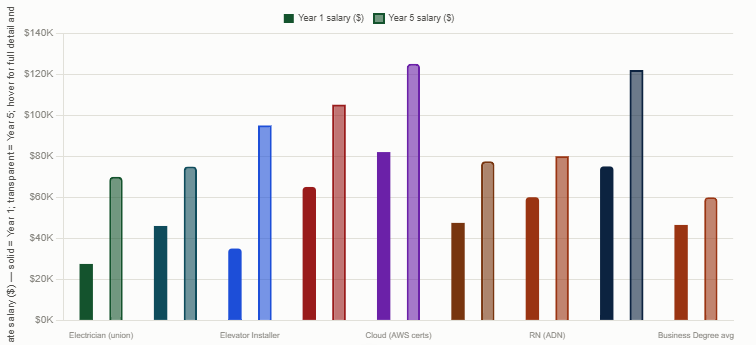
Fast path: Union apprenticeship route: apply at 18 with a high school diploma (or GED) and basic algebra competency. Apprenticeship begins within weeks or months. Year 1: ~$25,000–$30,000 while learning. Year 4: Licensed journeyman. Year 5: $60,000–$85,000 median. Year 10+: master electrician or electrical contractor, $100,000–$200,000+ depending on market and specialisation. Total debt at start of career: $0.
The specialisations that multiply the earning ceiling: data centre electrical work (where the Plano electricians in Mike Rowe’s account earned $240,000–$280,000), high-voltage transmission work, EV charging infrastructure installation, and solar integration. These are the electrical subfields being driven by the infrastructure requirements of AI and the energy transition.
The Blue Collar Recruiter’s July 2026 analysis reports that average starting wages for newly certified HVAC technicians in 2026 are $52,000 annually, surpassing many entry-level positions that require four-year degrees. The BLS projects 9% growth with 39,000 annual openings. Top HVAC technicians in commercial and industrial specialisations earn $80,000 to $120,000, with the data centre HVAC niche commanding premium rates.
The EPA 608 certification — required to handle refrigerants in HVAC work — is achievable in a few weeks. Formal HVAC training programmes range from 6 months to 2 years and cost $5,000 to $15,000. Some employers offer employer-sponsored training, effectively reducing entry cost to zero. For Gen Z graduates sceptical of the four-year degree model, HVAC offers a structured, progressive career from technician to senior technician to service manager, with a realistic path from $52,000 at entry to $80,000–$90,000 within five years.
Fast path: HVAC fast path: EPA 608 cert (6–12 weeks, approximately $500–$1,000). Enter an employer-sponsored apprenticeship or vocational programme. Year 1: technician assistant, $40,000–$50,000. Year 2–3: certified technician, $52,000–$65,000. Year 5+: senior commercial/industrial technician, $75,000–$90,000+. Year 10: service manager or own HVAC business, $100,000+. Total investment: $500–$15,000. Time to first solid paycheck: 6–18 months.
The CompTIA certification pathway is the industry-standard entry route. CompTIA A+ (IT fundamentals, approximately 3 months study and $240 in exam fees) followed by CompTIA Security+ (security fundamentals, approximately 3 to 6 months additional study and $392 in exam fees) produces a candidate with the credentials required for most entry-level analyst and SOC roles. Google, Apple, IBM, and other major employers have formally removed degree requirements for these positions in favour of demonstrated skill.
Fast path: Cybersecurity fast path: CompTIA A+ (~3 months, ~$240 exam fee). CompTIA Security+ (~3–6 months, ~$392 exam fee). Build a homelab, work through TryHackMe or HackTheBox for practical skills, create a portfolio on GitHub. Apply for entry-level SOC analyst or security analyst roles. Entry-level: $55,000–$80,000. Year 3–5: mid-level security engineer, $90,000–$120,000. Year 7–10: senior engineer or architect, $130,000–$180,000. Total investment: $500–$1,500 plus time. Degree: not required for entry-level at most major employers.
Cybersecurity job growth: 29% (BLS). Entry-level salaries: $55,000–$80,000 with certifications alone. AI/ML Engineers: $134,000–$220,000. AI Architects: $142,750–$196,750. Companies including Google, Apple, IBM no longer require degrees for many tech roles (BestOfMotivation.com April 2026; Supply Chain India Jobs July 2026).
Entry-level cloud roles (cloud support engineer, cloud operations analyst, junior DevOps engineer) command starting salaries of $75,000 to $95,000 in the US. Mid-level AWS Solutions Architects earn $120,000 to $160,000. Senior cloud architects and DevOps engineers in high-demand markets earn $150,000 to $200,000+. BestOfMotivation.com’s April 2026 Gen Z career guide identifies cloud computing as one of the four most important skill areas for Gen Z in 2026, alongside AI proficiency, cybersecurity, and data analytics.
Fast path: Cloud computing fast path: AWS Cloud Practitioner (~1 month, $100 exam fee; entry-level foundational credential). AWS Solutions Architect Associate (~3–6 months, $300 exam fee; the most valued entry credential for cloud roles). Build projects in a free-tier AWS account. Apply for cloud support engineer or junior DevOps roles. Year 1–2: $75,000–$95,000. Year 3–5: mid-level, $110,000–$140,000. Year 5+: senior architect, $150,000–$200,000+. Degree: not required for most entry and mid-level roles at Amazon, Microsoft, Google, or the major cloud consulting firms.
The financial case for nursing is unusually strong relative to other degree paths. A nursing degree at a public university costs approximately $30,000 in total debt — compared to $85,000+ for a typical four-year business or liberal arts degree. An RN starts at approximately $70,000 to $75,000. A nurse practitioner — requiring a master’s degree but achievable via a part-time programme while working as an RN — earns a median $129,000, with specialists earning up to $214,000 (University of Bridgeport data, cited BestJobSearchApps.com). The ROI on a nursing degree is among the best of any degree path.
Fast path: Nursing fast path: Associate Degree in Nursing (ADN) — 2 years, ~$15,000–$20,000, qualifies as an RN. Bachelor of Science in Nursing (BSN) — 4 years, ~$25,000–$35,000 at a public university; higher starting pay and faster advancement. RN salary: $70,000–$85,000. Advance to Nurse Practitioner via part-time MSN while working: 2–3 years additional. NP salary: $120,000–$129,000 median. Timeline from starting BSN to NP: approximately 6–7 years. Total debt if done efficiently: $30,000–$50,000 for degrees producing $120,000+ salaries.
Solar installation is accessible via a short training certification (many programmes run 2 to 6 weeks) and offers entry-level pay of $40,000 to $55,000. Wind turbine technicians require more specialised training (typically 2-year associate programmes at community colleges) and earn $50,000 to $80,000 with significant upside for offshore or large-scale installations. The career is inherently tied to the buildout of the energy transition: as long as wind and solar capacity continues to expand — which every major energy forecast projects — the technicians who maintain and install it are in demand.
Fast path: Green energy fast path: Solar installer certification (~4–8 weeks, ~$1,000–$3,000 or employer-paid). Entry-level: $40,000–$55,000. Wind turbine tech: 2-year associate degree or vocational programme (~$8,000–$15,000). Entry: $50,000–$65,000. Year 5+: senior technician, site supervisor, $75,000–$90,000. The sector's growth rate (50%–105% BLS projection) means demand for experienced technicians will intensify throughout the 2020s and 2030s.
In cybersecurity, cloud computing, and the tech trades, the salary jump on a lateral move to a new employer with updated skills is typically 15 to 25 percent — far exceeding the 3 to 5 percent annual pay review at most large employers. A Gen Z cybersecurity professional who starts at $65,000 at age 22 and makes three strategic moves (building skills between each, targeting employers who value the specific certifications earned) can realistically reach $130,000 to $160,000 by age 30. The same trajectory in the trades operates through journeyman-to-master advancement and specialisation into premium niches.
The Gen Z career strategy that produces the highest returns is not 'stay loyal to one employer' and it is not 'job-hop randomly.' It is 'build a genuinely valued skill, stay long enough to prove it, then move to the employer that values that skill most.' The combination of skills-first hiring, certification-over-degree credentialing, and a competitive employer market for experienced talent makes this strategy more accessible in 2026 than at any previous point in the modern labour market.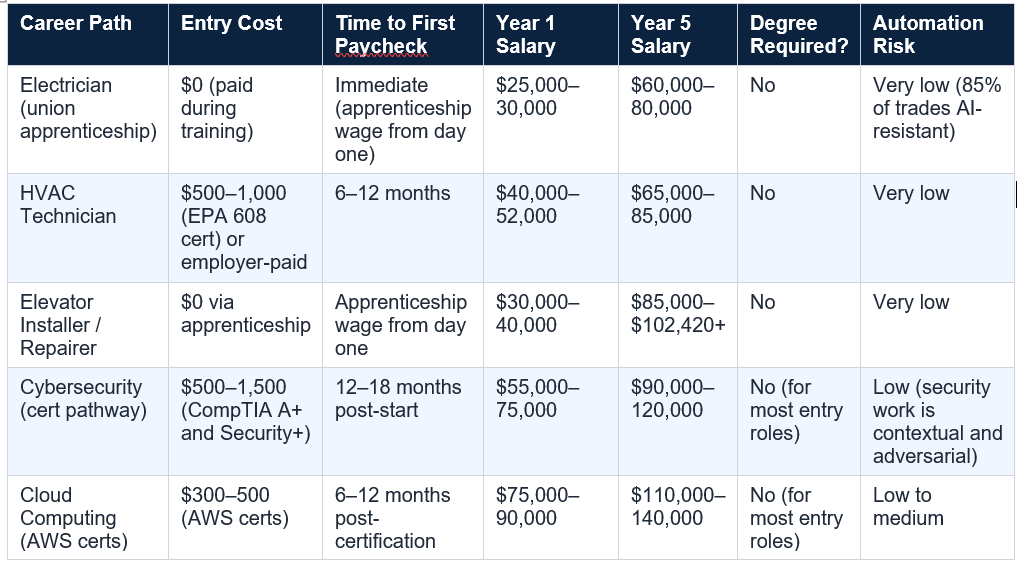
Trades deliver the best combination of low entry cost, immediate earning, AI resistance, and long-term income ceiling for those willing to do physical, skilled, and socially essential work. Cybersecurity and cloud computing deliver the best combination of salary relative to investment for those with genuine technical aptitude and willingness to self-direct their learning. Nursing delivers the best degree-required option, with an unusually strong ROI relative to other degree paths. Green energy delivers the highest growth rate for those comfortable with physically demanding outdoor work.
What all the fastest paths have in common is specificity. They are not generic. They do not come from drifting through four years of college hoping a diploma solves the problem. They come from choosing a specific skill, pursuing it directly, and entering a market where that skill is in demonstrable shortage. The trades shortage is real. The cybersecurity talent gap is real. The nursing vacancy rate is real. These are not manufactured narratives — they are structural supply-demand imbalances that translate directly into strong wages and fast hiring for qualified candidates.
The traditional path still works well for specific high-ROI degrees: nursing, computer science, engineering, and accounting all have strong, evidenced returns. The innovation is not that college is dead — it is that for the first time in a generation, the alternatives are genuinely competitive, and for many Gen Z individuals, they offer both a faster and a cheaper route to the same financial destination.
Yes — and it is increasingly common rather than exceptional. The BLS Occupational Outlook data for 2026 shows elevator installer and repairer median salaries of $102,420 for a role requiring a union apprenticeship (zero tuition, paid during training). Experienced electricians in high-demand specialisations (data centres, EV infrastructure) earn $120,000 to $200,000+. At BlackRock's 2026 Infrastructure Summit, Mike Rowe described meeting three electricians under 30, debt-free, earning $240,000–$280,000 annually, having been poached three separate times in the previous 18 months. In technology, cybersecurity engineers with 7–10 years of experience earn $130,000–$180,000 without requiring a degree at most employers. Cloud architects earn $150,000–$200,000+. These are achievable, not hypothetical — but they require specific skills, sustained effort, and typically 7–10 years from the starting point.
Are the skilled trades really resistant to AI automation?
Yes, to a high degree. 85% of skilled trades have been identified as resistant to automation (BestOfMotivation.com, April 2026, citing WEF and sector analysis). The core reason is structural: skilled trade work involves physical presence in variable, unpredictable environments; three-dimensional problem-solving that changes on every job site; and safety-critical judgement that must account for local conditions that cannot be pre-specified. An AI system can design a circuit, but it cannot run wire through a specific building, diagnose why a specific HVAC system is underperforming in a specific building at a specific ambient temperature, or weld in a tight space. The AI infrastructure boom — data centres, charging networks, renewable energy installations — is actively creating more demand for the trades, not less.
What is the fastest technology career path for Gen Z without a degree?
Cybersecurity is currently the fastest technology career accessible without a degree. The CompTIA A+ and Security+ certifications (achievable in 6–9 months of self-directed study at a total cost of approximately $600–$650 in exam fees) are the industry-standard entry credentials for security operations centre analyst and junior security analyst roles. Entry-level salaries are $55,000–$80,000. Cloud computing (AWS Solutions Architect Associate certification, achievable in 3–6 months) is a close second, with entry-level roles at $75,000–$95,000. Both paths benefit from the formal removal of degree requirements by Google, Apple, IBM, and many other major employers, who now evaluate candidates on demonstrated skills via portfolios and certifications.
Is trade school really cheaper than college in 2026?
Substantially cheaper. A full trade programme — including licensing exams and tools — typically costs $5,000 to $20,000. Union apprenticeships cost nothing in tuition and pay the apprentice a rising wage throughout training. The average four-year public university in the US costs approximately $85,000 to $107,000 after aid, and students earn nothing during the four years of attendance. A private university degree in a non-STEM field can cost $150,000 to $200,000 or more. The CampusROI.com analysis (April 2026) finds that 47% of trade credential holders now out-earn the median bachelor's degree holder — and at age 30, an electrician who started at 18 is approximately $250,000 ahead in cumulative net earnings vs. a business graduate who started college at the same age.
What should Gen Z do if they want a high salary but are not sure which path to take?
Start with an honest assessment of two things: what kind of work you are willing to do (physical and on-site vs. desk-based and remote; technical and logical vs. practical and manual) and where the genuine labour shortages are in your local market. The structural shortages — skilled trades, cybersecurity, nursing — are not temporary; they are driven by retirements, population demographics, and the infrastructure requirements of the energy and technology transitions, and they will persist throughout the 2020s and 2030s. Any of the paths described in this guide offers a direct route to solid, sustainable income. The fastest path is the one you will actually complete, with genuine competence. A half-completed electrical apprenticeship and a half-completed cybersecurity certification produce nothing. Choosing one path, committing to it, and building demonstrable skill in it is more important than choosing the theoretically optimal path.
How does the Gen Z job market differ from what Millennials experienced?
Gen Z enters a labour market shaped by three forces that were absent or much weaker when Millennials graduated: the AI disruption (which is actively restructuring which roles are in demand); the infrastructure buildout of the energy transition (which is driving demand for trade skills at a scale not seen in decades); and the formal removal of degree requirements by major employers in technology and adjacent sectors. Millennials graduated into a market where a bachelor's degree was the near-universal expected credential and where employer degree requirements were rarely questioned. Gen Z is graduating into a market where 47% of trade workers out-earn median degree holders, where Google and IBM hire without degree requirements in many roles, and where the cybersecurity and cloud computing talent shortages mean that a certification portfolio can produce a $75,000 starting salary faster than a four-year degree. The shift is real, structural, and accelerating.
Table of Contents
- The Default Route Is No Longer the Fastest Route
- Why the Degree Calculus Has Changed for Gen Z
- Career Path #1: Skilled Trades — The AI-Proof Paychecks
- Career Path #2: Electrician and Electrical Work — The Highest-Ceiling Trade
- Career Path #3: HVAC Technician — Every Building Needs One
- Career Path #4: Cybersecurity — The Fastest Tech Career Without a Degree
- Career Path #5: Cloud Computing and DevOps — Certifications Over Diplomas
- Career Path #6: Nursing and Healthcare — Bulletproof Demand
- Career Path #7: Green Energy — Wind, Solar, and the Coming Infrastructure Boom
- The Strategic Job-Hopper: How Gen Z Doubles Salary by 30
- The Full Comparison: Entry Cost, Time to Paycheck, and Five-Year Salary
- What Gen Z Should Avoid (Or At Least Question)
- Conclusion: The Fastest Path Depends on What You’re Willing to Build
- Frequently Asked Questions
1 Years vs 5 Years Salary By Career Path
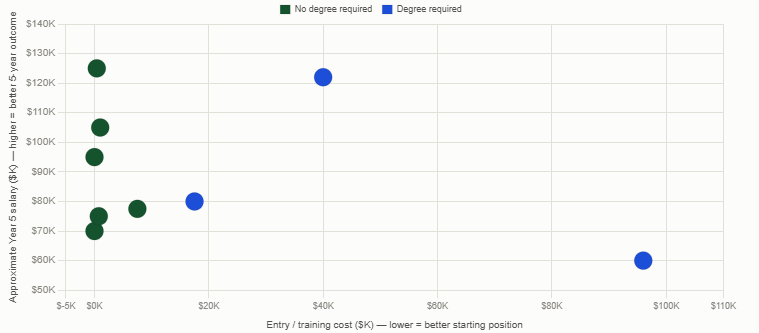
Entry Cost vs 5 years Salary: The ROI Picture
The Default Route Is No Longer the Fastest Route
For decades, the career advice given to every generation was essentially the same: graduate high school, attend a four-year college, earn a bachelor’s degree, and join the professional workforce. The path was linear, the credential was the ticket, and the income premium was assumed. Gen Z is inheriting a fundamentally different reality.Americans now owe more than $1.77 trillion in student loan debt across approximately 43 million borrowers. The average bachelor’s degree holder leaves school owing around $39,000 before interest (Education Data Initiative, cited TradeColleges.org, May 2026). Youth unemployment hit 9.5% in 2026, meaning a significant proportion of young adults who followed the prescribed path are discovering the credential does not automatically produce the career. Meanwhile, 47% of workers with trade credentials now out-earn the median bachelor’s degree holder — up from approximately 30% a decade ago (CampusROI.com, April 2026).
The fastest path to a solid, sustainable income for Gen Z in 2026 is not one path. It is several — and they diverge significantly from each other in cost, time, and outcome. This guide maps the most direct of those routes: the skilled trades that pay $60,000 to over $100,000 with two years of training; the technology certifications that produce six-figure starting salaries in months; and the healthcare careers that combine job security with genuine earning power. The traditional four-year degree route is included where it genuinely offers the best return. The goal is accuracy, not inspiration.
$1.77 trillion in US student loan debt (Education Data Initiative). 47% of trade credential holders out-earn the median bachelor's graduate (CampusROI.com April 2026). Youth unemployment: 9.5% in 2026. Trade school enrollment surged 48% since 2021. Gen Z = 31% of new apprenticeship enrolments (Blue Collar Recruiter, July 2026).
Why the Degree Calculus Has Changed for Gen Z
The argument for a four-year degree has always rested on the ‘college wage premium’ — the statistically observable difference in lifetime earnings between degree holders and non-degree holders. That premium still exists in aggregate. But it is heavily distorted by averaging high-earning STEM, nursing, and engineering degrees against low-earning humanities, social science, and general business degrees. The aggregate conceals the individual.CampusROI.com’s April 2026 analysis models three scenarios with 2026 costs and wages. An electrician starting a union apprenticeship at 18 earns approximately $20,000 per year during training, reaches $48,000 by age 20, and earns $65,000+ by age 30 — arriving at 30 with cumulative net earnings approximately $250,000 ahead of a business graduate who started at the same age. The business graduate started at a median $38,000 with $85,000 in debt and growing interest. The gap narrows for high-ROI degrees: a computer science graduate starting at $75,900 may surpass the electrician by their early 30s. A liberal arts or general business graduate — statistically the most common path — may never close it.
The One Big Beautiful Bill Act has added further pressure on the degree model: it caps Parent PLUS loans at $20,000 per year and sets a $257,500 lifetime federal borrowing limit, compressing the financial accessibility of the most expensive four-year programmes and making the cost comparison with trades more visible and direct.
The question for Gen Z is not 'is college worth it?' in the abstract. It is 'is this specific degree at this specific institution, for this specific career path, worth this specific cost?' That question produces very different answers for a nursing or computer science degree vs a general communications or social science degree. The fastest paths to income are the ones where the entry cost is low and the starting salary is high. Several of those paths do not go through a four-year university.
Career Path #1: Skilled Trades — The AI-Proof Paychecks
The skilled trades — electricians, plumbers, HVAC technicians, elevator installers, pipefitters, welders — are experiencing a structural labour shortage that is simultaneously driving wages up and reducing the time it takes to find full employment after qualifying. The retirement wave is a significant driver: the average tradesperson is now over 55, and the pipeline of new workers has not historically kept pace with the retirements underway.85% of skilled trades cannot be automated or replaced by AI, according to analysis cited by BestOfMotivation.com (April 2026) and Supply Chain India Jobs (July 2026). The reasoning is straightforward: the trades require physical presence, three-dimensional problem-solving in variable environments, manual dexterity under non-standard conditions, and safety-critical judgement. An AI system can generate a wiring diagram. It cannot run conduit through the walls of a building that does not yet exist, troubleshoot an HVAC fault in a 40-degree crawl space, or certify a gas connection. These are irreducibly human tasks.
At BlackRock’s 2026 Infrastructure Summit in March, Mike Rowe described meeting three electricians in Plano, Texas, all under 30, all debt-free, and all earning between $240,000 and $280,000 per year. All three had been poached three separate times in the previous 18 months. ‘It’s like the draft in the major leagues,’ Rowe told Fox Business. These are not representative medians — they are the top end of a well-compensated field — but they are not anomalies in a market where the infrastructure of AI data centres, electric vehicle charging networks, and renewable energy installations is being built by people with tools, not keyboards.
Skilled trades salary medians (BLS 2026): electricians $62,350; plumbers $62,970; HVAC mechanics $59,810; elevator installers $102,420. Trade school cost: $5,000–$20,000. Union apprenticeships: often zero tuition, paid during training. At age 30: trade apprentice is ~$250,000 ahead in cumulative net earnings vs. business graduate (CampusROI.com, April 2026). 85% of trades cannot be automated.
Career Path #2: Electrician and Electrical Work — The Highest-Ceiling Trade
The electrician is arguably the single best-value career path for Gen Z that does not require a degree, when measured by the combination of entry cost, time to reasonable income, long-term earning ceiling, and resistance to automation. The BLS projects 11% growth in electrician employment with 80,000 annual openings, driven by the electrification of transport, the expansion of AI data centre infrastructure, and the retrofitting of commercial and residential buildings for energy efficiency.The entry path: a union apprenticeship typically runs four to five years, combining on-the-job training with classroom instruction, pays a rising wage throughout (starting at approximately 40 to 50 percent of journeyman rates), and costs the apprentice zero in tuition. A non-union vocational programme takes one to two years and costs $5,000 to $15,000. Both produce a licensed electrician who can immediately command the median $62,350 (BLS 2026) with union journeyman rates in high-demand urban markets running $80,000 to $120,000.
Fast path: Union apprenticeship route: apply at 18 with a high school diploma (or GED) and basic algebra competency. Apprenticeship begins within weeks or months. Year 1: ~$25,000–$30,000 while learning. Year 4: Licensed journeyman. Year 5: $60,000–$85,000 median. Year 10+: master electrician or electrical contractor, $100,000–$200,000+ depending on market and specialisation. Total debt at start of career: $0.
The specialisations that multiply the earning ceiling: data centre electrical work (where the Plano electricians in Mike Rowe’s account earned $240,000–$280,000), high-voltage transmission work, EV charging infrastructure installation, and solar integration. These are the electrical subfields being driven by the infrastructure requirements of AI and the energy transition.
Career Path #3: HVAC Technician — Every Building Needs One
Heating, ventilation, and air conditioning technicians service and install the climate control systems in every commercial building, residential property, and — critically — every data centre in the country. As data centre construction accelerates to support AI workloads, the demand for HVAC technicians with the skills to manage precision cooling systems has become acute.The Blue Collar Recruiter’s July 2026 analysis reports that average starting wages for newly certified HVAC technicians in 2026 are $52,000 annually, surpassing many entry-level positions that require four-year degrees. The BLS projects 9% growth with 39,000 annual openings. Top HVAC technicians in commercial and industrial specialisations earn $80,000 to $120,000, with the data centre HVAC niche commanding premium rates.
The EPA 608 certification — required to handle refrigerants in HVAC work — is achievable in a few weeks. Formal HVAC training programmes range from 6 months to 2 years and cost $5,000 to $15,000. Some employers offer employer-sponsored training, effectively reducing entry cost to zero. For Gen Z graduates sceptical of the four-year degree model, HVAC offers a structured, progressive career from technician to senior technician to service manager, with a realistic path from $52,000 at entry to $80,000–$90,000 within five years.
Fast path: HVAC fast path: EPA 608 cert (6–12 weeks, approximately $500–$1,000). Enter an employer-sponsored apprenticeship or vocational programme. Year 1: technician assistant, $40,000–$50,000. Year 2–3: certified technician, $52,000–$65,000. Year 5+: senior commercial/industrial technician, $75,000–$90,000+. Year 10: service manager or own HVAC business, $100,000+. Total investment: $500–$15,000. Time to first solid paycheck: 6–18 months.
Career Path #4: Cybersecurity — The Fastest Tech Career Without a Degree
Cybersecurity is the technology career with the most accessible entry point relative to salary. The cybersecurity labour market has been in structural shortage for years, with demand growing at 29% (BLS) while the talent pool cannot keep pace. Entry-level cybersecurity roles — security analyst, SOC analyst, penetration testing junior — are among the few technology positions where a certification-based portfolio genuinely substitutes for a degree in the initial hiring decision.The CompTIA certification pathway is the industry-standard entry route. CompTIA A+ (IT fundamentals, approximately 3 months study and $240 in exam fees) followed by CompTIA Security+ (security fundamentals, approximately 3 to 6 months additional study and $392 in exam fees) produces a candidate with the credentials required for most entry-level analyst and SOC roles. Google, Apple, IBM, and other major employers have formally removed degree requirements for these positions in favour of demonstrated skill.
Fast path: Cybersecurity fast path: CompTIA A+ (~3 months, ~$240 exam fee). CompTIA Security+ (~3–6 months, ~$392 exam fee). Build a homelab, work through TryHackMe or HackTheBox for practical skills, create a portfolio on GitHub. Apply for entry-level SOC analyst or security analyst roles. Entry-level: $55,000–$80,000. Year 3–5: mid-level security engineer, $90,000–$120,000. Year 7–10: senior engineer or architect, $130,000–$180,000. Total investment: $500–$1,500 plus time. Degree: not required for entry-level at most major employers.
Cybersecurity job growth: 29% (BLS). Entry-level salaries: $55,000–$80,000 with certifications alone. AI/ML Engineers: $134,000–$220,000. AI Architects: $142,750–$196,750. Companies including Google, Apple, IBM no longer require degrees for many tech roles (BestOfMotivation.com April 2026; Supply Chain India Jobs July 2026).
Career Path #5: Cloud Computing and DevOps — Certifications Over Diplomas
Cloud computing — the management and deployment of computing infrastructure on platforms like Amazon Web Services (AWS), Microsoft Azure, and Google Cloud — is one of the fastest-growing technology sectors and one of the most accessible via certification rather than degree. AWS has the largest market share (approximately 31%) and the most established certification pathway; its entry-level Solutions Architect Associate certification is achievable in 3 to 6 months of self-directed study and costs $300 in exam fees.Entry-level cloud roles (cloud support engineer, cloud operations analyst, junior DevOps engineer) command starting salaries of $75,000 to $95,000 in the US. Mid-level AWS Solutions Architects earn $120,000 to $160,000. Senior cloud architects and DevOps engineers in high-demand markets earn $150,000 to $200,000+. BestOfMotivation.com’s April 2026 Gen Z career guide identifies cloud computing as one of the four most important skill areas for Gen Z in 2026, alongside AI proficiency, cybersecurity, and data analytics.
Fast path: Cloud computing fast path: AWS Cloud Practitioner (~1 month, $100 exam fee; entry-level foundational credential). AWS Solutions Architect Associate (~3–6 months, $300 exam fee; the most valued entry credential for cloud roles). Build projects in a free-tier AWS account. Apply for cloud support engineer or junior DevOps roles. Year 1–2: $75,000–$95,000. Year 3–5: mid-level, $110,000–$140,000. Year 5+: senior architect, $150,000–$200,000+. Degree: not required for most entry and mid-level roles at Amazon, Microsoft, Google, or the major cloud consulting firms.
Career Path #6: Nursing and Healthcare — Bulletproof Demand
If the skilled trades represent the fastest no-degree path and cybersecurity represents the fastest tech path, nursing represents the most reliable high-income path via a degree. The BLS projects nurse practitioner growth at 45.7% — the highest of any major occupation. Nursing unemployment is 1.42%, the lowest of any major profession (RDWorld / BLS). Healthcare generates 1.8 million openings per year through 2032. The sector is structurally insulated from automation: patient care requires physical presence, emotional intelligence, and clinical judgement that are irreducibly human.The financial case for nursing is unusually strong relative to other degree paths. A nursing degree at a public university costs approximately $30,000 in total debt — compared to $85,000+ for a typical four-year business or liberal arts degree. An RN starts at approximately $70,000 to $75,000. A nurse practitioner — requiring a master’s degree but achievable via a part-time programme while working as an RN — earns a median $129,000, with specialists earning up to $214,000 (University of Bridgeport data, cited BestJobSearchApps.com). The ROI on a nursing degree is among the best of any degree path.
Fast path: Nursing fast path: Associate Degree in Nursing (ADN) — 2 years, ~$15,000–$20,000, qualifies as an RN. Bachelor of Science in Nursing (BSN) — 4 years, ~$25,000–$35,000 at a public university; higher starting pay and faster advancement. RN salary: $70,000–$85,000. Advance to Nurse Practitioner via part-time MSN while working: 2–3 years additional. NP salary: $120,000–$129,000 median. Timeline from starting BSN to NP: approximately 6–7 years. Total debt if done efficiently: $30,000–$50,000 for degrees producing $120,000+ salaries.
Career Path #7: Green Energy — Wind, Solar, and the Coming Infrastructure Boom
Green energy is the fastest-growing sector in the trades, driven by federal infrastructure investment, state renewable energy mandates, and the accelerating build-out of clean energy capacity. The BLS projects solar photovoltaic installer jobs growing at 105% over the 10-year projection period, and wind turbine technician jobs growing at 50% — the fastest single-occupation growth rate in the BLS database. Both roles are trade-adjacent, physically demanding, technically skilled, and highly resistant to automation.Solar installation is accessible via a short training certification (many programmes run 2 to 6 weeks) and offers entry-level pay of $40,000 to $55,000. Wind turbine technicians require more specialised training (typically 2-year associate programmes at community colleges) and earn $50,000 to $80,000 with significant upside for offshore or large-scale installations. The career is inherently tied to the buildout of the energy transition: as long as wind and solar capacity continues to expand — which every major energy forecast projects — the technicians who maintain and install it are in demand.
Fast path: Green energy fast path: Solar installer certification (~4–8 weeks, ~$1,000–$3,000 or employer-paid). Entry-level: $40,000–$55,000. Wind turbine tech: 2-year associate degree or vocational programme (~$8,000–$15,000). Entry: $50,000–$65,000. Year 5+: senior technician, site supervisor, $75,000–$90,000. The sector's growth rate (50%–105% BLS projection) means demand for experienced technicians will intensify throughout the 2020s and 2030s.
The Strategic Job-Hopper: How Gen Z Doubles Salary by 30
BestOfMotivation.com’s April 2026 Gen Z careers analysis includes a finding that deserves its own section: job hoppers who move strategically can double their starting salary by age 30 through five well-planned career moves. This is not a careers cliché — it reflects a structural reality of the 2026 labour market, in which tenure-based pay increases at most employers have not kept pace with the salary premiums offered to external hires with two to four years of experience.In cybersecurity, cloud computing, and the tech trades, the salary jump on a lateral move to a new employer with updated skills is typically 15 to 25 percent — far exceeding the 3 to 5 percent annual pay review at most large employers. A Gen Z cybersecurity professional who starts at $65,000 at age 22 and makes three strategic moves (building skills between each, targeting employers who value the specific certifications earned) can realistically reach $130,000 to $160,000 by age 30. The same trajectory in the trades operates through journeyman-to-master advancement and specialisation into premium niches.
The Gen Z career strategy that produces the highest returns is not 'stay loyal to one employer' and it is not 'job-hop randomly.' It is 'build a genuinely valued skill, stay long enough to prove it, then move to the employer that values that skill most.' The combination of skills-first hiring, certification-over-degree credentialing, and a competitive employer market for experienced talent makes this strategy more accessible in 2026 than at any previous point in the modern labour market.
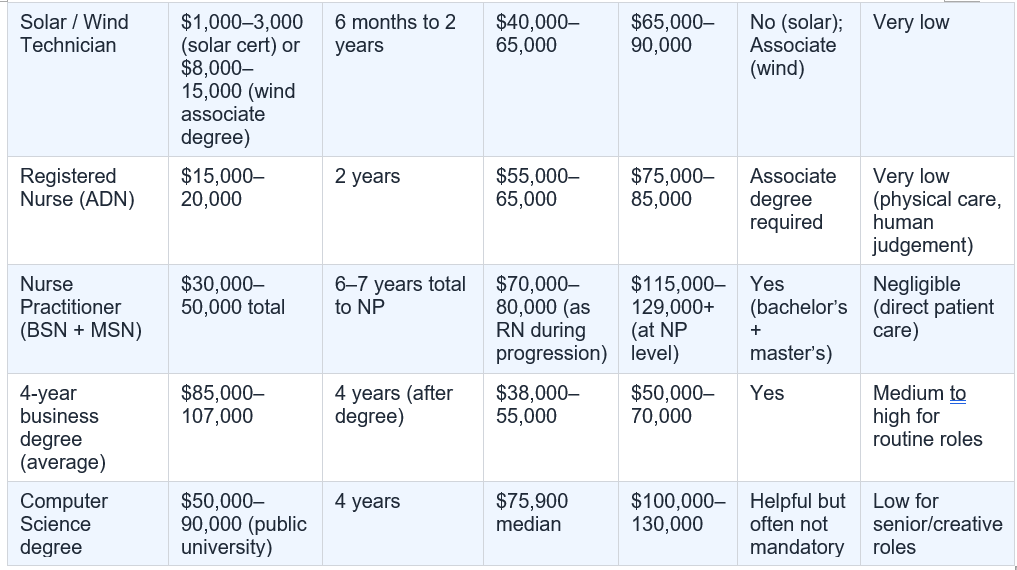
The Full Comparison: Entry Cost, Time to Paycheck, and Five-Year Salary
What Gen Z Should Avoid (Or At Least Question)
Not all credential pathways are equal, and some are significantly worse investments than others in 2026:- Expensive private university degrees in low-demand fields: a $180,000 liberal arts, communications, or general social science degree from a private institution is one of the worst ROI investments available in 2026. The starting salaries in these fields do not support the debt load, and the career premium over a trade or certification path is minimal or negative for many years.
- Low-quality online certificate mills: not all certifications are equal. A Google Career Certificate has real market value; a certificate from an unaccredited online programme may not. Before paying for any certification, verify that the credential is recognised by employers in the target field. CompTIA, AWS, Google, Microsoft, and Cisco are industry-recognised certifiers; unrecognised alternative credentials may be worthless in the job market.
- Undifferentiated generic business degrees: the four-year general business or management degree at an average university is statistically the most common and least financially differentiated credential in the US job market. Without a specific specialisation (finance, accounting, supply chain, data analytics) or a strong employer brand name on the diploma, this degree produces median outcomes that are frequently surpassed by tradespeople five years into their careers.
- Chasing trending roles without building underlying skills: data science, AI engineering, and related roles are genuinely high-paying but require rigorous technical foundations (mathematics, statistics, programming). Completing a two-month data science bootcamp without this foundation produces a credential but not a competent candidate. Employers are increasingly distinguishing between genuine technical ability and credential collection.
Conclusion
The fastest path to a solid paycheck for Gen Z is not universally one thing. It is contextual — it depends on the individual’s aptitudes, the local labour market, and the tolerance for different types of work. But several patterns emerge clearly from the 2026 data.Trades deliver the best combination of low entry cost, immediate earning, AI resistance, and long-term income ceiling for those willing to do physical, skilled, and socially essential work. Cybersecurity and cloud computing deliver the best combination of salary relative to investment for those with genuine technical aptitude and willingness to self-direct their learning. Nursing delivers the best degree-required option, with an unusually strong ROI relative to other degree paths. Green energy delivers the highest growth rate for those comfortable with physically demanding outdoor work.
What all the fastest paths have in common is specificity. They are not generic. They do not come from drifting through four years of college hoping a diploma solves the problem. They come from choosing a specific skill, pursuing it directly, and entering a market where that skill is in demonstrable shortage. The trades shortage is real. The cybersecurity talent gap is real. The nursing vacancy rate is real. These are not manufactured narratives — they are structural supply-demand imbalances that translate directly into strong wages and fast hiring for qualified candidates.
The traditional path still works well for specific high-ROI degrees: nursing, computer science, engineering, and accounting all have strong, evidenced returns. The innovation is not that college is dead — it is that for the first time in a generation, the alternatives are genuinely competitive, and for many Gen Z individuals, they offer both a faster and a cheaper route to the same financial destination.
Frequently Asked Questions
Can Gen Z actually earn $100,000+ without a degree?Yes — and it is increasingly common rather than exceptional. The BLS Occupational Outlook data for 2026 shows elevator installer and repairer median salaries of $102,420 for a role requiring a union apprenticeship (zero tuition, paid during training). Experienced electricians in high-demand specialisations (data centres, EV infrastructure) earn $120,000 to $200,000+. At BlackRock's 2026 Infrastructure Summit, Mike Rowe described meeting three electricians under 30, debt-free, earning $240,000–$280,000 annually, having been poached three separate times in the previous 18 months. In technology, cybersecurity engineers with 7–10 years of experience earn $130,000–$180,000 without requiring a degree at most employers. Cloud architects earn $150,000–$200,000+. These are achievable, not hypothetical — but they require specific skills, sustained effort, and typically 7–10 years from the starting point.
Are the skilled trades really resistant to AI automation?
Yes, to a high degree. 85% of skilled trades have been identified as resistant to automation (BestOfMotivation.com, April 2026, citing WEF and sector analysis). The core reason is structural: skilled trade work involves physical presence in variable, unpredictable environments; three-dimensional problem-solving that changes on every job site; and safety-critical judgement that must account for local conditions that cannot be pre-specified. An AI system can design a circuit, but it cannot run wire through a specific building, diagnose why a specific HVAC system is underperforming in a specific building at a specific ambient temperature, or weld in a tight space. The AI infrastructure boom — data centres, charging networks, renewable energy installations — is actively creating more demand for the trades, not less.
What is the fastest technology career path for Gen Z without a degree?
Cybersecurity is currently the fastest technology career accessible without a degree. The CompTIA A+ and Security+ certifications (achievable in 6–9 months of self-directed study at a total cost of approximately $600–$650 in exam fees) are the industry-standard entry credentials for security operations centre analyst and junior security analyst roles. Entry-level salaries are $55,000–$80,000. Cloud computing (AWS Solutions Architect Associate certification, achievable in 3–6 months) is a close second, with entry-level roles at $75,000–$95,000. Both paths benefit from the formal removal of degree requirements by Google, Apple, IBM, and many other major employers, who now evaluate candidates on demonstrated skills via portfolios and certifications.
Is trade school really cheaper than college in 2026?
Substantially cheaper. A full trade programme — including licensing exams and tools — typically costs $5,000 to $20,000. Union apprenticeships cost nothing in tuition and pay the apprentice a rising wage throughout training. The average four-year public university in the US costs approximately $85,000 to $107,000 after aid, and students earn nothing during the four years of attendance. A private university degree in a non-STEM field can cost $150,000 to $200,000 or more. The CampusROI.com analysis (April 2026) finds that 47% of trade credential holders now out-earn the median bachelor's degree holder — and at age 30, an electrician who started at 18 is approximately $250,000 ahead in cumulative net earnings vs. a business graduate who started college at the same age.
What should Gen Z do if they want a high salary but are not sure which path to take?
Start with an honest assessment of two things: what kind of work you are willing to do (physical and on-site vs. desk-based and remote; technical and logical vs. practical and manual) and where the genuine labour shortages are in your local market. The structural shortages — skilled trades, cybersecurity, nursing — are not temporary; they are driven by retirements, population demographics, and the infrastructure requirements of the energy and technology transitions, and they will persist throughout the 2020s and 2030s. Any of the paths described in this guide offers a direct route to solid, sustainable income. The fastest path is the one you will actually complete, with genuine competence. A half-completed electrical apprenticeship and a half-completed cybersecurity certification produce nothing. Choosing one path, committing to it, and building demonstrable skill in it is more important than choosing the theoretically optimal path.
How does the Gen Z job market differ from what Millennials experienced?
Gen Z enters a labour market shaped by three forces that were absent or much weaker when Millennials graduated: the AI disruption (which is actively restructuring which roles are in demand); the infrastructure buildout of the energy transition (which is driving demand for trade skills at a scale not seen in decades); and the formal removal of degree requirements by major employers in technology and adjacent sectors. Millennials graduated into a market where a bachelor's degree was the near-universal expected credential and where employer degree requirements were rarely questioned. Gen Z is graduating into a market where 47% of trade workers out-earn median degree holders, where Google and IBM hire without degree requirements in many roles, and where the cybersecurity and cloud computing talent shortages mean that a certification portfolio can produce a $75,000 starting salary faster than a four-year degree. The shift is real, structural, and accelerating.
0 Comments
Be the first to share your thoughts on this article.