

Financial Literacy
Gen Z: Moves to Make This Fall for a Financial Jumpstart

81% of Gen Z wants to be seen as financially responsible. 86% have financial regrets. Gen Z started saving for retirement at 23 — earlier than every prior generation. This fall is the best moment to build on what’s already working.

The challenges are real too. Forty-two percent are living paycheck to paycheck. Monthly debt payments for Gen Z rose 74 percent between 2020 and 2023 — well above the 11 percent for Boomers. Average savings are approximately $1,000. Only 27 percent own a home. But the combination of early retirement saving habits, financial planning engagement, and genuine optimism places Gen Z in a structurally better position than the surface-level statistics suggest — if the right moves are made in the right order.
Fall is the ideal moment to make those moves. Q4 brings Open Enrollment for employer health and benefits decisions, the final window to maximise 401(k) contributions before year-end, the best opportunity for tax-loss harvesting in taxable brokerage accounts, and the psychological reset of a new season. This guide presents eight specific financial moves Gen Z should make this fall to build the foundation the next ten years will stand on.
The Numbers: Gen Z started retirement saving at age 23 (Nationwide Retirement Institute) — earlier than every prior generation. 91.4% do some form of financial planning (Self Financial 2025) vs 53.7% across all generations. 81% say financial responsibility matters to them (BofA May 2026). 71% are optimistic about financial success (Axios/IndexBox April 2026).
The picture that emerges: Gen Z is a generation with strong financial intentions (81% prioritise financial responsibility), strong financial habits in specific areas (early retirement saving, HYSA adoption, high planning engagement), but facing structural cost pressures (student debt, housing costs, debt payment growth) that constrain the outcomes those intentions would otherwise produce. The fall moves below are targeted at widening the gap between cost pressures and wealth-building capacity.
Fall is the natural audit season because Q4 brings both annual subscription renewals and the impending holiday spending surge. The audit protocol:
The case is straightforward: HYSA rates at top-tier online institutions are up to 5.00 percent APY as of April 2026 (Fortune). Standard bank savings accounts average 0.39 percent APY (SoFi March 2026 data). The gap is more than 12 times. Keeping emergency funds or short-term savings in a standard bank account in a 5.00 percent HYSA environment is voluntarily leaving money on the table.
The emergency fund target: three to six months of essential living expenses. The average Gen Z savings balance of approximately $1,000 falls well short of this benchmark for most cost-of-living environments. The priority sequence:
But 680 is not good enough for the most competitive mortgage rates, the lowest auto loan APRs, or the best credit card rewards. The gap between a 680 score and a 740+ ‘Very Good’ score translates to:
The mechanics: a typical employer match is 50 percent of employee contributions up to 6 percent of salary. For a Gen Z employee earning $55,000, contributing 6 percent ($3,300/year, $275/month) triggers a $1,650 employer match — a guaranteed 50 percent return on that $3,300, before any market performance. Failing to contribute enough to capture the full match is the equivalent of declining a pay rise.
Fall-specific action: if your current 401(k) contribution is below your employer’s match threshold, increasing it in September captures three to four months of additional matched contributions before the December 31 year-end. The 2026 employee contribution limit is $23,500. For most Gen Z members well below this ceiling, the immediate goal is: contribute at minimum enough to capture the full employer match.
For those who are already capturing the full match: consider whether a contribution increase to further reduce 2026 taxable income makes sense given expected 2026 total income and marginal tax rate. A qualified tax adviser can model the trade-off.
The Numbers: Gen Z average retirement saving start age: 23 (Nationwide Retirement Institute). 2026 401(k) employee limit: $23,500. Typical employer match: 50% on up to 6% of salary = guaranteed 50% return on matched contributions. More than 80% of Gen Xers and Boomers regret not saving earlier (Nationwide).
The compounding arithmetic: $7,000 invested in a Roth IRA at age 23, earning 7 percent average annual returns over 40 years, grows to approximately $104,000 — completely tax-free. That is the value of one year’s contribution at the 2026 limit. For someone who contributes $7,000 per year from age 23 to 63:
Income limits apply: in 2026, the Roth IRA contribution ability phases out between $150,000 and $165,000 in MAGI for single filers, and $236,000 and $246,000 for married filing jointly. Most Gen Z members are well within the income limits. Those with higher incomes should explore the backdoor Roth IRA strategy with a qualified tax adviser.
YouGov’s November 2025 survey found that 49 percent of Gen Z only use credit cards or loans as a last resort — a cautious instinct that reflects either financial awareness or financial caution driven by anxiety. The constructive version of this caution is applying it actively to debt elimination rather than passively to debt avoidance.
The debt priority sequence for fall 2026:
Reality Check: 34.4% of Gen Z worried most about paying off debt (Self Financial 2025). Monthly debt payments for Gen Z rose 74% between 2020 and 2023 vs 11% for Boomers. The Roth IRA compounding advantage only reaches its full potential if high-interest debt has been eliminated first — because paying 21% on credit card debt while earning 7% average investment return is a guaranteed net loss of 14% per year on the debt balance.
The fall Open Enrollment checklist:
A financial goal written in vague terms (‘save more money’) produces different behaviour than a financial goal written in specific terms (‘transfer $300 per month automatically on the 1st of each month to my HYSA at [specific bank] to reach $3,600 by April 1, 2027’). Research on goal-setting and financial behaviour consistently shows that written, specific, time-bound goals significantly outperform unwritten or vague ones.
Fall is the right time to set the Q1 goal because the Q4 actions (401(k) increase, HSA election, HYSA opening, subscription audit savings) create the cash flow that funds the Q1 goal. The sequence runs forward: the fall moves free up $50 to $300 per month; that money is directed toward a specific Q1 goal; that goal is achieved by spring; a Q2 goal is set. This is what financial momentum looks like in practice.
The Nationwide Retirement Institute finding is the motivating data point here: more than 80 percent of Gen Xers and Baby Boomers regret not starting to save earlier. Gen Z is already starting earlier on average. The goal this fall is to make ‘starting earlier’ the permanent pattern rather than a one-time event.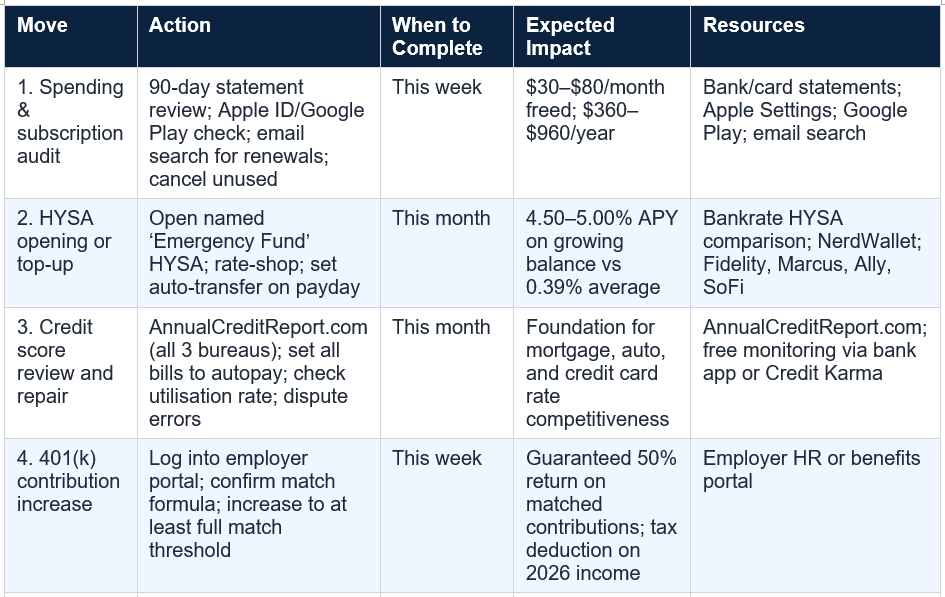
This is not a generation waiting for things to get easier. It is a generation that started building financial habits before those habits became easy. The eight moves in this guide are not a rescue plan. They are an acceleration of what is already working: directing the subscription audit savings into the HYSA, using the HYSA discipline to fund the Roth IRA, using the 401(k) increase to capture the employer match, using the credit score improvement to access better rates on the house purchase that is still coming.
Fall 2026 is the right moment to turn the good intentions into locked-in structures. Open the account. Increase the percentage. Write the goal. The generation that started saving at 23 can also be the generation that had all eight of these moves in place by 30.
If you have no emergency fund, opening a high-yield savings account and automating even $25 per week into it is the single most impactful structural move. Without an emergency fund, every unexpected expense drives debt accumulation, which undermines all other financial progress. If you have a basic emergency fund but are not capturing your full employer 401(k) match, increasing your contribution to the match threshold is the next most impactful move — it is a guaranteed return of 50% or more on matched contributions, which no other investment can reliably beat. The Bank of America Better Money Habits 2026 Gen Z study found that 42% of Gen Z are living paycheck to paycheck; the emergency fund is the structural intervention that breaks that cycle.
Why should Gen Z choose a Roth IRA over a traditional IRA?
Most Gen Z members are in relatively low marginal tax brackets (22% or lower) early in their careers. The Roth IRA taxes contributions now at these lower rates, then allows all future growth and qualified withdrawals to be completely tax-free — including decades of compounding returns. The traditional IRA deducts contributions now at the current (lower) tax rate but taxes all withdrawals in retirement at whatever rate applies then. For a 23-year-old expecting income to grow significantly over a 40-year career, paying tax now at 22% and getting tax-free withdrawals later typically beats paying no tax now but full rates on a much larger balance at retirement. Additionally, Roth IRA contributions (not earnings) can be withdrawn penalty-free at any time, providing a safety-valve flexibility that traditional IRAs and 401(k)s do not.
What credit score do I need before applying for a mortgage?
Most conventional mortgages require a minimum credit score of 620, but the most competitive rates typically require 740 or above. Gen Z's average credit score of 680 in 2026 (ScoreNerds March 2026, Experian Q4 2025 data) is above the 620 floor but below the best-rate threshold. ScoreNerds' analysis shows Gen Z gained 5 points year-over-year — the largest gain of any generation. Practical actions to close the gap to 740: set every bill to autopay (payment history is 35% of FICO); keep credit card utilisation below 30%, ideally below 10%; do not close old accounts; and avoid opening multiple new accounts in the months before a planned mortgage application.
How do I pick the right health insurance plan during Open Enrollment?
Compare your total expected annual cost across each plan option, not just the monthly premium. Total annual cost = (monthly premium × 12) + expected out-of-pocket costs (deductibles, copays, prescriptions) based on your actual healthcare usage in the past 12 months. Young, healthy Gen Z members who visit the doctor once or twice per year and take no regular prescriptions often find that a High-Deductible Health Plan (HDHP) with a Health Savings Account (HSA) costs less in total annual outlay than a traditional PPO — even accounting for higher out-of-pocket costs per visit. The HSA's triple tax advantage (pre-tax contributions, tax-free growth, tax-free qualified withdrawals) is an additional benefit that makes the HDHP option even more attractive for those who can afford the higher per-event deductible.
Is it possible to both pay off debt and save for retirement at the same time?
Yes, for most Gen Z members, and the sequencing matters. The recommended priority: (1) Employer 401(k) at least to the full match threshold — always, because the match is a 50%+ guaranteed return that no debt payoff strategy can beat. (2) Minimum $1,000 emergency fund in a HYSA. (3) High-interest debt payoff (above 10-15% APR), because 21% credit card interest costs more than any investment reliably returns. (4) Additional retirement contributions (Roth IRA, more 401(k)) and debt payoff below 7% APR can be done simultaneously; the trade-off between a 5% student loan interest rate and a 7% expected investment return is close enough that both deserve to continue. The Nationwide Retirement Institute finding that Gen Z starts retirement saving at 23 on average — earlier than any prior generation — confirms this parallel approach is working.
What is the most common financial regret among Gen Z?
Intuit/Credit Karma's Harris Poll survey found that 86% of Gen Z have financial regrets from 2025, with overspending (41%) and not saving enough (36%) as the two most common. Self Financial's July 2025 survey (n=2,038) found that 34.4% of Gen Z worry most about paying off debt. Bank of America's 2026 Cost of Adulting study found 42% of Gen Z are living paycheck to paycheck. The pattern: Gen Z has high financial awareness and high financial regret simultaneously — they know what they should be doing and regret not doing it consistently. The fall moves in this guide are designed specifically to convert the recurring intention of 'I should save more' into automated, structural commitments that happen without requiring a daily decision.
Table of Contents
- The Generation With the Most to Gain Right Now
- Where Gen Z Stands Financially in 2026: The Honest Picture
- Why Fall Is the Right Time for a Financial Jumpstart
- Move #1: Run a Full Subscription and Spending Audit
- Move #2: Open or Top Up a High-Yield Savings Account
- Move #3: Build or Repair Your Credit Score
- Move #4: Increase Your 401(k) Contribution Before Year-End
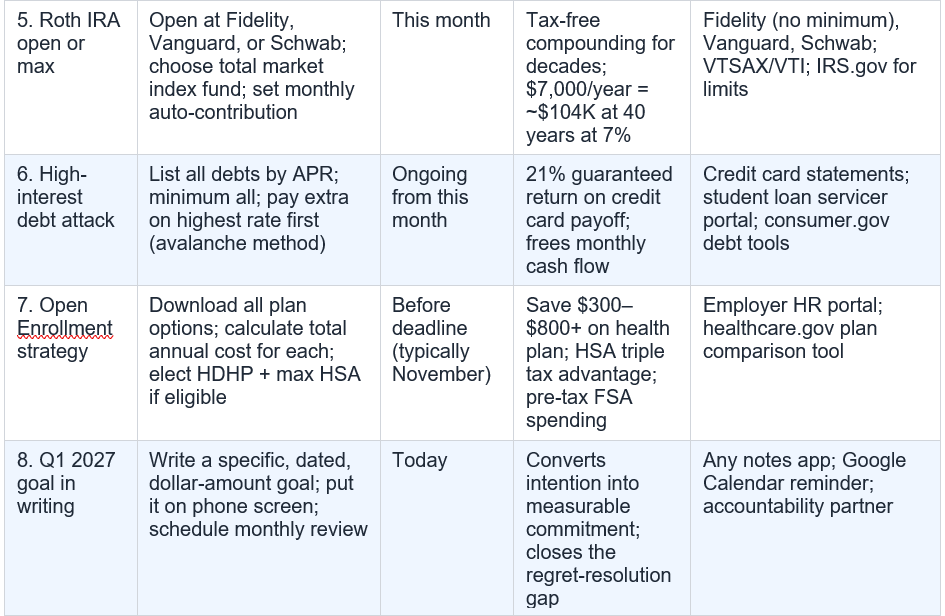
- Move #5: Open a Roth IRA (or Max It Out)
- Move #6: Attack the Highest-Interest Debt First
- Move #7: Lock In Open Enrollment Benefits Strategically
- Move #8: Set a Q1 2027 Financial Goal in Writing Today
- The Gen Z Financial Jumpstart Checklist
- What Not to Do This Fall
- Conclusion: The Generation Already Ahead of Schedule
- Frequently Asked Questions
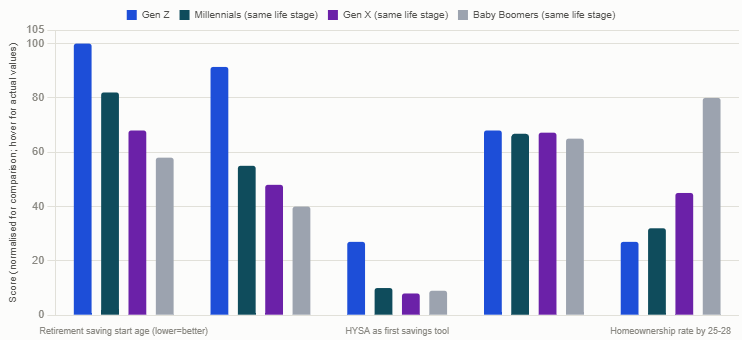
Gex Z vs Other Generations
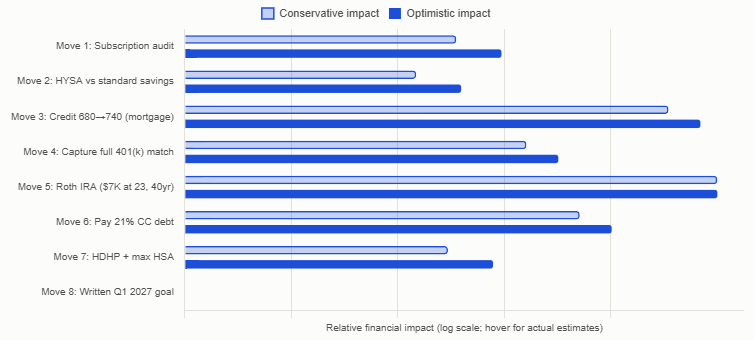
8-Moves Impact Timeline
The Generation With the Most to Gain Right Now
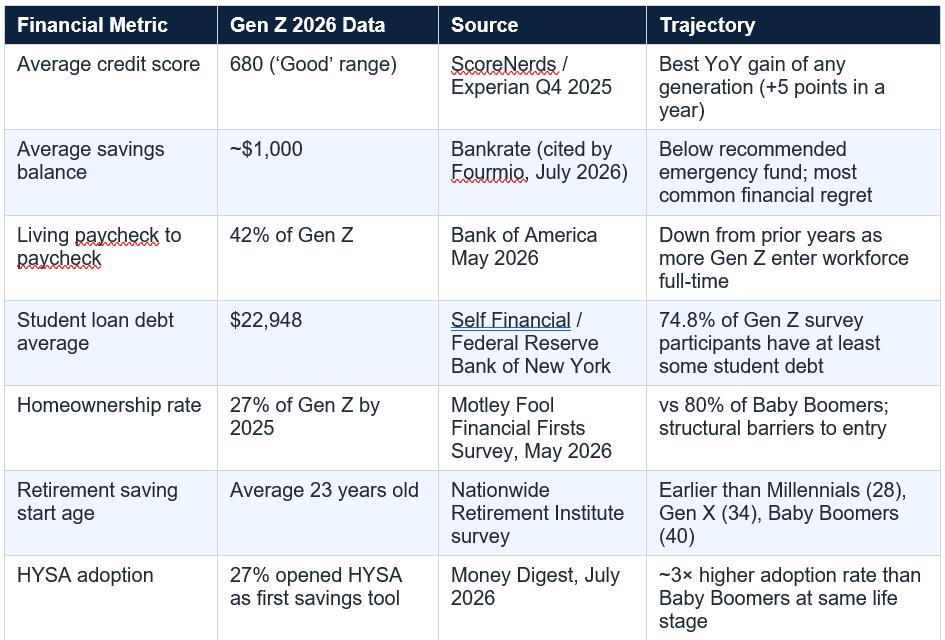
Here is what the data on Gen Z actually shows, stripped of both the doom-scrolling pessimism and the influencer optimism: this is a generation that started saving for retirement at 23 — earlier than Millennials (28), Gen X (34), and Baby Boomers (40), according to a Nationwide Retirement Institute survey. Eighty-one percent say being perceived as financially responsible matters to them (Bank of America, May 2026). Ninety-one percent do some form of financial planning — a rate nearly double the 53.7 percent across all generations (Self Financial, July 2025). And 71 percent are optimistic about reaching financial success, more than any other generation.The challenges are real too. Forty-two percent are living paycheck to paycheck. Monthly debt payments for Gen Z rose 74 percent between 2020 and 2023 — well above the 11 percent for Boomers. Average savings are approximately $1,000. Only 27 percent own a home. But the combination of early retirement saving habits, financial planning engagement, and genuine optimism places Gen Z in a structurally better position than the surface-level statistics suggest — if the right moves are made in the right order.
Fall is the ideal moment to make those moves. Q4 brings Open Enrollment for employer health and benefits decisions, the final window to maximise 401(k) contributions before year-end, the best opportunity for tax-loss harvesting in taxable brokerage accounts, and the psychological reset of a new season. This guide presents eight specific financial moves Gen Z should make this fall to build the foundation the next ten years will stand on.
The Numbers: Gen Z started retirement saving at age 23 (Nationwide Retirement Institute) — earlier than every prior generation. 91.4% do some form of financial planning (Self Financial 2025) vs 53.7% across all generations. 81% say financial responsibility matters to them (BofA May 2026). 71% are optimistic about financial success (Axios/IndexBox April 2026).
Where Gen Z Stands Financially in 2026: The Honest Picture
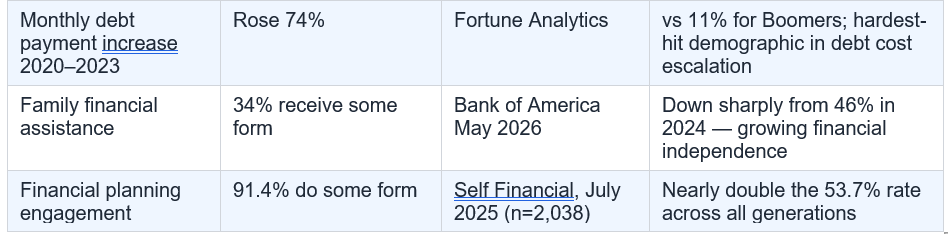
Understanding where you are is the prerequisite for knowing which moves matter most. The Gen Z financial landscape in 2026:The picture that emerges: Gen Z is a generation with strong financial intentions (81% prioritise financial responsibility), strong financial habits in specific areas (early retirement saving, HYSA adoption, high planning engagement), but facing structural cost pressures (student debt, housing costs, debt payment growth) that constrain the outcomes those intentions would otherwise produce. The fall moves below are targeted at widening the gap between cost pressures and wealth-building capacity.
Why Fall Is the Right Time for a Financial Jumpstart
Autumn is not an arbitrary season for a financial reset. Specific financial deadlines and opportunities cluster in Q4 that make the period from September through December uniquely important:- • Open Enrollment (typically November–December): most employers offer Open Enrollment for health insurance, HSA/FSA elections, life insurance, and disability coverage changes. Decisions made here are locked in for 12 months. A wrong choice in November costs for the entire following year.
- • 401(k) year-end window: increasing your contribution percentage in September or October captures two to four months of higher contributions before the December 31 year-end. Each dollar contributed to a traditional 401(k) reduces your taxable income for 2026. The 2026 401(k) employee limit is $23,500.
- • Roth IRA contribution window: the 2026 Roth IRA contribution limit is $7,000 (or $8,000 for those 50+). Contributions for 2026 can be made until Tax Day 2027 — but investing earlier means more time for compounding. Fall is an excellent time to open the account if not done yet, or to increase automatic monthly contributions to reach the annual limit.
- • Tax-loss harvesting window: for Gen Z with taxable brokerage accounts, October through December is the prime window to identify investments trading below cost basis, sell them to realise a tax loss (offset gains or deduct up to $3,000 of ordinary income), and immediately reinvest in a similar-but-not-identical fund to maintain market exposure. Consult a tax professional before executing.
- • FAFSA and student loan updates: the FAFSA for the 2027–2028 academic year opens December 1, 2026. For those still in higher education or navigating income-driven repayment recertification on student loans, fall is the season to review those obligations.
- • The Black Friday and holiday spending season: the most dangerous financial event of Q4 for impulse spending and debt accumulation. Entering it with a deliberate plan and a defined budget is a financial move in itself.
Move #1: Run a Full Subscription and Spending Audit
Move #1: Subscription and Spending Audit
Gen Z is the generation most engaged with digital subscriptions, which makes them the generation most exposed to subscription creep — the silent accumulation of recurring charges that individually feel negligible but collectively represent significant monthly spending. Average American monthly subscription spending is $219, but people estimate $86 — a 2.5-times gap (C+R Research, cited by LowerMySubs 2026). Gen Z spends more: approximately $377 per month by some estimates (Whop/Resubs 2026 data), the highest of any generation.Fall is the natural audit season because Q4 brings both annual subscription renewals and the impending holiday spending surge. The audit protocol:
- Export 90 days of bank and card statements. Highlight every recurring charge.
- Check Apple ID subscriptions (Settings → [Your Name] → Subscriptions) and Google Play (play.google.com/store/account/subscriptions).
- Search your email for ‘renewal,’ ‘receipt,’ and ‘subscription’ to catch annual charges.
- For each subscription: When did I last use this? Is it available free or through a bundle? Would I pay for this today? Cancel any that fail the test.
Move #2: Open or Top Up a High-Yield Savings Account
Move #2: Open or Max Your HYSA
Gen Z is already ahead of prior generations in HYSA adoption: 27 percent opened one as their first savings tool — nearly three times the rate of Baby Boomers at the same life stage, according to Money Digest in July 2026. For those who have not yet done so, fall 2026 is the moment. For those with existing HYSAs, fall is the time to review the rate and account setup.The case is straightforward: HYSA rates at top-tier online institutions are up to 5.00 percent APY as of April 2026 (Fortune). Standard bank savings accounts average 0.39 percent APY (SoFi March 2026 data). The gap is more than 12 times. Keeping emergency funds or short-term savings in a standard bank account in a 5.00 percent HYSA environment is voluntarily leaving money on the table.
The emergency fund target: three to six months of essential living expenses. The average Gen Z savings balance of approximately $1,000 falls well short of this benchmark for most cost-of-living environments. The priority sequence:
- First $1,000: open a dedicated HYSA named ‘Emergency Fund’ and set up an automatic transfer on payday. The name matters — named accounts are raided less frequently than generic savings accounts in behavioural economics research.
- $1,000 to one month’s expenses: continue automatic contributions until one month of essential expenses is covered. This is the minimum resilience threshold.
- One to three months: build toward the three-month target before accelerating investment contributions. The emergency fund is the financial protection that prevents one bad month from becoming six bad months via debt.
Move #3: Build or Repair Your Credit Score
Move #3: Build or Repair Your Credit Score
Gen Z’s average credit score of 680 in 2026 sits at the lower end of the ‘Good’ range — but the trajectory matters more than the snapshot. ScoreNerds’ March 2026 analysis of Experian State of Credit Q4 2025 data found that Gen Z gained 5 points year-over-year, the largest year-on-year gain of any generation. At the same stage of life, Millennials averaged 668 and Gen X averaged 672. Gen Z is ahead.But 680 is not good enough for the most competitive mortgage rates, the lowest auto loan APRs, or the best credit card rewards. The gap between a 680 score and a 740+ ‘Very Good’ score translates to:
- Mortgage: on a $350,000 30-year mortgage, the difference between a 680 and a 740 credit score can mean $100 to $200 per month in higher interest payments — $36,000 to $72,000 over the life of the loan.
- Auto loan: the difference between a 6 percent and a 9 percent auto loan APR on a $25,000 vehicle over 60 months is approximately $1,900 in additional interest.
- Credit card: scores above 740 typically unlock the highest rewards cards with the best sign-on bonuses, $0 annual-fee premium cards, and the lowest balance transfer rates.
- Payment history (35% of FICO): set every bill — every one — to automatic minimum payment. A single missed payment can drop a score 50 to 100 points. Automation eliminates this risk entirely.
- Credit utilisation (30% of FICO): keep total credit card balances below 30% of total credit limits; below 10% for the highest scores. If current utilisation is high, a lump-sum payoff or a credit limit increase request (without increasing spending) reduces the ratio.
- Length of credit history (15%): do not close old credit cards. The age of your oldest account is a positive factor. Keep old cards active with a small monthly charge.
- New credit (10%): avoid applying for multiple new accounts in Q4. Each hard inquiry can temporarily reduce the score by 5 to 10 points.
7. Move #4: Increase Your 401(k) Contribution Before Year-End
Move #4: Boost Your 401(k) Before December 31
Gen Z started contributing to workplace retirement plans at 23 on average — the earliest of any generation, according to the Nationwide Retirement Institute. This is genuinely impressive, and the compounding advantage it creates over a lifetime is substantial. But starting early is only the first move. The second is capturing the maximum employer match — the guaranteed return no other investment can beat.The mechanics: a typical employer match is 50 percent of employee contributions up to 6 percent of salary. For a Gen Z employee earning $55,000, contributing 6 percent ($3,300/year, $275/month) triggers a $1,650 employer match — a guaranteed 50 percent return on that $3,300, before any market performance. Failing to contribute enough to capture the full match is the equivalent of declining a pay rise.
Fall-specific action: if your current 401(k) contribution is below your employer’s match threshold, increasing it in September captures three to four months of additional matched contributions before the December 31 year-end. The 2026 employee contribution limit is $23,500. For most Gen Z members well below this ceiling, the immediate goal is: contribute at minimum enough to capture the full employer match.
For those who are already capturing the full match: consider whether a contribution increase to further reduce 2026 taxable income makes sense given expected 2026 total income and marginal tax rate. A qualified tax adviser can model the trade-off.
The Numbers: Gen Z average retirement saving start age: 23 (Nationwide Retirement Institute). 2026 401(k) employee limit: $23,500. Typical employer match: 50% on up to 6% of salary = guaranteed 50% return on matched contributions. More than 80% of Gen Xers and Boomers regret not saving earlier (Nationwide).
Move #5: Open a Roth IRA (or Max It Out)
Move #5: Open or Max Your Roth IRA
The Roth IRA is one of the most valuable financial instruments available specifically to young adults in lower tax brackets, and it is chronically underutilised by Gen Z. The structure: contributions are made after tax (no upfront deduction), but the account grows completely tax-free and qualified withdrawals in retirement are completely tax-free. For a Gen Z member in the 22 percent marginal tax bracket contributing $7,000 now, the long-run tax-free value far exceeds what a traditional IRA deduction saves today.The compounding arithmetic: $7,000 invested in a Roth IRA at age 23, earning 7 percent average annual returns over 40 years, grows to approximately $104,000 — completely tax-free. That is the value of one year’s contribution at the 2026 limit. For someone who contributes $7,000 per year from age 23 to 63:
- Total contributions over 40 years: $280,000.
- Value at 7% average annual returns at 63: approximately $1.47 million.
- Tax paid on the $1.47 million at withdrawal: zero (for qualified distributions).
Income limits apply: in 2026, the Roth IRA contribution ability phases out between $150,000 and $165,000 in MAGI for single filers, and $236,000 and $246,000 for married filing jointly. Most Gen Z members are well within the income limits. Those with higher incomes should explore the backdoor Roth IRA strategy with a qualified tax adviser.
9. Move #6: Attack the Highest-Interest Debt First
Move #6: Eliminate Your Highest-Rate Debt
Average Gen Z student loan debt is $22,948, and 74.8 percent of Gen Z survey participants carry at least some student debt (Self Financial 2025). Monthly debt payments for Gen Z rose 74 percent between 2020 and 2023 — higher than any other generation — according to Fortune Analytics. The combined pressure of student loans, credit card balances, and BNPL accounts is the primary constraint on Gen Z’s ability to build wealth.YouGov’s November 2025 survey found that 49 percent of Gen Z only use credit cards or loans as a last resort — a cautious instinct that reflects either financial awareness or financial caution driven by anxiety. The constructive version of this caution is applying it actively to debt elimination rather than passively to debt avoidance.
The debt priority sequence for fall 2026:
- • First: any debt above 20% APR — payday loans, high-rate retail cards, certain BNPL accounts that have rolled to interest-bearing status. These destroy wealth faster than any investment can build it. Pay these first, aggressively.
- • Second: credit card debt above 10% APR. At the average 2026 credit card APR of 21%, paying off credit card debt is a guaranteed 21% return — better than almost any investment strategy available to a retail investor.
- • Third: student loans. Federal student loans (typically 3–7% fixed rate for recent borrowers) should be managed within an income-driven repayment plan if necessary, with any surplus income applied as extra principal payments to accelerate payoff. Private student loans at higher rates deserve more aggressive repayment.
Reality Check: 34.4% of Gen Z worried most about paying off debt (Self Financial 2025). Monthly debt payments for Gen Z rose 74% between 2020 and 2023 vs 11% for Boomers. The Roth IRA compounding advantage only reaches its full potential if high-interest debt has been eliminated first — because paying 21% on credit card debt while earning 7% average investment return is a guaranteed net loss of 14% per year on the debt balance.
Move #7: Lock In Open Enrollment Benefits Strategically
Move #7: Use Open Enrollment Like a Financial Tool
Open Enrollment is the one time per year when employer benefits decisions can be actively optimised — and it is the most consistently underutilised financial opportunity available to working Gen Z members. Most employees default to whatever plan they had last year. This is a decision by inaction that may cost hundreds or thousands of dollars over the following 12 months.The fall Open Enrollment checklist:
- Health insurance plan: compare your 2027 plan options across total annual cost (premiums + deductible + expected out-of-pocket based on your actual healthcare usage). Young, healthy Gen Z members with low healthcare usage often find that a High-Deductible Health Plan (HDHP) costs significantly less in total annual outlay than a lower-deductible PPO — even accounting for occasional care costs.
- Health Savings Account (HSA): if you select an HDHP, maximise the HSA contribution. The 2026 HSA contribution limit is $4,300 for individuals ($8,550 for families). An HSA is the only triple-tax-advantaged account available — contributions reduce taxable income, growth is tax-free, and qualified withdrawals are tax-free. Unused funds roll over indefinitely and can be invested in index funds within the HSA for long-term tax-free growth.
- Flexible Spending Account (FSA): if you have a predictable medical or dependent care expense (dental work planned, contact lenses, therapy), an FSA allows you to pay for it with pre-tax dollars, effectively giving you a 22 to 24 percent discount on those expenses. Note: FSA funds are use-it-or-lose-it with limited rollover.
- Disability insurance: employer group disability coverage is typically the least expensive disability insurance available. If your employer offers short-term and long-term disability coverage, elect it. The probability of a working-age adult becoming disabled for three months or more is higher than most people estimate.
- Life insurance: if you have dependants, elect employer group life insurance at least at the guaranteed issue amount (no medical underwriting required). If you have no dependants, term life is lower priority than other uses of premium dollars.
Move #8: Set a Q1 2027 Financial Goal in Writing Today
Move #8: Write One Specific Financial Goal for Q1 2027
The most common Gen Z financial outcome pattern is strong intention without specific structure. Credit Karma’s Harris Poll survey found that 86 percent of Gen Z have financial regrets, with overspending (41%) and not saving enough (36%) as the top two. The gap between regret and resolution is almost always a gap in specificity, not a gap in motivation.A financial goal written in vague terms (‘save more money’) produces different behaviour than a financial goal written in specific terms (‘transfer $300 per month automatically on the 1st of each month to my HYSA at [specific bank] to reach $3,600 by April 1, 2027’). Research on goal-setting and financial behaviour consistently shows that written, specific, time-bound goals significantly outperform unwritten or vague ones.
Fall is the right time to set the Q1 goal because the Q4 actions (401(k) increase, HSA election, HYSA opening, subscription audit savings) create the cash flow that funds the Q1 goal. The sequence runs forward: the fall moves free up $50 to $300 per month; that money is directed toward a specific Q1 goal; that goal is achieved by spring; a Q2 goal is set. This is what financial momentum looks like in practice.
The Nationwide Retirement Institute finding is the motivating data point here: more than 80 percent of Gen Xers and Baby Boomers regret not starting to save earlier. Gen Z is already starting earlier on average. The goal this fall is to make ‘starting earlier’ the permanent pattern rather than a one-time event.
The Gen Z Financial Jumpstart Checklist
What Not to Do This Fall
The financial jumpstart can be undermined as easily as it is built. The specific Gen Z risks in Q4 2026:- Do not treat Black Friday and holiday spending as emotionally obligatory. The most financially damaging consumer behaviour of Q4 is the ‘I have to buy gifts and I’ll figure out the bill in January’ pattern. Set a holiday budget in October, transfer that exact amount to a separate spending account, and spend only from that account. When it’s gone, it’s gone.
- Do not invest in speculative assets before building the emergency fund. The SEC cautions that meme stocks, options trading, and cryptocurrency speculation result in losses for the majority of retail investors. For Gen Z members without an emergency fund, speculative investing is the financial equivalent of building the roof before the foundation.
- Do not skip Open Enrollment review. Defaulting to last year’s plan costs most working adults more than necessary. The 15 minutes of comparison at Open Enrollment is worth several hundred dollars at minimum.
- Do not cancel a Roth IRA contribution to fund a discretionary expense. The Roth IRA contribution window is annual and finite. Missing a year’s contribution loses that year’s tax-free compounding capacity permanently.
- Do not take on new BNPL debt while trying to pay down existing debt. Bank of America’s data on Gen Z and BNPL usage reflects a generation comfortable with instalment structures — which can be useful or destructive depending on whether the purchase would otherwise have been unaffordable.
Conclusion
The standard narrative about Gen Z and money focuses on the structural challenges: student debt, housing unaffordability, paycheck-to-paycheck living, the cost-of-living increases that outpaced wage growth by a significant margin. All of those are real. But the data also shows something the doom narrative consistently misses: Gen Z is starting retirement savings earlier than every prior generation. Gen Z is engaging with financial planning at nearly double the rate of the broader adult population. Gen Z adopted HYSAs as a first savings vehicle at three times the rate of Baby Boomers at the same life stage.This is not a generation waiting for things to get easier. It is a generation that started building financial habits before those habits became easy. The eight moves in this guide are not a rescue plan. They are an acceleration of what is already working: directing the subscription audit savings into the HYSA, using the HYSA discipline to fund the Roth IRA, using the 401(k) increase to capture the employer match, using the credit score improvement to access better rates on the house purchase that is still coming.
Fall 2026 is the right moment to turn the good intentions into locked-in structures. Open the account. Increase the percentage. Write the goal. The generation that started saving at 23 can also be the generation that had all eight of these moves in place by 30.
Frequently Asked Questions
What is the most important financial move Gen Z should make this fall?If you have no emergency fund, opening a high-yield savings account and automating even $25 per week into it is the single most impactful structural move. Without an emergency fund, every unexpected expense drives debt accumulation, which undermines all other financial progress. If you have a basic emergency fund but are not capturing your full employer 401(k) match, increasing your contribution to the match threshold is the next most impactful move — it is a guaranteed return of 50% or more on matched contributions, which no other investment can reliably beat. The Bank of America Better Money Habits 2026 Gen Z study found that 42% of Gen Z are living paycheck to paycheck; the emergency fund is the structural intervention that breaks that cycle.
Why should Gen Z choose a Roth IRA over a traditional IRA?
Most Gen Z members are in relatively low marginal tax brackets (22% or lower) early in their careers. The Roth IRA taxes contributions now at these lower rates, then allows all future growth and qualified withdrawals to be completely tax-free — including decades of compounding returns. The traditional IRA deducts contributions now at the current (lower) tax rate but taxes all withdrawals in retirement at whatever rate applies then. For a 23-year-old expecting income to grow significantly over a 40-year career, paying tax now at 22% and getting tax-free withdrawals later typically beats paying no tax now but full rates on a much larger balance at retirement. Additionally, Roth IRA contributions (not earnings) can be withdrawn penalty-free at any time, providing a safety-valve flexibility that traditional IRAs and 401(k)s do not.
What credit score do I need before applying for a mortgage?
Most conventional mortgages require a minimum credit score of 620, but the most competitive rates typically require 740 or above. Gen Z's average credit score of 680 in 2026 (ScoreNerds March 2026, Experian Q4 2025 data) is above the 620 floor but below the best-rate threshold. ScoreNerds' analysis shows Gen Z gained 5 points year-over-year — the largest gain of any generation. Practical actions to close the gap to 740: set every bill to autopay (payment history is 35% of FICO); keep credit card utilisation below 30%, ideally below 10%; do not close old accounts; and avoid opening multiple new accounts in the months before a planned mortgage application.
How do I pick the right health insurance plan during Open Enrollment?
Compare your total expected annual cost across each plan option, not just the monthly premium. Total annual cost = (monthly premium × 12) + expected out-of-pocket costs (deductibles, copays, prescriptions) based on your actual healthcare usage in the past 12 months. Young, healthy Gen Z members who visit the doctor once or twice per year and take no regular prescriptions often find that a High-Deductible Health Plan (HDHP) with a Health Savings Account (HSA) costs less in total annual outlay than a traditional PPO — even accounting for higher out-of-pocket costs per visit. The HSA's triple tax advantage (pre-tax contributions, tax-free growth, tax-free qualified withdrawals) is an additional benefit that makes the HDHP option even more attractive for those who can afford the higher per-event deductible.
Is it possible to both pay off debt and save for retirement at the same time?
Yes, for most Gen Z members, and the sequencing matters. The recommended priority: (1) Employer 401(k) at least to the full match threshold — always, because the match is a 50%+ guaranteed return that no debt payoff strategy can beat. (2) Minimum $1,000 emergency fund in a HYSA. (3) High-interest debt payoff (above 10-15% APR), because 21% credit card interest costs more than any investment reliably returns. (4) Additional retirement contributions (Roth IRA, more 401(k)) and debt payoff below 7% APR can be done simultaneously; the trade-off between a 5% student loan interest rate and a 7% expected investment return is close enough that both deserve to continue. The Nationwide Retirement Institute finding that Gen Z starts retirement saving at 23 on average — earlier than any prior generation — confirms this parallel approach is working.
What is the most common financial regret among Gen Z?
Intuit/Credit Karma's Harris Poll survey found that 86% of Gen Z have financial regrets from 2025, with overspending (41%) and not saving enough (36%) as the two most common. Self Financial's July 2025 survey (n=2,038) found that 34.4% of Gen Z worry most about paying off debt. Bank of America's 2026 Cost of Adulting study found 42% of Gen Z are living paycheck to paycheck. The pattern: Gen Z has high financial awareness and high financial regret simultaneously — they know what they should be doing and regret not doing it consistently. The fall moves in this guide are designed specifically to convert the recurring intention of 'I should save more' into automated, structural commitments that happen without requiring a daily decision.
0 Comments
Be the first to share your thoughts on this article.