

Financial Literacy
How Smart Americans Build Wealth in 2026

Key Statistics: Only 11% of Americans currently consider themselves wealthy (Fidelity 2024 State of Wealth Mobility Study). 80% of millionaires aggressively invested in employer-sponsored 401(k) plans (The World Data, Feb 2026). 75% of millionaires invested outside company retirement plans. Average millionaire has $810,000 saved across retirement accounts. 40–45% of millionaires built wealth through career earnings + consistent investing — not business ownership or inheritance (Wealthvieu, April 2026). 80% of Americans wish they had started investing earlier (IPX1031, August 2025). Average first investment age: 27. Gen Z: 20; Millennials: 26. 88% believe passive income is essential for retirement; 83% say multiple income streams are essential. 61% of Americans have a financial strategy in 2026, up from 58% last year (New York Life 2026 Wealth Watch). Only 52% confident retirement savings will last lifetime — down 21pp from 2025. 84% of Americans have new financial resolutions for 2026 (Vanguard survey). 55% plan to cut subscription costs (NerdWallet). Gift tax annual exclusion: $19,000 per recipient in 2026 ($38,000 for married couples).
Ask most Americans whether they consider themselves wealthy, and the answer is no. According to Fidelity Investments’ 2024 State of Wealth Mobility Study, only 11 percent of Americans currently consider themselves wealthy. Even more striking: only 35 percent believe they will ever become wealthy at any point in their lifetime. These figures do not describe a failure of effort or ambition. They describe a gap between how people understand wealth and how it is actually built.
According to Wealthvieu’s April 2026 millionaire statistics analysis, 40 to 45 percent of American millionaires built their net worth through career earnings combined with consistent, disciplined investing — not through business ownership, inheritance, or luck. The ‘boring path’ of earning income and systematically investing it is statistically the most common route to seven-figure wealth in America. This is a fact that the financial media, with its preference for extraordinary stories, dramatically underreports.
In 2026, 61 percent of Americans have a financial strategy in place, up from 58 percent last year, according to New York Life’s 2026 Wealth Watch Midyear Outlook. But only 52 percent are confident their retirement savings will last a lifetime — a figure that dropped 21 percentage points from 2025. The gap between having a plan and having confidence in that plan is precisely where wealth-building strategy lives. This article describes what smart Americans are doing differently in 2026.
Highland Financial Advisors’ January 2026 analysis is specific: a household earning $150,000 that saves 20 percent ($30,000) will accumulate far more wealth than a household earning $250,000 that saves only 5 percent ($12,500). Income matters, but the gap between earnings and spending matters more. This is the foundational insight that separates wealth-builders from high earners who remain financially insecure.
The second mindset distinction is the relationship with time. Eighty percent of Americans in the IPX1031 August 2025 survey said they wished they had started investing earlier. The average American makes their first investment at age 27. Gen Z investors are already doing better: the average Gen Z first investment age is 20, seven years earlier than the national average. Seven additional years of compounding is, depending on the return rate, the difference between a comfortable retirement and a financially secure one.
Fidelity Investments, 2024 State of Wealth Mobility Study: 40% of Americans who consider themselves wealthy attributed their success to investing strategically — making investments that aligned with their financial goals. Habits like early planning, consistent saving, and strategic investing helped them build financial confidence.
The ‘pay yourself first’ principle formalises automation into a philosophy. Rather than saving whatever remains after expenses, you treat savings and investments as non-negotiable expenses that come out of every paycheck before any discretionary spending occurs. This shifts saving from a monthly decision that must be won against competing impulses to a background process that happens regardless of mood, market news, or lifestyle temptations.
The specific 2026 implementation: set up automatic payroll diversion to your 401(k) at the maximum contribution rate you can sustain; set a separate automatic transfer on every payday to a high-yield savings account for your emergency fund until it reaches three to six months of expenses; and set a recurring investment in a taxable brokerage account or Roth IRA for long-term wealth building. Once these three automations are in place, wealth building happens by default. It requires no ongoing decisions.
NerdWallet’s 2026 survey data shows that 55 percent of Americans plan to cut subscription costs in 2026. Combined with automation, even modest savings on recurring costs compound significantly when redirected to systematic investment.
The reasons for the 401(k)’s effectiveness are structural, not circumstantial. Highland Financial Advisors’ January 2026 analysis summarises them: tax-deferred or tax-free growth (depending on traditional or Roth); automatic paycheck contributions that remove emotion; and employer matching, which is often an immediate 50 to 100 percent return on every dollar contributed. No other investment vehicle offers a guaranteed 50 to 100 percent immediate return on contribution.
The 2026 contribution limits: $23,500 per year for workers under 50; $31,000 for workers 50 and older (including the $7,500 catch-up contribution). Workers who consistently maximise their 401(k) contribution from their late 20s or 30s through retirement, particularly in accounts with a reasonable employer match, are on track to accumulate between $1 million and $3 million by retirement at historical equity market return rates. This is not a projection based on optimistic assumptions. It is the mathematical output of consistent contributions and compound growth over three to four decades.
Smart wealth-builders in 2026 treat income increases as wealth-building opportunities first and lifestyle upgrades second. A practical rule: when income increases, allocate at least 50 percent of the net increase to savings or investment before adjusting any spending category. If a raise adds $500 per month in net income, $250 per month goes to increased retirement contributions or taxable investing, and $250 per month is available for lifestyle improvement. Over a decade, this approach produces dramatically different wealth outcomes than a household that allows all income growth to flow into spending.
State Street Global Advisors’ 2026 investor roadmap frames the goal clearly: a household that saves 20 percent consistently will accumulate wealth regardless of starting salary. Consistent saving rates compound. The gap between earnings and spending — maintained consistently and invested productively — is the mechanism by which wealth is built.
The World Data’s 2026 millionaire analysis found that 75 percent of millionaires invested outside their company retirement plans, diversifying into taxable brokerage accounts, IRAs, and other investment vehicles. This means the majority of American millionaires are not wealthy because of their primary employment income alone — they have built investment portfolios that generate income independently of their working hours.
Multiple income streams for wealth-building purposes do not necessarily require a second job or a business. They can include:
Smart wealth-builders in 2026 are prioritising asset ownership in several forms:
The priority order for tax-advantaged investing in 2026:
Key protection strategies in 2026 include: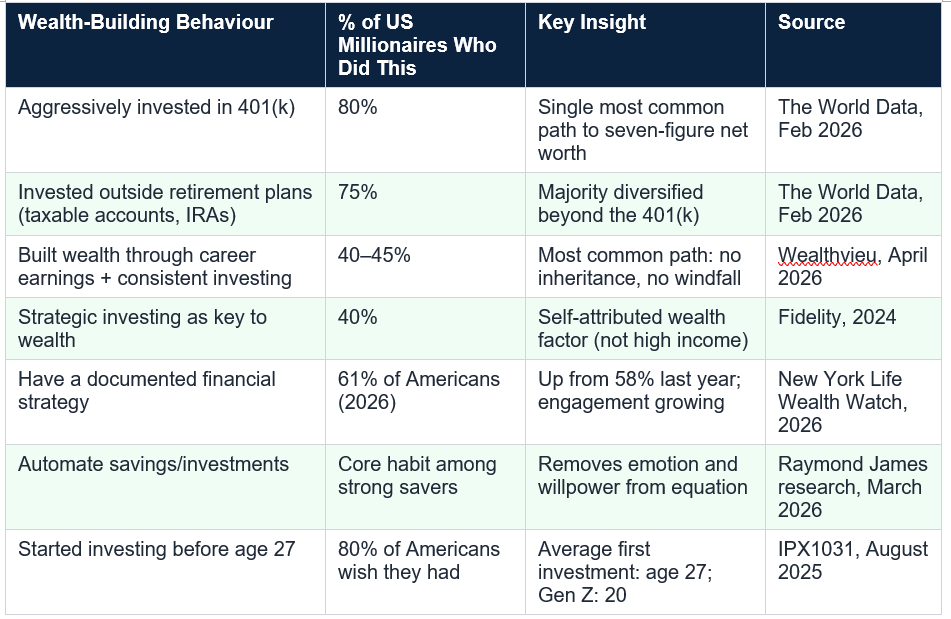
In 2026, the evidence is clear on what works and what does not. Eighty percent of millionaires went all-in on their 401(k). Seventy-five percent invested outside their retirement plans. The people who consider themselves wealthy say consistent saving and strategic investing got them there — not a specific investment call or a lucky break.
Only 35 percent of Americans believe they will ever become wealthy. The data suggests that far more are capable of it than believe it. The path is not glamorous. It is automated savings, maximised 401(k), disciplined lifestyle management, steady investment in diversified assets, and the patience to let compounding do its work. State Street’s 2026 investor roadmap ends with this principle: build SMART goals and maintain disciplined consistency. Consistency, compounded over decades, is how ordinary Americans build extraordinary wealth.
According to The World Data’s February 2026 analysis, 80% of American millionaires aggressively invested in employer-sponsored 401(k) plans, making it the single most common path to seven-figure net worth. 75% also invested outside retirement plans. Wealthvieu’s April 2026 research found 40–45% of millionaires built wealth through career earnings combined with consistent investing — no business ownership, no inheritance, no windfall. Fidelity’s 2024 State of Wealth Mobility Study found 40% attributed their wealth to strategic investing aligned with financial goals.
What percentage of Americans consider themselves wealthy?
Only 11% of Americans currently consider themselves wealthy, according to Fidelity’s 2024 State of Wealth Mobility Study. Just 35% believe they will become wealthy at any point in their lifetime. However, New York Life’s 2026 Wealth Watch Midyear Outlook found 61% of Americans now have a financial strategy in place, up from 58% the year before, suggesting growing engagement with wealth-building habits.
What is the single best wealth-building tool for most Americans?
The employer-sponsored 401(k) is statistically the most powerful wealth-building tool for most working Americans. It offers tax-deferred or tax-free growth, automatic paycheck contributions that remove emotional decision-making, and employer matching that amounts to an immediate 50–100% return on contributions. The 2026 contribution limit is $23,500 per year (under 50) or $31,000 (50 and older including catch-up).
How does lifestyle creep prevent wealth building?
Lifestyle creep occurs when spending rises proportionally with income, keeping the savings rate flat regardless of income growth. Highland Financial Advisors’ 2026 analysis shows a household earning $150,000 and saving 20% ($30,000) accumulates far more wealth than a household earning $250,000 but saving only 5% ($12,500). Smart wealth-builders allocate at least half of every income increase to savings or investment before adjusting any spending category.
What is the pay yourself first strategy?
Pay yourself first means treating savings and investment contributions as non-negotiable expenses that occur at the start of each pay period, before any discretionary spending. Instead of saving whatever remains after expenses, you automate transfers to savings and investment accounts on payday, ensuring consistent accumulation regardless of other financial pressures. Raymond James research (March 2026) identifies this as one of the most consistent habits among strong savers.
How many income streams should I have?
88% of Americans believe passive income is essential for retirement security, and 83% believe multiple income streams are essential for financial security overall, per IPX1031’s August 2025 survey. Most millionaires generate income from multiple sources: their primary career, dividend income from investments, interest income from bonds or savings, and in many cases real estate. Building even one additional income stream beyond primary employment provides meaningful long-term wealth-building acceleration.
What are the tax-advantaged accounts I should maximise in 2026?
In priority order: (1) 401(k) to the employer match — captures the immediate 50–100% return; (2) HSA if eligible — triple tax advantage for medical costs; (3) Roth IRA or traditional IRA ($7,000/$8,000 for 50+); (4) 401(k) to the maximum ($23,500/$31,000 for 50+); (5) taxable brokerage with tax-efficient index funds. The gift tax annual exclusion in 2026 is $19,000 per recipient ($38,000 for married couples), relevant for wealth transfer planning.
Table of Contents
- What Wealth Actually Looks Like in America
- The Wealth-Building Mindset: What Separates the 11%
- Strategy 1: Automate Everything, Decide Nothing
- Strategy 2: The 401(k) Is Still the Single Best Wealth Vehicle
- Strategy 3: Control Lifestyle Creep — The Gap Is the Point
- Strategy 4: Build Multiple Income Streams
- Strategy 5: Own Assets, Not Just Income
- Strategy 6: Master Your Taxes First, Then Invest
- Strategy 7: Protect What You Build
- The Millionaire Blueprint: What the Data Says Actually Works
- The Wealth-Building Timeline: What to Focus on Each Decade
- Common Mistakes That Derail Wealth Building in 2026
- Conclusion: The Boring Path Is Still the Right One
- Frequently Asked Questions
What Wealth Actually Looks Like in America
Ask most Americans whether they consider themselves wealthy, and the answer is no. According to Fidelity Investments’ 2024 State of Wealth Mobility Study, only 11 percent of Americans currently consider themselves wealthy. Even more striking: only 35 percent believe they will ever become wealthy at any point in their lifetime. These figures do not describe a failure of effort or ambition. They describe a gap between how people understand wealth and how it is actually built.According to Wealthvieu’s April 2026 millionaire statistics analysis, 40 to 45 percent of American millionaires built their net worth through career earnings combined with consistent, disciplined investing — not through business ownership, inheritance, or luck. The ‘boring path’ of earning income and systematically investing it is statistically the most common route to seven-figure wealth in America. This is a fact that the financial media, with its preference for extraordinary stories, dramatically underreports.
In 2026, 61 percent of Americans have a financial strategy in place, up from 58 percent last year, according to New York Life’s 2026 Wealth Watch Midyear Outlook. But only 52 percent are confident their retirement savings will last a lifetime — a figure that dropped 21 percentage points from 2025. The gap between having a plan and having confidence in that plan is precisely where wealth-building strategy lives. This article describes what smart Americans are doing differently in 2026.
The Wealth-Building Mindset: What Separates the 11%
The most important distinction between people who build meaningful wealth and people who do not is not income. It is how they relate to the money they earn. Fidelity’s research found that people who consider themselves wealthy attribute their success to three habits: early planning, consistent saving, and strategic investing. All three habits are about behaviour, not earnings.Highland Financial Advisors’ January 2026 analysis is specific: a household earning $150,000 that saves 20 percent ($30,000) will accumulate far more wealth than a household earning $250,000 that saves only 5 percent ($12,500). Income matters, but the gap between earnings and spending matters more. This is the foundational insight that separates wealth-builders from high earners who remain financially insecure.
The second mindset distinction is the relationship with time. Eighty percent of Americans in the IPX1031 August 2025 survey said they wished they had started investing earlier. The average American makes their first investment at age 27. Gen Z investors are already doing better: the average Gen Z first investment age is 20, seven years earlier than the national average. Seven additional years of compounding is, depending on the return rate, the difference between a comfortable retirement and a financially secure one.
Fidelity Investments, 2024 State of Wealth Mobility Study: 40% of Americans who consider themselves wealthy attributed their success to investing strategically — making investments that aligned with their financial goals. Habits like early planning, consistent saving, and strategic investing helped them build financial confidence.
Strategy 1: Automate Everything, Decide Nothing
Automation is the single most consistently cited wealth-building tool among financial advisers in 2026. Raymond James research from March 2026 identifies automation as one of the most consistent traits among strong savers: they remove the need for willpower by having savings transfers happen automatically before they can spend the money. According to Origin Financial, nearly every bank and financial platform supports some form of automatic transfer, recurring investment, or payroll contribution in 2026.The ‘pay yourself first’ principle formalises automation into a philosophy. Rather than saving whatever remains after expenses, you treat savings and investments as non-negotiable expenses that come out of every paycheck before any discretionary spending occurs. This shifts saving from a monthly decision that must be won against competing impulses to a background process that happens regardless of mood, market news, or lifestyle temptations.
The specific 2026 implementation: set up automatic payroll diversion to your 401(k) at the maximum contribution rate you can sustain; set a separate automatic transfer on every payday to a high-yield savings account for your emergency fund until it reaches three to six months of expenses; and set a recurring investment in a taxable brokerage account or Roth IRA for long-term wealth building. Once these three automations are in place, wealth building happens by default. It requires no ongoing decisions.
NerdWallet’s 2026 survey data shows that 55 percent of Americans plan to cut subscription costs in 2026. Combined with automation, even modest savings on recurring costs compound significantly when redirected to systematic investment.
Strategy 2: The 401(k) Is Still the Single Best Wealth Vehicle
Despite the complexity of the modern financial landscape and the proliferation of new investment products, the employer-sponsored 401(k) remains the most powerful wealth-building tool available to most working Americans. The World Data’s February 2026 analysis of US millionaire statistics found that 80 percent of American millionaires aggressively invested in employer-sponsored 401(k) plans, making it the single most common path to seven-figure net worth.The reasons for the 401(k)’s effectiveness are structural, not circumstantial. Highland Financial Advisors’ January 2026 analysis summarises them: tax-deferred or tax-free growth (depending on traditional or Roth); automatic paycheck contributions that remove emotion; and employer matching, which is often an immediate 50 to 100 percent return on every dollar contributed. No other investment vehicle offers a guaranteed 50 to 100 percent immediate return on contribution.
The 2026 contribution limits: $23,500 per year for workers under 50; $31,000 for workers 50 and older (including the $7,500 catch-up contribution). Workers who consistently maximise their 401(k) contribution from their late 20s or 30s through retirement, particularly in accounts with a reasonable employer match, are on track to accumulate between $1 million and $3 million by retirement at historical equity market return rates. This is not a projection based on optimistic assumptions. It is the mathematical output of consistent contributions and compound growth over three to four decades.
Strategy 3: Control Lifestyle Creep — The Gap Is the Point
Lifestyle creep is the tendency for spending to rise proportionally with income, leaving the savings rate unchanged regardless of how much a person earns. It is the primary explanation for why many high-income earners accumulate surprisingly little wealth over their careers. Every raise, promotion, and bonus becomes a new recurring expense rather than a new recurring investment.Smart wealth-builders in 2026 treat income increases as wealth-building opportunities first and lifestyle upgrades second. A practical rule: when income increases, allocate at least 50 percent of the net increase to savings or investment before adjusting any spending category. If a raise adds $500 per month in net income, $250 per month goes to increased retirement contributions or taxable investing, and $250 per month is available for lifestyle improvement. Over a decade, this approach produces dramatically different wealth outcomes than a household that allows all income growth to flow into spending.
State Street Global Advisors’ 2026 investor roadmap frames the goal clearly: a household that saves 20 percent consistently will accumulate wealth regardless of starting salary. Consistent saving rates compound. The gap between earnings and spending — maintained consistently and invested productively — is the mechanism by which wealth is built.
Strategy 4: Build Multiple Income Streams
The IPX1031 August 2025 survey of 854 Americans found that 88 percent believe passive income is essential for retirement financial security, and 83 percent believe having multiple income streams is essential for financial security overall. These beliefs are well-supported by the data on actual millionaire income profiles.The World Data’s 2026 millionaire analysis found that 75 percent of millionaires invested outside their company retirement plans, diversifying into taxable brokerage accounts, IRAs, and other investment vehicles. This means the majority of American millionaires are not wealthy because of their primary employment income alone — they have built investment portfolios that generate income independently of their working hours.
Multiple income streams for wealth-building purposes do not necessarily require a second job or a business. They can include:
- Dividend income from a taxable brokerage account holding dividend-paying stocks or ETFs
- Rental income from a property investment (including REITs as a lower-barrier alternative to direct property ownership)
- Interest income from bond holdings, bond funds, or high-yield savings
- Side business income from a skill or expertise monetised beyond primary employment
- Royalties or licensing income from creative or intellectual property
Strategy 5: Own Assets, Not Just Income
The distinction between earners and wealth-builders is often the distinction between those who own income-producing assets and those who do not. A salary is income; a portfolio of index funds is an asset. The salary disappears when employment ends. The portfolio continues to compound.Smart wealth-builders in 2026 are prioritising asset ownership in several forms:
Index Fund Portfolios
The evidence for low-cost, broadly diversified index funds as the core of an individual investor’s long-term wealth strategy has only strengthened over the past decade. Highland Financial Advisors’ 2026 analysis emphasises investing consistently as a core wealth habit, specifically through systematic contributions to diversified index funds. The combination of low expense ratios, broad market exposure, and minimal trading is the approach that decades of research supports for most individual investors.Real Estate
Real estate remains one of the most common and most effective wealth-building vehicles for American families. Homeownership builds equity through mortgage paydown and appreciation, and direct investment properties provide both income and appreciation. REITs offer a liquid, diversified alternative for investors who want real estate exposure without direct property management.Small Business Equity
For those with entrepreneurial inclinations, business ownership provides income plus asset appreciation potential. Wealthvieu’s data shows this path is less common among millionaires than the media suggests — but for those who pursue it successfully, the wealth-building potential is very large.Strategy 6: Master Your Taxes First, Then Invest
Tax efficiency is the highest-return skill available to any investor. Two dollars earned is worth more than two dollars in gross income if one is sheltered from tax and one is not. Smart wealth-builders in 2026 prioritise tax-advantaged accounts before taxable investing and use every available legal mechanism to reduce their tax burden.The priority order for tax-advantaged investing in 2026:
- 401(k) to the employer match: every dollar contributed that receives a match earns an immediate 50 to 100 percent return. This is always the first priority.
- Health Savings Account (HSA) if eligible: the HSA is the only account with triple tax advantage — contributions are pre-tax, growth is tax-free, and withdrawals for qualified medical expenses are tax-free. Fidelity specifically highlights HSAs as beneficial for wealthy individuals due to this triple tax savings.
- Roth IRA or traditional IRA ($7,000 per year in 2026; $8,000 for those 50+): the Roth provides tax-free growth and tax-free qualified withdrawals. For investors expecting higher future tax rates, the Roth is preferable.
- 401(k) to the maximum ($23,500 in 2026; $31,000 for 50+): after the IRA, return to the 401(k) to maximise the full contribution.
- Taxable brokerage: all investment above tax-advantaged limits goes here. Use tax-efficient funds (index funds, ETFs) to minimise taxable distributions.
Strategy 7: Protect What You Build
Wealth protection is the underrated half of wealth building. Every dollar lost to inadequate insurance, poor risk management, or a large unexpected expense is a dollar that must be rebuilt from income. Smart wealth-builders maintain the protective structures that prevent one event from undoing years of accumulation.Key protection strategies in 2026 include:
- Emergency fund of 3 to 6 months of essential expenses in a high-yield savings account: this prevents any unexpected expense from forcing liquidation of investments at an unfavourable time.
- Adequate life insurance and disability insurance: disability is significantly more likely than death for working-age Americans, yet disability insurance is far less commonly held. Protecting income during working years is as important as building investment portfolios.
- Umbrella liability insurance: relatively inexpensive for the coverage provided, umbrella policies protect accumulated assets from lawsuits that exceed standard homeowner or auto policy limits.
- Estate planning documents: a will, healthcare directive, and power of attorney protect accumulated wealth and ensure it passes as intended. Americans who work with a financial professional and own protection products are nearly twice as likely to feel confident their assets will last throughout retirement, per New York Life’s 2026 Wealth Watch.
The Millionaire Blueprint: What the Data Says Actually Works
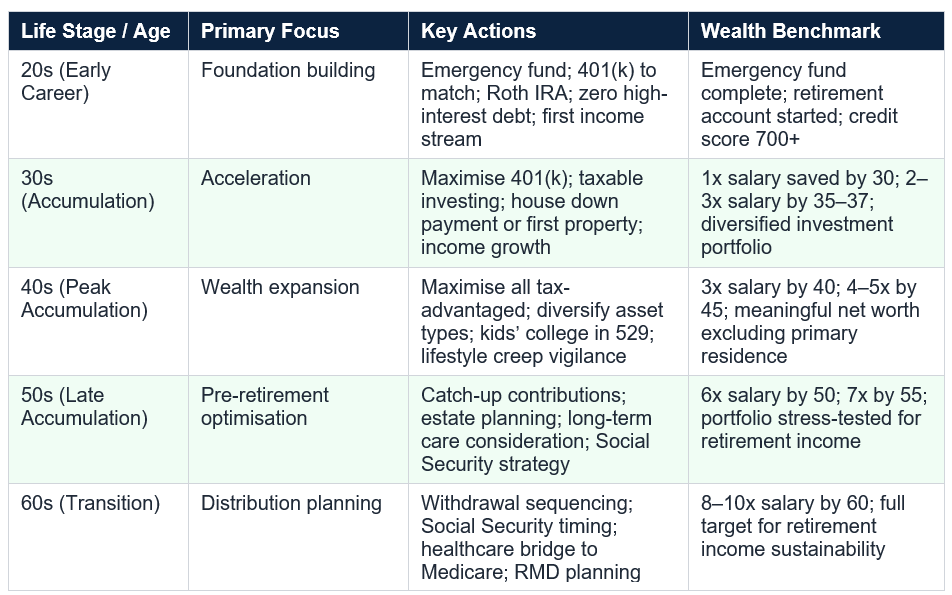
The Wealth-Building Timeline: What to Focus on Each Decade
Common Mistakes That Derail Wealth Building in 2026
- Holding too much cash: the $3 trillion retail money-market fund problem documented by the WSJ in August 2026 is real. Investors who moved to cash in 2022 and stayed there missed approximately 50 percent cumulative market gains from 2023 through 2025. Cash is not safe from opportunity cost.
- Waiting for the perfect time to invest: the investors who build the most wealth are not the ones who time markets correctly. They are the ones who invest consistently through all market conditions. Missing the ten best market days in any decade eliminates approximately 80 percent of that decade’s total return.
- Lifestyle creep consuming all income growth: a raise that converts entirely to additional spending adds zero to wealth. Smart wealth-builders allocate at least half of every income increase to savings or investment before any spending adjustment.
- Ignoring tax efficiency: holding actively managed funds in taxable accounts while holding bonds and CDs in tax-advantaged accounts is a common and costly sequencing error. Asset location (what you hold where) has a significant multi-decade impact on after-tax returns.
- Not having protection in place: one catastrophic medical bill, lawsuit, or disability can undo years of disciplined accumulation. Wealth protection is as important as wealth building.
- Chasing the shiny new thing: 2026 has its version of the same temptations that have always derailed retail investors. Highland Financial Advisors’ 2026 analysis puts it directly: social media is great at grabbing attention and terrible at delivering sound financial planning advice. If shortcuts actually worked, wealth wouldn’t be rare.
13. Conclusion: The Boring Path Is Still the Right One
Forty to forty-five percent of American millionaires built their wealth the boring way: career earnings plus consistent investing, without a business exit, an inheritance, or a lottery. The strategies they used are not secrets: automate savings, maximise tax-advantaged accounts, resist lifestyle creep, own assets, protect what you build, and invest for the long term without reacting to short-term market movements.In 2026, the evidence is clear on what works and what does not. Eighty percent of millionaires went all-in on their 401(k). Seventy-five percent invested outside their retirement plans. The people who consider themselves wealthy say consistent saving and strategic investing got them there — not a specific investment call or a lucky break.
Only 35 percent of Americans believe they will ever become wealthy. The data suggests that far more are capable of it than believe it. The path is not glamorous. It is automated savings, maximised 401(k), disciplined lifestyle management, steady investment in diversified assets, and the patience to let compounding do its work. State Street’s 2026 investor roadmap ends with this principle: build SMART goals and maintain disciplined consistency. Consistency, compounded over decades, is how ordinary Americans build extraordinary wealth.
Frequently Asked Questions
How do most American millionaires actually build their wealth?According to The World Data’s February 2026 analysis, 80% of American millionaires aggressively invested in employer-sponsored 401(k) plans, making it the single most common path to seven-figure net worth. 75% also invested outside retirement plans. Wealthvieu’s April 2026 research found 40–45% of millionaires built wealth through career earnings combined with consistent investing — no business ownership, no inheritance, no windfall. Fidelity’s 2024 State of Wealth Mobility Study found 40% attributed their wealth to strategic investing aligned with financial goals.
What percentage of Americans consider themselves wealthy?
Only 11% of Americans currently consider themselves wealthy, according to Fidelity’s 2024 State of Wealth Mobility Study. Just 35% believe they will become wealthy at any point in their lifetime. However, New York Life’s 2026 Wealth Watch Midyear Outlook found 61% of Americans now have a financial strategy in place, up from 58% the year before, suggesting growing engagement with wealth-building habits.
What is the single best wealth-building tool for most Americans?
The employer-sponsored 401(k) is statistically the most powerful wealth-building tool for most working Americans. It offers tax-deferred or tax-free growth, automatic paycheck contributions that remove emotional decision-making, and employer matching that amounts to an immediate 50–100% return on contributions. The 2026 contribution limit is $23,500 per year (under 50) or $31,000 (50 and older including catch-up).
How does lifestyle creep prevent wealth building?
Lifestyle creep occurs when spending rises proportionally with income, keeping the savings rate flat regardless of income growth. Highland Financial Advisors’ 2026 analysis shows a household earning $150,000 and saving 20% ($30,000) accumulates far more wealth than a household earning $250,000 but saving only 5% ($12,500). Smart wealth-builders allocate at least half of every income increase to savings or investment before adjusting any spending category.
What is the pay yourself first strategy?
Pay yourself first means treating savings and investment contributions as non-negotiable expenses that occur at the start of each pay period, before any discretionary spending. Instead of saving whatever remains after expenses, you automate transfers to savings and investment accounts on payday, ensuring consistent accumulation regardless of other financial pressures. Raymond James research (March 2026) identifies this as one of the most consistent habits among strong savers.
How many income streams should I have?
88% of Americans believe passive income is essential for retirement security, and 83% believe multiple income streams are essential for financial security overall, per IPX1031’s August 2025 survey. Most millionaires generate income from multiple sources: their primary career, dividend income from investments, interest income from bonds or savings, and in many cases real estate. Building even one additional income stream beyond primary employment provides meaningful long-term wealth-building acceleration.
What are the tax-advantaged accounts I should maximise in 2026?
In priority order: (1) 401(k) to the employer match — captures the immediate 50–100% return; (2) HSA if eligible — triple tax advantage for medical costs; (3) Roth IRA or traditional IRA ($7,000/$8,000 for 50+); (4) 401(k) to the maximum ($23,500/$31,000 for 50+); (5) taxable brokerage with tax-efficient index funds. The gift tax annual exclusion in 2026 is $19,000 per recipient ($38,000 for married couples), relevant for wealth transfer planning.
0 Comments
Be the first to share your thoughts on this article.