

Financial Literacy
What Should I Do With My Money? Accountants' Action Plan

Table of Contents
- The Question Everyone Has -- and Why the Answer Is Simpler Than You Think
- The Numbers Behind the Question: Where Most Americans Stand in 2026
- The Expert-Agreed Priority Order: What to Do With Your Money, in Order
- The Dollar Decision Guide: Where Should My Next Dollar Go?
- The Seven Steps in Detail: What to Do and Why
- Conclusion: The Plan Is Simple. The Execution Is What Makes the Difference.
- Frequently Asked Questions (FAQ)
- Should I pay off debt or invest first?
- How much should I have in emergency savings in 2026?
- What is the best type of investment account for beginners in 2026?
- How do I know if I am doing okay with my money?
- How do I actually stick to a financial plan?
- External References & Further Reading
The Question Everyone Has -- and Why the Answer Is Simpler Than You Think
Everyone who has money -- even a little bit -- eventually faces some version of the same question: what should I actually do with it? Should I pay off debt? Save it? Invest it? Keep it in a savings account? Put it in a retirement account? The financial industry offers an overwhelming volume of advice, products, and opinions. Most of it is directed at people who already have their foundations in place. This guide is for everyone else.The research is clear on two things: most Americans do not have their financial foundations in order, and most want to fix this. CNBC (June 5, 2026, citing a Vanguard report): 'Nearly 75% of Americans fell short of their saving and spending goals this year, yet 82% remain optimistic that 2026 will be their year for a resolution rebound.' iTHINK Financial (January 2026, citing the Bankrate 2025 Emergency Savings Report): '43% of Americans would need to borrow money through credit cards, personal loans, or family to cover a $1,000 emergency.' NerdWallet (2026): '30% of Americans planned on paying off at least one debt in full in 2026, and 46% planned to save for emergencies.' The gap between intending to improve and actually improving is not a gap in desire. It is a gap in a specific plan with a specific order.
This guide provides that order. It is the same order that NerdWallet, Vanguard, Morningstar, Dave Ramsey, CBS News financial experts, and virtually every other credible financial source agrees on, with 2026-specific numbers for each step. You do not need a finance degree. You do not need a six-figure income. You need the right sequence -- and the will to automate each step before moving to the next.
The Numbers Behind the Question: Where Most Americans Stand
Before the action plan, the context that explains why the plan is structured the way it is: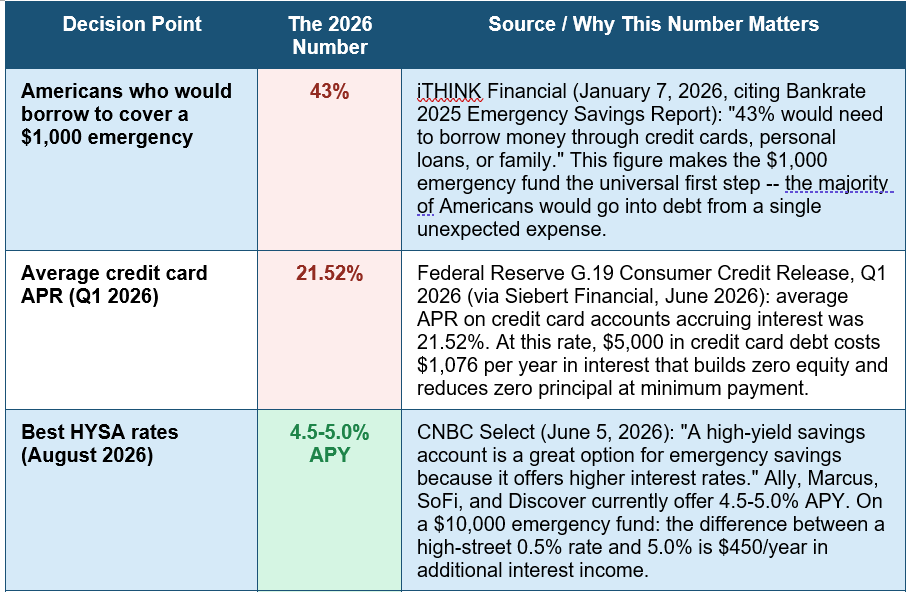
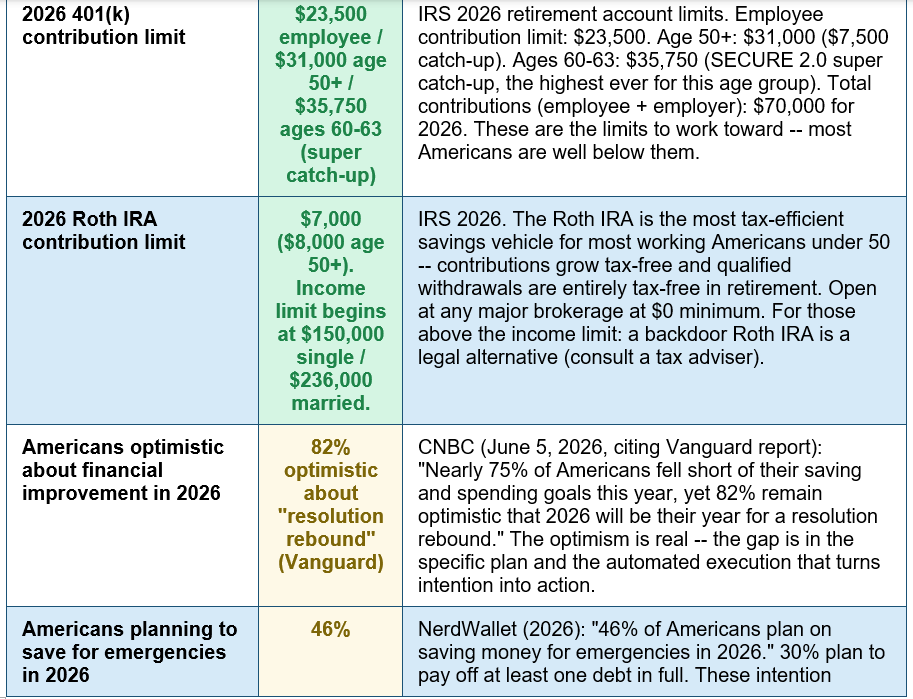

The 2026 financial starting point for most Americans: 43% would borrow for $1k emergency. 21.52% avg credit card APR. 4.5-5.0% HYSA rates. 82% optimistic about improving. $23,500 401k limit. — iTHINK Financial (January 2026, Bankrate 2025): '43% would borrow to cover $1,000 emergency; only 41% could pay from savings.' Federal Reserve G.19 Q1 2026 (via Siebert June 2026): '21.52% avg credit card APR.' CNBC (June 5, 2026): 'Best HYSA offer higher rates; 82% optimistic about 2026 resolution rebound (Vanguard).' NerdWallet 2026: '46% planned to save for emergencies; 30% planned to pay off debt.' IRS 2026: '$23,500 employee 401(k) limit.'
The Expert-Agreed Priority Order: What to Do With Your Money, in Order
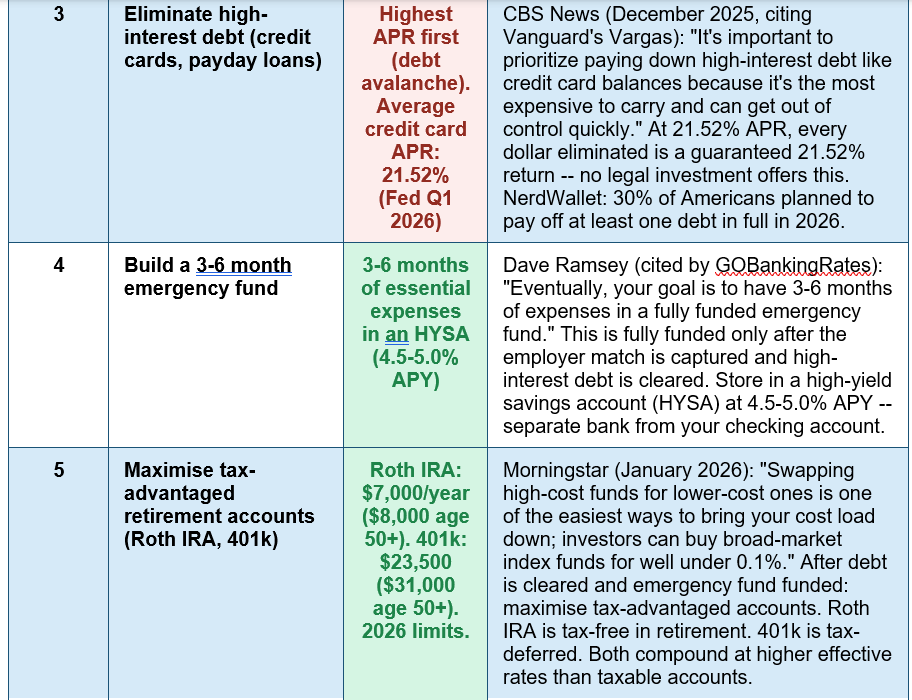
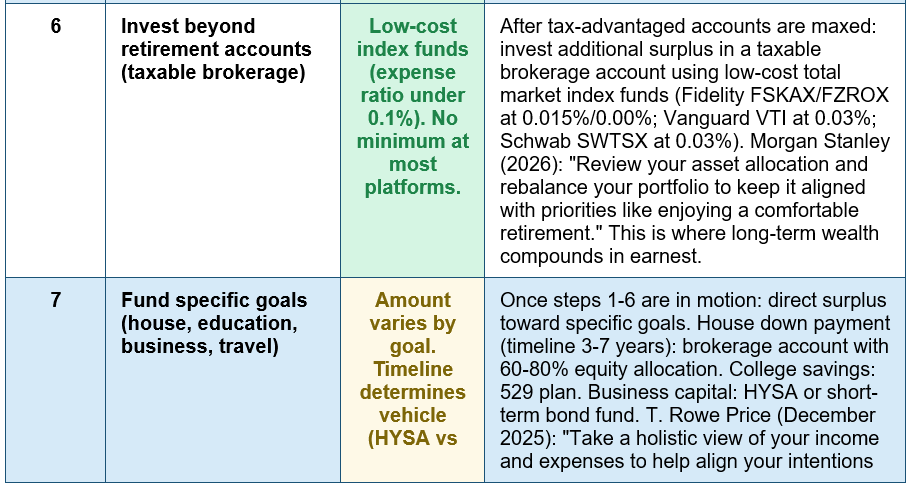
The following table is the financial priority order that experts consistently recommend -- with the specific 2026 numbers for each step: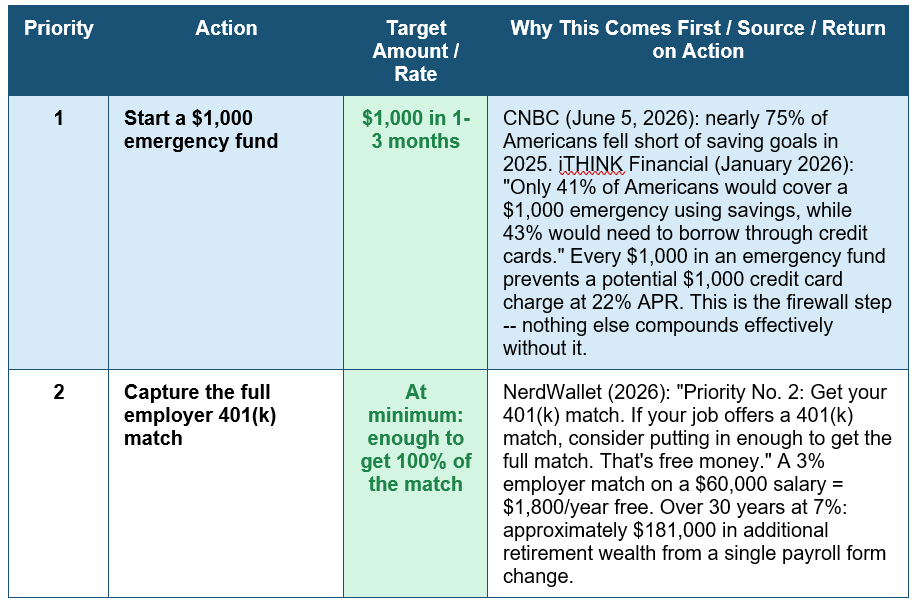 .
.

The Dollar Decision Guide: Where Should My Next Dollar Go?
Depending on where you are right now, the following table tells you exactly where your next available dollar should go: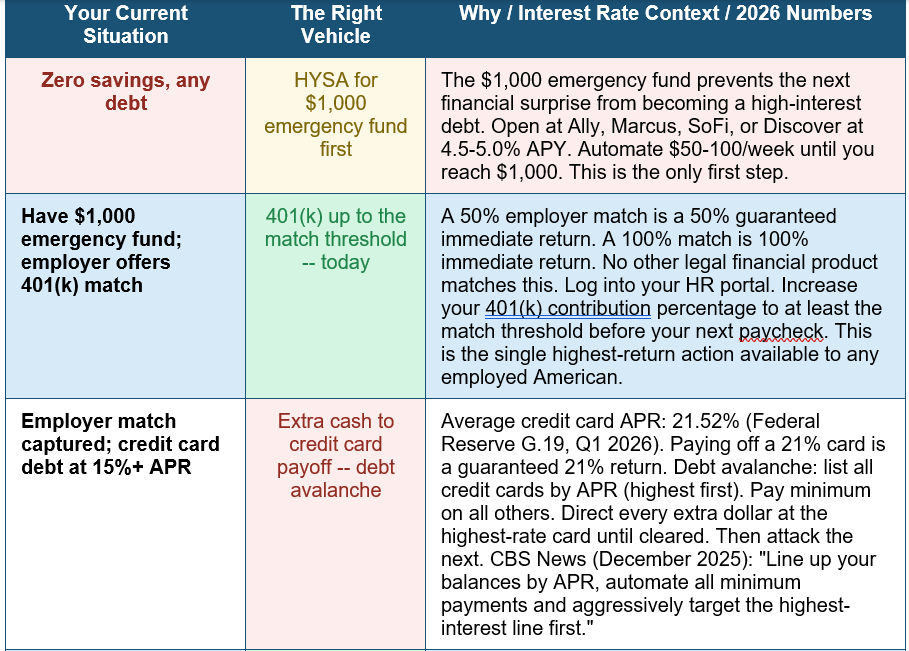
The Seven Steps in Detail: What to Do and Why
STEP 1 BUILD YOUR $1,000 EMERGENCY FUND FIRST | The only correct first step, regardless of income, debt level, or anything else
Before anything else -- before investing, before extra debt payments, before Roth IRAs -- you need $1,000 in a separate savings account that you do not touch for anything except genuine emergencies. iTHINK Financial (January 2026): 'Only 41% of Americans would cover a $1,000 emergency expense using savings. Building even a modest emergency fund should be a top financial priority for 2026.' NerdWallet (2026): 'Priority No. 1: Start an emergency fund. NerdWallet suggests starting an emergency fund of at least $500, which could be enough to cover small emergencies and repairs.' The reason this comes first: without a cash buffer, every financial setback -- a car repair, a medical bill, a broken appliance -- becomes a credit card charge at 22% APR. The emergency fund converts financial crises into planned withdrawals from your own account. The $1,000 target is achievable for most people in 4-8 weeks by temporarily cutting discretionary spending, picking up extra work, or selling items no longer needed. The account: a high-yield savings account (HYSA) at a different bank from your checking account, earning 4.5-5.0% APY (Ally, Marcus, SoFi, Discover). The different bank adds a small friction that reduces impulsive withdrawal for non-emergencies.DO THIS NOW: Open an HYSA account at Ally.com, Marcus.com, or SoFi.com this week. Transfer whatever you can immediately ($25, $50, $100 -- anything). Set up an automatic weekly transfer of $25-100. Do not stop until the balance reaches $1,000. This one account changes your entire financial risk profile.
STEP 2 CAPTURE THE FULL EMPLOYER 401(k) MATCH | The highest guaranteed return available to any employed American -- and it requires only a form
If your employer offers a 401(k) match, capturing it is the single most powerful financial action available to you -- and it requires nothing more than changing a contribution percentage in your HR system. NerdWallet (2026): 'Priority No. 2: Get your 401(k) match. If your job offers a 401(k) match, consider putting in enough to get the full match. That's free money.' A typical 3% match on a $60,000 salary provides $1,800/year in free employer contributions. That $1,800/year invested for 30 years at 7% average return = approximately $181,000 in additional retirement wealth. From a form change. The employer match is the highest guaranteed immediate return available to any employed person. A 50% match on your contribution is a 50% guaranteed return. A 100% match is a 100% guaranteed return. No investment product legally available provides a guaranteed return of this magnitude. Failing to capture it is the most expensive financial mistake an employed person can make -- and it is often made simply because no one explained it clearly. iTHINK Financial (January 2026): 'Failing to capture the match is leaving compensation on the table.'DO THIS NOW: Log into your HR or payroll portal today. Find your 401(k) contribution percentage. Find the employer match terms (e.g., '100% match on the first 3% of salary'). If you are not contributing at least enough to receive the full match -- increase your contribution now. This takes 5-10 minutes and starts generating returns on the next paycheck.
STEP 3 ELIMINATE HIGH-INTEREST DEBT | 21.52% credit card APR is a guaranteed drain. Every dollar paid is a guaranteed 21% return.
With the employer match captured and the $1,000 buffer in place, direct every available dollar at high-interest debt. CBS News (December 2025, citing Vanguard's head of investor research): 'It's important to prioritize paying down high-interest debt like credit card balances because it's the most expensive to carry and can get out of control quickly. Line up your balances by APR, automate all minimum payments and aggressively target the highest-interest line first.' The debt avalanche method: list all debts by APR from highest to lowest. Pay the minimum on every debt except the highest-APR one. Direct every extra dollar at the highest-APR debt until it is eliminated. Then move all freed-up payments to the next highest. Repeat. NerdWallet (2026) guidance: 'Focus on high-interest credit card debt or loans such as personal and payday loans.' What counts as high-interest: typically anything above 7-8% APR. Credit cards at 21.52% average. Payday loans. Personal loans above 10%. Store cards. These should be eliminated before significant investment beyond the employer match. Low-interest debt (mortgage below 6%, federal student loans at 3-5%) is a judgment call -- the expected stock market return of approximately 7% real makes aggressive paydown of sub-6% debt potentially less optimal than investing.DO THIS NOW: List every debt you carry with its APR. Order from highest to lowest. Set all minimum payments to automatic. Direct every dollar of surplus at the highest-APR debt. Use a free debt payoff calculator (NerdWallet, Undebt.it, or PowerPay.org) to see your exact payoff timeline. The visual progress of a shrinking balance is one of the most powerful motivators in personal finance.
STEP 4 BUILD THE FULL 3-6 MONTH EMERGENCY FUND | The financial moat that protects everything you are building
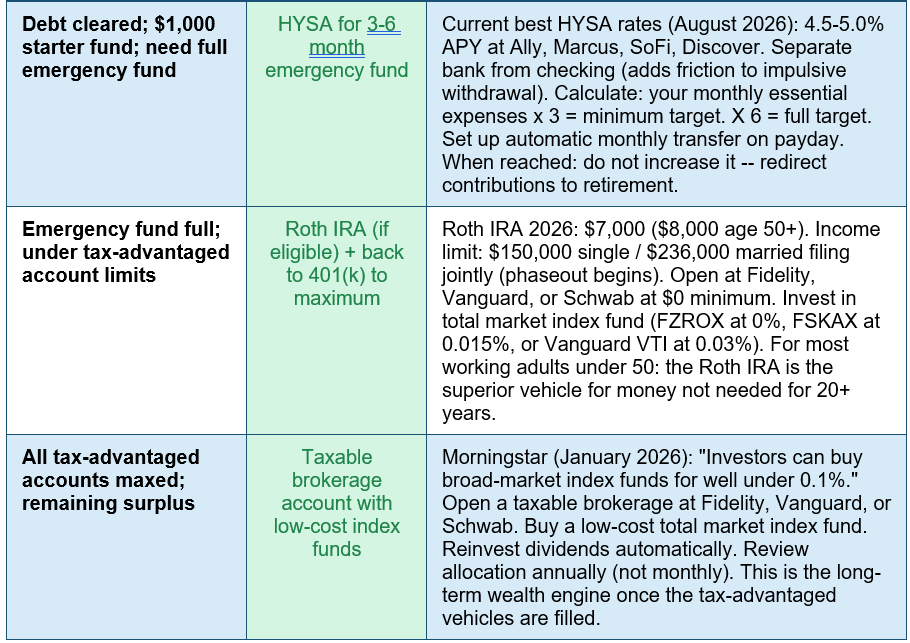
Once high-interest debt is eliminated, complete the emergency fund from the $1,000 starter to its full 3-6 month target. Dave Ramsey (cited by GOBankingRates): 'Eventually, your goal is to have 3-6 months of expenses in a fully funded emergency fund and at least 15% of your gross pay going into retirement savings.' Truist (2026): 'Create a short-term emergency savings goal like $1,000 to $2,000 and save money consistently -- having money set aside for emergencies creates a financial safety net and knowing it's there can help your peace of mind.' Calculate your 3-month target: add up your monthly essential expenses (housing + utilities + food + minimum debt payments + essential transport + insurance). Multiply by 3 for the minimum, by 6 for full coverage. Self-employed, freelance workers, and single-income households: target 6 months. Dual-income households with stable employment: 3 months is adequate. Store the full emergency fund in an HYSA at 4.5-5.0% APY. CNBC (June 5, 2026): 'A high-yield savings account is a great option for emergency savings because it offers higher interest rates.' The psychological benefit: Morgan Stanley (2026): 'Financial stability is closely linked to both physical and mental health.' The emergency fund is not just financial insurance -- it is mental health insurance.DO THIS NOW: Calculate your 3-month essential expense target. Subtract your current HYSA balance. Divide the remainder by the number of months you want to reach the target. Set up an automatic monthly transfer of that amount on payday. Keep the account at a different bank from your checking account so it takes a deliberate decision (and a day or two for transfer) to access.
STEP 5 MAXIMISE TAX-ADVANTAGED RETIREMENT ACCOUNTS | The government offers tax advantages on these accounts. Using them is not optional -- it is foundational.
With the emergency fund complete and high-interest debt cleared: maximise the tax-advantaged retirement accounts available to you. The priority order within this step: first, contribute to the 401(k) up to the employer match (already done in Step 2). Second, open and maximise a Roth IRA ($7,000 in 2026 for those under 50; $8,000 for 50+). Third, return to the 401(k) and contribute up to the annual maximum ($23,500 in 2026). Morningstar (January 2026): 'Swapping high-cost funds for lower-cost ones is one of the easiest ways to bring your cost load down; investors can buy broad-market index funds for well under 0.1%.' The Roth IRA is the right vehicle for most people currently in a lower tax bracket than they expect to be in retirement -- contributions are after-tax, but growth and qualified withdrawals are entirely tax-free. The traditional 401(k) is better for those in a high bracket now who expect lower income in retirement. For most people under 40: Roth first. Roth IRA eligibility in 2026: single filer with income below $150,000 (phaseout begins). Open at Fidelity, Vanguard, or Schwab at $0 minimum. Invest in a low-cost total market index fund (FZROX at 0.00%, VTI at 0.03%). Set contributions to automatic. Morgan Stanley (2026): 'Review your asset allocation and rebalance your portfolio to keep it aligned with priorities.'DO THIS NOW: If you do not have a Roth IRA: open one today at Fidelity (fidelity.com), Vanguard (vanguard.com), or Schwab (schwab.com). $0 minimum. Choose a target-date fund for your expected retirement year (simplest) or a total market index fund (most flexible). Set up monthly automatic contributions. The 2026 limit is $7,000 ($583/month) -- contribute whatever you can, even if not the maximum. Something beats nothing, every month.
STEP 6 INVEST BEYOND RETIREMENT ACCOUNTS | After the tax-advantaged vehicles are filled: the taxable brokerage account is the next growth engine
If you have maxed your Roth IRA and are contributing the maximum to your 401(k) and still have surplus to invest: a taxable brokerage account is the next vehicle. Morningstar (January 2026): 'Investors can buy broad-market index funds for well under 0.1%.' The low-cost total market index fund -- Fidelity FSKAX (0.015%), FZROX (0.00%), Vanguard VTI (0.03%), Schwab SWTSX (0.03%) -- provides broad US market exposure for essentially zero cost. The tax considerations in a taxable account: dividends are taxable in the year received; capital gains are taxable when you sell (long-term capital gains rates are 0%, 15%, or 20% depending on income). Tax-efficient strategies in a taxable account: hold index funds rather than active funds (lower turnover = lower capital gains distributions); use tax-loss harvesting during market downturns; hold international funds (may qualify for a foreign tax credit). Morgan Stanley (2026): 'Reviewing your asset allocation and rebalancing your portfolio to keep it aligned with priorities.' Annual rebalancing -- selling over-weighted assets and buying under-weighted ones -- maintains the target allocation without requiring active management decisions during market volatility.
DO THIS NOW: Open a taxable brokerage account at Fidelity, Vanguard, or Schwab ($0 minimum). Choose a low-cost index fund (FSKAX, FZROX, VTI, or SWTSX). Set up automatic monthly contributions. Review the allocation annually (not monthly). Do not check the balance during market downturns -- the only action that should follow a market drop is to continue your automated contributions.
STEP 7 FUND SPECIFIC GOALS | House, education, business, travel -- the financial vehicles vary by timeline and tax treatment
Once the foundational steps are in motion, direct remaining surplus toward specific goals. The key: the investment vehicle should match the goal's timeline. T. Rowe Price (December 2025): 'Take a holistic view of your income and expenses to help align your intentions with what's realistic given your current situation.' Timeline guide: (1) Under 2 years: HYSA at 4.5-5.0% APY or short-term Treasury bills. No equity exposure for money needed soon. (2) 2-5 years: Mix of HYSA and a moderate allocation (50-60% equity, 40-50% bonds/cash). Goal: a house down payment in 3 years might hold 40% in an HYSA and 60% in a balanced fund. (3) 5-10 years: 70-80% equity index fund, 20-30% bond fund. (4) 10+ years: 90%+ equity index fund (similar to retirement allocation). Specific goal vehicles: college savings: 529 plan (state tax deduction in most states). Starting a business: separate high-yield savings account labelled 'Business Capital.' First home: taxable brokerage account with moderate allocation for 5+ year timelines, HYSA for under 3 years. Major travel or sabbatical: HYSA, sized to your timeline.DO THIS NOW: List your top 2-3 non-retirement financial goals with specific dollar amounts and target dates. Calculate the monthly contribution needed for each. Open a dedicated account for each goal (separate HYSA or brokerage). Name each account after its goal. Set up automatic monthly contributions. The named account and the automation turn a vague aspiration into a funded plan.
Why the priority order matters more than the amounts. The most important financial insight in this guide is not any specific step -- it is the order. The person who invests $500/month in a brokerage before building an emergency fund will, with high statistical probability, eventually withdraw from that brokerage account to cover an emergency, paying taxes and potential early withdrawal penalties in the process. The person who invests $500/month in a Roth IRA before eliminating a 21% credit card is earning an expected 7% annual return while paying 21% on a debt -- a guaranteed negative arbitrage. The person who builds a 6-month emergency fund before capturing the employer match is forgoing a 50-100% guaranteed return in favour of a 4.5-5% HYSA rate. The order is determined by the returns and guarantees available at each step. The employer match has the highest guaranteed immediate return (50-100%). Eliminating 21% debt has the highest guaranteed subsequent return. The HYSA provides protection after the debt is gone. Tax-advantaged accounts provide the best after-tax compounding. The taxable brokerage comes last because its tax efficiency is lowest. Truist (2026): 'The first step of budgeting is to take a good look at your spending to determine where your money is going. Then, use those insights to create a spending plan that reflects your priorities and values.' The plan is only as effective as the execution -- and execution is only sustainable when it is automated.
FIVE MONEY DECISIONS THAT UNDERMINE THE PLAN: (1) INVESTING BEFORE ELIMINATING HIGH-INTEREST DEBT. At 21.52% credit card APR, every dollar invested in an index fund (expected 7% real return) is costing 14.52% net. Pay the card first. The guaranteed 21% return on credit card paydown beats any investment product available. (2) KEEPING YOUR EMERGENCY FUND IN A CHECKING ACCOUNT AT 0.5%. At $10,000 in an HYSA at 5% vs checking at 0.5%, the opportunity cost is $450/year in foregone interest income. The switch takes 20 minutes. (3) CASHING OUT A 401(k) WHEN LEAVING A JOB. The early withdrawal penalty is 10% plus income tax -- typically consuming 25-35% of the balance. Additionally: all future compound growth on the withdrawn amount is permanently lost. Always roll over to an IRA or a new employer's plan. (4) HOLDING ALL INVESTMENTS IN CASH BECAUSE 'THE MARKET SEEMS RISKY'. Cash at 5% loses purchasing power at 2.6% CPI inflation per year. $100,000 in cash for 10 years at 5% HYSA, with 3% annual inflation adjustment, is worth approximately $134,000 in real terms. The same amount in a total market index fund at 7% real return is worth approximately $197,000. Time in the market beats timing the market for virtually all historical periods. (5) SETTING A BUDGET ONCE AND NEVER REVIEWING IT. Morningstar (January 2026): 'Reviewing costs and translating those percentages into dollars and cents, then seeing if you can shave them down, is the most underrated financial exercise.' Subscription costs change, income changes, lifestyle changes. A 30-minute monthly review is worth thousands per year in redirected spending.
THE AUTOMATION CHECKLIST -- DO THESE FIVE THINGS AND THE PLAN RUNS ITSELF: (1) HYSA AUTO-TRANSFER: Set up a recurring weekly or biweekly transfer from checking to HYSA on payday -- before any other spending decision. Amount: whatever builds the $1,000 starter fund in 8 weeks. After $1,000 is reached: recalculate the amount needed to build the full 3-6 month fund and reset the transfer. (2) 401(k) CONTRIBUTION: Logged and set in your HR portal at the employer match threshold minimum. Once debt is cleared: increase toward the full annual limit. (3) ROTH IRA AUTO-CONTRIBUTION: $7,000/year = $583/month. Set up a monthly automatic contribution from your bank account to your Roth IRA. If $583 is too much: start with $100/month. Increase by $50/month every quarter. (4) DEBT MINIMUM PAYMENTS: Set every debt's minimum payment to automatic (bank's auto-bill-pay or creditor's autopay). Direct all surplus manually at the highest-rate debt. This ensures no missed payments damage your credit score while you are focused on the priority debt. (5) ANNUAL REVIEW REMINDER: Set a calendar appointment for the first Sunday in January -- 2 hours -- to review: all account balances, interest rates on any remaining debt, contribution rates, and whether the budget reflects your current income and expenses. The automation handles the month-to-month execution. The annual review handles the strategic adjustments.
YOUR PERSONAL MONEY PRIORITY ACTION PLAN -- START HERE: IDENTIFY YOUR CURRENT POSITION (10 minutes): Run through the priority table in this guide. What is your first uncomplete step? Do you have $1,000 in a separate savings account? If no: that is step 1. Are you capturing the full employer 401(k) match? If no: that is step 2. Do you have high-interest debt above 10% APR? If yes: that is step 3. Start at your uncomplete step and focus there exclusively until it is done. Do not try to do all seven steps simultaneously -- the order exists because each step creates the foundation for the next. CALCULATE ONE NUMBER: The single most important number to know today is your highest-interest debt rate. If you have a credit card at 22% APR and any discretionary spending, you have an action item. If your highest debt rate is below 7%, you are in the investment-first conversation. OPEN ONE ACCOUNT (20 minutes): Whatever your current step requires -- an HYSA, a Roth IRA, a 529 -- open it today at a reputable provider. All of the following have $0 minimums and no account fees: Ally Bank (HYSA), Marcus by Goldman Sachs (HYSA), Fidelity (Roth IRA, 401k rollover, taxable brokerage), Vanguard (Roth IRA, taxable brokerage), Schwab (Roth IRA, taxable). SET UP ONE AUTOMATION: Once the account is open, set up one automatic transfer or contribution. The amount is less important than the automation. The automation is the plan. FREE RESOURCES: CFPB Budget Worksheet consumerfinance.gov | NerdWallet Money Tracker nerdwallet.com | Fidelity Retirement Calculator fidelity.com | IRS 2026 Retirement Contribution Limits irs.gov.
Conclusion:
What should you do with your money? The same thing the experts have been saying for decades, adapted to the 2026 numbers: build the $1,000 emergency fund first. Capture the full employer 401(k) match. Eliminate high-interest debt. Complete the 3-6 month emergency fund. Maximise tax-advantaged retirement accounts. Invest in low-cost index funds. Fund specific life goals. Seven steps. In that order.CNBC (June 5, 2026): '82% of Americans remain optimistic that 2026 will be their year for a financial resolution rebound.' NerdWallet (2026): '46% planned to save for emergencies; 30% planned to pay off at least one debt.' iTHINK Financial (January 2026): 'You do not need a finance degree or a six-figure income to make meaningful progress. What you need is a clear roadmap and the willingness to take consistent action.' The gap between 75% who fell short of 2025 goals and 82% who are optimistic about 2026 is not a gap in desire or intelligence. It is a gap in specific, automated, step-by-step execution.
The plan in this guide works because it is based on mathematics, not motivation. The employer match captures free money. Eliminating 21% debt produces a guaranteed 21% return. The HYSA at 4.5-5.0% beats inflation. The Roth IRA compounds tax-free. The total market index fund grows wealth for zero cost. Each step is mechanical, not heroic. Set up the automation. Follow the order. Come back in a year and see what the numbers show.
Frequently Asked Questions (FAQ)
Should I pay off debt or invest first?The answer depends on the interest rate of your debt. The principle: if the guaranteed return on debt paydown (which equals the interest rate you are paying) exceeds the expected return on investment, pay off the debt first. If the investment return exceeds the debt rate, investing may be better. In practice in 2026: Credit card debt at 21.52% average APR (Federal Reserve Q1 2026): always pay this first before investing beyond the employer match. The guaranteed 21.52% return on paydown beats any investment product legally available. Payday loans (typically 300%+ APR): pay immediately, at all costs. Personal loans above 10% APR: pay before investing beyond the employer match. Student loans at 4-6% federal rate: this is a judgment call. At the expected 7% real market return, investing may produce slightly better expected returns than aggressive federal student loan paydown -- but the guaranteed return of debt paydown is worth something. Most financial planners say: pay minimums on student loans and invest in tax-advantaged accounts simultaneously. Mortgage debt at 3-7%: pay minimum and invest the surplus. The expected market return over 20-30 years exceeds even a 7% mortgage rate in most historical scenarios. The exception to all of this: the employer 401(k) match. Always contribute enough to capture the full match before paying any extra debt (except payday loans). The 50-100% guaranteed immediate return on the match beats every debt paydown strategy. NerdWallet (2026): 'Priority No. 2: Get your 401(k) match. That's free money.'
How much should I have in emergency savings in 2026?
Financial experts consistently recommend three to six months of essential living expenses as the full emergency fund target. The starting milestone: $1,000, which should be the very first financial goal before anything else. iTHINK Financial (January 2026): 'A more practical approach is to begin with a $1,000 starter emergency fund.' NerdWallet (2026): 'Many experts recommend trying to build up several months of bare-bones living expenses. Starting with at least $500 could be enough to cover small emergencies and repairs.' Dave Ramsey: '3-6 months of expenses in a fully funded emergency fund.' The right target depends on your employment type and household structure. Self-employed or freelance: six months minimum, because income interruptions are more common and unpredictable. Single income household: six months. Dual income, stable employment: three months is adequate. The calculation: list your monthly essential expenses -- rent or mortgage, utilities, food, minimum debt payments, insurance, essential transport. This is not your total monthly spending -- it is the minimum needed to maintain basic stability. Multiply by your target months. Where to keep it: a high-yield savings account (HYSA) at 4.5-5.0% APY in August 2026. Ally, Marcus, SoFi, and Discover all offer competitive rates. Keep it at a different bank from your checking account -- the small friction reduces impulsive spending from the emergency fund on non-emergencies. Never invest the emergency fund in stocks or equity funds -- it must be instantly accessible with zero risk of a market-driven decline at the moment you need it most.
What is the best type of investment account for beginners in 2026?
For most beginners in 2026, the right first investment account is a Roth IRA, followed by maximising the employer 401(k) match. The Roth IRA is the right first choice for most working adults under 50 for three specific reasons: (1) Tax-free growth and tax-free qualified withdrawals. Contributions are made with after-tax dollars, meaning all growth and distributions in retirement are entirely tax-free. For someone currently in a lower tax bracket than they expect to be in retirement, this is a powerful long-term advantage. (2) Contribution flexibility. Roth IRA contributions (not earnings) can be withdrawn at any time, penalty-free and tax-free, for any reason. This provides a degree of liquidity that traditional retirement accounts do not. (3) Zero minimum investment and $0 fees at major brokerages. Open a Roth IRA at Fidelity (fidelity.com), Vanguard (vanguard.com), or Schwab (schwab.com) with no minimum investment required. Within the Roth IRA, the right investment for most beginners: a low-cost total market index fund. FZROX at Fidelity (0.00% expense ratio), VTI at Vanguard (0.03%), or SWTSX at Schwab (0.03%). All provide broad US market exposure at essentially zero cost. Morningstar (January 2026): 'Investors can buy broad-market index funds for well under 0.1%.' The 2026 Roth IRA contribution limit: $7,000 for those under 50 ($583/month); $8,000 for age 50 and over. Income limits: contributions phase out for single filers above $150,000 and joint filers above $236,000. If your income exceeds these limits: the 401(k) is the primary vehicle, and a backdoor Roth IRA conversion is possible (consult a tax adviser).
How do I know if I am doing okay with my money?
The seven-step priority order in this guide is the benchmark. Run through each step and identify the first one you have not yet completed -- that is where you stand and what your next action is. The three most useful financial health checkpoints: (1) Emergency fund adequacy: do you have $1,000 in a separate savings account? If not, this is the first priority. If yes, do you have 3 months of essential expenses? If not, this is the priority after debt paydown. (2) High-interest debt: do you carry any balance on a credit card above 15% APR? If yes, this debt is actively destroying wealth at a faster rate than most investment products can build it. (3) Retirement savings rate: are you contributing at least 15% of gross income to retirement (employee + employer combined), per the recommendation from Dave Ramsey and Fidelity? Most Americans are not -- the national savings rate was 3.9% in Q1 2026 (Federal Reserve, via Yahoo Finance). The specific peer comparison benchmarks: for millennials (ages 30-45 in 2026), Fidelity recommends 1x salary saved by 30, 2x by 35, and 3x by 40. For the average: Fidelity's Q1 2026 data shows the average millennial 401(k) at $82,600 -- the median is approximately $40,000. If you are above the median for your age, you are ahead of most peers. If below: the plan in this guide is the fastest path to improvement. Morgan Stanley (2026): 'Stepping into 2026, it's time to take stock of your budget, debt and investments and check them against your financial goals.'
How do I actually stick to a financial plan?
The single most effective strategy for sticking to a financial plan is automation -- removing the decision from the path of execution. CNBC (June 5, 2026): '75% of Americans fell short of their saving and spending goals in 2025.' Most shortfalls are not the result of changed intentions -- they are the result of decisions that competing desires defeated in the moment. Automation defeats this: when a savings transfer happens automatically on payday before any spending decision is made, there is no in-the-moment decision to win or lose. Truist (2026): 'Writing down your goals, creating a routine, and checking in along the way can help you stay on track.' T. Rowe Price (December 2025): 'The most successful plans aren't just written and filed away -- they're revisited regularly.' The practical framework: (1) Set up all automated transfers and contributions in one session. HYSA transfer, 401(k) contribution, Roth IRA contribution, minimum debt payments. This session takes 1-2 hours and then runs on autopilot for months. (2) Schedule a monthly 30-minute check-in to review balances and identify any adjustments. (3) Schedule an annual 2-hour review to reassess the full financial picture: income changes, rate changes, new goals, and whether contribution rates need to increase. (4) Use the 'out of sight, out of mind' principle: keep savings accounts at a different bank from your checking account. When savings are less visible and less accessible, they are less likely to be raided for discretionary spending. The 82% of Americans who are optimistic about 2026 (CNBC/Vanguard) will convert that optimism into results only if the plan is automated, specific, and reviewed regularly.

0 Comments Comments