

Financial Literacy
Don't Waste Money on Fake Financial Gurus: Accounatnt Explains

Table of Contents
- The Guru Economy and Why It Is Costing People Their Savings
- Why Fake Financial Gurus Work: The Psychology Behind the Pitch
- The Scale of the Problem: What the 2025-2026 Data Shows
- 8 Red Flags That Identify a Fake Financial Guru
- Fake Guru vs Legitimate Adviser: A Detailed Comparison
- How to Verify Any Financial Adviser or Influencer Before Spending a Penny
- UK Verification Steps
- US Verification Steps
- Where to Get Legitimate Financial Education and Advice in 2026
- If You've Already Lost Money to a Financial Guru: What to Do
- Conclusion
- Frequently Asked Questions (FAQ)
The Guru Economy and Why It Is Costing People Their Savings
Scroll through TikTok, Instagram, or YouTube for thirty seconds and you will find them. The financial guru in front of the rented Lamborghini. The trading coach showing a phone screen with six-figure profits. The crypto expert with a countdown timer on their paid signals group membership. The 'passive income' coach selling a course that explains how they made their first million -- using a course about making your first million. The content is engineered for maximum aspiration and minimum scepticism.The statistics behind this industry in 2026 are not encouraging for those who engage with it. The Federal Trade Commission (FTC, April 27, 2026): in 2025, $1.1 billion was lost by Americans specifically to investment scams that originated on social media -- more than half of the $2.1 billion total lost to all social media scams that year. The FTC identified social media as the leading source of investment fraud. In the UK, the Financial Conduct Authority (FCA) increased enforcement actions against financial influencers by 174% in 2025 -- and the BrokerChooser FOI that prompted that action revealed that 42% of UK investors who followed social media financial tips lost money on those tips (FF News, July 15, 2026).
FINRA (cited in PlanAdviser, May 12, 2026): 60% of investors aged 18-34 used social media for investment ideas, and 61% made investment decisions based on finfluencer recommendations. The same FINRA research found that social media users and finfluencer followers who were targeted for fraud were 69% likely to lose money -- compared with 29% for non-users. Following finfluencers does not make investors smarter or better protected. The data shows it makes them more vulnerable. This guide identifies the specific tactics fake financial gurus use, the red flags that distinguish them from legitimate financial professionals, the regulatory landscape in the UK and US, and the specific verification steps that protect you before you spend a pound or dollar on any financial content or service online.
Why Fake Financial Gurus Work: The Psychology Behind the Pitch
Understanding why fake financial gurus are so effective is not about identifying gullible people. The FINRA research specifically found that finfluencer followers performed more due diligence than non-followers -- they were more likely to check credentials, verify information, and research platforms. And they still lost money at a higher rate. The effectiveness of the fake guru formula is not based on targeting the naive. It is based on exploiting specific and well-documented psychological mechanisms.BioCatch (May 4, 2026): 'Finfluencers are kind of like modern-day Seth Davises. They pose as trading mentors, crypto gurus, forex coaches, and, perhaps most enticingly, experts in the Gen Z holy grail of passive income. Their pitches rely on three key ingredients: lifestyle, exclusivity, and end-to-end encrypted communication.' The lifestyle component addresses status anxiety -- the desire to achieve the financial independence and material success shown in the content. The exclusivity component exploits the fear of missing out -- the sense that access to this particular group, signal, or strategy is a finite opportunity. The encrypted communication component removes the transaction from any regulatory oversight or verifiable record.
FINRA's research identified a further psychological mechanism that is particularly insidious: social media users and finfluencer followers had lower objective financial knowledge than non-users, but they reported higher subjective confidence -- 10-14 percentage points more confident in their financial knowledge than non-followers. This gap between actual knowledge and felt confidence is exactly the psychological state that makes financial fraud easier: the follower believes they understand the investment well enough to proceed, while actually lacking the knowledge to identify the red flags. The guru's content creates the feeling of financial sophistication without the substance of it.
Fake financial gurus in 2026 -- the scale of the problem: $1.1B lost to social media investment scams in 2025 (FTC). 42% of UK social media investors lose money. FCA enforcement up 7,300% in 2 years. — FTC (April 27, 2026): '$1.1 billion lost to investment scams originating on social media in 2025, more than half of total $2.1 billion social media scam losses.' FF News (July 15, 2026 -- 2 weeks ago, most current UK source): 'FCA increased enforcement actions against financial influencers by 174% in 2025; from 1 action in 2023 to 74 in 2025 -- a 7,300% increase over two years; 42% of UK investors lose money following social media tips.' FINRA (April 2026): '69% of finfluencer followers who were fraud targets lost money, vs 29% of non-followers.' USA Today/FTC: '$15.9 billion total US fraud losses in 2025 -- record high, 430% increase since 2020.'
The Scale of the Problem: What the 2025-2026 Data Shows
The following table maps the most current UK and US data on financial influencer fraud, investment scam losses, and regulatory enforcement: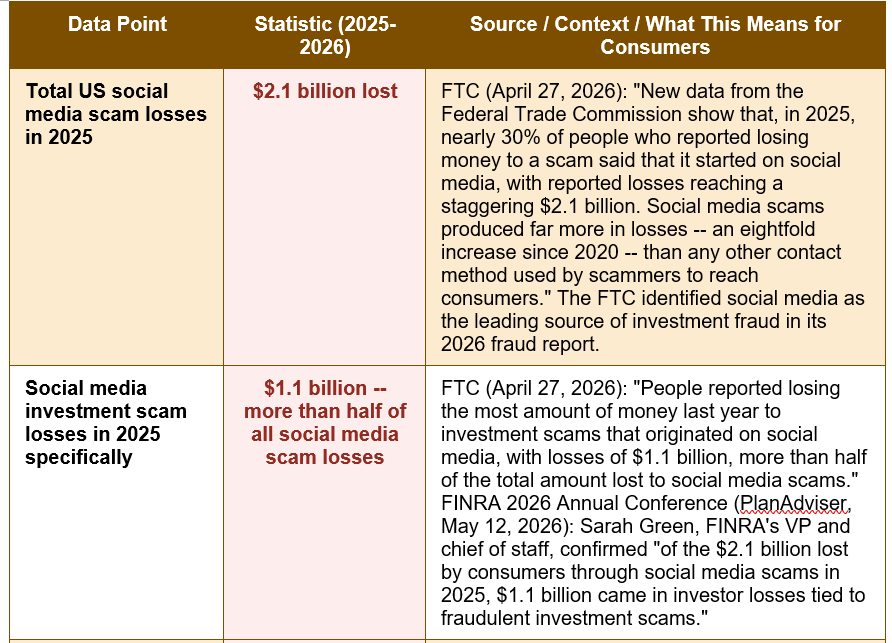
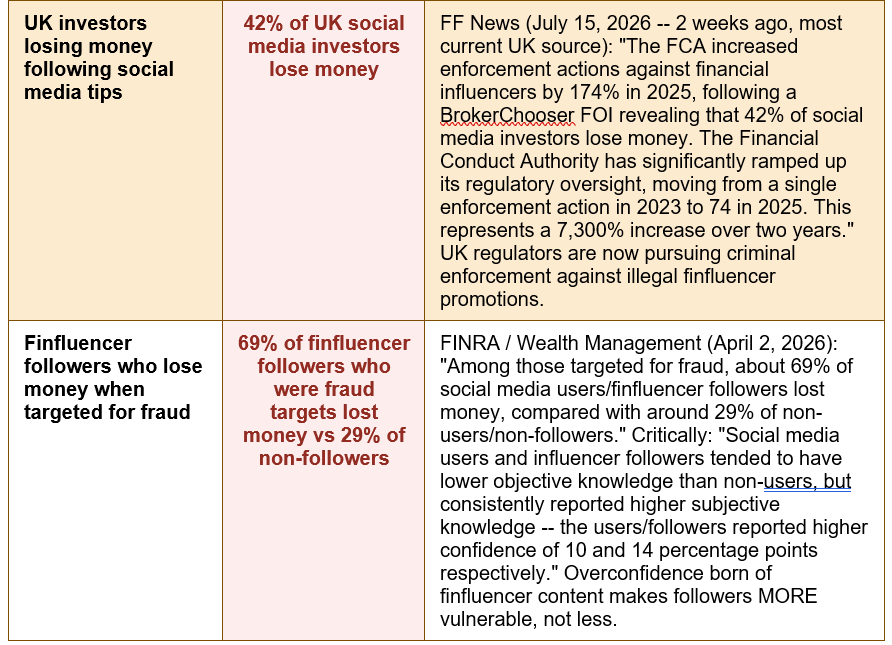
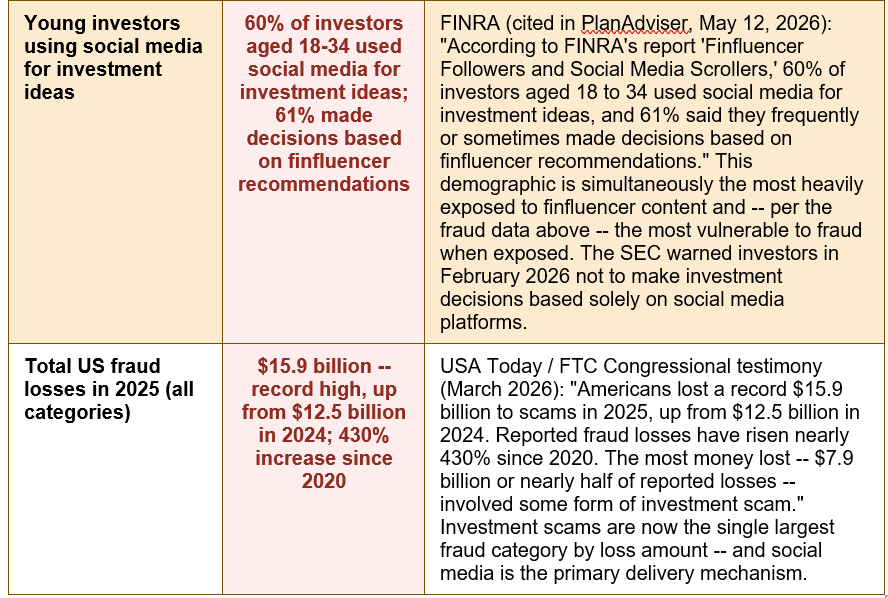
8 Red Flags That Identify a Fake Financial Guru
RED FLAG #1: Guaranteed Returns and Risk-Free Promises | The claim that no legitimate financial professional can legally make
Any person or channel that promises guaranteed investment returns, 'risk-free' strategies, or specific income figures from trading or investing is making a claim that no legitimate, regulated financial professional can legally make. Investment returns are inherently uncertain. Regulated advisers in both the UK and the US are legally required to communicate that investments can go down as well as up and that past performance does not predict future returns. A social media personality claiming 'I made £/$10,000 last month using this strategy and so can you' is either (a) operating without any regulatory accountability or (b) committing financial fraud. The FCA (UK) and SEC (US) both prohibit regulated professionals from making unqualified return guarantees. When you see them made freely on social media, the absence of regulatory accountability is the explanation -- not the existence of a legitimate investment method. FINRA (December 2025) reported a significant spike in investor complaints involving fraudulent investment groups promoted through social media, including encrypted group chats where the 'performance' screenshots shared were fabricated or cherry-picked.RED FLAG #2: Lifestyle Marketing as the Primary Credential | Rented cars, hired jets, and Airbnb mansions as proof of expertise
The most visible feature of fake financial guru content -- and the most effective at bypassing critical evaluation -- is lifestyle marketing. The Lamborghini, the private jet, the luxury apartment, the watch collection, and the apparent ability to make financial decisions from a laptop anywhere in the world are not coincidental features of this content. They are the primary sales tool. They create the implicit argument: 'I have this lifestyle, and this lifestyle is the result of my financial method, so you should pay for my method.' BioCatch (May 4, 2026): 'Their pitches rely on three key ingredients: lifestyle, exclusivity, and end-to-end encrypted communication.' What is rarely disclosed: the Lamborghini is rented for the day; the private jet photo is taken at a public preview terminal; the luxury house is an Airbnb rented for the video shoot. These props are not evidence of wealth generated by investment skill. They are marketing expenditures designed to create the impression of wealth. Legitimate financial advisers do not need to demonstrate their expertise through rented property or hired vehicles. Their credentials, regulatory status, and verifiable track record serve that purpose instead. Expertise that can only be demonstrated through consumer goods is not expertise -- it is branding.RED FLAG #3: "This Is Not Financial Advice" Used as a Legal Escape Hatch | The disclaimer that does not do what followers think it does
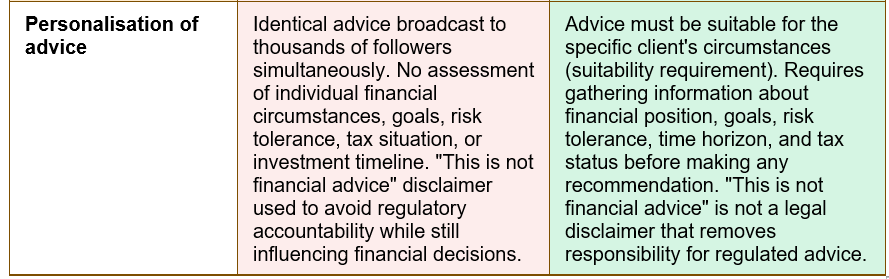
Virtually every financial influencer in the UK and the US includes some version of 'this is not financial advice' in their content. Many followers interpret this disclaimer as a genuine regulatory statement that protects the viewer. It is, in practice, an attempt by the content creator to avoid regulatory accountability for the financial decisions their content influences. The disclaimer does not change the legal or regulatory reality. In the UK, providing advice or making personalised recommendations that constitute 'regulated activity' under the Financial Services and Markets Act 2000 requires FCA authorisation -- regardless of what disclaimer appears on the screen. In the US, providing investment advice for compensation requires registration with the SEC as an investment adviser or with FINRA as a broker-dealer -- regardless of what appears in the description box. The FCA has been explicit that the 'not financial advice' disclaimer does not protect content creators who are providing what functionally constitutes regulated advice -- it is not a magic phrase that removes regulatory responsibility. The 7,300% increase in FCA enforcement actions (FF News, July 15, 2026) reflects this position: the regulator is treating the functional nature of the content, not the disclaimer, as the basis for enforcement. If the content is directing people toward specific financial decisions, it is regulated activity -- disclaimer or not.RED FLAG #4: Paid Groups, Discord Servers, and "Signals" Products | The business model that reveals the real income source
When a financial influencer's primary revenue stream is selling access to a paid Discord server, a WhatsApp signals group, a 'mastermind' membership, or a paid course -- rather than from the investments or trading strategy they claim to use -- the incentive structure of the product immediately becomes suspicious. If the trading strategy genuinely produced the returns claimed, the economic value of trading it independently would be many times larger than the course or membership fee. The only rational reason to sell a strategy that generates '500% returns' for a monthly membership fee of £/$50 is that the strategy does not generate those returns. FINRA (December 2025) specifically highlighted 'fraudulent investment groups promoted through social media, including encrypted group chats' as a major source of investor complaints. The BioCatch analysis of finfluencer fraud (May 2026) identified 'end-to-end encrypted communication' as one of the three core ingredients of the fake guru pitch specifically because it removes the transaction from any oversight or evidence trail. Any financial community whose primary selling point is that conversations are encrypted and cannot be monitored by regulators is a financial community to avoid.RED FLAG #5: Pump-and-Dump and Coordinated Market Manipulation | When the guru's followers are the exit liquidity
One of the most financially damaging tactics used by fake financial gurus is coordinated pump-and-dump activity: the content creator or their associates quietly accumulate a position in a low-liquidity asset (a small-cap stock, a cryptocurrency, a penny share), then promote that asset publicly to their large following, which drives the price up. The guru and associates then sell their position (dump) at the inflated price -- and the followers who bought based on the recommendation are left holding an asset whose price then collapses. The Securities and Exchange Commission (SEC) warned investors in February 2026 not to make investment decisions based solely on social media platforms or apps, specifically referencing these coordinated promotion schemes. The UK FCA has prosecuted multiple cases of pump-and-dump activity coordinated through social media and paid groups. The pattern to recognise: the guru promotes a specific, narrowly defined asset urgently ('this is breaking right now / get in before it moves'); the promotion creates FOMO-driven buying; the asset price rises; and then either the guru and associates sell (leaving followers holding a depreciating position) or -- in more sophisticated fraud -- the 'investment platform' to which followers are directed is entirely fake and withdrawals are denied.RED FLAG #6: Unverifiable Performance Claims and Screenshot Evidence | The evidence standard that proves nothing
Fake financial gurus display performance evidence primarily through screenshots of account balances, trade confirmations, or profit/loss statements. These images are: trivially easy to fabricate using image editing software; easily cherry-picked from a period of exceptional performance that does not reflect typical results; potentially representing a demonstration account with no real money at stake; and sometimes representing returns achieved at a time before fees, taxes, and realistic trade execution costs are accounted for. No screenshot of a trading account constitutes credible performance evidence. Legitimate investment performance evidence is audited by an independent third party, covers a defined multi-year period, reflects all trades (not selected winners), and includes risk metrics and drawdown information alongside return figures. FINRA's research found that social media users' subjective confidence in their financial knowledge was 10-14 percentage points higher than non-users, despite having lower objective knowledge. The performance screenshots are a significant contributor to this misplaced confidence: they create the illusion of verifiable evidence for claims that are, in fact, completely unverified. If a financial professional's primary evidence for their expertise is a phone screen showing a profit number, that is not evidence. That is a prop.RED FLAG #7: Social Proof Manipulation -- Fake Followers, Fake Testimonials, Fake Reviews | The manufactured appearance of community validation
Social proof -- the sense that many other people have benefited from a product or service -- is one of the most powerful persuasive mechanisms in human psychology. Fake financial gurus systematically manufacture social proof through: purchased followers (high follower counts that do not reflect genuine engagement); fake testimonials (staged or fabricated positive reviews); positive review astroturfing (paying followers to post positive content); and the algorithmic amplification of content that generates emotional reactions, which means outrage and excitement -- both of which the fake guru's content generates reliably -- spread faster than sober factual content. Regulators are increasingly aware of these tactics. FF News (July 15, 2026): 'Experts suggest that illegal finfluencer promotions thrive because content can be deleted and re-uploaded before regulators can intervene. This creates a high-risk environment for younger, inexperienced investors who lack the tools to verify the legitimacy of online claims.' The manufactured social proof creates the sense that the guru's community is large, successful, and satisfied -- when the reality is often that satisfied customers are underrepresented (because their gains are not exceptional enough to be broadcast), while dissatisfied and defrauded customers are distributed across multiple platforms, silenced by embarrassment, or unaware they have been defrauded at all.RED FLAG #8: Urgency, Scarcity, and Fear of Missing Out (FOMO) | The time pressure that bypasses due diligence
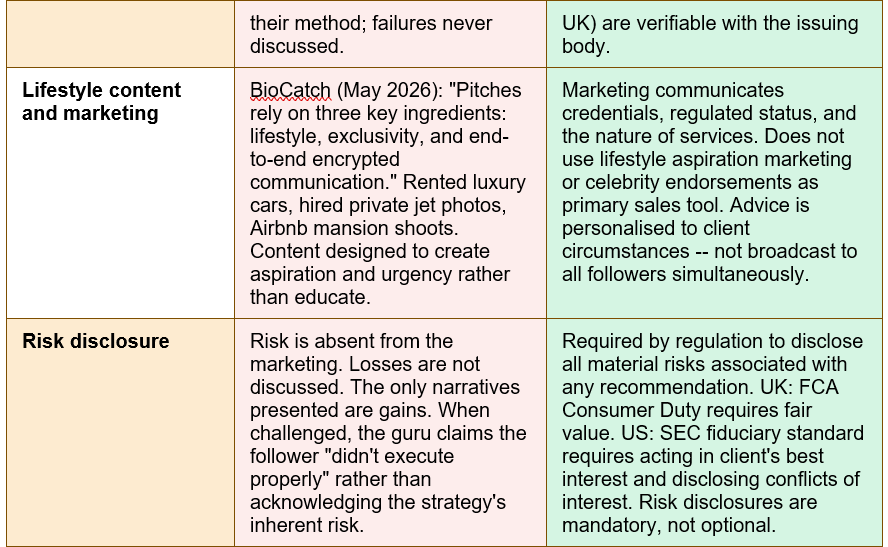
The countdown timer. The 'only 3 spots left in my mastermind.' The 'this opportunity closes tonight.' The 'I'm about to share this trade and then it's gone.' Time pressure and artificial scarcity are among the most reliably effective tools for bypassing rational evaluation and triggering impulsive financial decisions. They work specifically by making the cost of delay -- missing the window -- feel higher than the cost of proceeding without adequate research. Genuine investment opportunities do not disappear overnight. No legitimate financial adviser conducts business through countdown timers or 'limited-time offers' that expire in hours. The FTC (April 27, 2026) noted that social media investment scams frequently use artificial urgency to prevent victims from taking the time to verify claims or consult others. The correct response to any financial offer presented with a countdown timer or explicit scarcity claim is: take all the time you need. If the offer is genuine, it will still be available when your research is complete. If it has 'expired' when you return, it will reappear -- because the scarcity was manufactured, not real. Any financial product or service that requires you to make a decision before you are ready is a product whose seller understands that adequate research time would result in a different decision.Fake Guru vs Legitimate Adviser: A Detailed Comparison
The following table maps every key feature of fake financial gurus against equivalent features of legitimate, regulated financial advisers -- to provide a clear reference for evaluating any financial content or service encountered online: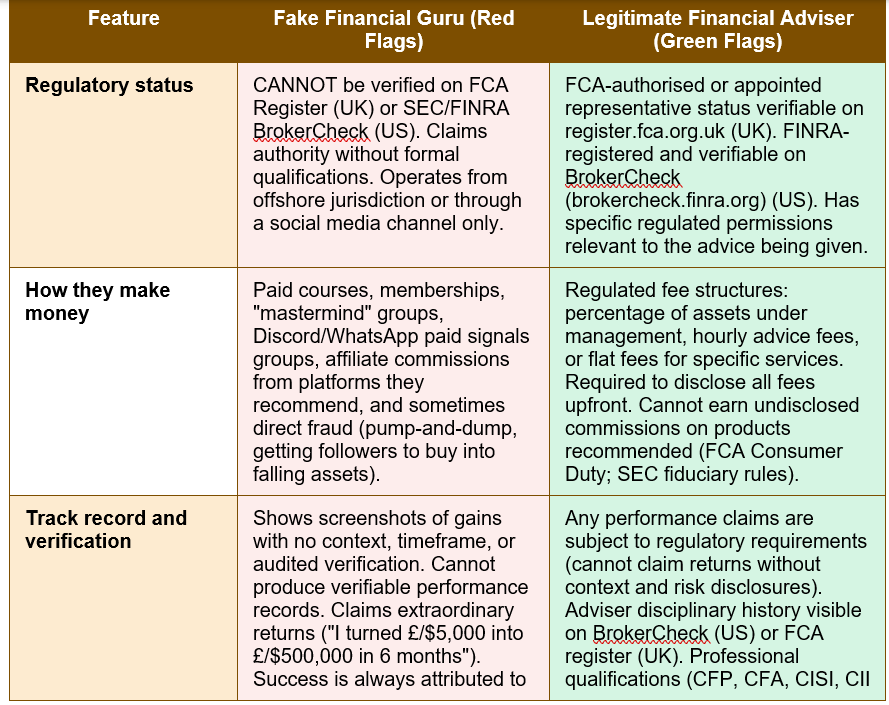
How to Verify Any Financial Adviser or Influencer Before Spending a Penny
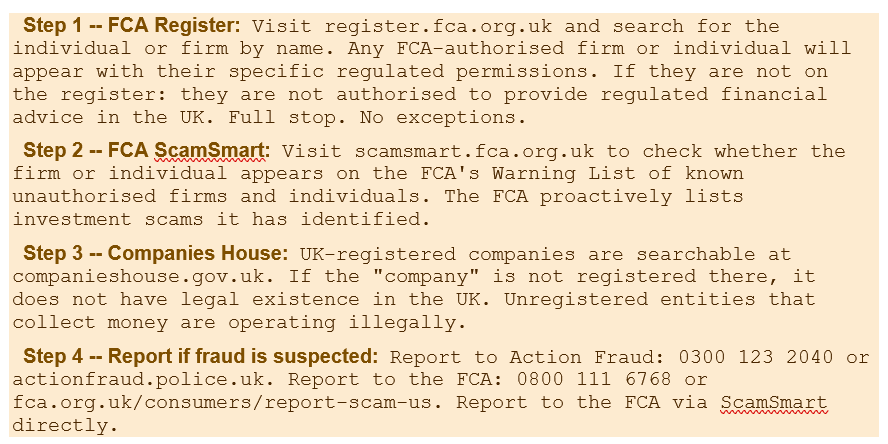
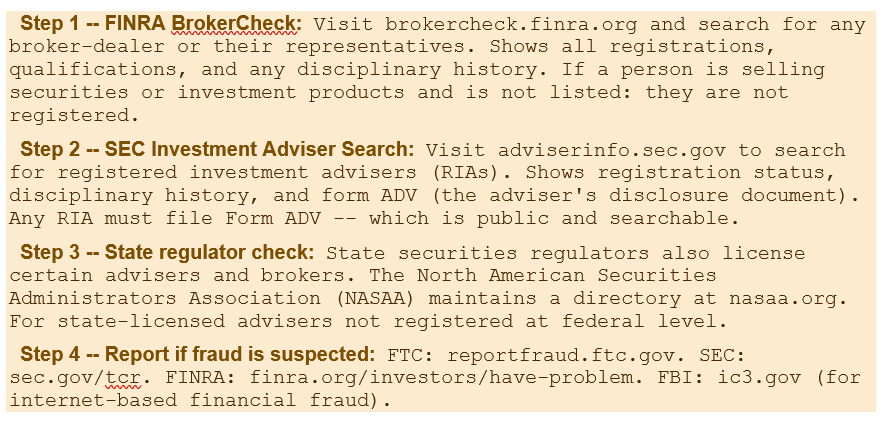
The single most effective action before engaging with any online financial advice, product, or service is regulatory verification. This takes approximately five minutes and is definitive.UK Verification Steps
US Verification Steps
The 'not financial advice' myth -- what it actually means in law. The phrase 'this is not financial advice' is ubiquitous in financial influencer content. Many followers interpret this as a protective statement that means the content is somehow less likely to cause harm or that the creator has less responsibility for its effects. Under UK law (Financial Services and Markets Act 2000), providing investment advice and making investment recommendations are regulated activities. Performing a regulated activity without FCA authorisation is a criminal offence. The disclaimer does not change this legal status. Under US law, providing investment advice for compensation requires SEC registration as an investment adviser -- the 'not financial advice' disclaimer does not provide a legal exemption from this requirement. The FCA (FF News, July 15, 2026) has moved specifically from civil to criminal enforcement against finfluencers, reflecting its view that disclaimers do not create the legal protection content creators believe they do. A disclaimer that says 'not financial advice' is evidence that the creator is aware they are operating in a regulated space -- not evidence that they are operating outside it.
Where to Get Legitimate Financial Education and Advice in 2026
The antidote to fake financial gurus is not avoiding financial education. It is finding the real thing. The following resources provide legitimate, regulated, or editorially credible financial information and access to qualified advice:- UK regulated financial guidance (free): MoneyHelper (moneyhelper.org.uk / 0800 138 7777) -- government-backed, free, covers debt, savings, pensions, benefits, mortgages, and all areas of personal finance. Staffed by qualified money guides. Citizens Advice (citizensadvice.org.uk / 0800 144 8848) -- free guidance on consumer rights, benefits, debt, and financial difficulties. Pension Wise -- free government service for those aged 50+ approaching pension decisions.
- UK regulated financial advice (paid, but regulated): Unbiased.co.uk and VouchedFor.co.uk -- directories of FCA-authorised financial advisers rated by real client reviews. SOLLA (societyoflaterlifeadvisers.co.uk) -- for later-life and retirement planning advice. Any adviser found through these directories can be verified on the FCA Register before engagement.
- US regulated financial guidance (free): CFPB (consumerfinance.gov) -- government-backed consumer financial guidance on all financial topics. FINRA Investor Education (finra.org/investors) -- free investor education and tools including BrokerCheck. USA.gov personal finance resources -- official government guidance on savings, retirement, and tax.
- US regulated financial advice (paid, but registered): NAPFA (napfa.org) -- National Association of Personal Financial Advisors, a directory of fee-only financial planners (no commission incentives). Garrett Planning Network (garrettplanningnetwork.com) -- affordable hourly-rate CFP advisers. XY Planning Network (xyplanningnetwork.com) -- fiduciary fee-only advisers specifically for Gen X and Millennial clients. All can be verified on adviserinfo.sec.gov before engagement.
- Credible financial media and educational content: UK: This Is Money, MoneySavingExpert (Martin Lewis -- not regulated advice but editorially credible and consumer-focused), MoneyWeek. US: Investopedia, The Wall Street Journal personal finance section, Morningstar. Academic / institutional: Khan Academy personal finance, MIT OpenCourseWare finance courses. These resources provide financial education without the regulatory conflicts of interest or fraud risk associated with unregulated social media content.
If You've Already Lost Money to a Financial Guru: What to Do
If you have already paid for a course, membership, signals service, or investment promoted by a financial influencer and lost money, the following steps are important:- Report it immediately: UK: Action Fraud (0300 123 2040 / actionfraud.police.uk) -- the national fraud reporting centre; FCA (0800 111 6768 / fca.org.uk/report); Financial Ombudsman Service (0800 023 4567) if the adviser was FCA-regulated and the complaint concerns the advice given. US: FTC (reportfraud.ftc.gov); SEC (sec.gov/tcr); FINRA (finra.org/investors/have-problem); FBI Internet Crime Complaint Center (ic3.gov). Reporting is important even if you do not expect to recover the money immediately -- the reports contribute to enforcement actions that protect others.
- Do not send more money: A common follow-on scam: after a victim loses money to an investment fraud, they are contacted again by the same or affiliated operators with a 'recovery service' that claims to be able to recover lost funds for a fee. This is the second stage of the fraud. No legitimate service charges upfront fees to recover investment losses. Do not send any further money to anyone claiming to be able to recover your losses for a fee.
- Document everything: Preserve all evidence: screenshots of the content, receipts, transaction records, email communications, and any other evidence of the investment promoted and the money paid. This documentation is required to support any enforcement action or recovery claim.
- Seek free legal advice: UK: Citizens Advice (0800 144 8848) can advise on whether the activity was regulated and whether a complaint to the Financial Ombudsman Service is appropriate. Consumer Rights Act protections may apply if a course or product was misrepresented. US: your state Attorney General's Consumer Protection Division; Legal Aid services; and AARP Fraud Watch Network (1-877-908-3360) particularly if an older adult was targeted.
THE FAKE FINANCIAL GURU CHECKLIST -- CHECK EVERY BOX BEFORE SPENDING A PENNY: BEFORE ENGAGING WITH ANY FINANCIAL CONTENT, COURSE, OR SERVICE ONLINE: (1) CHECK FCA REGISTER (UK): register.fca.org.uk -- is this person or firm authorised? (2) CHECK FINRA BROKERCHECK (US): brokercheck.finra.org -- are they registered? (3) CHECK FCA WARNING LIST (UK): scamsmart.fca.org.uk -- are they on the FCA's known scam list? (4) DO THEY PROMISE GUARANTEED RETURNS OR RISK-FREE INVESTMENTS? If yes: it is illegal. Walk away. (5) IS THE PRIMARY EVIDENCE OF THEIR EXPERTISE LIFESTYLE PHOTOS? If yes: that is marketing, not credentials. (6) DO THEY SELL A PAID GROUP, DISCORD SERVER, OR "SIGNALS" PRODUCT? If yes: investigate their business model carefully before paying. (7) DO THEY USE COUNTDOWN TIMERS OR URGENCY LANGUAGE? If yes: take more time, not less. Genuine opportunities survive research. (8) IS COMMUNICATION PRIMARILY THROUGH ENCRYPTED CHANNELS? If yes: ask why. Legitimate advisers welcome regulatory oversight. (9) CAN THEIR PERFORMANCE CLAIMS BE INDEPENDENTLY VERIFIED? If no: the claims are not evidence. (10) DOES THE "NOT FINANCIAL ADVICE" DISCLAIMER APPEAR PROMINENTLY WHILE SPECIFIC FINANCIAL RECOMMENDATIONS ARE MADE? If yes: the disclaimer does not provide legal protection and may actually signal awareness that the content is regulated activity. UK report: Action Fraud 0300 123 2040. US report: FTC reportfraud.ftc.gov | SEC sec.gov/tcr.
FIVE THINGS FAKE FINANCIAL GURUS WILL SAY AND WHAT THEY ACTUALLY MEAN: (1) 'I'M NOT A FINANCIAL ADVISER -- THIS IS JUST WHAT WORKED FOR ME.' Translation: 'I am attempting to influence your financial decisions while avoiding regulatory accountability for the consequences.' If the content is directing specific financial decisions -- which asset to buy, which platform to join, which strategy to use -- it is regulated activity regardless of the personal framing. (2) 'THE BANKS AND TRADITIONAL ADVISERS DON'T WANT YOU TO KNOW THIS.' Translation: 'I am using populist anti-establishment framing to make scepticism of my claims seem like deference to a corrupt system, rather than what it actually is: appropriate consumer protection.' Legitimate investment opportunities are not suppressed by banks. Banks are the primary buyers of the asset classes most commonly promoted by finfluencers. (3) 'MY STUDENTS MADE £/$X IN THEIR FIRST MONTH.' Translation: cherry-picked testimonials from a small number of successful early-stage students are being presented as representative results. If this is a genuine performance claim in a regulated context, it requires disclosure of the full range of client outcomes. Outside a regulated context, it is an advertising claim that is almost certainly misleading. (4) 'JOIN MY COMMUNITY -- WE LOOK OUT FOR EACH OTHER.' Translation: social belonging is being used as a sales mechanism. The 'community' is a product; the emotional connection to it is what prevents members from critically evaluating the value they are receiving or leaving when they should. FINRA (April 2026): social media users showed higher confidence in their financial knowledge despite having lower actual knowledge -- community membership contributes to this misplaced confidence. (5) 'REGULATORS ARE TRYING TO SHUT ME DOWN BECAUSE I'M TELLING THE TRUTH.' Translation: regulatory attention is being reframed as persecution to discredit the regulator and protect the business model. FCA enforcement actions against finfluencers increased 7,300% in two years (FF News, July 15, 2026) -- not because regulators are suppressing financial truth, but because the activity being pursued is causing documented, measurable financial harm to consumers.
Conclusion
The fake financial guru industry in 2026 is not a fringe problem. It is a $1.1 billion-per-year loss industry in the US alone (FTC, April 2026), backed by algorithms that amplify aspirational content and platforms that have, until recently, been slow to act on financial misinformation. The FCA's enforcement actions against finfluencers rose from 1 in 2023 to 74 in 2025 -- a 7,300% increase that reflects the scale of the problem and the regulator's growing determination to pursue criminal rather than merely civil enforcement (FF News, July 15, 2026).The data on who is most at risk is counterintuitive. FINRA (April 2026) found that finfluencer followers who were targeted for fraud were 69% likely to lose money -- compared with 29% for non-followers -- despite conducting more due diligence, not less. The vulnerability is created by the content itself, which instils a false sense of financial knowledge and confidence that makes followers worse at identifying fraud, not better. The 10-14 percentage point overconfidence gap identified by FINRA is the product of content that is designed to create the feeling of expertise without the substance of it.
The protection is straightforward: verify before you invest. Register.fca.org.uk (UK) and brokercheck.finra.org (US) are free, fast, and definitive. No legitimate financial professional will be absent from these registers. BioCatch (May 2026): 'In the end, if it looks too good to be true, it probably is.' The rented Lamborghini, the fabricated screenshot, the countdown timer, and the encrypted group chat are not signs of financial expertise. They are the marks of a business model that depends on your money more than on your success. Verify first. Spend never, unless the verification is complete and clean.
Frequently Asked Questions (FAQ)
How do I identify a fake financial guru?The eight red flags in this guide provide a comprehensive identification framework, but the most reliable single indicator is the absence of regulatory authorisation. In the UK, all persons and firms providing regulated financial advice or making investment recommendations must be FCA-authorised -- verifiable at register.fca.org.uk. In the US, investment advisers must be registered with the SEC (verifiable at adviserinfo.sec.gov) or their state regulator, and broker-dealers must be registered with FINRA (verifiable at brokercheck.finra.org). If a person or firm providing financial content or services cannot be verified on these registers, they are operating outside the regulatory framework -- regardless of how professional their content appears or how large their following is. Beyond regulatory verification, specific behavioural red flags include: promises of guaranteed returns or risk-free investments (illegal claims in both UK and US); lifestyle marketing as the primary credential (rented Lamborghinis, staged jet photos); paid Discord or signals groups as the primary revenue model; performance claims supported only by unverifiable screenshots; use of countdown timers and artificial scarcity to pressure decisions; and the 'not financial advice' disclaimer combined with specific investment recommendations (FF News, July 15, 2026; FCA enforcement evidence).
Is it illegal to give financial advice on social media?
In the UK, providing investment advice, making investment recommendations, or arranging investment transactions are regulated activities under the Financial Services and Markets Act 2000. Performing regulated activities without FCA authorisation is a criminal offence -- regardless of the platform on which it occurs, and regardless of any 'not financial advice' disclaimer that appears in the content. The FCA has been explicit that disclaimers do not change the regulatory status of content that functionally constitutes regulated advice. The FCA increased enforcement actions against finfluencers from 1 in 2023 to 74 in 2025 -- and moved from civil to criminal enforcement in multiple cases (FF News, July 15, 2026). In the US, providing investment advice for compensation requires SEC registration as an investment adviser (17 C.F.R. § 275.202(a)(11)-1) or an applicable exemption. The SEC warned investors in February 2026 not to make investment decisions based solely on social media platforms or apps. Social media does not create a regulatory exemption. Content that gives specific investment advice -- 'buy this stock,' 'join this crypto', 'sign up for this trading platform' -- while receiving compensation (including affiliate fees, course sales, or platform promotions) is regulated activity. FINRA (December 2025) reported a significant spike in investor complaints involving fraudulent investment groups promoted through social media.
How much money do people lose to fake financial gurus and investment scams?
The documented losses to social media investment scams and finfluencer fraud are significant and growing. US: FTC (April 27, 2026): in 2025, $1.1 billion was lost to investment scams that originated on social media -- more than half of the $2.1 billion total lost to all social media scams. USA Today/FTC Congressional testimony (March 2026): total US fraud losses in 2025 reached a record $15.9 billion -- up from $12.5 billion in 2024, and representing a 430% increase since 2020. Investment scams accounted for $7.9 billion of this total -- nearly half of all reported fraud losses. Social media was identified as the top contact method by reported losses. UK: BrokerChooser FOI data (cited in FF News, July 15, 2026): 42% of UK investors who followed social media financial tips lost money on those tips. The FCA's enforcement response -- 74 actions in 2025 compared with 1 in 2023 -- reflects the scale and severity of the problem in the UK market. FINRA (April 2, 2026): among social media users and finfluencer followers who were targeted for fraud, 69% lost money -- compared with 29% for non-users and non-followers. These figures reflect only reported losses. The actual aggregate loss is almost certainly much higher, as the majority of financial fraud goes unreported due to embarrassment, lack of awareness that the fraud is reportable, or uncertainty about whether a legitimate financial product simply performed poorly.
What should I do if I've been scammed by a financial influencer?
If you have lost money to a fake financial guru, paid course, signals service, or fraudulent investment promoted on social media, the steps are: (1) Report immediately -- UK: Action Fraud 0300 123 2040 / actionfraud.police.uk and the FCA 0800 111 6768 / fca.org.uk/report; US: FTC at reportfraud.ftc.gov, SEC at sec.gov/tcr, FINRA at finra.org/investors/have-problem, and FBI Internet Crime Complaint Center at ic3.gov. Reporting is important even if you do not expect immediate recovery -- your report contributes to the enforcement actions that protect others. (2) Do not send more money -- the 'recovery scam' is a documented second stage of financial fraud where victims are approached with offers to recover their losses for an upfront fee. This is always another fraud. No legitimate service charges upfront fees to recover investment losses. (3) Document everything -- preserve screenshots, transaction records, communication records, and any promotional content. This documentation supports any enforcement or recovery action. (4) Seek free advice -- UK: Citizens Advice 0800 144 8848 can advise on Consumer Rights Act protections if products were misrepresented; Financial Ombudsman Service 0800 023 4567 if any element of the activity was FCA-regulated. US: your state Attorney General's Consumer Protection Division; AARP Fraud Watch Network 1-877-908-3360; Legal Aid services.
Are there any legitimate financial influencers?
Yes -- there is a distinction between financial education content (which can be legitimately provided without FCA or SEC registration, provided it does not cross into personalised recommendations or regulated activity) and financial advice or investment recommendations (which require regulatory authorisation). Legitimate financial education content on social media exists and can be valuable: content that explains how financial products work, discusses general investing principles, demystifies financial concepts, or provides personal finance frameworks is educational and is produced by many credible individuals without crossing into regulated activity. The distinction from fake financial gurus: legitimate financial educators do not provide specific investment recommendations ('buy this stock / this crypto / this fund'); do not promise specific returns or guaranteed outcomes; disclose any affiliate relationships or financial interests transparently; are willing to be verified on regulatory registers if they are providing regulated services; and do not rely on lifestyle marketing as their primary credential. MoneySavingExpert (UK, founded by Martin Lewis -- widely cited as a consumer champion by the FCA) is an example of a large-scale non-regulated financial information resource that operates transparently, discloses all affiliate relationships, and has a strong track record of consumer advocacy. For genuine personalised advice, however, the only appropriate source remains a regulated professional verifiable on the FCA Register (UK) or SEC/FINRA registers (US) -- because only regulated professionals operate under a legal obligation to act in your interest.

0 Comments Comments