
Financial Literacy
Is Your Debit Card Really a Secret Debt Card? Accountans' Guide

Table of Contents
- The Card in Your Wallet That Nobody Warns You About
- How a Debit Card Becomes a Debt Card: The Mechanism Explained
- UK vs US: The Overdraft Comparison in 2026
- Five Hidden Ways Your Debit Card Creates Debt
- The $12.4 Billion Industry: Who Benefits From Your Overdraft?
- The Credit Myth: What a Debit Card Cannot Do
- The Fraud Protection Gap: Another Hidden Cost
- How to Audit Your Own Debit Card for Hidden Debt Risks
- Conclusion
- Frequently Asked Questions (FAQ)
The Card in Your Wallet That Nobody Warns You About
The debit card is marketed as the responsible alternative to credit. It draws directly from your bank account. It cannot create debt -- or so the story goes. You cannot spend what you do not have. Using a debit card means living within your means. It is the financially disciplined choice for people who want to avoid the risks of credit card borrowing. This narrative is repeated so consistently, and believed so widely, that it has become financial folklore. It is also, in important ways, misleading.The debit card can -- and for millions of consumers, regularly does -- function as a debt-creating instrument. It does so through mechanisms that are less visible than a credit card statement, less well-publicised than credit card interest rates, and in some respects less well-regulated. US banks earned $12.4 billion in overdraft fees from debit card and checking account customers in 2025, according to the National Consumer Law Center, cited by Consumers' Checkbook (June 15, 2026). In the UK, the most common arranged overdraft rate is 39.9% EAR -- higher than many credit cards -- applied to the very current account that most people believe is a safe, debt-free way to manage money.
US News (January 7, 2026) found that almost half of survey respondents mistakenly believe that debit cards help build credit -- a misconception that reveals how poorly the actual mechanics of debit card use are understood. The same survey found that two-thirds of Gen Z and Millennials overdrew their accounts in 2025. The debit card, for these consumers, is not the safe alternative to credit. It is credit -- expensive, poorly understood, and generating substantial revenue for the institutions that issue it. This guide examines every mechanism through which your debit card may be acting as a secret debt card, in both the UK and the US.
How a Debit Card Becomes a Debt Card: The Mechanism Explained
A debit card functions as a debt card through one primary mechanism: the overdraft. An overdraft occurs when a payment is made from a current account (UK) or checking account (US) that exceeds the available balance, and the bank processes the payment anyway rather than declining it. The result is a negative balance -- money the consumer now owes to the bank. The bank charges either a fee (US model) or interest at a specified annual rate (UK model) on this negative balance. In both cases, the consumer has incurred a debt that they did not explicitly apply for, on a product they almost certainly thought of as a spending-only tool.CFPB (official guidance): 'An overdraft occurs when you do not have enough money in your account to cover a transaction, and the bank or credit union pays for it anyway. You then have to pay back the amount your account was overdrawn, plus overdraft fees from your bank or credit union.' The language is simple. The financial reality is significant. The average debit card purchase that triggers a US overdraft is just $20 -- according to the Consumer Federation of America citing CFPB data -- while the typical overdraft fee is $35. That is a fee equal to 175% of the transaction amount, on a debt that lasts, in most cases, less than one week (CFPB research found that more than half of consumers who overdraft bring their account positive within three days).
In the UK, the mechanism changed significantly after the FCA's April 2020 overdraft pricing reforms, which required banks to charge a single annual interest rate (EAR) on all overdrafts, abolishing the complex daily and monthly fee structures that previously made overdraft costs opaque. UKCalculator (March 2026): 'Since the FCA's April 2020 reforms, most major UK banks charge between 19% and 40% EAR on arranged overdrafts.' The result of this reform, paradoxically, is that UK consumers now face a clearly stated rate -- but that rate is 39.9% EAR at Lloyds, HSBC, NatWest, Halifax, Nationwide, Santander, and First Direct. To put this in context: the average credit card interest rate in the UK is approximately 24.65% (Bank of England, December 2025, cited by Updraft May 2026). Many overdrafts are more expensive than the credit cards they are supposed to help consumers avoid.
Debit card hidden debt in 2026 -- the data: US: $12.4bn in overdraft fees in 2025. UK: 39.9% EAR overdraft rate at most major banks. 2/3 of Gen Z and Millennials overdrew accounts in 2025. — Consumers Checkbook (June 15, 2026): 'Overdraft revenues at the top 20 banks total could exceed $12.4 billion in 2025, up from an estimated $12.1 billion in 2024.' JPMorgan Chase: $1.1 billion. Wells Fargo: $924 million. UKCalculator (March 10, 2026): Lloyds, HSBC, NatWest, Halifax, Nationwide, Santander, First Direct: all charge 39.9% EAR. US News (January 7, 2026): 'Two-thirds of both Gen Zers and millennials reported overdrawing their accounts in 2025. Almost half of respondents mistakenly believe that debit cards help build credit.'
UK vs US: The Overdraft Comparison in 2026
The overdraft systems in the UK and US differ significantly in structure, but both create the same fundamental outcome: consumers paying significant sums for borrowing they may not have consciously chosen to take on. The following table compares both systems across the key dimensions: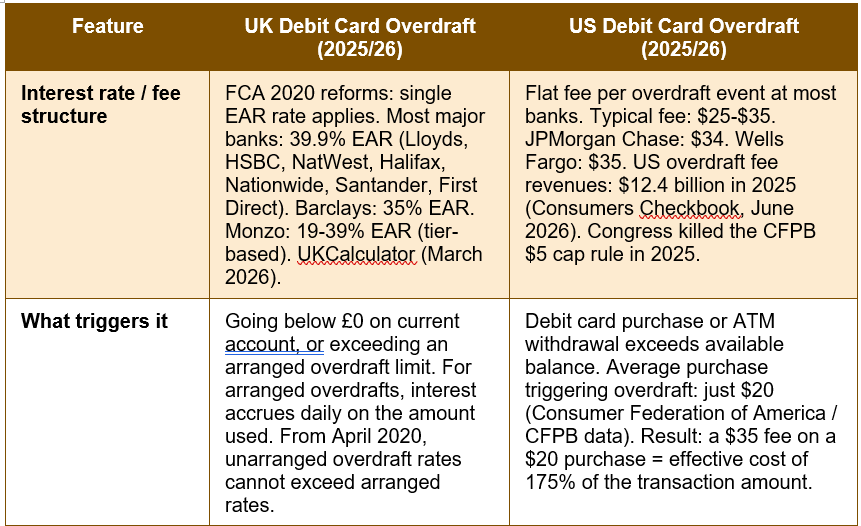
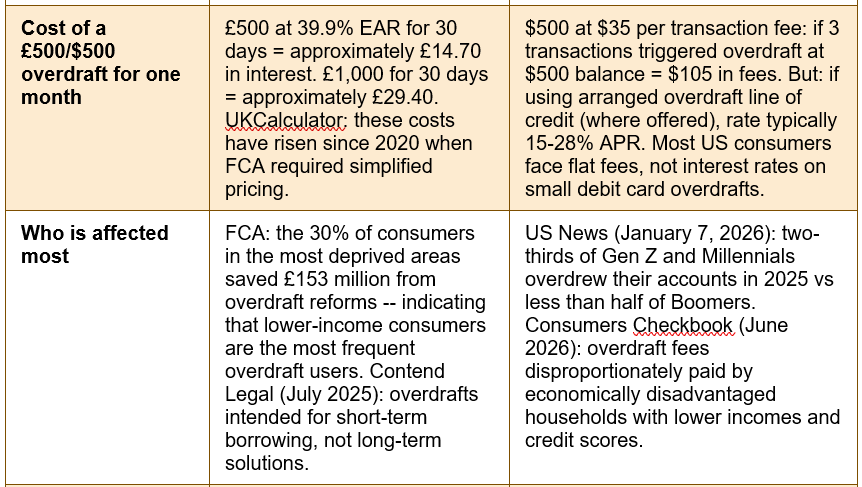
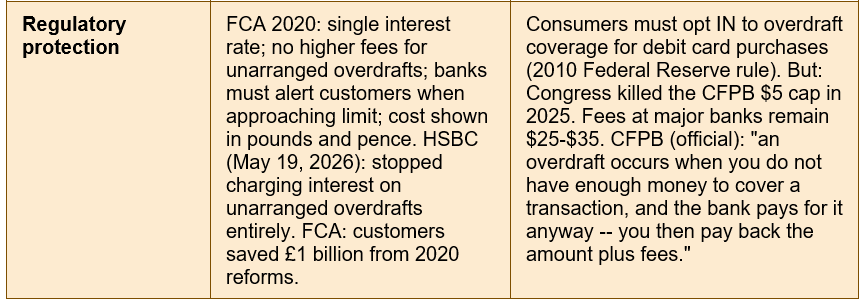
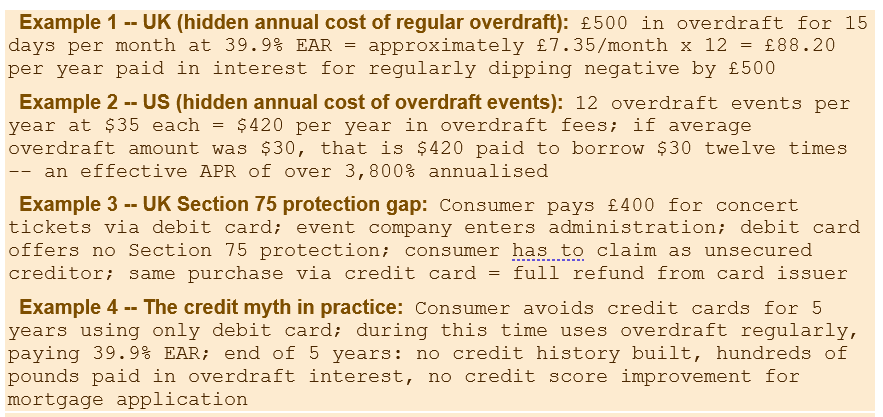
The EAR paradox in the UK -- higher overdraft rates since consumer protection improved: The FCA's 2020 overdraft reforms were designed to make overdraft costs clearer and reduce the disproportionate charges on unarranged overdrafts. They succeeded on the second goal -- consumers saved an estimated £1 billion (FCA). But the shift to a single EAR for all overdraft borrowing caused many banks to converge on a rate that is high by any standard: 39.9% EAR. Before 2020, many banks charged daily fees (typically £1-£2/day) on arranged overdrafts, which would equate to lower costs for those who used small overdrafts briefly. At 39.9% EAR, a £100 overdraft maintained for a full month costs approximately £2.98. A £500 overdraft costs approximately £14.70 per month. The reforms improved transparency and fairness significantly -- but at the cost of raising rates for moderate users of arranged overdrafts. The rate is now visible on every comparison site, which is progress. The rate itself is not consumer-friendly.
Five Hidden Ways Your Debit Card Creates Debt
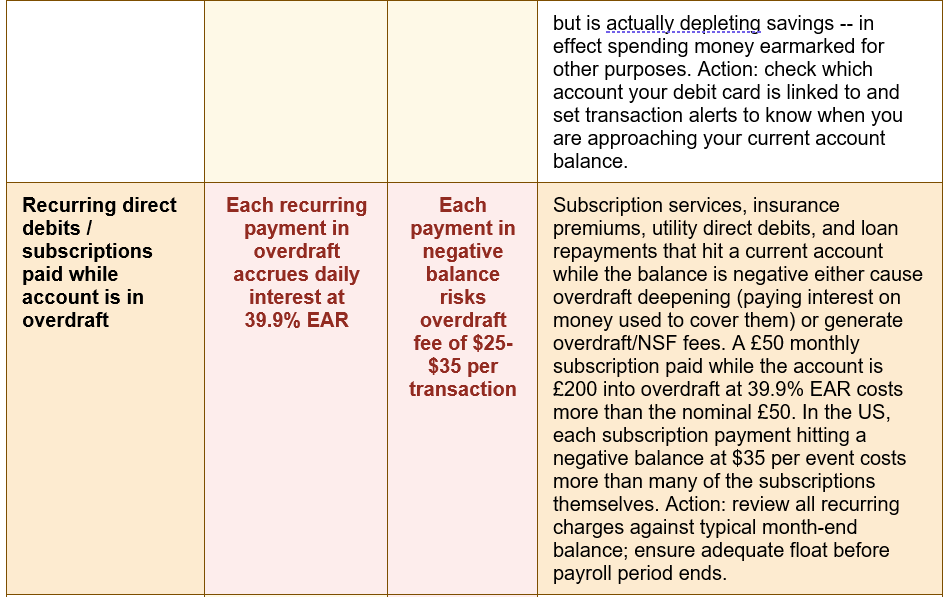
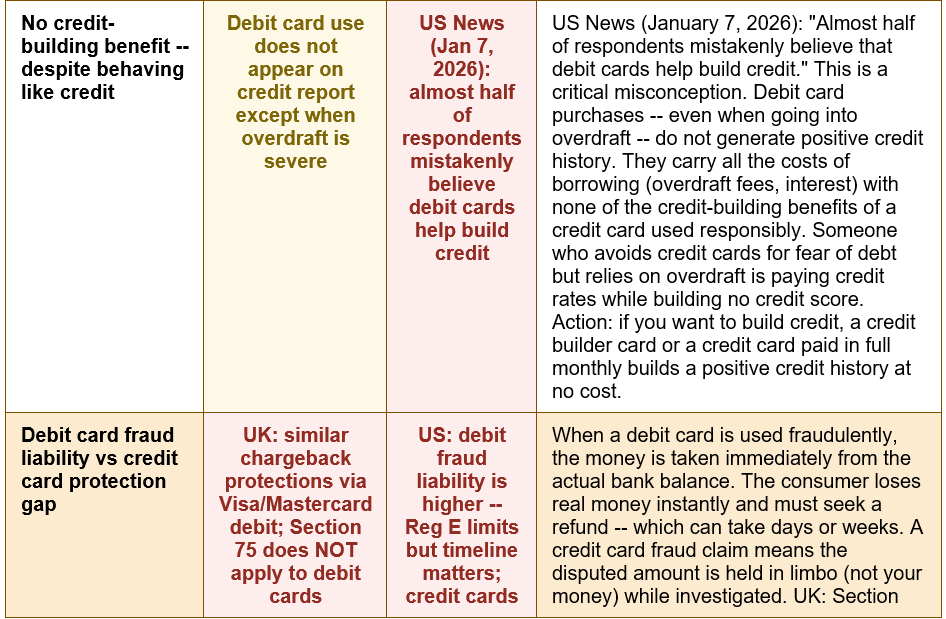
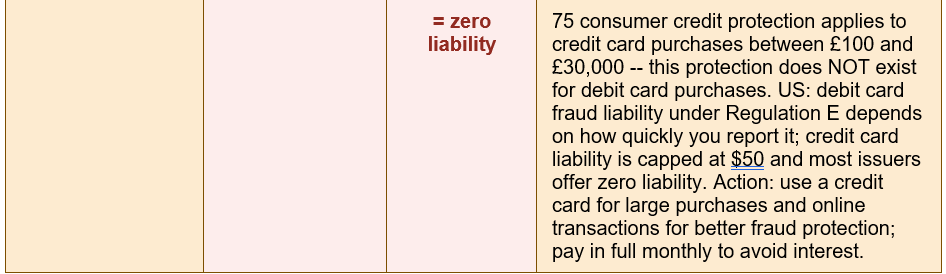
The overdraft is the most visible mechanism -- but it is not the only way a debit card can act as a debt card. The following table maps five specific mechanisms through which debit card use creates debt, financial loss, or missed opportunity: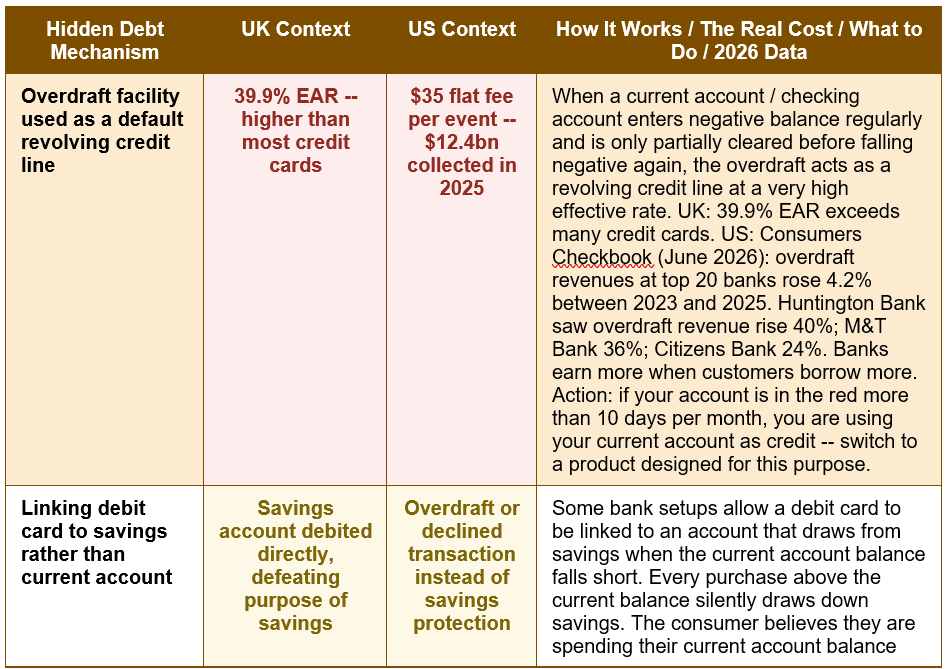
The $12.4 Billion Industry: Who Benefits From Your Overdraft?
Overdraft fees are not a minor revenue stream for banks -- they are a multi-billion dollar business model. Consumers' Checkbook (June 15, 2026), citing National Consumer Law Center (NCLC) data: 'The total could exceed $12.4 billion in 2025, up from an estimated $12.1 billion in 2024.' The biggest earners in 2025 were JPMorgan Chase ($1.1 billion), Wells Fargo ($924 million), and PNC Bank ($279 million). Some banks saw dramatic overdraft revenue growth: Huntington Bank up 40%, M&T Bank up 36%, Citizens Bank up 24%, USAA Federal Savings Bank up 471% since introducing overdraft fees in late 2023.The Consumer Financial Protection Bureau (CFPB) proposed capping overdraft fees at $5 at large US banks in 2024 -- based on the actual cost of processing overdraft transactions. Consumers' Checkbook: 'In 2025 Congress killed that regulation.' The current situation is that the typical US overdraft fee remains $25-$35, despite evidence that the actual cost of processing the transaction is a fraction of that. Consumers' Checkbook: 'Overdraft fees are not dead... At some banks you are still paying $25, $30, or even $35 per overdraft.' And crucially, these fees fall disproportionately on those least able to afford them -- Consumers' Checkbook: 'These fees are overwhelmingly paid by economically disadvantaged households, which have lower incomes and lower credit scores and are more likely to incur multiple fees.'
In the UK, the picture is different in structure but similar in outcomes. The FCA's reforms saved consumers £1 billion -- but the 39.9% EAR rate at most major banks remains a rate that, when sustained over weeks or months, generates significant interest charges on balances that may be modest in absolute terms. The FCA's own evaluation found that 'the 30% of consumers living in the most deprived areas in the UK saved £153 million in 2021 due to the new pricing rules' -- confirming that overdraft use, and therefore overdraft cost, is concentrated among lower-income consumers in both countries.
The Credit Myth: What a Debit Card Cannot Do
Perhaps the most financially damaging misconception about debit cards is the belief that using one helps build a credit score. US News (January 7, 2026): 'Almost half of respondents mistakenly believe that debit cards help build credit.' This is categorically false. Debit card transactions -- whether in positive balance or through overdraft -- are not reported to credit reference agencies (UK) or credit bureaus (US) in ways that build a positive credit history. Regular, responsible debit card use generates no credit score benefit whatsoever.The implication is significant. Many people choose debit cards specifically as a way to avoid credit cards because they fear debt or have difficulty managing credit. This is an entirely understandable choice -- but it means they are avoiding the one financial tool (a credit card used responsibly and paid in full monthly) that would actually help them build the credit history that unlocks better borrowing rates, mortgage eligibility, and financial options. Meanwhile, if they dip into overdraft to make purchases, they incur the costs of borrowing without any of the credit-building benefit. They are, in effect, paying credit-card-level or higher interest rates while building no credit at all.
Contend Legal (July 2025): 'Overdrafts are intended for short-term borrowing, not as a long-term solution. You are expected to repay any amount you borrow, ideally as soon as possible to minimise interest and fees. If you find yourself relying on your overdraft regularly, consider speaking to your bank about lowering your limit or exploring other borrowing options.' The advice to consider lowering your overdraft limit is counter-intuitive but sound: a lower overdraft limit creates a harder budget constraint, reduces the temptation to allow the account to drift negative, and forces the account holder to maintain a more careful balance of income against outgoings.
The Fraud Protection Gap: Another Hidden Cost
Beyond overdraft, there is a second, often overlooked dimension in which debit cards compare unfavourably to credit cards: fraud protection. When a debit card is used fraudulently, the money lost is real money -- the consumer's actual bank balance -- taken immediately and unavailable until the fraud claim is resolved. The resolution process can take days or weeks during which the consumer may face genuine financial difficulty. When a credit card is used fraudulently, the disputed amount sits in limbo while investigated -- the consumer's actual money is untouched.In the UK, Section 75 of the Consumer Credit Act 1974 provides additional protection for credit card purchases between £100 and £30,000 -- making the credit card issuer jointly liable with the retailer if a product is faulty, not delivered, or the company goes bust. This protection does not apply to debit card purchases. A consumer who pays £500 for goods that are not delivered via credit card can claim from their card issuer. A consumer who paid the same amount via debit card must pursue the retailer directly. The practical difference in how disputes resolve is significant -- credit card issuers have incentive to resolve claims quickly and can do so at scale; individual consumers chasing insolvent retailers often cannot.
In the US, Regulation E governs debit card fraud liability, but the timeline of reporting matters significantly: if reported within 2 business days, liability is limited to $50; between 2-60 days, up to $500; after 60 days, potentially unlimited. Credit card fraud liability under federal law is capped at $50 regardless of timing, and most major issuers offer zero liability on fraudulent transactions. The asymmetry in protection between debit and credit for fraud is one of the most financially consequential differences between the two instruments -- and one of the least discussed.
How to Audit Your Own Debit Card for Hidden Debt Risks
Understanding the risks of debit card debt is useful only if it produces action. The following steps convert awareness into financial protection:- Check how many days per month your account is in the red: Log into your banking app and review the last three months of statements. Count the days each month when the balance was below zero (or below your personal minimum threshold). If you are spending more than 7 days per month with a negative balance, you are effectively using your current account as a revolving credit facility at rates of 35-39.9% EAR (UK) or $35/event (US). This is expensive borrowing.
- Calculate what your overdraft actually costs you annually: UK: take the average amount you are overdrawn and the number of days per year. Use your bank's stated EAR to calculate the annual interest cost. UKCalculator: a £500 overdraft at 39.9% EAR for 30 days = £14.70; for 6 months = £88.20. US: count the number of overdraft fee events in the last 12 months (shown on your statements) and multiply by the fee charged. If you had 10 overdraft events at $35 each, you paid $350 for borrowing that was often less than $100 per event.
- Review whether your overdraft limit is creating a spending ceiling rather than an emergency buffer: Contend Legal (July 2025) specifically recommends considering lowering your overdraft limit if you find yourself relying on it regularly. If your overdraft limit is £1,000 and you consistently use £600-£800 of it in the last week of each month, the limit is enabling the behaviour rather than just protecting against emergencies. Request a reduction through your banking app.
- Set up balance alerts: All major UK and US banks now offer real-time balance alerts via app notification or SMS. Set alerts at: your intended minimum balance (e.g. £100 or $100 above zero); the point at which you enter your overdraft (at £0 or $0); and at specific thresholds within your overdraft if you have an arranged facility. The FCA requires UK banks to alert customers when they are approaching their overdraft limit -- but the specific alert settings are yours to configure.
- Consider whether a 0% credit builder card or credit card paid in full monthly would serve you better: For consumers who regularly use their overdraft but want to avoid credit cards, the comparison should be made honestly. A credit card paid in full every month charges zero interest and builds credit history. A regularly-used overdraft at 39.9% EAR charges significant interest and builds no credit history. The credit card, used responsibly, is the better financial instrument for the same spending. US News (January 7, 2026): debit card use does not help build credit -- but credit card use (paid in full) does.
YOUR DEBIT CARD DEBT AUDIT CHECKLIST -- 2026: STEP 1 -- LOOK AT YOUR STATEMENTS: How many days in the last 3 months was your account in negative balance? If more than 7 days per month: you are using your account as expensive credit. STEP 2 -- CALCULATE THE REAL COST: UK: multiply your average overdraft balance by your bank's EAR / 365 / 100 to get daily cost. US: count overdraft fee events in the last 12 months and multiply by your bank's fee ($25-$35). STEP 3 -- SET BALANCE ALERTS: Set up low-balance notifications at £100/$100 above zero AND at the point you enter overdraft. Use your banking app now. STEP 4 -- REVIEW YOUR OVERDRAFT LIMIT: If you regularly use 60%+ of your overdraft limit, consider requesting a reduction -- it creates a harder budget constraint. Contact your bank. STEP 5 -- UNDERSTAND WHAT YOUR DEBIT CARD CANNOT DO: It does NOT build your credit score. It does NOT give you Section 75 protection (UK) or the same fraud protection as a credit card (US). STEP 6 -- CONSIDER ALTERNATIVES: Credit card paid in full monthly: zero interest, builds credit score, better fraud protection, Section 75 (UK). Credit builder card: for those with poor credit who want to establish history responsibly. IF IN DEBT RELATED TO OVERDRAFT USE: UK: MoneyHelper 0800 138 7777, StepChange 0800 138 1111. US: NFCC 1-800-388-2227, CFPB consumerfinance.gov.
FIVE DEBIT CARD DEBT MYTHS THAT COST CONSUMERS MONEY: (1) 'MY DEBIT CARD CANNOT CREATE DEBT.' It can and does -- through the overdraft facility that most current accounts (UK) and checking accounts (US) carry. US banks earned $12.4 billion from this in 2025 alone (Consumers Checkbook, June 2026). The debt is real, the interest is high, and it is created without filling in a credit application. (2) 'USING MY DEBIT CARD REGULARLY BUILDS MY CREDIT SCORE.' US News (January 7, 2026): 'Almost half of respondents mistakenly believe that debit cards help build credit.' Debit card transactions are not reported to credit bureaus or credit reference agencies in ways that build positive credit history. Regular debit card use generates zero credit score benefit. (3) 'MY OVERDRAFT RATE IS LOWER THAN A CREDIT CARD.' In the UK: the standard arranged overdraft rate at Lloyds, HSBC, NatWest, Halifax, Nationwide, Santander, and First Direct is 39.9% EAR. The average UK credit card rate is 24.65% (Bank of England, December 2025). Your overdraft is almost certainly more expensive than a credit card, not less. (4) 'A DEBIT CARD GIVES ME THE SAME FRAUD PROTECTION AS A CREDIT CARD.' UK: Section 75 protection on purchases between £100 and £30,000 ONLY applies to credit cards, not debit cards. US: debit card fraud liability under Regulation E depends on how quickly you report it and is significantly less protective than credit card zero-liability policies. (5) 'I AVOID DEBT BY ONLY USING MY DEBIT CARD.' If your account regularly goes into overdraft -- even briefly, even by small amounts -- you are incurring debt at rates comparable to or higher than credit card rates, without any of the credit-building or consumer protection benefits. The avoidance of the credit card label does not avoid the substance of high-interest short-term borrowing.
Conclusion
The debit card is not inherently a debt card -- but for millions of consumers in both the UK and the US, it is functioning as one. The mechanisms through which this happens are real and costly: overdraft facilities that charge 39.9% EAR (UK) or $35 per event (US); interest accruing on accounts in the red for days or weeks per month; subscription payments processing through negative balances; and the critical structural disadvantages of weaker fraud protection and zero credit-building benefit.Consumers' Checkbook (June 15, 2026) captures the scale of the US problem: banks earned $12.4 billion in overdraft fees in 2025, with revenues rising at several major institutions. The US News (January 7, 2026) survey captures the knowledge gap that enables this revenue: nearly half of consumers believe their debit card builds credit, while two-thirds of younger consumers regularly overdraw their accounts. In the UK, the FCA's 2020 overdraft reforms improved transparency and fairness -- saving consumers £1 billion -- but the rate that most consumers face (39.9% EAR) is not, by any consumer-friendly measure, a low cost of borrowing.
The path forward is not to avoid debit cards entirely -- they are useful for budget management, avoiding credit card temptation, and everyday low-value transactions. It is to understand exactly how they work, what they cost when they enter negative territory, and what they cannot do. If your account goes negative more than occasionally, calculate the annual cost. Compare it to a credit card paid in full monthly -- zero interest, better protection, credit-building benefit. The conversation about responsible money management should start with an honest accounting of what the instruments we use actually cost us -- including the card we thought was the safe one.
Frequently Asked Questions (FAQ)
Can a debit card really create debt?Yes -- through the overdraft facility attached to most current accounts (UK) and checking accounts (US). CFPB (official): 'An overdraft occurs when you do not have enough money in your account to cover a transaction, and the bank or credit union pays for it anyway. You then have to pay back the amount your account was overdrawn, plus overdraft fees.' In the UK, banks charge interest at rates of 35-39.9% EAR on overdraft balances (UKCalculator, March 2026). In the US, banks charge a flat fee of $25-$35 per overdraft event. Consumers' Checkbook (June 15, 2026) confirmed that US banks earned $12.4 billion in overdraft fees in 2025. The Consumer Federation of America, citing CFPB data, found that the average debit card purchase triggering an overdraft is just $20 -- meaning a $35 fee is charged on a $20 debt. This is the definitional sense of a debit card creating debt: money borrowed from the bank, at a high effective cost, through a mechanism most consumers never consciously chose or analysed.
What is the overdraft interest rate on debit cards in the UK?
Since the FCA's April 2020 overdraft pricing reforms, UK banks must charge a single annual interest rate (EAR) on all overdrafts -- both arranged and unarranged. UKCalculator (March 10, 2026): 'Most major UK banks charge between 19% and 40% EAR on arranged overdrafts. Common rates include: Lloyds, HSBC, NatWest: 39.9% EAR. Monzo: 19-39% EAR (tier-based). Barclays: 35% EAR.' The practical cost of these rates: a £500 overdraft used for the full month costs approximately £14.70 in interest at 39.9% EAR; a £1,000 overdraft costs approximately £29.40 per month. To put this in context, the average UK credit card interest rate is approximately 24.65% (Bank of England, December 2025). Most UK bank overdraft rates are therefore higher than the average credit card rate. HSBC UK announced on May 19, 2026 that it stopped charging interest on unarranged overdrafts specifically. Before the FCA reforms, banks could charge much higher fees for unarranged overdrafts -- the FCA found that a £100 unarranged overdraft for a month cost some customers £70 in daily fees compared to £2.16 after the reforms. The reforms improved the position significantly, but the base rate of 39.9% EAR remains high.
Does using a debit card help build my credit score?
No -- this is one of the most widespread and financially costly misconceptions about debit cards. US News (January 7, 2026): 'Almost half of respondents mistakenly believe that debit cards help build credit.' Debit card purchases -- whether in positive balance or through overdraft -- are not reported to credit bureaus (US) or credit reference agencies (UK) in ways that create positive credit history. The debit card records money you already own being spent; it does not demonstrate your ability to borrow and repay, which is what credit scoring systems measure. If you want to build a credit score, the most effective tools are: a credit card used regularly and paid in full every month (no interest charged; positive payment history recorded); a credit builder card specifically designed for this purpose; or a credit builder loan from a credit union. None of these involve debit card use. The practical consequence of this misconception is that consumers who avoid credit cards specifically to stay out of debt, while regularly using their overdraft, are paying credit-card-level or higher interest rates with no credit score benefit. They are getting the worst of both worlds.
What are the overdraft fees at US banks in 2025/2026?
Overdraft fees at US banks in 2025 and 2026 remain at the levels they have occupied for years, following Congress's reversal of the CFPB's proposed $5 cap in 2025. Consumers' Checkbook (June 15, 2026): 'At some banks you are still paying $25, $30, or even $35 per overdraft. Overdraft fees are not dead.' The specific fees at major US banks: JPMorgan Chase charges $34 per overdraft; Wells Fargo charges $35. Total US bank overdraft revenues reached $12.4 billion in 2025, according to the National Consumer Law Center -- up from $12.1 billion in 2024. JPMorgan Chase earned $1.1 billion from overdraft fees in 2025; Wells Fargo earned $924 million; PNC earned $279 million. Some institutions saw dramatic increases: Huntington Bank overdraft revenue rose 40%; M&T Bank 36%; Citizens Bank 24%; USAA jumped 471% after introducing overdraft fees in late 2023. US News (January 7, 2026): 'The Consumer Financial Protection Bureau in 2024 acted to limit those fees to $5 at most large banks, but institutions fought that effort, and Congress ultimately overturned the rule before it took effect.' The status quo of high overdraft fees at US banks was therefore actively preserved by a legislative decision.
Is a debit card or credit card better for fraud protection?
A credit card provides stronger fraud protection than a debit card in most jurisdictions. In the UK, the most significant consumer protection advantage of credit cards over debit cards is Section 75 of the Consumer Credit Act 1974, which makes the credit card issuer jointly liable with the retailer for purchases between £100 and £30,000. This means: if you buy goods with a credit card and the retailer goes into administration, the goods are not delivered, or the service is faulty, you can claim from the credit card company rather than becoming an unsecured creditor of the failed business. Section 75 protection does NOT apply to debit card purchases of any amount. In the US, credit cards offer zero fraud liability (with most major issuers) regardless of when fraud is reported. Debit cards are governed by Regulation E, which limits liability based on reporting speed: $50 if reported within 2 business days, up to $500 within 60 days, potentially unlimited after 60 days. Additionally, when a debit card is used fraudulently, real money from the bank account is taken immediately and unavailable until the claim is resolved. Credit card fraud puts disputed funds in limbo while your actual money is untouched. For online purchases, large purchases, and travel bookings specifically, credit cards provide materially better consumer protection than debit cards in both the UK and the US.

0 Comments Comments