

Financial Literacy
How to Identify Your Financial Blind Spots: Accountant Explains

Table of Contents
- The Money Problems We Cannot See
- What Are Financial Blind Spots and Why Are They So Dangerous?
- The 5 Most Costly Financial Blind Spots -- With Hidden Annual Costs
- 9 Financial Blind Spots and How to Identify Them in Your Own Finances
- The Financial Blind Spot Self-Diagnostic: 6 Tests to Run Today
- How to Systematically Eliminate Financial Blind Spots
- UK vs US: How Financial Blind Spots Differ by Country
- UK-Specific Financial Blind Spots
- US-Specific Financial Blind Spots
- Conclusion
- Frequently Asked Questions (FAQ)
The Money Problems We Cannot See
There is a category of financial mistake that is fundamentally different from the mistakes people know they are making. When someone spends more than they should on eating out, they know. When someone delays saving for retirement, they know -- even if they choose to act on that knowledge only when the urgency becomes unavoidable. These are conscious choices, sometimes poor ones, but ones made with awareness.Financial blind spots are different. They are the dimensions of your financial life where you do not know what you do not know -- where the cost is real, the consequence is compounding, and the problem is invisible not because you have chosen to ignore it but because the structure of how the cost accumulates, or how the bias operates, or how the gap compounds, keeps it below the threshold of conscious awareness. Forbes, written by Tim Maurer CFP (May 11, 2025): 'Financial planning is powerless to remedy an unknown illness. By making the unconscious or subconscious conscious, now you're empowered to do something about it.'
Kiplinger (May 23, 2026): 'It's easy to recognize financial mistakes in retrospect, when we're counting the cost. But it's far better to be mindful of your own blind spots now and think critically about how they might affect your financial plan and progress.' The 2026 financial environment gives this observation particular urgency. Boldin (2 weeks ago): the EBRI 2026 Retirement Confidence Survey found that only 61% of workers feel confident they will have enough money to live comfortably throughout retirement -- a six-point drop from 2025 and one of the lowest readings since 2017. BHG Financial (February 13, 2026): a record 53% of Americans say their financial situation is getting worse. The gap between income and financial wellbeing -- the experience of earning more but feeling no more financially secure -- is often explained not by what people know they are doing wrong, but by what they do not know they are missing. This guide identifies the most significant financial blind spots, explains why each one is hard to see, and provides a specific diagnostic tool for identifying whether each blind spot applies to your own finances.
What Are Financial Blind Spots and Why Are They So Dangerous?
A financial blind spot is any area of your financial life where your perception of your situation is significantly more favourable than the reality -- where costs are higher than you believe, risks are greater than you recognise, or outcomes are worse than you project, without you being aware of the discrepancy. Milestone Financial Group (September 1, 2025): 'A financial blind spot is anything in your money life that's easy to miss or underestimate. Even the most careful person can have them.'The defining characteristic of a financial blind spot is not the size of the problem -- it is the invisibility. A large financial problem that you are aware of and working to address is not a blind spot. A small problem that you are not aware of, compounding quietly over years, can be more damaging than the large acknowledged problem precisely because nothing is being done to address it. The subscription you do not notice costs less per month than the credit card balance you are actively paying down -- but the credit card balance is being reduced while the subscription quietly renews every month, every year, indefinitely.
The danger of financial blind spots is compounded by three psychological mechanisms that make them self-reinforcing. First, confirmation bias: people are more likely to seek and remember information that confirms their existing view of their financial situation than information that challenges it. The person who believes they are saving responsibly will not spontaneously audit their subscription spend because they already believe they have that area under control. Second, present bias: costs and risks that materialise in the future are systematically underweighted relative to current costs and benefits. The retirement healthcare gap that will cost $172,500 twenty years from now feels less urgent than today's Netflix subscription. Third, normalisation: once a spending pattern or financial behaviour has been in place for long enough, it stops being noticed at all. The lifestyle inflation that absorbed a pay rise three years ago is no longer visible as inflation -- it is simply the lifestyle.
The financial blind spot data -- 2026: 1 in 5 Americans never thought about retirement healthcare costs. 75% of six-figure earners used credit because cash was tight. 61% retirement confidence -- lowest since 2017. — Boldin (2 weeks ago -- most current): 'One in five Americans has never thought about healthcare costs in retirement. That blind spot shows up as a shock in the first years after leaving work. Fidelity 2025: average $172,500 after-tax for individual retiree, $345,000 for couple.' BHG Financial (February 13, 2026): '2025 Harris Poll: three-quarters of six-figure earners used a credit card in past three months -- not for rewards but because cash was tight. Record 53% of Americans say their financial situation is getting worse.' EBRI 2026 Retirement Confidence Survey: '61% of workers feel confident they'll have enough for a comfortable retirement -- six-point drop from 2025, one of lowest readings since 2017.'
The 5 Most Costly Financial Blind Spots -- With Hidden Annual Costs
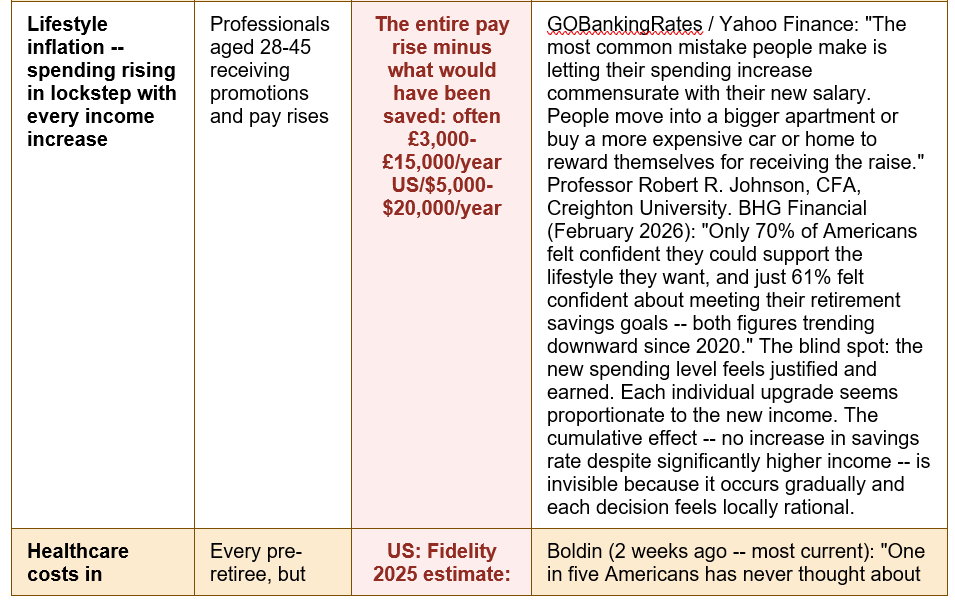
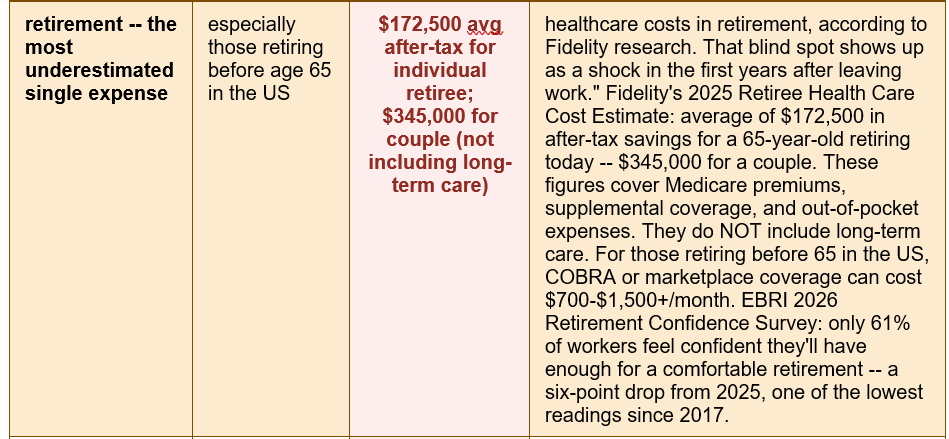
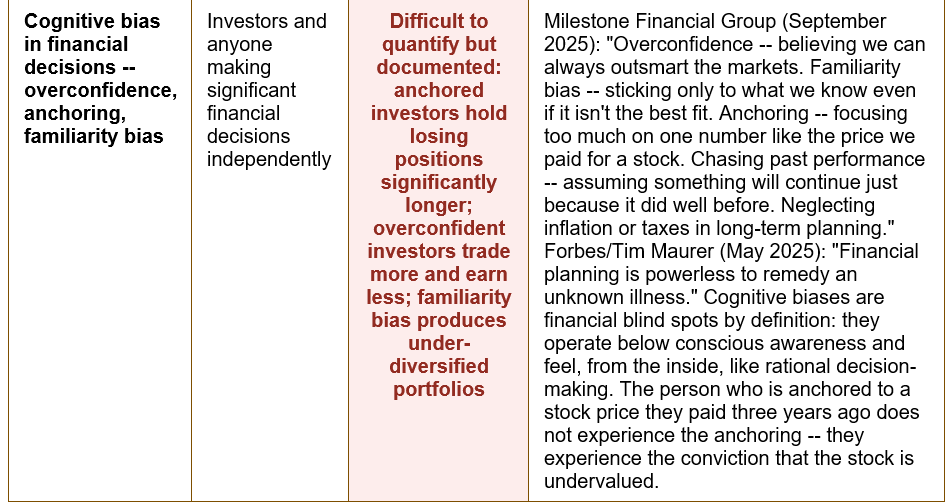
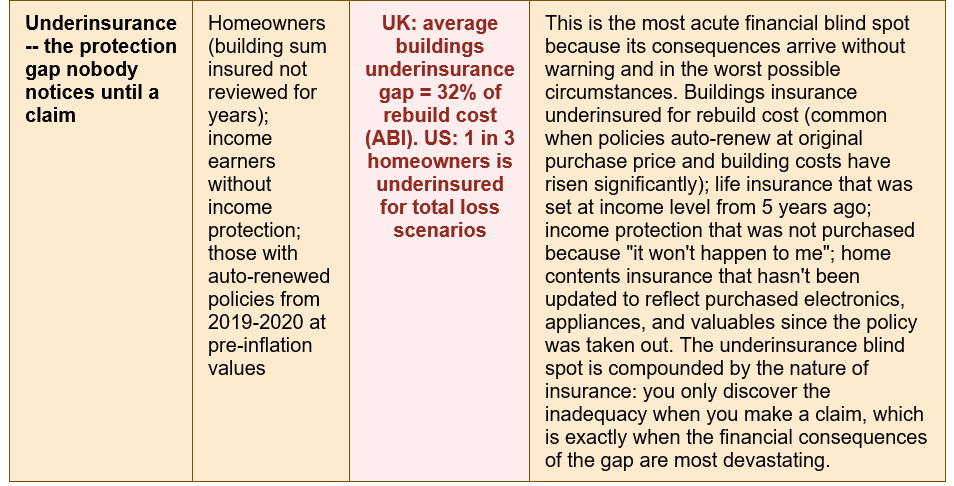
The following table maps the five most common and most costly financial blind spots, the populations most likely to have each one, and the research evidence for why they are difficult to see: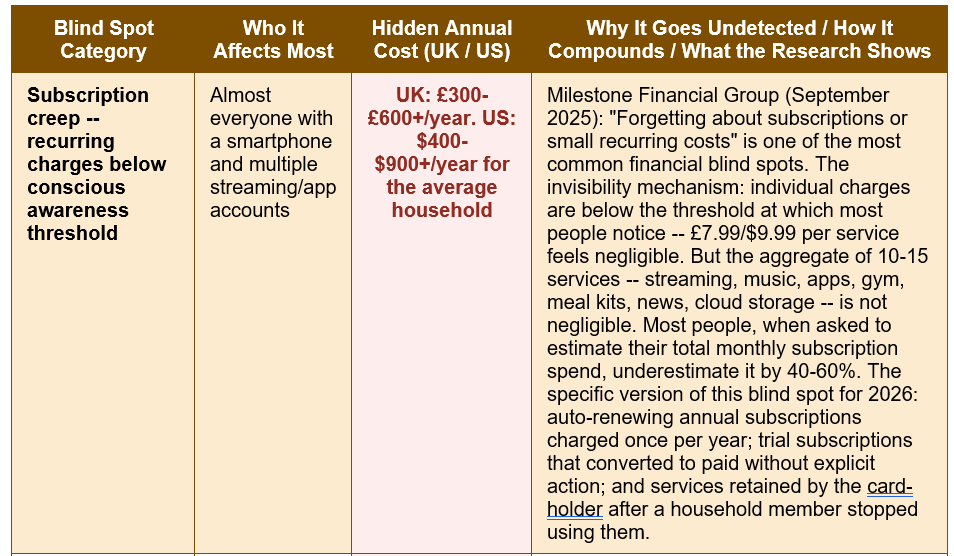
9 Financial Blind Spots and How to Identify Them in Your Own Finances
BLIND SPOT #1: Subscription Creep -- The Death by a Thousand Monthly Charges | The most universal blind spot in 2026
Subscription creep is the accumulation of recurring charges for services that were individually justified at the time of signing up but collectively represent a significant monthly cost that nobody consciously approved. The invisibility mechanism is precise: each individual charge is below the threshold at which most people engage conscious financial decision-making. The £7.99/$9.99 monthly charge for a streaming service is noticed when it first appears on the statement and then stops being noticed at all, because the brain re-categorises it from 'spending decision' to 'fixed expense.' Over time, the fixed expense category fills with services accumulated over years: streaming services from the family, the gym membership from January, the premium news subscription, the cloud storage, the meal kit service, the fitness app, the software subscription, the VPN, the anti-virus, the professional membership that auto-renews each October. The US CFPB estimates Americans pay $17 billion annually in overdraft fees -- many of these overdraft events are triggered by recurring charges the account holder had forgotten about. How to identify it: open your bank account and card statements from the last 3 months and list every charge that appears more than once. Add up the total of every recurring charge. Compare it to what you thought you were spending on subscriptions. The difference between the estimate and the actual figure is the blind spot. Action: cancel anything not actively used in the last 30 days. Pause rather than cancel where services are seasonal. Set a calendar reminder to audit subscriptions every 6 months.
BLIND SPOT #2: Lifestyle Inflation -- The Pay Rise That Disappears | When more income produces no more financial security
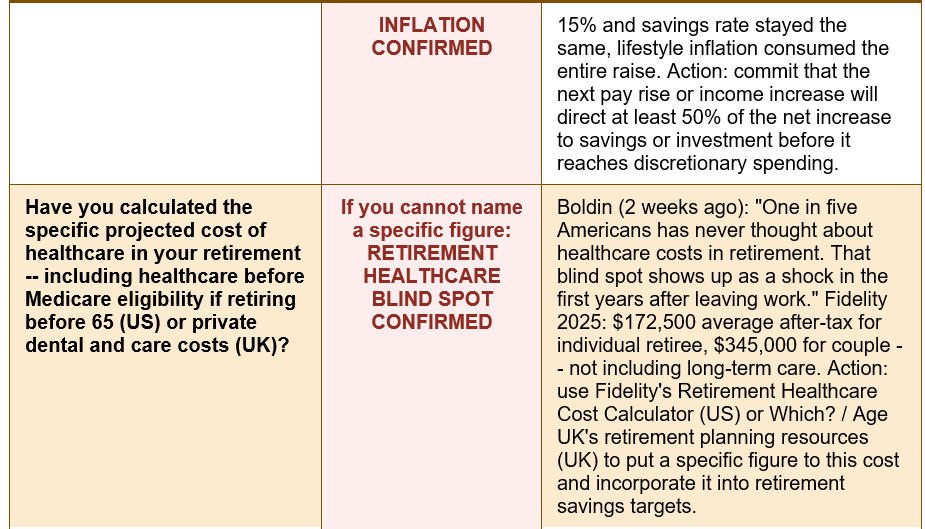
Lifestyle inflation is the phenomenon by which spending increases proportionally with income, leaving the savings rate -- and therefore long-term financial security -- unchanged despite significantly higher earnings. It is described by Professor Robert R. Johnson, CFA (Creighton University): 'The most common mistake people make is letting their spending increase commensurate with their new salary. People move into a bigger apartment or buy a more expensive car or home to reward themselves for receiving the raise.' The psychological mechanism: each spending increase that accompanies an income increase feels individually justified. The slightly better apartment is still a reasonable proportion of the new salary. The newer car is within budget. The more expensive holidays reflect the income level the family now occupies. None of these individual decisions is obviously wrong. The pattern of all of them together, consuming every incremental pound or dollar of income growth, is the blind spot. The test: take your gross income from 5 years ago and today. Calculate the percentage increase. Now calculate your savings rate (savings as a percentage of net income) for both periods. If income has risen 20% and the savings rate is unchanged, lifestyle inflation has consumed the entire raise. BHG Financial (February 2026): only 41% of Americans work with a financial adviser despite it becoming more valuable as income and financial responsibilities grow -- meaning most people are navigating lifestyle inflation decisions without any external accountability. Action: commit now that the next pay rise will direct at least 50% of the net increase to savings or investment before it reaches lifestyle spending. Automate that transfer before lifestyle spending has the opportunity to absorb it.
BLIND SPOT #3: Retirement Healthcare Costs -- The £/$172,500 Assumption Error | The most financially dangerous retirement blind spot
Retirement planning conversations focus almost entirely on whether there will be enough saved to replace pre-retirement income. The retirement healthcare cost blind spot is the near-universal failure to incorporate healthcare costs as a separate, significant, and specific retirement expense category. Boldin (2 weeks ago): 'One in five Americans has never thought about healthcare costs in retirement. That blind spot shows up as a shock in the first years after leaving work.' The figures are not small. Fidelity's 2025 Retiree Health Care Cost Estimate places the average at $172,500 in after-tax savings for a 65-year-old retiring today -- $345,000 for a couple. These figures cover Medicare premiums, supplemental coverage (Medigap or Medicare Advantage), and average out-of-pocket expenses. They do not include long-term care, which adds an entirely separate and potentially much larger cost. For those retiring before 65 in the US, pre-Medicare coverage adds an additional $700-$1,500+/month depending on location and coverage level. EBRI 2026 Retirement Confidence Survey: only 61% of workers feel confident they will have enough for a comfortable retirement -- a six-point drop from 2025. Healthcare costs are a significant component of the gap between projected and actual retirement adequacy for most people who have not specifically modelled this expense. UK equivalent: while NHS provision eliminates many of the acute costs that create the US healthcare gap, UK retirees face increasingly significant costs for private dental care, optical care, NHS prescription charges for those under 60, care home costs (average UK care home fees 2026: approximately £800-£1,200/week), and any private healthcare that supplements NHS provision. Action: use a dedicated retirement healthcare cost calculator to put a specific figure to this expense and incorporate it into your retirement savings target.
BLIND SPOT #4: The Tax Efficiency Gap -- Legal Savings Being Left on the Table | The blind spot that costs more the higher your income
Tax efficiency blind spots occur when legal and available mechanisms for reducing tax liability are not being used, often because the complexity of the options creates inertia. The cost is entirely avoidable and scales with income -- the higher the income, the larger the potential tax efficiency gain that is being missed. UK tax efficiency blind spots most commonly overlooked: the full ISA allowance (£20,000/year) not being utilised, meaning investment growth is being taxed when it could be permanently tax-free; pension contributions below the level at which income tax relief is generated (worth 20p per £1 for basic rate taxpayers and 40p per £1 for higher rate taxpayers); the Marriage Allowance (worth up to £1,260/year for couples where one partner is a non-taxpayer and the other is a basic rate taxpayer); and the failure to claim legitimate employment expenses, professional subscriptions, and home office costs for those eligible to do so. US tax efficiency blind spots most commonly overlooked: not contributing enough to the 401(k) to capture the full employer match (which represents an immediate 50-100% return on matched contributions); failing to maximise Roth IRA contributions (£/$7,500/year in 2026) when in a lower tax bracket; not using a Health Savings Account (HSA) where eligible (triple tax advantage: deductible contributions, tax-free growth, tax-free withdrawals for qualified medical expenses); and claiming insufficient deductions on Schedule C for legitimate business expenses. The blind spot: these opportunities are not new. They have been available for years. The inertia that prevents people from claiming them is the compound of complexity, unfamiliarity, and the absence of the immediate financial pain that motivates other financial decisions. Action: UK: check with HMRC's tax calculator and consider a one-hour consultation with a tax adviser to identify unclaimed reliefs. US: review your last 3 tax returns with a CPA to identify missed deductions and credits.
BLIND SPOT #5: Overconfidence in Market Timing -- The Self-Undermining Investor | The bias that makes intelligent people underperform index funds
Milestone Financial Group (September 2025): 'Overconfidence -- believing we can always outsmart the markets.' This is among the most extensively documented and most consequential financial blind spots for anyone who makes their own investment decisions. Overconfidence in investing manifests as: believing that the time to buy or sell a particular asset can be reliably identified in advance; holding more concentrated positions in familiar assets (companies in the sector you work in; the country you live in) than a rational diversification analysis would justify; trading more frequently than evidence suggests is beneficial, as each trade involves a transaction cost and a tax event; and dismissing index funds as insufficiently interesting despite their documented long-term outperformance of most active strategies. The data on this is not ambiguous: 79% of active large-cap US fund managers underperformed the S&P 500 in 2025 (SPIVA, S&P Dow Jones). If professionally paid, full-time analysts managing concentrated portfolios mostly cannot outperform the index, the individual investor checking markets on their lunch break is unlikely to do so reliably. The blind spot: overconfidence feels from the inside like well-founded confidence. The investor who outperformed in the last 2 years is not thinking about whether that reflected skill or market conditions. They are building the conviction that will produce the next overconfident move. Action: compare your actual portfolio performance over 5 years against the equivalent index. Include transaction costs and tax events. If the portfolio has underperformed the index net of costs, the active approach is not adding value over passive investment. Consider what proportion of your portfolio could be transitioned to low-cost index funds without sacrificing the engagement with investing you find valuable.
BLIND SPOT #6: Anchoring to Purchase Price -- The Investment That "Needs to Get Back to Even" | The cognitive trap that turns small losses into large ones
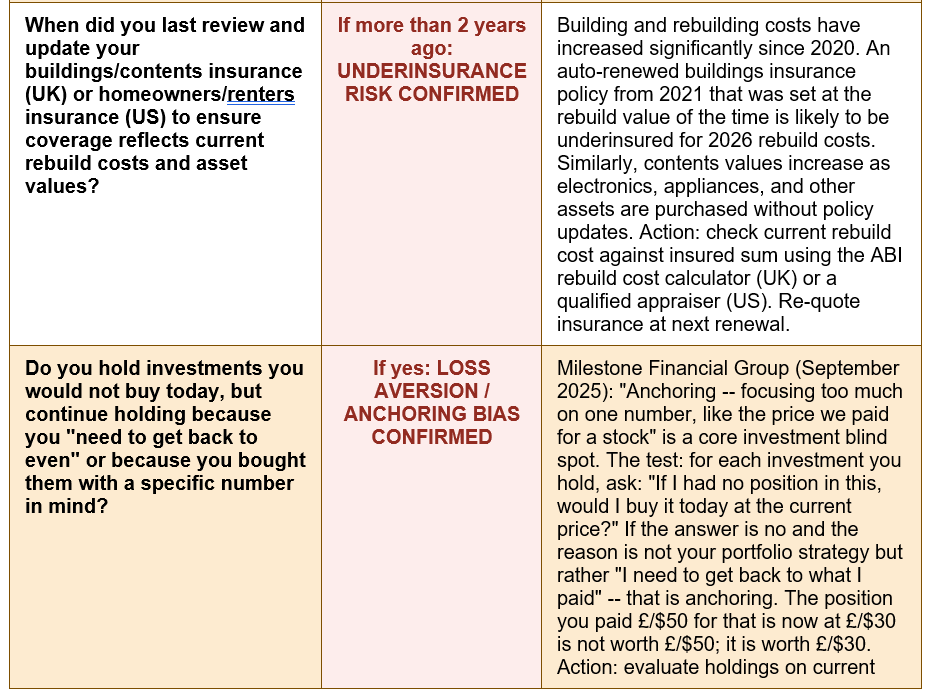
Anchoring is the tendency to weight the original price paid for an asset disproportionately in subsequent decisions about that asset. Its most destructive financial manifestation: holding a losing investment beyond any rational evidence-based justification because of the psychological need to 'get back to what I paid.' Milestone Financial Group (September 2025): 'Anchoring -- focusing too much on one number, like the price we paid for a stock.' The test: for every investment you currently hold, ask: 'If I had no position in this asset and had the money available, would I buy it at today's price?' If the answer is no -- if the only reason you are holding it is because you paid more for it -- you are anchored. The price you paid is irrelevant to the investment decision you face today. That money is gone regardless of what happens to the current position. The only financially relevant question is whether this asset, at its current price, is the best use of the capital it currently represents. A share bought at £/$50 that is now at £/$30 is not a '£/$50 asset at a discount.' It is a £/$30 asset. Holding it because selling would make the loss 'real' is loss aversion compounding an already poor outcome. Action: for every holding currently below its purchase price, write a specific forward-looking investment case for the position: why should this asset appreciate from its current level? If you cannot write a credible forward-looking case, the attachment to the purchase price is the only reason you are holding. That is the blind spot.
BLIND SPOT #7: Underinsurance -- The Protection Gap Nobody Finds Until They Need It | The silent risk that inflates over time as coverage stays fixed
Underinsurance is the gap between the coverage provided by an insurance policy and the actual cost of the loss it is supposed to protect against. In the context of financial blind spots, it is particularly dangerous because it is invisible -- by definition, you only discover it when you make a claim, which is also the worst possible moment to absorb a significant uninsured financial loss. UK buildings insurance: the Association of British Insurers has documented that a significant proportion of UK homeowners are underinsured for buildings -- meaning their policy would not cover the full cost of rebuilding their property in the event of a total loss. This commonly occurs because policies auto-renew at the original insured value, while building costs and property values have risen significantly. A policy set at a rebuild value of £200,000 in 2019 that auto-renews each year without adjustment may now be underinsured by £40,000-£80,000 relative to current rebuild costs. UK contents insurance similarly becomes outdated as new electronics, appliances, and other valuables are purchased without policy updates. US homeowners insurance: similar dynamics apply, with the additional risk in areas affected by climate events (flooding, wildfires, extreme weather) where standard homeowners policies may not cover the loss category that is most likely in that location. Life and income protection insurance: policies taken out when income was lower or family circumstances were different may no longer provide adequate replacement for the current financial obligations they are supposed to protect. Action: review every insurance policy for current adequacy. UK: use the ABI rebuild cost calculator for buildings insurance. Check contents value manually by listing electronics, appliances, furniture, clothing, and jewellery. US: request an insurance review from a licensed independent broker annually at policy renewal.
BLIND SPOT #8: The Debt Minimum Payment Trap -- Confusing Activity for Progress | When paying feels like solving but the balance barely moves
Making the minimum payment on a credit card or personal loan feels like doing the right thing -- the bill is paid, the account is current, and no late fees are charged. The blind spot: on a high-interest balance, minimum payments are almost entirely consumed by interest charges, with only a fraction reducing the principal. The result is that a balance can take decades and cost multiples of the original sum to clear on minimum payments alone. Americans pay approximately $120 billion annually in credit card debt interest and fees (CFPB). Many of these payments are minimum or near-minimum payments that generate significant ongoing interest costs without materially reducing the balance. The blindspot structure: the monthly payment is made and the account status shows 'current' -- both of which feel like resolution. The balance column, which shows only negligible reduction, is the number that reveals the blind spot. A £/$5,000 credit card balance at 24% APR on minimum payments (typically 2-3% of balance or a minimum floor) will take approximately 18-20 years to clear and will cost approximately £/$7,000-£/$9,000 in interest on top of the original £/$5,000. Action: for every debt with an interest rate above 10%, calculate the payoff timeline on current payments (use a debt payoff calculator -- many are free online). If the timeline extends beyond 3-5 years on current payments, allocate additional funds to accelerated payoff using the debt avalanche (highest rate first) or debt snowball (smallest balance first) method.
BLIND SPOT #9: Neglecting Future Self -- The Cognitive Distance Between You and 65-Year-Old You | Why long-term financial planning feels less urgent than it should
Neuroscience research has documented that people relate to their future selves more like strangers than like their current selves -- which helps explain why saving for retirement feels like giving money to someone else rather than protecting yourself. Present bias (the tendency to weight current costs and benefits more heavily than future ones) and the cognitive distance from the future self combine to make long-term financial planning chronically under-prioritised. EBRI 2026 Retirement Confidence Survey: only 61% of workers feel confident they will have enough money to live comfortably throughout retirement -- a six-point drop from 2025, one of the lowest readings since 2017. Boldin (2 weeks ago): 'One in five Americans has never thought about healthcare costs in retirement.' This is not primarily a financial literacy failure -- most people know they should save for retirement. It is a motivational architecture failure: the future self is not sufficiently vivid or proximate to generate the same urgency as current expenses. The blind spot: the feeling that 'retirement is a long way off' is not a rational financial assessment. It is a psychological distancing mechanism. Every year of delay in beginning or accelerating retirement savings carries a specific, calculable opportunity cost in compound growth. A 30-year-old who delays retirement savings for 5 years loses not 5 years of contributions but the compounding growth on those contributions over the subsequent 30-35 years. Action: calculate the specific cost of delay. Use a retirement calculator to compare your projected retirement position if you start or increase contributions today versus 5 years from now. The difference is the cost of the blind spot. Put a specific monetary figure on the delay -- this converts the abstract future into a concrete present cost.
The Financial Blind Spot Self-Diagnostic: 6 Tests to Run Today
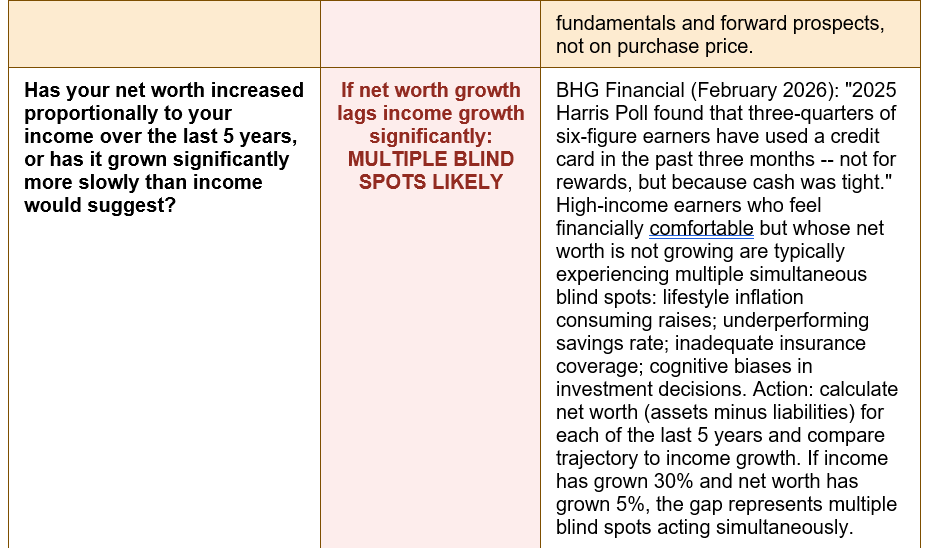
The following diagnostic tests are specifically designed to surface the most common financial blind spots. Each produces a concrete answer to whether the blind spot exists in your specific finances: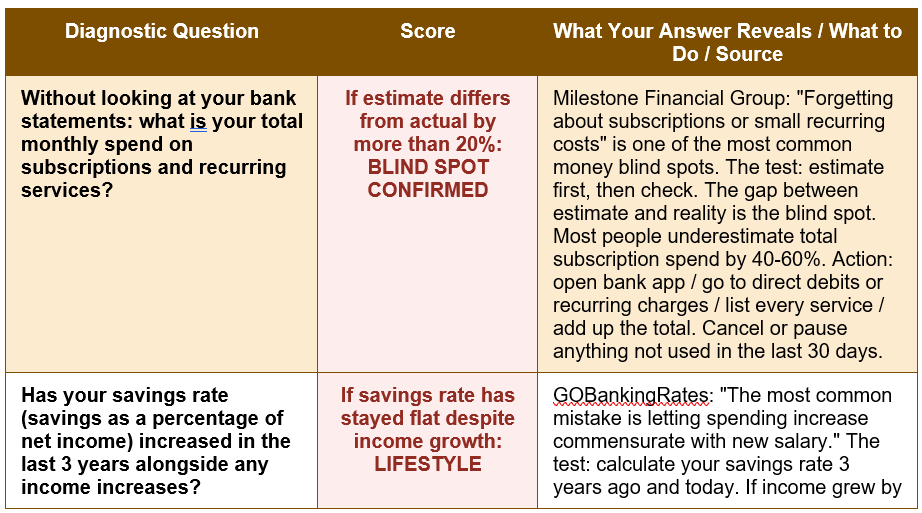
How to Systematically Eliminate Financial Blind Spots
Identifying a financial blind spot is only the first step. The following framework converts awareness into action:- The Annual Financial Audit: The single most effective structural protection against financial blind spots is a comprehensive annual review of every dimension of your financial life, with specific attention to areas where spending is automatic and therefore invisible. This mirrors Step 7 of the CFP Board's seven-step financial planning process (monitoring and updating). The audit should cover: full subscription and recurring charge audit (list everything, cancel anything unused); net worth calculation (assets minus liabilities) and comparison to the previous year; savings rate check (savings as percentage of net income, compared year-on-year); insurance adequacy review (has anything changed in value or circumstance that requires policy update?); investment portfolio review (is each holding still justified on current fundamentals?); tax efficiency check (are all available reliefs and allowances being utilised?). Kiplinger (May 23, 2026): 'Whether you're starting your career or nearing retirement, thinking critically about your financial outlook now will help you avoid costly errors in future.'
- External Accountability: The structural challenge of blind spots is that they are invisible from the inside. An external perspective -- from a financial adviser, an accountant, a financially literate partner or trusted friend -- provides the viewpoint that can identify what you cannot see yourself. Forbes/Tim Maurer (May 2025): 'Financial planning is powerless to remedy an unknown illness. By making the unconscious or subconscious conscious, now you're empowered to do something about it.' A professional financial review (even a one-off consultation) is specifically designed to surface what individual self-assessment misses. BHG Financial (February 2026): only 41% of Americans work with a financial adviser, despite guidance becoming more valuable as income and complexity grow.
- Specific Diagnostic Questions: The six diagnostic tests in the table above are designed to be uncomfortable -- and productive. The most effective way to use them is to answer each one as specifically as possible (with actual numbers, not impressions) and then compare the result to what you believed before answering. The gap between belief and fact is the blind spot. Milestone Financial Group (September 2025): 'A financial blind spot is anything in your money life that's easy to miss or underestimate. With a little awareness, they can be managed.'
- Automation as Blind Spot Protection: Many financial blind spots are not removed by awareness alone -- they require structural change to prevent recurrence. Automating savings transfers (so the money moves to savings before it can be spent on lifestyle inflation) and automating pension contributions (so they increase when salary increases) removes the ongoing cognitive load and willpower requirement that lifestyle inflation exploits. Similarly, setting a calendar reminder to audit subscriptions every 6 months converts a one-time awareness action into an ongoing structural protection.
The compounding cost of unidentified financial blind spots. The danger of financial blind spots is not primarily the cost in any single year -- it is the compounding cost over the years during which the blind spot goes unaddressed. A subscription costing £/$100/year costs £/$100 in year one. Over 10 years without detection, it costs £/$1,000 -- and may have inflated with price rises. A lifestyle inflation blind spot that prevents a savings rate increase of 5% of income at age 28 when income first reaches a meaningful level costs not 5% of that year's income but the compounding growth on 5% of income invested from age 28 to retirement. At 7% compound annual growth, £/$5,000 invested at age 28 grows to approximately £/$38,000 by age 65. The delay of one year in identifying the blind spot costs £/$38,000, not £/$5,000. This is why Forbes/Tim Maurer's framing is so precise: 'Financial planning is powerless to remedy an unknown illness.' The illness needs to be identified first -- and the identification, even if painful, is always more valuable the sooner it happens.
UK vs US: How Financial Blind Spots Differ by Country
UK-Specific Financial Blind Spots
- Pension auto-enrolment complacency: Auto-enrolment has enrolled millions of UK workers in workplace pensions who would not previously have saved -- a genuine policy success. The blind spot it has created: many workers believe that because they are enrolled and contributions are being made, their retirement savings are 'taken care of.' The minimum auto-enrolment contribution rate (5% employee plus 3% employer = 8% total) is almost certainly insufficient to provide a comfortable retirement income for most people. The blind spot is that the automatic nature of the contribution creates a psychological closure that prevents asking: 'Is 8% total actually enough?'
- The 40% tax trap -- not claiming pension tax relief as a higher-rate taxpayer: Higher-rate UK taxpayers (income above £50,270 in 2026) receive 40% income tax relief on pension contributions -- but only if they claim it via Self Assessment. Those who do not complete a Self Assessment tax return (because they are PAYE employees with no self-employment income) must actively claim the higher-rate relief through HMRC. Many higher-rate taxpayers on PAYE have been receiving only 20% relief (applied at source) for years without realising 40% was available. The unclaimed difference is a direct, quantifiable annual loss.
- ISA allowance not fully utilised: The annual ISA allowance (£20,000 for 2026/27) represents a permanent, compounding tax shelter that cannot be retrospectively claimed once a tax year passes. Each year the allowance is not fully used is a permanent loss of tax-free growth capacity. Most people who have not maximised their ISA allowance do not know exactly how much they have used -- the blind spot is not ignorance of the ISA but inaccurate belief that the allowance is being well utilised.
US-Specific Financial Blind Spots
- Medicare timing and the healthcare gap before 65: For any American planning to retire before age 65, the cost of health insurance before Medicare eligibility is one of the most significant and most underestimated retirement planning blind spots. COBRA coverage, marketplace plans, and part-time employment for benefits each carry significant costs and trade-offs that are rarely modelled in pre-retirement financial planning until the retirement date is imminent.
- Social Security optimisation -- the claiming age decision: Claiming Social Security at 62 versus 67 versus 70 produces dramatically different lifetime benefit totals depending on longevity. The difference between claiming at 62 (reduced benefit) and 70 (maximum benefit) can represent more than $100,000 in lifetime benefit for a typical earner who lives past 80. This decision is frequently made on a 'need the money now' basis rather than a longevity-adjusted optimisation analysis.
- State income tax in retirement -- the domicile blind spot: Many US retirees who relocate to a different state in retirement are not aware of which states have no state income tax (Florida, Texas, Nevada, Washington, Tennessee, and others) and which states tax pension income, Social Security, and retirement account withdrawals at meaningful rates. The decision of where to retire has significant and calculable tax implications that are a common blind spot in retirement planning.
YOUR FINANCIAL BLIND SPOT ELIMINATION CHECKLIST -- DO THESE NOW: TODAY (30 MINUTES): (1) Subscription audit: open bank statements and card statements for last 3 months. List every recurring charge. Calculate the total. Compare to what you thought you were spending. Cancel anything not actively used in the last 30 days. (2) Net worth calculation: total all assets (savings, investments, pension, property equity, other). Total all liabilities (mortgage, credit cards, loans, BNPL). Assets minus liabilities = net worth. Write this down. THIS WEEK: (3) Savings rate check: calculate savings as a percentage of net monthly income for this month and for 3 years ago. If the percentage has not increased despite income growth: identify the lifestyle inflation that absorbed the rise. (4) Retirement healthcare cost: use Fidelity's Retirement Healthcare Cost Calculator (US) or Which?/Age UK resources (UK) to put a specific figure on healthcare costs in retirement. Compare this to your current retirement savings trajectory. (5) Insurance review: check when buildings/homeowners insurance, contents insurance, life insurance, and income protection were last reviewed and updated. If more than 2 years: schedule a review. THIS MONTH: (6) Tax efficiency check: UK: are you using the full ISA allowance? If you are a higher-rate taxpayer, are you claiming pension tax relief through Self Assessment? US: are you capturing the full employer 401(k) match? Are you maxing your Roth IRA? ANNUALLY: (7) Repeat all six checks. Specifically compare net worth year-on-year. Review all insurance at renewal. Re-run the subscription audit. UK FREE HELP: MoneyHelper 0800 138 7777. US FREE HELP: CFPB consumerfinance.gov. For complex areas (tax, pensions, investments): consult a regulated financial adviser.
THE FIVE MOST DANGEROUS THINGS PEOPLE TELL THEMSELVES ABOUT THEIR FINANCIAL BLIND SPOTS: (1) 'I AM FINANCIALLY COMFORTABLE, SO I PROBABLY DON'T HAVE ANY MAJOR BLIND SPOTS.' BHG Financial (February 2026): '2025 Harris Poll found that three-quarters of six-figure earners used a credit card in the past three months -- not for rewards, but because cash was tight.' Financial comfort and financial blind spots are not mutually exclusive. They are frequently coexistent. The most damaging blind spots often occur precisely in the financial range where income is high enough to accommodate significant invisible costs without triggering the financial distress that would otherwise prompt a review. (2) 'I HAVE A ROUGH SENSE OF MY FINANCES -- THAT'S GOOD ENOUGH.' Diagnostic accuracy matters: the difference between thinking you spend £/$300/month on subscriptions and actually spending £/$580/month is not a rounding error -- it is £/$280/month, £/$3,360/year, invisibly misdirected. Rough senses produce rough plans. (3) 'I'LL THINK ABOUT RETIREMENT HEALTHCARE COSTS WHEN I GET CLOSER TO RETIREMENT.' Boldin (2 weeks ago): '1 in 5 Americans has never thought about healthcare costs in retirement. That blind spot shows up as a shock in the first years after leaving work.' The cost of addressing a retirement planning blind spot increases significantly the closer you are to retirement -- because less time remains to accumulate the savings needed to fill the gap. (4) 'MY INSURANCE AUTO-RENEWS, SO IT MUST BE UP TO DATE.' Auto-renewal means the policy continues -- it does not mean the coverage remains adequate. Buildings insurance set at 2019 rebuild values, contents insurance that predates several major electronics purchases, and life insurance set at a lower income level are all examples of policies that auto-renewed accurately but became materially inadequate over time without anyone noticing. (5) 'I AM AWARE OF MY FINANCIAL BIASES, SO THEY DON'T AFFECT ME.' The Dunning-Kruger effect in finance: the people most confident they are immune to cognitive biases are frequently the most affected by them. Cognitive biases operate below conscious awareness by definition. Kiplinger (May 2026): 'It's far better to be mindful of your own blind spots now and think critically about how they might affect your financial plan and progress.' Mindfulness of bias is the beginning, not the end, of addressing it.
Conclusion
Financial blind spots are the most expensive problems in personal finance precisely because they are not being addressed. The deliberate financial mistake -- the choice to overspend, to under-save, to take on too much debt -- is at least a conscious error that can be consciously corrected. The financial blind spot compounds quietly in the background, unaddressed because undetected, for as long as it takes to become a crisis or until someone deliberately looks for it.Forbes/Tim Maurer (May 11, 2025): 'Financial planning is powerless to remedy an unknown illness. By making the unconscious or subconscious conscious, now you're empowered to do something about it.' The nine blind spots in this guide -- subscription creep, lifestyle inflation, retirement healthcare costs, the tax efficiency gap, overconfidence in market timing, anchoring to purchase price, underinsurance, the debt minimum payment trap, and the failure to make the future self real and proximate -- are not abstract academic concepts. They are specific, documented, quantifiable financial costs that are currently present in a significant proportion of UK and US household finances. The EBRI 2026 Retirement Confidence Survey's finding that confidence has dropped to 61% -- among the lowest readings in nearly a decade -- is partly a reflection of the accumulated cost of unidentified blind spots.
Kiplinger (May 23, 2026): 'Whether you're starting your career or nearing retirement, thinking critically about your financial outlook now will help you avoid costly errors in future. Your financial future is worth the effort.' The effort required is not extraordinary. The subscription audit takes 30 minutes. The savings rate check takes 15 minutes. The retirement healthcare cost calculation takes an afternoon. None of these actions is complex. All of them require only the willingness to look directly at what the blind spot has been keeping invisible. That willingness is the first and most important action in financial blind spot elimination.

0 Comments Comments