

Financial Literacy
What To Do With Your First Paycheck As A Teenager

Table of Contents
- The Most Powerful Paycheck of Your Life
- Step One: Understand Your Pay Stub Before You Spend Anything
- Gross Pay vs Net Pay
- Why Reading Your Pay Stub Matters
- Step Two: Open a Bank Account (If You Haven't Already)
- Step Three: Split Your Paycheck Before You Spend It
- The 7 Steps to Handle Your First Paycheck Like a Pro
- Conclusion: Your First Paycheck Is the Beginning of Everything
- Frequently Asked Questions (FAQ)
The Most Powerful Paycheck of Your Life
Your first paycheck feels different from any you will ever receive. It is proof that your time has real value, that someone will pay you for it, and that you can earn your own money. Greenlight (May 2025): 'Getting paid is a fabulous feeling at any age. But there's something extra sweet about your first paycheck as a working teenager. That first check delivers some freedom to do what you want. But it's also a reflection of the responsibility and hard work you've put in to earn that money in the first place.'It is also, without question, the most powerful paycheck you will ever receive -- not because of how much it is worth right now, but because of how much time it has to grow. The mathematics of compound interest mean that money saved and invested at 16 has almost 50 years to compound before traditional retirement age. $100 saved and invested at age 16 at 7% average annual return becomes approximately $493,000 at age 65. The same $100 at age 26 becomes approximately $243,000. The first paycheck is the beginning of that compounding story, and the habits formed in how you handle it are the habits most likely to persist.
Here is what the data shows about most teenagers and money: InvestInMe (June 17, 2026): 51% of teens say saving is a priority, but only 29% actually save consistently. 56% admit to impulse buying at least once a week, with social media as the primary trigger. Only 24% understand how to create and stick to a budget -- the lowest-rated financial skill among teens. And only 17 states in the US require a financial education course for high school graduation, meaning 83% of teens reach their first paycheck without formal instruction on what to do with it. This guide is that instruction. It is practical, specific, and built around the data on what actually works -- not just what sounds good in theory.
Step One: Understand Your Pay Stub Before You Spend Anything
Before you do anything with your first paycheck, spend five minutes reading the pay stub that comes with it. Commerce Bank (May 4, 2026): 'First paychecks can come with surprises. Paychecks can be smaller than expected because taxes and other withholdings are taken out, making it important for teens to understand how their pay is calculated before they start spending.'Gross Pay vs Net Pay
Webster First Credit Union (June 2, 2026): 'When you look at your pay stub, you might notice that the amount you take home is lower than what you expected. This is completely normal. Gross pay is the total amount of money you earned during a specific pay period, before any taxes or insurance are taken out. Net pay is your take-home pay -- the final amount you receive after all deductions have been made.'If your employer agreed to pay you $12 per hour and you worked 20 hours, your gross pay is $240. Your net pay -- what actually lands in your account -- will be lower after deductions. Webster First: 'Your employer is required by law to withhold certain taxes from your gross pay. These deductions typically include federal and state income taxes, local taxes, Social Security, and Medicare.' As a part-time teenager, your income tax withholding may be low or zero depending on your total annual earnings. But Social Security and Medicare (7.65% combined in the US) will typically be deducted regardless of your earnings level.
Why Reading Your Pay Stub Matters
Commerce Bank (May 4, 2026): 'Reviewing each pay stub helps teens understand their earnings, confirm hours worked, and spot any errors -- building early habits of financial responsibility.' Always check that the hours recorded match your own records. Mistakes happen and it is your right to flag them. Lake City Bank (May 27, 2026): 'While your teen looks forward to that first paycheck, prepare them for the withholding they'll see.' Understanding this from the first paycheck means you will never be surprised by deductions again, you budget from your net pay (not gross), and you start building the habit of reviewing financial documents -- a habit that pays dividends for life.Teen financial literacy gap in 2026: 51% say saving is a priority. Only 29% save consistently. 56% impulse buy weekly. Only 24% can budget. Only 17 US states require financial education. — InvestInMe Teen Financial Literacy Statistics 2026 (June 17, 2026 -- most current): '51% of teens say saving is a priority but only 29% actually save consistently. 35% have no savings at all. 56% of teens admit to impulse buying at least once a week -- social media is the primary trigger. Only 24% understand how to create and stick to a budget -- lowest-rated financial skill among teens. Only 17 states require a personal finance course for graduation.' Sources: Junior Achievement Teens & Savings Survey 2024; Common Sense Media Teen Shopping Habits 2024; PISA Financial Literacy Assessment 2022.
Step Two: Open a Bank Account (If You Haven't Already)
Before you can deposit your first paycheck, you need somewhere to put it. Commerce Bank (May 4, 2026): 'Once they've opened a checking account, tell your teen to work with their employer to set up direct deposit. This means their paycheck will be deposited into their checking account without the need to pick up a paper check and take it to their bank.'Most banks and credit unions offer accounts specifically designed for teenagers. Lake City Bank (May 27, 2026): 'Most employers pay via direct deposit, so if your teen doesn't have a bank account, now is the time to open one. Start with an account like Lake City Bank's StartSmart, specially designed as a first bank account for individuals aged 14 to 23.' Commerce Bank: 'If your teen is under 18, a parent or guardian will need to be a co-owner on the account. If they're 18 or older, consider talking with them about adding you as an authorized user. That way, they can start building financial independence while still benefiting from guidance and support.'
What to look for in a teen bank account: no monthly fees (or fees waived for students); a debit card with manageable daily limits; online and mobile app access so you can monitor your balance in real time; and ideally, a linked savings account so you can transfer between accounts easily. Greenlight (May 2025): 'Use a debit card: while credit cards can be useful tools to build credit, debit cards represent a finite amount of money and can be effective money management tools for budgeting, saving, and avoiding overspending.' A debit card lets you spend only what you have -- which is the right starting point for your first months of earning.
Step Three: Split Your Paycheck Before You Spend It
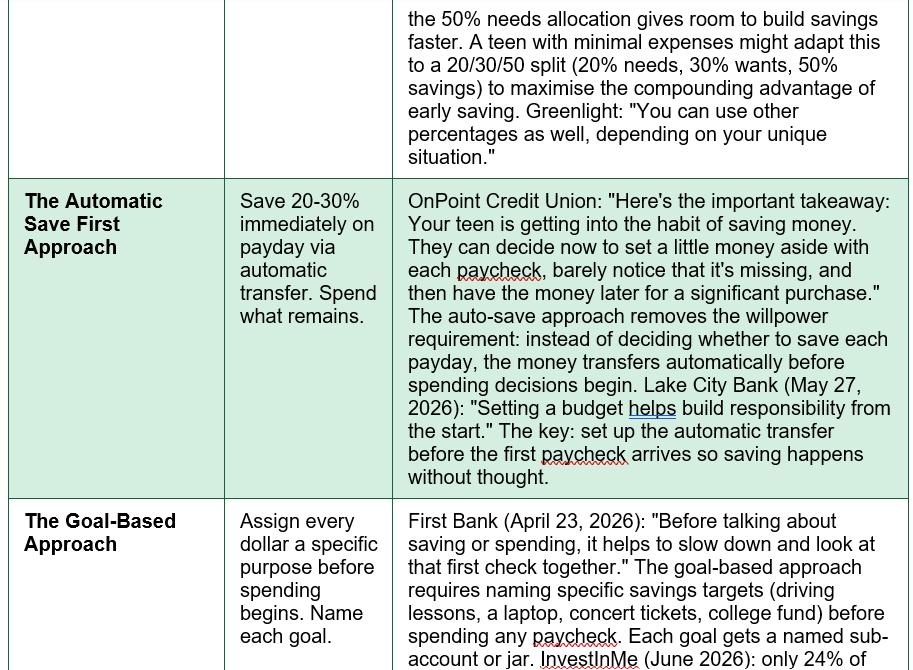
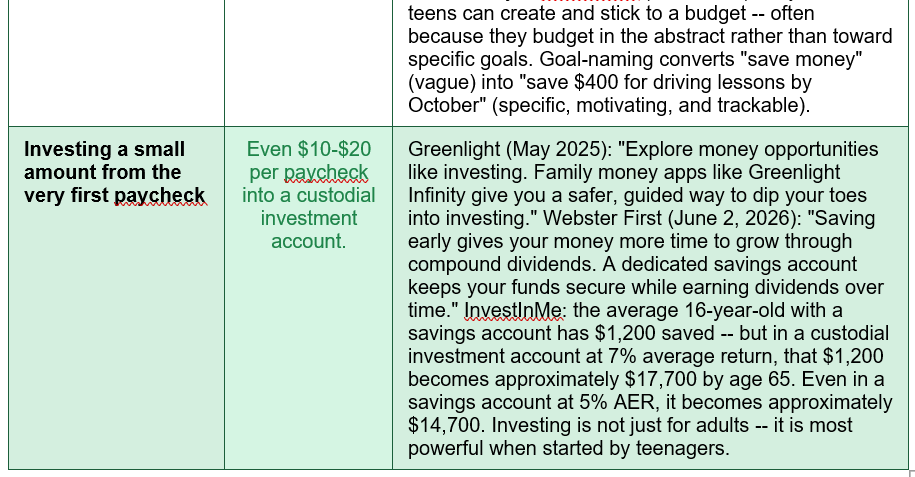
The most important financial habit you can build from your first paycheck is deciding where your money goes before you spend it, not after. Here are the most effective allocation approaches, with data on which ones stick: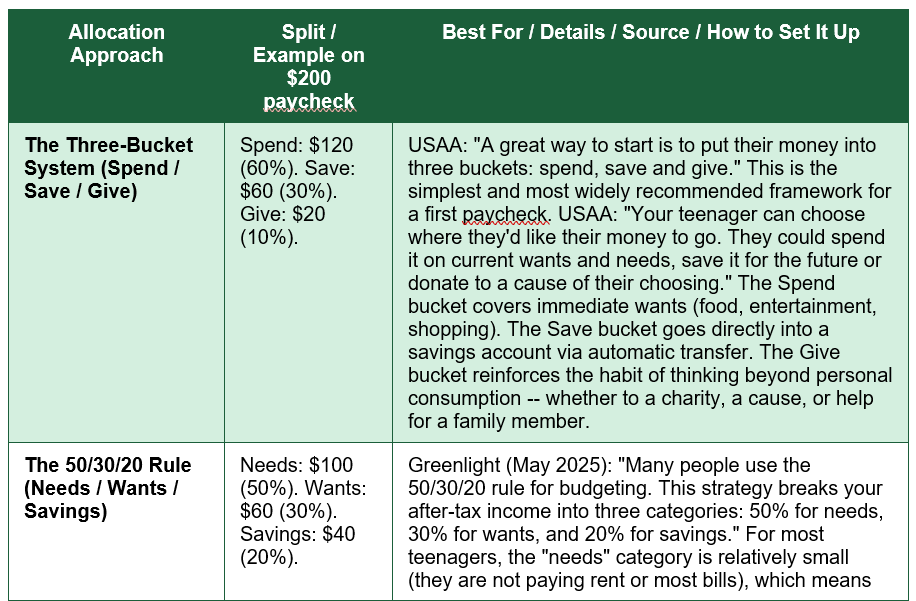
The 7 Steps to Handle Your First Paycheck Like a Pro
STEP #1: READ THE PAY STUB FIRST -- EVERY TIME | Know your actual take-home before you plan anything
Webster First (June 2026): 'When you look at your pay stub, you might notice that the amount you take home is lower than what you expected. This is completely normal.' Your budget and spending plan must be built on your net pay -- what you actually receive -- not your gross pay or the hourly rate multiplied by hours worked. Deductions for federal and state income tax, Social Security, and Medicare reduce what hits your account. For most teenagers working part-time, the total tax rate is typically 10-15% at federal level plus state taxes where applicable. Always check hours recorded against your own log. Commerce Bank: 'Reviewing each pay stub helps teens understand their earnings, confirm hours worked, and spot any errors.'STEP #2: SET UP DIRECT DEPOSIT TO A TEEN-FRIENDLY ACCOUNT | Get paid automatically -- no paper checks, no trips to the bank
Commerce Bank (May 4, 2026): 'Work with your employer to set up direct deposit. This means their paycheck will be deposited into their checking account without the need to pick up a paper check.' Direct deposit also makes automatic saving easier, you can arrange for a fixed amount to transfer to your savings account on the same day the deposit clears, before any spending temptations arise. Lake City Bank (May 27, 2026): 'Combining a checking account with budgeting and digital tools creates a strong foundation for financial independence.' Choose an account with a mobile app so you can check your balance instantly -- awareness of your balance is one of the most effective spending controls available. Greenlight: 'Use an app like Greenlight to monitor your spending and learn real-time smart money management skills.'STEP #3: SAVE BEFORE YOU SPEND -- AUTOMATE IT | The habit that separates the 29% who save consistently from the 71% who do not
InvestInMe (June 2026): '51% of teens say saving money is a priority, but only 29% actually save consistently.' The gap between intention and action is closed by automation, not willpower. On the day your paycheck deposits, arrange an automatic transfer of your target savings amount to a separate savings account. Even if it is $10 or $20, this is the habit. OnPoint Credit Union: 'Your teen can decide now to set a little money aside with each paycheck, barely notice that it's missing, and then have the money later for a significant purchase. The lesson? Saving pays off, and it isn't that painful.' How much to save: aim for at minimum 20% of your net pay from the very first paycheck. If you can manage 30%, even better. Webster First (June 2026): 'Saving early gives your money more time to grow through compound dividends.' The account matters less than the habit -- even a basic savings account earning 4-5% interest beats money spent on impulse purchases at zero return.STEP #4: SET A SPECIFIC SAVINGS GOAL -- MAKE IT REAL | Vague savings goals fail. Specific goals with deadlines succeed.
InvestInMe (June 2026): only 24% of teens can create and stick to a budget. One of the most common reasons abstract saving fails is the absence of a specific target. USAA: 'It's important to plan where their money will go, even if they don't have specific goals in mind.' First Bank (April 23, 2026): 'Before talking about saving or spending, it helps to slow down and look at that first check together.' The approach that works: name every savings goal specifically and put a dollar figure and a deadline on it. Not 'save for a car' -- 'save £1,500 for driving lessons and my first car by June 2027.' Not 'save for college' -- 'save $3,000 for first semester books and supplies by August 2027.' The goal-naming process converts saving from a virtue into a plan. And plans with deadlines and dollar amounts are measurably more likely to be achieved than vague intentions. Keep your named goals visible -- on your phone wallpaper, on a notes app, anywhere you see them regularly.STEP #5: BUDGET YOUR SPEND MONEY -- SOCIAL MEDIA IS DESIGNED TO SPEND IT FOR YOU | 56% of teens impulse buy weekly. A simple spending limit is your defence.
InvestInMe (June 2026): '56% of teens admit to impulse buying at least once a week, with social media being the primary trigger.' Your spending money (the 60-70% left after saving) should be allocated to specific categories before you encounter any advertising or social media. A simple spending budget: eating out and coffee ($30-40/week), entertainment ($20-30/week), clothing and shopping ($20-30/week), other ($10-20/week). Greenlight (May 2025): 'Use an app: a simple money app can help you monitor your spending and learn real-time smart money management skills.' The budgeting app is not about restriction -- it is about visibility. InvestInMe: 'The average teen spends $60 per week on food alone, often without tracking where the money goes.' Tracking does not stop spending. It makes spending a conscious choice rather than an unconscious default. OnPoint Credit Union: 'One of the keys to getting teens to understand the importance of budgeting is to help them see the habit as a means to freedom and independence. As teens near adulthood, they crave more independence.' Budgeting produces independence -- because it is the system that makes financial goals achievable on any income.STEP #6: GIVE A SMALL AMOUNT -- THE HABIT THAT SHAPES YOUR RELATIONSHIP WITH MONEY | The dimension of financial behaviour most financial education skips entirely
USAA: 'A great way to start is to put their money into three buckets: spend, save and give. Your teenager can choose where they'd like their money to go -- spend it on current wants and needs, save it for the future or donate to a cause of their choosing.' Even a small giving allocation -- 5-10% of earnings -- builds a relationship with money that is fundamentally different from pure consumption. It creates the habit of thinking about money as a tool for impact, not just for personal gratification. This is not a moral requirement -- it is a practical financial psychology habit. People who give consistently from their income from an early age tend to demonstrate stronger financial discipline overall, because giving requires the same intentional decision-making process as saving. The specific cause does not matter -- what matters is the deliberate allocation decision made before spending begins.STEP #7: START INVESTING -- EVEN A TINY AMOUNT -- AS EARLY AS POSSIBLE | $100/month at 16 = $493,000 at 65. The maths is extraordinary.
This is the step most people think is for adults only. It is not. Greenlight (May 2025): 'Explore money opportunities like investing. Family money apps like Greenlight Infinity give you a safer, guided way to dip your toes into investing.' Webster First (June 2026): 'Saving early gives your money more time to grow through compound dividends.' The specific mathematics that make starting at 16 extraordinary: $50/month invested at age 16 at 7% average annual return for 49 years = approximately $246,000 at age 65. The same $50/month starting at age 26 (only 10 years later) = approximately $121,000. Starting a decade earlier produces approximately $125,000 more from the same monthly contribution. In the UK: any teenager with earnings from a job can open a Stocks & Shares ISA at age 18, or a parent can open a Stocks & Shares Junior ISA (up to £9,000/year tax-free). In the US: a custodial Roth IRA can be opened for a teen with earned income -- contributions are capped at the lesser of earned income or the annual IRA limit. A custodial brokerage account is also available for any minor through a parent. InvestInMe: 'The average 16-year-old with a savings account has $1,200 saved.' In a savings account at 5%, that $1,200 grows to approximately $14,700 by age 65. In an investment account at 7%, it grows to approximately $17,700. The investment difference is meaningful -- and the only thing required to access it is opening the right account.The compound interest experiment: what your first paycheck could become. This is the most important single concept in personal finance, and it is best understood with real numbers. Imagine you earn $200 per paycheck (net) from a part-time job. You decide to save and invest $40 (20%) from every paycheck. That is $80 per month. At 7% average annual return: after 10 years (at age 26), your $9,600 in contributions has grown to approximately $13,900 -- the extra $4,300 came from compound growth. After 20 years (at age 36): your $19,200 in contributions has grown to approximately $41,700 -- the extra $22,500 came from growth. After 40 years (at age 56): your $38,400 in contributions has grown to approximately $214,000. After 49 years (at age 65): your $47,040 in contributions has grown to approximately $402,000. You contributed $47,040 of your own money. The market contributed $354,960. You did nothing except start early and be consistent. This is why Greenlight calls the first paycheck 'a reflection of the responsibility and hard work you've put in' -- and why that effort, channelled into a saving and investing habit from the very first paycheck, pays dividends that dwarf the original effort for the rest of your life.
FIVE FIRST PAYCHECK MISTAKES THAT SET BACK YOUR FINANCIAL START: (1) SPENDING THE ENTIRE FIRST PAYCHECK TO CELEBRATE. Celebration is valid and deserved -- but spending the entire first paycheck sets a precedent. The habit formed with the first paycheck tends to persist. If the first paycheck is entirely spent, the second is likely to be too. Celebrate with a specific, pre-decided amount (say, $30 or £20 from your spending bucket). The rest follows your plan. (2) NOT OPENING A SAVINGS ACCOUNT BEFORE THE PAYCHECK ARRIVES. InvestInMe: 35% of teens have no savings at all. The most common reason is not having a dedicated savings account separate from their spending account. Set up the savings account before you receive the first paycheck so the allocation system is ready to run immediately. (3) LETTING SOCIAL MEDIA DECIDE WHERE YOUR MONEY GOES. InvestInMe (June 2026): 56% of teens impulse buy at least once a week, triggered primarily by social media. Build your spending plan before you open any social media app on payday. The advertising systems on social platforms are designed by billion-dollar companies to extract money from you impulsively. Your spending plan is your defence. (4) BUDGETING ON GROSS PAY INSTEAD OF NET PAY. Commerce Bank (May 2026): paychecks are smaller than expected because of withholding. Always base your budget on your net pay (what actually deposits) -- not the hourly rate times hours worked. Taxes and deductions are real and will not disappear. (5) WAITING TO START SAVING 'UNTIL YOU EARN MORE.' The habit of saving a percentage of earnings -- whatever the earnings -- is the financial skill that matters. Starting with 20% of $100 is more valuable than planning to start with 20% of $500 when the bigger paycheck arrives. The amount is secondary to the habit. And the habit compounds just like the money does.
YOUR FIRST PAYCHECK ACTION PLAN: BEFORE YOUR FIRST PAYCHECK ARRIVES: (1) Open a teen-friendly checking account with a linked savings account. Most require a parent/guardian co-signer if under 18. Commerce Bank, Lake City Bank StartSmart, Greenlight (US); Monzo, Starling Bank, Halifax (UK) all offer teen or student accounts. (2) Ask your employer to set up direct deposit to your checking account. (3) Decide your split in advance: use 60/30/10 (spend/save/give) or 80/20 (spend/save) as a starting point. Name your first savings goal with a dollar amount and a date. ON FIRST PAYDAY: (4) Read your pay stub before spending anything. Check hours, deductions, and net pay. (5) Transfer your savings amount to your savings account immediately -- before any spending. Do this on the same day the deposit clears. (6) Divide your spending money into rough weekly amounts so you do not front-load spending at the start of the pay period. WHEN YOU TURN 18 (US) OR IMMEDIATELY (UK WITH PARENT HELP): (7) Open a Stocks & Shares ISA (UK, tax-free, from £25/month) or a Custodial Roth IRA (US, if you have earned income) and begin investing even a small amount monthly into a global index fund. The earlier this starts, the more the compounding works in your favour. FREE TEEN MONEY TOOLS: Greenlight (US, teens): greenlightcard.com | Monzo (UK): monzo.com | CFPB Youth Financial Education: consumerfinance.gov/consumer-tools/financial-well-being/ | MoneyHelper (UK): moneyhelper.org.uk/en/money-troubles/way-forward/money-help-for-young-adults
Conclusion: Your First Paycheck Is the Beginning of Everything
Your first paycheck as a teenager is not just money. It is the first chapter of your financial story. Greenlight (May 2025): 'That commitment deserves celebration, but you also need to nurture it. As tempting as it is to spend that first paycheck on something big, it's a great opportunity to start practicing smart money habits.' The data shows that most teenagers have the intention -- 51% say saving is a priority. The gap is the system. Only 29% actually save consistently. Building the system -- the split, the automatic transfer, the named savings goal, the spending plan -- turns the 51% who intend to save into the 29% who actually do.The seven steps in this guide are not complicated. They do not require a high income, financial expertise, or willpower beyond the initial setup. Read the pay stub. Open the right accounts. Split before you spend. Name your savings goal. Budget your spending money. Give a small amount. And start investing as early as possible -- even $10 or $20 per paycheck -- so that compound growth begins doing the work your future self will thank you for.
Lake City Bank (May 27, 2026): 'Your teen's first paycheck is more than just money -- it's a first step toward financial responsibility. Teaching them how to budget, manage a checking account, and save for goals equips them with skills they'll use for life.' $100/month invested at 16 at 7% average annual return becomes approximately $493,000 at 65. This is not a fantasy. It is the mathematics of starting early. Your first paycheck is the beginning of that story. Make it count.
Frequently Asked Questions (FAQ)
How much of my first paycheck should I save?Most financial experts recommend saving a minimum of 20% of your net pay (take-home pay after taxes) from your very first paycheck. Greenlight (May 2025): the 50/30/20 rule suggests 50% for needs, 30% for wants, and 20% for savings. For most teenagers, whose 'needs' (rent, utilities, food) are covered by parents, the 50% needs category is lower -- meaning you can redirect more toward savings. A realistic starting target: save 20-30% of each paycheck. If your net paycheck is $200, save $40-$60 before spending anything else. OnPoint Credit Union: 'Your teen can decide now to set a little money aside with each paycheck, barely notice that it's missing, and then have the money later for a significant purchase.' The key is not the percentage -- it is the automaticity. Set up a transfer to your savings account on the day your paycheck deposits so the saving happens before spending decisions compete with it. InvestInMe (June 2026): 35% of teens have no savings at all -- the most common reason being the absence of a dedicated savings account and automatic transfer. Opening both before the first paycheck arrives is the single most effective structural change available.
Why is my paycheck smaller than I expected?
This is the most common surprise for first-time earners and it is completely normal. Webster First Credit Union (June 2, 2026): 'When you look at your pay stub, you might notice that the amount you take home is lower than what you expected. This is completely normal. Gross pay is the total amount of money you earned during a specific pay period, before any taxes or insurance are taken out. Net pay is your take-home pay -- the final amount you receive after all deductions have been made.' Commerce Bank (May 4, 2026): 'Your employer is required by law to withhold certain taxes from your gross pay. These deductions typically include federal and state income taxes, local taxes, Social Security, and Medicare.' For a part-time teenager in the US earning below approximately $14,600 per year (the standard deduction for a single filer in 2026), federal income tax withholding may be zero or very small if you file a W-4 claiming exemption. However, Social Security (6.2%) and Medicare (1.45%) -- together 7.65% -- are withheld regardless of earnings level. State income tax varies by state. In the UK: teenagers earning below the Personal Allowance (£12,570 in 2025/26) pay no income tax, but National Insurance contributions begin at earnings above the secondary threshold for employees (check gov.uk/national-insurance for current thresholds). Always build your budget from the net pay figure on your pay stub, not from gross earnings.
Should a teenager invest or just save?
Both -- and the investing should start as early as possible, even in very small amounts. Greenlight (May 2025): 'Explore money opportunities like investing. Family money apps like Greenlight Infinity give you a safer, guided way to dip your toes into investing.' Webster First (June 2026): 'Saving early gives your money more time to grow through compound dividends.' The distinction: saving (in a bank savings account) preserves your money and earns modest interest (typically 4-5% in a good account in 2026). Investing (in a diversified stock market index fund) produces higher long-term returns historically (approximately 7% average annual return on a global index fund) but involves some risk of short-term value fluctuations. For a teenager: savings accounts are appropriate for money you will need within 1-3 years (a car, gap year travel, driving lessons, college supplies). Investment accounts are appropriate for money you will not need for at least 5-10 years (a house deposit in your mid-twenties, retirement starting at 65). InvestInMe (June 2026): the average 16-year-old with a savings account has $1,200 saved. In a savings account at 5%, that $1,200 grows to approximately $14,700 by age 65. In an investment account at 7%, it becomes approximately $17,700. The investment difference is meaningful and available to any teenager with earned income through a custodial account (US) or Junior ISA (UK). Both require a parent or guardian as co-signer for those under 18.
What is the best budgeting method for a teenager?
The best budgeting method for a teenager is the one they will actually use consistently. Two frameworks stand out in the research and practical guidance: the Three-Bucket System (Spend/Save/Give) and the 50/30/20 Rule. USAA recommends the Three-Bucket System: 'A great way to start is to put their money into three buckets: spend, save and give. Your teenager can choose where they'd like their money to go -- spend it on current wants and needs, save it for the future or donate to a cause of their choosing.' This is the simplest possible framework for a first-time earner. Greenlight recommends the 50/30/20 Rule: '50% for needs, 30% for wants, and 20% for savings.' For most teenagers, adapting this to 70/20/10 (70% spending, 20% saving, 10% investing or giving) is more realistic when actual expenses are low. InvestInMe (June 2026): only 24% of teens understand how to create and stick to a budget -- the lowest-rated financial skill among teens. The research suggests this low rate is not because budgeting is hard, but because budgeting is typically taught abstractly rather than applied to real money immediately. The most effective teen budgeting approach: use a phone app (Greenlight, YNAB, Emma, or even a basic notes app), categorise your spending for the first month, and adjust the split based on what actually happened rather than what you planned.
Do I have to pay taxes on my first paycheck as a teenager?
In the United States: it depends on your total earnings for the year and how you fill out your W-4 form. Webster First (June 2, 2026): 'Your employer is required by law to withhold certain taxes from your gross pay. These deductions typically include federal and state income taxes, local taxes, Social Security, and Medicare.' Social Security (6.2%) and Medicare (1.45%) -- total 7.65% -- are withheld from virtually all employee earnings regardless of age or income level. For federal income tax: if your total annual earnings from all jobs will be below the standard deduction for a single filer (approximately $14,600 for 2025/26 in the US), you can claim exemption from federal income tax withholding on your W-4 form by writing 'Exempt' in the appropriate field. This means federal income tax will not be withheld from your paycheck, and your take-home pay will be higher. However, if your total income for the year ends up exceeding the standard deduction threshold, you would owe tax at filing time. Always check with a parent or tax professional about whether to claim exempt. In the United Kingdom: teenagers pay no income tax on earnings below the Personal Allowance (£12,570 in 2025/26). National Insurance contributions begin at the employee primary threshold (check current thresholds at gov.uk/national-insurance). If you earn below the NI threshold, no National Insurance is deducted. If you earn above it, NI is deducted at 8% on earnings between the primary threshold and £50,270.

0 Comments Comments