
Financial Literacy
7 Ways I Track My Monthly Expenses: What Actually Works

Table of Contents
- Why Most Expense Tracking Systems Fail -- and What Actually Works
- Why Tracking Monthly Expenses Is the Foundation of Every Other Financial Habit
- The 7 Methods at a Glance: Which One Matches Your Life?
- The 7 Ways I Track My Monthly Expenses: In Detail
- Conclusion: The Method Matters Less Than Doing It
- Frequently Asked Questions (FAQ)
Why Most Expense Tracking Systems Fail -- and What Actually Works
I used to think I had a reasonable idea of where my money went each month. I knew the rent, the utilities, the car payment -- the fixed costs that hit the account on the same date every month. It was the rest that was murky. The coffees, the takeaways, the subscriptions I had forgotten about, the Amazon impulse purchases, the nights out that somehow cost more than expected. The fixed costs I knew. The variable costs I estimated badly. The estimates were consistently, embarrassingly lower than the truth.According to Associated Bank (April 17, 2026): 'Over 53% of people struggle with expense tracking, but the right system transforms financial chaos into clear action steps.' That majority experience of struggling is not about discipline -- it is about systems. The people who track expenses consistently are not unusually motivated. They have found a method that fits their life and runs with minimal friction. The people who give up by week three have typically chosen a method that requires more daily effort than their life naturally supports.
The seven methods in this guide cover every point on the effort-automation spectrum -- from a fully automated bank-syncing app that categorises spending without any manual input, to a handwritten daily log that records every transaction the moment it happens. What they have in common: each one creates financial visibility, and financial visibility creates financial change. CNBC Select (June 23, 2026): 'Tracking spending is the first step to getting your finances in order.' This guide is the map. The seven methods are the routes. The right one for you is the one you will actually use -- and this guide helps you identify which that is.
Why Tracking Monthly Expenses Is the Foundation of Every Other Financial Habit
Every other financial habit -- budgeting, saving, investing, debt reduction, building wealth -- depends on one fundamental piece of information: knowing where the money goes. Without this, every financial goal is an aspiration competing against an invisible opponent. With it, the opponent has a name, a number, and a category -- and it can be reduced, redirected, or eliminated.Associated Bank (April 17, 2026): 'Expense tracking creates financial awareness that leads to real saving. The best approach uses budgeting apps with automatic bank connections: they categorize expenses, send spending alerts and require zero manual input.' The awareness itself is the mechanism. Research on financial behaviour consistently shows that people who know their actual spending -- not estimated, not guessed, but tracked -- make materially different decisions than those who do not. When you know that you have spent £180 on eating out in the first three weeks of the month, the decision about Friday night's restaurant feels different than when you are operating from a vague sense that you have spent 'some' on food.
CNBC Select (April 21, 2026): 'Distinguish between fixed and variable expenses. Fixed expenses can't be changed and must be paid every month, while variable expenses are more flexible and can be removed from your budget if need be.' This distinction is the basis of every expense tracking system: fixed costs are visible by default (they hit the account predictably). Variable costs are where the tracking work happens -- and where the saving potential lies. The first month of consistent tracking almost always reveals £200-£400 in variable spending that was leaving without producing corresponding value: forgotten subscriptions, convenience spending, impulse purchases made under different conditions than the sober light of a monthly review. The tracking is not the goal. The awareness the tracking creates is.
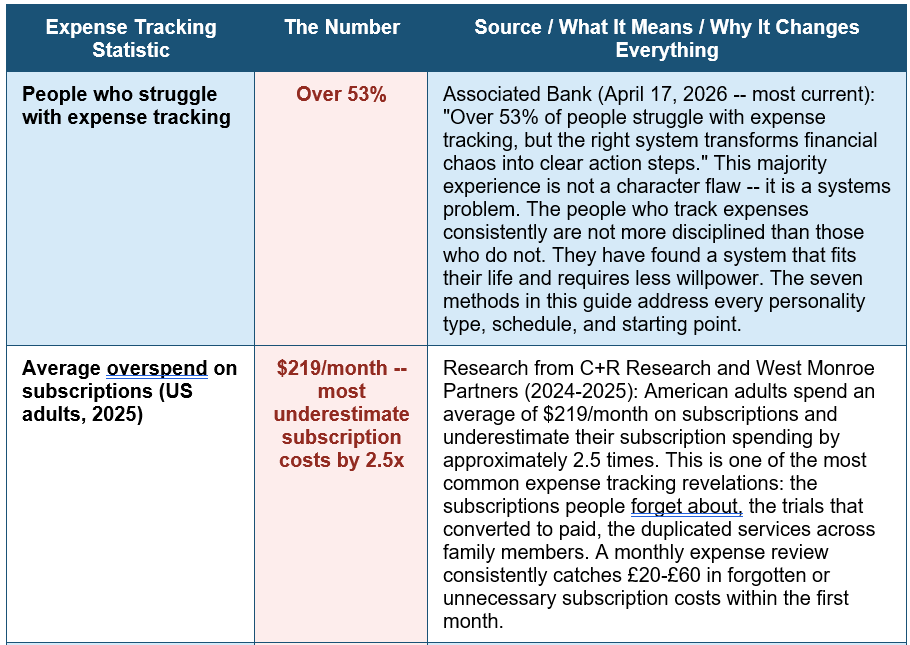
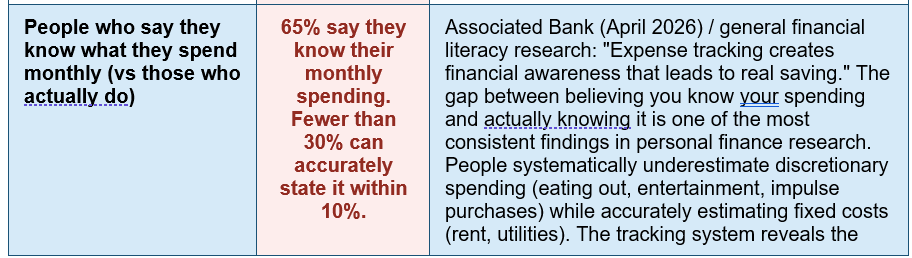
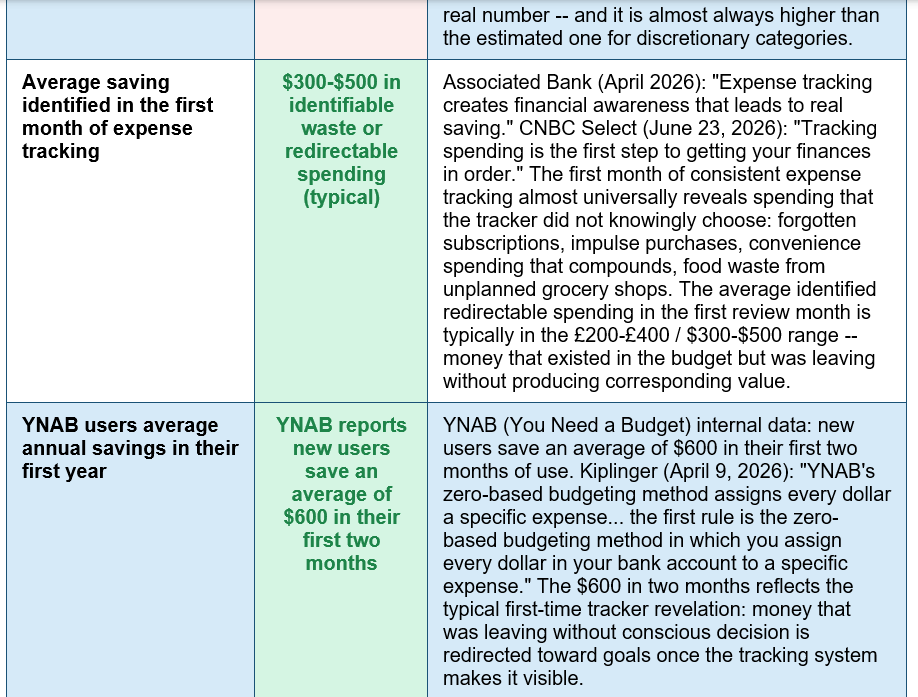
Expense tracking in 2026 -- the numbers: 53% struggle to track consistently. $219/month on forgotten subscriptions. $300-500 identifiable waste in month 1. YNAB users: $600 saved in first 2 months. — Associated Bank (April 17, 2026 -- most current): '53% of people struggle with expense tracking.' West Monroe/C+R Research (2024-25): 'Average US adult spends $219/month on subscriptions and underestimates by 2.5x.' Associated Bank: '$300-500 in identifiable waste typical in first tracking month.' YNAB internal data: 'New users save average $600 in first two months.' NerdWallet (June 30, 2026 -- most current reviews): 'Best budget apps: YNAB, PocketGuard, Monarch Money.' Forbes Advisor (2 days ago -- most current testing): 'Monarch top pick for ease of use.'
The 7 Methods at a Glance: Which One Matches Your Life?
The following table maps all seven expense tracking methods against effort level, cost, and the specific circumstances where each one works best: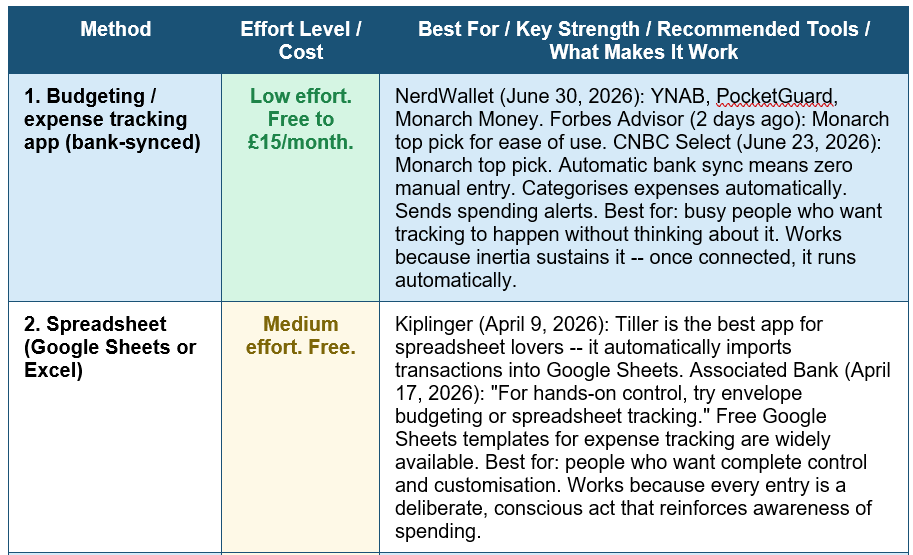
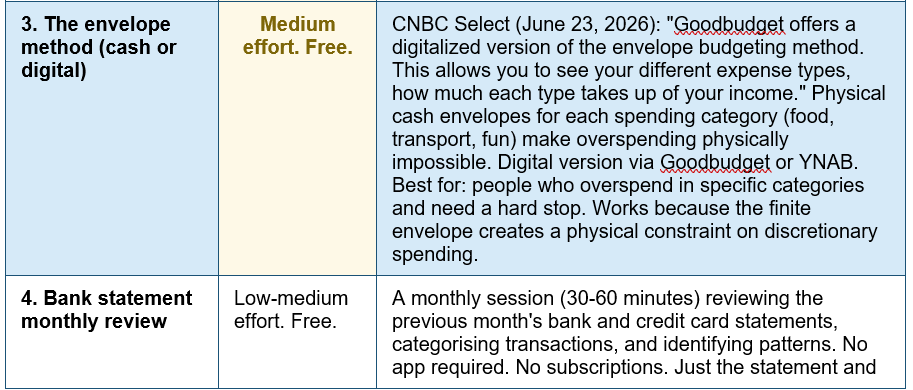
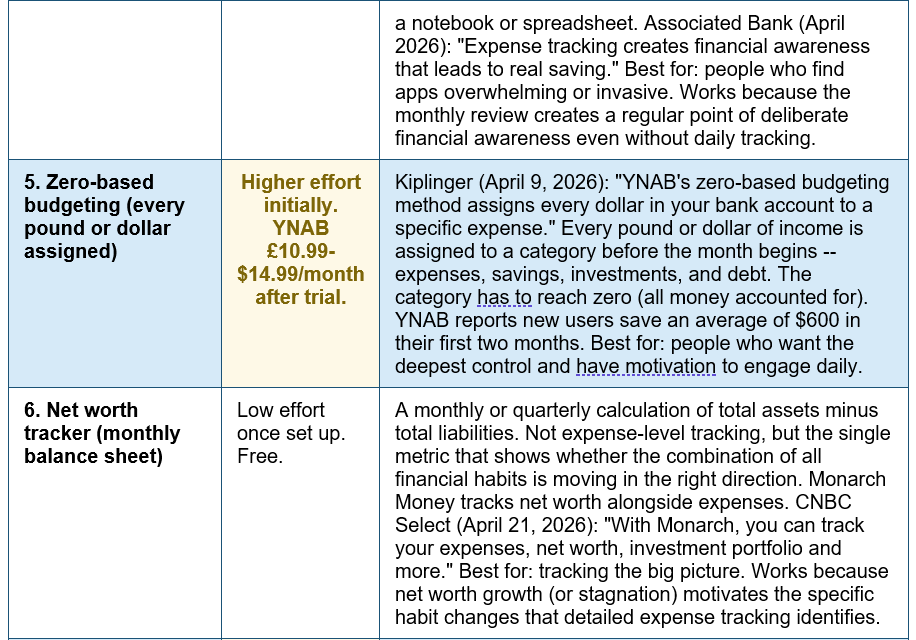
The 7 Ways I Track My Monthly Expenses: In Detail
WAY #1 A BUDGETING APP WITH AUTOMATIC BANK SYNC | The method that works without willpower -- because it runs without you
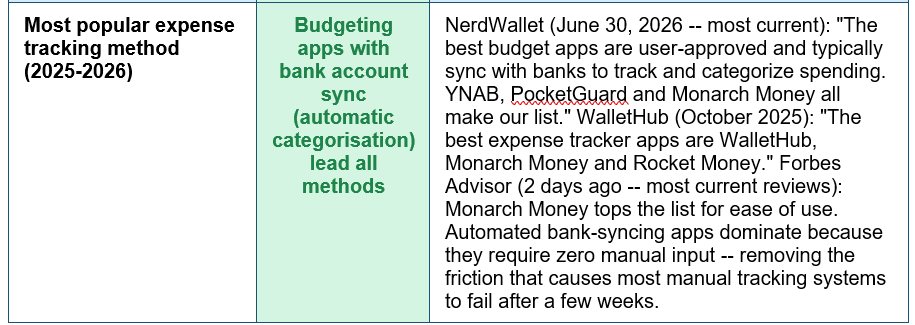
This is the method I recommend first to almost everyone, because it is the only one that is genuinely self-sustaining once set up. You connect your bank accounts and credit cards to the app, and from that point, every transaction is automatically imported, categorised, and logged. You do not have to remember to track. You do not have to manually enter anything. The system runs while you live your life. NerdWallet (June 30, 2026 -- most current): 'The best budget apps are user-approved and typically sync with banks to track and categorize spending. YNAB, PocketGuard and Monarch Money all make our list.' Forbes Advisor (2 days ago -- most current testing): Monarch Money tops the latest reviews for ease of use. CNBC Select (June 23, 2026): Monarch is the top pick for best expense tracker, noting it allows you to 'track your expenses, net worth, investment portfolio and more.' WalletHub (October 2025): 'WalletHub automatically categorizes your expenses in your budget and uses AI to clean up your transaction data. It provides information about your historical spending, clearly listing the total amount spent in each category for the past six months, along with a six-month average.' The best current apps for this method: Monarch Money (US, $14.99/month, best-in-class reviews across Forbes and CNBC); YNAB / You Need a Budget (US/UK, £10.99/month, strongest for zero-based budgeting alongside tracking); PocketGuard (US, free tier available, includes a 'Pace' feature that alerts if you are spending too quickly relative to how many days remain in the month); Emma (UK, strong Open Banking integration with UK current accounts and credit cards); Monzo/Starling built-in spending insights (UK, free, automatic categorisation within the banking app itself). What makes this work: zero friction. The tracking happens automatically. The app sends alerts. The reports are generated without effort. You look at the results rather than creating them.WAY #2 A SPREADSHEET (GOOGLE SHEETS OR EXCEL) | Maximum control. Zero cost. The satisfying click of a system you built yourself.
The spreadsheet is the expense tracking method with the longest history, the most flexibility, and the highest learning curve. It requires manual data entry -- either copying from bank statements or entering transactions as they happen -- but it produces a completely customised view of your finances that no app can precisely replicate. Associated Bank (April 17, 2026): 'For hands-on control, try envelope budgeting or spreadsheet tracking.' Kiplinger (April 9, 2026): 'Tiller may be the best app for you if you like using spreadsheets to balance your budget.' Tiller is the bridge between manual spreadsheets and automatic bank sync: it imports bank transactions automatically into a Google Sheets or Excel template, giving you the automation benefit while maintaining full spreadsheet control. The pure manual spreadsheet approach: download a free Google Sheets expense tracking template (search 'Google Sheets expense tracker template' -- dozens of quality options are freely available), or build your own with columns for date, description, category, amount, and payment method. At the end of each week, sit down with your bank statement and enter the week's transactions. At the end of the month, the spreadsheet totals each category and produces a clear picture of where the money went. What makes this work: the act of manually entering each transaction is itself a financial awareness exercise. You cannot enter '£8.50 -- coffee' eleven times in a month without noticing the pattern. The spreadsheet makes spending visible in a way that automatic categorisation sometimes obscures.WAY #3 THE ENVELOPE METHOD (CASH OR DIGITAL) | A hard stop on discretionary spending. Physically impossible to overspend.
The envelope method is the oldest budgeting system in personal finance, and one of the most effective for specific overspending problems. In its physical form: at the start of the month, you withdraw the amount budgeted for each variable spending category in cash and place it in a labelled envelope. Food: £400. Entertainment: £100. Clothing: £50. Transport top-up: £80. When the envelope is empty, the spending in that category stops for the month. There is no credit card to reach for. The money is gone. The physical constraint is absolute. CNBC Select (June 23, 2026): 'Goodbudget offers a digitalized version of the envelope budgeting method. This allows you to see your different expense types, how much each type takes up of your income.' Goodbudget (US/UK, free tier with 20 envelope categories) is the most widely recommended digital envelope app. YNAB also operates on envelope principles, though it adds more flexibility for moving money between categories when needed. What makes this work: the envelope method directly addresses the most common expense tracking failure -- knowing spending is over budget but continuing to spend anyway. The empty envelope is a hard stop that no amount of financial awareness can override. It works best for people who have identified specific categories (food delivery, clothing, going out) where they consistently overspend despite knowing the number.WAY #4 THE MONTHLY BANK STATEMENT REVIEW | One session per month. No app. No subscription. Pure financial awareness.
Not everyone wants an app connected to their bank account, and not everyone has the patience for daily manual entry. The monthly bank statement review is the minimum viable expense tracking system -- one deliberate session per month in which you review the previous month's transactions, categorise them, and note the patterns. This is how I started tracking expenses before moving to an app. The process: on the first weekend of each new month, download or print your bank and credit card statements for the previous month. Go through every transaction. Group them into broad categories: housing, food and drink, transport, entertainment, clothing, subscriptions, other. Total each category. Compare to the previous month and to your expectations. Note the biggest surprises. Associated Bank (April 17, 2026): 'Expense tracking creates financial awareness that leads to real saving.' The monthly review reliably produces at least two to three significant discoveries in any first session: a subscription that has been running unnoticed, a food spending total that is double the estimate, a category where the total is higher than anticipated. CNBC Select (April 21, 2026): 'List your monthly expenses. It can be helpful to start with necessary expenses first, like rent and car payments, then move to wants, savings and nice-to-haves.' This is exactly the monthly review process formalised. What makes this work: it requires nothing but time and honesty. No app, no subscription, no data sharing. One session per month creates twelve financial reviews per year -- and twelve deliberate moments of financial awareness that most people who never track do not have.WAY #5 ZERO-BASED BUDGETING (EVERY POUND OR DOLLAR HAS A JOB) | The most thorough system. Every penny accounted for before the month begins.
Zero-based budgeting is the most rigorous expense management framework available to an individual. The principle: at the start of each month, you assign every pound or dollar of expected income to a specific category -- rent, food, transport, savings, investment, debt payment, entertainment -- until the total reaches zero. Income minus all allocations equals zero. Every pound or dollar has a specific purpose before you spend it. Kiplinger (April 9, 2026): 'YNAB's first rule is the zero-based budgeting method in which you assign every dollar in your bank account to a specific expense. If an emergency arises, the app accommodates budget changes for surprise expenses. YNAB's fourth rule is to age your money -- once you get used to budgeting and spending less, you can pay for your current monthly bills with money you saved from the previous month rather than from your most recent paycheck.' YNAB is the market's most established zero-based budgeting app. It also offers live money-management workshops online. The system's strength is precision: because every pound is pre-allocated, overspending in one category requires consciously taking money from another. This forces a genuine trade-off decision rather than passive overspending. What makes this work: YNAB internal data shows new users save an average of $600 in their first two months. The deliberateness of assigning every dollar before spending it fundamentally changes the relationship with money -- from reactive (spend, then see what is left) to proactive (decide, then spend within the decision).WAY #6 THE NET WORTH TRACKER (MONTHLY BALANCE SHEET) | Zoom out. Track the number that actually matters -- not just the month's spending.
This is not expense tracking in the traditional sense -- it is the meta-metric that tells you whether all your financial habits combined are moving you in the right direction. Net worth: total assets (savings, investments, property value, pension pot) minus total liabilities (mortgage, student loans, car finance, credit card balances, any other debt). A monthly or quarterly net worth calculation is the single number that captures whether budgeting, frugal living, investing, and earning are collectively producing financial progress. CNBC Select (April 21, 2026): 'With Monarch, you can track your expenses, net worth, investment portfolio and more. Collaborate with your partner and save reports to stay on track and achieve your financial goals.' Forbes Advisor (2 days ago): Monarch tracks real-time investment portfolios alongside spending and net worth. Building a simple monthly net worth tracker takes fifteen minutes: create a spreadsheet with two columns (assets and liabilities), update the figures on the first of each month, and calculate the balance. The trend over 12-24 months is the most motivating financial data available. When you can see net worth increasing by £300, £500, or £1,000 per month, the daily expense tracking habits that produce that increase feel purposeful and rewarding. What makes this work: it connects daily spending decisions to long-term financial outcome. The person who sees their net worth declining despite a decent income has irrefutable evidence that the spending patterns need addressing. The person who sees it rising has motivation to sustain the habits.WAY #7 THE DAILY PEN AND PAPER LOG | Mindfulness meets money. The act of writing changes the act of spending.
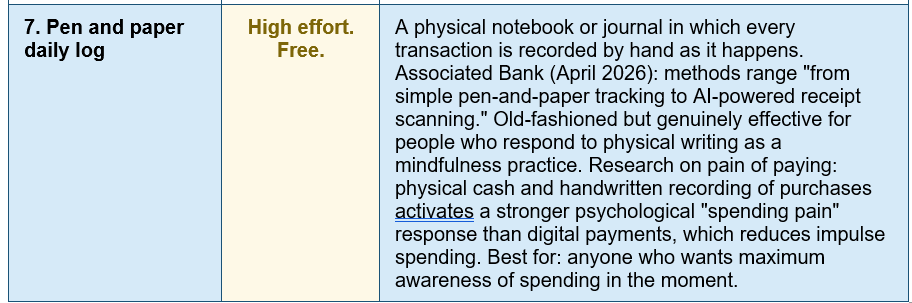
The pen-and-paper daily log is the most effortful method in this guide -- and for a specific type of person, it is the most effective. The practice: carry a small notebook (or use the notes app on your phone, but physical is better for this purpose) and record every transaction the moment it happens. Date. Description. Amount. Nothing else required. Review the day's entries each evening. Total the week on Sunday. Associated Bank (April 17, 2026): expense tracking methods range 'from simple pen-and-paper tracking to AI-powered receipt scanning.' The research basis for this method: the pain of paying. Studies in behavioural economics show that physical payment methods (cash, handwritten recording) activate a stronger neurological 'spending pain' response than digital payments. When you have to physically write '£4.50 -- coffee' in a notebook, the transaction feels more real than an invisible tap on a contactless card reader. This is the method that works for people who have tried apps and found them too easy to ignore. The notification arrives, is swiped away, and is forgotten. The notebook sits on the desk every evening, waiting to be filled in. The physical presence of the recording system creates accountability that digital notifications do not. What makes this work: the act of writing is itself the awareness intervention. You cannot write the number without registering the number. And registering the number is what changes the next decision. This is the method for people who want to change their relationship with spending, not just track it.Why I use a combination of methods -- and why you probably should too. After testing all seven methods over several years, the combination that works best for me is: a bank-syncing app (Method 1) running automatically in the background to catch everything; a monthly net worth tracker (Method 6) reviewed on the first of each month to see the trend; and a periodic manual bank statement review (Method 4) whenever a month feels financially unclear. Associated Bank (April 2026): 'Select one method from the five options based on your lifestyle and preferences. You can always change later.' That 'you can always change later' is important. The right method is not fixed. It evolves with your circumstances, your financial goals, and your life stage. A 22-year-old with a single bank account and one credit card might thrive with nothing more than a monthly statement review. A 38-year-old with a mortgage, investment accounts, a pension, and three credit cards needs the automated app and the net worth tracker. Start with the simplest method that creates genuine visibility. Add layers when your financial picture becomes more complex. The goal is always the same: to know where the money goes, in enough detail to make different decisions when you need to.
FIVE EXPENSE TRACKING MISTAKES THAT MAKE THE SYSTEM FAIL: (1) CHOOSING THE MOST SOPHISTICATED METHOD FIRST. CNBC Select (April 21, 2026): 'You don't always need a complex spreadsheet to create a solid budget. In fact, the simpler you can make the process for yourself, the better.' Starting with a zero-based budgeting app when you have never tracked expenses before is like starting a running programme with a marathon. The complexity causes abandonment within weeks. Start with Method 4 (monthly statement review) or Method 1 (auto-sync app). Add complexity only after the basic habit is established. (2) TRACKING INCOME BUT NOT ALL EXPENSES. Most people track their salary accurately but undercount expenses in cash, small purchases, and digital micro-transactions (apps, games, in-app purchases). These small amounts accumulate significantly: £2.50 coffees five times a week is £650/year. £1.99 in-app purchases weekly are £103/year. Track everything, including the small amounts. (3) SETTING UP A SYSTEM BUT NOT REVIEWING IT. WalletHub (October 2025): WalletHub provides six-month historical spending averages. A bank-syncing app that runs automatically is only useful if you look at the reports. Schedule a standing 20-minute monthly financial review to interpret what the system has collected. Tracking without reviewing is like weighing yourself every morning and never looking at the scale. (4) HAVING SEPARATE TRACKING FOR CASH AND CARDS. Cash spending is the most common tracking gap -- it leaves no digital trail. If you spend significant amounts in cash, you need either a physical receipt pocket (collect all receipts and enter weekly) or a near-zero-cash policy (use cards for all spending so the bank statement is the complete record). Most bank-syncing apps only capture electronic transactions. (5) GIVING UP AFTER ONE BAD MONTH. Expense tracking is most valuable when it shows you a difficult truth. A month that reveals £500 more discretionary spending than you thought you were making is not a failure -- it is the exact information the system exists to surface. That revelation is the value. The discomfort of the number is the motivation to change it.
YOUR EXPENSE TRACKING STARTER PLAN -- THIS WEEK: CHOOSE YOUR METHOD (pick ONE to start): EASIEST START (10 minutes): Download Monarch Money (US) or Emma (UK) and connect your main bank account and one credit card. Review the automatic categories at the end of the week. HANDS-ON START (30 minutes): Open Google Sheets, search for a free expense tracker template, and manually enter last month's transactions from your bank statement. LOWEST FRICTION (free, no app): Print or download last month's bank statement. Get a highlighter. Go through every line. Group transactions into five categories: Housing, Food, Transport, Entertainment, Everything Else. Total each category. The totals are your baseline. WHICH METHOD SUITS YOU? Auto-tracking with minimal effort: Monarch Money / Emma / PocketGuard. Zero-based budgeting depth: YNAB. Spreadsheet control: Google Sheets + Tiller. Digital envelope system: Goodbudget. Net worth big picture: Monarch Money / simple spreadsheet. Physical writing for maximum awareness: pen-and-paper daily log. AFTER YOUR FIRST MONTH: Identify the single biggest expense category surprise. Find one specific item to reduce by 20-30% in month two. Set up a standing monthly reminder (first Sunday of each month) to review spending. Gradually build the habit from one month to the next. FREE GUIDANCE: UK: MoneyHelper 0800 138 7777 | MoneySavingExpert.com. US: CFPB consumerfinance.gov.
Conclusion: The Method Matters Less Than Doing It
More than half of people struggle to track expenses consistently. The research is clear on why: not because they lack the motivation, but because they have not found a system that fits their life. Associated Bank (April 17, 2026): 'Over 53% of people struggle with expense tracking, but the right system transforms financial chaos into clear action steps.'The seven methods in this guide span the full range from fully automated (the bank-syncing app that runs without any input) to entirely manual (the handwritten daily log that captures every transaction in real time). Between them, they cover every personality type, schedule, comfort with technology, and financial complexity level. None of them is objectively the best. The best is the one you will actually use for more than two weeks.
CNBC Select (June 23, 2026): 'Tracking spending is the first step to getting your finances in order.' Forbes Advisor (2 days ago -- most current): Monarch Money tops the latest testing for ease of use. YNAB users save an average of $600 in their first two months. The savings are real. The awareness they produce is real. And the financial decisions that awareness enables -- the subscriptions cancelled, the spending reduced, the surplus redirected to savings and investment -- are the compounding result of a habit that started with one monthly statement review, one connected app, or one notebook entry. Start there. The system builds from the first decision to look.
Frequently Asked Questions (FAQ)
What is the best app for tracking monthly expenses in 2026?The best expense tracking app in 2026 depends on what you want from it, but three stand out from the current evidence. Forbes Advisor (2 days ago -- most current testing and ranking): Monarch Money is the top-rated budgeting and expense tracking app for ease of use, offering automatic bank sync, net worth tracking, investment portfolio monitoring, and partner collaboration features. CNBC Select (June 23, 2026): Monarch Money is also the top pick for expense tracking, with particular strength in its multi-account view and spending categorisation. NerdWallet (June 30, 2026): their list of top budget apps includes YNAB for zero-based budgeting, PocketGuard for its real-time 'how much is left to spend' view and Pace feature (which alerts users when they are spending their monthly budget too quickly), and Monarch for overall capability. WalletHub (October 2025): WalletHub's own app tops their review for AI-powered transaction categorisation and six-month spending history. For UK users specifically: Emma (emma-app.com) is widely recommended for its Open Banking integration with UK banks and credit cards, automatic categorisation, and subscription tracker. Monzo and Starling Bank both offer built-in spending categorisation and insights within their banking apps at no extra cost -- the simplest starting point for UK users who bank with either provider. The most important choice is the one you will actually use. If Monarch's $14.99/month feels expensive, start with a free option (PocketGuard free tier, Emma free tier, or your bank's own spending insights). Upgrade when the habit is established and the financial visibility is producing clear results.
How do I start tracking expenses if I've never done it before?
Start with the simplest possible method and build from there. Associated Bank (April 17, 2026): 'Select one method based on your lifestyle and preferences. You can always change later.' The simplest starting point for an absolute beginner: the monthly bank statement review (Method 4). This requires nothing except time, your bank statement, and a notebook. Print or download last month's bank and credit card statements. Go through every line. Group transactions into five to seven broad categories: Housing, Food and Drink, Transport, Entertainment, Subscriptions, Shopping, Other. Total each category. Write the totals down. That is your first month's expense tracking -- completed in one 30-60 minute session, with no app, no subscription, and no data shared with any third party. The totals you calculate in that first session are almost certainly going to contain at least one significant surprise: a spending category that is materially higher than you expected. That surprise is the value the tracking creates. CNBC Select (April 21, 2026): 'Tracking spending is the first step to getting your finances in order. An expense tracker app can make it a lot easier to account for every dollar as you spend it, rather than sitting down with a fistful of receipts.' Once you have done one manual review and experienced the clarity it produces, consider graduating to a bank-syncing app (Monarch, YNAB, Emma, PocketGuard) that automates the data collection and categorisation for all future months.
Is YNAB worth the subscription fee?
YNAB (You Need a Budget) is worth the subscription fee for the specific type of saver it is designed for -- and is probably not worth it for people who want passive, low-effort tracking. YNAB costs approximately £10.99/month (UK) or $14.99/month (US) after a 34-day free trial (college students get 12 months free). Kiplinger (April 9, 2026): 'YNAB is a strong choice if you want a detailed and hands-on budgeting app to monitor expenses.' The zero-based budgeting system YNAB employs assigns every dollar or pound a specific purpose before you spend it -- requiring daily or weekly engagement with the app. YNAB also offers live online money-management workshops. The evidence that YNAB works: YNAB's own data shows new users save an average of $600 in their first two months. At $14.99/month, the subscription pays for itself if you save even $30 per month as a direct result of using it. The honest caveat: YNAB requires more engagement than passive bank-syncing apps like Monarch. If you are not willing to assign categories, respond to alerts, and check the app multiple times per week, the fee is not worth it. For someone who wants the deepest possible control over their budget and is motivated to engage with their finances daily, YNAB is the most powerful system available. For someone who wants minimal friction and automatic operation, Monarch Money at the same price point produces better results with less effort.
How do I track cash expenses that don't appear on bank statements?
Cash expenses are the most common gap in expense tracking systems, because they leave no digital trail. Any transaction paid in cash -- a market stall purchase, a tip, a cash-in-hand payment -- will not appear on a bank statement or be captured by a bank-syncing app. There are three approaches to filling this gap. First, move to near-zero cash: use a debit or credit card for virtually all purchases. This creates a complete digital record in your bank statement and removes the cash-tracking problem entirely. The majority of expense tracking experts recommend this approach as the simplest solution. CNBC Select (April 2026): 'Distinguishing between fixed and variable expenses' is easier when everything is on a card record. Second, if you regularly use cash, collect every receipt and enter them manually into your tracking system at the end of each day or week. Physical receipt collection (a small envelope or sleeve in your wallet) takes 30 seconds per transaction. Weekly entry takes five to ten minutes. Third, use the daily pen-and-paper log (Method 7): record every transaction -- cash and card -- at the moment it happens. This is the highest-effort method but produces the most complete record. Most bank-syncing apps allow you to manually add transactions to supplement the automatic bank feed. Adding a 'cash' payment method in Monarch, YNAB, or PocketGuard allows cash transactions to be logged alongside automatic card records in the same view.
How often should I review my tracked expenses?
Monthly is the minimum frequency that produces meaningful financial change. Weekly is optimal for most people. Daily is best for those using the pen-and-paper log or YNAB's zero-based system. The review frequency should match the method: PocketGuard's 'Pace' feature (NerdWallet, June 30, 2026): alerts users 'if they're spending their budget too quickly based on how much money remains and how many days are left in the month' -- this is designed for frequent checking. Bank statement review (Method 4): monthly is sufficient and is the entire point of the method. Spreadsheet tracking (Method 2): weekly entry with monthly totalling works well. Bank-syncing apps (Method 1): the app runs continuously, but reviewing the categorised spending weekly means you can adjust behaviour mid-month rather than only discovering overspending when it is too late. The monthly review is non-negotiable regardless of method. CNBC Select (April 21, 2026): 'Figure out your monthly net income. List your monthly expenses.' This monthly cadence creates 12 financial awareness moments per year -- more than most people who do not track have in five years. The practical setup: schedule a standing calendar reminder on the first Sunday of each month. Label it 'Monthly money review.' Set it to repeat. Fifteen to thirty minutes per month reviewing tracked expenses is the single highest-value financial habit per hour of time invested.

0 Comments Comments