

Financial Literacy
The One Financial Decision That Haunts You for 20 Years

Table of Contents
- The Decision Made at 18 That Follows You to 42
- The Decision: What It Is, Why It Haunts, and Who It Affects
- The Debt Haunting: Statistics That Show the Full Picture
- The 20-Year Impact Map: How the Decision Shows Up at Every Stage of Life
- The Five Sub-Decisions Nobody Explains Before You Sign
- How to Think About the Decision -- Whether You Are Making It, Advising on It, or Managing Its Consequences
- If You Are Making the Decision Now (or Helping Someone Who Is)
- If You Are Already Living With the Consequences
- Conclusion: The Decision Is Not Irreversible -- But Information Is the Only Antidote
- Frequently Asked Questions (FAQ)
The Decision Made at 18 That Follows You to 42
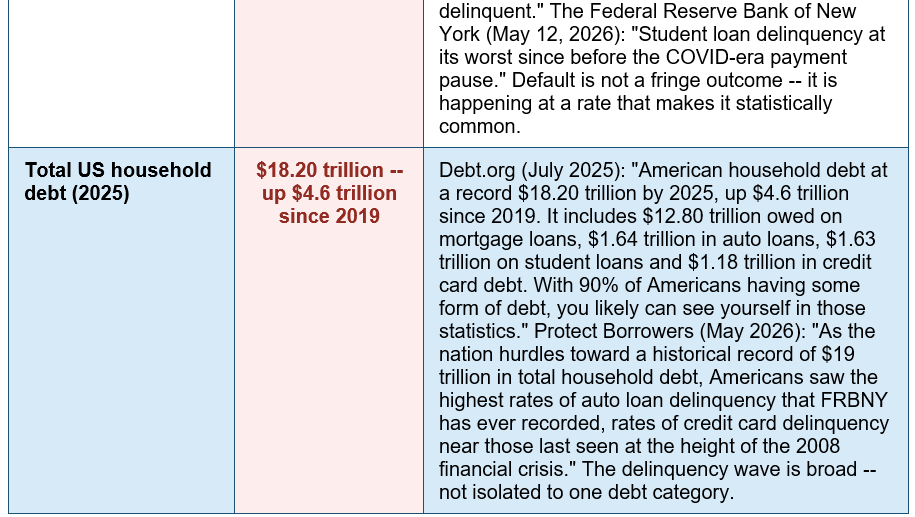
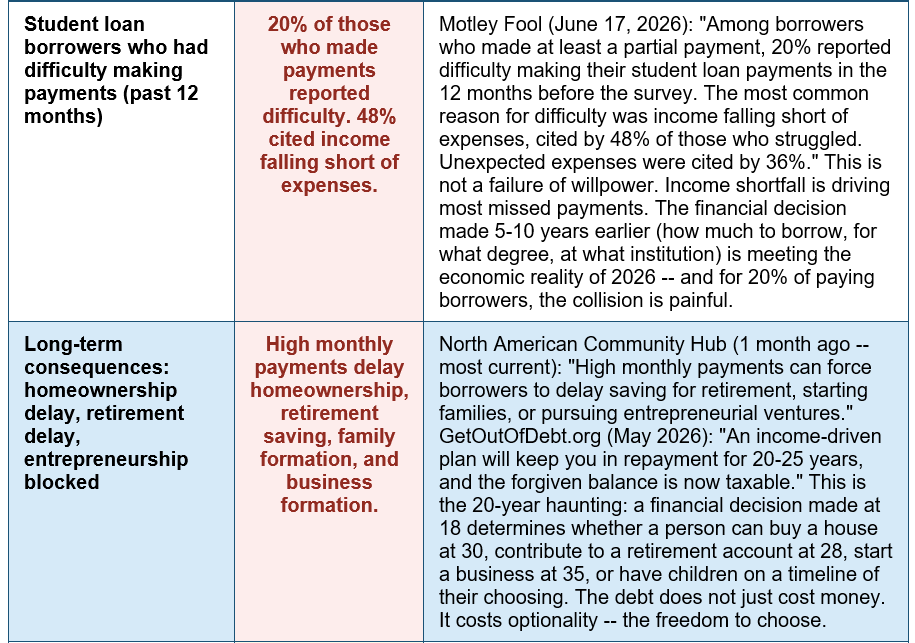
At 18, most people are not equipped to make one of the most consequential financial decisions of their lives. They do not have a credit history. They have never signed a loan document. They have little or no experience with compound interest. They are making their choice under significant social pressure -- the assumption that college is the path, that debt is normal, that it all works out in the end. And then, for 42.8 million Americans, it does not quite work out the way the brochure suggested.US student loan debt reached $1.9 trillion in Q1 2026, according to the Federal Reserve and Motley Fool's most current research (June 17, 2026). The average federal student loan borrower carries $39,547 in debt. One borrower defaulted every nine seconds in 2025, according to Protect Borrowers and the Century Foundation -- 3,500 people per day, 1.27 million per year entering the financial state that enables wage garnishment, tax seizure, and credit score destruction. The Federal Reserve Bank of New York reported in May 2026 that student loan delinquency had reached its worst level since before the COVID-era payment pause. And 20% of borrowers who made at least partial payments reported difficulty in the previous 12 months, with the most common reason being income falling short of expenses.
This is the decision that haunts. Not because college is wrong. Not because every borrower made a mistake. But because the decision to borrow -- how much, for what, at which institution, with what plan for repayment -- was made without the information needed to make it well. The consequences of making it badly are not limited to inconvenience. They delay homeownership, suppress retirement savings, block career changes, compress family timing, and for millions of people, define the financial shape of their entire thirties and forties. This guide is not an argument against college. It is a complete picture of the financial decision most people were asked to make at 18, the data on what it has cost, and the specific framework for making a better version of that decision -- whether you are making it now, helping someone who is, or managing the consequences of one already made.
The Decision: What It Is, Why It Haunts, and Who It Affects
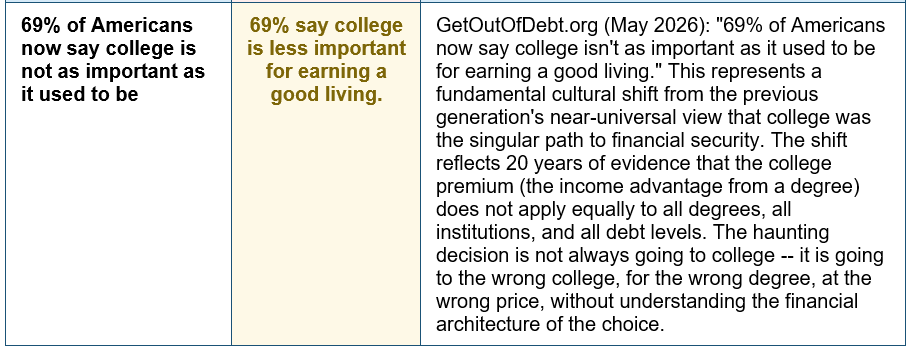
The haunting financial decision is not simply 'going to college.' It is the specific combination of: how much debt is taken on; for which credential and which institution; with what projected return on that investment in terms of career and income; and with what understanding of the repayment mechanics that will govern the next one to three decades of financial life. GetOutOfDebt.org (May 2026): '47% of Class of 2024 bachelor's degree recipients from four-year public and private nonprofit colleges graduated with student loan debt, with an average balance of $29,560 in federal and private student loan debt -- a number that sounds manageable but compounds quickly at typical federal interest rates. For the Class of 2026, NerdWallet projects that number will climb to $43,500.'The haunting is structural, not moral. North American Community Hub (most current, 1 month ago): 'High monthly payments can force borrowers to delay saving for retirement, starting families, or pursuing entrepreneurial ventures.' The delay is compounding in nature: retirement savings not made at 25 do not simply resume at 35 -- the 10 years of compounding growth on those savings is permanently lost. A home not purchased at 30 because of debt-to-income ratio constraints means 10 years of equity building that cannot be retroactively captured. A career change not made at 32 because student loan payments require a stable salary constrains professional development in ways that affect lifetime earnings. The debt does not just cost money. It costs optionality -- the ability to choose.
And the decision is particularly haunting because of who makes it and when. GetOutOfDebt.org (May 2026): '69% of Americans now say college isn't as important as it used to be for earning a good living.' This represents a fundamental cultural shift from the previous generation's near-universal belief. But the cultural shift came after most current borrowers made their decisions. They borrowed during the years when the cultural consensus was that college was non-negotiable and debt was temporary. The consequences of that consensus are now $1.9 trillion and counting.
The student loan haunting in 2026: $1.9T total debt. 42.8M borrowers. $39,547 average balance. One default every 9 seconds in 2025. 20% of paying borrowers struggled. 69% say college is less important now. — Motley Fool (June 17, 2026 -- most current): 'Student loan debt approached $1.9 trillion in Q1 2026.' GetOutOfDebt.org (May 2026): '$1.84 trillion, 42.8 million borrowers, average $39,547.' Protect Borrowers (Jan 2026): 'A student loan borrower defaulted every nine seconds in 2025.' Motley Fool: '20% of paying borrowers reported difficulty. Income shortfall cited by 48% of those who struggled.' GetOutOfDebt.org: '69% of Americans now say college isn't as important for earning a good living.'
The Debt Haunting: Statistics That Show the Full Picture
The following table maps the most current data on student loan debt and its systemic consequences -- the numbers behind the haunting: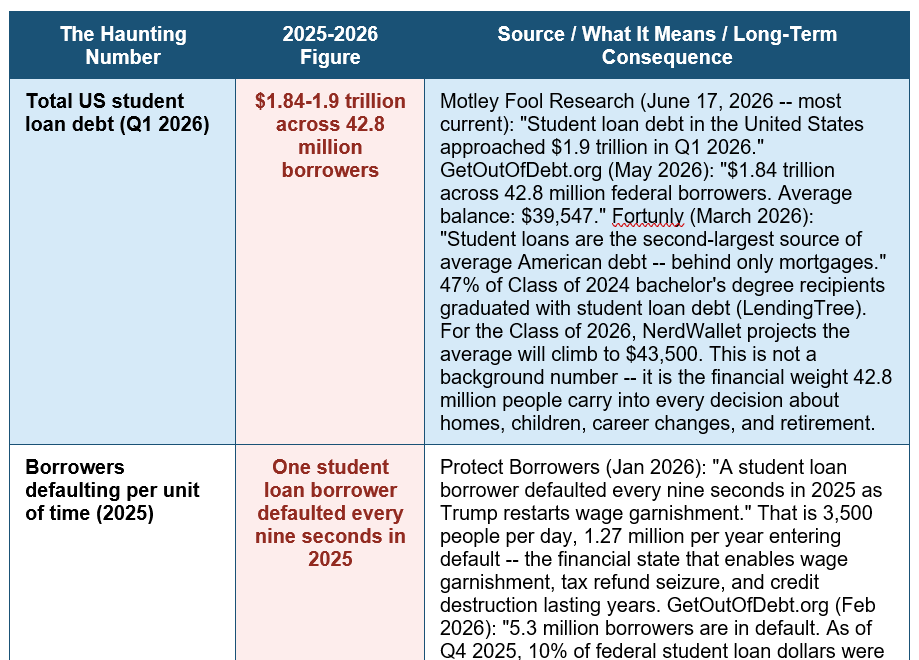
The 20-Year Impact Map: How the Decision Shows Up at Every Stage of Life
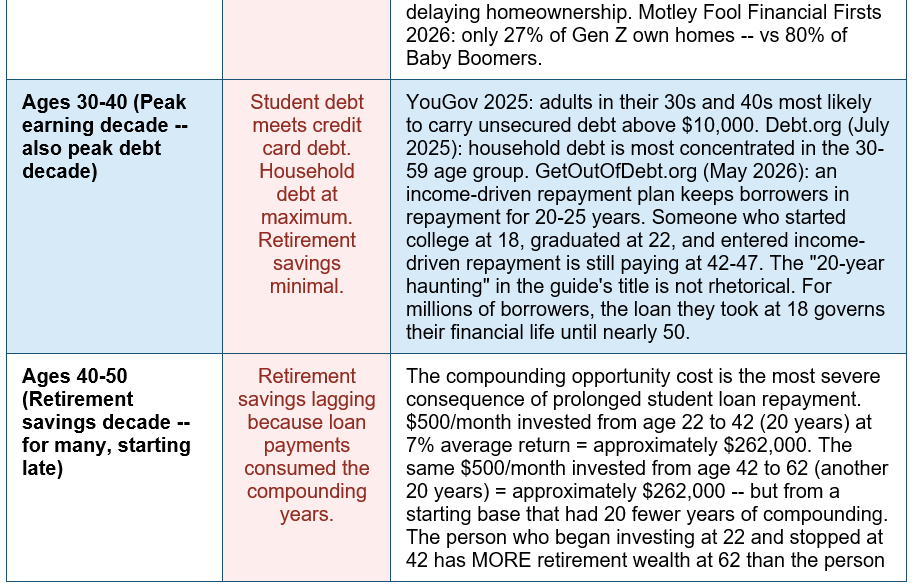
The following table traces how a typical student loan decision made at 18 manifests across the next two decades of financial life: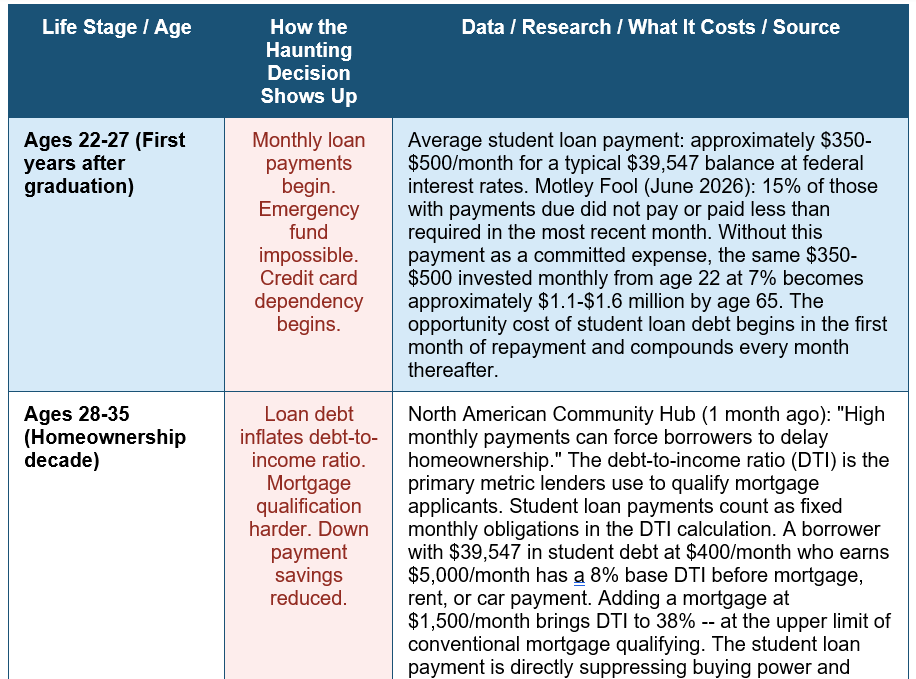

The Five Sub-Decisions Nobody Explains Before You Sign
The haunting financial decision is not one choice -- it is five interconnected choices most people make without understanding any of them:DECISION #1: HOW MUCH TO BORROW RELATIVE TO YOUR EXPECTED STARTING SALARY | The rule nobody teaches before the loan documents are signed
The most widely cited rule for student debt affordability -- rarely explained before signing -- is that total student loan debt should not exceed your expected first-year salary after graduation. If a nursing degree produces $55,000 starting salary and you borrow $55,000, you are at the threshold. If an arts degree produces $35,000 starting salary and you borrow $80,000, you are at more than double the threshold. North American Community Hub (1 month ago): 'High monthly payments can force borrowers to delay saving for retirement, starting families, or pursuing entrepreneurial ventures.' The specific calculation: total loan balance divided by expected starting salary should be 1.0 or below. Above 1.5, payments become genuinely burdensome relative to income. Above 2.0, income-driven repayment is likely the only viable option -- keeping you in repayment for 20-25 years. GetOutOfDebt.org (May 2026): 'An income-driven plan will keep you in repayment for 20-25 years, and the forgiven balance is now taxable.' The forgiven balance being taxable is a critical 2026 development: borrowers who complete an income-driven plan and have balances forgiven at the end now face an income tax bill on the forgiven amount -- potentially tens of thousands of dollars in a single year. This is a consequence most people making loan decisions today are not aware of.DECISION #2: WHICH INSTITUTION -- AND THE RETURN ON INVESTMENT CALCULATION | The $100,000 difference between two degrees with the same name
Not all degrees are equal in their financial return -- and not all institutions offering the same degree produce the same employment outcomes. GetOutOfDebt.org (May 2026): 'Students at for-profit colleges have lower earnings and higher debt. It's more likely that they will have a harder time paying back the loans.' The return on investment calculation for a college degree involves three variables: the total cost of the credential (tuition + living costs - grants/scholarships), the expected income premium from that credential (starting salary minus what the person would have earned without the degree), and the time required to break even on the investment. A $150,000 private university degree producing the same $45,000 starting salary as a $40,000 community college + state university pathway is not three times better -- it is three times more expensive. The break-even analysis: at a $5,000 annual salary premium (the income advantage of the private degree over the alternative path), the extra $110,000 in cost takes 22 years to break even. Most people making these decisions at 18 are not running these numbers. They are responding to brand recognition, campus visits, and social expectation.DECISION #3: FEDERAL VS PRIVATE LOANS -- THE DIFFERENCE THAT DEFINES YOUR OPTIONS | The loan type you choose at 18 determines your options in hardship at 35
US News (April 17, 2026): 'Federal loans have long offered several fixed and income-driven repayment plans. Those options will change significantly on July 1, 2026, and borrowers need to understand the ramifications.' GetOutOfDebt.org (May 2026): 'Federal loans ($1.693 trillion of the $1.84 trillion total) offer income-driven repayment, forgiveness programs, and hardship protections. Private loans are harder to manage in financial hardship. Private loan interest rates can be variable and significantly higher.' The critical difference: federal loans offer deferment, forbearance, income-driven repayment, and access to forgiveness programmes when hardship occurs. Private loans typically offer none of these protections. A person who loses their job at 32 and has $50,000 in federal loans can apply for income-driven repayment and make $0 payments while unemployed. The same person with $50,000 in private loans has far fewer options. The choice between federal and private loans -- often made as an afterthought after exhausting federal limits -- can determine whether a hardship in your thirties is a temporary adjustment or a financial catastrophe.DECISION #4: THE OPPORTUNITY COST OF NOT INVESTING DURING REPAYMENT YEARS | The $500/month going to a loan payment that could have been compounding for 20 years
This is the haunting that is most invisible until it is too late to reverse. The money paid toward student loans during the prime compounding years of a financial life is money that does not compound. Motley Fool (June 17, 2026): '20% of those who had difficulty [with payments] had their loans assigned to a debt collector in the past year.' But even the 80% who are managing payments are paying an opportunity cost measured in compound growth. The specific mathematics: $500/month paid toward student loans from age 22 to 42 (20 years) represents $120,000 in principal payments. If that same $500/month had been invested in a global index fund at 7% average annual return from age 22 to 42, it would have grown to approximately $262,000 -- $142,000 more than the payments themselves, created purely by compound growth. This opportunity cost compounds further after the repayment period: the person who began investing at 22 starts the second 20-year compounding period (42-62) from a base that includes 20 years of compounding gains. The person who only began investing at 42 starts from zero. The same monthly contribution for the same 20 years produces a dramatically different outcome depending on which 20 years the compounding begins.DECISION #5: THE REPAYMENT PLAN CHOICE -- AND HOW 2026 POLICY CHANGES AFFECT IT | The July 2026 changes that every borrower needs to understand now
US News (April 17, 2026): 'Changes to federal law will impact which repayment plans are available to borrowers after July 1, 2026. Each borrower needs to consider their unique circumstances when determining how best to repay student loans.' GetOutOfDebt.org (May 2026): 'The One Big Beautiful Bill phases out SAVE, PAYE, IBR, and ICR plans.' This 2026 policy development is significant for any borrower currently enrolled in or planning to use income-driven repayment. The SAVE plan (the most generous income-driven plan, which reduced minimum payments and accelerated forgiveness timelines) has been in litigation and faces elimination. PAYE and ICR are also being phased out. The practical impact for current and future borrowers: the repayment plan landscape in 2026 is materially different from what it was in 2024. US News: 'I could caution that this is the time to be careful about consolidation,' says Glenn Sanger-Hodgson, financial planner. 'There is an urgency for those with Parent PLUS loans to consolidate before the July 1 deadline.' The haunting extends to repayment decisions: the choice of repayment plan, made without full understanding of its 20-25 year implications, is itself a sub-decision within the larger haunting.The other haunting decisions: when student loans are not the only answer. The student loan decision is the most statistically prevalent haunting financial decision for younger Americans -- but it is not the only one. Three others compete for the title of 'the decision that follows you for 20 years.' First: buying too much house at the wrong time. A mortgage signed at the peak of an interest rate cycle on a home at the top of the buyer's budget creates 25-30 years of financial constraint -- reduced capacity to save, invest, change career, or absorb income shocks. Second: carrying consumer credit card debt from one decade to the next. YouGov 2025: adults in their 30s and 40s were the cohort most likely to carry unsecured debt above $10,000. Debt carried at 22% APR from age 25 to 35 costs the compounding equivalent of a significant investment portfolio. Third: choosing the wrong career for purely financial reasons -- or the wrong career for purely passion reasons without regard to economics. Career choices, like education decisions, are made without full financial information and carry 20-40 year consequences for both income trajectory and job satisfaction. The student loan decision is highlighted in this guide not to diminish these others but because it is the one most often made by 17-18-year-olds with the least financial information and the highest long-term stakes.
How to Think About the Decision -- Whether You Are Making It, Advising on It, or Managing Its Consequences
If You Are Making the Decision Now (or Helping Someone Who Is)
- Apply the 1x salary rule: Total student debt should not exceed projected first-year income in your target field. Research median starting salaries for specific roles in your target field using Bureau of Labor Statistics data (bls.gov) or LinkedIn Salary. If the debt-to-income ratio exceeds 1.5x, seriously evaluate lower-cost pathways.
- Compare the full ROI: What does this institution cost over four years (total including living costs, minus all grants and scholarships)? What is the median starting salary for graduates of this institution in this specific programme? How many years to break even on the cost premium vs the lower-cost alternative? Community college + state university transfer is a legitimate, financially superior path for many students.
- Maximise federal loans before any private borrowing: Federal loans offer income-driven repayment, deferment, forbearance, and forgiveness pathways. Private loans offer almost none of these protections. Exhaust federal Subsidised and Unsubsidised loan limits before considering private loans. The interest rates, flexibility, and downside protection of federal loans are materially better in almost every scenario.
- Understand the July 2026 repayment changes: US News (April 17, 2026): repayment plans are changing significantly from July 1, 2026. The SAVE, PAYE, and ICR plans are being phased out. Verify current plan availability at studentaid.gov before making any consolidation decisions. GetOutOfDebt.org: "The new IDR plan in July 2026 may help -- but you need to be out of default to use it."
- Quantify the opportunity cost: Before signing, calculate what the projected monthly payment ($350-$500/month on a typical $39,547 balance) would become if invested for 20 years at 7% average return. This is not to discourage the loan -- it is to ensure the decision is made with full information about its financial weight.
If You Are Already Living With the Consequences
- Know your repayment options: Federal borrowers have income-driven repayment options that cap payments at a percentage of discretionary income. GetOutOfDebt.org (May 2026): "Rehabilitation and consolidation are available right now." If you are behind or at risk of default, act before wage garnishment begins -- rehabilitation is available.
- Do not sacrifice retirement for loan payoff: GetOutOfDebt.org: "Your retirement is protected -- don't sacrifice it." The compounding advantage of early retirement investing means that maintaining retirement contributions while making minimum income-driven loan payments is mathematically superior to accelerating loan payoff at the cost of retirement contributions in most scenarios.
- Accelerate payoff on high-interest private loans first: Private loan interest is not tax-deductible, carries higher rates, and has fewer hardship protections. If you have both federal and private loans, direct any surplus at private loans while making minimum payments on federal loans (which have income protection options if circumstances change).
- Pursue Public Service Loan Forgiveness if eligible: Government and qualified non-profit employment qualifies for PSLF, which forgives federal loan balances after 10 years of qualifying payments. This is one of the most powerful debt relief programmes available and is significantly underutilised. Check eligibility at studentaid.gov/PSLF.
FIVE THINGS ABOUT STUDENT LOANS MOST PEOPLE LEARN TOO LATE: (1) THE FORGIVEN BALANCE IS NOW TAXABLE. GetOutOfDebt.org (May 2026): 'An income-driven plan will keep you in repayment for 20-25 years, and the forgiven balance is now taxable.' A borrower who has $40,000 forgiven after 25 years of income-driven repayment now owes income tax on $40,000 in the forgiveness year -- potentially $8,000-$16,000 as a tax bill, depending on tax bracket. Plan for this. (2) ONE DEFAULT EVERY NINE SECONDS -- AND WAGE GARNISHMENT HAS RESTARTED. Protect Borrowers (Jan 2026): one borrower defaulted every nine seconds in 2025. The Trump administration restarted wage garnishment for 5.3 million defaulted borrowers. If you are in default, rehabilitation is available -- but it requires action before collections escalate. Contact your servicer. (3) REPAYMENT PLANS ARE CHANGING AS OF JULY 2026. US News (April 2026): significant changes effective July 1, 2026. The SAVE, PAYE, IBR, and ICR plans are being phased out or altered. Verify your current plan status at studentaid.gov. (4) PRIVATE STUDENT LOAN BANKRUPTCY IS MORE POSSIBLE THAN YOU THINK. GetOutOfDebt.org (May 2026): 'Bankruptcy discharge of private student loans IS possible in some circumstances -- a recent Supreme Court ruling and growing body of case law has made this more achievable than it was five years ago.' This is not a first resort -- but for those with overwhelming private loan balances, consult a student loan bankruptcy attorney. (5) THE OPPORTUNITY COST IS PERMANENT. The compounding investment returns not earned during repayment years cannot be recovered. This is not meant to generate despair -- it is meant to generate urgency about minimising the repayment period through income-driven plans, refinancing where appropriate, and supplementary payments when income allows.
STUDENT LOAN ACTION PLAN -- WHAT TO DO THIS WEEK: IF YOU HAVE NOT YET TAKEN LOANS: (1) Research median starting salaries for your target career at bls.gov/ooh (US) or uk.glassdoor.com (UK). Apply the 1x rule: debt should not exceed projected Year 1 salary. (2) Calculate the full 4-year cost of each institution you are considering, after all grants and scholarships. (3) Compare community college + transfer vs direct enrollment. The credential earned is often identical; the cost is dramatically lower. (4) Exhaust federal loan options before any private loans. Verify current plans at studentaid.gov. IF YOU ALREADY HAVE STUDENT LOANS: (5) Log into studentaid.gov (US) or your UK Student Loan Company account and confirm your current repayment plan and outstanding balance. (6) Check your eligibility for Public Service Loan Forgiveness (PSLF) at studentaid.gov/PSLF if you work in government or qualifying non-profit. (7) If you have private loans above federal rates, check current refinancing rates -- but never refinance federal loans to private, as you permanently lose federal protections. (8) If you are in default or at risk: contact your servicer immediately about rehabilitation. Do not wait for collections. (9) Do not stop retirement contributions to accelerate loan payoff unless the loan interest rate exceeds your expected investment return. IF YOU ARE ADVISING A YOUNGER PERSON: (10) Share the 1x salary rule, the federal vs private distinction, and the July 2026 repayment plan changes. These three pieces of information could reshape the most consequential financial decision they will make. FREE GUIDANCE: US: CFPB studentloans.gov | studentaid.gov | NFCC nfcc.org. UK: gov.uk/student-finance | MoneyHelper 0800 138 7777.
Conclusion: The Decision Is Not Irreversible -- But Information Is the Only Antidote
At $1.9 trillion in total debt and 42.8 million borrowers, the student loan crisis is the defining financial haunting of a generation. One borrower defaulted every nine seconds in 2025. Twenty percent of paying borrowers reported difficulty in the previous 12 months. The income-driven repayment plans that offered a path through are being restructured or eliminated as of July 2026. And the forgiven balances that borrowers were told would provide relief are now taxable -- producing a tax bill at the end of a 20-25 year repayment journey that most borrowers did not anticipate when they signed their loan documents at 18.The haunting is not primarily about bad intentions. Most borrowers made the decision they were culturally expected to make, with the information available to them, at an age when the full 20-year financial architecture of the choice was invisible. GetOutOfDebt.org: 'The practical reality for most borrowers: don't count on forgiveness. Understand your repayment options and optimize for what's available today, not what might be available tomorrow.' This is the constructive response to the haunting: not regret, but action. Know your current plan. Know the July 2026 changes. Know your forgiveness options. Know when to protect retirement over accelerated repayment. Know the difference between federal and private options. Know the 1x salary rule before anyone close to you signs another loan document.
The decision made at 18 does not have to define the next 20 years unchangeably. But changing its trajectory requires information that most people were not given at the point of decision. This guide is that information, as current as July 2026 allows. The haunting diminishes with clarity.
Frequently Asked Questions (FAQ)
How much student loan debt is too much?The most widely used financial planning rule for student loan affordability is that total student loan debt at graduation should not exceed your projected first-year salary in your target career. This is sometimes called the 1x salary rule. If you expect to earn $45,000 in your first job after graduation, borrowing more than $45,000 in total student loans (federal and private combined) puts you in a position where the standard 10-year repayment plan will consume a disproportionate share of your take-home pay. GetOutOfDebt.org (May 2026): '47% of Class of 2024 bachelor's degree recipients graduated with student loan debt, with an average balance of $29,560.' At the $29,560 average, standard repayment at federal interest rates produces monthly payments of approximately $275-$320 -- manageable on most professional salaries but significant. At the graduate school average (which skews the overall average of $39,547 upward considerably), payments become a major budget constraint. North American Community Hub (1 month ago): 'High monthly payments can force borrowers to delay saving for retirement, starting families, or pursuing entrepreneurial ventures.' Above 1.5x projected first-year salary, income-driven repayment becomes necessary, extending the repayment timeline to 20-25 years. Above 2.0x, the debt is financially severe relative to the expected income and the institution's and programme's return on investment should be carefully re-evaluated before signing.
What happens if I default on student loans in 2026?
Student loan default in 2026 carries severe and immediate financial consequences. Protect Borrowers (January 2026): 'A student loan borrower defaulted every nine seconds in 2025 as Trump restarts wage garnishment.' The consequences of default include: wage garnishment (the federal government can take up to 15% of disposable earnings without a court order); tax refund seizure (federal tax refunds are automatically intercepted to repay defaulted loans); Social Security benefit offsets (for older borrowers, up to 15% of Social Security benefits can be withheld); credit score damage (a default record remains on the credit report for seven years, affecting mortgage qualification, car loan rates, and sometimes employment); and loss of eligibility for future federal student aid or income-driven repayment plans. GetOutOfDebt.org (May 2026): 'The new IDR plan in July 2026 may help -- but you need to be out of default to use it. Rehabilitation and consolidation are available right now.' Default is not a permanent state -- rehabilitation (making nine on-time monthly payments over ten consecutive months) removes the default status from your credit report and restores access to income-driven repayment. If you are at risk of default, contact your loan servicer immediately to discuss rehabilitation or consolidation before collections begin.
What is changing about student loan repayment plans in July 2026?
July 2026 represents one of the most significant changes to federal student loan repayment options in years. US News (April 17, 2026): 'Changes to federal law will impact which repayment plans are available to borrowers after July 1, 2026. Each borrower needs to consider their unique circumstances when determining how best to repay student loans.' GetOutOfDebt.org (May 2026): 'The One Big Beautiful Bill phases out SAVE, PAYE, IBR, and ICR plans.' The SAVE plan -- which had been the most generous income-driven repayment plan, with lower minimum payment thresholds and accelerated forgiveness timelines -- has been in active litigation and is being phased out. PAYE (Pay As You Earn), IBR (Income-Based Repayment for new borrowers), and ICR (Income-Contingent Repayment) are also being affected. The practical implications: (1) borrowers currently enrolled in these plans should verify their plan status at studentaid.gov immediately; (2) US News specifically cautions against consolidation decisions made in haste ahead of the July deadline without careful consideration of the implications; (3) any borrower planning to rely on income-driven repayment for long-term management of their loan balance needs to understand which plans will remain available and at what terms. The July 2026 changes underscore a core risk of student loan borrowing: the rules governing repayment can change, and decisions made under one set of rules may be governed by a different set of rules 10-20 years into the repayment period.
Should I stop investing to pay off student loans faster?
For most borrowers, the answer is no -- and GetOutOfDebt.org (May 2026) is explicit: 'Your retirement is protected -- don't sacrifice it.' The mathematical case for maintaining retirement investment alongside student loan repayment is compounding. The investment returns earned during the early compounding years (22-42) are irreplaceable -- they generate returns that build on returns for decades. A $5,000 retirement contribution at age 25 at 7% average return becomes approximately $74,000 by age 65. The same $5,000 invested at 45 becomes approximately $19,000. The 20-year difference in starting point produces a $55,000 difference in outcome from the same initial investment. The exception: high-interest private student loans above 7-8% APR. If private loan interest exceeds the expected investment return, eliminating that debt first is mathematically justified. For federal loans, which typically carry interest rates of 5-7% for undergraduate and 6-8% for graduate, the threshold is close and depends on individual circumstances. The priority order most financial advisers recommend: (1) capture the full employer pension/401(k) match first -- this is a guaranteed 100% return on matched contributions and should not be foregone for any debt payoff; (2) maintain income-driven minimum loan payments; (3) build a small emergency fund; (4) invest in retirement accounts; (5) then direct any surplus to loan payoff above the minimum.
Is college still worth the debt in 2026?
The honest answer in 2026 is: it depends -- far more than it did for previous generations. GetOutOfDebt.org (May 2026): '69% of Americans now say college isn't as important as it used to be for earning a good living.' This reflects a genuine shift in the labour market as well as a response to the debt burden. The college wage premium (the income advantage of a degree holder over a non-degree holder) remains real and statistically significant in aggregate -- but it varies enormously by institution, programme, and field. A nursing degree, an engineering credential, or a computer science degree from a state university at $40,000 in total debt produces a very different financial outcome than a humanities degree from a private university at $150,000 in total debt, even if both result in the same starting salary. The framework for evaluating whether a specific college decision is financially justified in 2026: (1) What is the all-in cost of this specific programme at this specific institution after all grants and scholarships? (2) What is the median starting salary for graduates of this programme at this institution? (3) What is the lower-cost alternative path to the same credential or outcome? (4) Does the debt-to-expected-income ratio stay below 1.0-1.5x? North American Community Hub: '20% of adults with undergraduate degrees and 24% of postgraduate degree holders carry student loan debt.' This means a significant portion of degree holders graduate without debt -- through scholarships, family contribution, community college transfer, or in-state tuition at lower-cost institutions. The answer to 'is college worth it' is always 'which college, which degree, and at what price.'

0 Comments Comments