

Financial Literacy
Money Milestones Nobody Tells Young Adults About

Table of Contents
- The Financial Education Gap That Nobody Is Closing
- The Financial Reality for Younger Adults in 2025-2026
- The 9 Hidden Money Milestones: At a Glance
- The 9 Milestones in Detail: What Nobody Told You and Why It Matters
- Conclusion: The Milestones Are Available to Anyone -- The Information Was the Missing Piece
- Frequently Asked Questions (FAQ)
The Financial Education Gap That Nobody Is Closing
Most younger adults in 2026 learned the same formal curriculum about money: something vague about supply and demand in economics class, a lesson about balancing a cheque book that has never been relevant to their lives, and a general cultural message that if you work hard and spend sensibly, everything works out. What they were not taught is substantially more consequential: how compound interest works against you on debt and for you on investment. What a credit score actually means for the price you pay for everything. Why the employer match on a pension or 401(k) is the highest-return investment most people will ever encounter. Why a $1,000 emergency fund is more important than a $10,000 investment portfolio in your twenties.The data on what this education gap produces is not abstract. PLANADVISER (April 21, 2026): a study by Beyond Finance and Operation Hope found that more than three-quarters of Gen Z and Millennial respondents (77%) reported using 'survival spending' tactics -- buy now, pay later services and borrowing money from family -- to cover essential expenses such as groceries and utilities. Motley Fool Money's 2026 Financial Firsts Survey (May 18, 2026): only 27% of Gen Z owned homes by 2025, compared to 80% of baby boomers. YouGov 2025 US money habits: adults in their thirties and forties were the cohort most likely to carry unsecured debt balances above $10,000 -- the generation that did everything they were told but arrived at their most financially demanding years carrying the accumulated weight of the decisions they made in their twenties without adequate information.
This is not a guide about deprivation. The Citizens Bank Next Gen Survey (2025, 2,309 US adults aged 18-34) found that young adults define success as 'living debt-free (64%), supporting a family (60%) and affording their lifestyle without stress (58%).' These are not extravagant aspirations. They are reasonable, achievable goals -- and they are goals that the nine milestones in this guide are specifically designed to support. The milestones are not secrets. They are simply the things that financial education, most parents, most media, and most cultural narratives have consistently failed to communicate clearly and early enough to actually change behaviour. Until now.
The Financial Reality for Younger Adults in 2025-2026
Before addressing the milestones, it is worth understanding the financial landscape in which Gen Z and Millennials are navigating these decisions. The following data frames the challenge: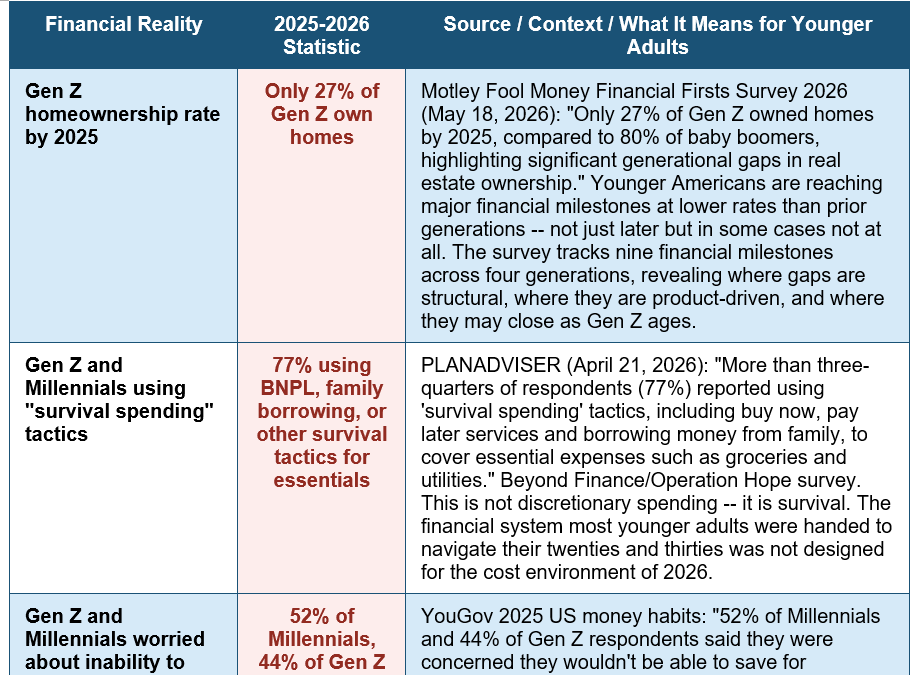
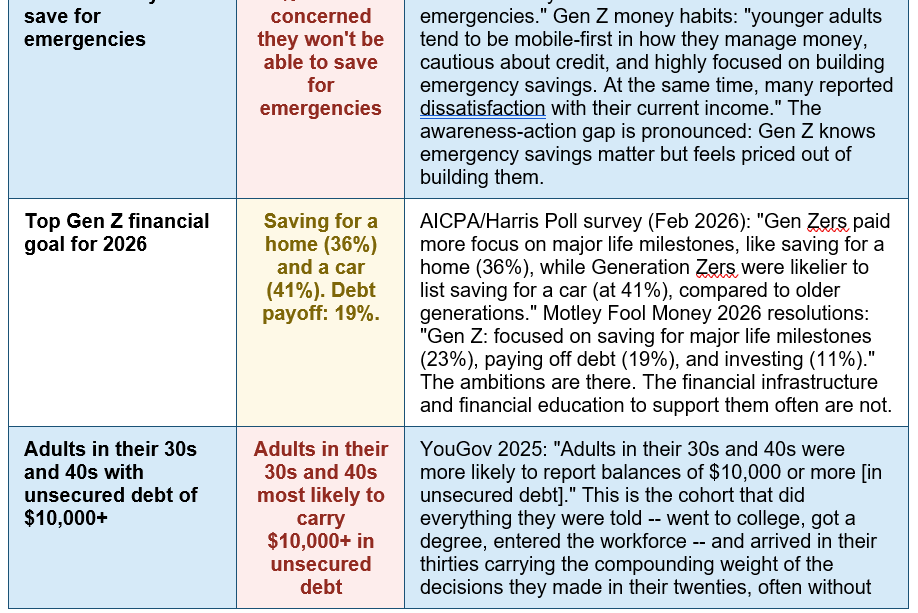
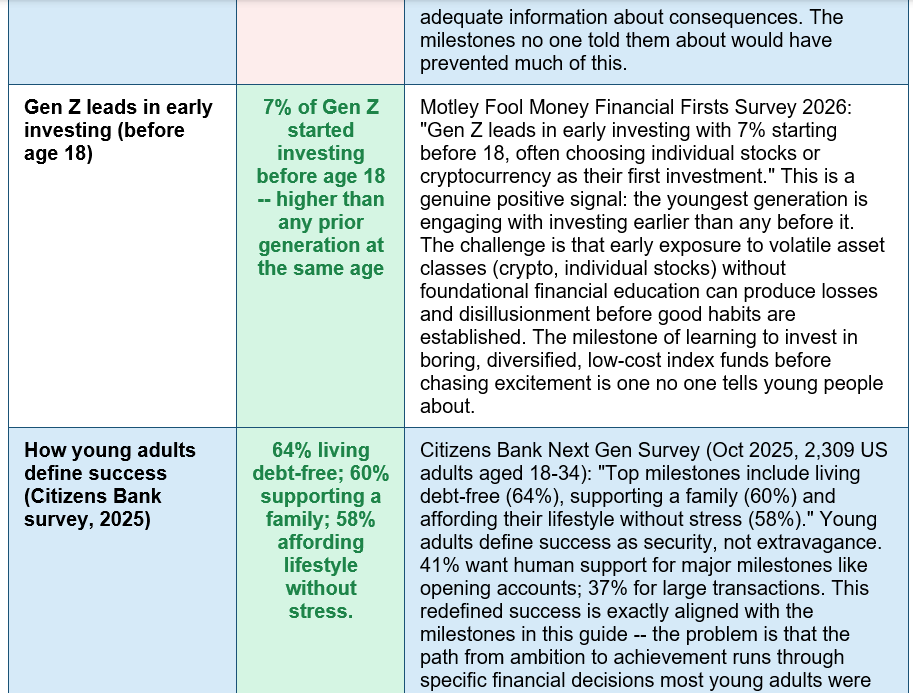

Younger adults in 2025-2026 -- the defining numbers: 77% using survival spending. 27% of Gen Z own homes. 52% of Millennials worried about emergency savings. #1 financial resolution: pay off debt (25% of all Americans). — PLANADVISER (April 2026): '77% of Gen Z and Millennial respondents using survival spending tactics for essentials.' Motley Fool Money Financial Firsts 2026: 'Only 27% of Gen Z owned homes by 2025 vs 80% of Baby Boomers.' YouGov 2025: '52% of Millennials and 44% of Gen Z concerned they won't be able to save for emergencies.' AICPA/Harris Poll Feb 2026: Gen Z top goal: saving for home (36%), car (41%). Motley Fool 2026 resolutions: paying off debt #1 for 25% of all Americans; Gen Z prioritise major life milestones (23%), debt payoff (19%), investing (11%).
The 9 Hidden Money Milestones: At a Glance
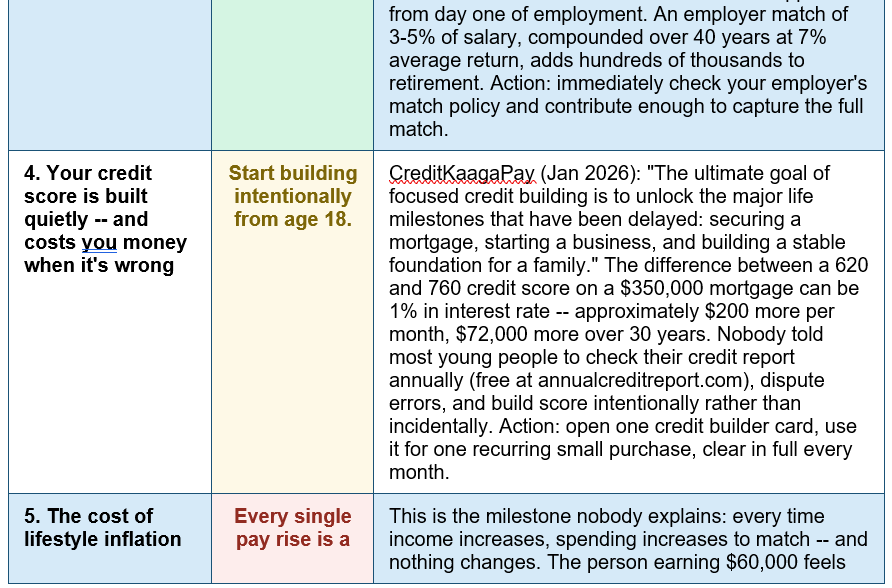
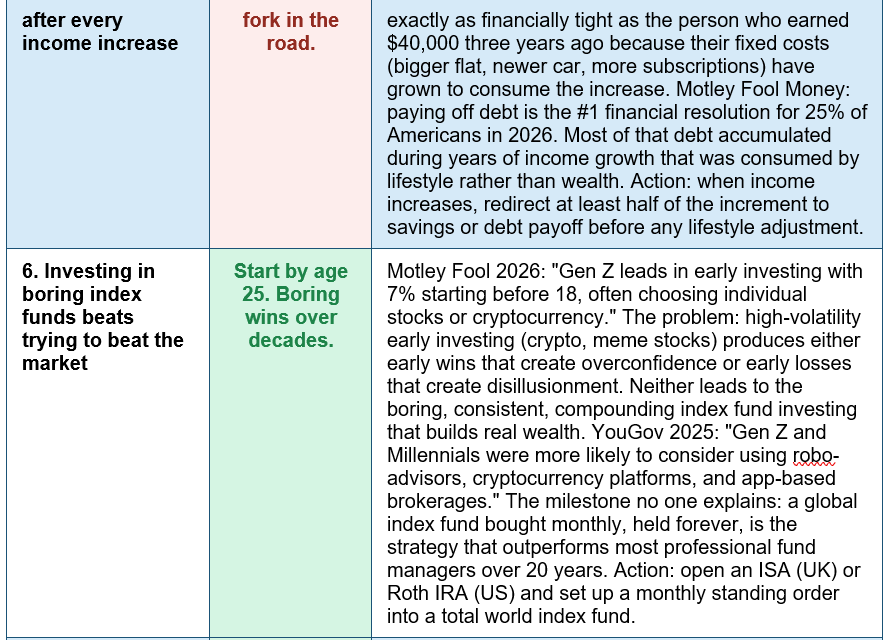
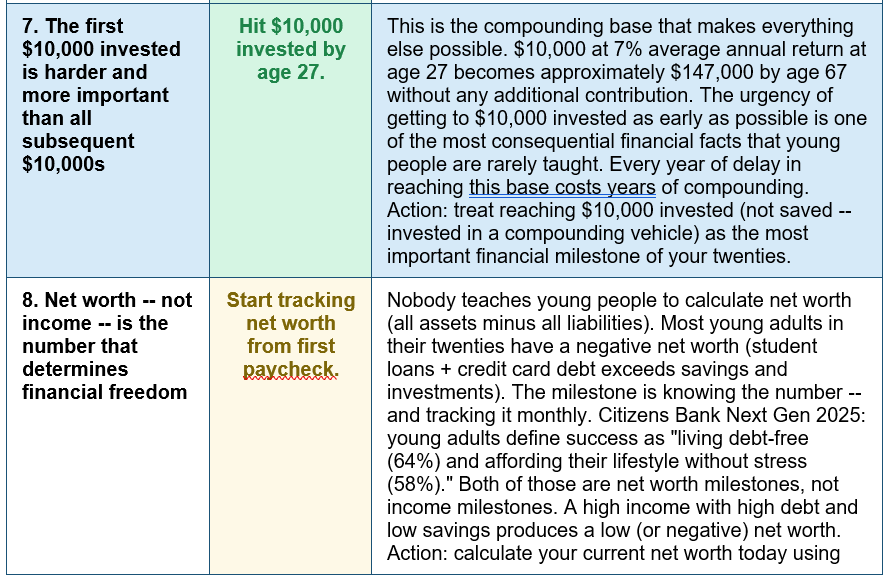
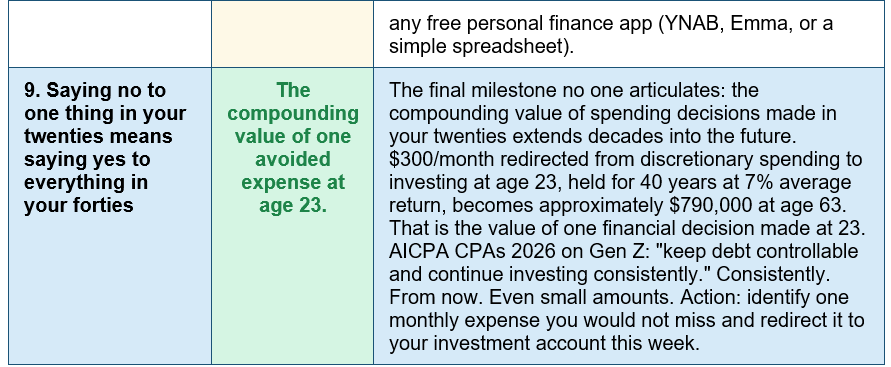
The following table maps all nine milestones with their ideal timing, why they matter, and one specific action for each: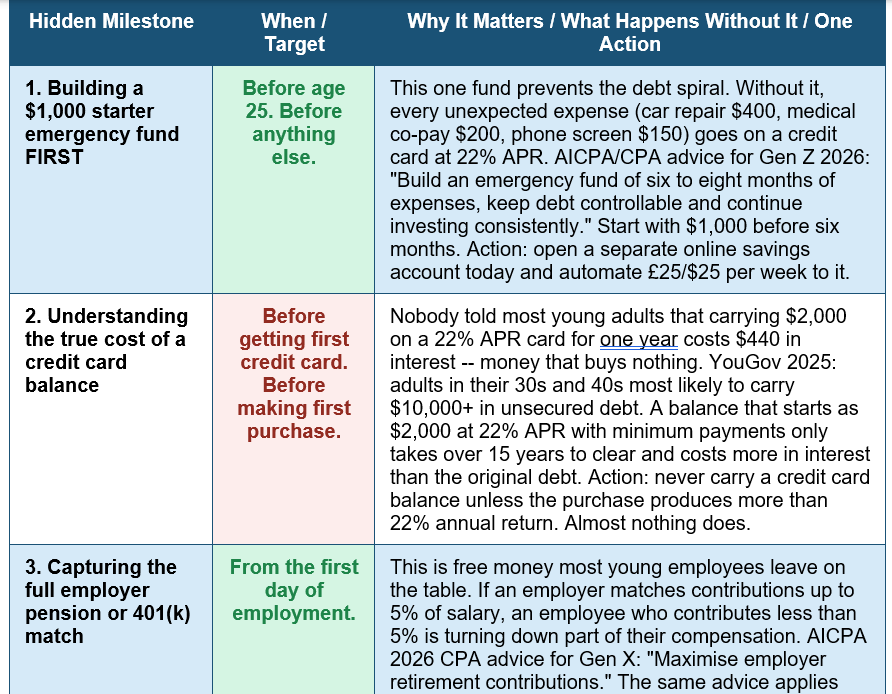
The 9 Milestones in Detail: What Nobody Told You and Why It Matters
MILESTONE #1: BUILD A $1,000 STARTER EMERGENCY FUND BEFORE ANYTHING ELSE | The one fund that prevents a decade of debt
This is the milestone that comes before all others -- before investing, before paying extra on debt, before saving for a home. And it is almost never explained in these terms. AICPA survey of CPAs giving advice to Gen Z in 2026: 'Build an emergency fund of six to eight months of expenses, keep debt controllable and continue investing consistently.' The sequencing matters: the emergency fund first. Here is why. Without a $1,000 buffer, every unexpected expense -- and the data shows these happen to approximately one in four Americans per quarter -- goes onto a credit card at an average APR of 22%. A $400 car repair becomes a $488 problem if left on a 22% card for 12 months. It becomes a $594 problem at 24 months. The emergency fund converts financial crises into inconveniences. PLANADVISER (April 2026): 77% of Gen Z and Millennials are using survival spending tactics for essentials -- buy now, pay later and family borrowing. Most of this survival spending is covering costs that a $1,000 emergency fund would have absorbed. The fund is the foundation. Without it, every other financial plan breaks down the moment life is unpredictable -- which is always.MILESTONE #2: UNDERSTAND WHAT A CREDIT CARD BALANCE ACTUALLY COSTS | Nobody explained the maths -- and it costs thousands
The milestone here is not 'avoid debt' -- it is understanding precisely what carrying a credit card balance costs in real money so the decision is informed rather than accidental. YouGov 2025: adults in their thirties and forties most likely to carry unsecured debt above $10,000. Most of that debt accumulated through a decade of carrying credit card balances without understanding the compounding cost. The mathematics: $2,000 carried on a 22% APR card at minimum payments (approximately 2% of the balance per month) takes approximately 14 years to clear and costs more in interest than the original debt. A $500 purchase carried for 12 months at 22% APR costs $110 in interest -- the equivalent of a 22% price surcharge on everything bought with borrowed money. The milestone is knowing this number before carrying a balance. YouGov 2025: 'one in four Americans used buy now, pay later services in the past year, particularly for short-term budgeting and flexibility.' BNPL used as short-term budgeting can spiral into the same compounding problem as credit card debt when payments accumulate. The milestone: treat any credit product with a 22%+ rate as the most expensive money in the world -- because it is.MILESTONE #3: CAPTURE YOUR FULL EMPLOYER MATCH -- IT IS FREE MONEY WITH A DEADLINE | Every month without the match is money permanently lost
The employer pension match -- or 401(k) match in the US -- is the closest thing to free money that the financial system offers. If an employer matches employee contributions up to 5% of salary, every pound or dollar contributed up to that threshold is matched 100% by the employer. That is a guaranteed 100% return before any market performance. And yet a significant proportion of young employees contribute below the match threshold -- either because no one explained it, because the paperwork felt complicated, or because the contribution reduced take-home pay in a month when it felt unaffordable. AICPA 2026 CPA advice for Gen X catching up: 'Maximising employer retirement contributions.' The advice should start from the first job, not the catch-up years. The compounding impact: an employer match of 3% of a $40,000 salary ($1,200/year) invested from age 22 to 67 at 7% average return adds approximately $340,000 to a retirement pot -- money that was never available to invest without the match, and that permanently disappears for every year of non-participation.MILESTONE #4: BUILD YOUR CREDIT SCORE INTENTIONALLY FROM THE START | The invisible number that determines the price of your biggest life purchases
CreditKaagaPay (January 2026): 'The ultimate goal of focused credit building is to unlock the major life milestones that have been delayed: securing a mortgage, starting a business, and building a stable foundation for a family.' Nobody tells young people that their credit score begins being written from the first credit account they open -- and that the score created over the next five years will determine the interest rate on their first mortgage, which in turn determines the amount they pay every month for 30 years. The difference between a 620 and 760 credit score on a 30-year $350,000 mortgage is approximately 0.5-1% in interest rate -- $90-200 per month, or $32,000-$72,000 over the life of the loan. The milestone is not 'avoid credit cards' -- it is understanding how credit scores are built (payment history 35%, credit utilisation 30%, length of history 15%, new credit 10%, mix of credit 10%) and building intentionally from the start. Motley Fool Financial Firsts 2026: the gaps in credit building across generations are partly structural and partly product-driven. The action: open one credit-building product (secured card or credit-builder loan), use it for small, recurring purchases, clear the balance in full every month without exception, and check your free credit report annually at annualcreditreport.com (US) or via Credit Karma, Experian, or Checkmyfile (UK).MILESTONE #5: FIGHT LIFESTYLE INFLATION AT EVERY INCOME INCREASE | Every pay rise is a fork in the road -- most people take the wrong path
This is perhaps the most invisible milestone because it feels like a reward rather than a trap. When income increases -- a promotion, a new job, a side hustle that scales -- the natural response is to upgrade the lifestyle that income was previously constraining. A bigger flat. A better car. More restaurant meals. More subscriptions. Better clothes. The result: two years later, the person earning 30% more feels exactly as financially tight as before, because their fixed costs have grown to consume the increase. Motley Fool 2026 Financial New Year's Resolution Report: paying off debt is the #1 financial resolution for 25% of all Americans -- debt that accumulated during years of income growth. Citizens Bank Next Gen 2025: young adults define success as 'affording their lifestyle without stress (58%).' But lifestyle that grows to match income never produces this outcome -- it permanently postpones it. The milestone: when income increases, direct at least 50% of the increment to savings, investment, or debt reduction before any lifestyle change. Automate the transfer on the day the new salary takes effect. The remaining 50% can improve lifestyle. This is the discipline that converts income growth into net worth growth.MILESTONE #6: INVEST IN BORING INDEX FUNDS BEFORE EXCITING ALTERNATIVES | The strategy that beats most professional fund managers -- and requires no skill
Motley Fool Financial Firsts 2026: 'Gen Z leads in early investing with 7% starting before 18, often choosing individual stocks or cryptocurrency as their first investment.' YouGov 2025: 'Gen Z and Millennials were more likely to consider using robo-advisors, cryptocurrency platforms, and app-based brokerages.' The enthusiasm for investing early is genuinely positive. The risk is that the first experience involves high-volatility assets that produce either early wins (creating overconfidence) or early losses (creating disillusionment and exit from investing entirely). The milestone nobody explains: a low-cost global index fund -- one that simply tracks the performance of thousands of companies in one investment -- produces returns that beat the majority of actively managed funds over any 20-year period, consistently, without requiring any expertise, market timing, or stock selection. The data on this is unambiguous in the academic literature. The action: open an ISA (UK) or Roth IRA (US); choose a single total-world index fund with the lowest available management fee (typically 0.07-0.22% per year); set up a monthly automatic contribution; and do not change it based on market news.MILESTONE #7: HIT $10,000 INVESTED BY 27 -- THE BASE THAT CHANGES EVERYTHING | The first $10,000 is harder and more valuable than any subsequent $10,000
This milestone is expressed as a specific number and a specific age because specificity is what converts aspiration into action. $10,000 invested at age 27 at 7% average annual return becomes approximately $147,000 at age 67, without any additional contribution. The same $10,000 invested at 37 becomes approximately $75,000. The same $10,000 invested at 47 becomes approximately $38,000. The difference between reaching this milestone at 27 vs 47 is $109,000 -- from the same single $10,000 investment, with no additional money. This is the mathematical case for urgency. AICPA 2026 CPAs advising Gen Z: 'continue investing consistently.' Consistently is the key word -- not a large lump sum, but consistent monthly investing that accumulates to $10,000 as fast as possible. At $200/month from age 23, this milestone is reached by age 27. At $100/month, by age 30. Both are significantly better than waiting. The action: name reaching $10,000 invested as your explicit financial target for your twenties -- not earning a certain salary, not buying a specific item, not taking a specific holiday. Get to $10,000 invested. Everything compounds from there.MILESTONE #8: TRACK YOUR NET WORTH -- NOT JUST YOUR INCOME | The number that actually tells you whether you're getting ahead
Citizens Bank Next Gen Survey 2025: young adults define success as 'living debt-free (64%).' But most young adults have no idea what their net worth is -- whether they are getting closer to or further from their own definition of success. Net worth is total assets minus total liabilities: savings + investments + property value MINUS credit card balances + student loans + car loans + any other debt. Most young adults in their early to mid-twenties have a negative net worth because student loans and initial debts exceed limited early savings. This is normal. The milestone is knowing the number and tracking it monthly, because the number is what changes behaviour. YouGov 2025: 52% of Millennials worry they cannot save for emergencies -- but the worry is unfocused. A monthly net worth calculation converts a vague anxiety into a specific measurement that can improve by a specific amount in a specific timeframe. The action: spend 30 minutes today listing every asset you own and every debt you carry. Subtract debts from assets. That is your current net worth. Write it down. Calculate it again next month. Watch whether it is moving in the right direction.MILESTONE #9: UNDERSTAND THAT SMALL DAILY DECISIONS IN YOUR TWENTIES HAVE FORTY-YEAR CONSEQUENCES | The compounding value of one avoided expense at age 23
AICPA CPAs advising Gen Z in 2026: 'keep debt controllable and continue investing consistently.' The word 'consistently' contains the entire case for this milestone. The compounding effect of consistent small decisions over 40 years is mathematically extraordinary and almost entirely absent from financial education. $300 per month redirected from discretionary spending to investment at age 23, held for 40 years at 7% average annual return, accumulates to approximately $790,000 at age 63. This is not $300/month that disappears -- it is the compounding of one consistent monthly decision, made once, automated, and sustained. The AICPA/Harris Poll survey (February 2026) found that for Gen Z, the top financial priorities were home ownership (36%), car savings (41%), and investing (11%). The 11% who list investing as a priority are building the foundation that makes the other 89% of goals achievable more quickly. The milestone is not spending less -- it is understanding that the redirection of one recurring expense from consumption to compounding investment changes the forty-year financial trajectory in ways that no single income increase can replicate.Why these milestones are not taught -- and why that matters. The Citizens Bank Next Gen Survey (2025, 2,309 US adults aged 18-34) found that 41% of young adults want human support for major financial milestones like opening accounts, and 37% want support for large transactions. Young adults are not indifferent to financial education -- they actively want guidance on the major decisions. The gap is systemic: school curricula rarely cover compound interest in the applied sense, credit scores as a life-determining mechanism, the employer match as a first financial priority, or lifestyle inflation as the primary wealth-prevention mechanism. PLANADVISER (April 2026): 'Young people can now engage with money in real time, which makes it essential that education keeps pace.' The EverFi report from which this quote comes was based on responses from 133,000 students in high school financial education programmes. Even students receiving formal financial education in 2025-26 are encountering curricula that cover the theoretical without adequately addressing the specific decision points where behaviour actually changes. These nine milestones are an attempt to fill that gap -- in plain language, with specific numbers, and with one action per milestone that can be taken today.
FIVE FINANCIAL DECISIONS YOUNGER ADULTS ARE MOST COMMONLY GETTING WRONG IN 2026: (1) USING BNPL FOR ESSENTIALS. PLANADVISER (April 2026): 77% of Gen Z and Millennials report using survival spending tactics including BNPL for groceries and utilities. BNPL used for essential spending is a sign that the monthly budget is structurally unworkable and that a $1,000 emergency fund is the real solution -- not another deferred payment mechanism. (2) INVESTING IN CRYPTO BEFORE BUILDING AN EMERGENCY FUND. Motley Fool 2026: 7% of Gen Z started investing before 18, often in individual stocks or cryptocurrency. Speculative investment without a financial buffer beneath it is gambling, not wealth-building. Build the emergency fund first. (3) NOT KNOWING WHAT YOUR EMPLOYER MATCH IS. The proportion of young workers who leave their employer match on the table is significant and represents one of the most concrete missed financial opportunities available. Check your HR portal or payroll department this week. (4) INCREASING LIFESTYLE SPENDING IMMEDIATELY AFTER EVERY INCOME INCREASE. YouGov 2025: adults in their thirties and forties most likely to carry $10,000+ in unsecured debt despite being at peak earnings. Lifestyle inflation converts every pay rise into a new minimum. The fix: automate savings increases the same day a pay rise takes effect, before spending patterns adjust. (5) NEVER CALCULATING NET WORTH. YouGov 2025: 52% of Millennials worried about emergency savings -- but without a net worth calculation, this worry has no specific target and no measurable progress. Calculate it today. The number is confronting and useful in equal measure.
YOUR MONEY MILESTONES ACTION PLAN -- WHAT TO DO THIS WEEK: MILESTONE #1 -- EMERGENCY FUND: Open a separate savings account at a different bank. Set up an automatic weekly transfer of £25 or $25. Name the account "Emergency Fund." Do not touch it. MILESTONE #2 -- CREDIT CARDS: Log into every credit account you hold and check the APR. If you are carrying any balance above 0%, calculate the annual interest cost. Make paying this down (debt avalanche: highest rate first) your most urgent financial goal after the emergency fund. MILESTONE #3 -- EMPLOYER MATCH: Log into your HR portal or payroll system today. Find out what your employer matches. If you are not contributing enough to get the full match, increase your contribution this week. This is the highest-return financial action available to any employed person. MILESTONE #4 -- CREDIT SCORE: Check your credit report free (US: annualcreditreport.com | UK: Experian, Equifax, Credit Karma). Look for errors. If you have no credit history, open one credit-builder product. MILESTONE #7 -- FIRST $10,000 INVESTED: Open an ISA (UK) or Roth IRA (US) if you do not have one. Choose a global index fund. Set up a monthly standing order. Name this account "$10,000 by 27" and track it monthly. MILESTONE #8 -- NET WORTH: Spend 30 minutes today. List every asset (savings + investments + property). List every debt (student loans + credit card + car loan). Subtract. Write the number down. Track it monthly. FREE GUIDANCE: UK: MoneyHelper 0800 138 7777 | MoneySavingExpert.com. US: CFPB consumerfinance.gov | NFCC nfcc.org.
Conclusion: The Milestones Are Available to Anyone -- The Information Was the Missing Piece
Seventy-seven percent of Gen Z and Millennial Americans are using survival spending tactics for essential expenses. Only 27% of Gen Z own homes. Adults in their thirties and forties -- the cohort that did everything right on paper -- are the most likely to carry unsecured debt above $10,000. These numbers are not the result of bad intentions. They are the result of a systemic gap between the financial decisions younger adults face and the financial education they received before facing them.The nine milestones in this guide are not exotic. They are not available only to high earners. They do not require a finance degree or specialist knowledge. A $1,000 emergency fund prevents the debt spiral. Understanding credit card APRs changes borrowing behaviour. Capturing the employer match is free money with a deadline. Building a credit score from age 18 reduces the cost of every major purchase for the next thirty years. Resisting lifestyle inflation at every income increase is the habit that converts earning into wealth. Investing in boring index funds consistently outperforms exciting alternatives over time. Reaching $10,000 invested by age 27 changes the compounding trajectory for the rest of a financial life. Tracking net worth monthly makes progress visible and measurable. Understanding that $300/month redirected from consumption to investment at age 23 becomes $790,000 at age 63 changes the way small daily decisions feel.
Citizens Bank Next Gen Survey 2025: young adults define success as living debt-free, supporting a family, and affording their lifestyle without stress. Not extravagance. Not luxury. Security. These milestones are the specific, practical path to that definition of success. The information was the missing piece. Now you have it.
Frequently Asked Questions (FAQ)
What financial milestones should I hit in my 20s?The most important financial milestones for your twenties, in the order that produces the best outcomes, are: (1) Build a $1,000 starter emergency fund before any other financial action. This prevents the debt spiral from unexpected expenses. (2) Capture the full employer pension or 401(k) match from your first day of employment -- this is a guaranteed 100% return on the matched contribution. (3) Understand and manage your credit score intentionally from age 18 or from the first credit product you open. (4) Eliminate any high-interest consumer debt (credit card balances above 0% APR) using the debt avalanche method (highest rate first). (5) Begin investing in a low-cost global index fund through a tax-advantaged account (ISA in the UK, Roth IRA or 401(k) in the US), with an explicit target of reaching $10,000 invested by age 27. AICPA 2026 CPA advice for Gen Z: 'Build an emergency fund of six to eight months of expenses, keep debt controllable and continue investing consistently.' Motley Fool Financial Firsts 2026: only 27% of Gen Z own homes by 2025 vs 80% of baby boomers -- homeownership is a meaningful milestone that becomes significantly more accessible when the preceding milestones are in place. Citizens Bank Next Gen Survey 2025: 64% of young adults aged 18-34 define success as living debt-free. The milestones above are the specific path to that definition.
How much should I have saved by age 25?
The research provides specific benchmarks rather than a single universal figure. Emergency fund: the AICPA's 2026 CPA recommendations for Gen Z specify six to eight months of essential expenses as the full target -- but a $1,000 starter fund by age 22 and three months by age 25 is a realistic and meaningful milestone. Investment portfolio: reaching $10,000 invested (not just saved -- invested in a compounding vehicle like an index fund ISA or Roth IRA) by age 25-27 is a powerful milestone because of the compounding advantage of starting early. $10,000 invested at 25 at 7% average annual return becomes approximately $200,000 at 65 without any additional contribution. Net worth: many people in their mid-twenties have a negative net worth due to student debt -- this is not failure, it is common. The milestone is knowing the number and tracking it moving toward positive. YouGov 2025: 52% of Millennials worry they cannot save for emergencies. The specific benchmarks that reduce this worry: $1,000 emergency fund (immediate priority), one month of expenses in emergency fund (by age 23-24), first $10,000 invested (by age 25-27). These are achievable at most income levels above the poverty line through consistent automated saving and investing.
Is buy now, pay later bad for young people's finances?
BNPL is a financial product, not inherently good or bad -- the context of use determines the outcome. PLANADVISER (April 21, 2026): 77% of Gen Z and Millennials reported using survival spending tactics including buy now, pay later for essentials like groceries and utilities. When BNPL is used for essential spending that cannot be funded from current income, it signals that monthly income is structurally insufficient relative to costs -- and that BNPL is deferring rather than solving the problem. Accumulated BNPL payment obligations compound the monthly cash flow problem they were intended to solve. YouGov 2025: 'one in four Americans used buy now, pay later in the past year. Rather than replacing cards, BNPL was often used alongside them, particularly for short-term budgeting and flexibility.' Used for a large planned purchase (an appliance, a phone) where the payments are clearly budgeted, fully repaid on time, and 0% interest, BNPL can be a neutral financial tool. Used for regular spending as a substitute for income that does not exist, it is an expensive deferral mechanism. The milestone is understanding the difference and having the $1,000 emergency fund that makes the first use case unnecessary for most small emergencies.
How do I start investing with no money?
You start with whatever amount is genuinely surplus -- even if that is £10 or $10 per month. The milestone is not the amount. It is the automation, the account, and the habit. The specific steps: (1) Open an account. In the UK: a Stocks & Shares ISA via Vanguard, AJ Bell, or Fidelity takes 15-30 minutes online and has no minimum investment for a regular monthly standing order. In the US: a Roth IRA at Fidelity, Vanguard, or Schwab with no account minimum. (2) Choose one fund. A global index fund (Vanguard FTSE All-World ETF in the UK; Vanguard Total World Stock (VT) in the US) is the specific recommendation of most financial researchers for a starting investor. (3) Set up a standing order or automatic transfer for the day after payday. Even £10 or $10 per month. The investment habit precedes the investment amount. AICPA 2026 CPAs: 'continue investing consistently' for Gen Z -- the word 'consistently' contains the entire strategy. Motley Fool Financial Firsts 2026: 7% of Gen Z started investing before 18. The milestone is starting, not the starting amount. YouGov 2025: Gen Z is 'mobile-first in managing money, cautious about credit, and highly focused on building emergency savings.' Transfer that focus to investing too, from the smallest possible starting amount.
Why is my employer pension match so important?
The employer pension match (UK workplace pension) or 401(k) match (US) is the closest thing to free money with a deadline that the financial system offers. If your employer matches your contributions up to 5% of your salary, every pound or dollar you contribute up to that level is matched 100% by your employer -- before any investment return, before any tax relief. This is a guaranteed 100% return on the matched contribution. Missing it is equivalent to turning down part of your salary. AICPA 2026 survey of financial planning professionals: 'Maximising employer retirement contributions' was listed as a top recommendation for Gen X -- the generation that is now catching up on retirement savings after years of competing costs. The advice should begin from the first job, not decades later. The compounding impact of capturing the full match from age 22 is enormous: an employer match of 3% of a $40,000 salary ($1,200/year) invested from age 22 to 67 at 7% average annual return adds approximately $340,000 to a retirement portfolio. Motley Fool 2026 resolutions: 'saving more for retirement' (9%) and 'investing' (11%) are listed as goals for Gen Z and Millennials. Capturing the employer match is the first and highest-priority action in both of these categories -- it requires no market timing, no stock selection, and no expertise. It requires only contributing enough to receive what is already available.

0 Comments Comments