
Food
Hidden Cost of Deliveroo, Uber Eats & Just Eat UK
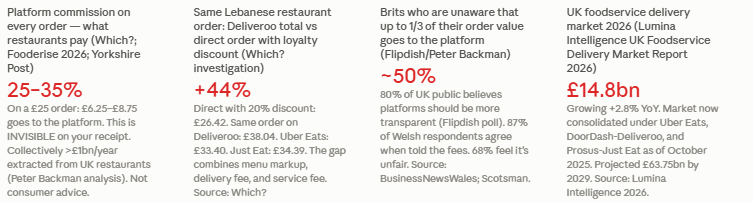
The UK food delivery market will reach £14.8 billion in 2026. Nearly half of customers have no idea that up to 30–35% of every order value goes straight to the platform in commission. That £25 curry you ordered last night? Up to £8.75 of it never reached the restaurant. This guide breaks down every fee layer — delivery charges, service fees, menu markups, and commission — to reveal what you are actually paying, who gets it, and what the real annual cost of app-ordering looks like for a regular UK user.
As of October 2025, the market consolidated under three global tech conglomerates: Uber Eats (backed by Uber); DoorDash-Deliveroo (following Amazon’s sale of its Deliveroo stake and DoorDash’s acquisition); and Prosus-Just Eat (Lumina Intelligence 2026). This consolidation matters to consumers and restaurants alike because it concentrates market power in fewer hands — reducing the competitive pressure that might otherwise push commissions down or fees lower.
But the size and growth of this industry conceals a fee structure that most customers neither understand nor scrutinise. Nearly half of UK takeaway buyers are unaware that up to one-third of their order value is typically redirected to the platform in commission, according to research by Flipdish and independent analyst Peter Backman. The platforms collectively extract more than £1 billion in annual fees from UK restaurants alone — in a market worth £8.5 billion at the time of the analysis (Peter Backman; Yorkshire Post; Scotsman). This article follows the money, layer by layer, to reveal exactly who pays what and when. Not consumer advice.
UK food delivery market 2026: £14.8bn, +2.8% YoY (Lumina Intelligence 2026). Projected: £63.75bn by 2029. Three platforms now dominate: Uber Eats; DoorDash-Deliveroo; Prosus-Just Eat. Platforms collectively extract >£1bn/year in fees from UK restaurants in a market worth £8.5bn. London restaurants alone: ~£452m/year to delivery platforms (Peter Backman analysis). ~50% of UK takeaway buyers unaware that up to 1/3 of order value goes to platform as commission. 46% of UK consumers say delivery fees are their #1 criterion when choosing a platform (Statista 2023). Sources: Lumina Intelligence 2026; Peter Backman/Flipdish; Zego.com; Statista. Not consumer advice.
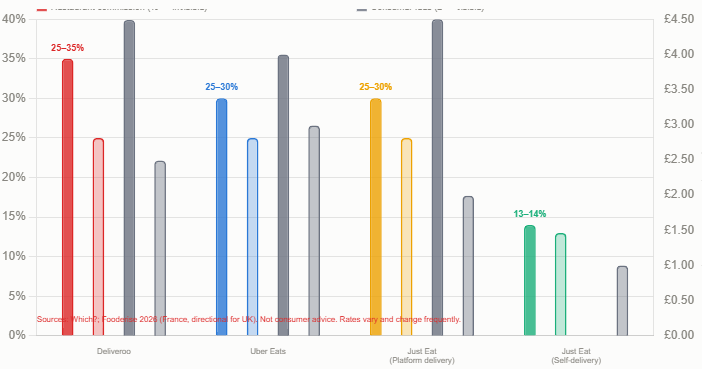
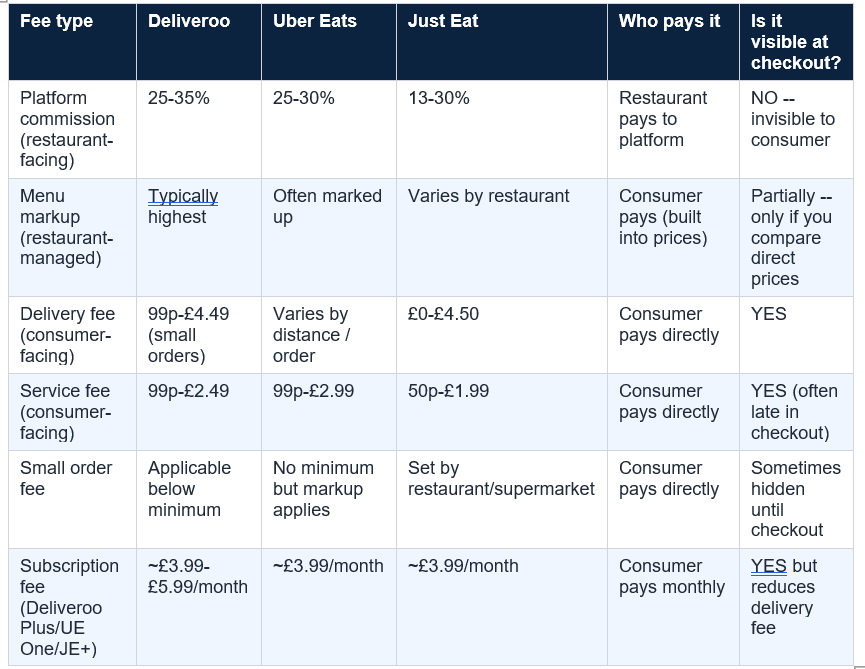
Layer One is the platform commission charged to the restaurant. This is invisible to you as a consumer — it is a percentage of the order value that the restaurant pays to the platform for the right to appear on the app and receive orders. Current rates are 25–35% for Deliveroo, 25–30% for Uber Eats, and 13–30% for Just Eat depending on the plan (Fooderise 2026). On a £25 order, this commission is between £6.25 and £8.75 — never shown to you on your receipt.
Layer Two is the menu markup. Restaurants, facing commission rates of 25–35%, typically raise their app prices above their direct-order prices to claw back some of the commission cost. Which? found a chicken shish costing £12.95 direct was £13.95 on Just Eat and Uber Eats and £14.95 on Deliveroo. This is not the restaurant profiteering; it is a structural adjustment to make app-channel economics viable. It means you are paying for the platform commission twice — once through the menu price and once indirectly through the restaurant’s reduced margin.
Layer Three is the consumer-facing fees charged directly by the app: delivery fees, service fees, and small-order charges. These are visible but often underestimated in their total impact, particularly when the service fee is expressed as a small absolute amount (50p, 99p, £1.65) that does not trigger the same mental accounting as a larger stated price. Combined with the invisible markup and commission, the gap between what you pay and what the restaurant receives can be dramatic.
The three hidden cost layers combined: (1) Menu markup (e.g. +£1-£2 per item on Deliveroo vs direct price -- Which?); (2) Platform commission (25-35% of order value paid by restaurant, effectively embedded in higher prices and lower restaurant margins); (3) Consumer-facing fees (delivery fee up to £4.49, service fee up to £2.49 on Deliveroo -- Which?/Asian Trader). On a £25 order: you might pay £29-£32 all-in, while the restaurant receives £16-£18 after commission. The gap between what you hand over and what the restaurant keeps can exceed 40% of your payment. Not consumer advice.
Peter Backman, an independent analyst who has studied UK restaurant economics in depth, estimated that Deliveroo, Just Eat, and Uber Eats together secured more than £1 billion in annual fees from UK restaurants in the UK’s £8.5 billion takeaway market. By city: London restaurants paid approximately £452 million; Manchester approximately £68 million; Birmingham £53 million; Leeds £41 million; Newcastle £40 million (Peter Backman analysis via BusinessNewsWales).
What makes this commission particularly significant is what it is not: it is not a one-time setup fee or a monthly subscription. It is a percentage taken from every single order, every time, indefinitely. A restaurant doing £10,000 per month through Deliveroo at 30% commission pays £3,000 per month to the platform — £36,000 per year. For a small independent restaurant with thin margins already under pressure from food cost inflation and energy costs, this is not an operational cost; it is an existential question.
Fionn Hart, MD of Flipdish (restaurant ordering platform): 'Research shows that nearly half of takeaway buyers are unaware that up to one-third of their takeaway value is typically siphoned to these marketplaces in commission. Unknowingly, customers are lining the pockets of executives at the expense of local restaurateurs and staff.' (Doncaster Free Press; Yorkshire Post; Scotsman). Conor McCarthy, CEO of Flipdish: 'Restaurants in Cardiff and Swansea are serving up an eye-watering amount of money to online food marketplaces. In exchange, the tech companies promise new customers but in reality most takeaway buyers have their trusted favourites.' (BusinessNewsWales, 2020).
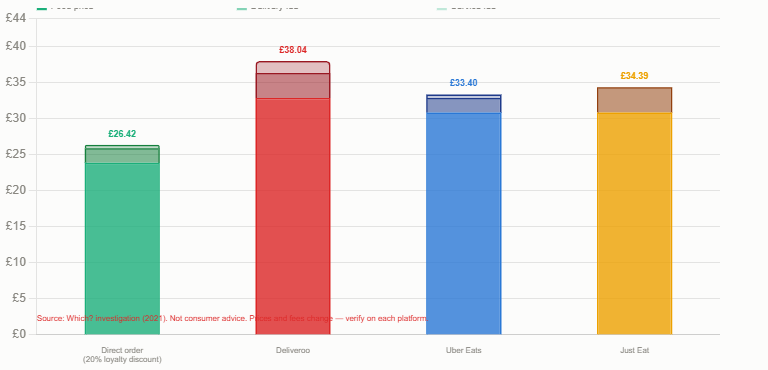
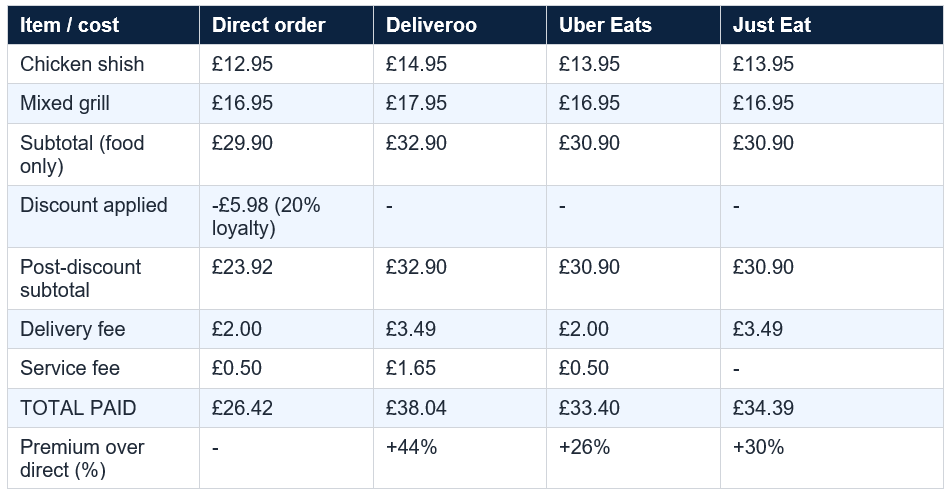
The Which? investigation provides the clearest documented evidence. At a Lebanese restaurant: a chicken shish cost £12.95 when ordering direct from the restaurant. The same item was listed at £13.95 on Just Eat and Uber Eats — £1 more. On Deliveroo, it was £14.95 — £2 more than direct, or 15.4% higher. A mixed grill at the same restaurant was £16.95 direct, £17.95 on Deliveroo, and £16.95 on the other two. The combined order of these two items: £29.90 direct (before delivery and service fees), £32.90 on Deliveroo, £30.90 on Uber Eats and Just Eat (Which?, 2021). The proportional difference is consistent with the structural practice: restaurants on Deliveroo, which charges the highest commission, typically mark up the most.
The Which? investigation also found that a direct order from the same restaurant — with a 20% loyalty discount applied — produced a subtotal of £23.92 versus app subtotals of £30.90 to £32.90. This illustrates a dimension of the cost gap that is often overlooked: ordering directly not only avoids the app-channel markup but also allows loyalty programmes and direct discounts to be applied, compounding the saving. Not consumer advice.
Deliveroo charges a delivery fee of 99p to £4.49 for orders under £15, plus a service fee of between 99p and £2.49 (Which?/Asian Trader). At the high end, this adds £6.98 to a sub-£15 order before the menu markup is factored in. Just Eat’s delivery fee ranges from nothing to £4.50, alongside a ‘small order fee’ set by the individual restaurant or supermarket, and a further service fee of 50p to £1.99. Uber Eats has no minimum spend but charges a service fee of 99p to £2.99, and its menu items typically carry the price markup discussed in the previous section.
Subscription schemes partially offset the delivery fee. Deliveroo Plus, Uber Eats One, and Just Eat’s membership offer free delivery on eligible orders above minimum spend thresholds, typically priced at approximately £3.99–£5.99 per month. For a regular user ordering once a week at £25 per order, the maths may favour a subscription over individual delivery fees. But subscriptions do not eliminate the service fee, the menu markup, or the embedded platform commission — and they create a psychological commitment effect that can increase the frequency and value of ordering. Not consumer advice.
This means a grocery basket worth £50 on Morrisons.com would cost approximately £67 through Uber Eats or £57.50 through Deliveroo — before the delivery fee, service fee, or any small order surcharge. On a £50 basket through Uber Eats at a 34% markup, the consumer pays £17 more for the same items. For a weekly grocery order, this differential is not trivial: at £17 per order, 52 weeks per year equates to £884 in extra annual grocery costs versus ordering from the supermarket’s own website or visiting the store.
The convenience proposition for grocery delivery is clear: speed (delivery in as little as 30 minutes in urban areas), no minimum spend, and access without a car or physical trip. For specific circumstances — a missing ingredient mid-cook, a late-night necessity, no access to transport — a 34% markup may be entirely rational. For anyone using app-based grocery delivery as a regular substitute for supermarket shopping, however, the annual cost is significant. Not consumer advice.
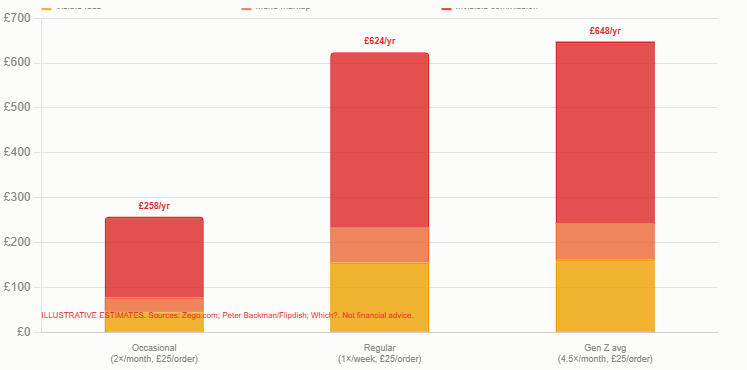
Annual Cost Maths: Annual cost modelling for a regular UK user (illustrative estimates): SCENARIO A (once a week, average order £25): 52 orders × £25 = £1,300/year in app orders. At 30% embedded commission: ~£390/year redirected to platforms from restaurant revenue. Average consumer-facing fees (delivery + service): ~£3/order × 52 = £156/year. Menu markup vs direct ordering: ~£2/order × 52 = £104/year. Subscription (Deliveroo Plus at ~£4.99/month): £59.88/year. Total cost above restaurant's direct equivalent: approximately £260-£350/year in visible and invisible fees, markups, and surcharges above what ordering directly would cost. SCENARIO B (Gen Z, 4.5 orders/month at £25 each): 54 orders/year × £25 = £1,350/year. Platform-extracted fees at 30%: ~£405/year. Consumer-facing charges: ~£162/year. Total premium vs direct ordering: approximately £300-£430/year. Not financial advice. Figures are illustrative estimates based on cited data.
These are not costs you see itemised on a receipt. They are embedded in the menu prices you pay and in the commission the restaurant remits to the platform after every order. The consumer-facing delivery fee and service fee are visible but often mentally categorised as small. The more material cost — the markup and the embedded commission — is entirely invisible unless you take the step of comparing the app price to the restaurant’s direct price. Most consumers never do.
A Gen Z consumer ordering 4.5 times per month at an average order value of £25 is spending approximately £1,350 per year on food delivery. At a 30% platform commission embedded in pricing (which the restaurant absorbs and partially passes on through markup), approximately £405 of that annual spend — roughly the cost of a weekend city break — is flowing to the three dominant platforms. Add consumer-facing fees of approximately £3 per order and the total platform-related costs reach approximately £567 per year for a user ordering at the Gen Z average frequency.
This figure is not paid out explicitly. It is the aggregate of hundreds of small choices across a year. The £1.65 service fee on a Tuesday night curry, the £3.49 delivery fee when the minimum spend isn’t quite reached, the £1 markup on the chicken shish versus the restaurant’s direct price. Individually, each is negligible. Cumulatively, they represent a substantial and largely invisible tax on convenience that most Gen Z consumers have never calculated.
Eighty per cent of the British public — four in five — believe the aggregators should be more transparent online about the hidden fee charged to restaurants (Flipdish/Peter Backman poll; cited in Doncaster Free Press; Yorkshire Post; Scotsman). This represents an overwhelming public mandate for disclosure that has not been acted upon by the platforms. Commission rates do not appear on consumer receipts. Service fee percentages are shown in absolute terms, not as percentages of the order. The proportion of each payment that reaches the restaurant is never disclosed.
The information asymmetry is not accidental. Platforms that revealed the effective total cost — including the embedded commission — might prompt consumers to order directly, seek cheaper alternatives, or reduce order frequency. The opacity is a structural feature of the business model, not an oversight. Regulatory attention on this transparency gap has been growing across European markets, with some countries legislating to cap commissions at 15–20% (Fooderise 2026).
First, the majority of delivery app customers are not new customers generated by the platform. Research cited by Conor McCarthy (CEO, Flipdish) and repeated in multiple sources indicates that most takeaway buyers have their trusted favourites and use apps for convenience and re-ordering rather than discovery. The platform’s customer acquisition argument is weakest precisely for the restaurants that need it least — those with established customer bases who are essentially paying 30% to process repeat orders from their own loyal customers.
Second, the profitability of the platforms themselves has been elusive for much of their existence. Deliveroo was famously loss-making through its public listing period. Just Eat faced investor pressure over years of losses before consolidation. The commission revenue has been funding growth, marketing, and subsidised rider pay rather than generating profit for investors at the rates the fees might imply. The £1 billion extracted from UK restaurants has not produced proportional shareholder value at the platform level; it has funded the growth of the ecosystem.
Third, the rider pay question remains contentious. Delivery riders are gig economy workers in the UK, classified as workers (following the Supreme Court ruling regarding Uber) with entitlement to minimum wage, holiday pay, and certain other rights. But the rider experience varies enormously. The commission that restaurants pay does not translate to proportionally higher rider income; the platforms manage their own margin between what the restaurant pays and what the rider receives. Not all of the 30% goes to the person on the bicycle.
The maths are widely understood in the industry: a restaurant making a 10% net margin on a £10 dish earns £1. Put that same £10 dish on Deliveroo at 30% commission, and the restaurant receives £7 — a £3 shortfall before even considering the cost of the food, the packaging (which must now be more expensive to survive delivery), the increased staff time for packaging orders, and any customer complaints about late or incorrect delivery.
This is why four in five restaurateurs — according to surveys cited in the regional press investigation — have considered or implemented app-channel price increases. It is not profiteering; it is arithmetic. The platform delivery channel is structurally loss-making for many restaurants at direct-price points. The only ways to make it viable are to raise app prices, reduce portion sizes, or accept the channel as a loss-leader for brand visibility that hopefully converts customers to direct ordering.
Peter Backman, the independent analyst, noted during the pandemic: ‘It’s not an ideal model in terms of the bottom line but it puts cash in the till and businesses will take anything they can get.’ In 2026, with the pandemic economics replaced by cost-of-living and energy inflation, the delivery channel’s economics remain challenging. Not business advice.
Lumina Intelligence (2026) notes that consumer motivation for choosing delivery is changing: health (+4.6 percentage points in importance) and quality (+2.2 percentage points) show the largest increases among delivery users in 2026, outpacing price. Consumers are trading up. The average order value is rising. The frequency is rising among higher-income households. This is not a market of people who don’t know the cost and would stop if they did; it is a market of people who have consciously or unconsciously decided the premium is worth paying for specific occasions.
The appropriate question is not whether delivery apps are a bad deal — they clearly have a significant total cost premium versus direct ordering — but whether the frequency and occasion of their use matches the value you are getting from the convenience. Ordering via Deliveroo once a month as a genuine treat is economically trivial. Ordering daily or four times a week as a substitute for meal planning is, at current fee structures, a significant and largely unacknowledged financial commitment. Not consumer advice.
This is not an argument against delivery apps — they provide genuine value to millions of UK consumers every week and they represent real technology, real infrastructure, and real employment for riders. But it is an argument for transparency that 80% of UK consumers explicitly say they want, and an argument for informed use that the hidden cost structure actively discourages. Knowing that £820 of your annual household spend on takeaways includes a very substantial and largely invisible platform premium should at minimum prompt the occasional direct order.
The UK’s £14.8 billion food delivery market in 2026 is funded by consumers who are, by and large, not fully aware of the cost structure they are supporting. The information is not secret — it is available in Which? investigations, analyst reports, and regional newspaper investigations. But it is not on the receipt. And until it is, the three-layer hidden cost of UK food delivery will continue to be paid by millions who would behave differently if the full picture were visible. Not consumer advice.
Current commission rates vary by platform and plan. Multiple sources including Which?, Fooderise (2026), and regional press investigations report: Deliveroo: 25-35% of order value. Uber Eats: 25-30% (Plus/Premium plans). Just Eat: 13-14% for self-delivery (restaurant provides own riders) or 25-30% for platform-delivered orders. The most widely cited general figure across the UK press is approximately 30% — so if a restaurant sells a pizza for £10, £3 goes to the platform. These are restaurant-facing costs, not shown to consumers on their receipt. Sources: Which?; Fooderise 2026; Doncaster Free Press; Yorkshire Post; Scotsman. Not financial advice. Commission rates change; verify with platforms directly.
Am I paying more for the same food on Deliveroo than if I ordered direct?
Almost certainly yes, if the restaurant has its own direct ordering option. Which? found a chicken shish costing £12.95 direct was £13.95 on Just Eat and Uber Eats (£1 more) and £14.95 on Deliveroo (£2 more or 15.4% higher). The total order difference in their investigation was 27-44% more through apps versus direct ordering with a loyalty discount. The markup occurs because restaurants raise app prices to partially recover the 25-35% commission they pay to the platform. You are effectively paying the platform commission twice: once through higher menu prices and once through the reduced margin that forces the restaurant to absorb the rest. Source: Which? investigation (Shefalee Loth). Not consumer advice.
What is the annual cost of ordering from delivery apps regularly?
This depends on frequency and order size. Using Zego.com's figure of approximately £820 per person annually on takeaways (a broad UK average), and assuming roughly 30% of this flows to platform costs (commission embedded in prices plus consumer-facing fees), the platform-related cost for a regular user is approximately £240-£390 per year. For Gen Z users ordering at the average frequency of 4.5 times per month at approximately £25 per order (£1,350/year), total platform-related costs including embedded commission, markup, and consumer-facing fees could reach £400-£567 per year. These are estimates based on publicly cited industry data, not precise calculations. Not financial advice.
Do food delivery subscription schemes (Deliveroo Plus, Uber Eats One) actually save money?
They can, but only for the delivery fee element — and only if you use them often enough. A Deliveroo Plus subscription at approximately £3.99-£5.99/month eliminates delivery fees on eligible orders. If you would otherwise pay a £3 delivery fee per order, the subscription pays for itself after 1-2 orders per month. But subscriptions do not eliminate the service fee (still charged per order), the menu markup (higher prices on the app versus direct), or the embedded platform commission (paid by the restaurant). They create a psychological commitment that can increase ordering frequency. Whether they represent a net saving depends entirely on whether you order often enough and whether you compare your total app spend against direct ordering costs. Not financial advice.
Is there a cheaper way to order food for delivery in the UK?
Yes. The cheapest options in order: (1) Call the restaurant directly and ask about their own delivery service — many deliver directly at lower or no delivery fee and no menu markup. (2) Use the restaurant's own website or app — lower-commission direct ordering platforms charge 1-5% versus 25-35% for the major apps, and the saving is partly reflected in lower prices. (3) Use platform subscriptions if you order at least twice a month. (4) Collect your order rather than having it delivered — eliminates delivery fees entirely. (5) Compare prices between Deliveroo, Uber Eats, and Just Eat before placing an order — commissions and markups vary, and the cheapest option for a specific restaurant is not always the same platform. Not consumer advice.
Table of Contents
- The £14.8 Billion Business You Are Funding
- The Three-Layer Hidden Cost Structure
- Layer One: Restaurant Commission — Up to 35% Before You Pay a Penny
- Layer Two: Menu Markup — The Price Inflation You Probably Haven’t Noticed
- Layer Three: Consumer-Facing Fees — Delivery Charges, Service Fees, and Small Order Penalties
- The Which? Investigation: Real Prices, Real Differences
- The Grocery Markup: When Apps Sell Your Weekly Shop
- What a Regular User Actually Pays Per Year
- Who Pays the Most: Gen Z’s Hidden Food Delivery Bill
- The Transparency Gap: What Most Customers Don’t Know
- What the Money Does NOT Go Towards
- The Restaurant Perspective: Survival Maths on a Knife Edge
- Cheaper Alternatives: Ordering Direct, Loyalty Schemes, and Subscriptions
- Is the Convenience Worth the Cost?
- Conclusion: The Real Price of That £25 Order
- Frequently Asked Questions
Real price comparison — the same order across all channels
Where your money goes — the hidden cost breakdown
Annual cost — what regular ordering really adds up to
The £14.8 Billion Business You Are Funding
The UK foodservice delivery market will reach £14.8 billion in 2026, growing at 2.8% year-on-year according to Lumina Intelligence’s UK Foodservice Delivery Market Report 2026. What was once an occasional Friday night treat has become embedded in everyday eating habits, with Monday and Tuesday now gaining market share as delivery becomes, in Lumina’s words, ‘a core early-week family meal solution.’ By 2029, the overall UK food delivery market is projected to reach £63.75 billion (Zego.com). UK households collectively spend approximately £820 per person annually on takeaways, according to market data cited by Zego.com.As of October 2025, the market consolidated under three global tech conglomerates: Uber Eats (backed by Uber); DoorDash-Deliveroo (following Amazon’s sale of its Deliveroo stake and DoorDash’s acquisition); and Prosus-Just Eat (Lumina Intelligence 2026). This consolidation matters to consumers and restaurants alike because it concentrates market power in fewer hands — reducing the competitive pressure that might otherwise push commissions down or fees lower.
But the size and growth of this industry conceals a fee structure that most customers neither understand nor scrutinise. Nearly half of UK takeaway buyers are unaware that up to one-third of their order value is typically redirected to the platform in commission, according to research by Flipdish and independent analyst Peter Backman. The platforms collectively extract more than £1 billion in annual fees from UK restaurants alone — in a market worth £8.5 billion at the time of the analysis (Peter Backman; Yorkshire Post; Scotsman). This article follows the money, layer by layer, to reveal exactly who pays what and when. Not consumer advice.
UK food delivery market 2026: £14.8bn, +2.8% YoY (Lumina Intelligence 2026). Projected: £63.75bn by 2029. Three platforms now dominate: Uber Eats; DoorDash-Deliveroo; Prosus-Just Eat. Platforms collectively extract >£1bn/year in fees from UK restaurants in a market worth £8.5bn. London restaurants alone: ~£452m/year to delivery platforms (Peter Backman analysis). ~50% of UK takeaway buyers unaware that up to 1/3 of order value goes to platform as commission. 46% of UK consumers say delivery fees are their #1 criterion when choosing a platform (Statista 2023). Sources: Lumina Intelligence 2026; Peter Backman/Flipdish; Zego.com; Statista. Not consumer advice.
The Three-Layer Hidden Cost Structure
The reason the cost of ordering through Deliveroo, Uber Eats, or Just Eat is so difficult for consumers to evaluate is that the cost is not a single fee. It is at least three distinct layers, each partially visible and each adding to the total. Understanding all three is necessary to understand what you are actually paying relative to ordering directly from the restaurant.Layer One is the platform commission charged to the restaurant. This is invisible to you as a consumer — it is a percentage of the order value that the restaurant pays to the platform for the right to appear on the app and receive orders. Current rates are 25–35% for Deliveroo, 25–30% for Uber Eats, and 13–30% for Just Eat depending on the plan (Fooderise 2026). On a £25 order, this commission is between £6.25 and £8.75 — never shown to you on your receipt.
Layer Two is the menu markup. Restaurants, facing commission rates of 25–35%, typically raise their app prices above their direct-order prices to claw back some of the commission cost. Which? found a chicken shish costing £12.95 direct was £13.95 on Just Eat and Uber Eats and £14.95 on Deliveroo. This is not the restaurant profiteering; it is a structural adjustment to make app-channel economics viable. It means you are paying for the platform commission twice — once through the menu price and once indirectly through the restaurant’s reduced margin.
Layer Three is the consumer-facing fees charged directly by the app: delivery fees, service fees, and small-order charges. These are visible but often underestimated in their total impact, particularly when the service fee is expressed as a small absolute amount (50p, 99p, £1.65) that does not trigger the same mental accounting as a larger stated price. Combined with the invisible markup and commission, the gap between what you pay and what the restaurant receives can be dramatic.
The three hidden cost layers combined: (1) Menu markup (e.g. +£1-£2 per item on Deliveroo vs direct price -- Which?); (2) Platform commission (25-35% of order value paid by restaurant, effectively embedded in higher prices and lower restaurant margins); (3) Consumer-facing fees (delivery fee up to £4.49, service fee up to £2.49 on Deliveroo -- Which?/Asian Trader). On a £25 order: you might pay £29-£32 all-in, while the restaurant receives £16-£18 after commission. The gap between what you hand over and what the restaurant keeps can exceed 40% of your payment. Not consumer advice.
Layer One: Restaurant Commission — Up to 35% Before You Pay a Penny
Platform commission is the foundational cost in the food delivery ecosystem. Multiple sources confirm the ranges: Deliveroo charges 25–35% of order value (up to 35% noted by Which?); Uber Eats charges 25–30% under its Plus and Premium plans; Just Eat charges 25–30% for platform-delivered orders and 13–14% when the restaurant provides its own delivery (Fooderise 2026). The simple, widely cited figure from multiple regional newspaper investigations is that the three major platforms charge approximately 30% — meaning if a business sells a pizza for £10, £3 goes to the delivery company.Peter Backman, an independent analyst who has studied UK restaurant economics in depth, estimated that Deliveroo, Just Eat, and Uber Eats together secured more than £1 billion in annual fees from UK restaurants in the UK’s £8.5 billion takeaway market. By city: London restaurants paid approximately £452 million; Manchester approximately £68 million; Birmingham £53 million; Leeds £41 million; Newcastle £40 million (Peter Backman analysis via BusinessNewsWales).
What makes this commission particularly significant is what it is not: it is not a one-time setup fee or a monthly subscription. It is a percentage taken from every single order, every time, indefinitely. A restaurant doing £10,000 per month through Deliveroo at 30% commission pays £3,000 per month to the platform — £36,000 per year. For a small independent restaurant with thin margins already under pressure from food cost inflation and energy costs, this is not an operational cost; it is an existential question.
Fionn Hart, MD of Flipdish (restaurant ordering platform): 'Research shows that nearly half of takeaway buyers are unaware that up to one-third of their takeaway value is typically siphoned to these marketplaces in commission. Unknowingly, customers are lining the pockets of executives at the expense of local restaurateurs and staff.' (Doncaster Free Press; Yorkshire Post; Scotsman). Conor McCarthy, CEO of Flipdish: 'Restaurants in Cardiff and Swansea are serving up an eye-watering amount of money to online food marketplaces. In exchange, the tech companies promise new customers but in reality most takeaway buyers have their trusted favourites.' (BusinessNewsWales, 2020).
Layer Two: Menu Markup — The Price Inflation You Probably Haven’t Noticed
Because restaurants absorb 25–35% of every order as platform commission, many — not all, but many — raise their in-app prices above their direct-order prices to partially recover this cost. This practice is permitted by the platforms (they explicitly allow restaurants to set higher prices on their apps than in the restaurant) and widespread across the industry, though the degree of markup varies significantly.The Which? investigation provides the clearest documented evidence. At a Lebanese restaurant: a chicken shish cost £12.95 when ordering direct from the restaurant. The same item was listed at £13.95 on Just Eat and Uber Eats — £1 more. On Deliveroo, it was £14.95 — £2 more than direct, or 15.4% higher. A mixed grill at the same restaurant was £16.95 direct, £17.95 on Deliveroo, and £16.95 on the other two. The combined order of these two items: £29.90 direct (before delivery and service fees), £32.90 on Deliveroo, £30.90 on Uber Eats and Just Eat (Which?, 2021). The proportional difference is consistent with the structural practice: restaurants on Deliveroo, which charges the highest commission, typically mark up the most.
The Which? investigation also found that a direct order from the same restaurant — with a 20% loyalty discount applied — produced a subtotal of £23.92 versus app subtotals of £30.90 to £32.90. This illustrates a dimension of the cost gap that is often overlooked: ordering directly not only avoids the app-channel markup but also allows loyalty programmes and direct discounts to be applied, compounding the saving. Not consumer advice.
Layer Three: Consumer-Facing Fees — Delivery Charges, Service Fees, and Small Order Penalties
Even before accounting for the invisible commission and the menu markup, the consumer-facing fee layer is more complex than it first appears. Three distinct charges can appear on a single order: a delivery fee, a service fee, and a small order fee. Each is presented at different points in the checkout flow, which means many customers do not calculate the total surcharge until the final payment screen.Deliveroo charges a delivery fee of 99p to £4.49 for orders under £15, plus a service fee of between 99p and £2.49 (Which?/Asian Trader). At the high end, this adds £6.98 to a sub-£15 order before the menu markup is factored in. Just Eat’s delivery fee ranges from nothing to £4.50, alongside a ‘small order fee’ set by the individual restaurant or supermarket, and a further service fee of 50p to £1.99. Uber Eats has no minimum spend but charges a service fee of 99p to £2.99, and its menu items typically carry the price markup discussed in the previous section.
Subscription schemes partially offset the delivery fee. Deliveroo Plus, Uber Eats One, and Just Eat’s membership offer free delivery on eligible orders above minimum spend thresholds, typically priced at approximately £3.99–£5.99 per month. For a regular user ordering once a week at £25 per order, the maths may favour a subscription over individual delivery fees. But subscriptions do not eliminate the service fee, the menu markup, or the embedded platform commission — and they create a psychological commitment effect that can increase the frequency and value of ordering. Not consumer advice.
The Which? Investigation: Real Prices, Real Differences
Which? magazine conducted a detailed price comparison across Deliveroo, Just Eat, Uber Eats, and direct ordering for a specific Lebanese restaurant — ordering the same two dishes from each channel. The results provide the most concrete published illustration of the full cost layering available for the UK market. The Which? investigation predates 2026 but the structural dynamics it reveals — menu markups, layered fees, and the gap between app and direct pricing — remain the standard model across the industry.
The Grocery Markup: When Apps Sell Your Weekly Shop
The markup dynamic is not limited to restaurant meals. Deliveroo and Uber Eats have both expanded aggressively into grocery and convenience delivery, partnering with supermarkets including Morrisons, Co-op, Sainsbury’s, and others. A Which? investigation into grocery pricing found that a basket of goods cost 34% more through Uber Eats and 15% more through Deliveroo than on the Morrisons.com website — before delivery charges were applied (Which?/Asian Trader).This means a grocery basket worth £50 on Morrisons.com would cost approximately £67 through Uber Eats or £57.50 through Deliveroo — before the delivery fee, service fee, or any small order surcharge. On a £50 basket through Uber Eats at a 34% markup, the consumer pays £17 more for the same items. For a weekly grocery order, this differential is not trivial: at £17 per order, 52 weeks per year equates to £884 in extra annual grocery costs versus ordering from the supermarket’s own website or visiting the store.
The convenience proposition for grocery delivery is clear: speed (delivery in as little as 30 minutes in urban areas), no minimum spend, and access without a car or physical trip. For specific circumstances — a missing ingredient mid-cook, a late-night necessity, no access to transport — a 34% markup may be entirely rational. For anyone using app-based grocery delivery as a regular substitute for supermarket shopping, however, the annual cost is significant. Not consumer advice.
What a Regular User Actually Pays Per Year
The aggregate annual cost of regular food delivery app use is rarely calculated by individuals because each order is evaluated in isolation (‘it’s just one order’) rather than as a cumulative pattern. The mathematics change significantly when annualised.Annual Cost Maths: Annual cost modelling for a regular UK user (illustrative estimates): SCENARIO A (once a week, average order £25): 52 orders × £25 = £1,300/year in app orders. At 30% embedded commission: ~£390/year redirected to platforms from restaurant revenue. Average consumer-facing fees (delivery + service): ~£3/order × 52 = £156/year. Menu markup vs direct ordering: ~£2/order × 52 = £104/year. Subscription (Deliveroo Plus at ~£4.99/month): £59.88/year. Total cost above restaurant's direct equivalent: approximately £260-£350/year in visible and invisible fees, markups, and surcharges above what ordering directly would cost. SCENARIO B (Gen Z, 4.5 orders/month at £25 each): 54 orders/year × £25 = £1,350/year. Platform-extracted fees at 30%: ~£405/year. Consumer-facing charges: ~£162/year. Total premium vs direct ordering: approximately £300-£430/year. Not financial advice. Figures are illustrative estimates based on cited data.
These are not costs you see itemised on a receipt. They are embedded in the menu prices you pay and in the commission the restaurant remits to the platform after every order. The consumer-facing delivery fee and service fee are visible but often mentally categorised as small. The more material cost — the markup and the embedded commission — is entirely invisible unless you take the step of comparing the app price to the restaurant’s direct price. Most consumers never do.
Who Pays the Most: Gen Z’s Hidden Food Delivery Bill
Gen Z is the demographic driving UK food delivery growth most aggressively. According to Zego.com, 69% of Gen Z consumers use food delivery apps regularly, and Gen Z orders food via delivery 4.5 times per month — more than any other age group. Sixty-three per cent of individuals aged 18–29 have used a food delivery app in the past 90 days. Lumina Intelligence (2026) notes that growth in 2026 is being powered by consumers with household incomes above £100,000, with London consumers outperforming nationally — but the volume base sits with younger, urban, digitally-native cohorts who order habitually rather than occasionally.A Gen Z consumer ordering 4.5 times per month at an average order value of £25 is spending approximately £1,350 per year on food delivery. At a 30% platform commission embedded in pricing (which the restaurant absorbs and partially passes on through markup), approximately £405 of that annual spend — roughly the cost of a weekend city break — is flowing to the three dominant platforms. Add consumer-facing fees of approximately £3 per order and the total platform-related costs reach approximately £567 per year for a user ordering at the Gen Z average frequency.
This figure is not paid out explicitly. It is the aggregate of hundreds of small choices across a year. The £1.65 service fee on a Tuesday night curry, the £3.49 delivery fee when the minimum spend isn’t quite reached, the £1 markup on the chicken shish versus the restaurant’s direct price. Individually, each is negligible. Cumulatively, they represent a substantial and largely invisible tax on convenience that most Gen Z consumers have never calculated.
The Transparency Gap: What Most Customers Don’t Know
The single most consistent finding across every piece of consumer research on food delivery fees is that customers do not know what the platforms charge. The Flipdish/Peter Backman research found that nearly half of takeaway buyers are unaware that up to one-third of their order value is typically redirected to the platform in commission. In Wales specifically, 55% of takeaway customers were simply unaware of the high fees; when told, 68% felt it was unfair, and 87% believed platforms should be more transparent (BusinessNewsWales poll, 2020).Eighty per cent of the British public — four in five — believe the aggregators should be more transparent online about the hidden fee charged to restaurants (Flipdish/Peter Backman poll; cited in Doncaster Free Press; Yorkshire Post; Scotsman). This represents an overwhelming public mandate for disclosure that has not been acted upon by the platforms. Commission rates do not appear on consumer receipts. Service fee percentages are shown in absolute terms, not as percentages of the order. The proportion of each payment that reaches the restaurant is never disclosed.
The information asymmetry is not accidental. Platforms that revealed the effective total cost — including the embedded commission — might prompt consumers to order directly, seek cheaper alternatives, or reduce order frequency. The opacity is a structural feature of the business model, not an oversight. Regulatory attention on this transparency gap has been growing across European markets, with some countries legislating to cap commissions at 15–20% (Fooderise 2026).
What the Money Does NOT Go Towards
A common defence of platform commission rates is that they represent the cost of a significant service: technology infrastructure, marketing, customer acquisition, payment processing, insurance, and rider pay. These are genuine costs. But several caveats deserve examination.First, the majority of delivery app customers are not new customers generated by the platform. Research cited by Conor McCarthy (CEO, Flipdish) and repeated in multiple sources indicates that most takeaway buyers have their trusted favourites and use apps for convenience and re-ordering rather than discovery. The platform’s customer acquisition argument is weakest precisely for the restaurants that need it least — those with established customer bases who are essentially paying 30% to process repeat orders from their own loyal customers.
Second, the profitability of the platforms themselves has been elusive for much of their existence. Deliveroo was famously loss-making through its public listing period. Just Eat faced investor pressure over years of losses before consolidation. The commission revenue has been funding growth, marketing, and subsidised rider pay rather than generating profit for investors at the rates the fees might imply. The £1 billion extracted from UK restaurants has not produced proportional shareholder value at the platform level; it has funded the growth of the ecosystem.
Third, the rider pay question remains contentious. Delivery riders are gig economy workers in the UK, classified as workers (following the Supreme Court ruling regarding Uber) with entitlement to minimum wage, holiday pay, and certain other rights. But the rider experience varies enormously. The commission that restaurants pay does not translate to proportionally higher rider income; the platforms manage their own margin between what the restaurant pays and what the rider receives. Not all of the 30% goes to the person on the bicycle.
The Restaurant Perspective: Survival Maths on a Knife Edge
From the restaurant’s perspective, the delivery platform is simultaneously a lifeline and a cost centre that defies conventional profitability logic. A restaurant with a food cost of 30%, labour at 35%, rent at 15%, and other costs at 10% has a pre-platform profit margin of approximately 10%. Adding a 30% platform commission on delivery orders — which must come from somewhere — eliminates the margin entirely unless prices are raised significantly.The maths are widely understood in the industry: a restaurant making a 10% net margin on a £10 dish earns £1. Put that same £10 dish on Deliveroo at 30% commission, and the restaurant receives £7 — a £3 shortfall before even considering the cost of the food, the packaging (which must now be more expensive to survive delivery), the increased staff time for packaging orders, and any customer complaints about late or incorrect delivery.
This is why four in five restaurateurs — according to surveys cited in the regional press investigation — have considered or implemented app-channel price increases. It is not profiteering; it is arithmetic. The platform delivery channel is structurally loss-making for many restaurants at direct-price points. The only ways to make it viable are to raise app prices, reduce portion sizes, or accept the channel as a loss-leader for brand visibility that hopefully converts customers to direct ordering.
Peter Backman, the independent analyst, noted during the pandemic: ‘It’s not an ideal model in terms of the bottom line but it puts cash in the till and businesses will take anything they can get.’ In 2026, with the pandemic economics replaced by cost-of-living and energy inflation, the delivery channel’s economics remain challenging. Not business advice.
Cheaper Alternatives: Ordering Direct, Loyalty Schemes, and Subscriptions
The most effective way to reduce the cost of food delivery is also the most obvious: order directly from the restaurant. Most restaurants that appear on delivery apps also accept telephone orders, have their own website ordering systems, or operate through lower-commission platforms. Ordering directly eliminates the menu markup, often allows loyalty discounts to apply, and typically reduces the delivery fee. The restaurant receives the full order value.- Call or order direct: most independent restaurants have a phone number. Calling directly eliminates app commission and markup entirely. Many offer their own delivery at lower or no delivery fee. Check the restaurant’s own website before opening the app.
- Restaurant’s own ordering app or website: many restaurants use lower-commission platforms (such as Square, Flipdish, or What the Fork) for their direct digital ordering, where commission rates are 1–5% rather than 25–35%. A restaurant’s own website ordering gives you their actual prices without app-channel markup.
- Platform subscriptions if you order frequently: Deliveroo Plus, Uber Eats One, and Just Eat’s scheme all eliminate delivery fees on eligible orders for a monthly subscription. At approximately £4–£6 per month, these pay off after 1–2 orders per month. But subscriptions do not eliminate service fees, menu markups, or embedded commission.
- Compare prices before ordering: for any regular order, spend 60 seconds comparing the restaurant’s direct price to the app price. The difference, multiplied by your ordering frequency, quickly tells you the annual saving from switching to direct ordering for your most-used restaurants.
- Pick-up where possible: eliminating the delivery element removes the delivery fee entirely. Many apps allow collection orders, which typically have lower or no delivery fees. The service fee may still apply, but the saving on delivery is real.
Is the Convenience Worth the Cost?
The economic case against delivery apps is clear when the numbers are laid out as this article has done. But convenience has genuine value, and the question ‘is it worth it’ is ultimately personal. A working parent feeding two children at 6pm after a long commute who has ten minutes before the school run is not making the same calculation as a student on a budget ordering their third delivery of the week.Lumina Intelligence (2026) notes that consumer motivation for choosing delivery is changing: health (+4.6 percentage points in importance) and quality (+2.2 percentage points) show the largest increases among delivery users in 2026, outpacing price. Consumers are trading up. The average order value is rising. The frequency is rising among higher-income households. This is not a market of people who don’t know the cost and would stop if they did; it is a market of people who have consciously or unconsciously decided the premium is worth paying for specific occasions.
The appropriate question is not whether delivery apps are a bad deal — they clearly have a significant total cost premium versus direct ordering — but whether the frequency and occasion of their use matches the value you are getting from the convenience. Ordering via Deliveroo once a month as a genuine treat is economically trivial. Ordering daily or four times a week as a substitute for meal planning is, at current fee structures, a significant and largely unacknowledged financial commitment. Not consumer advice.
Conclusion
When you place a £25 order on Deliveroo, the money does not go to one place. Approximately £7.50 goes to the platform in commission from the restaurant. Perhaps £1–£2 more of the menu price reflects the markup the restaurant added to survive the commission. You also pay a delivery fee (£2–£4.49), a service fee (99p–£2.49), and possibly a small order fee. By the time your food arrives, you have spent £30–£34, of which the restaurant may have received as little as £16–£18. The platform that wrote the code and owns the server has extracted as much as £10–£14 from a single transaction.This is not an argument against delivery apps — they provide genuine value to millions of UK consumers every week and they represent real technology, real infrastructure, and real employment for riders. But it is an argument for transparency that 80% of UK consumers explicitly say they want, and an argument for informed use that the hidden cost structure actively discourages. Knowing that £820 of your annual household spend on takeaways includes a very substantial and largely invisible platform premium should at minimum prompt the occasional direct order.
The UK’s £14.8 billion food delivery market in 2026 is funded by consumers who are, by and large, not fully aware of the cost structure they are supporting. The information is not secret — it is available in Which? investigations, analyst reports, and regional newspaper investigations. But it is not on the receipt. And until it is, the three-layer hidden cost of UK food delivery will continue to be paid by millions who would behave differently if the full picture were visible. Not consumer advice.
Frequently Asked Questions
How much commission do Deliveroo, Uber Eats and Just Eat charge restaurants in the UK?Current commission rates vary by platform and plan. Multiple sources including Which?, Fooderise (2026), and regional press investigations report: Deliveroo: 25-35% of order value. Uber Eats: 25-30% (Plus/Premium plans). Just Eat: 13-14% for self-delivery (restaurant provides own riders) or 25-30% for platform-delivered orders. The most widely cited general figure across the UK press is approximately 30% — so if a restaurant sells a pizza for £10, £3 goes to the platform. These are restaurant-facing costs, not shown to consumers on their receipt. Sources: Which?; Fooderise 2026; Doncaster Free Press; Yorkshire Post; Scotsman. Not financial advice. Commission rates change; verify with platforms directly.
Am I paying more for the same food on Deliveroo than if I ordered direct?
Almost certainly yes, if the restaurant has its own direct ordering option. Which? found a chicken shish costing £12.95 direct was £13.95 on Just Eat and Uber Eats (£1 more) and £14.95 on Deliveroo (£2 more or 15.4% higher). The total order difference in their investigation was 27-44% more through apps versus direct ordering with a loyalty discount. The markup occurs because restaurants raise app prices to partially recover the 25-35% commission they pay to the platform. You are effectively paying the platform commission twice: once through higher menu prices and once through the reduced margin that forces the restaurant to absorb the rest. Source: Which? investigation (Shefalee Loth). Not consumer advice.
What is the annual cost of ordering from delivery apps regularly?
This depends on frequency and order size. Using Zego.com's figure of approximately £820 per person annually on takeaways (a broad UK average), and assuming roughly 30% of this flows to platform costs (commission embedded in prices plus consumer-facing fees), the platform-related cost for a regular user is approximately £240-£390 per year. For Gen Z users ordering at the average frequency of 4.5 times per month at approximately £25 per order (£1,350/year), total platform-related costs including embedded commission, markup, and consumer-facing fees could reach £400-£567 per year. These are estimates based on publicly cited industry data, not precise calculations. Not financial advice.
Do food delivery subscription schemes (Deliveroo Plus, Uber Eats One) actually save money?
They can, but only for the delivery fee element — and only if you use them often enough. A Deliveroo Plus subscription at approximately £3.99-£5.99/month eliminates delivery fees on eligible orders. If you would otherwise pay a £3 delivery fee per order, the subscription pays for itself after 1-2 orders per month. But subscriptions do not eliminate the service fee (still charged per order), the menu markup (higher prices on the app versus direct), or the embedded platform commission (paid by the restaurant). They create a psychological commitment that can increase ordering frequency. Whether they represent a net saving depends entirely on whether you order often enough and whether you compare your total app spend against direct ordering costs. Not financial advice.
Is there a cheaper way to order food for delivery in the UK?
Yes. The cheapest options in order: (1) Call the restaurant directly and ask about their own delivery service — many deliver directly at lower or no delivery fee and no menu markup. (2) Use the restaurant's own website or app — lower-commission direct ordering platforms charge 1-5% versus 25-35% for the major apps, and the saving is partly reflected in lower prices. (3) Use platform subscriptions if you order at least twice a month. (4) Collect your order rather than having it delivered — eliminates delivery fees entirely. (5) Compare prices between Deliveroo, Uber Eats, and Just Eat before placing an order — commissions and markups vary, and the cheapest option for a specific restaurant is not always the same platform. Not consumer advice.

0 Comments Comments