
Credits
Hidden Reasons Why People Get Rejected for Credit

THE CREDIT REJECTION REALITY | 1 in 5 UK adults are declined for credit each year. 48% of US applicants denied at least one product. Most never find out the real reason. This guide reveals 8 hidden causes -- and the specific fixes for each one.
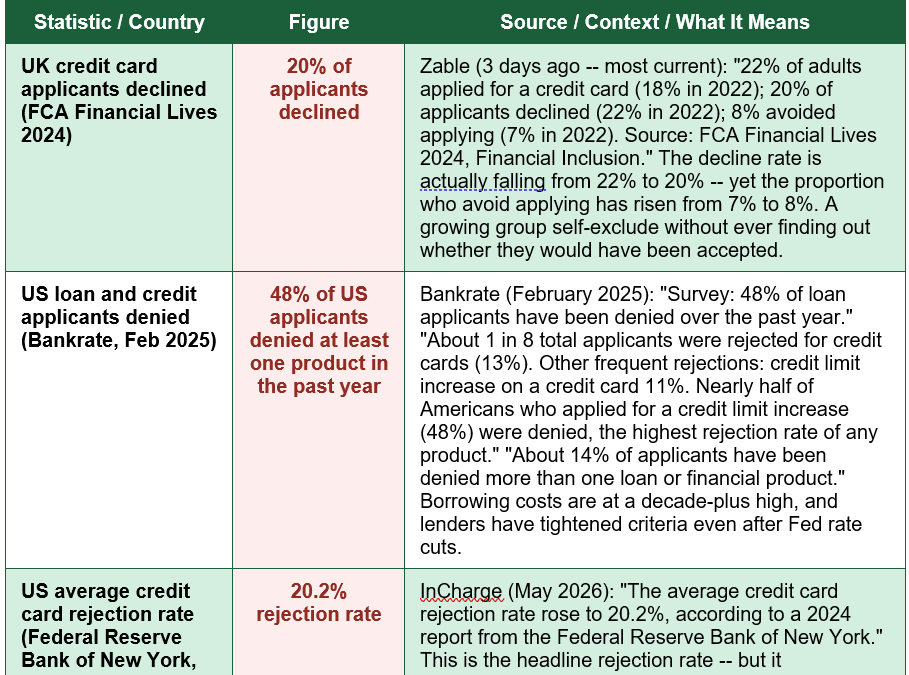
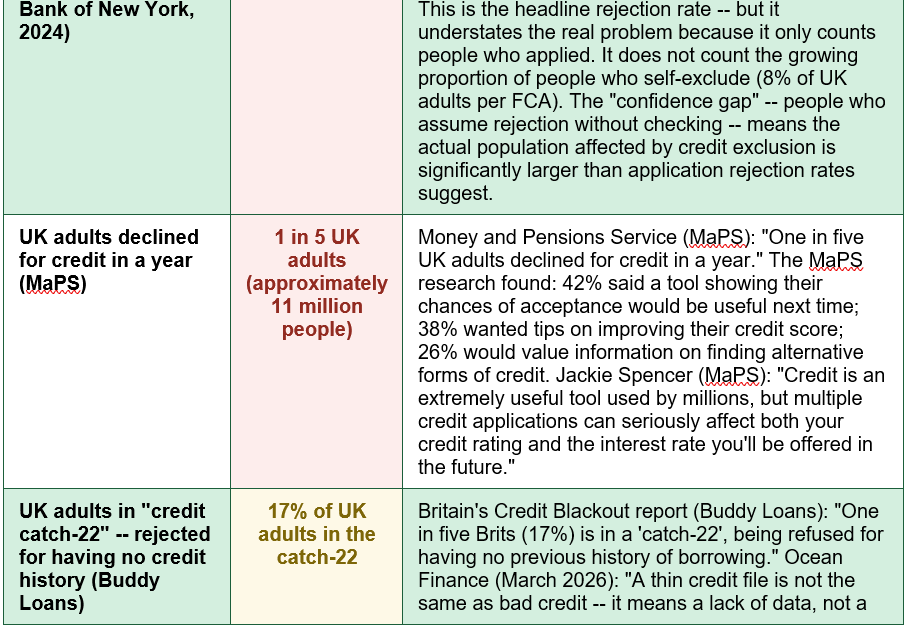
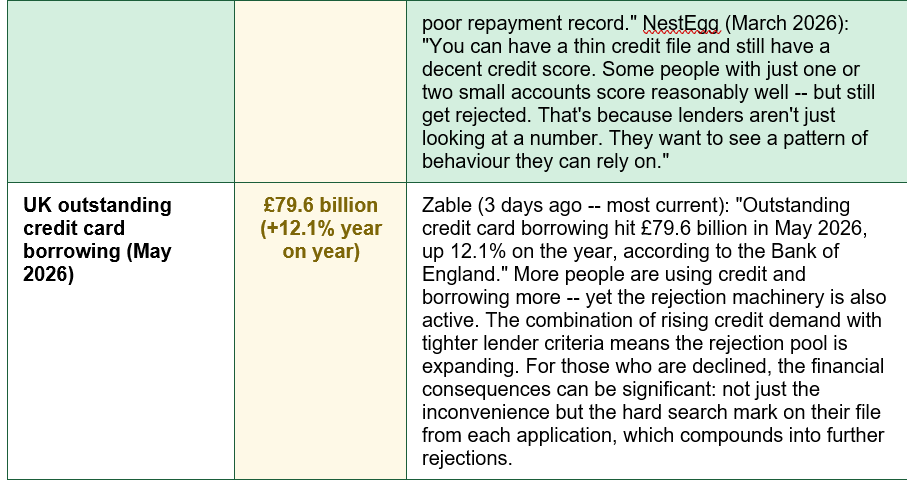
The numbers are striking. In the UK, FCA Financial Lives 2024 data shows that 20% of credit card applicants are declined -- and on top of that, 8% of UK adults avoid applying entirely because they assume the answer will be no. One in five UK adults is declined for credit in a year, according to the Money and Pensions Service -- approximately 11 million people. In the US, Bankrate's February 2025 survey found that 48% of Americans who applied for any credit product in the past year were denied at least one. The Federal Reserve Bank of New York reported that the average credit card rejection rate reached 20.2% in 2024 -- the highest in the Federal Reserve's tracking of this data.
The frustration is not just the rejection itself. It is the opacity. Lenders in the UK and US are not required to explain precisely why they rejected an application -- they must tell you which credit reference agency they used, but not what specifically on the report triggered the decline. This means that people make the same mistake twice, three times, each time leaving another hard search mark on their file that makes the next application more likely to fail. This guide cuts through the opacity. It explains the most common hidden reasons why credit applications are declined -- reasons that have nothing to do with deliberate financial recklessness -- and provides a specific, actionable fix for every one of them.
The confidence gap: the people who never apply because they assume rejection. Zable (3 days ago -- most current): 'Some of it is a confidence gap, where people assume rejection without checking. That matters, because you can now check your likelihood of approval with a soft search that doesn't affect your credit score. Understanding what a soft credit check is can remove a lot of the guesswork. The data shows two different problems. Some people are being declined, but a far larger group never apply because they assume the answer will be no. Checking your eligibility with a soft search costs you nothing and tells you where you actually stand, without leaving a mark on your credit file.' The FCA Financial Lives 2024 data confirms this: 8% of UK adults avoided applying for credit in the year studied because they assumed rejection -- up from 7% in 2022. This self-exclusion group is growing even as the actual rejection rate is falling. The tools that address this -- eligibility checkers on MSE Credit Club, ClearScore, TotallyMoney, and Experian -- are free, take minutes, and leave no mark on the credit file. Using them is not applying for credit. It is finding out whether applying for credit makes sense. The distinction matters enormously.
FIVE MISTAKES THAT TURN ONE CREDIT REJECTION INTO MANY MORE: (1) RE-APPLYING IMMEDIATELY AFTER REJECTION. Every new application creates a new hard search. If you apply for five credit cards in a month after being rejected, each hard search compounds the problem -- five applications in 30 days looks exactly like financial desperation to the next lender who opens your file. RULE: wait at least 3-6 months after any rejection before applying again, unless you have specifically identified and fixed the problem first. (2) NOT CHECKING WHY YOU WERE REJECTED BEFORE REAPPLYING. Lenders must tell you which credit reference agency they used. Request a free copy of that report immediately and check it for errors, thin history, financial associations, or high utilisation. Fix the specific problem before applying again. (3) APPLYING FOR MULTIPLE PRODUCTS SIMULTANEOUSLY. Rate-shopping by applying to five lenders at once and waiting to see who says yes is credit-destroying behaviour. Every one of those applications leaves a hard search. Use soft-search eligibility checkers instead -- they show you all your options in one place with no file impact. (4) NOT CHECKING ALL THREE CREDIT REFERENCE AGENCIES. Experian, Equifax, and TransUnion hold different data from different lenders. An error that causes your rejection might appear on one report and not the others. Checking only one gives you an incomplete picture. Check all three -- free of charge individually or together via Checkmyfile.com. (5) GIVING UP AND NOT BUILDING YOUR PROFILE. Being declined once is not a life sentence. Ocean Finance (March 2026): 'Building your credit file takes time, but it doesn't have to feel like a big task. The steps below are practical, low-cost, and most of them can be started today. Consistency is what makes the difference -- small, regular positive actions build up over months and years into something lenders can really work with.'
COMPLETE CREDIT REJECTION ACTION PLAN -- WHAT TO DO NEXT: IMMEDIATELY AFTER REJECTION: (1) Do NOT apply anywhere else yet. (2) Contact the lender and ask which credit reference agency they used. (3) Request a free credit report from that agency within 28 days (Experian experian.co.uk, Equifax equifax.co.uk, TransUnion via creditkarma.co.uk). (4) Check for errors, old addresses, financial associations, high utilisation, and thin history. (5) Also check the other two agencies -- they hold different data. WITHIN 4 WEEKS: (6) Register on the electoral roll if not already done (gov.uk/register-to-vote -- 5 minutes). (7) Dispute any credit report errors directly with the relevant CRA -- they have 28 days to respond and must correct confirmed errors. (8) Apply for a notice of disassociation from any old financial associations with people whose accounts are closed. (9) Check credit utilisation across all cards -- aim to reduce any card above 30% utilisation before applying again. OVER 3-6 MONTHS: (10) Use Experian Boost or CreditLadder to add regular bill payments and rent to your credit file -- these count as positive payment history. (11) If you have a thin file, open a credit-builder card (Capital One Classic, Tesco Foundation, Aqua Basic) and use it for small purchases, clearing in full each month. (12) After 6 months of rebuilding, use a soft-search eligibility checker | ClearScore free at clearscore.com | TotallyMoney free at totallymoney.com) to find products where your approval likelihood is 70%+. Only then make a formal application. FREE HELP: MoneyHelper 0800 138 7777 | StepChange 0800 138 1111 | Citizens Advice 0800 144 8848.
Not being on the electoral roll is a five-minute fix. A thin credit file can be addressed with a credit-builder card used responsibly over 12 months. Multiple hard searches can be prevented entirely with soft-search eligibility checkers that are free and leave no mark. Financial associations can be identified and removed. Credit report errors can be disputed and corrected. High utilisation can be reduced before an application. Affordability concerns can be mitigated by reducing existing debt. And applying for the wrong product can be avoided by matching your profile to the right product before making any formal application.
None of these fixes are complicated. All of them are available to anyone, at no cost, right now. The credit system is not designed to be impenetrable -- but it is designed assuming that applicants understand how it works. Most people do not. Zable (3 days ago): 'Checking your eligibility with a soft search costs you nothing and tells you where you actually stand, without leaving a mark on your credit file.' That sentence describes the most important shift available to anyone who has been rejected for credit or fears they might be. Use the tools. Check the file. Fix what can be fixed. Apply from a position of knowledge rather than hope. The system is navigable -- and the people who navigate it successfully are simply the ones who know where to look.
A good credit score does not guarantee acceptance for any specific credit product. There are several reasons why a high credit score can coexist with a declined application. First, lenders use their own internal affordability models, not just your credit score. Experian (2026): 'It's always the lender that decides to approve or refuse your application. Credit reference agencies like us can't decide, and we're not told when you're refused or why.' If your debt-to-income ratio is above the lender's threshold, or if your income is variable (self-employment, zero-hours contract, recent job change), the internal model may reject the application regardless of credit score. Second, your credit score from one agency (Experian, Equifax, or TransUnion) may not match the score or data the lender used, because different agencies have different information and different scoring models. Third, not being on the electoral roll, having a financial association with someone who has poor credit, or an error on your report at the agency the lender checked can all cause rejection independent of your numerical score. Fourth, you may have a high score but be applying for a product designed for an even higher-profile customer -- with more income, more credit history, or more geographic stability. Check your report with all three agencies, verify your electoral roll registration, check your utilisation rates, and use an eligibility checker to ensure you are applying for a product matched to your actual profile.
Does being rejected for credit affect my credit score?
The rejection itself does not affect your credit score -- but the hard search that the lender ran as part of the application process does. Ocean Finance (March 2026): when a lender runs a hard search on your credit file as part of assessing your application, that search is recorded and is visible to other lenders for 12 months. A single hard search has a small negative impact on your score. Multiple hard searches in a short period have a larger negative impact because they collectively signal to lenders that you may be experiencing financial difficulty or urgently seeking credit. The hard search mark remains on your file for 12 months whether your application was accepted or rejected. This is why the advice is consistent: do not apply for multiple credit products in rapid succession after a rejection. Each new application adds another hard search mark, compounding the impact and making each subsequent application less likely to succeed. Use soft-search eligibility checkers before making any formal application -- these assess your likely eligibility without creating a hard search, so you can compare products and approval likelihoods without any file impact.
How long does a credit rejection stay on my record?
The credit rejection itself does not appear on your credit file -- lenders are not notified of your rejections by other lenders. What does stay on your credit file is the hard search that the rejecting lender ran as part of the application. Hard searches remain visible on your credit file for 12 months from the date the search was run, after which they disappear automatically. During those 12 months, any lender reviewing your file can see that a search was run and make their own inferences. After 12 months, the search is no longer visible. This means the practical advice is to wait at least 3-6 months after any rejection before applying elsewhere -- giving time to identify and fix the problem, and reducing the cluster effect of multiple searches. For more serious negative marks: missed payments stay on your credit file for six years from the date of the missed payment; defaults stay for six years from the date of default; County Court Judgments (CCJs) stay for six years from the date of the judgment; and bankruptcy stays for six years from the date of discharge. None of these are caused by a credit rejection -- they reflect actual payment failures. A credit rejection itself leaves only the hard search, which disappears in 12 months.
What is an eligibility checker and does it hurt my credit score?
An eligibility checker is a free tool offered by comparison sites, credit reference agencies, and credit card providers that allows you to see your likelihood of being approved for a specific credit product before making a formal application. Eligibility checkers run a soft search on your credit file -- a check that is visible to you but not to lenders assessing future applications. Soft searches do not affect your credit score in any way. Zable (3 days ago): 'You can now check your likelihood of approval with a soft search that doesn't affect your credit score. Understanding what a soft credit check is can remove a lot of the guesswork. Checking your eligibility with a soft search costs you nothing and tells you where you actually stand, without leaving a mark on your credit file.' The tools: MSE Credit Club (free, at moneysavingexpert.com/credit-club) shows your eligibility for credit cards and loans with an approval percentage for each. ClearScore (free, at clearscore.com) provides your Equifax credit score and soft-search eligibility for credit cards and loans. TotallyMoney (free, at totallymoney.com) provides your TransUnion credit score and eligibility checking. Experian (free account at experian.co.uk) provides eligibility checking for credit cards, loans, and mortgages. These tools allow you to compare products across the market, see which ones you are most likely to be approved for, and choose the best match for your profile -- all without a single hard search or any impact on your credit score. Always use an eligibility checker before making any formal credit application.
How can I build credit if I keep being rejected for having no credit history?
The catch-22 of needing credit to build credit affects 17% of UK adults according to Buddy Loans research -- but it is solvable through specific strategies designed exactly for this situation. NestEgg (March 2026): 'A thin credit file is not the same as bad credit -- it means a lack of data, not a poor repayment record.' The most effective approaches in order of accessibility and impact: (1) Register on the electoral roll at gov.uk/register-to-vote. This takes five minutes and immediately strengthens your identity verification with lenders -- it is the fastest win available to anyone with a thin file. (2) Apply for a credit-builder credit card. These are specifically designed for people with no or limited credit history. Examples: Capital One Classic, Aqua Classic, Tesco Foundation card, Marbles. They typically have low credit limits (£200-£500) and higher APRs -- but if you use them only for small, regular purchases and clear the balance in full each month, you never pay interest and you build a positive payment record every month. (3) Use Experian Boost. This free service (at experian.co.uk/boost) adds your regular bill payments -- council tax, streaming subscriptions, utilities -- to your Experian credit file as positive data. Payments you are already making that were previously invisible to lenders now count in your favour. (4) CreditLadder and Credit Builder by CreditLadder (creditladder.co.uk) add your rental payments to your Experian and/or Equifax credit file. If you rent and pay on time every month, these are significant positive data points that lenders can now see. (5) Ocean Finance (March 2026): 'Keep old accounts open. If you have any old credit accounts that are in good standing, keep them open. The length of your credit history is an important factor in your credit score.' After 12-18 months of consistent positive actions, your file will have enough data for mainstream lenders to make an informed decision -- and an eligibility checker will show meaningfully higher approval likelihoods across a wider range of products.
Table of Contents
- The Credit Rejection Epidemic Nobody Talks About
- Credit Rejection in Numbers: The UK and US Data for 2024-2026
- The 8 Hidden Reasons People Are Rejected for Credit
- The 8 Hidden Reasons at a Glance: Reference Chart
- Conclusion
- Frequently Asked Questions (FAQ)
- Why was I declined for credit even though I have a good credit score?
- Does being rejected for credit affect my credit score?
- How long does a credit rejection stay on my record?
- What is an eligibility checker and does it hurt my credit score?
- How can I build credit if I keep being rejected for having no credit history?
- External References & Further Reading
The Credit Rejection Epidemic Nobody Talks About
Every year, millions of people are turned down for credit -- a mortgage, a credit card, a personal loan, a car finance agreement, or even a mobile phone contract -- without ever being told exactly why. The rejection letter says 'we are unable to approve your application at this time.' The door closes. And the person on the other side is left to guess what they did wrong, whether they should try again, and whether trying again will somehow make things worse.The numbers are striking. In the UK, FCA Financial Lives 2024 data shows that 20% of credit card applicants are declined -- and on top of that, 8% of UK adults avoid applying entirely because they assume the answer will be no. One in five UK adults is declined for credit in a year, according to the Money and Pensions Service -- approximately 11 million people. In the US, Bankrate's February 2025 survey found that 48% of Americans who applied for any credit product in the past year were denied at least one. The Federal Reserve Bank of New York reported that the average credit card rejection rate reached 20.2% in 2024 -- the highest in the Federal Reserve's tracking of this data.
The frustration is not just the rejection itself. It is the opacity. Lenders in the UK and US are not required to explain precisely why they rejected an application -- they must tell you which credit reference agency they used, but not what specifically on the report triggered the decline. This means that people make the same mistake twice, three times, each time leaving another hard search mark on their file that makes the next application more likely to fail. This guide cuts through the opacity. It explains the most common hidden reasons why credit applications are declined -- reasons that have nothing to do with deliberate financial recklessness -- and provides a specific, actionable fix for every one of them.
Credit Rejection in Numbers: The UK and US Data for 2024-2026
Understanding the scale of credit rejection -- and the demographic patterns behind it -- is essential context before addressing the causes. The following table maps the most current data from both sides of the Atlantic:
The 8 Hidden Reasons People Are Rejected for Credit
These are the causes that most credit rejection letters never mention -- the structural, technical, and behavioural factors that lenders weigh alongside your credit score, and that affect millions of applicants who have done nothing obviously wrong:HIDDEN REASON #1: NOT BEING ON THE ELECTORAL ROLL | The five-minute fix that surprises most people
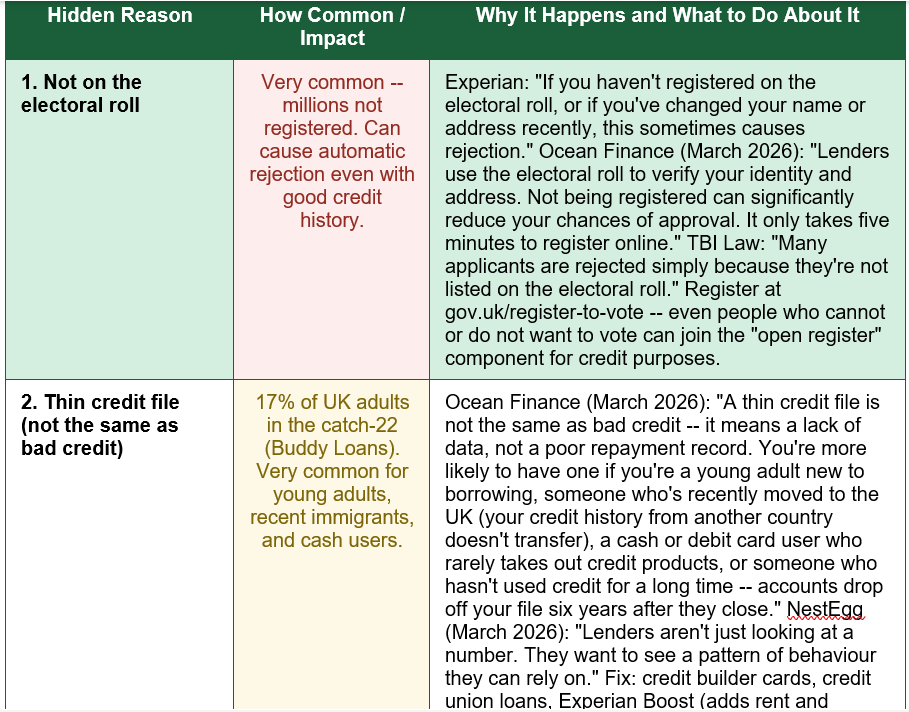
Of all the hidden reasons for credit rejection, not being registered on the electoral roll is possibly the most widespread and the most easily fixed. Experian (2026): 'If you can't register to vote, your applications for credit and services may take longer to process, and you could even be rejected.' Lenders use the electoral roll -- the official list of registered voters maintained by local councils -- to verify your identity and confirm your current address. This is not about your voting habits. It is about whether the lender can verify that you are who you say you are, and that you live where you claim to live. Ocean Finance (March 2026): 'Lenders use the electoral roll to verify your identity and address. Not being registered can significantly reduce your chances of approval.' TBI Law (2026): 'Many applicants are rejected simply because they're not listed on the electoral roll.' The people most affected: those who have recently moved and not updated their registration; younger adults who have never registered; people who moved to the UK from another country; and renters who move frequently. Critically, this is a problem even for people with otherwise good financial histories -- your payment record, income, and existing accounts all become harder to verify without an electoral roll match. The fix is genuinely simple: visit gov.uk/register-to-vote and register at your current address. It takes five minutes. The update appears on your credit file within approximately two to four weeks -- and the benefit is immediate and lasting.HIDDEN REASON #2: A THIN CREDIT FILE -- NOT BAD CREDIT, BUT THE WRONG KIND OF NOTHING | Why being responsible with money can count against you
A thin credit file means your credit report has very little information on it -- not necessarily negative information, but simply a lack of data. This is one of the most counterintuitive rejection reasons because it affects people who have been financially responsible: they have never borrowed irresponsibly, never defaulted, never missed a payment. They simply have not borrowed much. Ocean Finance (March 2026): 'A thin credit file is not the same as bad credit -- it means a lack of data, not a poor repayment record.' NestEgg (March 2026): 'You can have a thin credit file and still have a decent credit score. Some people with just one or two small accounts score reasonably well -- but still get rejected. That's because lenders aren't just looking at a number. They want to see a pattern of behaviour they can rely on.' The groups most affected include young adults who are new to borrowing; people who have recently moved to the UK (credit history from another country does not transfer); cash or debit card users who never use credit products; and people who have not used any credit in several years (accounts drop off the credit file six years after they close). The catch-22 cited by 17% of UK adults is exactly this: being rejected for having no credit history, while being unable to build a credit history without being accepted. The fix: start with the lowest-barrier credit products. A credit-building credit card (designed for this situation, with low limits and high acceptance rates) used for small purchases and cleared in full each month builds a positive repayment record within 6-12 months. Experian Boost adds regular bill payments, rental payments, and council tax to the Experian credit file -- payments that most people are already making consistently.HIDDEN REASON #3: TOO MANY RECENT CREDIT APPLICATIONS -- EACH ONE LEAVES A MARK | The spiral that turns one rejection into several
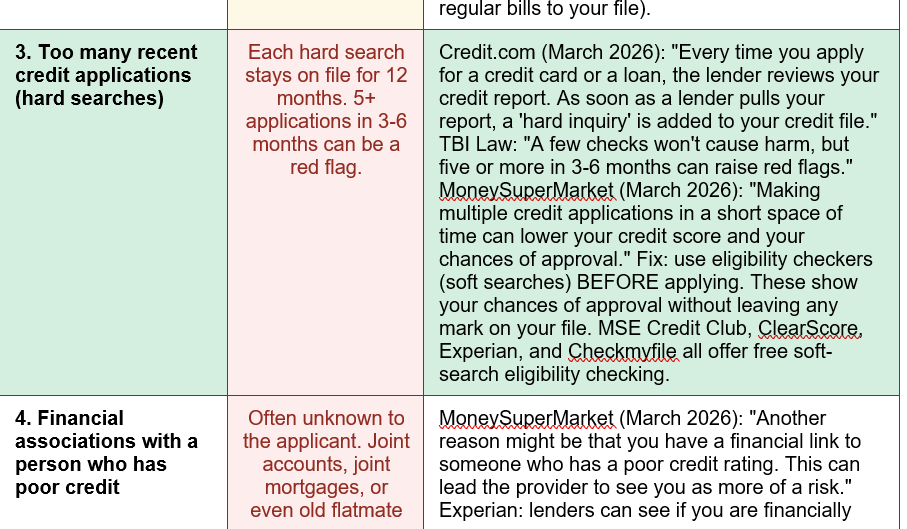
Every time you apply for credit -- a credit card, a loan, a mortgage, car finance, a mobile phone contract -- the lender typically runs a hard search on your credit file. This hard search is recorded and is visible to every other lender who looks at your file for the next 12 months. Credit.com (March 2026): 'Every time you apply for a credit card or a loan, the lender reviews your credit report. As soon as a lender pulls your report, a hard inquiry is added to your credit file.' TBI Law: 'A few checks won't cause harm, but five or more in 3-6 months can raise red flags.' Why do multiple hard searches cause rejections? Because from a lender's perspective, a cluster of recent credit applications suggests that the applicant may be in financial difficulty and is urgently seeking credit -- regardless of whether this is actually true. A person who was recently rejected and is now trying other lenders looks, on paper, identical to a person who is desperate for credit due to financial problems. MoneySuperMarket (March 2026): 'Making multiple credit applications in a short space of time can lower your credit score and your chances of approval.' The fix is prevention: always use soft-search eligibility checkers before making a formal application. These show your likely approval odds without leaving any trace on your credit file. MSE Credit Club, ClearScore, Experian, TotallyMoney, and Checkmyfile all offer free soft-search tools. Only make a hard application when you have a high eligibility score on the specific product -- typically defined as 70% or above likelihood of approval.HIDDEN REASON #4: FINANCIAL ASSOCIATIONS WITH SOMEONE WHO HAS POOR CREDIT | Your ex-partner's credit history might still be affecting yours
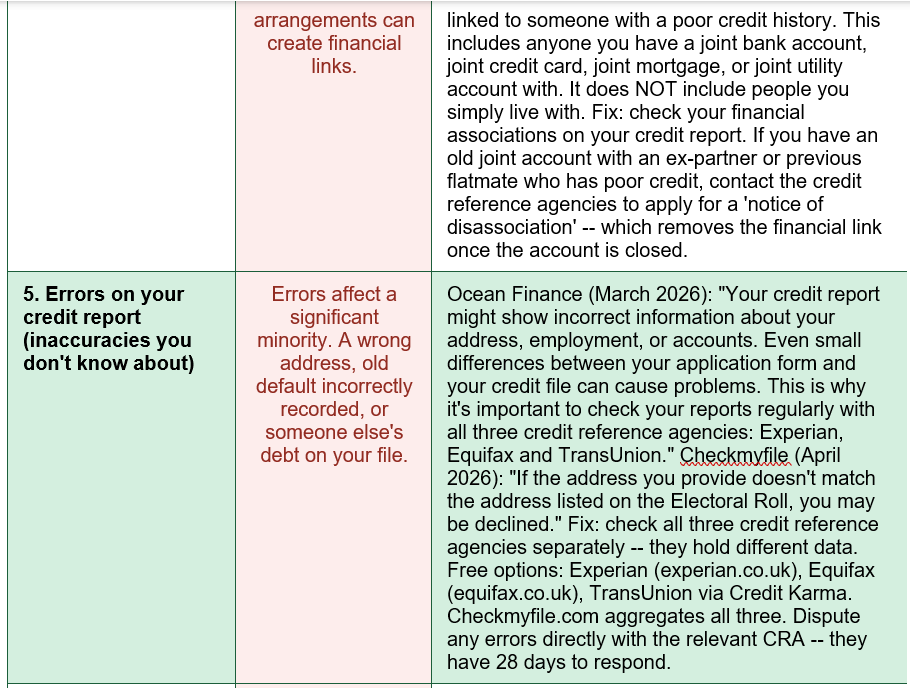
Financial association is one of the least understood causes of credit rejection -- and one of the most disturbing, because it means your credit applications can be affected by another person's financial behaviour that you have no control over. MoneySuperMarket (March 2026): 'Another reason might be that you have a financial link to someone who has a poor credit rating. This can lead the provider to see you as more of a risk.' A financial association is created when two people have a joint financial account: a joint bank account, a joint credit card, a joint mortgage, or a joint utility or phone contract. It is not created simply by living with someone. If your ex-partner, a former flatmate, or a family member with whom you once shared a financial account has poor credit, lenders can see this link and factor it into their assessment of your application -- even though you are responsible for your own finances and they are responsible for theirs. Experian (2026): lenders can see if you are financially linked to someone with a poor credit history, and this can affect their decision. The fix: first, check your credit report with all three credit reference agencies to see who you are financially associated with. If you find a historical association with someone you no longer have joint accounts with, contact the credit reference agency directly and apply for a 'notice of disassociation.' This removes the financial link from your file, but only if all joint accounts have been closed. While the association exists, it is factored into lenders' risk assessment of your applications.HIDDEN REASON #5: ERRORS ON YOUR CREDIT REPORT | Inaccuracies that you cannot see are causing rejections you do not understand
Credit report errors are more common than most people realise -- and because most people never check their credit reports, these errors continue to cause rejections without the applicant ever knowing why. Ocean Finance (March 2026): 'Your credit report might show incorrect information about your address, employment, or accounts. Even small differences between your application form and your credit file can cause problems.' Checkmyfile (April 2026): 'If the address you provide doesn't match the address listed on the electoral roll, you may be declined.' Common errors include: an old address still listed as current; a default or missed payment incorrectly recorded (not yours, or now paid but still showing as outstanding); a closed account still showing as open; someone else's information on your file (a fraud risk flag); an account linked to the wrong name (name change after marriage not updated); or a County Court Judgment (CCJ) that has been satisfied but is still showing as outstanding. Experian (2026): 'It's important to find out why you were refused before you apply again. Making multiple credit applications in a short space of time can lower your credit score and your chances of approval.' The fix: check all three credit reference agencies separately -- Experian, Equifax, and TransUnion. They hold different data from different lenders, so an error can appear on one report and not the others. Free access: Experian (experian.co.uk), Equifax (equifax.co.uk), and TransUnion via Credit Karma (creditkarma.co.uk). Checkmyfile.com is a paid service (£14.99/month after a 30-day free trial) that aggregates all three in one view. Dispute any inaccuracies directly with the CRA -- they have 28 days to investigate and respond, and must correct confirmed errors.HIDDEN REASON #6: HIGH CREDIT UTILISATION | The number on your credit card statement that lenders watch more than your score
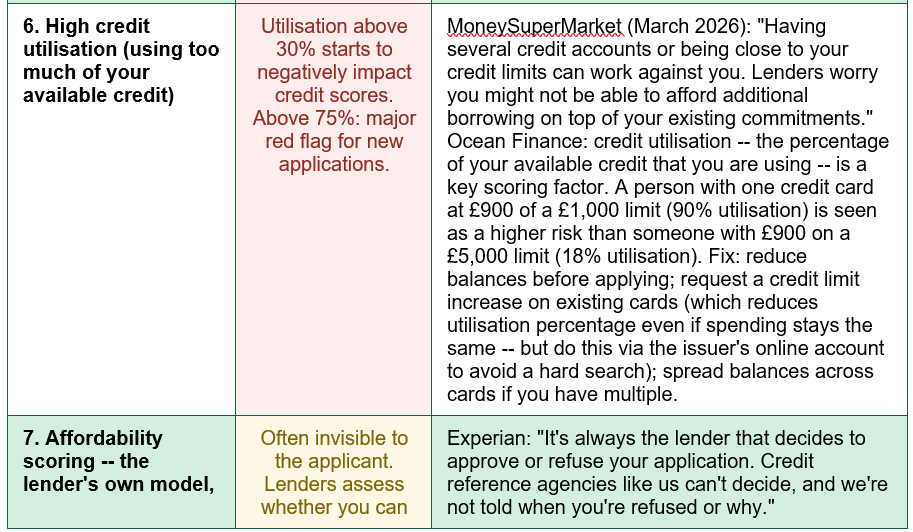
Credit utilisation -- the percentage of your available revolving credit that you are currently using -- is one of the most important and least understood factors in credit decisions. MoneySuperMarket (March 2026): 'Having several credit accounts or being close to your credit limits can work against you. Lenders worry you might not be able to afford additional borrowing on top of your existing commitments.' The mechanics: if you have a credit card with a £2,000 limit and £1,800 outstanding, your utilisation on that card is 90%. Even if you have an excellent payment history and have never missed a payment, 90% utilisation signals to lenders that you are highly dependent on your existing credit and may not be able to afford additional borrowing. FICO scoring models in the US use credit utilisation as approximately 30% of the total score -- making it the second most important factor after payment history. UK lenders also weight utilisation heavily in their internal affordability models. The impact compounds: high utilisation on multiple cards is more alarming to lenders than high utilisation on one card. A person with three cards all at 80% utilisation looks significantly more stretched than a person with one card at 80% and two cards at low usage. The fix: reduce card balances before making a credit application. Even reducing utilisation from 80% to below 30% on individual cards can produce a meaningful credit score improvement within one to two reporting cycles (typically 30-60 days). Alternatively, requesting a credit limit increase on existing cards (without spending more) mathematically reduces utilisation percentage -- but request this via the card issuer's online account to avoid triggering a hard search.HIDDEN REASON #7: AFFORDABILITY SCORING -- THE INVISIBLE MODEL YOU CANNOT SEE | Your credit score passed. The lender's own model failed you.
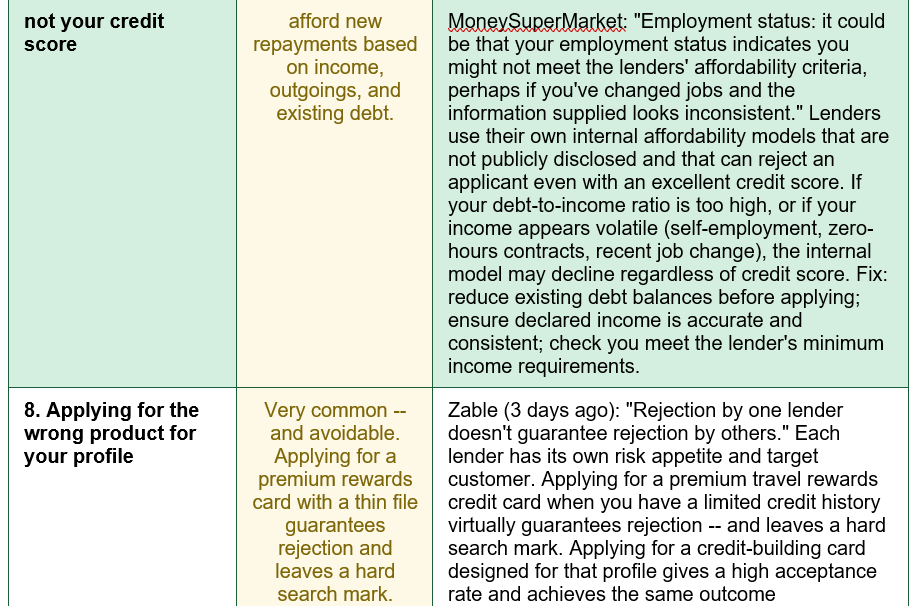
This is the rejection reason that generates the most frustration -- and the most confusion -- among applicants with good credit scores. Experian (2026): 'It's always the lender that decides to approve or refuse your application. Credit reference agencies like us can't decide, and we're not told when you're refused or why.' Every lender operates its own internal affordability model that is separate from -- and additional to -- your credit score. This model assesses whether you can afford the repayments on the new credit product, based on your declared income, your visible existing debt obligations, your employment status, and your expenditure patterns where these can be inferred. The model is not publicly disclosed and its specific thresholds and weightings are proprietary. This means a person with an Excellent credit score on Experian's scale can still be rejected by a specific lender because their debt-to-income ratio exceeds that lender's internal threshold, or because their employment contract (zero-hours, freelance, recently changed) triggers a risk flag. MoneySuperMarket (March 2026): 'Employment status: it could be that your employment status indicates that you might not meet the lenders' affordability criteria, perhaps if you've changed jobs and the information supplied looks inconsistent.' The fix: reduce existing debt balances before applying; ensure income declarations are accurate and consistent with verifiable evidence; if self-employed, lenders often require at least two years of accounts; check whether the specific lender has a minimum income requirement and confirm your income meets it. If you are declined for affordability reasons, asking the lender directly for the specific reason -- in writing if necessary -- is your right under the UK's Consumer Duty regulation.HIDDEN REASON #8: APPLYING FOR THE WRONG PRODUCT | Premium card, thin file, guaranteed rejection -- and a hard search mark you cannot remove
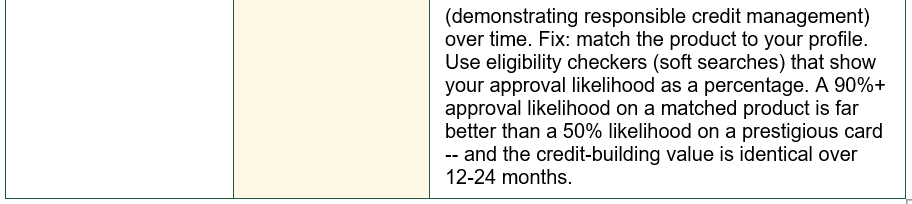
The final hidden reason is structural: applying for a credit product that is designed for a financial profile significantly better than yours guarantees rejection, leaves a hard search mark, and achieves nothing except making the next application harder. Zable (3 days ago): 'Rejection by one lender doesn't guarantee rejection by others.' Each lender targets a specific customer profile with its credit products. A market-leading travel rewards credit card is designed for customers with excellent credit scores, significant income, and long credit histories -- and it will reject applicants who fall outside that profile regardless of any other positive factors. The same outcome (a credit account that demonstrates responsible management) can be achieved by a credit-building product designed specifically for limited-history or rebuilding applicants, with a high acceptance rate. The irony: the credit-building value of a year's responsible management of a credit-builder card is identical to a year on a premium rewards card. The score improvement from clearing a credit-builder card each month is the same. But the rejection rate is dramatically different, as is the risk of accumulating hard searches. The fix: match your application to your profile. Use eligibility checkers -- MSE Credit Club, ClearScore, TotallyMoney, Experian -- to see your approval likelihood across a range of products before applying for any of them. A 90% approval likelihood on a credit-builder card is worth far more than a 50% likelihood on a premium rewards card. Apply for the product where your eligibility score is highest. Once you have built 12-24 months of positive history with an accessible product, reapply for a more premium product from a position of clear eligibility.The 8 Hidden Reasons at a Glance: Reference Chart
The following table summarises all 8 hidden rejection reasons with their impact level and what to do about each one:The confidence gap: the people who never apply because they assume rejection. Zable (3 days ago -- most current): 'Some of it is a confidence gap, where people assume rejection without checking. That matters, because you can now check your likelihood of approval with a soft search that doesn't affect your credit score. Understanding what a soft credit check is can remove a lot of the guesswork. The data shows two different problems. Some people are being declined, but a far larger group never apply because they assume the answer will be no. Checking your eligibility with a soft search costs you nothing and tells you where you actually stand, without leaving a mark on your credit file.' The FCA Financial Lives 2024 data confirms this: 8% of UK adults avoided applying for credit in the year studied because they assumed rejection -- up from 7% in 2022. This self-exclusion group is growing even as the actual rejection rate is falling. The tools that address this -- eligibility checkers on MSE Credit Club, ClearScore, TotallyMoney, and Experian -- are free, take minutes, and leave no mark on the credit file. Using them is not applying for credit. It is finding out whether applying for credit makes sense. The distinction matters enormously.
FIVE MISTAKES THAT TURN ONE CREDIT REJECTION INTO MANY MORE: (1) RE-APPLYING IMMEDIATELY AFTER REJECTION. Every new application creates a new hard search. If you apply for five credit cards in a month after being rejected, each hard search compounds the problem -- five applications in 30 days looks exactly like financial desperation to the next lender who opens your file. RULE: wait at least 3-6 months after any rejection before applying again, unless you have specifically identified and fixed the problem first. (2) NOT CHECKING WHY YOU WERE REJECTED BEFORE REAPPLYING. Lenders must tell you which credit reference agency they used. Request a free copy of that report immediately and check it for errors, thin history, financial associations, or high utilisation. Fix the specific problem before applying again. (3) APPLYING FOR MULTIPLE PRODUCTS SIMULTANEOUSLY. Rate-shopping by applying to five lenders at once and waiting to see who says yes is credit-destroying behaviour. Every one of those applications leaves a hard search. Use soft-search eligibility checkers instead -- they show you all your options in one place with no file impact. (4) NOT CHECKING ALL THREE CREDIT REFERENCE AGENCIES. Experian, Equifax, and TransUnion hold different data from different lenders. An error that causes your rejection might appear on one report and not the others. Checking only one gives you an incomplete picture. Check all three -- free of charge individually or together via Checkmyfile.com. (5) GIVING UP AND NOT BUILDING YOUR PROFILE. Being declined once is not a life sentence. Ocean Finance (March 2026): 'Building your credit file takes time, but it doesn't have to feel like a big task. The steps below are practical, low-cost, and most of them can be started today. Consistency is what makes the difference -- small, regular positive actions build up over months and years into something lenders can really work with.'
COMPLETE CREDIT REJECTION ACTION PLAN -- WHAT TO DO NEXT: IMMEDIATELY AFTER REJECTION: (1) Do NOT apply anywhere else yet. (2) Contact the lender and ask which credit reference agency they used. (3) Request a free credit report from that agency within 28 days (Experian experian.co.uk, Equifax equifax.co.uk, TransUnion via creditkarma.co.uk). (4) Check for errors, old addresses, financial associations, high utilisation, and thin history. (5) Also check the other two agencies -- they hold different data. WITHIN 4 WEEKS: (6) Register on the electoral roll if not already done (gov.uk/register-to-vote -- 5 minutes). (7) Dispute any credit report errors directly with the relevant CRA -- they have 28 days to respond and must correct confirmed errors. (8) Apply for a notice of disassociation from any old financial associations with people whose accounts are closed. (9) Check credit utilisation across all cards -- aim to reduce any card above 30% utilisation before applying again. OVER 3-6 MONTHS: (10) Use Experian Boost or CreditLadder to add regular bill payments and rent to your credit file -- these count as positive payment history. (11) If you have a thin file, open a credit-builder card (Capital One Classic, Tesco Foundation, Aqua Basic) and use it for small purchases, clearing in full each month. (12) After 6 months of rebuilding, use a soft-search eligibility checker | ClearScore free at clearscore.com | TotallyMoney free at totallymoney.com) to find products where your approval likelihood is 70%+. Only then make a formal application. FREE HELP: MoneyHelper 0800 138 7777 | StepChange 0800 138 1111 | Citizens Advice 0800 144 8848.
Conclusion
Credit rejection affects millions of people every year -- one in five UK adults, nearly half of US credit applicants -- and the overwhelming majority are never told precisely why. The eight hidden reasons in this guide are not exotic edge cases. They are structural features of how credit assessment works that catch people out regardless of their intentions or their actual financial responsibility.Not being on the electoral roll is a five-minute fix. A thin credit file can be addressed with a credit-builder card used responsibly over 12 months. Multiple hard searches can be prevented entirely with soft-search eligibility checkers that are free and leave no mark. Financial associations can be identified and removed. Credit report errors can be disputed and corrected. High utilisation can be reduced before an application. Affordability concerns can be mitigated by reducing existing debt. And applying for the wrong product can be avoided by matching your profile to the right product before making any formal application.
None of these fixes are complicated. All of them are available to anyone, at no cost, right now. The credit system is not designed to be impenetrable -- but it is designed assuming that applicants understand how it works. Most people do not. Zable (3 days ago): 'Checking your eligibility with a soft search costs you nothing and tells you where you actually stand, without leaving a mark on your credit file.' That sentence describes the most important shift available to anyone who has been rejected for credit or fears they might be. Use the tools. Check the file. Fix what can be fixed. Apply from a position of knowledge rather than hope. The system is navigable -- and the people who navigate it successfully are simply the ones who know where to look.
Frequently Asked Questions (FAQ)
Why was I declined for credit even though I have a good credit score?A good credit score does not guarantee acceptance for any specific credit product. There are several reasons why a high credit score can coexist with a declined application. First, lenders use their own internal affordability models, not just your credit score. Experian (2026): 'It's always the lender that decides to approve or refuse your application. Credit reference agencies like us can't decide, and we're not told when you're refused or why.' If your debt-to-income ratio is above the lender's threshold, or if your income is variable (self-employment, zero-hours contract, recent job change), the internal model may reject the application regardless of credit score. Second, your credit score from one agency (Experian, Equifax, or TransUnion) may not match the score or data the lender used, because different agencies have different information and different scoring models. Third, not being on the electoral roll, having a financial association with someone who has poor credit, or an error on your report at the agency the lender checked can all cause rejection independent of your numerical score. Fourth, you may have a high score but be applying for a product designed for an even higher-profile customer -- with more income, more credit history, or more geographic stability. Check your report with all three agencies, verify your electoral roll registration, check your utilisation rates, and use an eligibility checker to ensure you are applying for a product matched to your actual profile.
Does being rejected for credit affect my credit score?
The rejection itself does not affect your credit score -- but the hard search that the lender ran as part of the application process does. Ocean Finance (March 2026): when a lender runs a hard search on your credit file as part of assessing your application, that search is recorded and is visible to other lenders for 12 months. A single hard search has a small negative impact on your score. Multiple hard searches in a short period have a larger negative impact because they collectively signal to lenders that you may be experiencing financial difficulty or urgently seeking credit. The hard search mark remains on your file for 12 months whether your application was accepted or rejected. This is why the advice is consistent: do not apply for multiple credit products in rapid succession after a rejection. Each new application adds another hard search mark, compounding the impact and making each subsequent application less likely to succeed. Use soft-search eligibility checkers before making any formal application -- these assess your likely eligibility without creating a hard search, so you can compare products and approval likelihoods without any file impact.
How long does a credit rejection stay on my record?
The credit rejection itself does not appear on your credit file -- lenders are not notified of your rejections by other lenders. What does stay on your credit file is the hard search that the rejecting lender ran as part of the application. Hard searches remain visible on your credit file for 12 months from the date the search was run, after which they disappear automatically. During those 12 months, any lender reviewing your file can see that a search was run and make their own inferences. After 12 months, the search is no longer visible. This means the practical advice is to wait at least 3-6 months after any rejection before applying elsewhere -- giving time to identify and fix the problem, and reducing the cluster effect of multiple searches. For more serious negative marks: missed payments stay on your credit file for six years from the date of the missed payment; defaults stay for six years from the date of default; County Court Judgments (CCJs) stay for six years from the date of the judgment; and bankruptcy stays for six years from the date of discharge. None of these are caused by a credit rejection -- they reflect actual payment failures. A credit rejection itself leaves only the hard search, which disappears in 12 months.
What is an eligibility checker and does it hurt my credit score?
An eligibility checker is a free tool offered by comparison sites, credit reference agencies, and credit card providers that allows you to see your likelihood of being approved for a specific credit product before making a formal application. Eligibility checkers run a soft search on your credit file -- a check that is visible to you but not to lenders assessing future applications. Soft searches do not affect your credit score in any way. Zable (3 days ago): 'You can now check your likelihood of approval with a soft search that doesn't affect your credit score. Understanding what a soft credit check is can remove a lot of the guesswork. Checking your eligibility with a soft search costs you nothing and tells you where you actually stand, without leaving a mark on your credit file.' The tools: MSE Credit Club (free, at moneysavingexpert.com/credit-club) shows your eligibility for credit cards and loans with an approval percentage for each. ClearScore (free, at clearscore.com) provides your Equifax credit score and soft-search eligibility for credit cards and loans. TotallyMoney (free, at totallymoney.com) provides your TransUnion credit score and eligibility checking. Experian (free account at experian.co.uk) provides eligibility checking for credit cards, loans, and mortgages. These tools allow you to compare products across the market, see which ones you are most likely to be approved for, and choose the best match for your profile -- all without a single hard search or any impact on your credit score. Always use an eligibility checker before making any formal credit application.
How can I build credit if I keep being rejected for having no credit history?
The catch-22 of needing credit to build credit affects 17% of UK adults according to Buddy Loans research -- but it is solvable through specific strategies designed exactly for this situation. NestEgg (March 2026): 'A thin credit file is not the same as bad credit -- it means a lack of data, not a poor repayment record.' The most effective approaches in order of accessibility and impact: (1) Register on the electoral roll at gov.uk/register-to-vote. This takes five minutes and immediately strengthens your identity verification with lenders -- it is the fastest win available to anyone with a thin file. (2) Apply for a credit-builder credit card. These are specifically designed for people with no or limited credit history. Examples: Capital One Classic, Aqua Classic, Tesco Foundation card, Marbles. They typically have low credit limits (£200-£500) and higher APRs -- but if you use them only for small, regular purchases and clear the balance in full each month, you never pay interest and you build a positive payment record every month. (3) Use Experian Boost. This free service (at experian.co.uk/boost) adds your regular bill payments -- council tax, streaming subscriptions, utilities -- to your Experian credit file as positive data. Payments you are already making that were previously invisible to lenders now count in your favour. (4) CreditLadder and Credit Builder by CreditLadder (creditladder.co.uk) add your rental payments to your Experian and/or Equifax credit file. If you rent and pay on time every month, these are significant positive data points that lenders can now see. (5) Ocean Finance (March 2026): 'Keep old accounts open. If you have any old credit accounts that are in good standing, keep them open. The length of your credit history is an important factor in your credit score.' After 12-18 months of consistent positive actions, your file will have enough data for mainstream lenders to make an informed decision -- and an eligibility checker will show meaningfully higher approval likelihoods across a wider range of products.
0 Comments
Be the first to share your thoughts on this article.