

Real Estate
How Can Renters Build Wealth When They Can't Afford to Buy?

Homeowners have nearly 40x the median net worth of renters. But the Fed found renter net worth aged 25-34 rose 40% since 2019. The gap is real. It is not permanent. The numbers are uncomfortable. The Federal Reserve’s Survey of Consumer Finances found that homeowners had nearly 40 times the median net worth of renters in 2022. That is not a typo. And with home prices up 48% between 2019 and 2024 while household incomes rose just 22% — according to MarketWatch data via Asiae.co.kr’s September 2026 analysis — the gap between what it costs to buy and what most renters can actually afford has become a structural feature of the housing market rather than a temporary anomaly. Thirty percent of non-homeowners aged 18 to 34 said they were unlikely to buy a home in the near future in Gallup surveys aggregated for 2025-2026 — more than double the 13% who said so in 2013-2015. So the question is not whether renters face a disadvantage. They do. The question is whether there is a path to meaningful wealth-building that does not require owning a home — and what that path actually demands. The same Federal Reserve data shows that median renter net worth among 25 to 34 year olds exceeded $80,000 in 2023, up 40% since 2019, driven not by property ownership but by investing, side hustles, and alternative assets. There is a path. This article explains what it involves, what it requires, and what it cannot guarantee.
🇬🇧 UK context: UK wealth gap: £338,170 over 30 years (Mortgage Advice Bureau / Mortgage Solutions July 2025). Year 10 gap: ~£12,157. 65% of UK renters aspire to buy; 27% believe never able to afford. 56% would buy if mortgage matched rent. UK renter tools: Stocks and Shares ISA (£20,000/year); Lifetime ISA (£4,000/year + 25% bonus for first home or age 60); Cash ISA (emergency fund); pension.
In theory, yes — with significant conditions. Mark Zandi, quoted in MarketWatch analysis via Asiae.co.kr September 2026, identifies the specific requirement: 'For a tenant to build up comparable wealth, they must invest the surplus every year for 30 years without interruption, and refrain from withdrawing funds even when the stock market falls.' The Federal Reserve's 2023 data found that median renter net worth among 25-34-year-olds exceeded $80,000, up 40% since 2019, driven by investing rather than property. The UK Mortgage Solutions July 2025 analysis found a £338,170 wealth creation gap over 30 years — but this represents the outcome without any alternative investment strategy. With disciplined investing, the gap narrows. Whether it can be fully closed depends on individual market conditions, investment returns, local property price growth, and crucially, the discipline to maintain contributions.
What is the best way for a renter to start building wealth in 2026?
InvestWithRoots' May-June 2026 strategy identifies five core mechanisms: (1) invest the monthly cost difference between renting and owning ($500-$1,500/month in most major US markets); (2) invest in real estate through REITs and Reg A platforms; (3) build and protect an emergency fund as a prerequisite; (4) report rent to credit bureaus to build credit history; (5) consistently contribute to retirement accounts. The FinanceBuzz 2026 analysis of Federal Reserve data identifies the root cause: only 48.2% of renters held appreciating assets in 2022. The solution is not complex — it is acquiring and holding appreciating assets within tax-advantaged wrappers.
How can renters invest in real estate without buying property?
REITs (Real Estate Investment Trusts) are the primary mechanism. Publicly traded REIT ETFs are accessible through standard brokerage accounts, can be held inside ISAs (UK) or IRAs (US), and provide diversified exposure to commercial and residential real estate without requiring a deposit, mortgage, or property management obligations. InvestWithRoots identifies REITs and Regulation A investment platforms as giving renters 'the wealth-building benefit of real estate ownership without any of the homeownership obligations.' The tradeoff is the absence of leverage — a homeowner's equity return is amplified by the mortgage; a REIT investor does not have that structural advantage.
What is rent reporting and does it actually help?
Rent reporting involves using a service that submits your regular rental payments to one or more major credit bureaus — establishing a payment history that a standard rental arrangement does not create. InvestWithRoots identifies this as building 'the credit profile needed for future financial opportunities.' In the US, services such as RentTrack and Experian RentBureau provide this. In the UK, CreditLadder and Canopy offer equivalent services. A stronger credit profile affects the interest rate on all future borrowing and mortgage eligibility. The Mortgage Advice Bureau's July 2025 research found 56% of UK renters would consider buying if mortgage repayments matched rent — positioning them to benefit from the best available rates.
Should I keep renting and investing, or try to buy as soon as possible?
InvestWithRoots' June 2026 analysis identifies the key determinant: 'Whether renting or buying is smarter in 2026 depends on your local market, how long you plan to stay, your financial readiness, and your wealth-building strategy.' The Mortgage Advice Bureau's research found that 'many renters are much closer to buying than they realise.' The key financial markers for when buying typically becomes the stronger long-term choice are: plan to stay in the location for at least 5-7 years (covering transaction costs and initial interest-heavy mortgage periods); a deposit that avoids high mortgage insurance premiums; mortgage payments that don't exceed the rent-or-buy threshold by a margin that would significantly reduce investment capacity.
Table of Contents
- The Honest Starting Point: What the Wealth Gap Actually Shows
- Strategy 1 Invest the Rent-vs-Buy Difference
- Strategy 2 Invest in Real Estate Without Buying Property
- Strategy 3 Build Credit Through Rent Reporting
- Strategy 4 Automate Retirement Contributions First
- Strategy 5 Build the Emergency Fund as a Non-Negotiable Foundation
- The UK Picture: £338,170 and What Renters Should Know
- The Comparison: Renter Wealth-Building vs Homeownership
- The Honest Caveat: What This Strategy Demands
- Conclusion: The Gap Is Real. The Path Exists. It Requires Discipline.
- Frequently Asked Questions
The Honest Starting Point: What the Wealth Gap Actually Shows
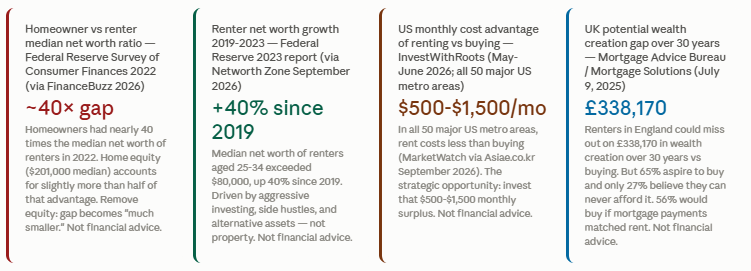
The Federal Reserve’s Survey of Consumer Finances is the most comprehensive data source on American household wealth, and its most frequently quoted finding for this conversation is stark: homeowners had nearly 40 times the median net worth of renters in 2022. The FinanceBuzz 2026 analysis of this data adds the essential context: home equity explains most but not all of this gap. Median net housing wealth reached $201,000 for homeowners in 2022, accounting for slightly more than half of the homeowner net worth advantage. Remove home equity from the equation, and the gap becomes ‘much smaller, though it doesn’t disappear completely.’ The portion of the gap that persists after removing home equity reflects differences in investment behaviour, retirement account participation, and asset ownership more broadly — differences that are directly addressable by renters who understand the mechanics. Only 48.2% of renters held any appreciating assets in 2022, compared to nearly all homeowners (for whom the home itself is an appreciating asset). This is the real problem: not that renters cannot own appreciating assets, but that most do not. About half of renters were spending at least 30% of their income on housing, leaving limited margin for investment. But the Federal Reserve’s 2023 data, cited by Networth Zone in September 2026, shows that the picture is changing: median renter net worth among 25-34-year-olds exceeded $80,000, up 40% since 2019, driven not by property ownership but by investing and alternative asset classes. The path exists. It is narrow. It requires intentionality that homeownership does not. Homeowners: nearly 40x median net worth of renters (Federal Reserve 2022 via FinanceBuzz 2026). Home equity accounts for slightly more than half homeowner net worth ($200,000 median). Remove home equity: wealth gap 'much smaller but doesn't disappear.' Only 48.2% of renters held appreciating assets (Federal Reserve via FinanceBuzz). Renter net worth aged 25-34: exceeded $80,000, up 40% since 2019 (Federal Reserve 2023 via Networth Zone September 2026).Strategy 1 Invest the Rent-vs-Buy Difference
Turn the monthly cost gap into your investment engine
In 2026, owning a comparable home costs $500 to $1,500 more per month than renting in most major US markets, according to InvestWithRoots’ May 2026 analysis. That is the rent-vs-buy difference — the monthly surplus that a renter retains compared to what a homeowner of an equivalent property pays when you factor in mortgage payments, property tax, maintenance, and insurance. The strategic opportunity for wealth-building renters is to invest that difference rather than absorb it as discretionary spending. This is the strategy that Asiae.co.kr’s September 2026 MarketWatch analysis identifies as the vehicle by which ‘some high-income young earners in the United States are choosing to remain tenants, investing not only the difference between rent and the cost of owning, but also the lump sum they would have allocated for a down payment into financial assets.’ The mathematics of this approach are well-established. Mark Zandi, quoted in MarketWatch via the same analysis, provides the honest caveat: ‘For a tenant to build up comparable wealth, they must invest the surplus every year for 30 years without interruption, and refrain from withdrawing funds even when the stock market falls.’ That condition — without interruption, including during downturns — is the critical discipline that InvestWithRoots frames directly: ‘Homeowners build wealth because they’re forced to. Renters build wealth only if they choose to.’ The forced savings mechanism of the mortgage has no automatic equivalent for renters. Creating that equivalent requires automation: standing order into an ISA (UK), automatic contribution to a 401(k) or IRA (US), or regular transfer into a brokerage account. In 2026, all-in monthly cost of owning exceeds renting by $500-$1,500 in most major US markets (InvestWithRoots May-June 2026). Home prices +48% 2019-2024; incomes +22% (MarketWatch via Asiae.co.kr September 2026). Rent costs less than buying in all 50 major US metro areas (MarketWatch).Strategy 2 Invest in Real Estate Without Buying Property
REITs, Reg A platforms, and fractional real estate exposure
The idea that you cannot participate in real estate investment without buying a property has been structurally undermined by the development of Real Estate Investment Trusts (REITs) and Regulation A investment platforms. REITs are publicly traded or non-traded investment vehicles that hold portfolios of income-producing real estate — commercial property, residential property, warehousing, healthcare facilities — and distribute most of their income to shareholders. The FinanceBuzz 2026 analysis identifies the core insight: ‘It’s that households generally need to own appreciating assets to build substantial wealth.’ Homeownership is one way to own an appreciating asset. REITs are another. InvestWithRoots’ May 2026 strategy guide for renters identifies this explicitly: ‘Invest in real estate without buying a property. You get the wealth-building benefit of real estate ownership without any of the homeownership obligations.’ Publicly traded REIT ETFs (such as those tracking the FTSE NAREIT or equivalent UK index) are accessible through standard brokerage accounts with no minimum investment, can be held inside tax-advantaged wrappers (ISA in the UK, IRA in the US), and provide diversified exposure across multiple property types and geographies rather than the concentrated, leveraged, single-property exposure of owning one home. The tradeoff compared to direct homeownership is the absence of leverage: a homeowner who buys a £250,000 house with a £50,000 deposit benefits from leverage (a £25,000 rise in house value is a 50% return on the deposit). A REIT investor does not have access to this structural lever. 48.2% of renters held appreciating assets in 2022 — vs nearly all homeowners (Federal Reserve via FinanceBuzz 2026). REITs and Reg A vehicles give renters real estate exposure without a mortgage (InvestWithRoots May-June 2026). Federal Reserve 2023: median renter net worth 25-34 exceeded $80,000, up 40% since 2019, driven by investing and alternatives (Networth Zone September 2026).Strategy 3 Build Credit Through Rent Reporting
Turn the payment you're already making into a credit-building event
Rent is typically the largest single monthly payment a renter makes — and in most jurisdictions it is completely invisible to credit bureaus by default. A homeowner making mortgage payments builds credit history with every payment, automatically, because mortgage servicers report to credit bureaus as a standard practice. A renter paying the same or higher amount for accommodation builds no credit history from that payment unless they take a specific additional step. InvestWithRoots’ strategy guide identifies rent reporting as one of five core wealth-building mechanisms for renters: ‘Report rent to build credit — the credit profile needed for future financial opportunities.’ Rent reporting services submit your regular rental payments to one or more of the major credit bureaus, establishing a consistent, on-time payment history that strengthens your credit profile. In the US, services such as RentTrack, Experian RentBureau, and others provide this. In the UK, CreditLadder and Canopy offer rental payment reporting. A stronger credit score has direct financial consequences: it affects the interest rate offered on all future borrowing, insurance premiums in some markets, and most importantly, mortgage qualification terms when and if the renter does eventually choose to buy. The Mortgage Advice Bureau’s July 2025 research on renters found that 56% of renters said they would consider buying if mortgage repayments matched rent, which is increasingly possible as lending innovation continues. A strong credit profile positions a renter to access the best available mortgage rates at that point. Rent payments not reported by default to credit bureaus — unlike mortgage payments (InvestWithRoots May 2026). Rent reporting services (US: RentTrack, Experian; UK: CreditLadder, Canopy) submit rental payments to credit bureaus. 56% of UK renters would consider buying if mortgage payments matched rent (Mortgage Advice Bureau / Mortgage Solutions July 2025).Strategy 4 Automate Retirement Contributions First
The wealth-building baseline that compounds independent of property prices
The NBC Boston and Aspen Institute analysis of renter wealth-building identifies the most reliable wealth-building lever available to renters across all income brackets: consistently contributing to retirement accounts. For the renter earning over $100,000, the strategy is clear: fill tax-advantaged retirement accounts first (401k, IRA in the US; pension, ISA in the UK), then invest the remaining surplus. For renters at lower income levels, the retirement account is both more challenging to fund and more consequential — a small contribution made consistently from a young age has decades of compounding available to it. The Federal Reserve data, cited by FinanceBuzz’ 2026 analysis, shows that the home equity differential accounts for most but not all of the homeowner-renter wealth gap: ‘Remove home equity from the equation, and the homeowner-renter wealth gap becomes much smaller, though it doesn’t disappear completely.’ That remaining gap is largely explained by differences in investment behaviour and retirement account participation. The NBC Boston analysis of the Aspen Institute research identifies this pattern: ‘Renters who do hold [appreciating] assets tend to have lower median values compared with homeowners.’ The solution is not mysterious. It is the same solution that InvestWithRoots identifies: ‘Consistently contribute to retirement accounts.’ The 401k employer match is the only guaranteed 50-100% immediate return on investment available to most workers. Leaving it unclaimed because housing costs are tight is the most expensive decision a renter can make. Home equity accounts for 'slightly more than half' of homeowners' median net worth; $200,000 median home equity vs total median homeowner net worth (Aspen Institute via NBC Boston). Remove home equity and wealth gap becomes 'much smaller' (FinanceBuzz 2026). 'Consistently contribute to retirement accounts' — core renter wealth-building strategy (InvestWithRoots May 2026).Strategy 5 Build the Emergency Fund as a Non-Negotiable Foundation
Stability before strategy
Every wealth-building strategy for renters breaks down without the foundational layer of financial stability. About half of renters spent at least 30% of their income on housing in 2022 (Federal Reserve data via FinanceBuzz 2026), leaving limited capacity for emergency savings, investments, or a future home purchase. The Aspen Institute’s analysis, cited by NBC Boston, identifies the income hierarchy directly: for renters earning under $25,000 per year, the first requirement is ‘financial stability to meet the precondition for wealth building.’ An emergency fund of three to six months of essential expenses is that precondition. Without it, every financial setback — job loss, car repair, medical bill, unexpected move cost — translates into debt, which compounds against the wealth-building process rather than for it. InvestWithRoots’ May 2026 strategy identifies ‘build and protect an emergency fund’ as one of the five core renter wealth-building mechanisms, not as an add-on to the investment strategy but as a prerequisite for it. A renter with three months of emergency savings who loses their job can maintain investment contributions while managing the transition. A renter without that buffer must stop all investments, may take on high-interest debt, and loses the compounding continuity that makes the strategy viable. For UK renters, this means ISA cash as the emergency fund vehicle — accessible, tax-free, and separate from investment funds. About half of renters spent at least 30% of income on housing in 2022 (Federal Reserve via FinanceBuzz 2026). 'Financial stability is the precondition for wealth building' for lower-income renters (Aspen Institute via NBC Boston). 'Build and protect an emergency fund' — core renter strategy (InvestWithRoots May 2026).The UK Picture: £338,170 and What Renters Should Know
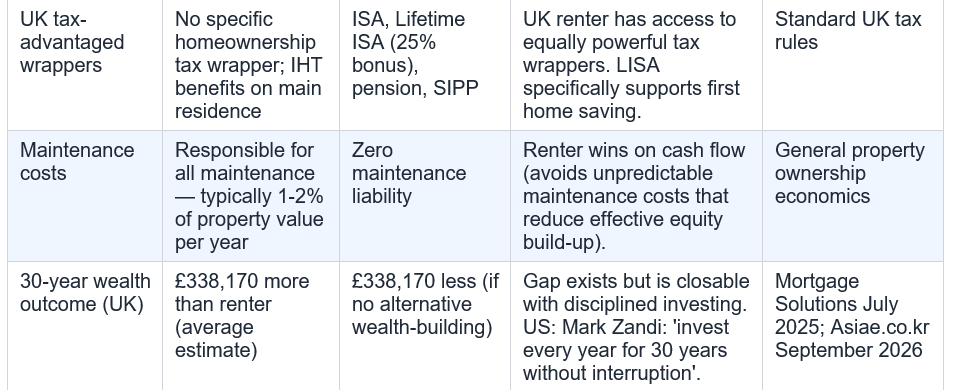
Mortgage Solutions’ July 2025 reporting on Mortgage Advice Bureau research produced the most specific calculation of the renter wealth gap in the UK: renters in England could lose out on around £338,170 in potential wealth creation over 30 years compared to those who buy. By year 10, the homeowner advantage is already approximately £12,157. The numbers are significant, but the same research surfaces a more nuanced picture. Around 65% of renters aspire to buy a home, but only 27% believe they will never be able to afford it. Around 56% of renters said they would consider buying if mortgage repayments matched their current rent — suggesting that the barrier is largely the upfront cost (deposit, stamp duty) and initial repayment level rather than a permanent incapacity to afford homeownership. Ben Thompson of the Mortgage Advice Bureau made the point directly: ‘Many renters are much closer to buying than they realise.’ For UK renters who are building wealth while renting, the Stocks and Shares ISA is the primary vehicle: up to £20,000 per year tax-free, accessible at any point, and capable of holding a diversified portfolio including REIT ETFs, global equity trackers, and bonds. The Lifetime ISA (LISA) specifically supports renters who are saving for a first home purchase: up to £4,000 per year (within the £20,000 ISA allowance), with a 25% government bonus, accessible at age 60 or for a first home purchase up to £450,000. The cash ISA provides the emergency fund layer. The pension provides the long-term retirement foundation. UK renters have a complete tax-advantaged toolkit that, if fully utilised, partially closes the wealth gap identified in the Mortgage Solutions research.🇬🇧 UK context: UK wealth gap: £338,170 over 30 years (Mortgage Advice Bureau / Mortgage Solutions July 2025). Year 10 gap: ~£12,157. 65% of UK renters aspire to buy; 27% believe never able to afford. 56% would buy if mortgage matched rent. UK renter tools: Stocks and Shares ISA (£20,000/year); Lifetime ISA (£4,000/year + 25% bonus for first home or age 60); Cash ISA (emergency fund); pension.
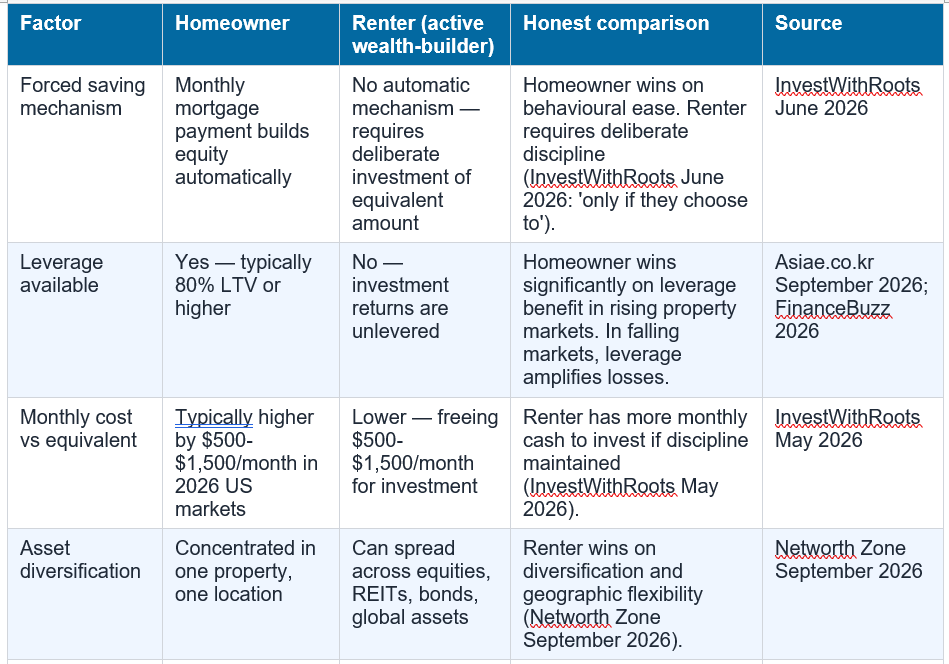
The Comparison: Renter Wealth-Building vs Homeownership
Sources: FinanceBuzz 2026; InvestWithRoots May-June 2026; Asiae.co.kr/MarketWatch September 2026; Mortgage Solutions July 2025; Federal Reserve. Not financial or property advice. Individual circumstances vary significantly by location, income, and discipline.
The Honest Caveat: What This Strategy Demands
Grant Sabatier, author of Financial Freedom, quoted in Networth Zone’s September 2026 analysis, provides the most important contextualisation of the renter wealth-building path: ‘In reality, it’s the most flexible way to build wealth — if you know where to put that money instead.’ That conditional — ‘if you know where to put that money instead’ — is where most renter wealth-building strategies fail. Mark Zandi’s caveat, quoted in the same research context: ‘For a tenant to build up comparable wealth, they must invest the surplus every year for 30 years without interruption, and refrain from withdrawing funds even when the stock market falls.’ The comparison between renting-plus-investing and homeownership is often framed as a simple mathematical choice. It is not. The homeowner’s path has a built-in behavioural infrastructure: the mortgage direct debit, the equity that accumulates without a decision being made, the social and psychological weight of owning property that discourages casual liquidation. The renter’s investment path requires all of that discipline to be generated internally, maintained through market downturns, sustained through periods of lifestyle inflation, and protected from the multitude of legitimate spending demands that arise over 30 years. InvestWithRoots frames it plainly: ‘Homeowners build wealth because they’re forced to. Renters build wealth only if they choose to.’ The choice is real, it is available, and the data shows a growing number of renters are making it successfully. But calling it easy would misrepresent what it requires.Conclusion
The Federal Reserve data that shows homeowners with nearly 40 times the median net worth of renters is the right number to start with, because it takes the problem seriously. The same data shows that the gap is driven primarily by home equity and secondarily by differential asset ownership — and that the second factor is directly addressable. The Federal Reserve’s 2023 report found that median renter net worth among 25-34-year-olds exceeded $80,000, up 40% since 2019, driven by investing and alternative assets. The strategies in this article — investing the rent-vs-buy difference, accessing real estate through REITs, building credit through rent reporting, automating retirement contributions, and protecting the emergency fund foundation — are not theoretical. They are the mechanisms that the growing share of wealth-building renters are actually using. The honest caveat remains Mark Zandi’s: comparable wealth requires investing consistently for 30 years without interruption. That is the price of the path. It is not impossibly high. But it is higher than the discipline required of the homeowner who set up a mortgage direct debit thirty years ago and never touched it. The gap between those two paths is not destiny. It is design. And it can be deliberately closed — not perfectly, and not easily, but meaningfully and measurably. Always consult a qualified financial adviser.Frequently Asked Questions
Can renters really build as much wealth as homeowners?In theory, yes — with significant conditions. Mark Zandi, quoted in MarketWatch analysis via Asiae.co.kr September 2026, identifies the specific requirement: 'For a tenant to build up comparable wealth, they must invest the surplus every year for 30 years without interruption, and refrain from withdrawing funds even when the stock market falls.' The Federal Reserve's 2023 data found that median renter net worth among 25-34-year-olds exceeded $80,000, up 40% since 2019, driven by investing rather than property. The UK Mortgage Solutions July 2025 analysis found a £338,170 wealth creation gap over 30 years — but this represents the outcome without any alternative investment strategy. With disciplined investing, the gap narrows. Whether it can be fully closed depends on individual market conditions, investment returns, local property price growth, and crucially, the discipline to maintain contributions.
What is the best way for a renter to start building wealth in 2026?
InvestWithRoots' May-June 2026 strategy identifies five core mechanisms: (1) invest the monthly cost difference between renting and owning ($500-$1,500/month in most major US markets); (2) invest in real estate through REITs and Reg A platforms; (3) build and protect an emergency fund as a prerequisite; (4) report rent to credit bureaus to build credit history; (5) consistently contribute to retirement accounts. The FinanceBuzz 2026 analysis of Federal Reserve data identifies the root cause: only 48.2% of renters held appreciating assets in 2022. The solution is not complex — it is acquiring and holding appreciating assets within tax-advantaged wrappers.
How can renters invest in real estate without buying property?
REITs (Real Estate Investment Trusts) are the primary mechanism. Publicly traded REIT ETFs are accessible through standard brokerage accounts, can be held inside ISAs (UK) or IRAs (US), and provide diversified exposure to commercial and residential real estate without requiring a deposit, mortgage, or property management obligations. InvestWithRoots identifies REITs and Regulation A investment platforms as giving renters 'the wealth-building benefit of real estate ownership without any of the homeownership obligations.' The tradeoff is the absence of leverage — a homeowner's equity return is amplified by the mortgage; a REIT investor does not have that structural advantage.
What is rent reporting and does it actually help?
Rent reporting involves using a service that submits your regular rental payments to one or more major credit bureaus — establishing a payment history that a standard rental arrangement does not create. InvestWithRoots identifies this as building 'the credit profile needed for future financial opportunities.' In the US, services such as RentTrack and Experian RentBureau provide this. In the UK, CreditLadder and Canopy offer equivalent services. A stronger credit profile affects the interest rate on all future borrowing and mortgage eligibility. The Mortgage Advice Bureau's July 2025 research found 56% of UK renters would consider buying if mortgage repayments matched rent — positioning them to benefit from the best available rates.
Should I keep renting and investing, or try to buy as soon as possible?
InvestWithRoots' June 2026 analysis identifies the key determinant: 'Whether renting or buying is smarter in 2026 depends on your local market, how long you plan to stay, your financial readiness, and your wealth-building strategy.' The Mortgage Advice Bureau's research found that 'many renters are much closer to buying than they realise.' The key financial markers for when buying typically becomes the stronger long-term choice are: plan to stay in the location for at least 5-7 years (covering transaction costs and initial interest-heavy mortgage periods); a deposit that avoids high mortgage insurance premiums; mortgage payments that don't exceed the rent-or-buy threshold by a margin that would significantly reduce investment capacity.
0 Comments
Be the first to share your thoughts on this article.