

Business
How Fee-Only Financial Advisors Put Clients First
Only 27% of Americans use a financial adviser. Of those, most never ask how their adviser is paid. The answer matters enormously: an adviser who earns commissions on the products they recommend has a financial interest in what they tell you. A fee-only adviser does not. On June 22, 2026, NAPFA formalised what that difference means in practice — five binding duties and a compensation model that draws a bright line between advice that serves you and advice that serves the adviser. This guide explains exactly where that line is.
Most people who hire a financial adviser never ask the one question that determines whether the advice they receive is designed for their benefit or for the adviser's. The question is simple: 'How are you paid, and by whom?' The answer — specifically whether the adviser earns commissions on the financial products they recommend, or whether they are paid exclusively by the client — is the single most important variable in determining whose interests the advice serves.
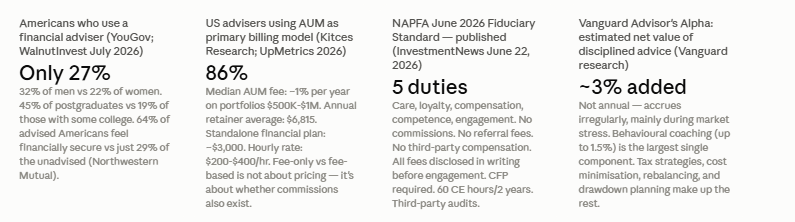
Only 27% of Americans use a financial adviser, according to YouGov data cited by WalnutInvest's July 2026 financial adviser statistics report. Of those who do, the research consistently shows that they are significantly better off for it: 64% of advised Americans feel financially secure compared to just 29% of those without an adviser (Northwestern Mutual). Vanguard's Advisor's Alpha framework, developed in 2001 and updated regularly, estimates that disciplined advice from an aligned adviser can add approximately 3% in net returns over time. But those benefits are substantially conditional on the advice being truly aligned — given by someone whose income does not depend on which products they recommend to you.
On June 22, 2026, the National Association of Personal Financial Advisors (NAPFA) published a newly formalised Fiduciary Standard that draws the sharpest line yet between what fee-only advice means in practice and what the rest of the industry does. Five binding duties. No commissions. No referral fees. No third-party compensation of any kind. All fees disclosed in writing before the engagement begins. NAPFA CEO Kathryn Dattomo summarised it directly: 'The word fiduciary is used often, but what it means in practice is not always clear. NAPFA-Registered Financial Advisors commit to putting clients first in every recommendation and relationship.' (InvestmentNews, June 22, 2026.) This guide explains every element of that commitment — and why it matters for anyone who works with or is considering working with a financial professional.
327,000 financial adviser jobs (BLS 2024; WalnutInvest July 2026). 283,000 active client-facing advisers (Cerulli; WalnutInvest July 2026). Only 27% of Americans use an adviser (YouGov; WalnutInvest). 64% of advised Americans feel financially secure vs 29% unadvised (Northwestern Mutual). 86% of advisers use AUM fees as primary billing model (Kitces Research; UpMetrics 2026). 1% median AUM fee on $500K-$1M portfolio. Vanguard Advisor's Alpha: approximately 3% in net returns from disciplined advice. NAPFA June 22, 2026: new Fiduciary Standard — five binding duties; no commissions; all fees in writing before engagement.
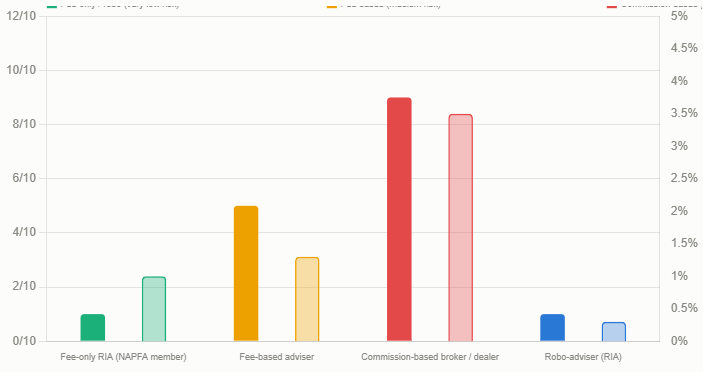
Commission-based advisers earn their income by selling financial products. Every time a client purchases a mutual fund with a sales load, an annuity, or a life insurance policy, the adviser receives a payment from the product provider — not from the client. The client may not pay any visible fee at all, which can create the impression that the advice is free. It is not. The commission is embedded in the product's cost structure, and because the adviser earns more from some products than others, there is a systematic incentive to recommend higher-commission products regardless of whether they are the best option for the client. Variable annuities, whole-life insurance policies, and loaded mutual funds have historically been among the highest-commission products — and among the products most often cited in adviser misconduct cases.
Fee-based advisers charge the client a fee (typically a percentage of assets managed, an hourly rate, or a flat fee) and also earn commissions on some products they sell. The fee portion of the relationship may be genuine, transparent, and well-intentioned. The commission portion introduces a structural conflict: in the part of the relationship where commissions are available, the adviser benefits from recommending higher-commission products. The two income streams can coexist in the same client relationship, sometimes in the same recommendation. WalnutInvest's June 2026 fee-only vs fee-based comparison notes precisely: 'The two terms sound nearly identical, and fee-based is sometimes used precisely because it borrows the cleaner reputation of fee-only.'
Fee-only advisers are compensated exclusively by their clients. No commissions. No product sales incentives. No referral fees. No revenue-sharing arrangements with any third party. Payment takes the form of a percentage of assets managed, an hourly rate, a flat project fee, or an annual or monthly retainer — all of which are agreed with the client in advance. The fee-only structure does not eliminate the possibility of poor advice, but it eliminates the specific financial incentive to recommend products that benefit the adviser at the client's expense.
The terminology problem: the difference between 'fee-only' and 'fee-based' is a single word and a profound structural distinction. But there are no regulatory rules preventing a fee-based adviser from describing themselves using language that sounds very similar to fee-only. The NerdWallet 2026 guide to fee-only vs fee-based advisers notes: 'Understanding whether your advisor is getting payments for steering you toward certain mutual funds or other financial products is important — and raises questions about conflicts of interest.' The verification burden falls on the client, which is why knowing exactly what to look for matters. Not financial advice.
The amounts involved are not trivial. A loaded mutual fund charging 5.75% upfront on a $100,000 investment costs $5,750 before any management fee. An annuity with a 7-year surrender period and a 7% surrender charge creates a $7,000 exit cost if the client needs to access funds in year two. A whole-life insurance policy charging 10-15 times the premium of comparable term coverage may require 20 years of premium payments before the cash value exceeds the premiums paid. These are not hypothetical edge cases — they are documented costs in the financial products that have historically generated the highest commission rates.
The fee-only model removes these incentives entirely. A fee-only adviser who recommends a particular mutual fund or insurance product receives no financial benefit from doing so. Their recommendation is driven by the product's suitability for the client, not by the product's commission schedule. This does not guarantee that every recommendation is correct — advisers make mistakes regardless of compensation structure — but it does remove the systematic financial incentive to be wrong in a specific, profitable direction.
The commission vs fee-only cost comparison. Scenario: $500,000 portfolio, 30-year horizon, 6% gross return. COMMISSION STRUCTURE: Front-load fund at 5.75% sales charge = $28,750 upfront cost on initial investment. Annual expense ratio of fund with commission: 1.0-1.5% (higher expense funds often pay higher commissions). After 30 years at 6% gross, net of 1.25% annual cost: approximately $1.84 million. FEE-ONLY STRUCTURE: No front-load. AUM fee of 1% on growing assets. Low-cost index funds: 0.05% expense ratio. Total annual cost: approximately 1.05%. After 30 years at 6% gross, net of 1.05% annual cost: approximately $2.02 million. Difference: approximately $180,000 more over 30 years from lower-cost, conflict-free advice. This is a simplified illustration. Actual outcomes depend on specific products, markets, and individual circumstances. Not financial advice — consult a qualified adviser.
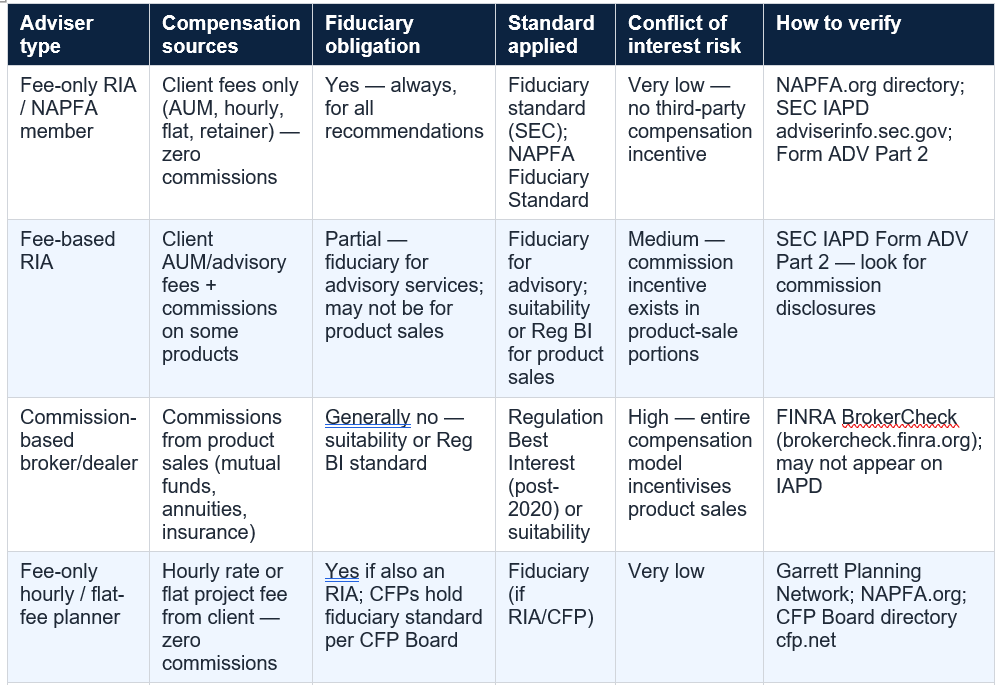
Not every financial adviser is a fiduciary. SEC-registered investment advisers (RIAs) are held to the fiduciary standard by law. Broker-dealers — who operate under FINRA regulation rather than SEC investment adviser regulation — are generally held to the lower 'suitability' standard, which only requires that recommendations be reasonably appropriate for the client, not necessarily the best available option. Many financial professionals operate as both an RIA and a broker-dealer simultaneously, which means they may be acting as a fiduciary during part of the client relationship and under the suitability standard during other parts — potentially in the same conversation.
The CFP (Certified Financial Planner) credential imposed its own fiduciary requirement on certificate holders as of October 2019: CFPs must act as fiduciaries when providing financial advice, even if they are not technically an RIA. NAPFA has long required fiduciary commitment from all members. The layering of fiduciary obligations through different regulatory bodies and professional standards creates a landscape where the term 'fiduciary' is used broadly, which is precisely why NAPFA's June 2026 formalised standard is significant — it specifies, in binding written form, exactly what the duty requires in practice.
The fiduciary standard in plain language: your adviser must recommend what is best for you, even when something else would be better for them. They must disclose all conflicts of interest. They must not accept compensation that creates incentives to act against your interests. If they have a financial interest in what they recommend, they must tell you — and if they cannot eliminate that interest, they may not be able to be a true fiduciary at all. This standard applies automatically to all NAPFA members and SEC-registered RIAs. It does not apply automatically to broker-dealers or insurance agents who sell financial products. Source: NAPFA June 2026; InvestmentNews June 22, 2026. Not legal advice.
The practical difference is easiest to see in specific product choices. Consider a 60-year-old investor with $200,000 to invest for retirement, who wants moderate growth with some income. A fiduciary adviser's obligation is to recommend the option that best serves those goals — which might be a simple, low-cost balanced index fund at 0.10% annual expense ratio. A broker-dealer's obligation under the suitability standard is to recommend something that could reasonably be described as suitable for those goals — which might include a variable annuity with a 2.5% annual fee, a 7-year surrender charge, and a commission rate of 6-7% paid to the broker from the product provider. Both are arguably 'suitable' for a moderate-growth-with-income goal. Only one is best.
The SEC's Regulation Best Interest (Reg BI), which took effect in June 2020, raised the standard for broker-dealers above pure suitability — requiring them to act in the client's 'best interest' when making a recommendation. But Reg BI is weaker than the fiduciary standard in important ways: it applies only at the point of recommendation rather than throughout the relationship, does not require full conflict elimination, and does not prohibit commissions. The NAPFA fee-only fiduciary standard applies at all times and prohibits the conflict entirely.
The suitability standard exists for broker-dealers — not for RIAs. If your financial adviser is registered as a broker-dealer or works for a brokerage firm, they may be operating under the suitability standard for some or all of their recommendations, even if they use language suggesting otherwise. The clearest way to determine the standard your adviser operates under: ask them directly whether they are a fiduciary at all times for all of their recommendations. If the answer is anything other than an unqualified 'yes,' the distinction matters. Check their Form ADV filing with the SEC's Investment Adviser Public Disclosure (IAPD) database to verify their registration status. Not financial advice.
But the AUM model is not the only fee-only structure available — and it is not always the best fit for every client. A client with modest investable assets but complex planning needs (a small business owner navigating retirement accounts, a divorcing individual dealing with asset division, a young professional with student debt and no significant portfolio yet) may be better served by one of the alternative fee-only structures:
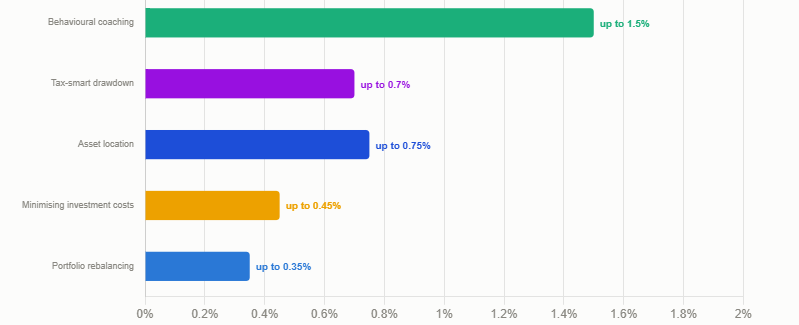
The 3% is not a claim that advisers can outperform the market. It is an estimate of the value that comes from preventing behavioural mistakes, implementing tax-efficient strategies, keeping costs low, and providing coherent financial planning. Vanguard identifies the specific sources of the estimated value: behavioural coaching (up to 1.5% — preventing panic-selling during market downturns and excessive risk-taking during bull markets); tax-smart strategies including asset location (up to 0.75% — placing tax-efficient investments in taxable accounts and tax-generating investments in tax-advantaged accounts); minimising investment costs (up to 0.45% — selecting low-cost funds over higher-cost alternatives); rebalancing back to target allocation (up to 0.35%); and implementing a tax-smart drawdown strategy in retirement (up to 0.70%).
Vanguard is explicit that the 3% is not expected annually — it accrues irregularly, and the largest share of it materialises during periods of market stress when clients are most tempted to abandon their investment plan. The behavioural coaching component — up to 1.5% of the 3% total — is the single largest contributor, and it is also the component most directly tied to the adviser relationship rather than product selection or portfolio construction. A client who stays invested during a 30% market decline and holds through the recovery captures returns that a panicking investor does not. An aligned adviser who calls during the panic to provide perspective is the mechanism.
The 3% Vanguard estimate is most cleanly realised with a fee-only fiduciary adviser for a structural reason: each of the five value-add components works most reliably when the adviser has no financial incentive to recommend a particular product. An adviser who earns commissions on insurance products may be more likely to recommend insurance during market volatility (for understandable reasons). An adviser who earns more from actively managed funds than from index funds may be less likely to recommend the lower-cost option. The alignment of interests is not incidental to the value of advice — it is foundational to it. Source: Vanguard Advisor's Alpha research. Not financial advice.
Variable annuities are perhaps the most documented example. These products combine an insurance component with investment subaccounts. They can serve genuine financial planning purposes. But their total annual fee load — which can include mortality and expense charges, administrative fees, fund expenses, and optional rider charges — often runs 2.5% to 4% per year, compared to a simple balanced fund or target-date fund at 0.05% to 0.20%. The difference in long-term outcomes from a 3.8% annual fee versus a 0.15% annual fee on the same gross return is substantial over a multi-decade retirement. The commission paid to the adviser at sale can be 6% to 8% of the premium — a significant incentive to recommend.
Whole-life insurance occupies a similar position. There are genuine use cases for permanent life insurance in sophisticated estate planning. But the product is also one of the highest-commission financial products available, and it is frequently recommended in contexts where term insurance plus a straightforward investment account would produce significantly better outcomes for the client at a fraction of the cost. The commission earned on whole-life insurance can be 50% to 100% of the first year's premium.
The Patch/Plymouth fee-only analysis from a NAPFA member perspective states the structural issue concisely: 'These commissions provide an incentive to sell products with the highest payout to the advisor (e.g. loaded mutual funds, variable annuities, whole life insurance) regardless of whether or not this is the best option for the client.' The fee-only model eliminates this incentive not by making advisers more ethical, but by removing the financial reward for less ethical recommendations.
The CFP (Certified Financial Planner) designation is the most widely recognised comprehensive financial planning credential. It requires a bachelor's degree, a CFP Board-registered financial planning education programme, passage of the CFP examination (a rigorous 170-question exam covering financial planning, investments, taxes, estate planning, insurance, and retirement), 6,000 hours of professional financial planning experience (or 4,000 hours of apprenticeship), adherence to the CFP Board's Code of Ethics and Standards of Conduct, and 30 hours of continuing education every two years. In 2025, 6,709 new CFP professionals were certified — the highest annual number ever recorded (UpMetrics 2026). As of 2023, the US had 98,875 CFPs, the largest national total globally.
RIA (Registered Investment Adviser) status with the SEC or state securities regulator is a registration, not a credential — but it is legally significant. SEC-registered RIAs are legally required to act as fiduciaries. They must file Form ADV annually, disclosing their compensation model, services, and any conflicts of interest. In 2025, 16,544 SEC-registered RIA firms managed $176.8 trillion in assets for 73.7 million clients (UpMetrics citing IAA/SEC data). Most RIAs are small businesses: 67.4% manage less than $1 billion in AUM.
NAPFA membership is the most specific credential for fee-only fiduciary advice. NAPFA-Registered Financial Advisors must be CFPs, must operate on a strictly fee-only basis (as defined by NAPFA's Fiduciary Standard), and must commit to all five duties formalised in June 2026. NAPFA membership is verifiable through napfa.org and constitutes the most direct single verification of fee-only fiduciary status available to the public.

The Vanguard Advisor's Alpha research suggests that disciplined, aligned advice is worth approximately 3% in net returns over time — primarily through behavioural coaching during market stress, tax efficiency, and cost management. At a 1% AUM fee, the net value-add from good advice is approximately 2% annually — on a $500,000 portfolio, that is $10,000 per year in value that compounds over decades. The difference between advice that is designed for your benefit and advice that benefits the adviser in ways you may not see accumulates to hundreds of thousands of dollars over a retirement horizon.
The question worth asking before signing any engagement agreement: 'Are you a fiduciary at all times for all of your recommendations, and do you receive any compensation from any source other than the fees I pay you directly?' Ask for the answer in writing. Verify the answer through adviserinfo.sec.gov, NAPFA.org, and cfp.net. The five minutes of verification is one of the most valuable financial actions available. Not financial advice — consult qualified advisers for guidance specific to your situation.
Fee-only and fee-based sound nearly identical but describe fundamentally different compensation structures. A fee-only adviser is paid exclusively by the client — through an AUM fee (percentage of assets managed), an hourly rate, a flat project fee, or a retainer. They earn no commissions, no referral fees, and no third-party compensation of any kind. A fee-based adviser charges the client similar fees but also earns commissions on financial products they sell — such as insurance policies, annuities, or mutual funds with sales loads. The commission portion creates a potential conflict of interest: in those parts of the relationship where commissions are available, the adviser may benefit financially from recommending higher-commission products, even when lower-cost alternatives would better serve the client. WalnutInvest's June 2026 fee-only vs fee-based comparison notes that 'fee-based is sometimes used precisely because it borrows the cleaner reputation of fee-only.' The practical difference can be worth hundreds of thousands of dollars over a long investing horizon. Not financial advice.
What did NAPFA's June 2026 Fiduciary Standard change?
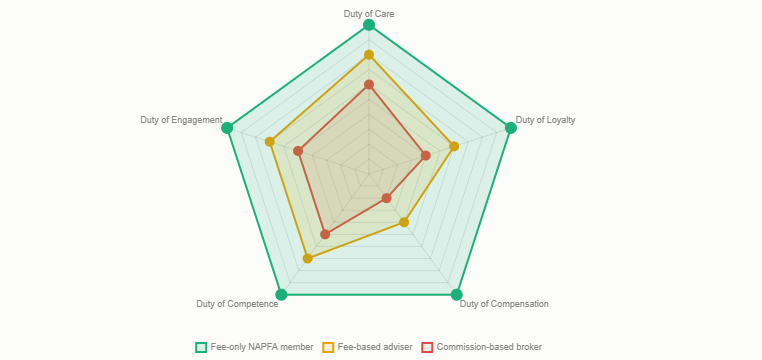
On June 22, 2026, the National Association of Personal Financial Advisors published a newly formalised Fiduciary Standard that codifies, in specific and binding written terms, what it means to operate as a fee-only fiduciary adviser. The standard sets five binding duties that apply at all times — not only during discrete transactions: duty of care (professional knowledge applied to client circumstances); duty of loyalty (client interests above all others); duty of compensation (no commissions, no referral fees, no third-party compensation; all fees disclosed in writing before engagement); duty of competence (CFP certification required; 60 hours of CE every two years); and duty of engagement (ongoing relationship that adapts as the client's circumstances change). The standard also requires periodic third-party audits to verify compliance. NAPFA CEO Kathryn Dattomo was quoted in InvestmentNews on June 22, 2026: 'The word fiduciary is used often, but what it means in practice is not always clear. NAPFA-Registered Financial Advisors commit to putting clients first in every recommendation and relationship.' Not legal advice.
How much does a fee-only financial adviser cost?
Fee-only advisers use several pricing structures, and the right one depends on your financial situation and needs. The most common is the AUM (assets under management) fee: approximately 1% of invested assets per year for portfolios in the $500,000 to $1 million range (2026 State of Financial Planning Fees study by Datos Insights and Envestnet MoneyGuide; Harness.co 2026). Fees decrease as assets grow — portfolios above $5 million typically see fees below 1%. Alternatives include: hourly rates of $200 to $400 per hour; flat project fees averaging approximately $3,000 for a comprehensive financial plan (Kitces Research); annual retainers averaging $6,815 (NerdWallet 2026); and monthly subscriptions averaging approximately $595/month ($7,140/year) (Harness.co 2026). For clients with modest assets but complex planning needs, the Garrett Planning Network offers access to fee-only advisers who charge hourly or flat fees rather than AUM percentages. Not financial advice.
How do I find a fee-only financial adviser?
Three primary resources exist for finding fee-only fiduciary advisers. NAPFA.org: the National Association of Personal Financial Advisors maintains a searchable directory of NAPFA-Registered Financial Advisors by location and specialty. NAPFA membership requires adherence to the fee-only fiduciary standard formalised in June 2026 — all members commit to no commissions and all five binding fiduciary duties. GarrettPlanningNetwork.com: a network of fee-only advisers who specifically offer hourly and project-based services, making fee-only advice accessible without requiring a minimum asset level. XYPlanningNetwork.com: a network of fee-only CFP professionals who serve clients using monthly subscription or retainer models, focused particularly on Gen X and Millennial clients. Before engaging any adviser, verify their registration at adviserinfo.sec.gov (SEC's IAPD), check their CFP status at cfp.net, and ask them in writing whether they are a fiduciary at all times and whether they accept any compensation from sources other than client fees. Not financial advice.
Is a fiduciary adviser always better than a non-fiduciary?
The fiduciary standard eliminates the specific conflict of interest created by commission-based compensation — and that conflict has been documented to produce measurable harm to clients through higher-cost product recommendations. However, the fiduciary standard does not guarantee competence, does not prevent mistakes, and does not automatically mean the adviser's investment approach is sound or well-suited to your circumstances. A fiduciary adviser can still provide poor advice; the standard addresses the incentive structure, not the quality of judgement. What the fiduciary standard does guarantee, when properly applied: the adviser's compensation structure does not create a financial incentive to recommend something other than what is best for you. Vanguard's Advisor's Alpha research suggests that this alignment, combined with disciplined financial planning practices, can add approximately 3% in net returns over time — primarily through behavioural coaching and tax efficiency rather than market outperformance. Combined with the NAPFA competence and continuing education requirements, a fee-only fiduciary who holds the CFP credential and has a clean regulatory record provides the strongest combination of alignment, competence verification, and accountability available in the advisory profession. Not financial advice.
Table of Contents
- The Question Nobody Asks Their Financial Adviser
- The Three Ways Financial Advisers Are Paid
- Fee-Only vs Fee-Based: Why One Letter Changes Everything
- The Fiduciary Standard: What It Means to Be Legally Obligated to You
- NAPFA's June 2026 Fiduciary Standard: Five Binding Duties
- The Suitability Standard: Why 'Good Enough' Is Not Good Enough
- What Fee-Only Advisers Actually Charge in 2026
- The Vanguard Advisor's Alpha: Quantifying What Good Advice Is Worth
- The Real Cost of Commission-Driven Advice
- How to Verify Whether Your Adviser Is Truly Fee-Only
- Credentials That Matter: CFP, RIA, and NAPFA Membership
- Comparison: Fee-Only vs Fee-Based vs Commission-Based
- Conclusion: The Question Worth Asking Before You Sign Anything
- Frequently Asked Questions
Compensation models: who earns what and how conflicts arise
Vanguard Advisor's Alpha: where the 3% value comes from
NAPFA June 2026: five duties that define fee-only fiduciary advice
The Question Nobody Asks Their Financial Adviser
Most people who hire a financial adviser never ask the one question that determines whether the advice they receive is designed for their benefit or for the adviser's. The question is simple: 'How are you paid, and by whom?' The answer — specifically whether the adviser earns commissions on the financial products they recommend, or whether they are paid exclusively by the client — is the single most important variable in determining whose interests the advice serves.Only 27% of Americans use a financial adviser, according to YouGov data cited by WalnutInvest's July 2026 financial adviser statistics report. Of those who do, the research consistently shows that they are significantly better off for it: 64% of advised Americans feel financially secure compared to just 29% of those without an adviser (Northwestern Mutual). Vanguard's Advisor's Alpha framework, developed in 2001 and updated regularly, estimates that disciplined advice from an aligned adviser can add approximately 3% in net returns over time. But those benefits are substantially conditional on the advice being truly aligned — given by someone whose income does not depend on which products they recommend to you.
On June 22, 2026, the National Association of Personal Financial Advisors (NAPFA) published a newly formalised Fiduciary Standard that draws the sharpest line yet between what fee-only advice means in practice and what the rest of the industry does. Five binding duties. No commissions. No referral fees. No third-party compensation of any kind. All fees disclosed in writing before the engagement begins. NAPFA CEO Kathryn Dattomo summarised it directly: 'The word fiduciary is used often, but what it means in practice is not always clear. NAPFA-Registered Financial Advisors commit to putting clients first in every recommendation and relationship.' (InvestmentNews, June 22, 2026.) This guide explains every element of that commitment — and why it matters for anyone who works with or is considering working with a financial professional.
327,000 financial adviser jobs (BLS 2024; WalnutInvest July 2026). 283,000 active client-facing advisers (Cerulli; WalnutInvest July 2026). Only 27% of Americans use an adviser (YouGov; WalnutInvest). 64% of advised Americans feel financially secure vs 29% unadvised (Northwestern Mutual). 86% of advisers use AUM fees as primary billing model (Kitces Research; UpMetrics 2026). 1% median AUM fee on $500K-$1M portfolio. Vanguard Advisor's Alpha: approximately 3% in net returns from disciplined advice. NAPFA June 22, 2026: new Fiduciary Standard — five binding duties; no commissions; all fees in writing before engagement.
The Three Ways Financial Advisers Are Paid
The financial advice industry has three primary compensation structures, and understanding all three is necessary to understand what any individual adviser's incentives actually are. The structures are not equally aligned with client interests.Commission-based advisers earn their income by selling financial products. Every time a client purchases a mutual fund with a sales load, an annuity, or a life insurance policy, the adviser receives a payment from the product provider — not from the client. The client may not pay any visible fee at all, which can create the impression that the advice is free. It is not. The commission is embedded in the product's cost structure, and because the adviser earns more from some products than others, there is a systematic incentive to recommend higher-commission products regardless of whether they are the best option for the client. Variable annuities, whole-life insurance policies, and loaded mutual funds have historically been among the highest-commission products — and among the products most often cited in adviser misconduct cases.
Fee-based advisers charge the client a fee (typically a percentage of assets managed, an hourly rate, or a flat fee) and also earn commissions on some products they sell. The fee portion of the relationship may be genuine, transparent, and well-intentioned. The commission portion introduces a structural conflict: in the part of the relationship where commissions are available, the adviser benefits from recommending higher-commission products. The two income streams can coexist in the same client relationship, sometimes in the same recommendation. WalnutInvest's June 2026 fee-only vs fee-based comparison notes precisely: 'The two terms sound nearly identical, and fee-based is sometimes used precisely because it borrows the cleaner reputation of fee-only.'
Fee-only advisers are compensated exclusively by their clients. No commissions. No product sales incentives. No referral fees. No revenue-sharing arrangements with any third party. Payment takes the form of a percentage of assets managed, an hourly rate, a flat project fee, or an annual or monthly retainer — all of which are agreed with the client in advance. The fee-only structure does not eliminate the possibility of poor advice, but it eliminates the specific financial incentive to recommend products that benefit the adviser at the client's expense.
The terminology problem: the difference between 'fee-only' and 'fee-based' is a single word and a profound structural distinction. But there are no regulatory rules preventing a fee-based adviser from describing themselves using language that sounds very similar to fee-only. The NerdWallet 2026 guide to fee-only vs fee-based advisers notes: 'Understanding whether your advisor is getting payments for steering you toward certain mutual funds or other financial products is important — and raises questions about conflicts of interest.' The verification burden falls on the client, which is why knowing exactly what to look for matters. Not financial advice.
Fee-Only vs Fee-Based: Why One Letter Changes Everything
The practical consequence of the fee-only vs fee-based distinction is real money — potentially a significant amount of it over a lifetime of investing. The mechanism works through product selection. A commission-driven recommendation can steer a client into a higher-cost fund when a lower-cost alternative would have served them equally well or better; into a variable annuity with a 3% surrender charge and complex fee structure when a simpler allocation would have been more appropriate; or into a cash-value life insurance product when term insurance and a straightforward investment account would have better served the underlying financial need.The amounts involved are not trivial. A loaded mutual fund charging 5.75% upfront on a $100,000 investment costs $5,750 before any management fee. An annuity with a 7-year surrender period and a 7% surrender charge creates a $7,000 exit cost if the client needs to access funds in year two. A whole-life insurance policy charging 10-15 times the premium of comparable term coverage may require 20 years of premium payments before the cash value exceeds the premiums paid. These are not hypothetical edge cases — they are documented costs in the financial products that have historically generated the highest commission rates.
The fee-only model removes these incentives entirely. A fee-only adviser who recommends a particular mutual fund or insurance product receives no financial benefit from doing so. Their recommendation is driven by the product's suitability for the client, not by the product's commission schedule. This does not guarantee that every recommendation is correct — advisers make mistakes regardless of compensation structure — but it does remove the systematic financial incentive to be wrong in a specific, profitable direction.
The commission vs fee-only cost comparison. Scenario: $500,000 portfolio, 30-year horizon, 6% gross return. COMMISSION STRUCTURE: Front-load fund at 5.75% sales charge = $28,750 upfront cost on initial investment. Annual expense ratio of fund with commission: 1.0-1.5% (higher expense funds often pay higher commissions). After 30 years at 6% gross, net of 1.25% annual cost: approximately $1.84 million. FEE-ONLY STRUCTURE: No front-load. AUM fee of 1% on growing assets. Low-cost index funds: 0.05% expense ratio. Total annual cost: approximately 1.05%. After 30 years at 6% gross, net of 1.05% annual cost: approximately $2.02 million. Difference: approximately $180,000 more over 30 years from lower-cost, conflict-free advice. This is a simplified illustration. Actual outcomes depend on specific products, markets, and individual circumstances. Not financial advice — consult a qualified adviser.
The Fiduciary Standard: What It Means to Be Legally Obligated to You
The word 'fiduciary' carries legal weight that most other financial industry terms do not. A fiduciary is a person or organisation legally obligated to act in the best interests of another party — not merely to avoid fraud, not merely to recommend products that are suitable, but to prioritise the client's interests above all others, including the adviser's own financial interests. In the context of financial advice, a fiduciary adviser must recommend the best option available for the client even when a different option would benefit the adviser more.Not every financial adviser is a fiduciary. SEC-registered investment advisers (RIAs) are held to the fiduciary standard by law. Broker-dealers — who operate under FINRA regulation rather than SEC investment adviser regulation — are generally held to the lower 'suitability' standard, which only requires that recommendations be reasonably appropriate for the client, not necessarily the best available option. Many financial professionals operate as both an RIA and a broker-dealer simultaneously, which means they may be acting as a fiduciary during part of the client relationship and under the suitability standard during other parts — potentially in the same conversation.
The CFP (Certified Financial Planner) credential imposed its own fiduciary requirement on certificate holders as of October 2019: CFPs must act as fiduciaries when providing financial advice, even if they are not technically an RIA. NAPFA has long required fiduciary commitment from all members. The layering of fiduciary obligations through different regulatory bodies and professional standards creates a landscape where the term 'fiduciary' is used broadly, which is precisely why NAPFA's June 2026 formalised standard is significant — it specifies, in binding written form, exactly what the duty requires in practice.
The fiduciary standard in plain language: your adviser must recommend what is best for you, even when something else would be better for them. They must disclose all conflicts of interest. They must not accept compensation that creates incentives to act against your interests. If they have a financial interest in what they recommend, they must tell you — and if they cannot eliminate that interest, they may not be able to be a true fiduciary at all. This standard applies automatically to all NAPFA members and SEC-registered RIAs. It does not apply automatically to broker-dealers or insurance agents who sell financial products. Source: NAPFA June 2026; InvestmentNews June 22, 2026. Not legal advice.
NAPFA's June 2026 Fiduciary Standard: Five Binding Duties
On June 22, 2026, NAPFA published a newly formalised Fiduciary Standard that defines, in specific and binding terms, what it means to operate as a fee-only fiduciary financial adviser. InvestmentNews described it as NAPFA 'drawing a sharper line between truly conflict-free advice and the broader industry.' The standard codifies five core duties that apply to all NAPFA-Registered Financial Advisors at all times — not only during discrete transactions.- Duty of Care: the adviser must provide advice and service that reflects the adviser's professional knowledge, skills, and diligence, applied to the client's specific circumstances, goals, and needs. This is the competence dimension of fiduciary duty — not just doing no harm, but bringing genuine expertise to bear.
- Duty of Loyalty: the adviser must prioritise the client's interests above all others at all times, including above the adviser's own financial interests and the interests of the adviser's firm. When a conflict of interest exists, it must be disclosed. When it cannot be mitigated, the adviser may need to decline the engagement.
- Duty of Compensation: under NAPFA's June 2026 standard, advisers may not accept commissions for the sale of any financial products, enter into revenue-sharing arrangements, or accept referral fees. All compensation must be transparent, reasonable, and free from conflicts of interest. All fees — including how and when they may change — must be disclosed in writing before the engagement begins.
- Duty of Competence: advisers must hold the CFP certification, demonstrating that they have met the education, examination, and experience requirements of the CFP Board. They must complete 60 hours of continuing education every two years, ensuring that professional knowledge remains current with changes in tax law, investment research, and financial planning practice.
- Duty of Engagement: the adviser must maintain an ongoing relationship with clients that reflects genuine attention to their evolving circumstances. This is not a transactional relationship that concludes when a product is sold — it is a continuing advisory relationship that adapts as the client's life, goals, and financial situation change.
The Suitability Standard: Why 'Good Enough' Is Not Good Enough
The suitability standard is the lower legal standard applied to broker-dealers and their registered representatives. Under the suitability standard, a financial professional must have a reasonable basis for believing that a recommended product is suitable for the client, based on the client's investment objectives, risk tolerance, and financial situation. The product does not need to be the best available option. It does not need to be the cheapest. It does not even need to be the option the adviser would choose for themselves. It needs to be suitable — a significantly lower bar.The practical difference is easiest to see in specific product choices. Consider a 60-year-old investor with $200,000 to invest for retirement, who wants moderate growth with some income. A fiduciary adviser's obligation is to recommend the option that best serves those goals — which might be a simple, low-cost balanced index fund at 0.10% annual expense ratio. A broker-dealer's obligation under the suitability standard is to recommend something that could reasonably be described as suitable for those goals — which might include a variable annuity with a 2.5% annual fee, a 7-year surrender charge, and a commission rate of 6-7% paid to the broker from the product provider. Both are arguably 'suitable' for a moderate-growth-with-income goal. Only one is best.
The SEC's Regulation Best Interest (Reg BI), which took effect in June 2020, raised the standard for broker-dealers above pure suitability — requiring them to act in the client's 'best interest' when making a recommendation. But Reg BI is weaker than the fiduciary standard in important ways: it applies only at the point of recommendation rather than throughout the relationship, does not require full conflict elimination, and does not prohibit commissions. The NAPFA fee-only fiduciary standard applies at all times and prohibits the conflict entirely.
The suitability standard exists for broker-dealers — not for RIAs. If your financial adviser is registered as a broker-dealer or works for a brokerage firm, they may be operating under the suitability standard for some or all of their recommendations, even if they use language suggesting otherwise. The clearest way to determine the standard your adviser operates under: ask them directly whether they are a fiduciary at all times for all of their recommendations. If the answer is anything other than an unqualified 'yes,' the distinction matters. Check their Form ADV filing with the SEC's Investment Adviser Public Disclosure (IAPD) database to verify their registration status. Not financial advice.
What Fee-Only Advisers Actually Charge in 2026
The fee-only model's most common pricing structure is the AUM (assets under management) fee: a percentage of the client's invested assets charged annually, often billed quarterly. The median AUM fee is approximately 1% per year for portfolios in the $500,000 to $1 million range, per the 2026 State of Financial Planning Fees study by Datos Insights and Envestnet MoneyGuide, as reported by Harness.co's 2026 financial adviser fee analysis. Fees decrease as assets grow: portfolios above $5 million typically see fees below 1%, and by 2026, 83% of US advisers expect to charge less than 1% for clients with $5 million or more.But the AUM model is not the only fee-only structure available — and it is not always the best fit for every client. A client with modest investable assets but complex planning needs (a small business owner navigating retirement accounts, a divorcing individual dealing with asset division, a young professional with student debt and no significant portfolio yet) may be better served by one of the alternative fee-only structures:
- Flat / project fee: a one-time fee for a specific, defined scope of work — typically a comprehensive financial plan. Average cost approximately $3,000 for a standalone comprehensive plan (Kitces Research; WalnutInvest July 2026). This is not an ongoing relationship; it is a one-time engagement that delivers a specific document and set of recommendations.
- Hourly rate: $200 to $400 per hour (Harness.co 2026). Best for clients who need advice on a specific question or decision rather than ongoing management. Total cost depends on complexity and time.
- Annual retainer: a fixed annual fee for ongoing advisory access and services, regardless of the number of meetings or hours spent. Average annual retainer: $6,815 (NerdWallet 2026); RIA clients often pay $7,550+. Increasingly common for clients who need planning but have limited investable assets.
- Monthly subscription: a recurring monthly fee, averaging approximately $595/month ($7,140/year) (Harness.co 2026). Common among newer fee-only firms targeting younger clients who prefer subscription billing models and ongoing digital access.
The Vanguard Advisor's Alpha: Quantifying What Good Advice Is Worth
Vanguard's Advisor's Alpha framework, first published in 2001 and updated regularly, attempts to quantify the financial value that a disciplined, aligned adviser adds to a client's outcome. The headline number — approximately 3% in net returns over time — is one of the most cited findings in the financial planning industry. Understanding what that 3% actually represents is important for evaluating whether the cost of professional advice is justified.The 3% is not a claim that advisers can outperform the market. It is an estimate of the value that comes from preventing behavioural mistakes, implementing tax-efficient strategies, keeping costs low, and providing coherent financial planning. Vanguard identifies the specific sources of the estimated value: behavioural coaching (up to 1.5% — preventing panic-selling during market downturns and excessive risk-taking during bull markets); tax-smart strategies including asset location (up to 0.75% — placing tax-efficient investments in taxable accounts and tax-generating investments in tax-advantaged accounts); minimising investment costs (up to 0.45% — selecting low-cost funds over higher-cost alternatives); rebalancing back to target allocation (up to 0.35%); and implementing a tax-smart drawdown strategy in retirement (up to 0.70%).
Vanguard is explicit that the 3% is not expected annually — it accrues irregularly, and the largest share of it materialises during periods of market stress when clients are most tempted to abandon their investment plan. The behavioural coaching component — up to 1.5% of the 3% total — is the single largest contributor, and it is also the component most directly tied to the adviser relationship rather than product selection or portfolio construction. A client who stays invested during a 30% market decline and holds through the recovery captures returns that a panicking investor does not. An aligned adviser who calls during the panic to provide perspective is the mechanism.
The 3% Vanguard estimate is most cleanly realised with a fee-only fiduciary adviser for a structural reason: each of the five value-add components works most reliably when the adviser has no financial incentive to recommend a particular product. An adviser who earns commissions on insurance products may be more likely to recommend insurance during market volatility (for understandable reasons). An adviser who earns more from actively managed funds than from index funds may be less likely to recommend the lower-cost option. The alignment of interests is not incidental to the value of advice — it is foundational to it. Source: Vanguard Advisor's Alpha research. Not financial advice.
The Real Cost of Commission-Driven Advice
The most frequently cited products in commission-driven advice concerns share three characteristics: they are complex enough that the cost is difficult for the client to evaluate independently; they are long-term commitments that are expensive to exit once entered; and they generate higher adviser compensation than the simpler, lower-cost alternatives that might serve the same financial need more effectively.Variable annuities are perhaps the most documented example. These products combine an insurance component with investment subaccounts. They can serve genuine financial planning purposes. But their total annual fee load — which can include mortality and expense charges, administrative fees, fund expenses, and optional rider charges — often runs 2.5% to 4% per year, compared to a simple balanced fund or target-date fund at 0.05% to 0.20%. The difference in long-term outcomes from a 3.8% annual fee versus a 0.15% annual fee on the same gross return is substantial over a multi-decade retirement. The commission paid to the adviser at sale can be 6% to 8% of the premium — a significant incentive to recommend.
Whole-life insurance occupies a similar position. There are genuine use cases for permanent life insurance in sophisticated estate planning. But the product is also one of the highest-commission financial products available, and it is frequently recommended in contexts where term insurance plus a straightforward investment account would produce significantly better outcomes for the client at a fraction of the cost. The commission earned on whole-life insurance can be 50% to 100% of the first year's premium.
The Patch/Plymouth fee-only analysis from a NAPFA member perspective states the structural issue concisely: 'These commissions provide an incentive to sell products with the highest payout to the advisor (e.g. loaded mutual funds, variable annuities, whole life insurance) regardless of whether or not this is the best option for the client.' The fee-only model eliminates this incentive not by making advisers more ethical, but by removing the financial reward for less ethical recommendations.
How to Verify Whether Your Adviser Is Truly Fee-Only
The verification process for fee-only status is available through public regulatory databases that are free to access and take minutes to check. The steps are straightforward.- Check the SEC's Investment Adviser Public Disclosure (IAPD) database at adviserinfo.sec.gov. Search for the adviser by name or firm. Review their Form ADV filing — specifically Part 2, which describes how the firm and its advisers are compensated. Look for any references to commissions, securities transaction fees, or product sales. If the compensation section describes revenue beyond client-paid fees, the adviser is fee-based, not fee-only.
- Search NAPFA.org's member directory. NAPFA membership requires adherence to the fee-only fiduciary standard. A NAPFA-Registered Financial Advisor has committed in writing to the five duties codified in NAPFA's June 2026 Fiduciary Standard — including the prohibition on commissions and third-party compensation. This is the fastest single verification for fee-only status.
- Search GARRETTPLANNINGNETWORK.COM for fee-only advisers who specifically offer hourly and project-based services. This network focuses on making fee-only advice accessible to middle-income clients.
- Ask directly and in writing: 'Are you a fiduciary at all times for all of your recommendations?' and 'Do you receive any compensation — in any form — from any source other than the fees I pay you directly?' Ask for the answer in writing. A genuinely fee-only fiduciary adviser will confirm both unambiguously.
- Verify CFP status at cfp.net for advisers holding the CFP designation. The CFP Board imposes its own fiduciary requirement and provides a public directory that shows current CFP certification status and any disciplinary history.
Credentials That Matter: CFP, RIA, and NAPFA Membership
The financial services industry has hundreds of designations and certifications, many of which require minimal training and carry minimal regulatory requirements. Three specific credentials or registrations carry genuinely meaningful standards in the context of fee-only fiduciary advice.The CFP (Certified Financial Planner) designation is the most widely recognised comprehensive financial planning credential. It requires a bachelor's degree, a CFP Board-registered financial planning education programme, passage of the CFP examination (a rigorous 170-question exam covering financial planning, investments, taxes, estate planning, insurance, and retirement), 6,000 hours of professional financial planning experience (or 4,000 hours of apprenticeship), adherence to the CFP Board's Code of Ethics and Standards of Conduct, and 30 hours of continuing education every two years. In 2025, 6,709 new CFP professionals were certified — the highest annual number ever recorded (UpMetrics 2026). As of 2023, the US had 98,875 CFPs, the largest national total globally.
RIA (Registered Investment Adviser) status with the SEC or state securities regulator is a registration, not a credential — but it is legally significant. SEC-registered RIAs are legally required to act as fiduciaries. They must file Form ADV annually, disclosing their compensation model, services, and any conflicts of interest. In 2025, 16,544 SEC-registered RIA firms managed $176.8 trillion in assets for 73.7 million clients (UpMetrics citing IAA/SEC data). Most RIAs are small businesses: 67.4% manage less than $1 billion in AUM.
NAPFA membership is the most specific credential for fee-only fiduciary advice. NAPFA-Registered Financial Advisors must be CFPs, must operate on a strictly fee-only basis (as defined by NAPFA's Fiduciary Standard), and must commit to all five duties formalised in June 2026. NAPFA membership is verifiable through napfa.org and constitutes the most direct single verification of fee-only fiduciary status available to the public.
Conclusion
The financial services industry is vast, well-compensated, and only partially aligned with client interests by default. Of the more than one million individuals registered in the securities industry in the US, only those who are SEC-registered RIAs are legally required to act as fiduciaries at all times. Of those, only NAPFA members have committed to the specific, formally codified standard — five binding duties, no commissions of any kind, all fees in writing before engagement begins — that NAPFA formalised in June 2026.The Vanguard Advisor's Alpha research suggests that disciplined, aligned advice is worth approximately 3% in net returns over time — primarily through behavioural coaching during market stress, tax efficiency, and cost management. At a 1% AUM fee, the net value-add from good advice is approximately 2% annually — on a $500,000 portfolio, that is $10,000 per year in value that compounds over decades. The difference between advice that is designed for your benefit and advice that benefits the adviser in ways you may not see accumulates to hundreds of thousands of dollars over a retirement horizon.
The question worth asking before signing any engagement agreement: 'Are you a fiduciary at all times for all of your recommendations, and do you receive any compensation from any source other than the fees I pay you directly?' Ask for the answer in writing. Verify the answer through adviserinfo.sec.gov, NAPFA.org, and cfp.net. The five minutes of verification is one of the most valuable financial actions available. Not financial advice — consult qualified advisers for guidance specific to your situation.
Frequently Asked Questions
What is the difference between a fee-only and a fee-based financial adviser?Fee-only and fee-based sound nearly identical but describe fundamentally different compensation structures. A fee-only adviser is paid exclusively by the client — through an AUM fee (percentage of assets managed), an hourly rate, a flat project fee, or a retainer. They earn no commissions, no referral fees, and no third-party compensation of any kind. A fee-based adviser charges the client similar fees but also earns commissions on financial products they sell — such as insurance policies, annuities, or mutual funds with sales loads. The commission portion creates a potential conflict of interest: in those parts of the relationship where commissions are available, the adviser may benefit financially from recommending higher-commission products, even when lower-cost alternatives would better serve the client. WalnutInvest's June 2026 fee-only vs fee-based comparison notes that 'fee-based is sometimes used precisely because it borrows the cleaner reputation of fee-only.' The practical difference can be worth hundreds of thousands of dollars over a long investing horizon. Not financial advice.
What did NAPFA's June 2026 Fiduciary Standard change?
On June 22, 2026, the National Association of Personal Financial Advisors published a newly formalised Fiduciary Standard that codifies, in specific and binding written terms, what it means to operate as a fee-only fiduciary adviser. The standard sets five binding duties that apply at all times — not only during discrete transactions: duty of care (professional knowledge applied to client circumstances); duty of loyalty (client interests above all others); duty of compensation (no commissions, no referral fees, no third-party compensation; all fees disclosed in writing before engagement); duty of competence (CFP certification required; 60 hours of CE every two years); and duty of engagement (ongoing relationship that adapts as the client's circumstances change). The standard also requires periodic third-party audits to verify compliance. NAPFA CEO Kathryn Dattomo was quoted in InvestmentNews on June 22, 2026: 'The word fiduciary is used often, but what it means in practice is not always clear. NAPFA-Registered Financial Advisors commit to putting clients first in every recommendation and relationship.' Not legal advice.
How much does a fee-only financial adviser cost?
Fee-only advisers use several pricing structures, and the right one depends on your financial situation and needs. The most common is the AUM (assets under management) fee: approximately 1% of invested assets per year for portfolios in the $500,000 to $1 million range (2026 State of Financial Planning Fees study by Datos Insights and Envestnet MoneyGuide; Harness.co 2026). Fees decrease as assets grow — portfolios above $5 million typically see fees below 1%. Alternatives include: hourly rates of $200 to $400 per hour; flat project fees averaging approximately $3,000 for a comprehensive financial plan (Kitces Research); annual retainers averaging $6,815 (NerdWallet 2026); and monthly subscriptions averaging approximately $595/month ($7,140/year) (Harness.co 2026). For clients with modest assets but complex planning needs, the Garrett Planning Network offers access to fee-only advisers who charge hourly or flat fees rather than AUM percentages. Not financial advice.
How do I find a fee-only financial adviser?
Three primary resources exist for finding fee-only fiduciary advisers. NAPFA.org: the National Association of Personal Financial Advisors maintains a searchable directory of NAPFA-Registered Financial Advisors by location and specialty. NAPFA membership requires adherence to the fee-only fiduciary standard formalised in June 2026 — all members commit to no commissions and all five binding fiduciary duties. GarrettPlanningNetwork.com: a network of fee-only advisers who specifically offer hourly and project-based services, making fee-only advice accessible without requiring a minimum asset level. XYPlanningNetwork.com: a network of fee-only CFP professionals who serve clients using monthly subscription or retainer models, focused particularly on Gen X and Millennial clients. Before engaging any adviser, verify their registration at adviserinfo.sec.gov (SEC's IAPD), check their CFP status at cfp.net, and ask them in writing whether they are a fiduciary at all times and whether they accept any compensation from sources other than client fees. Not financial advice.
Is a fiduciary adviser always better than a non-fiduciary?
The fiduciary standard eliminates the specific conflict of interest created by commission-based compensation — and that conflict has been documented to produce measurable harm to clients through higher-cost product recommendations. However, the fiduciary standard does not guarantee competence, does not prevent mistakes, and does not automatically mean the adviser's investment approach is sound or well-suited to your circumstances. A fiduciary adviser can still provide poor advice; the standard addresses the incentive structure, not the quality of judgement. What the fiduciary standard does guarantee, when properly applied: the adviser's compensation structure does not create a financial incentive to recommend something other than what is best for you. Vanguard's Advisor's Alpha research suggests that this alignment, combined with disciplined financial planning practices, can add approximately 3% in net returns over time — primarily through behavioural coaching and tax efficiency rather than market outperformance. Combined with the NAPFA competence and continuing education requirements, a fee-only fiduciary who holds the CFP credential and has a clean regulatory record provides the strongest combination of alignment, competence verification, and accountability available in the advisory profession. Not financial advice.

0 Comments Comments