

Professional & Career Development
How Midlife Millennials Are Rethinking Their Careers
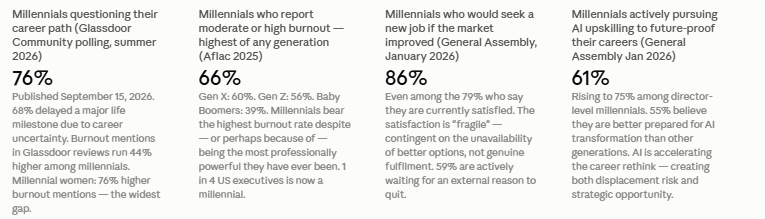
76% of millennials are actively questioning their career path. 66% report moderate or high burnout — the highest rate of any generation. 59% are quietly waiting for a reason to quit a job they dislike. And yet one in four executives is now a millennial, and this generation holds the largest share of the American workforce at 33-36%. The paradox of 2026: millennials are the most professionally powerful they have ever been — and the most dissatisfied. This is what is driving the rethink.
They entered the workforce during the dot-com bust, came of age professionally during the 2008 financial crisis, built their careers through a decade of austerity, survived a global pandemic, and adapted to every technological disruption from social media to AI. In 2026, millennials — born between 1980 and 1996, now ages 30 to 46 — are more professionally powerful than at any point in their lives. They hold 33-36% of the American workforce, the largest share of any generation. One in four executives is now a millennial. They have nearly closed the management gap with Gen X.
And 76% of them are actively questioning whether they are in the right career.
That is the finding from Glassdoor's September 2026 analysis, published September 15 in Staffing Industry Analysts. It is not the first data point suggesting a brewing midlife professional crisis. An ELVTR survey published in February found that 59% of millennials are waiting for an external reason — including a layoff — to leave a job they already dislike. A General Assembly survey of 515 millennial knowledge workers found that 86% would likely seek a new job if the market improved, even among the 79% who describe themselves as currently satisfied. Aflac's research found that approximately 66% of millennials report moderate or high burnout — the highest rate of any generation, including Gen Z.
This guide examines what is driving the millennial career rethink of 2026, what data reveals about what this generation actually wants from their professional lives, and what the paths forward look like for a generation that is simultaneously at the height of its institutional power and the depth of its professional disillusionment.
76% of millennials question their career paths (Glassdoor Community polling, summer 2026; Staffing Industry Analysts September 15, 2026). 66% report moderate or high burnout — highest rate of any generation (Aflac; Fortune May 2025). 59% look for an external reason to quit a job they dislike (ELVTR; Allwork.Space February 2026). 86% would seek a new job if the market improved (General Assembly; Business Wire January 2026). 55% are still figuring out their career path (ELVTR; Allwork.Space February 2026). 68% delayed a major life milestone due to career uncertainty (Glassdoor 2026). Millennials = 33-36% of US workforce, largest generation. 1 in 4 US executives is now a millennial.
What they share is a generational context defined by successive economic disruptions. The 2001-2002 recession hit early career millennials at graduation. The 2008-2009 financial crisis hit mid-career millennials at the point when salary growth and job stability are most critical for long-term financial trajectory. Research from politis.com.cy's Millennial Career Crisis analysis describes the structural damage directly: 'Economic disruptions such as the Great Recession altered the labour market prospects millennials faced on graduation. These disruptions lengthened the process of establishing financial independence and delayed milestones such as home ownership and long-term employment stability compared with previous cohorts.'
In 2026, this history manifests in a specific set of circumstances: a generation that has worked harder, for longer, for less certain returns than they were promised — and is now doing so from a position of genuine professional authority for the first time. Glassdoor's September 2026 analysis via Allwork.Space describes the paradox with precision: millennials outnumber Baby Boomers in management and leadership roles, one in four executives is a millennial, and yet they 'reported employment worries more often than any other age group' and were 'about 50% more likely to mention layoffs, burnout and job insecurity in job reviews.'
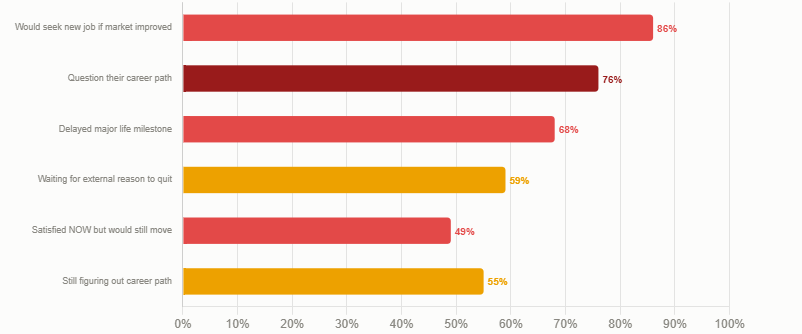
The ELVTR survey, published by Allwork.Space in February 2026, found that among U.S. millennials, 55% say they are still figuring out their career path and 59% say they sometimes look for an external reason — such as a layoff — to leave a job they already dislike. The specificity of that second figure is striking. It is not that 59% of millennials are dissatisfied — it is that more than half are specifically looking for permission to leave rather than acting on their own volition. The difficult hiring market, combined with financial obligations accumulated over a decade of midlife (mortgages, children, ageing parents), creates a trap: too constrained to leave easily, too dissatisfied to stay enthusiastically.
The General Assembly survey of 515 millennial knowledge workers (ages 29-44, US and UK, December 2025-January 2026) adds another dimension. 79% describe themselves as currently satisfied with their jobs. But 86% would likely seek a new job if the market improved, and 49% would actively look for a new role the moment conditions changed. The publication's framing is precise: 'that satisfaction is fragile.' The 79% satisfaction figure coexists with the 86% mobility figure because the satisfaction is conditional — contingent on the unavailability of better options, not on genuine fulfilment in the current role.
Glassdoor's September 2026 Community poll, covering the summer of 2026 and published in Staffing Industry Analysts on September 15, brings the most comprehensive numbers: 76% of millennials question their career paths, 68% have delayed a major life milestone because of career uncertainty, and burnout mentions in Glassdoor reviews run 44% higher among millennials than among other generations. The September 15 timing — just six days ago — makes this the most current major survey on the topic.
Understanding why millennials specifically bear the highest burnout rate requires understanding their structural position in the workplace. They are old enough to carry full adult financial obligations — mortgages, dependents, parental support responsibilities — but young enough to still have decades of required working years ahead. They have accumulated enough tenure in their organisations to be managing others, which multiplies the emotional labour required, but they have not yet reached the seniority that typically brings autonomy and reduced day-to-day pressure. They are, in the language of organisational research, in the most demanding life stage simultaneously — high pressure at work and high pressure at home, with neither the insulation of seniority nor the flexibility of youth.
The Glassdoor data adds a gender dimension: millennial women mention burnout 76% more often than all other workers — the widest generational-gender gap in the analysis. This reflects the well-documented compounding effect of caregiving responsibilities (children, elderly parents, and often both) combined with professional obligations, which falls disproportionately on women in this age cohort. Politis.com.cy's Millennial Career Crisis research cites a 2025 study of 352 millennial employees finding that 'workers who lacked meaningful engagement or social support at work experienced higher levels of exhaustion and disengagement, conditions that align with the numbness millennials increasingly describe.'
The burnout numbers tell a story about timing, not character. Millennials are the generation that entered adult financial responsibilities at the worst economic moments (2001, 2008, 2020) and are now managing peak household financial obligations while also being asked to manage teams, adapt to AI transformation, and perform at senior professional levels — all simultaneously. The burnout is structural, not personal. Understanding that distinction is the starting point for the career rethink. Source: Aflac report; Fortune May 2025; Glassdoor September 2026; Politis.com.cy Millennial Career Crisis analysis.
The paradox is that the success was built on a model of work they have increasingly come to question. Traditional success narratives — climb the corporate ladder, accumulate seniority, optimise for compensation and title — require the kind of sustained engagement and sacrifice that the burnout data suggests millennials can no longer sustain. Politis.com.cy's Millennial Career Crisis analysis identifies this as a structural mismatch: 'At the heart of the millennial career crisis is a growing mismatch between traditional success narratives and contemporary socioeconomic realities.'
The irony is sharpest for the highest earners. The General Assembly data found that 75% of director-level millennials are actively pursuing AI upskilling to future-proof their careers — a higher rate than any other level. These are not people who are failing professionally. These are people at the peak of their careers who are proactively planning to change what their careers look like, because they can see that the current model is unsustainable and that the technological landscape ahead requires a different configuration of skills.
The satisfaction paradox: 79% of millennials say they are satisfied with their current jobs. But 86% would look for something new the moment the market made it possible. This is not contradiction — it is conditional contentment. It is the satisfaction of someone who has made peace with a situation they cannot currently change, not the satisfaction of someone who would not change it if they could. The distinction has enormous implications for employers — and for the millions of midlife millennials doing quiet strategic planning for what comes next. Source: General Assembly; Business Wire January 2026.
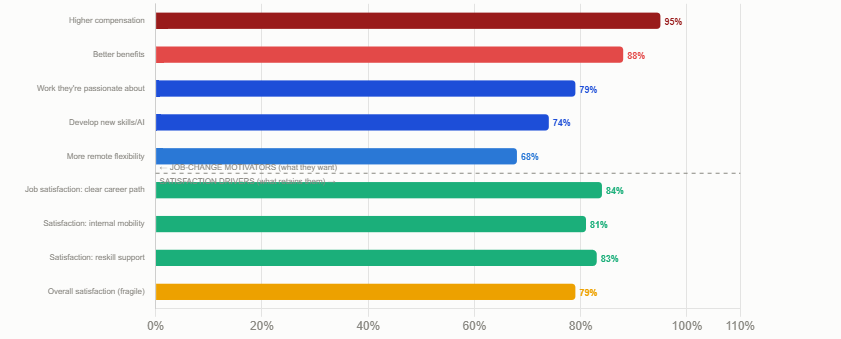
The order matters. Compensation is first — which challenges the narrative that millennials have stopped caring about money in favour of purpose. They have not. But the Deloitte 2026 Gen Z and Millennial Survey (22,500+ respondents, 44 countries) adds important context: millennials are 'moving away from fast-paced progression toward more deliberate, sustainable career choices,' and cost of living is the top concern. The combination — compensation matters enormously because costs are high and career security is uncertain, but progression for its own sake is no longer the goal — describes a generation recalibrating what sufficient and sustainable look like.
The skill development and AI upskilling data reveals the forward-looking dimension of the rethink. 61% of millennials are actively pursuing AI education to future-proof their careers (General Assembly; Business Wire January 2026). This is not passive adaptation. It is strategic investment in career resilience — building skills that protect against displacement while also creating optionality for pivots. The Glassdoor analysis terms it 'stability stacking,' and it represents a fundamentally different career philosophy from the credential-and-tenure model that millennials were taught to follow.
Remote flexibility remains the fifth priority — not the first, despite its cultural prominence in millennial career narratives. The data suggests that flexibility is important but not as important as the economic fundamentals (compensation, security) and the personal meaning dimension (passion, growth). This is a more nuanced picture than the generational stereotype of millennials demanding work-life balance above all else.
The AI risk picture for millennials is genuinely complex. The Chadix/Outsource Accelerator survey of more than 3,000 business leaders found that 38% identify millennials as the generation most at risk from AI displacement — specifically because their mid-level roles in automation-heavy industries (administrative, analytical, customer-facing, marketing) are more vulnerable than the senior-level positions occupied by Gen X and Boomers or the entry-level roles occupied by Gen Z. The same survey found management and technical engineering roles the least vulnerable — which is precisely where millennials need to move if they want to stay ahead of displacement.
At the same time, millennials are not passive recipients of the AI disruption. Morning Consult's State of Workers 2025 analysis found that millennials are the biggest users of AI at work — and saw almost double-digit growth in AI use between 2024 and 2025. The Udacity survey found that more than half of millennials believe AI has significantly improved their decision-making (55%), alleviated their stress levels (53%), and boosted their creativity (53%). And 55% of millennials believe they are better prepared than other generations for the AI transformation (General Assembly January 2026).
The Deloitte 2026 survey captures the ambivalence with precision: millennials 'largely see the proliferation of AI as an accelerant, not a threat, expecting it to free up more time, improve output, open new paths for growth, and create new opportunities — but many also feel that they are adapting to AI faster than their organisations.' That last phrase is critical. Millennials who are ahead of their employers on AI adoption are the most likely to feel the friction between their evolving capabilities and the rigid structures of the organisations they work within. That friction is part of what is driving the rethink.
The AI displacement risk is real for specific millennial roles. Mid-level administrative, analytical, and customer service roles — where many millennials are concentrated — face genuine automation pressure. The response is not panic but strategic repositioning: moving from task execution toward human judgement, relationship management, and AI oversight roles where the combination of technical literacy and interpersonal skill is harder to automate. Stability stacking (building multiple skill sets and career options) is the specific strategy Glassdoor's September 2026 analysis identifies as the dominant millennial response. Not career advice — individual circumstances vary.
It is, in essence, the career equivalent of diversification — and it reflects a generation that has learned through hard experience that relying on a single employer for lifetime economic security is both naive and dangerous. Millennials who entered the workforce before the 2008 crisis watched colleagues laid off en masse in their 30s. Millennials who built their careers through the 2010s watched industries disrupted in ways their mentors had not predicted. The pandemic provided the most recent and most dramatic illustration: entire sectors collapsed with weeks of warning.
Stability stacking manifests in several specific behaviours that the data captures. 61% are investing in AI education and upskilling (General Assembly). A growing share are building side income streams — freelance work, consulting, content creation — that give them financial options outside their primary employer. Many are deliberately developing skills adjacent to their current field (data literacy, project management, people management) to increase transferability if a pivot becomes necessary. The goal is not to leave their current career immediately but to be genuinely capable of leaving it — which paradoxically creates a better negotiating position within it.
The Glassdoor analysis notes that stability stacking 'can result in an AI-leaning career relaunch or long-term pivot into a new industry.' Both outcomes are intentional rather than reactive. The millennial who has spent two years developing AI skills, building a freelance client list, and completing a certification in a new domain is not being carried by the current into a new career — they are steering.
This financial reality is precisely why 59% of millennials are waiting for an external reason to quit rather than acting on their own dissatisfaction. The risk calculus of a voluntary career change at 38 or 42 is fundamentally different from the same change at 24. A mid-career pivot to a passion-driven but lower-compensation role requires months of preparation, a clear financial runway, and in many cases a household financial plan that accounts for temporary income reduction.
The financial preparation for a midlife career pivot. Before any major career change, financial readiness requires: (1) An emergency fund of 6-12 months of essential expenses — double the standard 3-6 month buffer, because job searches in new fields typically take longer and income gaps during transitions are unpredictable. (2) Retirement contributions that do not lapse during transition — even small monthly contributions maintained through a career change preserve the compounding trajectory that large early contributions create. (3) A clear income timeline — what is the expected salary in the new career path at 6 months, 12 months, and 3 years? What is the break-even point where new career income meets current lifestyle cost? (4) Debt clarity — which obligations are fixed (mortgage, car loan) and which are flexible? Understanding the true monthly minimum reduces the income floor below which the pivot becomes financially untenable. This is a financial framework, not advice. Consult a qualified financial adviser before any significant career transition.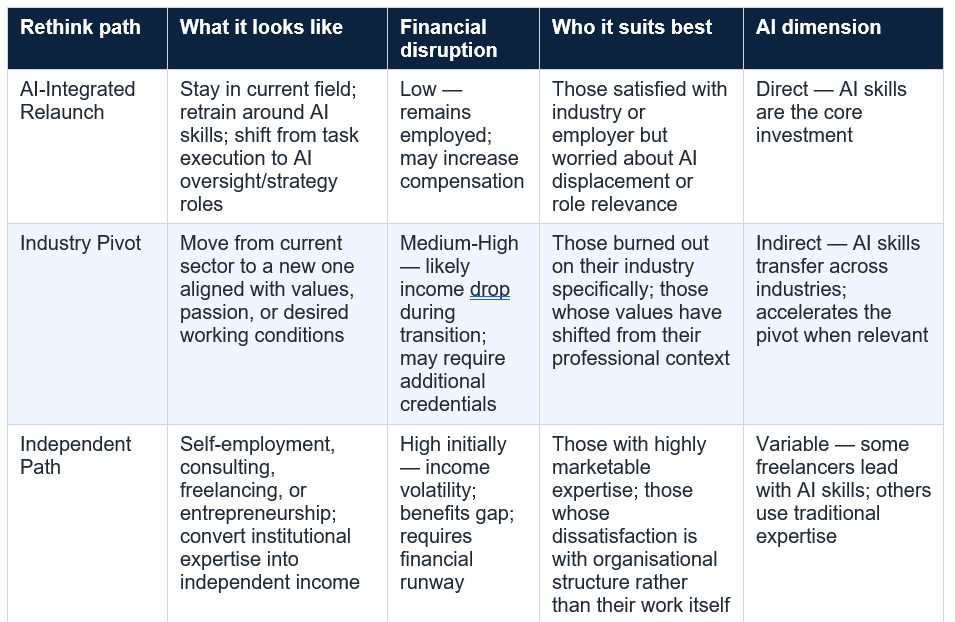
The specific miss: most organisations invest in compensation and benefits (the first two millennial job-change motivators) while neglecting career path clarity and learning opportunities (motivators three and four). The result is workers who are paid adequately but see no intelligible future within the organisation — and therefore place themselves in the 79% satisfied-but-ready-to-leave category the moment the market shifts.
The internal mobility gap is particularly acute. The General Assembly data found that employees who believe they have access to internal career opportunities report 81% job satisfaction, and those who believe their company would support them upskilling for a new internal position report 83% satisfaction. These are among the highest satisfaction scores in the survey. But internal mobility programs — structured pathways for experienced employees to move into new roles without leaving the company — remain rare in most organisations. The result is that millennials who want career change go outside, when they could be served internally.
The Glassdoor Allwork.Space September 2026 analysis notes a structural irony: 'The generation has nearly closed the management gap with Gen X... and yet they reported employment worries more often than any other age group.' Organisations that have successfully promoted millennials into management have not created the conditions that make management sustainable for this generation. The promotion was given; the support infrastructure was not.
For midlife millennials in the rethink: the practical starting point is not a dramatic resignation but a deliberate audit. What specifically drives the dissatisfaction — the industry, the employer, the role, the pace, the colleagues, the commute, the values mismatch? The answer determines which of the four paths is most appropriate. Then: what is the financial runway for the version of change that the audit suggests? And what skills or credentials would most directly close the gap between the current role and the desired one? The rethink is most productive when it is specific rather than general — 'I need to leave' is less useful than 'I need to spend the next 18 months building these skills and this financial buffer so that I can make this specific transition in a position of strength.' Not career or financial advice.
The more useful frame is not crisis but correction. A generation that was told to sacrifice work-life balance in pursuit of institutional success is reassessing that trade-off from a position of professional maturity. A generation that built careers in organisations that could not guarantee their stability through two recessions and a pandemic is building personal career resilience instead of institutional loyalty. A generation that is the most AI-exposed in the workforce is also the most active in acquiring the skills to navigate that exposure. These are not signs of a generation failing. They are signs of a generation recalibrating.
Stability stacking — building the training, the relationships, the financial literacy, and the career options that create personal economic security — is the practical expression of that recalibration. It is not dramatic. It does not require quitting tomorrow. It requires the deliberate, sustained investment in skills, financial resilience, and career optionality that positions the midlife millennial to act from choice rather than necessity when the next transition arrives.
The rethink is happening whether employers engage with it or not. The ones who engage with it — offering genuine internal mobility, AI upskilling investment, and sustainable workloads — will retain the midlife talent whose combination of institutional knowledge, technical literacy, and management experience is extraordinarily difficult to replace. The ones who do not will be the external reason that 59% of their millennial workforce has been quietly waiting for. Not career, financial, or legal advice.
The most recent comprehensive data comes from Glassdoor's Community polling conducted during the summer of 2026 and published in Staffing Industry Analysts on September 15, 2026 — six days ago. It found that 76% of millennials say they are actively questioning their career paths. Separately, an ELVTR survey published by Allwork.Space in February 2026 found that 55% of U.S. millennials say they are still figuring out their career path and 59% say they sometimes look for an external reason — such as a layoff — to leave a job they already dislike. A General Assembly survey of 515 millennial knowledge workers (ages 29-44, US and UK, December 2025) found that 86% would likely seek a new job if the job market improved, even though 79% describe themselves as currently satisfied. Taken together, these surveys paint a consistent picture: the majority of midlife millennials are engaged in some form of active career questioning, and most would change their situation if economic conditions made it possible to do so safely. The dissatisfaction is widespread; the inaction is largely structural and financial rather than a sign of acceptance.
Why are millennials burning out more than Gen Z?
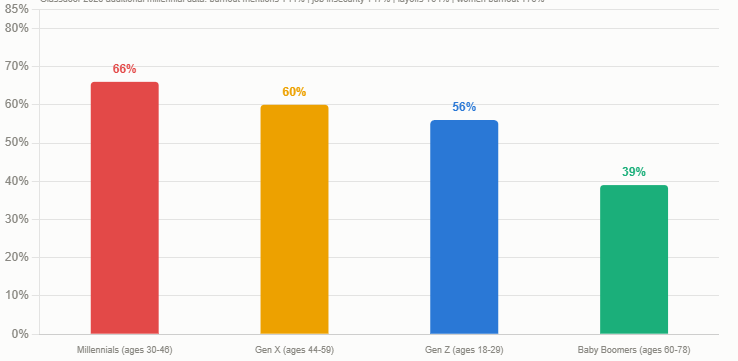
The Aflac report cited by Fortune in May 2025 found that approximately 66% of millennials report moderate or high burnout — higher than Gen Z (56%), Gen X (60%), and Baby Boomers (39%). The higher millennial rate reflects their structural position in the workforce: old enough to carry full adult financial obligations (mortgages, children, ageing parents) but still decades away from retirement, meaning they cannot exit without significant financial consequences. They are concentrated in management roles, which multiplies emotional labour and responsibility without necessarily providing the autonomy or compensation that makes that load sustainable. Millennial women face a particular burden: Glassdoor's September 2026 analysis found that millennial women mention burnout 76% more than all other workers — the widest gender-generational gap in the data — reflecting the compounding of professional management responsibilities with disproportionate caregiving obligations at home. The burnout is structural, not personal: it is the predictable outcome of placing peak household and professional pressure on the same generation simultaneously, in economic conditions that have been consistently more difficult than the previous generation's.
What is 'stability stacking' and how are millennials doing it?
Stability stacking is the term Glassdoor's September 2026 analysis uses to describe the dominant midlife millennial career strategy: building a combination of relevant training, people skills, financial literacy, and career optionality to create personal economic security that is not dependent on any single employer. It is, in essence, career diversification — the professional equivalent of not putting all your money in one stock. In practice, stability stacking looks like: investing in AI upskilling (61% of millennials are doing this, per General Assembly January 2026); building freelance or consulting income alongside primary employment; developing adjacent skills that increase career transferability; and maintaining the financial reserves that make a voluntary career change possible when the time comes. The strategy reflects a generational lesson earned through two recessions, a pandemic, and accelerating AI disruption: institutional loyalty is not a reliable protection against disruption. The most secure career is one that can survive the loss of any single employer. Glassdoor notes that stability stacking 'can result in an AI-leaning career relaunch or long-term pivot into a new industry' — both intentional outcomes rather than reactive ones. Not career advice — individual approaches vary.
What do millennials actually want from their careers in 2026?
General Assembly's January 2026 survey of 515 millennial knowledge workers (ages 29-44) found that when asked what would motivate a career change, millennials ranked: (1) Higher compensation; (2) Better benefits; (3) Work they are passionate about; (4) Opportunities to develop new skills; (5) More remote flexibility. The priority order challenges several millennial stereotypes. Money comes first — because midlife millennials carry significant financial obligations and the cost-of-living pressures documented in Deloitte's 2026 Gen Z and Millennial Survey are real. But passion and growth come third and fourth, immediately after the financial basics — suggesting that once economic floors are met, meaning and development matter enormously. The General Assembly data also found that clear career path access is one of the strongest predictors of satisfaction: employees who believe they have access to internal career opportunities report 81% job satisfaction, and those who believe their company would support them in reskilling for a new internal role report 83% satisfaction. The practical implication: millennials want to grow and change within their careers — and organisations that make internal growth possible retain them; those that do not lose them when the market improves.
How is AI affecting the millennial career rethink?
AI is both a risk factor and a catalyst for the millennial career rethink. On the risk side: a Chadix/Outsource Accelerator survey of 3,000+ business leaders found that 38% identify millennials as the generation most at risk from AI displacement, because their mid-level roles in administrative, analytical, and customer-facing functions are more vulnerable to automation than senior leadership or entry-level roles. The mid-level management and professional role is the specific concentration where AI automation risk is highest. On the catalyst side: millennials are responding more actively to AI than any other generation. General Assembly's January 2026 survey found 61% are actively pursuing AI education to future-proof their careers — rising to 75% among director-level millennials. Morning Consult found millennials are the biggest users of AI at work and saw almost double-digit growth in AI use from 2024 to 2025. More than half believe AI has improved their decision-making, reduced their stress, and boosted their creativity (Udacity survey). Deloitte's 2026 survey found many millennials feel they are 'adapting to AI faster than their organisations.' The net result: AI is accelerating the career rethink by creating both urgency (the displacement risk) and opportunity (the skill-building path and the stability stacking strategy) at precisely the moment when burnout and career questioning were already at their peak.
Table of Contents
- The Generation at the Peak — and the Breaking Point
- Who Midlife Millennials Are in 2026
- The Numbers Behind the Dissatisfaction
- Why Burnout Hits Millennials Hardest
- The Paradox: Success Without Satisfaction
- What Millennials Say They Actually Want
- The AI Disruption Accelerating the Rethink
- Stability Stacking: The New Midlife Career Strategy
- The Financial Reality of a Midlife Career Pivot
- The Four Career Rethink Paths Millennials Are Taking
- What Employers Are Getting Wrong
- Conclusion: The Rethink Is Not a Crisis — It's a Correction
- Frequently Asked Questions
The scale of the rethink: dissatisfaction data across surveys
Burnout By Generation -- Why Millennials Lead
What they want + the stability stacking strategy
The Generation at the Peak — and the Breaking Point
They entered the workforce during the dot-com bust, came of age professionally during the 2008 financial crisis, built their careers through a decade of austerity, survived a global pandemic, and adapted to every technological disruption from social media to AI. In 2026, millennials — born between 1980 and 1996, now ages 30 to 46 — are more professionally powerful than at any point in their lives. They hold 33-36% of the American workforce, the largest share of any generation. One in four executives is now a millennial. They have nearly closed the management gap with Gen X.And 76% of them are actively questioning whether they are in the right career.
That is the finding from Glassdoor's September 2026 analysis, published September 15 in Staffing Industry Analysts. It is not the first data point suggesting a brewing midlife professional crisis. An ELVTR survey published in February found that 59% of millennials are waiting for an external reason — including a layoff — to leave a job they already dislike. A General Assembly survey of 515 millennial knowledge workers found that 86% would likely seek a new job if the market improved, even among the 79% who describe themselves as currently satisfied. Aflac's research found that approximately 66% of millennials report moderate or high burnout — the highest rate of any generation, including Gen Z.
This guide examines what is driving the millennial career rethink of 2026, what data reveals about what this generation actually wants from their professional lives, and what the paths forward look like for a generation that is simultaneously at the height of its institutional power and the depth of its professional disillusionment.
76% of millennials question their career paths (Glassdoor Community polling, summer 2026; Staffing Industry Analysts September 15, 2026). 66% report moderate or high burnout — highest rate of any generation (Aflac; Fortune May 2025). 59% look for an external reason to quit a job they dislike (ELVTR; Allwork.Space February 2026). 86% would seek a new job if the market improved (General Assembly; Business Wire January 2026). 55% are still figuring out their career path (ELVTR; Allwork.Space February 2026). 68% delayed a major life milestone due to career uncertainty (Glassdoor 2026). Millennials = 33-36% of US workforce, largest generation. 1 in 4 US executives is now a millennial.
Who Midlife Millennials Are in 2026
The millennial generation in 2026 spans a 16-year age range — from a 30-year-old who entered the workforce during the height of the pandemic-era remote work explosion to a 46-year-old who graduated college in 2002, directly into the wreckage of the dot-com collapse. This range matters because the millennial experience is not uniform. The older millennial (ages 40-46) navigated a fundamentally different early career than the younger millennial (ages 30-35), and the midlife career rethink looks different across that spectrum.What they share is a generational context defined by successive economic disruptions. The 2001-2002 recession hit early career millennials at graduation. The 2008-2009 financial crisis hit mid-career millennials at the point when salary growth and job stability are most critical for long-term financial trajectory. Research from politis.com.cy's Millennial Career Crisis analysis describes the structural damage directly: 'Economic disruptions such as the Great Recession altered the labour market prospects millennials faced on graduation. These disruptions lengthened the process of establishing financial independence and delayed milestones such as home ownership and long-term employment stability compared with previous cohorts.'
In 2026, this history manifests in a specific set of circumstances: a generation that has worked harder, for longer, for less certain returns than they were promised — and is now doing so from a position of genuine professional authority for the first time. Glassdoor's September 2026 analysis via Allwork.Space describes the paradox with precision: millennials outnumber Baby Boomers in management and leadership roles, one in four executives is a millennial, and yet they 'reported employment worries more often than any other age group' and were 'about 50% more likely to mention layoffs, burnout and job insecurity in job reviews.'
The Numbers Behind the Dissatisfaction
The scale of millennial career dissatisfaction in 2026 is not captured by a single survey — it is consistent across multiple independent data sources published within months of each other, all pointing in the same direction.The ELVTR survey, published by Allwork.Space in February 2026, found that among U.S. millennials, 55% say they are still figuring out their career path and 59% say they sometimes look for an external reason — such as a layoff — to leave a job they already dislike. The specificity of that second figure is striking. It is not that 59% of millennials are dissatisfied — it is that more than half are specifically looking for permission to leave rather than acting on their own volition. The difficult hiring market, combined with financial obligations accumulated over a decade of midlife (mortgages, children, ageing parents), creates a trap: too constrained to leave easily, too dissatisfied to stay enthusiastically.
The General Assembly survey of 515 millennial knowledge workers (ages 29-44, US and UK, December 2025-January 2026) adds another dimension. 79% describe themselves as currently satisfied with their jobs. But 86% would likely seek a new job if the market improved, and 49% would actively look for a new role the moment conditions changed. The publication's framing is precise: 'that satisfaction is fragile.' The 79% satisfaction figure coexists with the 86% mobility figure because the satisfaction is conditional — contingent on the unavailability of better options, not on genuine fulfilment in the current role.
Glassdoor's September 2026 Community poll, covering the summer of 2026 and published in Staffing Industry Analysts on September 15, brings the most comprehensive numbers: 76% of millennials question their career paths, 68% have delayed a major life milestone because of career uncertainty, and burnout mentions in Glassdoor reviews run 44% higher among millennials than among other generations. The September 15 timing — just six days ago — makes this the most current major survey on the topic.
Why Burnout Hits Millennials Hardest
Burnout is not distributed equally across the workforce. Aflac's research found that approximately 66% of millennials report moderate or high burnout — the highest rate of any generation. Gen X trails at 60%, Gen Z at 56%, Baby Boomers at 39%. Fortune's May 2025 reporting on the Aflac data notes: 'People who experience high levels of burnout are much more likely to suffer from severe mental health issues such as anxiety, depression and post-traumatic stress — so the stakes couldn't be higher.'Understanding why millennials specifically bear the highest burnout rate requires understanding their structural position in the workplace. They are old enough to carry full adult financial obligations — mortgages, dependents, parental support responsibilities — but young enough to still have decades of required working years ahead. They have accumulated enough tenure in their organisations to be managing others, which multiplies the emotional labour required, but they have not yet reached the seniority that typically brings autonomy and reduced day-to-day pressure. They are, in the language of organisational research, in the most demanding life stage simultaneously — high pressure at work and high pressure at home, with neither the insulation of seniority nor the flexibility of youth.
The Glassdoor data adds a gender dimension: millennial women mention burnout 76% more often than all other workers — the widest generational-gender gap in the analysis. This reflects the well-documented compounding effect of caregiving responsibilities (children, elderly parents, and often both) combined with professional obligations, which falls disproportionately on women in this age cohort. Politis.com.cy's Millennial Career Crisis research cites a 2025 study of 352 millennial employees finding that 'workers who lacked meaningful engagement or social support at work experienced higher levels of exhaustion and disengagement, conditions that align with the numbness millennials increasingly describe.'
The burnout numbers tell a story about timing, not character. Millennials are the generation that entered adult financial responsibilities at the worst economic moments (2001, 2008, 2020) and are now managing peak household financial obligations while also being asked to manage teams, adapt to AI transformation, and perform at senior professional levels — all simultaneously. The burnout is structural, not personal. Understanding that distinction is the starting point for the career rethink. Source: Aflac report; Fortune May 2025; Glassdoor September 2026; Politis.com.cy Millennial Career Crisis analysis.
The Paradox: Success Without Satisfaction
The most counterintuitive aspect of the 2026 millennial career data is not the dissatisfaction — it is that the dissatisfaction coexists with genuine professional success. Millennials now hold the largest share of the U.S. workforce. They lead management teams. One in four executives is a millennial. They have spent 15-25 years building skills, credentials, networks, and professional reputations. They have, by conventional metrics, succeeded.The paradox is that the success was built on a model of work they have increasingly come to question. Traditional success narratives — climb the corporate ladder, accumulate seniority, optimise for compensation and title — require the kind of sustained engagement and sacrifice that the burnout data suggests millennials can no longer sustain. Politis.com.cy's Millennial Career Crisis analysis identifies this as a structural mismatch: 'At the heart of the millennial career crisis is a growing mismatch between traditional success narratives and contemporary socioeconomic realities.'
The irony is sharpest for the highest earners. The General Assembly data found that 75% of director-level millennials are actively pursuing AI upskilling to future-proof their careers — a higher rate than any other level. These are not people who are failing professionally. These are people at the peak of their careers who are proactively planning to change what their careers look like, because they can see that the current model is unsustainable and that the technological landscape ahead requires a different configuration of skills.
The satisfaction paradox: 79% of millennials say they are satisfied with their current jobs. But 86% would look for something new the moment the market made it possible. This is not contradiction — it is conditional contentment. It is the satisfaction of someone who has made peace with a situation they cannot currently change, not the satisfaction of someone who would not change it if they could. The distinction has enormous implications for employers — and for the millions of midlife millennials doing quiet strategic planning for what comes next. Source: General Assembly; Business Wire January 2026.
What Millennials Say They Actually Want
The General Assembly survey is the most granular recent source on what millennials actually want from their professional lives, beyond the dissatisfaction headline. When asked what would motivate a job change, millennials ranked their priorities: (1) higher compensation, (2) better benefits, (3) work they are passionate about, (4) opportunities to develop new skills, and (5) more remote flexibility.The order matters. Compensation is first — which challenges the narrative that millennials have stopped caring about money in favour of purpose. They have not. But the Deloitte 2026 Gen Z and Millennial Survey (22,500+ respondents, 44 countries) adds important context: millennials are 'moving away from fast-paced progression toward more deliberate, sustainable career choices,' and cost of living is the top concern. The combination — compensation matters enormously because costs are high and career security is uncertain, but progression for its own sake is no longer the goal — describes a generation recalibrating what sufficient and sustainable look like.
The skill development and AI upskilling data reveals the forward-looking dimension of the rethink. 61% of millennials are actively pursuing AI education to future-proof their careers (General Assembly; Business Wire January 2026). This is not passive adaptation. It is strategic investment in career resilience — building skills that protect against displacement while also creating optionality for pivots. The Glassdoor analysis terms it 'stability stacking,' and it represents a fundamentally different career philosophy from the credential-and-tenure model that millennials were taught to follow.
Remote flexibility remains the fifth priority — not the first, despite its cultural prominence in millennial career narratives. The data suggests that flexibility is important but not as important as the economic fundamentals (compensation, security) and the personal meaning dimension (passion, growth). This is a more nuanced picture than the generational stereotype of millennials demanding work-life balance above all else.
The AI Disruption Accelerating the Rethink
Artificial intelligence is not the cause of the millennial career rethink — the burnout and dissatisfaction data predates the current AI wave. But it is a powerful accelerant, because it is forcing the career question at precisely the moment when millennials were already asking it.The AI risk picture for millennials is genuinely complex. The Chadix/Outsource Accelerator survey of more than 3,000 business leaders found that 38% identify millennials as the generation most at risk from AI displacement — specifically because their mid-level roles in automation-heavy industries (administrative, analytical, customer-facing, marketing) are more vulnerable than the senior-level positions occupied by Gen X and Boomers or the entry-level roles occupied by Gen Z. The same survey found management and technical engineering roles the least vulnerable — which is precisely where millennials need to move if they want to stay ahead of displacement.
At the same time, millennials are not passive recipients of the AI disruption. Morning Consult's State of Workers 2025 analysis found that millennials are the biggest users of AI at work — and saw almost double-digit growth in AI use between 2024 and 2025. The Udacity survey found that more than half of millennials believe AI has significantly improved their decision-making (55%), alleviated their stress levels (53%), and boosted their creativity (53%). And 55% of millennials believe they are better prepared than other generations for the AI transformation (General Assembly January 2026).
The Deloitte 2026 survey captures the ambivalence with precision: millennials 'largely see the proliferation of AI as an accelerant, not a threat, expecting it to free up more time, improve output, open new paths for growth, and create new opportunities — but many also feel that they are adapting to AI faster than their organisations.' That last phrase is critical. Millennials who are ahead of their employers on AI adoption are the most likely to feel the friction between their evolving capabilities and the rigid structures of the organisations they work within. That friction is part of what is driving the rethink.
The AI displacement risk is real for specific millennial roles. Mid-level administrative, analytical, and customer service roles — where many millennials are concentrated — face genuine automation pressure. The response is not panic but strategic repositioning: moving from task execution toward human judgement, relationship management, and AI oversight roles where the combination of technical literacy and interpersonal skill is harder to automate. Stability stacking (building multiple skill sets and career options) is the specific strategy Glassdoor's September 2026 analysis identifies as the dominant millennial response. Not career advice — individual circumstances vary.
Stability Stacking: The New Midlife Career Strategy
'Stability stacking' is the term Glassdoor's September 2026 analysis applies to the dominant career strategy emerging among midlife millennials: building a combination of relevant training, people skills, financial literacy, and career optionality to create personal economic security that is not dependent on any single employer, role, or industry.It is, in essence, the career equivalent of diversification — and it reflects a generation that has learned through hard experience that relying on a single employer for lifetime economic security is both naive and dangerous. Millennials who entered the workforce before the 2008 crisis watched colleagues laid off en masse in their 30s. Millennials who built their careers through the 2010s watched industries disrupted in ways their mentors had not predicted. The pandemic provided the most recent and most dramatic illustration: entire sectors collapsed with weeks of warning.
Stability stacking manifests in several specific behaviours that the data captures. 61% are investing in AI education and upskilling (General Assembly). A growing share are building side income streams — freelance work, consulting, content creation — that give them financial options outside their primary employer. Many are deliberately developing skills adjacent to their current field (data literacy, project management, people management) to increase transferability if a pivot becomes necessary. The goal is not to leave their current career immediately but to be genuinely capable of leaving it — which paradoxically creates a better negotiating position within it.
The Glassdoor analysis notes that stability stacking 'can result in an AI-leaning career relaunch or long-term pivot into a new industry.' Both outcomes are intentional rather than reactive. The millennial who has spent two years developing AI skills, building a freelance client list, and completing a certification in a new domain is not being carried by the current into a new career — they are steering.
The Financial Reality of a Midlife Career Pivot
The career rethink that 76% of millennials are conducting has a financial dimension that most career conversation ignores. Midlife millennials in 2026 are not the 22-year-old fresh graduate who can take a pay cut for a passion job and cover the shortfall by moving to a cheaper apartment. They are, in large numbers, carrying mortgages, dependent children, student loan balances, and in some cases already providing financial support to ageing parents. The sandwich generation burden is real and documented.This financial reality is precisely why 59% of millennials are waiting for an external reason to quit rather than acting on their own dissatisfaction. The risk calculus of a voluntary career change at 38 or 42 is fundamentally different from the same change at 24. A mid-career pivot to a passion-driven but lower-compensation role requires months of preparation, a clear financial runway, and in many cases a household financial plan that accounts for temporary income reduction.
The financial preparation for a midlife career pivot. Before any major career change, financial readiness requires: (1) An emergency fund of 6-12 months of essential expenses — double the standard 3-6 month buffer, because job searches in new fields typically take longer and income gaps during transitions are unpredictable. (2) Retirement contributions that do not lapse during transition — even small monthly contributions maintained through a career change preserve the compounding trajectory that large early contributions create. (3) A clear income timeline — what is the expected salary in the new career path at 6 months, 12 months, and 3 years? What is the break-even point where new career income meets current lifestyle cost? (4) Debt clarity — which obligations are fixed (mortgage, car loan) and which are flexible? Understanding the true monthly minimum reduces the income floor below which the pivot becomes financially untenable. This is a financial framework, not advice. Consult a qualified financial adviser before any significant career transition.
The Four Career Rethink Paths Millennials Are Taking
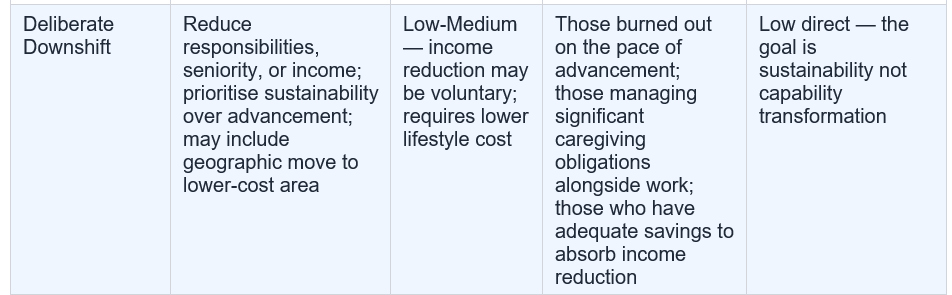
The millennial career rethink does not produce a single destination. The data and emerging career pattern literature suggest four distinct paths that midlife millennials are navigating, often in combination:- The AI-Integrated Relaunch: staying in the same industry or function but fundamentally repositioning around AI skills and human-AI collaboration. This is the path of the 61% who are actively pursuing AI upskilling. It does not require leaving a current employer — it requires becoming a different kind of professional within the existing career structure. The goal is to move from roles at high automation risk (task execution, data entry, routine analysis) to roles where human judgement and AI literacy combine (AI oversight, prompt engineering, strategic data interpretation, AI-augmented client relationships). Glassdoor terms this an 'AI-leaning career relaunch.'
- The Industry Pivot: moving from a current field to one that is structurally more aligned with the person's values, interests, or desired work conditions. This is the most financially disruptive path and the one that requires the most advance preparation. Common pivot directions include: corporate to nonprofit or public sector; corporate to education or training; finance or law to wellness or health services; marketing or media to technology or data. The General Assembly data identifies a desire to work they are passionate about as the third-highest motivator for a job change, after compensation and benefits.
- The Independent Path: leaving employment entirely for self-employment, consulting, freelancing, or entrepreneurship. The millennial who quits their corporate job to pet-sit and travel (documented by Fortune in January 2026) represents the extreme end of this spectrum. More common is the senior millennial professional who converts their institutional expertise into a consulting practice — keeping the domain knowledge, the client relationships, and the earning potential while shedding the organisational structure that has become the primary source of dissatisfaction.
- The Deliberate Downshift: voluntarily stepping back from seniority, responsibility, or compensation in exchange for sustainability. This is the counterpart to the hustle-culture ambition that defined the millennial career script. Deloitte's 2026 survey captures the philosophical shift: millennials are moving toward 'more deliberate, sustainable career choices' rather than fast-paced progression. For some, this means requesting reduced responsibilities, declining promotions, or leaving management for individual contributor roles. For others, it means geographic moves to lower cost-of-living areas that make a lower-pressure job financially viable.
What Employers Are Getting Wrong
The millennial career rethink is not primarily a problem that individual millennials need to solve. It is, in large part, a retention and management crisis that employers are failing to address. The General Assembly data is direct about this: 'Retaining millennial talent hinges on learning opportunities, AI skills, internal mobility, and career path clarity — not just compensation.'The specific miss: most organisations invest in compensation and benefits (the first two millennial job-change motivators) while neglecting career path clarity and learning opportunities (motivators three and four). The result is workers who are paid adequately but see no intelligible future within the organisation — and therefore place themselves in the 79% satisfied-but-ready-to-leave category the moment the market shifts.
The internal mobility gap is particularly acute. The General Assembly data found that employees who believe they have access to internal career opportunities report 81% job satisfaction, and those who believe their company would support them upskilling for a new internal position report 83% satisfaction. These are among the highest satisfaction scores in the survey. But internal mobility programs — structured pathways for experienced employees to move into new roles without leaving the company — remain rare in most organisations. The result is that millennials who want career change go outside, when they could be served internally.
The Glassdoor Allwork.Space September 2026 analysis notes a structural irony: 'The generation has nearly closed the management gap with Gen X... and yet they reported employment worries more often than any other age group.' Organisations that have successfully promoted millennials into management have not created the conditions that make management sustainable for this generation. The promotion was given; the support infrastructure was not.
For midlife millennials in the rethink: the practical starting point is not a dramatic resignation but a deliberate audit. What specifically drives the dissatisfaction — the industry, the employer, the role, the pace, the colleagues, the commute, the values mismatch? The answer determines which of the four paths is most appropriate. Then: what is the financial runway for the version of change that the audit suggests? And what skills or credentials would most directly close the gap between the current role and the desired one? The rethink is most productive when it is specific rather than general — 'I need to leave' is less useful than 'I need to spend the next 18 months building these skills and this financial buffer so that I can make this specific transition in a position of strength.' Not career or financial advice.
Conclusion
The headline numbers are striking enough to sound like a crisis: 76% questioning their career path, 66% burned out, 59% waiting for a reason to quit. But the Glassdoor analysis itself offers a more useful frame. When asked whether the millennial career rethink is just midlife 'dressed up in generational branding,' Glassdoor's analyst acknowledged the complexity while noting: 'Take a look back 15 years, at Gen X — things are a little worse in 2026 than 2011.' Worse, not categorically different. The midlife career reassessment is universal. What is specific to this generation is the scale of it, driven by accumulating structural grievances, and the timing of it, accelerated by AI disruption at the precise moment when the burnout is peaking.The more useful frame is not crisis but correction. A generation that was told to sacrifice work-life balance in pursuit of institutional success is reassessing that trade-off from a position of professional maturity. A generation that built careers in organisations that could not guarantee their stability through two recessions and a pandemic is building personal career resilience instead of institutional loyalty. A generation that is the most AI-exposed in the workforce is also the most active in acquiring the skills to navigate that exposure. These are not signs of a generation failing. They are signs of a generation recalibrating.
Stability stacking — building the training, the relationships, the financial literacy, and the career options that create personal economic security — is the practical expression of that recalibration. It is not dramatic. It does not require quitting tomorrow. It requires the deliberate, sustained investment in skills, financial resilience, and career optionality that positions the midlife millennial to act from choice rather than necessity when the next transition arrives.
The rethink is happening whether employers engage with it or not. The ones who engage with it — offering genuine internal mobility, AI upskilling investment, and sustainable workloads — will retain the midlife talent whose combination of institutional knowledge, technical literacy, and management experience is extraordinarily difficult to replace. The ones who do not will be the external reason that 59% of their millennial workforce has been quietly waiting for. Not career, financial, or legal advice.
Frequently Asked Questions
How many millennials are rethinking their careers in 2026?The most recent comprehensive data comes from Glassdoor's Community polling conducted during the summer of 2026 and published in Staffing Industry Analysts on September 15, 2026 — six days ago. It found that 76% of millennials say they are actively questioning their career paths. Separately, an ELVTR survey published by Allwork.Space in February 2026 found that 55% of U.S. millennials say they are still figuring out their career path and 59% say they sometimes look for an external reason — such as a layoff — to leave a job they already dislike. A General Assembly survey of 515 millennial knowledge workers (ages 29-44, US and UK, December 2025) found that 86% would likely seek a new job if the job market improved, even though 79% describe themselves as currently satisfied. Taken together, these surveys paint a consistent picture: the majority of midlife millennials are engaged in some form of active career questioning, and most would change their situation if economic conditions made it possible to do so safely. The dissatisfaction is widespread; the inaction is largely structural and financial rather than a sign of acceptance.
Why are millennials burning out more than Gen Z?
The Aflac report cited by Fortune in May 2025 found that approximately 66% of millennials report moderate or high burnout — higher than Gen Z (56%), Gen X (60%), and Baby Boomers (39%). The higher millennial rate reflects their structural position in the workforce: old enough to carry full adult financial obligations (mortgages, children, ageing parents) but still decades away from retirement, meaning they cannot exit without significant financial consequences. They are concentrated in management roles, which multiplies emotional labour and responsibility without necessarily providing the autonomy or compensation that makes that load sustainable. Millennial women face a particular burden: Glassdoor's September 2026 analysis found that millennial women mention burnout 76% more than all other workers — the widest gender-generational gap in the data — reflecting the compounding of professional management responsibilities with disproportionate caregiving obligations at home. The burnout is structural, not personal: it is the predictable outcome of placing peak household and professional pressure on the same generation simultaneously, in economic conditions that have been consistently more difficult than the previous generation's.
What is 'stability stacking' and how are millennials doing it?
Stability stacking is the term Glassdoor's September 2026 analysis uses to describe the dominant midlife millennial career strategy: building a combination of relevant training, people skills, financial literacy, and career optionality to create personal economic security that is not dependent on any single employer. It is, in essence, career diversification — the professional equivalent of not putting all your money in one stock. In practice, stability stacking looks like: investing in AI upskilling (61% of millennials are doing this, per General Assembly January 2026); building freelance or consulting income alongside primary employment; developing adjacent skills that increase career transferability; and maintaining the financial reserves that make a voluntary career change possible when the time comes. The strategy reflects a generational lesson earned through two recessions, a pandemic, and accelerating AI disruption: institutional loyalty is not a reliable protection against disruption. The most secure career is one that can survive the loss of any single employer. Glassdoor notes that stability stacking 'can result in an AI-leaning career relaunch or long-term pivot into a new industry' — both intentional outcomes rather than reactive ones. Not career advice — individual approaches vary.
What do millennials actually want from their careers in 2026?
General Assembly's January 2026 survey of 515 millennial knowledge workers (ages 29-44) found that when asked what would motivate a career change, millennials ranked: (1) Higher compensation; (2) Better benefits; (3) Work they are passionate about; (4) Opportunities to develop new skills; (5) More remote flexibility. The priority order challenges several millennial stereotypes. Money comes first — because midlife millennials carry significant financial obligations and the cost-of-living pressures documented in Deloitte's 2026 Gen Z and Millennial Survey are real. But passion and growth come third and fourth, immediately after the financial basics — suggesting that once economic floors are met, meaning and development matter enormously. The General Assembly data also found that clear career path access is one of the strongest predictors of satisfaction: employees who believe they have access to internal career opportunities report 81% job satisfaction, and those who believe their company would support them in reskilling for a new internal role report 83% satisfaction. The practical implication: millennials want to grow and change within their careers — and organisations that make internal growth possible retain them; those that do not lose them when the market improves.
How is AI affecting the millennial career rethink?
AI is both a risk factor and a catalyst for the millennial career rethink. On the risk side: a Chadix/Outsource Accelerator survey of 3,000+ business leaders found that 38% identify millennials as the generation most at risk from AI displacement, because their mid-level roles in administrative, analytical, and customer-facing functions are more vulnerable to automation than senior leadership or entry-level roles. The mid-level management and professional role is the specific concentration where AI automation risk is highest. On the catalyst side: millennials are responding more actively to AI than any other generation. General Assembly's January 2026 survey found 61% are actively pursuing AI education to future-proof their careers — rising to 75% among director-level millennials. Morning Consult found millennials are the biggest users of AI at work and saw almost double-digit growth in AI use from 2024 to 2025. More than half believe AI has improved their decision-making, reduced their stress, and boosted their creativity (Udacity survey). Deloitte's 2026 survey found many millennials feel they are 'adapting to AI faster than their organisations.' The net result: AI is accelerating the career rethink by creating both urgency (the displacement risk) and opportunity (the skill-building path and the stability stacking strategy) at precisely the moment when burnout and career questioning were already at their peak.

0 Comments Comments