

Credits
How Premium Credit Cards Stack Up Against Each Other

Annual fees now range from $395 to $895 for the top premium travel cards. The June 2025 Chase Sapphire Reserve fee hike to $795 was the largest premium-card fee increase in the modern points era. Here is the complete side-by-side comparison for 2026.

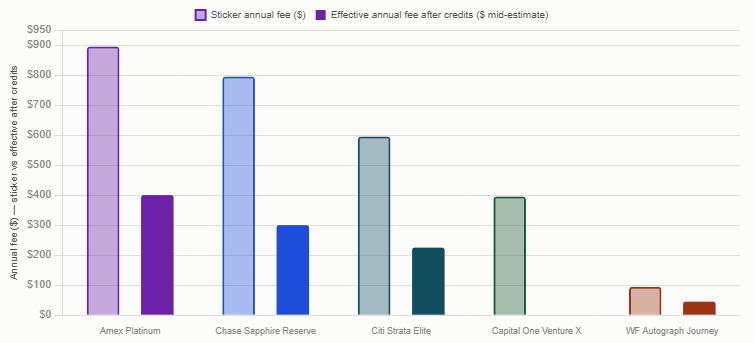
Annual Fee vs Effective Fees
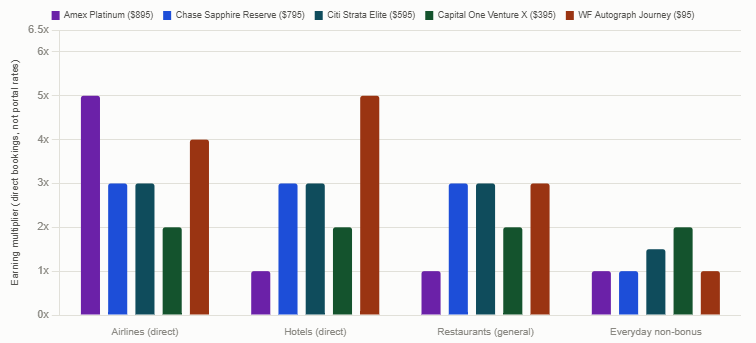
Earning Rates By Category
The big four in the 2026 premium travel card landscape are the American Express Platinum Card ($895), the Chase Sapphire Reserve ($795), the Capital One Venture X ($395), and the new Citi Strata Elite ($595). Each occupies a distinct position in the market. The Amex Platinum is the luxury network play with the broadest lounge access and the most ancillary credits. The Chase Sapphire Reserve is the travel insurance and hotel credit powerhouse for active travellers. The Capital One Venture X is the mathematical simplicity card that comes closest to a guaranteed positive ROI. The Citi Strata Elite sits between the extremes as the ThankYou points loyalist's option. Below that tier, the Wells Fargo Autograph Journey and the Citi Strata Premier offer genuinely competitive rewards at $95 annual fees, making them the strongest arguments that premium earning does not require a premium fee.
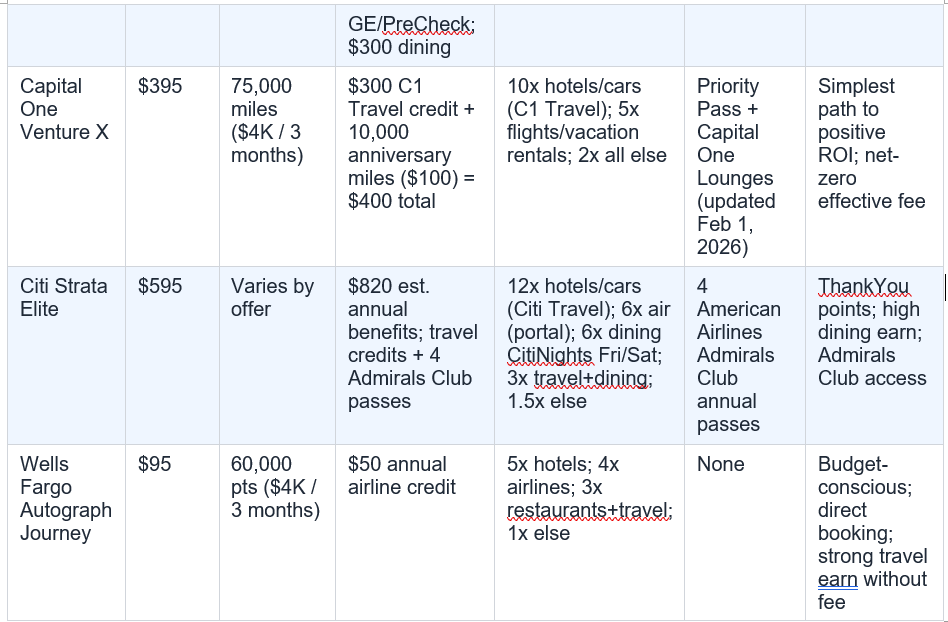
The Numbers: Annual fees 2026: Amex Platinum $895, Chase Sapphire Reserve $795 (up from $550 June 2025 — largest modern-era fee hike), Citi Strata Elite $595, Capital One Venture X $395, Wells Fargo Autograph Journey $95. Amex Platinum has the largest lounge network of any card issuer: 1,550+ as of January 2026.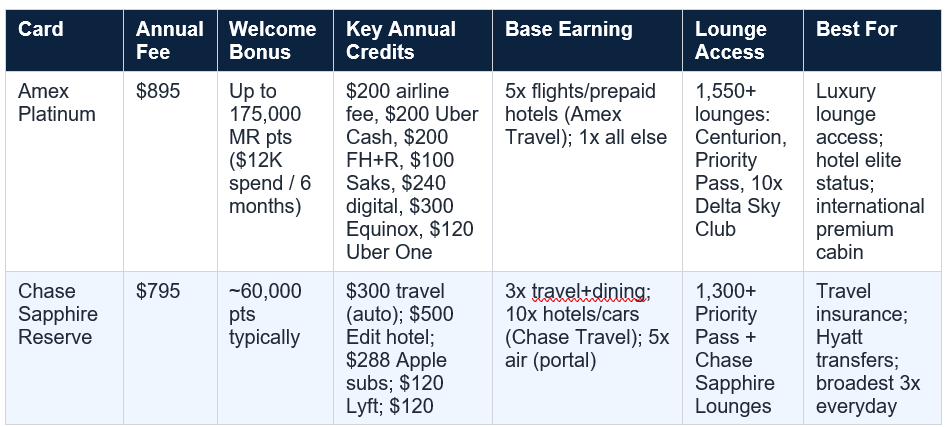
The case for the Amex Platinum rests on five pillars:
The Chase Sapphire Reserve's competitive advantages:
Verdict — Chase Sapphire Reserve: Best for frequent travellers who value comprehensive travel insurance, prize Hyatt transfers, and naturally spend on travel and dining. At $795, requires active benefit engagement. The $300 travel credit is automatic; the Edit hotel and Apple credits require deliberate planning.
CNN Underscored's June 2026 analysis identifies the Venture X as 'best overall value' in the premium tier specifically because the effective net annual fee is approximately zero for any cardholder who uses Capital One Travel at all. Roame's June 2026 comparison confirms: 'That makes the card straightforward for travelers who already book at least one paid trip per year.'
The Venture X's earning structure is the simplest: 2x on everything, plus elevated rates within the Capital One Travel portal. This flat-rate structure delivers above-average returns on all spending without requiring category management. The caveat: the $300 credit and elevated rates require using Capital One Travel, which may not suit travellers who prefer to book directly. Lounge policy was also updated February 1, 2026 — verify current guest terms with Capital One.
Verdict — Capital One Venture X: Best for value-conscious premium card seekers who want guaranteed positive ROI without credit-tracking complexity. The simplest card on this list and the most reliably net-zero effective fee. Not the card for luxury hotel enthusiasts or aspirational first-class redemptions — the card for travellers who want premium benefits without premium management overhead.
The Strata Elite's distinctive features:
Verdict — Citi Strata Elite: Best for Citi ThankYou points loyalists, frequent American Airlines travellers who want occasional Admirals Club access, and heavy weekend restaurant spenders who can use the CitiNights 6x. A mid-complexity premium card with meaningful benefits that does not require the daily credit-tracking intensity of the Amex Platinum.
Specific competitive advantages: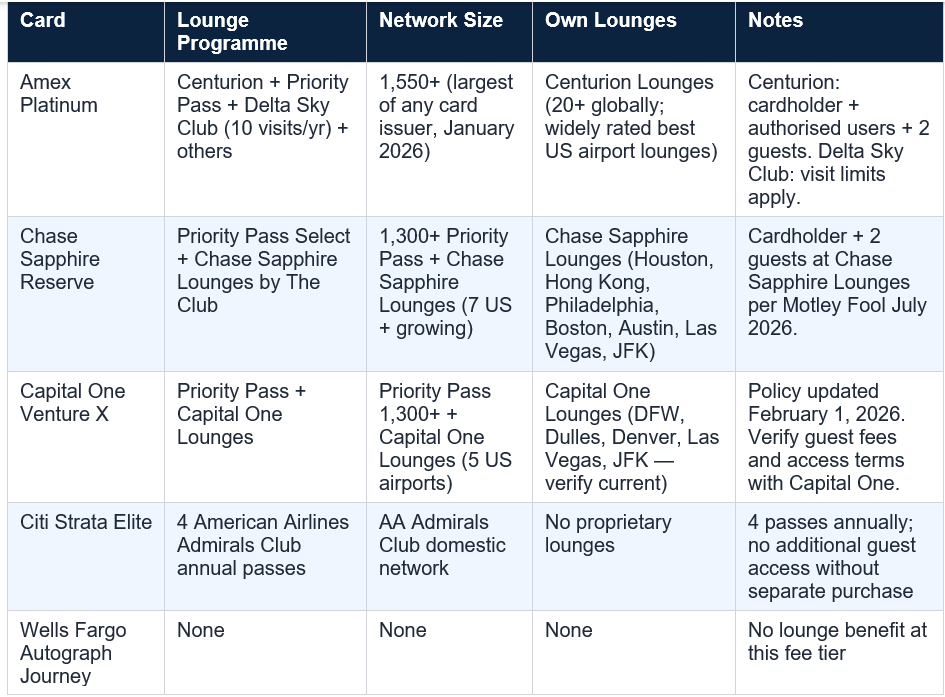
The Chase–Hyatt relationship is widely considered the most reliably valuable hotel transfer in the US market. Amex Membership Rewards' connections to Singapore Airlines and Air France KLM provide access to aspirational first and business class redemptions that deliver the highest cents-per-point value for the right traveller.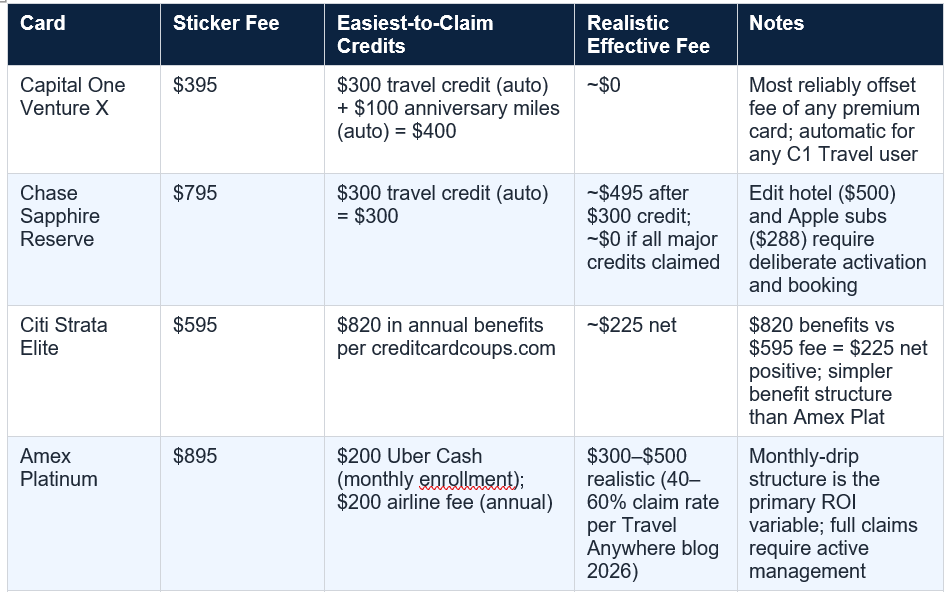

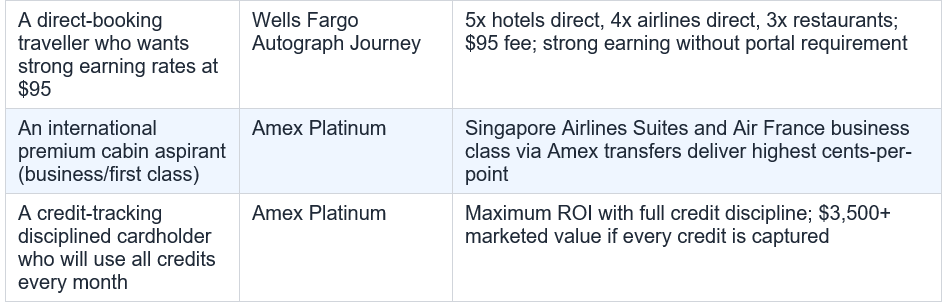
The analysis across all five cards yields the same conclusion in every scenario: the card that delivers positive ROI is the one whose specific benefits match the cardholder's specific travel behaviour. The Amex Platinum is extraordinary for Centurion Lounge users who track their monthly credits. The Chase Sapphire Reserve is extraordinary for Hyatt loyalists who rent cars frequently. The Capital One Venture X is extraordinary for travellers who want the simplest possible path to a net-zero annual fee. The Citi Strata Elite is extraordinary for weekend diners in the Citi ThankYou ecosystem. The Wells Fargo Autograph Journey is extraordinary for travellers who book directly and want competitive earning without premium overhead.
Before upgrading to or switching any premium card, answer one question: which of this card's top three benefits will I naturally use at least once in the next 12 months? If the answer is none, the card is the wrong fit regardless of its marketed value. The premium card that wins is the one you can actually use.
There is no single best premium card — the right card depends on your travel behaviour and spending patterns. Capital One Venture X ($395) is best for guaranteed positive ROI and simplicity: the $300 travel credit plus 10,000 anniversary miles offset the entire fee for any cardholder who books one trip through Capital One Travel. Chase Sapphire Reserve ($795) is best for Hyatt transfers, travel insurance, and comprehensive trip protections. Amex Platinum ($895) is best for lounge access (1,550+ lounges, including Centurion Lounges) and luxury hotel perks. Citi Strata Elite ($595) is best for Citi ThankYou points loyalists with heavy weekend dining. Wells Fargo Autograph Journey ($95) is best for direct-booking travellers who want premium earning rates without a premium fee.
Is the Chase Sapphire Reserve worth the $795 annual fee in 2026?
The Chase Sapphire Reserve is worth $795 if you can claim its most valuable credits. Chase's official 2026 disclosure markets over $2,700 in annual cardmember value — but that requires claiming the $300 automatic travel credit, $500 Edit hotel credit, $288 Apple subscriptions credit, and $120 Lyft credit. Travel Anywhere blog's 2026 testing found the card 'returns approximately $2,700 in annual cardmember value but only if the holder realistically claims' all major credits. If you only use the $300 travel credit, your effective fee is $495 — significantly more than the Capital One Venture X's approximately $0 effective fee.
How does Amex Platinum's lounge access compare to Chase Sapphire Reserve?
The Amex Platinum has the broader network at 1,550+ lounges (as of January 2026), including Centurion Lounges (rated the best US credit card lounges), 10 annual Delta Sky Club visits, and Priority Pass. The Chase Sapphire Reserve provides Priority Pass Select (1,300+ lounges) plus Chase Sapphire Lounges (7 US locations). For domestic US travellers, the key differentiator is whether you frequently use airports with Centurion Lounges (20+ globally). If yes, the Amex Platinum's lounge access justifies much of the $895 fee for 10+ trips per year.
What is the effective annual fee for each premium card after credits?
After realistically claimed credits: Capital One Venture X is effectively $0 (the $300 travel credit + $100 anniversary miles offset the $395 fee for any Capital One Travel user). Chase Sapphire Reserve is approximately $495 net after the $300 automatic travel credit; closer to $0 if the $500 Edit hotel credit, $288 Apple credit, and $120 Lyft credit are all claimed. Amex Platinum is approximately $300–$500 for most cardholders per Travel Anywhere blog's 2026 testing (40–60% realistic credit claim rate). Citi Strata Elite is approximately $225 net ($820 benefits vs $595 fee per creditcardcoups.com). Wells Fargo Autograph Journey is approximately $45 after the $50 airline credit.
Are premium credit cards worth it if you only travel 2–3 times per year?
For 2–3 trips per year, the Capital One Venture X ($395) is the easiest to justify: one Capital One Travel booking captures the $300 credit, and the 2x flat-rate earning rewards all spending. The Amex Platinum and Chase Sapphire Reserve are harder to justify for occasional travellers because their highest-value benefits (Centurion Lounge access, Hyatt transfers, comprehensive travel insurance) deliver the most value for frequent travellers. CNN Underscored's June 2026 analysis suggests the Chase Sapphire Preferred ($95) 'remains a great starter transferable points credit card' for occasional travellers who want core benefits without a premium fee.
What changed in the premium credit card market in 2025–2026?
Two major developments shaped the landscape. First, the Chase Sapphire Reserve increased its annual fee from $550 to $795 in June 2025 — the largest premium-card fee increase in the modern points-and-miles era per Travel Anywhere blog. This was paired with a benefits expansion that raised marketed annual cardmember value from approximately $1,000 to over $2,700. Second, the Citi Strata Elite launched in 2026 at $595, filling the gap between the Venture X and the $795–$895 tier and described as the 'Goldilocks card' in the premium space (LazyPoints April 2026). Additionally, the Bilt Palladium launched February 7, 2026 as the first premium card with rent-and-mortgage earning at $495. Capital One also updated its Venture X lounge policy effective February 1, 2026 — verify current guest terms directly with Capital One.
Annual Fee vs Effective Fees
Earning Rates By Category
Table of Contents
- The Premium Card Landscape in 2026
- The Side-by-Side: Annual Fees, Bonus Offers, and Key Credits
- Card #1: Amex Platinum — The Luxury Powerhouse
- Card #2: Chase Sapphire Reserve — The Travel Insurance and Transfer King
- Card #3: Capital One Venture X — The Best Net-Zero Annual Fee Card
- Card #4: Citi Strata Elite — The Goldilocks Card
- Card #5: Wells Fargo Autograph Journey — The Best $95 Premium Alternative
- Lounge Access: The Benefit That Drives Most Upgrade Decisions
- Transfer Partners: Where Your Points Actually Go
- Earning Rates: Which Card Earns Most on Your Real Spend
- The Effective Annual Fee: What You Pay After Credits
- Who Should Get Which Card: The Decision Matrix
- Stacking Premium Cards: When Two Is Better Than One
- Conclusion: The Premium Card That Wins Is the One You Can Actually Use
- Frequently Asked Questions
The Premium Card Landscape in 2026
The premium credit card market of 2026 looks different from any prior year. The June 2025 Chase Sapphire Reserve fee increase from $550 to $795 — the largest premium-card fee increase in the modern points-and-miles era, per Travel Anywhere blog — forced every serious traveller to reconsider the premium card stack. With fees now ranging from $395 to $895 at the top tier, the question is no longer 'is a premium card worth it?' It is 'which premium card earns more than its fee for my specific travel and spending pattern?'The big four in the 2026 premium travel card landscape are the American Express Platinum Card ($895), the Chase Sapphire Reserve ($795), the Capital One Venture X ($395), and the new Citi Strata Elite ($595). Each occupies a distinct position in the market. The Amex Platinum is the luxury network play with the broadest lounge access and the most ancillary credits. The Chase Sapphire Reserve is the travel insurance and hotel credit powerhouse for active travellers. The Capital One Venture X is the mathematical simplicity card that comes closest to a guaranteed positive ROI. The Citi Strata Elite sits between the extremes as the ThankYou points loyalist's option. Below that tier, the Wells Fargo Autograph Journey and the Citi Strata Premier offer genuinely competitive rewards at $95 annual fees, making them the strongest arguments that premium earning does not require a premium fee.
The Numbers: Annual fees 2026: Amex Platinum $895, Chase Sapphire Reserve $795 (up from $550 June 2025 — largest modern-era fee hike), Citi Strata Elite $595, Capital One Venture X $395, Wells Fargo Autograph Journey $95. Amex Platinum has the largest lounge network of any card issuer: 1,550+ as of January 2026.
The Side-by-Side: Annual Fees, Bonus Offers, and Key Credits
Card #1: Amex Platinum — The Luxury Powerhouse
The Amex Platinum at $895 is the most expensive mainstream premium card in 2026, and it justifies that fee through the widest lounge network of any card issuer (1,550+ as of January 2026) and a stack of luxury travel benefits no other card in this comparison matches.The case for the Amex Platinum rests on five pillars:
- Lounge access: Centurion Lounges (widely regarded as the best US airport lounges), Priority Pass, 10 annual Delta Sky Club visits, and select partner lounges. For frequent flyers transiting Centurion Lounge airports, this alone can justify the fee.
- Hotel and travel perks: Fine Hotels + Resorts (complimentary breakfast, room upgrades, late checkout, and a $100+ property credit on eligible stays), automatic Marriott Bonvoy Gold Elite status, automatic Hilton Honors Gold status.
- Credits at face value: $200 airline fee credit, $200 Fine Hotels + Resorts credit, $200 Uber Cash ($15/month + $20 December), $100 Saks Fifth Avenue, $240 digital entertainment — totalling over $900 before the $300 Equinox and $120 Uber One credits.
- Transfer partners: 21 airline partners and 3 hotel partners, including Air France KLM, Singapore Airlines, and ANA for premium cabin redemptions.
- Welcome bonus: up to 175,000 Membership Rewards points after $12,000 in spending in six months — the largest absolute bonus in this comparison.
- Best lounge network of any card (1,550+, including Centurion Lounges)
- Two automatic hotel elite statuses (Marriott Gold, Hilton Gold)
- Largest welcome bonus available (up to 175,000 MR points)
- Fine Hotels + Resorts: breakfast, upgrades, late checkout, $100+ property credit
- Monthly-drip credit structure requires active enrollment and tracking
- Realistic effective fee $300-$500 for most cardholders (not near-zero)
- 1x on all non-travel purchases — weakest everyday earning in the comparison
- $12,000 spend requirement for full welcome bonus is the highest here
Card #2: Chase Sapphire Reserve — The Travel Insurance and Transfer King
The Chase Sapphire Reserve's June 2025 fee increase to $795 was the card story of 2025 in the points-and-miles world. The increase was paired with a comprehensive benefits expansion: a new $500 Edit hotel credit, $288 Apple subscriptions credit, $120 Lyft credit, and a $300 dining credit through Sapphire Reserve Exclusive Tables. Chase's official 2026 disclosure markets over $2,700 in annual cardmember valueThe Chase Sapphire Reserve's competitive advantages:
- Travel insurance: the most comprehensive in this comparison — trip cancellation/interruption insurance, primary auto rental collision coverage (saves $20–$30 per rental day vs buying at the counter), lost luggage reimbursement, emergency evacuation, and travel accident insurance.
- Hyatt partnership: the 1:1 transfer to World of Hyatt is widely regarded as the most valuable hotel transfer partnership. Hyatt award rates have remained stable while competitors have devalued.
- Broad 3x earning: 3x on all travel and dining (not just portal bookings or specific airline purchases). Chase defines 'travel' expansively — including Airbnb, tolls, taxis, and parking.
- Chase Sapphire Lounges: Chase's own lounge network (7 US locations and growing) is smaller than Centurion but highly rated, particularly JFK and Boston.
Verdict — Chase Sapphire Reserve: Best for frequent travellers who value comprehensive travel insurance, prize Hyatt transfers, and naturally spend on travel and dining. At $795, requires active benefit engagement. The $300 travel credit is automatic; the Edit hotel and Apple credits require deliberate planning.
Card #3: Capital One Venture X — The Best Net-Zero Annual Fee Card
The Capital One Venture X is the standout value story in the 2026 premium card market. At $395, it is the least expensive of the four primary premium cards, and its fee is the most reliably offset. The $300 annual Capital One Travel credit automatically applies to bookings through the portal, and the 10,000 anniversary miles (awarded each year from the first) are worth $100 toward travel. Combined, these offset $400 against the $395 fee.CNN Underscored's June 2026 analysis identifies the Venture X as 'best overall value' in the premium tier specifically because the effective net annual fee is approximately zero for any cardholder who uses Capital One Travel at all. Roame's June 2026 comparison confirms: 'That makes the card straightforward for travelers who already book at least one paid trip per year.'
The Venture X's earning structure is the simplest: 2x on everything, plus elevated rates within the Capital One Travel portal. This flat-rate structure delivers above-average returns on all spending without requiring category management. The caveat: the $300 credit and elevated rates require using Capital One Travel, which may not suit travellers who prefer to book directly. Lounge policy was also updated February 1, 2026 — verify current guest terms with Capital One.
- Most reliable path to positive ROI: $300 travel credit + $100 anniversary miles covers the $395 fee
- 2x flat-rate on all purchases — simplest premium card earning structure
- Lowest annual fee in the premium tier ($395)
- Priority Pass + Capital One Lounges: solid airport lounge coverage
- High earning rates require Capital One Travel portal; direct bookings earn 2x only
- No luxury hotel programme equivalent to Fine Hotels + Resorts
- Lounge policy updated February 1, 2026 — verify current guest terms
- Fewer aspirational transfer partners than Chase or Amex ecosystems
Verdict — Capital One Venture X: Best for value-conscious premium card seekers who want guaranteed positive ROI without credit-tracking complexity. The simplest card on this list and the most reliably net-zero effective fee. Not the card for luxury hotel enthusiasts or aspirational first-class redemptions — the card for travellers who want premium benefits without premium management overhead.
Card #4: Citi Strata Elite — The Goldilocks Card
The Citi Strata Elite, launched in 2026 at a $595 annual fee, occupies the space between the Venture X and the Amex Platinum/Chase Sapphire Reserve tier. LazyPoints' April 2026 guide describes it as a 'Goldilocks card in the premium space' that 'perfectly straddles the line between the ultra-practical Venture X and the high-end Amex Platinum and Chase Sapphire Reserve in terms of fee and credits, simplicity, earning rates, and lounge access.'The Strata Elite's distinctive features:
- Exceptional portal earning: 12x on hotels, car rentals, and attractions booked on cititravel.com; 6x on air through Citi Travel. Among the highest portal multipliers of any premium card.
- CitiNights dining bonus: 6x at restaurants including restaurant delivery from 6 PM to 6 AM ET on Friday and Saturday — a specific and high-value category multiplier for regular weekend diners.
- 1.5x base rate: above the standard 1x common to many premium cards; even non-bonus spending earns more than average.
- American Airlines Admirals Club passes: 4 annual passes to Admirals Club lounges domestically — providing lounge access at American's network without the $595/year AAdvantage Executive card.
Verdict — Citi Strata Elite: Best for Citi ThankYou points loyalists, frequent American Airlines travellers who want occasional Admirals Club access, and heavy weekend restaurant spenders who can use the CitiNights 6x. A mid-complexity premium card with meaningful benefits that does not require the daily credit-tracking intensity of the Amex Platinum.
Card #5: Wells Fargo Autograph Journey — The Best $95 Premium Alternative
The Wells Fargo Autograph Journey is not technically in the premium fee tier at $95, but View from the Wing's July 2026 analysis makes the case: 'You don't have to spend $395, $795 or $895 to earn valuable rewards.' The Autograph Journey earns 5x on hotels, 4x on airlines, and 3x on restaurants and other travel — rates that beat many premium cards' direct booking earning rates on actual travel spend.Specific competitive advantages:
- • Direct booking earning: 5x on hotels booked directly (not through a portal) and 4x on direct airline bookings. The Chase Sapphire Reserve and Amex Platinum offer higher rates in their portals but typically only 3x or 1x respectively on direct hotel bookings.
- • Airbnb and cruises: the Autograph Journey earns 3x on other travel including Airbnb and cruises. This category is not always bonused on premium cards that define travel narrowly.
- • $50 airline credit with $50+ airline purchase — making effective net fee approximately $45.
- The weakness: Bankrate's March 2026 review identifies a smaller transfer partner network. The card transfers to IAG Avios (British Airways, Aer Lingus, Iberia), Air France KLM, Cathay Pacific, JetBlue, Virgin, Wyndham, and Choice — workable but less powerful than Chase or Amex.
Lounge Access: The Benefit That Drives Most Upgrade Decisions
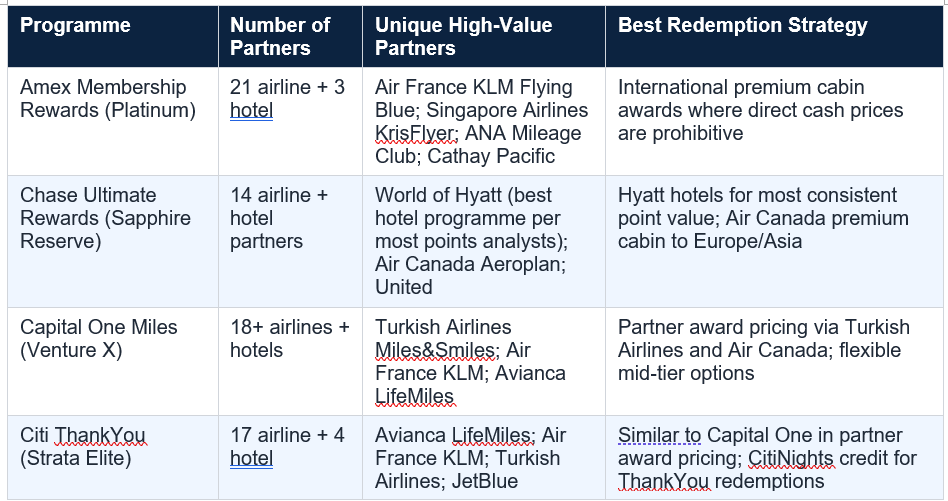
Transfer Partners: Where Your Points Actually Go
The Chase–Hyatt relationship is widely considered the most reliably valuable hotel transfer in the US market. Amex Membership Rewards' connections to Singapore Airlines and Air France KLM provide access to aspirational first and business class redemptions that deliver the highest cents-per-point value for the right traveller.
Earning Rates: Which Card Earns Most on Your Real Spend
The best earning card depends entirely on your spend category and whether portal booking is acceptable. Key comparisons:- Flights booked directly with airlines: Amex Platinum 5x, Citi Strata Elite 3x (6x portal), Chase Sapphire Reserve 3x (5x portal), Wells Fargo Autograph Journey 4x, Capital One Venture X 2x (5x portal).
- Hotels booked directly: Wells Fargo Autograph Journey 5x, Chase Sapphire Reserve 3x (10x portal), Citi Strata Elite 3x (12x portal), Capital One Venture X 2x (10x portal), Amex Platinum 1x (5x only through Amex Travel).
- Restaurants / dining: Citi Strata Elite 3x (6x CitiNights Fri/Sat), Chase Sapphire Reserve 3x (4x portal), Wells Fargo Autograph Journey 3x, Capital One Venture X 2x, Amex Platinum 1x.
- Everyday non-travel spend: Capital One Venture X 2x (strongest in the premium tier), Citi Strata Elite 1.5x, all others 1x.
The Effective Annual Fee: What You Pay After Credits
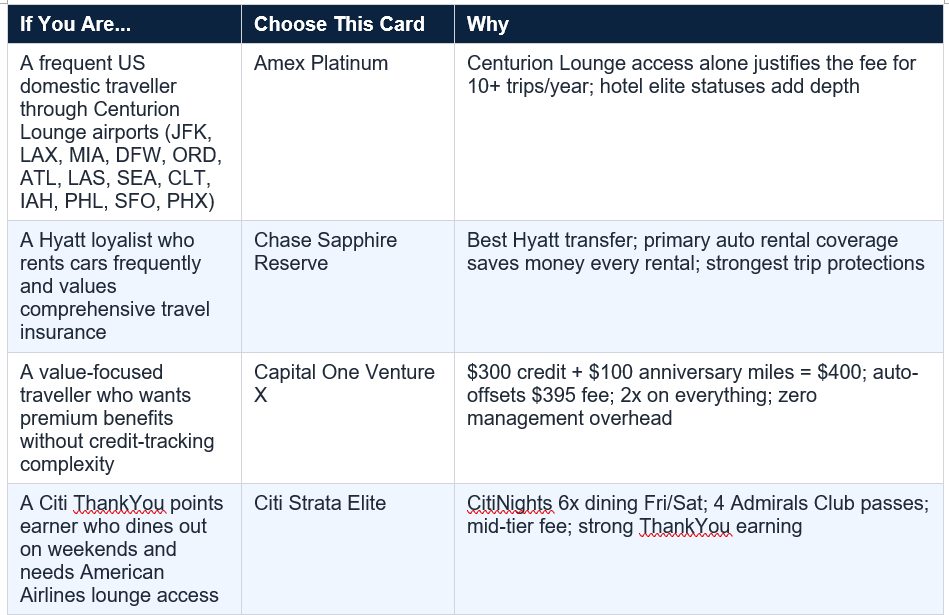
Who Should Get Which Card: The Decision Matrix
Stacking Premium Cards: When Two Is Better Than One
Many serious points-and-miles enthusiasts carry two or more premium cards, using each for the categories or benefits it does best:- Amex Platinum + Chase Sapphire Reserve: Amex handles direct airline (5x), Fine Hotels + Resorts, and Centurion Lounges. Chase handles all travel and dining not on airlines (3x), Hyatt transfers, and car rentals (primary insurance). Combined fee: $1,690 — only justifiable if both cards' top benefits are actively used.
- Capital One Venture X + Citi Strata Premier ($95): Venture X provides lounge access and 2x everywhere; Citi Strata Premier provides 3x on gas, groceries, restaurants, and air. Combined fee: $490 — premium-plus-everyday at a lower combined fee than the Amex Platinum alone.
- Amex Platinum + Wells Fargo Autograph Journey: Amex handles airlines (5x) and Centurion Lounges; Autograph Journey handles direct hotel bookings (5x) at $95. Combined fee: $990 — comparable to the Chase Sapphire Reserve alone with broader earning coverage.
Conclusion
The premium credit card market of 2026 has never been more expensive, more competitive, or more benefit-laden. The Chase Sapphire Reserve's fee increase to $795 raised the bar for what 'premium' costs. The Citi Strata Elite's arrival at $595 filled a gap between the Venture X and the $795–$895 tier. The Amex Platinum has held its $895 position with an expanding credit stack.The analysis across all five cards yields the same conclusion in every scenario: the card that delivers positive ROI is the one whose specific benefits match the cardholder's specific travel behaviour. The Amex Platinum is extraordinary for Centurion Lounge users who track their monthly credits. The Chase Sapphire Reserve is extraordinary for Hyatt loyalists who rent cars frequently. The Capital One Venture X is extraordinary for travellers who want the simplest possible path to a net-zero annual fee. The Citi Strata Elite is extraordinary for weekend diners in the Citi ThankYou ecosystem. The Wells Fargo Autograph Journey is extraordinary for travellers who book directly and want competitive earning without premium overhead.
Before upgrading to or switching any premium card, answer one question: which of this card's top three benefits will I naturally use at least once in the next 12 months? If the answer is none, the card is the wrong fit regardless of its marketed value. The premium card that wins is the one you can actually use.
Frequently Asked Questions
What is the best premium credit card in 2026?There is no single best premium card — the right card depends on your travel behaviour and spending patterns. Capital One Venture X ($395) is best for guaranteed positive ROI and simplicity: the $300 travel credit plus 10,000 anniversary miles offset the entire fee for any cardholder who books one trip through Capital One Travel. Chase Sapphire Reserve ($795) is best for Hyatt transfers, travel insurance, and comprehensive trip protections. Amex Platinum ($895) is best for lounge access (1,550+ lounges, including Centurion Lounges) and luxury hotel perks. Citi Strata Elite ($595) is best for Citi ThankYou points loyalists with heavy weekend dining. Wells Fargo Autograph Journey ($95) is best for direct-booking travellers who want premium earning rates without a premium fee.
Is the Chase Sapphire Reserve worth the $795 annual fee in 2026?
The Chase Sapphire Reserve is worth $795 if you can claim its most valuable credits. Chase's official 2026 disclosure markets over $2,700 in annual cardmember value — but that requires claiming the $300 automatic travel credit, $500 Edit hotel credit, $288 Apple subscriptions credit, and $120 Lyft credit. Travel Anywhere blog's 2026 testing found the card 'returns approximately $2,700 in annual cardmember value but only if the holder realistically claims' all major credits. If you only use the $300 travel credit, your effective fee is $495 — significantly more than the Capital One Venture X's approximately $0 effective fee.
How does Amex Platinum's lounge access compare to Chase Sapphire Reserve?
The Amex Platinum has the broader network at 1,550+ lounges (as of January 2026), including Centurion Lounges (rated the best US credit card lounges), 10 annual Delta Sky Club visits, and Priority Pass. The Chase Sapphire Reserve provides Priority Pass Select (1,300+ lounges) plus Chase Sapphire Lounges (7 US locations). For domestic US travellers, the key differentiator is whether you frequently use airports with Centurion Lounges (20+ globally). If yes, the Amex Platinum's lounge access justifies much of the $895 fee for 10+ trips per year.
What is the effective annual fee for each premium card after credits?
After realistically claimed credits: Capital One Venture X is effectively $0 (the $300 travel credit + $100 anniversary miles offset the $395 fee for any Capital One Travel user). Chase Sapphire Reserve is approximately $495 net after the $300 automatic travel credit; closer to $0 if the $500 Edit hotel credit, $288 Apple credit, and $120 Lyft credit are all claimed. Amex Platinum is approximately $300–$500 for most cardholders per Travel Anywhere blog's 2026 testing (40–60% realistic credit claim rate). Citi Strata Elite is approximately $225 net ($820 benefits vs $595 fee per creditcardcoups.com). Wells Fargo Autograph Journey is approximately $45 after the $50 airline credit.
Are premium credit cards worth it if you only travel 2–3 times per year?
For 2–3 trips per year, the Capital One Venture X ($395) is the easiest to justify: one Capital One Travel booking captures the $300 credit, and the 2x flat-rate earning rewards all spending. The Amex Platinum and Chase Sapphire Reserve are harder to justify for occasional travellers because their highest-value benefits (Centurion Lounge access, Hyatt transfers, comprehensive travel insurance) deliver the most value for frequent travellers. CNN Underscored's June 2026 analysis suggests the Chase Sapphire Preferred ($95) 'remains a great starter transferable points credit card' for occasional travellers who want core benefits without a premium fee.
What changed in the premium credit card market in 2025–2026?
Two major developments shaped the landscape. First, the Chase Sapphire Reserve increased its annual fee from $550 to $795 in June 2025 — the largest premium-card fee increase in the modern points-and-miles era per Travel Anywhere blog. This was paired with a benefits expansion that raised marketed annual cardmember value from approximately $1,000 to over $2,700. Second, the Citi Strata Elite launched in 2026 at $595, filling the gap between the Venture X and the $795–$895 tier and described as the 'Goldilocks card' in the premium space (LazyPoints April 2026). Additionally, the Bilt Palladium launched February 7, 2026 as the first premium card with rent-and-mortgage earning at $495. Capital One also updated its Venture X lounge policy effective February 1, 2026 — verify current guest terms directly with Capital One.
0 Comments
Be the first to share your thoughts on this article.