

Finance
How Real Families Handle the Great Wealth Transfer
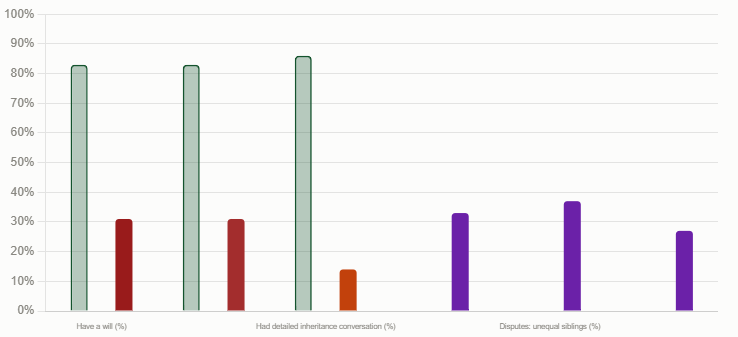
$124 trillion will change hands between baby boomers and younger generations by 2048 — the largest wealth transfer in human history. Heirs are already receiving approximately $2.5 trillion per year, and that figure will top $4 trillion by 2036 as boomer deaths accelerate from 2.6 million annually today to 4 million by 2037. Yet only 31% of Americans have a will. Only 14% have had a detailed conversation with family about inheritance. And probate court disputes have risen 32% since 2020. The numbers are staggering. The preparation is not. This guide examines what the Great Wealth Transfer actually means for real families — the opportunities, the risks, the disputes, the taxes, and the conversations most families are still avoiding.

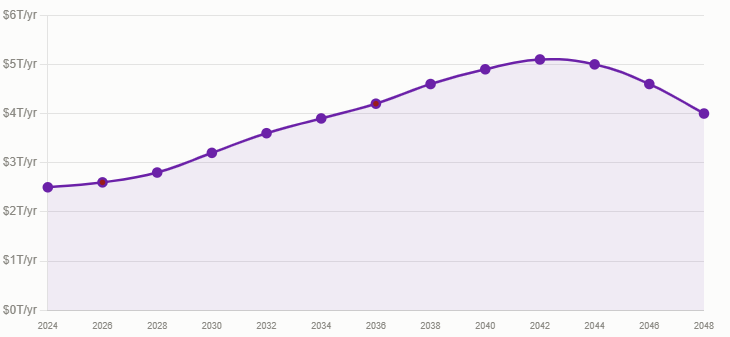
Heirs in the United States are currently receiving approximately $2.5 trillion per year in inheritances and living gifts (Cerulli Associates, cited Acorns, July 14, 2026). That annual figure will more than double — to over $4 trillion per year — around 2036. The total transfer projected through 2048 is $124 trillion, a figure that replaced the earlier $84 trillion estimate as home values and stock portfolios grew.
One in three adult children expects an inheritance to create conflict with their siblings. Only 14% of American adults have had a detailed conversation about inheritance with family members. And between 2020 and 2024, probate and estate cases entering state courts rose 32%. These are not statistics about wealthy families with complex estates. They are statistics about ordinary families — the households where the Great Wealth Transfer is actually happening.
$124 trillion anticipated to be transferred by 2048 (Cerulli; Acorns July 2026). Heirs currently receiving $2.5 trillion/year. Baby boomers hold $93 trillion in assets — 3× US 2025 GDP. Only 31% of Americans have a will (Trust & Will 2025). Only 14% have had a detailed inheritance conversation with family (survey Nov 2025). Probate court disputes: +32% between 2020 and 2024 (National Center for State Courts). Federal estate tax exemption 2026: $15 million individual / $30 million couple (One Big Beautiful Bill Act, July 4, 2025).
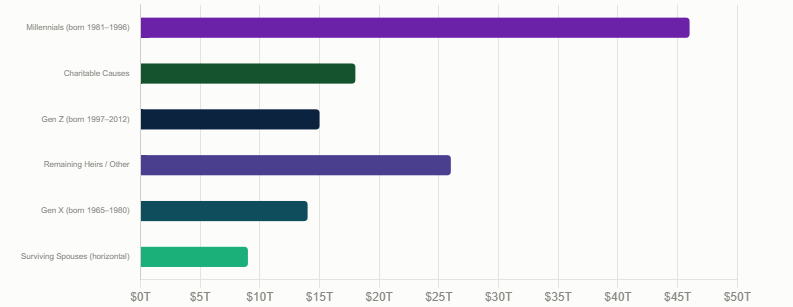
The Cerulli projection breaks down as approximately $105 trillion to heirs and $18 trillion to charitable causes. Of the $105 trillion going to heirs, the generational share is striking: millennials receive the largest slice at $46 trillion by 2048; Gen X receives approximately $14 trillion over the next decade (being the first in line chronologically); and Gen Z receives approximately $15 trillion. The remaining $30+ trillion is distributed across other beneficiaries and remaining wealth that remains within boomer households longer than initially expected.
The critical nuance comes from UBS's analysis, cited by Fortune in December 2024: $9 trillion of the transfer will go to spouses first — horizontal inheritances — before reaching the next generation. Because women statistically outlive men, this means a significant proportion of boomer wealth will first pass to surviving boomer-age wives, who will then transfer it to the next generation one layer later. This is why the timeline for when millennials actually receive their inheritance is longer than the generational headlines suggest: Gen X is first in line, followed by boomer spouses, followed by millennials.
Acorns' July 2026 guide provides the important timing update: 'Heirs are already inheriting around $2.5 trillion a year, a figure that Cerulli projects will top $4 trillion around 2036. One thing worth knowing: The $124 trillion figure is newer and larger than the number you may have seen before. It replaced an earlier and widely repeated projection of about $84 trillion from 2020.' The increase reflects stock market appreciation and real estate value growth since 2020 — boomer portfolios grew, so the eventual transfer grew with them.
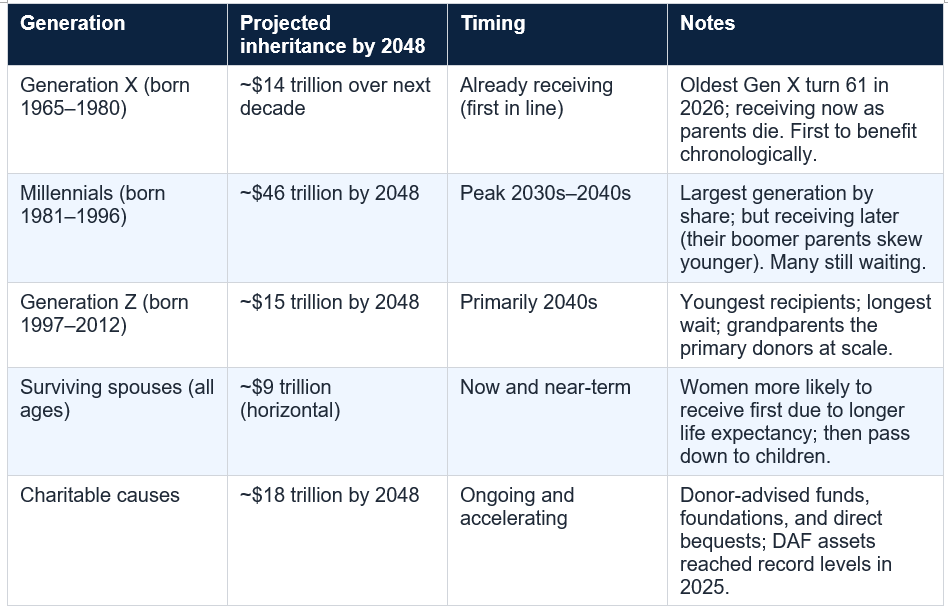
The timing mismatch between expectation and reality is significant. Acorns' July 2026 analysis delivers an important correction for younger recipients: 'If you're in Gen Z — or even a younger millennial — you may be decades away from any inheritance, if you receive one at all. Some will, but most millennials and Gen Z will inherit far less than they expect, and many won't inherit at all.' Inheritance, unlike wages, is not evenly distributed across any generation.
This is the fundamental inequality embedded in the Great Wealth Transfer: the $124 trillion is real, but it is not distributed evenly. The top decile of boomers — those who accumulated significant stock portfolios, paid-off real estate in appreciating markets, and funded defined contribution retirement plans over decades — will transfer very large estates. The median boomer, who may have limited retirement savings, a modest home in a flat property market, and significant healthcare costs in their final years, will transfer very little.
The Michigan Journal of Economics (2025) notes this concentration explicitly: 'Baby boomers account for 51.8% of the country's total wealth, worth $78.55 trillion.' But that wealth is not spread evenly across 77 million boomers. A small proportion holds the vast majority of it. The result is that while the aggregate Great Wealth Transfer is genuinely unprecedented, the individual family experience will vary dramatically: some families are managing the distribution of multi-million dollar portfolios, investment properties, and business interests; others are dividing a modest home and a retirement account that was substantially drawn down by healthcare and long-term care costs before death.
The expectation gap is itself a risk. Kiplinger's September 2026 analysis — published five days before this article — finds that adult children who expect a large inheritance and receive a smaller one experience not just financial disappointment but relational damage. When expectations are not communicated and aligned in advance, even a fair inheritance can feel unfair — because it is measured against an assumed amount rather than a known one. The expectation gap is closed by conversation, not by the size of the estate.
The consequences of dying without a will (dying intestate) range from inconvenient to catastrophic. Without a will: state intestacy laws determine who receives the assets — a formula that may not reflect the deceased's actual wishes; the probate process is longer and more expensive; there is no designated executor to manage the estate; guardianship of minor children may be contested; and specific assets may not reach the intended recipients if beneficiary designations are not coordinated with the overall estate. Mondaq's analysis — published five days before this article — emphasises this coordination issue: retirement account beneficiary designations, life insurance policies, and jointly-held property all transfer outside of a will, meaning an estate plan that does not address these separately is incomplete even if a will exists.
The Echelon Financial analysis (January 2026) frames the consequence clearly: 'That gap represents not only trillions in potential financial mismanagement but also years of avoidable family conflict and stress. Without structure and foresight, inheritances can fracture families instead of fortifying them.' Elder law attorney Evan Farr, cited by fwbusiness.com (January 2026), provides the ground-level reality: 'I have seen many families torn apart when there was no plan, no decision maker, and no documentation providing direction. Siblings fight over money, who makes care decisions, and perceptions of unfair treatment by others. Relatives may even go to court to settle disputes regarding the loved one's estate and spend tens of thousands of dollars fighting each other rather than honoring the individual they care about.'
A will alone is not a complete estate plan. For families with meaningful assets, a comprehensive plan should also address: healthcare proxy and power of attorney documents (who makes medical decisions if you are incapacitated before death); beneficiary designations on retirement accounts and life insurance (these override a will); a revocable living trust (if probate avoidance and privacy are priorities); and — for business owners — a business succession plan. Mondaq's September 2026 analysis emphasises that estate plans written ten, fifteen, or twenty years ago frequently no longer reflect current goals, family circumstances, or tax law. An estate plan is not a one-time document — it requires periodic review.
The reasons for avoidance are well-documented in the psychology of inheritance. Money, mortality, and family dynamics are the three most difficult conversational topics in American culture. Combining all three in a single discussion is genuinely uncomfortable for most families — and the discomfort tends to increase with the size of the estate, because more money means more at stake and more potential for conflict if expectations are not aligned.
Kiplinger's September 2026 analysis brings the adult children's perspective: 'Although half of the adult children in the survey preferred an even split with siblings, one in five thought inheritances should be based on factors such as how much each of them had helped their parents (11%) or each one's financial need (9%). Many also anticipated trouble ahead, with one-third of the adult children respondents expecting an inheritance to create conflict with their siblings.' These are families where the conversation has not happened — where one child assumes equal division, another assumes contribution-weighted distribution, and a third assumes need-based allocation, all in the same family and none of them talking to each other or to their parents about it.
Financial psychologist Brad Klontz, co-author of Psychology of Financial Planning and quoted in Kiplinger's September 2026 article, explains the mechanism of post-inheritance conflict: 'Adult children will often view inheritances through the lens of unresolved issues and patterns in the family, especially if the way assets are divided between siblings comes as a surprise to them. Someone feels hurt and thinks, Oh, Mom must have loved you more than me, or You influenced our parents behind my back.' The surprise is the wound — not necessarily the distribution itself.
Schedule one family money conversation before the end of 2026. It does not need to cover everything. It needs to start. For parents: consider sharing the existence and general structure of your estate plan — not the specific dollar amounts, but the principle behind how you have structured it and why. For adult children: consider asking your parents whether they have an updated will, who they have named as executor, and whether their beneficiary designations on retirement accounts and life insurance are current. These questions do not require a legal discussion — they require a willingness to sit in mild discomfort for 30 minutes. The fwbusiness.com survey finding: 83% acknowledge the importance of this conversation, yet 86% have not had it. The barrier is not knowledge. It is avoidance.
The most common sources of family conflict in estate distribution, per Fidelity Wealth Management's April 2026 report, are: unequal distributions (primary driver of disputes); unequal treatment among siblings (37% of family disputes); and conflicts between biological children and stepchildren (27% of disputes — a figure that will grow as blended families become more prevalent among boomers). TheStreet's April 2026 analysis of the Fidelity report is direct: 'Uneven estate distributions are fueling legal battles, destroying sibling relationships, and leaving lasting financial scars on families who never saw the conflict coming.'
The San Francisco Chronicle's July 18, 2026 investigation — published just eight weeks before this article — gives the human dimension to the statistics. The Chronicle asked readers to share their experiences of the Great Wealth Transfer, and sibling disputes were 'a recurring theme.' One reader, Bianca Neumann, describes a family home her grandmother purchased in San Francisco's SoMa district in 1954. Three siblings — Neumann's mother, aunt, and uncle — have all lived in it their entire lives with their families. 'When she asks what's the plan for the house when they get older and someone needs to move to assisted living or dies, nobody has an answer. Everyone is in denial.'
Estate planning attorney Mark Gilfix, quoted in the same Chronicle article, provides the financial context for procrastination: drawn-out sibling battles can cost six to seven figures to resolve in court, and 'the only people who win are the lawyers.' The irony is that the estate planning required to prevent these outcomes typically costs a fraction of what a single contested probate proceeding costs — and takes a fraction of the time.
Family Snapshot: The Planned Transfer: Parents with an Updated Estate Plan James and Linda, both 74, revisited their estate plan in 2025 after reading about the Great Wealth Transfer. Their estate includes a home, a 401(k), taxable brokerage accounts, and a life insurance policy. With their estate attorney, they updated their will to reflect current wishes; created a revocable living trust to avoid probate on the home; updated all beneficiary designations on the 401(k) and life insurance (which had not been updated since 2008); and set up a family meeting with their two adult children to explain their intentions — not the dollar amounts, but the principles. Their daughter was named executor; their son was named healthcare proxy. No surprises were left. The family conversation was uncomfortable for 45 minutes. It will prevent years of conflict.
Family Snapshot: The Blended Family Complication: A Second Marriage and Competing Claims Robert, 78, married his second wife Patricia in 2012. He has two adult children from his first marriage. Patricia has one adult child. Robert's will, last updated in 2008, leaves everything to his 'children' — ambiguously drafted language that his family members interpret differently. His retirement accounts still name his first wife as beneficiary (never updated after the divorce). His home is jointly titled with Patricia. Under current law, the home passes automatically to Patricia; the retirement accounts go to his ex-wife (the listed beneficiary regardless of divorce); and the residual estate goes into probate with contested interpretation. Legal fees, family conflict, and outcomes that serve no one's actual intentions are the result. This scenario is not unusual. It is one of the most common estate planning failures estate attorneys encounter.
Family Snapshot: The Millennial Waiting Game: What Most of the $124 Trillion Actually Looks Like Sophia, 36, has read extensively about the Great Wealth Transfer and expects a meaningful inheritance from her parents, both 68. Her parents' estate consists of: a home worth $380,000 with $140,000 in remaining mortgage; a 401(k) with $220,000 (partially drawn down in 2020 during the pandemic); and approximately $40,000 in savings. Total gross estate: approximately $640,000. After mortgage payoff, potential long-term care costs (the average American spends $138,000 on long-term care in their lifetime; Genworth 2024), and estate administration costs, Sophia and her brother might each receive $100,000–$150,000 — not the six-figure-per-year passive income stream that Great Wealth Transfer headlines can inadvertently imply. This is a genuine and meaningful inheritance. It is not a retirement strategy.
Family Snapshot: The Family Business: The Most Complex Transfer Scenario The Marchetti family owns a regional landscaping business started by the parents in 1987, now worth approximately $2.8 million. Three adult children are involved: one runs the business full-time, one is a silent partner, and one has no involvement and wants cash. Without a business succession plan, the death of the parents leaves: the active child unable to buy out the others without destroying the business's cash flow; the uninvolved child entitled to immediate liquidity that the business cannot provide; and the silent partner caught between them. A buy-sell agreement funded by life insurance, established years before the transfer, would have converted this conflict into a clean transaction. Without it, the family faces a forced sale, family litigation, or business failure — outcomes that destroy the asset that took 40 years to build.
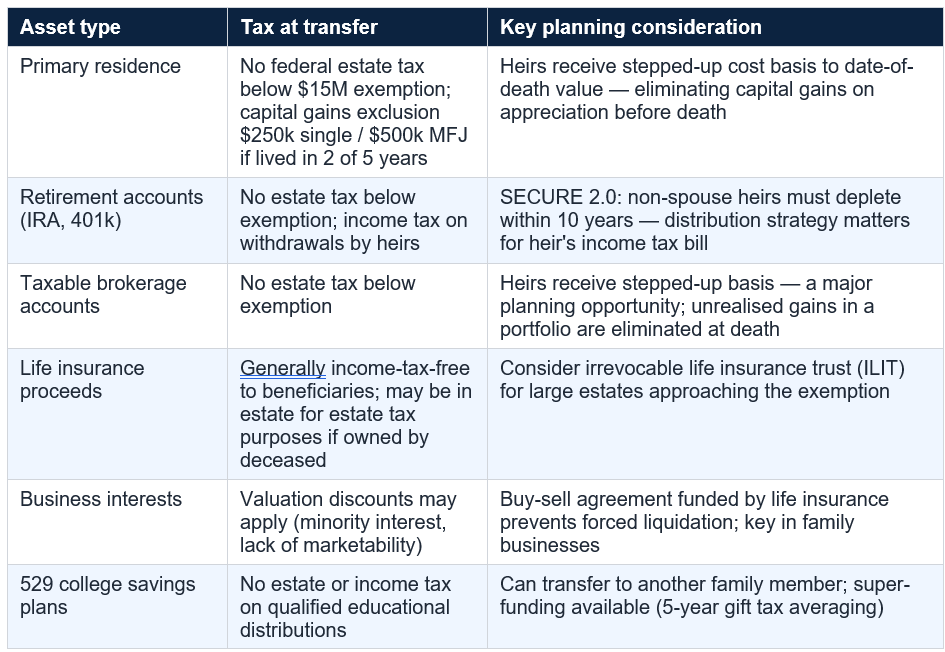
However, state-level taxes are a different matter and vary significantly. Mondaq's analysis — published five days before this article — provides examples: New York imposes an estate tax on estates exceeding $7.35 million, with a cliff provision that eliminates the entire exclusion if the estate exceeds the threshold by more than 5%. Pennsylvania charges an inheritance tax ranging from 0% to 15%, with different rates for different beneficiaries (4.5% for direct descendants such as children). Other states including Iowa, Kentucky, Maryland, Nebraska, and New Jersey also impose some form of inheritance or estate tax. Many states have no estate or inheritance tax at all.
For retirement accounts — the largest asset in many middle-class estates — the SECURE 2.0 Act's 10-year rule for non-spouse beneficiaries creates a significant income tax planning issue. Under this rule, most non-spouse heirs must deplete an inherited IRA or 401(k) within 10 years. The withdrawal strategy within that decade can significantly affect the total tax bill: taking equal distributions over 10 years versus taking everything in year 10 can produce meaningfully different tax outcomes depending on the beneficiary's own income tax situation. This is a planning opportunity that many families are missing because they are not having the conversation before the transfer occurs.
Acorns' July 2026 guide provides the expectation correction that many heirs need: 'The average inheritance in the U.S. is about $46,200, according to Federal Reserve data. That figure is skewed upward by a small number of very large estates, so the typical amount most people receive is lower.' For heirs who have been mentally planning around a larger sum, this reality check is important — not to diminish the value of what is received, but to calibrate financial decisions accordingly.
For millennials receiving a meaningful inheritance — whether $50,000 or $500,000 — the financial literacy research suggests a consistent hierarchy of uses: first, eliminate high-interest consumer debt (which prevents the inherited capital from being eroded by 21% APR interest charges); second, establish or replenish an emergency fund (3–6 months of essential expenses in accessible savings); third, maximise tax-advantaged investment accounts (Roth IRA, 401(k) catch-up contributions if in the catch-up age range); fourth, invest the remainder in a diversified, low-cost portfolio aligned with a long time horizon.
The emotional dimension of receiving an inheritance should also be acknowledged. Grief and financial decisions are a difficult combination. The death of a parent or grandparent, the pressure of distributing or managing an unexpected asset, and the complex family dynamics that estate settlements can expose all make the period immediately following an inheritance one of the worst times to make irreversible financial decisions. Financial planners who specialise in inheritance planning often recommend a 6-month minimum waiting period for any major discretionary spending from inherited funds.
But the gap between the potential of the Great Wealth Transfer and its actual outcome for most families is determined almost entirely by preparation and communication — not by the size of the estate. Only 31% have a will. Only 14% have had the conversation. Probate disputes are up 32%. These are preventable failures. They are happening not because families do not love each other, but because money, mortality, and family dynamics are uncomfortable to discuss — and most families choose to avoid the discomfort until a crisis forces them into it.
The families who navigate the Great Wealth Transfer well are not necessarily the wealthiest. They are the ones who had the conversation, updated the documents, aligned the beneficiary designations, and understood that the greatest gift a generation can give the next is not just the money — it is the plan, the communication, and the clarity that allows the money to arrive without fracturing the family that receives it.
The latest Cerulli Associates projection, updated as home and stock values rose from the original 2020 estimate, puts the total Great Wealth Transfer at approximately $124 trillion through 2048 — replacing the earlier $84 trillion figure. Of this total, approximately $105 trillion is expected to go to heirs and $18 trillion to charitable causes. Baby boomers and the Silent Generation are the primary source, collectively holding at least $93 trillion in assets (Visa, July 2026). The transfer is already happening: heirs are currently receiving approximately $2.5 trillion per year, a figure that will accelerate to over $4 trillion annually around 2036 as boomer deaths climb from 2.6 million per year today toward 4 million by 2037. The leading edge of the Baby Boom turned 80 on January 1, 2026 (SalesGlobe, May 2026).
What is the average inheritance in the US?
The Federal Reserve puts the average US inheritance at approximately $46,200 (cited Acorns, July 2026). However, this figure is significantly skewed upward by a small number of very large estates — the typical amount most people receive is lower, and many will receive nothing. The $124 trillion total is heavily concentrated at the top of the wealth distribution: a relatively small proportion of boomers hold the vast majority of boomer wealth. Millennials who are expecting six-figure inheritances may be disappointed: as Acorns notes in their July 2026 guide, 'most millennials and Gen Z will inherit far less than they expect, and many won't inherit at all.'
Why are estate disputes rising?
Probate and estate cases entering state courts rose approximately 32% between 2020 and 2024, based on data from 39 states compiled by the National Center for State Courts. Legal experts attribute much of this increase directly to the Great Wealth Transfer — more estates being settled creates more opportunities for disputes. The most common causes: unequal distributions between children; conflicts between biological children and stepchildren (27% of disputes per STEP); and estates where there is no will, no clear plan, and no documented expression of the deceased's wishes. Fidelity Wealth Management's April 2026 report identifies rising unequal inheritances as the primary driver. Estate attorney Mark Gilfix notes that sibling battles can cost six to seven figures to resolve — 'the only people who win are the lawyers' (SF Chronicle, July 2026).
What taxes apply to inheritances in the US in 2026?
For most American families, federal estate tax is not a concern. The One Big Beautiful Bill Act (signed July 4, 2025) raised the federal estate and gift tax exemption to $15 million per individual ($30 million per married couple), meaning fewer than 0.1% of estates owe any federal estate tax. However, state taxes vary widely: New York taxes estates over $7.35 million; Pennsylvania charges inheritance tax of 4.5%–15% on transfers to direct descendants; several other states have estate or inheritance taxes with their own thresholds. Additionally, inherited retirement accounts (IRA, 401(k)) are subject to income tax when withdrawn — and SECURE 2.0 requires most non-spouse heirs to deplete inherited retirement accounts within 10 years, making the withdrawal strategy important for tax planning. Inherited stocks and real estate typically receive a stepped-up cost basis to the date-of-death value, eliminating capital gains tax on pre-death appreciation. Consult a qualified estate planning attorney for advice specific to your state.
What if my parents don't have a will?
If parents die without a will (intestate), state law determines how assets are distributed — typically to the spouse first, then to children in equal shares, with more complex rules for blended families, unmarried partners, and other situations. The process goes through probate, which can be slower and more expensive than with a will. Assets with beneficiary designations (retirement accounts, life insurance) are not affected by intestacy — they transfer directly to the named beneficiary regardless of what any will or intestacy law says. The most practical step: encourage parents to create a basic will and healthcare proxy, and to update beneficiary designations on all accounts. These documents can be created with an estate planning attorney for a few hundred to a few thousand dollars — a fraction of what a contested probate proceeding costs.
What should millennials do with an inheritance when they receive one?
Acorns and Kiplinger both recommend treating an inherited sum as a legacy first — understanding what it represents and pausing before making major decisions. The evidence-based financial priority hierarchy for inherited funds: (1) pay off high-interest consumer debt (credit cards, personal loans) — there is no investment that reliably returns 21% after tax; (2) establish or replenish an emergency fund of 3–6 months of expenses; (3) maximise tax-advantaged accounts (Roth IRA, 401(k)) before investing in taxable accounts; (4) invest the remainder in a diversified, low-cost index fund portfolio aligned with your time horizon; (5) only then consider larger discretionary spending (home down payment, etc.). Financial planners recommend waiting at least 6 months before any major discretionary spending from inherited funds — grief and major financial decisions are a difficult combination. Engage a fee-only fiduciary financial planner before making large decisions.
Table of Contents
- The Largest Wealth Transfer in Human History
- The Numbers: How Big Is the Great Wealth Transfer?
- Who Gets What — and When?
- The Reality Check: What Most Families Are Actually Receiving
- The Preparation Crisis: Only 31% Have a Will
- The Conversation Gap: Only 14% Have Discussed Inheritance
- When Inheritances Tear Families Apart: The Rising Dispute Data
- Real Family Scenarios: How Different Families Are Navigating This
- The Tax Picture: What Federal and State Law Now Says
- What Families Should Be Doing Right Now: A Practical Checklist
- For the Heirs: How to Receive an Inheritance Wisely
- Conclusion: Planning Is the Greatest Gift
- Frequently Asked Questions
Who Gets What: $125T Generational Breakdown
The Preparation Gap: 6 Critical Metrices
Transfer Timeline: Annual flow 2024 - 2048
The Largest Wealth Transfer in Human History
Something unprecedented is happening in American family finance. Baby boomers — who built their wealth across five decades of rising stock markets, appreciating real estate, and employer pension plans that no longer exist for their children — are beginning to transfer that wealth to the next generation at a scale and speed that has no historical precedent. The leading edge of the Baby Boom turned 80 on January 1, 2026. Boomer deaths are rising from 2.6 million per year today toward 4 million annually by 2037 (SalesGlobe, May 2026). The transfer is not a future event. It is happening now.Heirs in the United States are currently receiving approximately $2.5 trillion per year in inheritances and living gifts (Cerulli Associates, cited Acorns, July 14, 2026). That annual figure will more than double — to over $4 trillion per year — around 2036. The total transfer projected through 2048 is $124 trillion, a figure that replaced the earlier $84 trillion estimate as home values and stock portfolios grew.
One in three adult children expects an inheritance to create conflict with their siblings. Only 14% of American adults have had a detailed conversation about inheritance with family members. And between 2020 and 2024, probate and estate cases entering state courts rose 32%. These are not statistics about wealthy families with complex estates. They are statistics about ordinary families — the households where the Great Wealth Transfer is actually happening.
$124 trillion anticipated to be transferred by 2048 (Cerulli; Acorns July 2026). Heirs currently receiving $2.5 trillion/year. Baby boomers hold $93 trillion in assets — 3× US 2025 GDP. Only 31% of Americans have a will (Trust & Will 2025). Only 14% have had a detailed inheritance conversation with family (survey Nov 2025). Probate court disputes: +32% between 2020 and 2024 (National Center for State Courts). Federal estate tax exemption 2026: $15 million individual / $30 million couple (One Big Beautiful Bill Act, July 4, 2025).
The Numbers: How Big Is the Great Wealth Transfer?
The scale of the Great Wealth Transfer requires some grounding, because the headline numbers are genuinely difficult to contextualise. $124 trillion: that is the latest Cerulli Associates projection for total wealth transfer through 2048. To put it in perspective, Visa's July 2026 economic analysis notes that baby boomers alone are sitting on at least $93 trillion in assets — more than three times the entire US GDP of approximately $31 trillion in 2025, and more than the total wealth held by Gen X and millennials combined.The Cerulli projection breaks down as approximately $105 trillion to heirs and $18 trillion to charitable causes. Of the $105 trillion going to heirs, the generational share is striking: millennials receive the largest slice at $46 trillion by 2048; Gen X receives approximately $14 trillion over the next decade (being the first in line chronologically); and Gen Z receives approximately $15 trillion. The remaining $30+ trillion is distributed across other beneficiaries and remaining wealth that remains within boomer households longer than initially expected.
The critical nuance comes from UBS's analysis, cited by Fortune in December 2024: $9 trillion of the transfer will go to spouses first — horizontal inheritances — before reaching the next generation. Because women statistically outlive men, this means a significant proportion of boomer wealth will first pass to surviving boomer-age wives, who will then transfer it to the next generation one layer later. This is why the timeline for when millennials actually receive their inheritance is longer than the generational headlines suggest: Gen X is first in line, followed by boomer spouses, followed by millennials.
Acorns' July 2026 guide provides the important timing update: 'Heirs are already inheriting around $2.5 trillion a year, a figure that Cerulli projects will top $4 trillion around 2036. One thing worth knowing: The $124 trillion figure is newer and larger than the number you may have seen before. It replaced an earlier and widely repeated projection of about $84 trillion from 2020.' The increase reflects stock market appreciation and real estate value growth since 2020 — boomer portfolios grew, so the eventual transfer grew with them.
Who Gets What — and When?
The Great Wealth Transfer is not a uniform windfall distributed equally across generations. It is highly concentrated. Cerulli Associates estimates that 81% of all transfers — roughly $100 trillion — come from boomer and older households. Within that group, wealth is itself highly concentrated: a small number of very large estates dominate the total, while the median estate transferred is significantly smaller than the average.The timing mismatch between expectation and reality is significant. Acorns' July 2026 analysis delivers an important correction for younger recipients: 'If you're in Gen Z — or even a younger millennial — you may be decades away from any inheritance, if you receive one at all. Some will, but most millennials and Gen Z will inherit far less than they expect, and many won't inherit at all.' Inheritance, unlike wages, is not evenly distributed across any generation.
The Reality Check: What Most Families Are Actually Receiving
The gap between the headline $124 trillion and what individual families are actually receiving is enormous — and psychologically important. The Federal Reserve data cited by Acorns puts the average US inheritance at approximately $46,200. But as Acorns notes carefully: 'That figure is skewed upward by a small number of very large estates, so the typical amount most people receive is lower. In short, the average is a lot smaller than the six-figure sums many young adults expect.'This is the fundamental inequality embedded in the Great Wealth Transfer: the $124 trillion is real, but it is not distributed evenly. The top decile of boomers — those who accumulated significant stock portfolios, paid-off real estate in appreciating markets, and funded defined contribution retirement plans over decades — will transfer very large estates. The median boomer, who may have limited retirement savings, a modest home in a flat property market, and significant healthcare costs in their final years, will transfer very little.
The Michigan Journal of Economics (2025) notes this concentration explicitly: 'Baby boomers account for 51.8% of the country's total wealth, worth $78.55 trillion.' But that wealth is not spread evenly across 77 million boomers. A small proportion holds the vast majority of it. The result is that while the aggregate Great Wealth Transfer is genuinely unprecedented, the individual family experience will vary dramatically: some families are managing the distribution of multi-million dollar portfolios, investment properties, and business interests; others are dividing a modest home and a retirement account that was substantially drawn down by healthcare and long-term care costs before death.
The expectation gap is itself a risk. Kiplinger's September 2026 analysis — published five days before this article — finds that adult children who expect a large inheritance and receive a smaller one experience not just financial disappointment but relational damage. When expectations are not communicated and aligned in advance, even a fair inheritance can feel unfair — because it is measured against an assumed amount rather than a known one. The expectation gap is closed by conversation, not by the size of the estate.
The Preparation Crisis: Only 31% Have a Will
The single most striking statistic in the Great Wealth Transfer landscape is not the total dollar amount. It is the preparation gap. According to Trust & Will's 2025 Estate Planning Report, cited by Echelon Financial, only 31% of Americans currently have a will — despite the fact that 83% acknowledge the importance of estate planning. This means that approximately two-thirds of the $124 trillion in eventual transfers is currently heading toward families without a documented plan for how it should be distributed.The consequences of dying without a will (dying intestate) range from inconvenient to catastrophic. Without a will: state intestacy laws determine who receives the assets — a formula that may not reflect the deceased's actual wishes; the probate process is longer and more expensive; there is no designated executor to manage the estate; guardianship of minor children may be contested; and specific assets may not reach the intended recipients if beneficiary designations are not coordinated with the overall estate. Mondaq's analysis — published five days before this article — emphasises this coordination issue: retirement account beneficiary designations, life insurance policies, and jointly-held property all transfer outside of a will, meaning an estate plan that does not address these separately is incomplete even if a will exists.
The Echelon Financial analysis (January 2026) frames the consequence clearly: 'That gap represents not only trillions in potential financial mismanagement but also years of avoidable family conflict and stress. Without structure and foresight, inheritances can fracture families instead of fortifying them.' Elder law attorney Evan Farr, cited by fwbusiness.com (January 2026), provides the ground-level reality: 'I have seen many families torn apart when there was no plan, no decision maker, and no documentation providing direction. Siblings fight over money, who makes care decisions, and perceptions of unfair treatment by others. Relatives may even go to court to settle disputes regarding the loved one's estate and spend tens of thousands of dollars fighting each other rather than honoring the individual they care about.'
A will alone is not a complete estate plan. For families with meaningful assets, a comprehensive plan should also address: healthcare proxy and power of attorney documents (who makes medical decisions if you are incapacitated before death); beneficiary designations on retirement accounts and life insurance (these override a will); a revocable living trust (if probate avoidance and privacy are priorities); and — for business owners — a business succession plan. Mondaq's September 2026 analysis emphasises that estate plans written ten, fifteen, or twenty years ago frequently no longer reflect current goals, family circumstances, or tax law. An estate plan is not a one-time document — it requires periodic review.
The Conversation Gap: Only 14% Have Discussed Inheritance
Beyond the will gap is the conversation gap. A survey of 1,000 US adults conducted in November 2025 and reported by fwbusiness.com (January 2026) found that only 14% of American adults have had detailed conversations about inheritance with family members. Eighty-three per cent acknowledge the importance of estate planning; 86% have not had the conversation. This is not indifference — it is avoidance.The reasons for avoidance are well-documented in the psychology of inheritance. Money, mortality, and family dynamics are the three most difficult conversational topics in American culture. Combining all three in a single discussion is genuinely uncomfortable for most families — and the discomfort tends to increase with the size of the estate, because more money means more at stake and more potential for conflict if expectations are not aligned.
Kiplinger's September 2026 analysis brings the adult children's perspective: 'Although half of the adult children in the survey preferred an even split with siblings, one in five thought inheritances should be based on factors such as how much each of them had helped their parents (11%) or each one's financial need (9%). Many also anticipated trouble ahead, with one-third of the adult children respondents expecting an inheritance to create conflict with their siblings.' These are families where the conversation has not happened — where one child assumes equal division, another assumes contribution-weighted distribution, and a third assumes need-based allocation, all in the same family and none of them talking to each other or to their parents about it.
Financial psychologist Brad Klontz, co-author of Psychology of Financial Planning and quoted in Kiplinger's September 2026 article, explains the mechanism of post-inheritance conflict: 'Adult children will often view inheritances through the lens of unresolved issues and patterns in the family, especially if the way assets are divided between siblings comes as a surprise to them. Someone feels hurt and thinks, Oh, Mom must have loved you more than me, or You influenced our parents behind my back.' The surprise is the wound — not necessarily the distribution itself.
Schedule one family money conversation before the end of 2026. It does not need to cover everything. It needs to start. For parents: consider sharing the existence and general structure of your estate plan — not the specific dollar amounts, but the principle behind how you have structured it and why. For adult children: consider asking your parents whether they have an updated will, who they have named as executor, and whether their beneficiary designations on retirement accounts and life insurance are current. These questions do not require a legal discussion — they require a willingness to sit in mild discomfort for 30 minutes. The fwbusiness.com survey finding: 83% acknowledge the importance of this conversation, yet 86% have not had it. The barrier is not knowledge. It is avoidance.
When Inheritances Tear Families Apart: The Rising Dispute Data
The statistical evidence that the Great Wealth Transfer is generating family conflict is striking. Between 2020 and 2024, probate and estate cases entering state courts rose approximately 32%, based on data from 39 states compiled by the National Center for State Courts (cited MH Education, April 2026). Legal experts who work in estate litigation attribute much of this increase directly to the Great Wealth Transfer — more estates being settled means more disputes arising, particularly where there is no clear plan, clear communication, or clear documentation.The most common sources of family conflict in estate distribution, per Fidelity Wealth Management's April 2026 report, are: unequal distributions (primary driver of disputes); unequal treatment among siblings (37% of family disputes); and conflicts between biological children and stepchildren (27% of disputes — a figure that will grow as blended families become more prevalent among boomers). TheStreet's April 2026 analysis of the Fidelity report is direct: 'Uneven estate distributions are fueling legal battles, destroying sibling relationships, and leaving lasting financial scars on families who never saw the conflict coming.'
The San Francisco Chronicle's July 18, 2026 investigation — published just eight weeks before this article — gives the human dimension to the statistics. The Chronicle asked readers to share their experiences of the Great Wealth Transfer, and sibling disputes were 'a recurring theme.' One reader, Bianca Neumann, describes a family home her grandmother purchased in San Francisco's SoMa district in 1954. Three siblings — Neumann's mother, aunt, and uncle — have all lived in it their entire lives with their families. 'When she asks what's the plan for the house when they get older and someone needs to move to assisted living or dies, nobody has an answer. Everyone is in denial.'
Estate planning attorney Mark Gilfix, quoted in the same Chronicle article, provides the financial context for procrastination: drawn-out sibling battles can cost six to seven figures to resolve in court, and 'the only people who win are the lawyers.' The irony is that the estate planning required to prevent these outcomes typically costs a fraction of what a single contested probate proceeding costs — and takes a fraction of the time.
Real Family Scenarios: How Different Families Are Navigating This
The Great Wealth Transfer plays out very differently depending on the size of the estate, the family structure, and whether planning has been done. The following composite scenarios — drawn from themes in the published reporting — illustrate the range.Family Snapshot: The Planned Transfer: Parents with an Updated Estate Plan James and Linda, both 74, revisited their estate plan in 2025 after reading about the Great Wealth Transfer. Their estate includes a home, a 401(k), taxable brokerage accounts, and a life insurance policy. With their estate attorney, they updated their will to reflect current wishes; created a revocable living trust to avoid probate on the home; updated all beneficiary designations on the 401(k) and life insurance (which had not been updated since 2008); and set up a family meeting with their two adult children to explain their intentions — not the dollar amounts, but the principles. Their daughter was named executor; their son was named healthcare proxy. No surprises were left. The family conversation was uncomfortable for 45 minutes. It will prevent years of conflict.
Family Snapshot: The Blended Family Complication: A Second Marriage and Competing Claims Robert, 78, married his second wife Patricia in 2012. He has two adult children from his first marriage. Patricia has one adult child. Robert's will, last updated in 2008, leaves everything to his 'children' — ambiguously drafted language that his family members interpret differently. His retirement accounts still name his first wife as beneficiary (never updated after the divorce). His home is jointly titled with Patricia. Under current law, the home passes automatically to Patricia; the retirement accounts go to his ex-wife (the listed beneficiary regardless of divorce); and the residual estate goes into probate with contested interpretation. Legal fees, family conflict, and outcomes that serve no one's actual intentions are the result. This scenario is not unusual. It is one of the most common estate planning failures estate attorneys encounter.
Family Snapshot: The Millennial Waiting Game: What Most of the $124 Trillion Actually Looks Like Sophia, 36, has read extensively about the Great Wealth Transfer and expects a meaningful inheritance from her parents, both 68. Her parents' estate consists of: a home worth $380,000 with $140,000 in remaining mortgage; a 401(k) with $220,000 (partially drawn down in 2020 during the pandemic); and approximately $40,000 in savings. Total gross estate: approximately $640,000. After mortgage payoff, potential long-term care costs (the average American spends $138,000 on long-term care in their lifetime; Genworth 2024), and estate administration costs, Sophia and her brother might each receive $100,000–$150,000 — not the six-figure-per-year passive income stream that Great Wealth Transfer headlines can inadvertently imply. This is a genuine and meaningful inheritance. It is not a retirement strategy.
Family Snapshot: The Family Business: The Most Complex Transfer Scenario The Marchetti family owns a regional landscaping business started by the parents in 1987, now worth approximately $2.8 million. Three adult children are involved: one runs the business full-time, one is a silent partner, and one has no involvement and wants cash. Without a business succession plan, the death of the parents leaves: the active child unable to buy out the others without destroying the business's cash flow; the uninvolved child entitled to immediate liquidity that the business cannot provide; and the silent partner caught between them. A buy-sell agreement funded by life insurance, established years before the transfer, would have converted this conflict into a clean transaction. Without it, the family faces a forced sale, family litigation, or business failure — outcomes that destroy the asset that took 40 years to build.
The Tax Picture: What Federal and State Law Now Says
For most families, federal estate tax is not a concern in 2026. The One Big Beautiful Bill Act — signed into law on July 4, 2025 — raised the federal estate and gift tax exemption to $15 million per individual, or $30 million per married couple. TheStreet's April 2026 analysis confirms that fewer than 0.1% of estates pay any federal estate tax as a result of this threshold. For the vast majority of American families transferring homes, retirement accounts, and modest investment portfolios, federal estate tax is effectively irrelevant.However, state-level taxes are a different matter and vary significantly. Mondaq's analysis — published five days before this article — provides examples: New York imposes an estate tax on estates exceeding $7.35 million, with a cliff provision that eliminates the entire exclusion if the estate exceeds the threshold by more than 5%. Pennsylvania charges an inheritance tax ranging from 0% to 15%, with different rates for different beneficiaries (4.5% for direct descendants such as children). Other states including Iowa, Kentucky, Maryland, Nebraska, and New Jersey also impose some form of inheritance or estate tax. Many states have no estate or inheritance tax at all.
For retirement accounts — the largest asset in many middle-class estates — the SECURE 2.0 Act's 10-year rule for non-spouse beneficiaries creates a significant income tax planning issue. Under this rule, most non-spouse heirs must deplete an inherited IRA or 401(k) within 10 years. The withdrawal strategy within that decade can significantly affect the total tax bill: taking equal distributions over 10 years versus taking everything in year 10 can produce meaningfully different tax outcomes depending on the beneficiary's own income tax situation. This is a planning opportunity that many families are missing because they are not having the conversation before the transfer occurs.
What Families Should Be Doing Right Now: A Practical Checklist
The gap between knowing action is needed and taking it is the central challenge of the Great Wealth Transfer for ordinary families. The following checklist addresses the most common gaps identified in the 2025–2026 research:- For parents: create or update your will. If you have not reviewed your will in the past five years, it almost certainly needs updating. Marriage, divorce, births, deaths, and changes in tax law all affect whether a will still reflects your intentions. For families with meaningful assets (homes, retirement accounts, business interests), engage an estate planning attorney rather than using an online template alone.
- For parents: update ALL beneficiary designations. Retirement accounts (IRA, 401(k)), life insurance policies, and bank accounts with payable-on-death designations transfer outside your will. A will that says one thing and a beneficiary designation that says another creates the Robert and Patricia scenario described above. Review all designations annually and after any major life event.
- For parents: consider a revocable living trust if probate avoidance matters to you. Unlike a will, a trust does not go through probate — it transfers assets directly to beneficiaries, faster, privately, and without court involvement. Particularly valuable for families with real estate in multiple states (each state requires its own probate proceeding without a trust).
- For parents: plan for long-term care costs. The average American spends $138,000 on long-term care in their lifetime — often the largest late-life expense (Genworth 2024). Long-term care insurance, hybrid life/LTC policies, or a Medicaid planning strategy can protect assets from being consumed before transfer. Families should discuss care preferences and care funding before a health crisis makes these decisions urgent.
- For adult children: have the conversation. Ask your parents whether they have a current will, who is named as executor, and whether their beneficiary designations are up to date. These questions are acts of love, not greed — they give your parents the opportunity to ensure their wishes are documented and understood. The Kiplinger September 2026 survey found one-third of adult children expect inheritance to create sibling conflict: the time to address this expectation is before the inheritance, not after.
- For heirs receiving an inheritance: pause before spending. Kiplinger and Acorns both recommend treating an inheritance as a legacy first — understanding the source, values, and effort behind the wealth — before making any major financial decisions. Large windfalls are associated with rapid dissipation; research shows lottery winners return to their pre-windfall financial position within 3–5 years (Steady Wealth March 2026). Engage a fee-only financial planner (fiduciary) before making any large decisions with inherited funds.
For the Heirs: How to Receive an Inheritance Wisely
The heir's experience of the Great Wealth Transfer is often underrepresented in the estate planning literature, which focuses almost exclusively on the giver's perspective. But how heirs receive, manage, and use inherited wealth determines whether it extends a legacy or dissipates within a generation.Acorns' July 2026 guide provides the expectation correction that many heirs need: 'The average inheritance in the U.S. is about $46,200, according to Federal Reserve data. That figure is skewed upward by a small number of very large estates, so the typical amount most people receive is lower.' For heirs who have been mentally planning around a larger sum, this reality check is important — not to diminish the value of what is received, but to calibrate financial decisions accordingly.
For millennials receiving a meaningful inheritance — whether $50,000 or $500,000 — the financial literacy research suggests a consistent hierarchy of uses: first, eliminate high-interest consumer debt (which prevents the inherited capital from being eroded by 21% APR interest charges); second, establish or replenish an emergency fund (3–6 months of essential expenses in accessible savings); third, maximise tax-advantaged investment accounts (Roth IRA, 401(k) catch-up contributions if in the catch-up age range); fourth, invest the remainder in a diversified, low-cost portfolio aligned with a long time horizon.
The emotional dimension of receiving an inheritance should also be acknowledged. Grief and financial decisions are a difficult combination. The death of a parent or grandparent, the pressure of distributing or managing an unexpected asset, and the complex family dynamics that estate settlements can expose all make the period immediately following an inheritance one of the worst times to make irreversible financial decisions. Financial planners who specialise in inheritance planning often recommend a 6-month minimum waiting period for any major discretionary spending from inherited funds.
Conclusion
The Great Wealth Transfer is already underway. $2.5 trillion is changing hands every year, accelerating toward $4 trillion by 2036, with a total of $124 trillion projected through 2048. The opportunity this represents for American families — to extend financial security across generations, to fund education and homeownership, to build lasting legacies — is genuine and significant.But the gap between the potential of the Great Wealth Transfer and its actual outcome for most families is determined almost entirely by preparation and communication — not by the size of the estate. Only 31% have a will. Only 14% have had the conversation. Probate disputes are up 32%. These are preventable failures. They are happening not because families do not love each other, but because money, mortality, and family dynamics are uncomfortable to discuss — and most families choose to avoid the discomfort until a crisis forces them into it.
The families who navigate the Great Wealth Transfer well are not necessarily the wealthiest. They are the ones who had the conversation, updated the documents, aligned the beneficiary designations, and understood that the greatest gift a generation can give the next is not just the money — it is the plan, the communication, and the clarity that allows the money to arrive without fracturing the family that receives it.
Frequently Asked Questions
How much is the Great Wealth Transfer worth and when is it happening?The latest Cerulli Associates projection, updated as home and stock values rose from the original 2020 estimate, puts the total Great Wealth Transfer at approximately $124 trillion through 2048 — replacing the earlier $84 trillion figure. Of this total, approximately $105 trillion is expected to go to heirs and $18 trillion to charitable causes. Baby boomers and the Silent Generation are the primary source, collectively holding at least $93 trillion in assets (Visa, July 2026). The transfer is already happening: heirs are currently receiving approximately $2.5 trillion per year, a figure that will accelerate to over $4 trillion annually around 2036 as boomer deaths climb from 2.6 million per year today toward 4 million by 2037. The leading edge of the Baby Boom turned 80 on January 1, 2026 (SalesGlobe, May 2026).
What is the average inheritance in the US?
The Federal Reserve puts the average US inheritance at approximately $46,200 (cited Acorns, July 2026). However, this figure is significantly skewed upward by a small number of very large estates — the typical amount most people receive is lower, and many will receive nothing. The $124 trillion total is heavily concentrated at the top of the wealth distribution: a relatively small proportion of boomers hold the vast majority of boomer wealth. Millennials who are expecting six-figure inheritances may be disappointed: as Acorns notes in their July 2026 guide, 'most millennials and Gen Z will inherit far less than they expect, and many won't inherit at all.'
Why are estate disputes rising?
Probate and estate cases entering state courts rose approximately 32% between 2020 and 2024, based on data from 39 states compiled by the National Center for State Courts. Legal experts attribute much of this increase directly to the Great Wealth Transfer — more estates being settled creates more opportunities for disputes. The most common causes: unequal distributions between children; conflicts between biological children and stepchildren (27% of disputes per STEP); and estates where there is no will, no clear plan, and no documented expression of the deceased's wishes. Fidelity Wealth Management's April 2026 report identifies rising unequal inheritances as the primary driver. Estate attorney Mark Gilfix notes that sibling battles can cost six to seven figures to resolve — 'the only people who win are the lawyers' (SF Chronicle, July 2026).
What taxes apply to inheritances in the US in 2026?
For most American families, federal estate tax is not a concern. The One Big Beautiful Bill Act (signed July 4, 2025) raised the federal estate and gift tax exemption to $15 million per individual ($30 million per married couple), meaning fewer than 0.1% of estates owe any federal estate tax. However, state taxes vary widely: New York taxes estates over $7.35 million; Pennsylvania charges inheritance tax of 4.5%–15% on transfers to direct descendants; several other states have estate or inheritance taxes with their own thresholds. Additionally, inherited retirement accounts (IRA, 401(k)) are subject to income tax when withdrawn — and SECURE 2.0 requires most non-spouse heirs to deplete inherited retirement accounts within 10 years, making the withdrawal strategy important for tax planning. Inherited stocks and real estate typically receive a stepped-up cost basis to the date-of-death value, eliminating capital gains tax on pre-death appreciation. Consult a qualified estate planning attorney for advice specific to your state.
What if my parents don't have a will?
If parents die without a will (intestate), state law determines how assets are distributed — typically to the spouse first, then to children in equal shares, with more complex rules for blended families, unmarried partners, and other situations. The process goes through probate, which can be slower and more expensive than with a will. Assets with beneficiary designations (retirement accounts, life insurance) are not affected by intestacy — they transfer directly to the named beneficiary regardless of what any will or intestacy law says. The most practical step: encourage parents to create a basic will and healthcare proxy, and to update beneficiary designations on all accounts. These documents can be created with an estate planning attorney for a few hundred to a few thousand dollars — a fraction of what a contested probate proceeding costs.
What should millennials do with an inheritance when they receive one?
Acorns and Kiplinger both recommend treating an inherited sum as a legacy first — understanding what it represents and pausing before making major decisions. The evidence-based financial priority hierarchy for inherited funds: (1) pay off high-interest consumer debt (credit cards, personal loans) — there is no investment that reliably returns 21% after tax; (2) establish or replenish an emergency fund of 3–6 months of expenses; (3) maximise tax-advantaged accounts (Roth IRA, 401(k)) before investing in taxable accounts; (4) invest the remainder in a diversified, low-cost index fund portfolio aligned with your time horizon; (5) only then consider larger discretionary spending (home down payment, etc.). Financial planners recommend waiting at least 6 months before any major discretionary spending from inherited funds — grief and major financial decisions are a difficult combination. Engage a fee-only fiduciary financial planner before making large decisions.

0 Comments Comments