
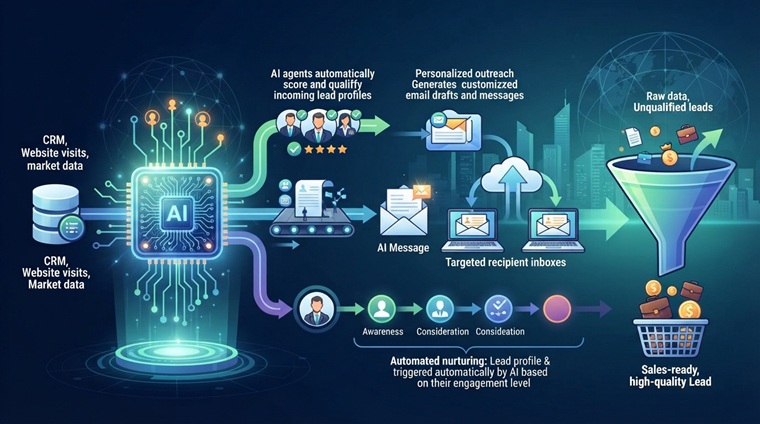
AI for business
How to Automate B2B Lead Generation Using AI

84% of B2B companies now use AI for lead generation. Companies using AI report 47% higher conversion rates and 50% more leads (McKinsey). Up to 60% reduction in cost per lead. Here is the framework, the data, and the tools.
B2B lead generation used to be a volume game. Send more emails. Make more calls. Book more demos. The quality of each individual touch was secondary to the number of touches, because the funnel was wide and the conversion rates were low enough that volume was the only real variable. AI has fundamentally changed this equation. The stealthagents.com AI lead generation statistics 2026 research is direct: 84% of B2B companies now use AI-powered solutions for lead generation. McKinsey’s research shows AI adoption driving 47% higher conversion rates and 50% more leads across sales and marketing functions. Salesforce’s State of Sales report (7,700 sales professionals globally) found that companies using AI lead generation tools see 67% higher conversion rates than those relying on manual processes. The global B2B lead generation market is valued at $12.50 billion in 2026 (limelightdigital.co.uk). This article covers the five core pillars of AI-automated B2B lead generation, the research behind each, the specific tools that implement them, and the practical starting points for teams at any maturity level.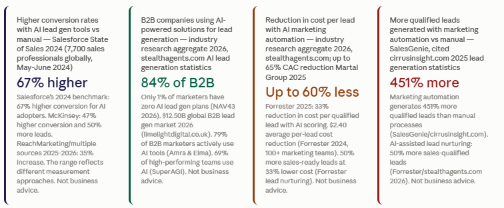
McKinsey: AI adoption → 47% higher conversion rates and 50% more leads. Salesforce State of Sales 2024 (7,700 professionals): 67% higher conversion with AI vs manual. $12.50B global B2B lead generation market 2026 (limelightdigital.co.uk). Only 1% of marketers have zero AI lead gen plans (NAV43 2026).
84% of B2B companies use AI-powered solutions for lead generation (industry research aggregate 2026). Multi-source enrichment: 15-20% accuracy improvement over single-source (LeadPages/TheStarrConspiracy 2025). SaaS case study: 38% improvement in lead conversion rates after eliminating manual data enrichment (markettailor.io). Source: stealthagents.com AI lead gen statistics 2026; markettailor.io; thestarrconspiracy.com.
AI-powered data enrichment that pulls from 50+ data sources to build enriched prospect lists automatically. Apollo.io: B2B prospecting and contact database with AI filtering. ZoomInfo: enterprise-level intent data and contact enrichment. 6sense/Demandbase: best for ABM-focused intent data (NAV43 2026). LinkedIn Sales Navigator: direct integration with the highest-converting B2B channel.
Build your ICP definition before touching any AI tool. AI prospecting is only as good as the parameters you give it. Define: company size, industry vertical, tech stack, geography, revenue, and the specific buyer role you target. Then use an enrichment tool (Clay or Apollo) to build a targeted list. Review the first 50 records manually to validate quality before scaling.
AI lead scoring accuracy: 72-85% vs 48-54% traditional (Forrester/Gartner; stealthagents.com 2026). MQL-to-SQL conversion: 31% (AI scoring) vs 15% (manual) — 2.1x higher (Marketo/Adobe Engagement Economy; stealthagents.com 2026). McKinsey B2B Pulse 2025: 30-45% improvement in lead-to-opportunity conversion after 6 months with AI prioritisation. Cost reduction: 33% lower cost per qualified lead (Forrester 2025). $5.6B predictive lead scoring market 2025.
HubSpot: built-in AI lead scoring within the CRM — analyses historical contact behaviour to predict future conversions. Salesforce Einstein: enterprise AI scoring integrated with Salesforce CRM. Marketo/Adobe Marketo Engage: the platform behind the Engagement Economy research; sophisticated AI scoring and nurturing. 6sense: uses intent data to score accounts by buying stage (not just contact behaviour).
Export your last 12 months of closed-won and closed-lost deals. Identify the five to ten attributes that most clearly differentiate the wins from the losses — industry, company size, tech stack, content consumed, response time to outreach. Feed these into your scoring model as the training set. Review and recalibrate the model every quarter.
Follow-up sequencing and nurture: 49% automation adoption (stealthagents.com 2026). LinkedIn Lead Gen Forms: 13% conversion rate vs 2.35% landing page benchmark; 25% higher conversion and 15% lower acquisition costs (LinkedIn/cirrusinsight.com 2025). Email: $44:1 ROI (EmailMonday). Intent data: 93% report higher conversion rates (Martal). AI chatbots: 40% higher engagement than traditional chat (markettailor.io). 62% of marketers: intent data significantly improves lead quality (ReachMarketing 2025).
Apollo.io / Instantly / Lemlist: AI email sequencing with personalisation variables pulled from enrichment data. LinkedIn Sales Navigator + Expandi/Dux-Soup: automated LinkedIn outreach within platform terms. 6sense/Bombora: intent data feeds that trigger personalised outreach when a company enters active research behaviour. Intercom/Drift: AI chatbot pre-qualification on website. HubSpot Sequences: integrated nurturing within CRM.
Write three template sequences before automating anything: (1) cold outreach — problem-led, not product-led; (2) follow-up sequence — adds value each touch rather than just checking in; (3) re-engagement — for leads that went cold. Use intent data to personalise the opening line of each email with a specific trigger (they recently searched X, they just hired a Y role, their competitor just did Z). Test subject lines first.
Intent data: 93% report higher conversion rates (Martal/cirrusinsight.com). 62% of marketers: intent data significantly improves lead quality (ReachMarketing 2025). ABM: 97% report higher ROI (cirrusinsight.com). 5-8x higher ROI from data-driven AI strategies (Mailmodo 2026; G2 2026). 67% of B2B companies use AI to analyse buyer behaviour and predict intent (limelightdigital.co.uk 2026).
6sense: the market leader in B2B intent data for ABM. Predicts which accounts are in an active buying cycle and identifies the anonymous researchers behind website visits. Demandbase: similar capability to 6sense; strong for mid-market and enterprise ABM. Bombora: the primary third-party intent data provider; tracks topic research across 5,000+ B2B websites. G2 Buyer Intent: identifies companies researching your category on G2's review platform.
Start with your own first-party intent data before buying third-party. Set up GA4 or equivalent to track specific high-intent pages (pricing, demo request, case studies) and build audiences based on page-visit depth rather than page visits alone. Then layer in a third-party intent provider for the accounts that match your ICP. Assign dedicated SDR outreach to accounts that show intent signals — these are the 3-5% who are ready to talk now.
AI-assisted lead nurturing: 50% more sales-qualified leads (Forrester; stealthagents.com 2026). Companies excelling at lead nurturing: 50% more sales-ready leads at 33% lower cost (Forrester/G2 2026). Marketing automation: 451% more qualified leads than manual processes (SalesGenie/cirrusinsight.com). Sources: stealthagents.com; G2 2026; cirrusinsight.com.
HubSpot: best all-in-one CRM + automation for SMB and mid-market. Automated workflows, AI lead scoring, and sequencing in one platform. Salesforce + Pardot/Marketing Cloud: enterprise CRM with deep nurturing automation. Marketo (Adobe): the specialist nurturing platform for complex multi-touch B2B cycles. ActiveCampaign: strong automation for smaller teams with limited dedicated ops resource.
Map your pipeline stages before configuring any automation. For each stage, define: the entry criteria (what behaviour moves a lead in), the exit criteria (what moves them forward), and the automated action that fires on entry. Start with three automated workflows: (1) new lead assignment + immediate welcome sequence; (2) high-intent behaviour trigger (pricing page visit → rep notification); (3) re-engagement workflow for leads stuck at the same stage for 30+ days.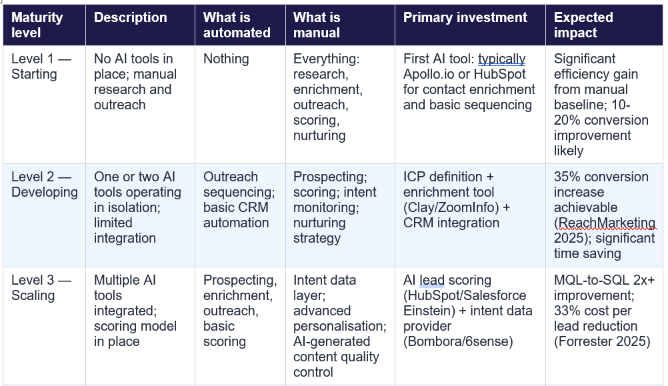
The research shows a range depending on the specific capability and measurement source. Salesforce's State of Sales 2024 (7,700 sales professionals globally) found companies using AI lead generation tools see 67% higher conversion rates than those using manual processes. McKinsey's research shows 47% higher conversion rates from AI adoption across sales and marketing. ReachMarketing's January 2025 B2B lead generation statistics found a 35% increase in conversion rates with AI-powered lead gen tools — a figure cited by multiple research sources including limelightdigital.co.uk 2026 and the G2 lead generation statistics 2026. For AI lead scoring specifically, Marketo/Adobe's Engagement Economy research found that B2B organisations using AI scoring report MQL-to-SQL conversion rates 2.1x higher (31% vs 15%) than teams using manual qualification (stealthagents.com 2026). The variation across these figures (35-67%) reflects differences in measurement methodology, starting baseline, implementation maturity, and industry.
What are the most important AI tools for B2B lead generation in 2026?
The research and practitioner frameworks identify different tools for different functions. For prospecting and enrichment: Clay (multi-source enrichment), Apollo.io (prospecting and sequencing), and ZoomInfo (enterprise data enrichment). For intent data and ABM: 6sense and Demandbase (NAV43 2026 specifically recommends these for ABM-focused intent data). For lead scoring: HubSpot AI scoring, Salesforce Einstein, and Marketo/Adobe Engage. For outreach sequencing: Apollo.io, Instantly, and Lemlist for email; LinkedIn Sales Navigator with Expandi for LinkedIn. For CRM and nurturing: HubSpot (all-in-one SMB/mid-market), Salesforce (enterprise), and ActiveCampaign (smaller teams). LinkedIn as a channel should not be overlooked: cirrusinsight.com's 2025 statistics show LinkedIn Lead Gen Forms achieving approximately 13% conversion rates versus the ~2.35% landing page benchmark.
What is intent data and how does it improve lead generation?
Intent data is digital behavioural data that identifies which companies are actively researching a problem or solution in your category. It is collected by monitoring what content businesses are reading, what keywords they are searching, and which competitor or review sites they are visiting across the web. The cirrusinsight.com 2025 lead generation statistics describe the shift: 'Lead generation in 2025 is a signal game.' The practical effect: instead of reaching out to all 10,000 companies in your total addressable market, intent data identifies the 300-500 that are actively evaluating solutions right now — producing dramatically better response rates and conversion outcomes. 93% of marketers using intent data report higher conversion rates (Martal, cited cirrusinsight.com). 62% state it significantly improves lead quality (ReachMarketing 2025). ABM, which is the primary delivery mechanism for intent data targeting, is reported to deliver higher ROI by 97% of users. Primary tools: 6sense, Demandbase, Bombora, and G2 Buyer Intent.
How long does it take to see results from AI lead generation?
McKinsey's B2B Pulse 2025 provides the most specific timeline: companies with deployed AI prioritisation tools see 30-45% improvement in lead-to-opportunity conversion rates after 6 months of operation (stealthagents.com 2026). The key qualifier is 'deployed' — the 6-month timeline runs from when the tools are operational and generating data, not from when the subscription starts. The initial setup period (ICP definition, data enrichment, CRM configuration, scoring model training) typically takes 4-8 weeks. The first meaningful results in outreach are visible within 30-60 days of the system going live. The full impact on pipeline conversion and cost per lead, as measured in the Forrester and McKinsey research, typically requires a full quarter of operation to measure reliably.
What does the 30% rule mean for AI and human collaboration in lead gen?
The NAV43 2026 framework's 30% rule is a guide to dividing responsibility between AI and human effort in lead generation: AI handles the repetitive, data-intensive tasks (prospecting from databases, enrichment, lead scoring, outreach sequencing, nurturing triggers) while humans handle the judgment-intensive, creative, and relationship-critical tasks (ICP strategy, content quality, complex objection handling, enterprise relationship development, model recalibration). The practical application: if your SDR team was spending 70% of their time on research, list building, and follow-up, AI automation frees that 70% for higher-value human activity — primarily personalising the most important outreach, managing relationships with high-intent accounts, and developing the strategic inputs that make the AI system more effective. The stealthagents.com 2026 research finds that follow-up sequencing and nurture represent 49% of automated lead generation functions — the highest single adoption rate — consistent with this principle.
B2B lead generation used to be a volume game. Send more emails. Make more calls. Book more demos. The quality of each individual touch was secondary to the number of touches, because the funnel was wide and the conversion rates were low enough that volume was the only real variable. AI has fundamentally changed this equation. The stealthagents.com AI lead generation statistics 2026 research is direct: 84% of B2B companies now use AI-powered solutions for lead generation. McKinsey’s research shows AI adoption driving 47% higher conversion rates and 50% more leads across sales and marketing functions. Salesforce’s State of Sales report (7,700 sales professionals globally) found that companies using AI lead generation tools see 67% higher conversion rates than those relying on manual processes. The global B2B lead generation market is valued at $12.50 billion in 2026 (limelightdigital.co.uk). This article covers the five core pillars of AI-automated B2B lead generation, the research behind each, the specific tools that implement them, and the practical starting points for teams at any maturity level.
Table of Contents
- Why AI Has Made Traditional B2B Lead Generation Obsolete
- The Five-Pillar AI Lead Generation Framework
- Pillar 1 AI-Powered Prospecting and Data Enrichment
- Pillar 2 AI Lead Scoring: Prioritising the Leads That Will Actually Convert
- Pillar 3 Automated Outreach and Personalisation at Scale
- Pillar 4 Intent Data and Predictive Analytics: Finding Buyers Before They Find You
- Pillar 5 CRM Integration and Automated Lead Nurturing Workflows
- The AI Lead Generation Maturity Model: Where Are You?
- ROI Framework: How to Calculate the Business Case
- Conclusion: The 30% Rule and What Comes Next
- Frequently Asked Questions
Why AI Has Made Traditional B2B Lead Generation Obsolete
The economics of traditional B2B lead generation — cold calls at 1-2% connection rates, cold emails at 1-2% reply rates, trade show badges that sit in a spreadsheet for six months — were never particularly good. They were the only option available. The shift that AI has produced is not incremental improvement in those economics. It is a structural change in the model: from volume-dependent, manually intensive outreach to signal-driven, algorithmically prioritised, personalised engagement at scale. The stealthagents.com AI lead generation statistics 2026 research captures the scale of this shift: McKinsey shows AI adoption driving 47% higher conversion rates and 50% more leads across sales and marketing functions. The Salesforce State of Sales 2024 — surveying 7,700 sales professionals globally — found 67% higher conversion rates for companies using AI lead generation tools versus manual processes. The limelightdigital.co.uk 2026 research puts the global B2B lead generation market at $12.50 billion, reflecting the scale of commercial investment in this transformation. And critically, only 1% of marketers now have zero AI lead generation plans (NAV43 2026) — which means that for the 99% who are at least planning AI adoption, the question is no longer whether to automate but how to do it in a way that produces measurable returns. Not specific business advice.McKinsey: AI adoption → 47% higher conversion rates and 50% more leads. Salesforce State of Sales 2024 (7,700 professionals): 67% higher conversion with AI vs manual. $12.50B global B2B lead generation market 2026 (limelightdigital.co.uk). Only 1% of marketers have zero AI lead gen plans (NAV43 2026).
The Five-Pillar AI Lead Generation Framework
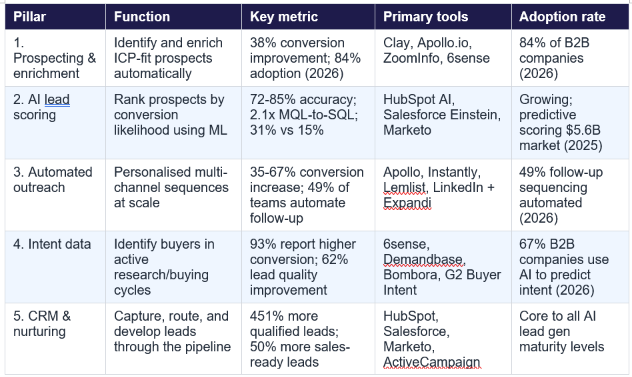
The NAV43 2026 framework describes AI lead generation as having three pillars: data intelligence, automated engagement, and pipeline optimisation. The fuller picture across the research involves five distinct functions that together constitute a complete AI-automated B2B lead generation system. Each pillar is independently valuable but produces compounding returns when they operate together — the output of prospecting feeds the scoring model; the scoring model directs the outreach; the outreach is personalised by intent data; the CRM captures and nurtures what outreach generates. This article covers each pillar in sequence: prospecting and enrichment; lead scoring; automated outreach and personalisation; intent data and predictive analytics; and CRM integration and automated nurturing.
Pillar 1 AI-Powered Prospecting and Data Enrichment
The first bottleneck in most B2B lead generation systems is prospecting: the process of identifying companies and individuals who fit your ideal customer profile (ICP) and turning that identification into usable contact data. This has historically been manual, slow, and prone to the quality problems that come from human data entry at scale. AI changes both the speed and the intelligence of this process. Markettailor.io’s analysis of AI lead generation, citing IBM’s research, identifies AI systems that ‘quickly analyse buyer behaviour, prioritise leads based on conversion likelihood, and deploy personalised outreach across email, LinkedIn, and voice channels.’ The data enrichment dimension is particularly significant: a leading SaaS company cited in the markettailor.io research saved dozens of hours per month by eliminating manual data enrichment, while simultaneously improving data quality and lead conversion rates by 38%. The mechanism is straightforward: AI-powered enrichment tools pull from multiple data sources simultaneously (company databases, LinkedIn, intent signals, web scraping) and cross-reference them in real time, producing a single enriched prospect record without manual research. The stealthagents.com AI lead generation statistics 2026 research found that multi-source enrichment achieves 15-20% accuracy improvement over single-source tools. The NAV43 2026 framework specifically recommends Clay for data enrichment workflows and 6sense or Demandbase for ABM-focused intent data. The 84% of B2B companies now using AI-powered lead generation solutions (industry research aggregate 2026, stealthagents.com) reflects how central this automation has become to the modern B2B pipeline.84% of B2B companies use AI-powered solutions for lead generation (industry research aggregate 2026). Multi-source enrichment: 15-20% accuracy improvement over single-source (LeadPages/TheStarrConspiracy 2025). SaaS case study: 38% improvement in lead conversion rates after eliminating manual data enrichment (markettailor.io). Source: stealthagents.com AI lead gen statistics 2026; markettailor.io; thestarrconspiracy.com.
AI-powered data enrichment that pulls from 50+ data sources to build enriched prospect lists automatically. Apollo.io: B2B prospecting and contact database with AI filtering. ZoomInfo: enterprise-level intent data and contact enrichment. 6sense/Demandbase: best for ABM-focused intent data (NAV43 2026). LinkedIn Sales Navigator: direct integration with the highest-converting B2B channel.
Build your ICP definition before touching any AI tool. AI prospecting is only as good as the parameters you give it. Define: company size, industry vertical, tech stack, geography, revenue, and the specific buyer role you target. Then use an enrichment tool (Clay or Apollo) to build a targeted list. Review the first 50 records manually to validate quality before scaling.
Pillar 2 AI Lead Scoring: Prioritising the Leads That Will Actually Convert
Lead scoring — the process of ranking prospects by their likelihood to convert into customers — has existed since the early days of marketing automation. The problem with traditional lead scoring is that it relies on rules that humans define: if someone visits the pricing page, give them 10 points; if they open three emails, give them 15. These rules are approximations of conversion behaviour, not predictions of it. AI lead scoring replaces rule-based threshold models with machine learning that identifies the actual patterns in historical conversion data. The stealthagents.com 2026 research on AI lead scoring statistics is specific: AI-powered models achieve predictive accuracy of 72-85%, compared to 48-54% for traditional rule-based scoring — based on Forrester Research and Gartner data. The business impact is measurable: Marketo/Adobe’s Engagement Economy research found that B2B organisations using AI lead scoring report MQL-to-SQL conversion rates 2.1 times higher than teams using manual qualification — averaging 31% MQL-to-SQL versus 15% for non-AI approaches. McKinsey’s B2B Pulse 2025 found that companies with deployed AI prioritisation tools see a 30-45% improvement in lead-to-opportunity conversion rates after six months of operation. The cost implication is equally significant: Forrester Research 2025 found a 33% reduction in cost per qualified lead with AI lead scoring, and Forrester’s 2024 research across 100+ marketing teams found an average per-lead cost reduction of $2.40. The predictive lead scoring market itself reached $5.6 billion in 2025 (stealthagents.com 2026), reflecting the scale of investment going into this capability.AI lead scoring accuracy: 72-85% vs 48-54% traditional (Forrester/Gartner; stealthagents.com 2026). MQL-to-SQL conversion: 31% (AI scoring) vs 15% (manual) — 2.1x higher (Marketo/Adobe Engagement Economy; stealthagents.com 2026). McKinsey B2B Pulse 2025: 30-45% improvement in lead-to-opportunity conversion after 6 months with AI prioritisation. Cost reduction: 33% lower cost per qualified lead (Forrester 2025). $5.6B predictive lead scoring market 2025.
HubSpot: built-in AI lead scoring within the CRM — analyses historical contact behaviour to predict future conversions. Salesforce Einstein: enterprise AI scoring integrated with Salesforce CRM. Marketo/Adobe Marketo Engage: the platform behind the Engagement Economy research; sophisticated AI scoring and nurturing. 6sense: uses intent data to score accounts by buying stage (not just contact behaviour).
Export your last 12 months of closed-won and closed-lost deals. Identify the five to ten attributes that most clearly differentiate the wins from the losses — industry, company size, tech stack, content consumed, response time to outreach. Feed these into your scoring model as the training set. Review and recalibrate the model every quarter.
Pillar 3 Automated Outreach and Personalisation at Scale
The convergence that AI has made possible in B2B outreach is personalisation at volume — which until recently was a contradiction in terms. Personalised outreach requires human judgment and time; volume requires automation; the two were historically in tension. AI resolves the tension by generating personalised messages from structured data at scale. The stealthagents.com 2026 research identifies follow-up sequencing and nurture as the most commonly automated lead generation function at 49% adoption. The cirrusinsight.com lead generation statistics note that LinkedIn Lead Gen Forms achieve approximately 13% conversion rates versus the standard 2.35% landing page benchmark, and that ‘AI-driven personalisation is driving adoption across tools’ on the platform. Email remains the highest-ROI channel: cirrusinsight.com cites $44:1 ROI for large businesses (EmailMonday), with 15-25% open rates and 1-5% reply rates for well-executed sequences. Intent data is the intelligence layer that makes AI personalisation meaningful: 93% of marketers using intent data report higher conversion rates (Martal, cited cirrusinsight.com), and 62% of marketers state that using intent data significantly improves lead quality and conversion rates (ReachMarketing January 2025). The mechanism is that intent data identifies which companies are actively researching a problem your product solves — allowing personalisation that addresses an active need rather than interrupting someone with a problem they don’t yet recognise. AI chatbots represent a parallel channel: markettailor.io’s research found that AI chatbots pre-qualifying leads in real time demonstrate 40% higher engagement rates than traditional button-only chat interfaces.Follow-up sequencing and nurture: 49% automation adoption (stealthagents.com 2026). LinkedIn Lead Gen Forms: 13% conversion rate vs 2.35% landing page benchmark; 25% higher conversion and 15% lower acquisition costs (LinkedIn/cirrusinsight.com 2025). Email: $44:1 ROI (EmailMonday). Intent data: 93% report higher conversion rates (Martal). AI chatbots: 40% higher engagement than traditional chat (markettailor.io). 62% of marketers: intent data significantly improves lead quality (ReachMarketing 2025).
Apollo.io / Instantly / Lemlist: AI email sequencing with personalisation variables pulled from enrichment data. LinkedIn Sales Navigator + Expandi/Dux-Soup: automated LinkedIn outreach within platform terms. 6sense/Bombora: intent data feeds that trigger personalised outreach when a company enters active research behaviour. Intercom/Drift: AI chatbot pre-qualification on website. HubSpot Sequences: integrated nurturing within CRM.
Write three template sequences before automating anything: (1) cold outreach — problem-led, not product-led; (2) follow-up sequence — adds value each touch rather than just checking in; (3) re-engagement — for leads that went cold. Use intent data to personalise the opening line of each email with a specific trigger (they recently searched X, they just hired a Y role, their competitor just did Z). Test subject lines first.
Pillar 4 Intent Data and Predictive Analytics: Finding Buyers Before They Find You
Intent data is the capability that most dramatically changes the timing of B2B lead generation. Traditional lead generation operates on a push model: you reach out to a prospect and hope they have the problem you solve. Intent data operates on a pull model: it monitors the digital behaviour of companies across the web — the content they are reading, the keywords they are searching, the competitors they are researching — and signals when a company is actively in a buying cycle for your category. The cirrusinsight.com 2025 lead generation statistics identify this as a defining shift: ‘Lead generation in 2025 is a signal game.’ The data supports the impact: 93% of marketers using intent data report higher conversion rates (Martal, cited cirrusinsight.com). 62% state it significantly improves lead quality (ReachMarketing 2025). ABM (Account-Based Marketing) — which is the delivery mechanism for intent data — is reported to deliver higher ROI by 97% of users (cirrusinsight.com). The G2 2026 lead generation statistics research cites the ProductFruits case study where intent-driven targeting via G2 Ads doubled their ad lead conversion rate. The markettailor.io analysis notes that companies using data-driven lead generation strategies powered by AI achieve 5-8x higher ROI than traditional approaches. The stealthagents.com 2026 statistics identify the adoption rate: 67% of B2B companies now use AI to analyse customer behaviour and predict buying intent (limelightdigital.co.uk). The practical implication is a shift in resource allocation: rather than spending budget reaching out to all possible prospects, AI intent tools allow teams to concentrate on the 3-5% of their total addressable market that is actively evaluating solutions in their category right now.Intent data: 93% report higher conversion rates (Martal/cirrusinsight.com). 62% of marketers: intent data significantly improves lead quality (ReachMarketing 2025). ABM: 97% report higher ROI (cirrusinsight.com). 5-8x higher ROI from data-driven AI strategies (Mailmodo 2026; G2 2026). 67% of B2B companies use AI to analyse buyer behaviour and predict intent (limelightdigital.co.uk 2026).
6sense: the market leader in B2B intent data for ABM. Predicts which accounts are in an active buying cycle and identifies the anonymous researchers behind website visits. Demandbase: similar capability to 6sense; strong for mid-market and enterprise ABM. Bombora: the primary third-party intent data provider; tracks topic research across 5,000+ B2B websites. G2 Buyer Intent: identifies companies researching your category on G2's review platform.
Start with your own first-party intent data before buying third-party. Set up GA4 or equivalent to track specific high-intent pages (pricing, demo request, case studies) and build audiences based on page-visit depth rather than page visits alone. Then layer in a third-party intent provider for the accounts that match your ICP. Assign dedicated SDR outreach to accounts that show intent signals — these are the 3-5% who are ready to talk now.
Pillar 5 CRM Integration and Automated Lead Nurturing Workflows
Prospecting, scoring, and outreach are only valuable if they feed into a system that captures, tracks, and nurtures leads through the full pipeline. CRM integration is the connective tissue of the AI lead generation system: it is where the enriched prospect data, the scoring outputs, and the outreach sequences combine into a manageable workflow. The stealthagents.com 2026 research found that companies excelling at AI-assisted lead nurturing generate 50% more sales-qualified leads (Forrester Research). The G2 2026 statistics cite the equivalent Forrester finding: companies that excel at lead nurturing generate 50% more sales-ready leads at a 33% lower cost. The key distinction between nurturing and outreach is timing and length: outreach targets prospects who have not yet engaged; nurturing targets prospects who have engaged but not yet converted, and uses a longer, value-delivery content sequence to move them through the funnel. Marketing automation is the scale mechanism: the stealthagents.com research cites SalesGenie’s finding that marketing automation generates 451% more qualified leads than manual processes. The practical AI applications within CRM and nurturing are: automated lead routing (new leads assigned to the right rep based on territory, industry, or deal size without manual assignment); behavioural triggers (a prospect who visits the pricing page for the third time automatically triggers an immediate personal outreach notification to the assigned rep); and lifecycle stage automation (a lead that downloads three resources is automatically advanced in the pipeline and moves to a higher-intent nurturing sequence).AI-assisted lead nurturing: 50% more sales-qualified leads (Forrester; stealthagents.com 2026). Companies excelling at lead nurturing: 50% more sales-ready leads at 33% lower cost (Forrester/G2 2026). Marketing automation: 451% more qualified leads than manual processes (SalesGenie/cirrusinsight.com). Sources: stealthagents.com; G2 2026; cirrusinsight.com.
HubSpot: best all-in-one CRM + automation for SMB and mid-market. Automated workflows, AI lead scoring, and sequencing in one platform. Salesforce + Pardot/Marketing Cloud: enterprise CRM with deep nurturing automation. Marketo (Adobe): the specialist nurturing platform for complex multi-touch B2B cycles. ActiveCampaign: strong automation for smaller teams with limited dedicated ops resource.
Map your pipeline stages before configuring any automation. For each stage, define: the entry criteria (what behaviour moves a lead in), the exit criteria (what moves them forward), and the automated action that fires on entry. Start with three automated workflows: (1) new lead assignment + immediate welcome sequence; (2) high-intent behaviour trigger (pricing page visit → rep notification); (3) re-engagement workflow for leads stuck at the same stage for 30+ days.
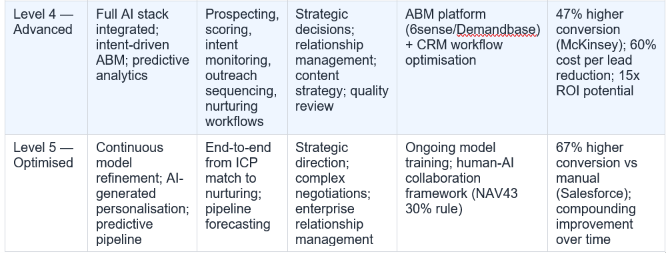
The AI Lead Generation Maturity Model: Where Are You?
ROI Framework: How to Calculate the Business Case
The NAV43 2026 framework includes a concrete ROI calculator approach for justifying AI lead generation investment. The five inputs are: current monthly lead volume, current MQL-to-SQL conversion rate, current cost per lead, average deal value, and expected AI uplift percentages. A simplified version: if your team currently generates 200 leads per month at a 15% MQL-to-SQL rate, with a $50 cost per lead and a $5,000 average deal value, your current monthly SQL volume is 30, and your cost per SQL is $333. Applying McKinsey’s 47% conversion uplift and Forrester’s 33% cost reduction: new MQL-to-SQL rate is 22%; new cost per lead is $33; new monthly SQL volume is 44; new cost per SQL is $150. The improvement: 14 additional SQLs per month at $183 lower cost per SQL. At a 20% close rate and $5,000 ACV, 14 additional SQLs produces approximately 2.8 additional deals per month, or $14,000 additional monthly revenue. Against a typical AI stack cost of $3,000-8,000/month for SMB-to-mid-market, the ROI calculation is compelling. Not financial or business advice — these are illustrative calculations based on published research averages that vary significantly by industry, team, and implementation quality.Conclusion
The NAV43 2026 framework introduces what it calls the 30% rule for human-AI collaboration in lead generation: AI should handle the repetitive, data-intensive, and pattern-recognition tasks (prospecting, enrichment, scoring, sequencing) while humans handle the judgment-intensive, relationship-critical, and creative tasks (strategy, complex objection handling, enterprise relationship development, content quality control). The research supports this frame. The stealthagents.com 2026 statistics put adoption at 84% of B2B companies already using AI-powered solutions. The conversion data from McKinsey (47% higher), Salesforce (67% higher), and Forrester (33% lower cost per qualified lead) provides the business case. But the most revealing data point is the most basic: 451% more qualified leads from marketing automation (SalesGenie, cited cirrusinsight.com) against a baseline of very poor manual lead generation productivity. The improvement is not marginal. It is structural. The teams that implement AI lead generation systematically — with a defined ICP, enriched data, calibrated scoring, intent-triggered outreach, and a CRM that captures and develops everything the system generates — are not competing at the same level as teams running manual processes. The window for competitive differentiation from AI-automated lead generation is narrowing, precisely because adoption is already at 84%.Frequently Asked Questions
How much does AI lead generation actually improve conversion rates?The research shows a range depending on the specific capability and measurement source. Salesforce's State of Sales 2024 (7,700 sales professionals globally) found companies using AI lead generation tools see 67% higher conversion rates than those using manual processes. McKinsey's research shows 47% higher conversion rates from AI adoption across sales and marketing. ReachMarketing's January 2025 B2B lead generation statistics found a 35% increase in conversion rates with AI-powered lead gen tools — a figure cited by multiple research sources including limelightdigital.co.uk 2026 and the G2 lead generation statistics 2026. For AI lead scoring specifically, Marketo/Adobe's Engagement Economy research found that B2B organisations using AI scoring report MQL-to-SQL conversion rates 2.1x higher (31% vs 15%) than teams using manual qualification (stealthagents.com 2026). The variation across these figures (35-67%) reflects differences in measurement methodology, starting baseline, implementation maturity, and industry.
What are the most important AI tools for B2B lead generation in 2026?
The research and practitioner frameworks identify different tools for different functions. For prospecting and enrichment: Clay (multi-source enrichment), Apollo.io (prospecting and sequencing), and ZoomInfo (enterprise data enrichment). For intent data and ABM: 6sense and Demandbase (NAV43 2026 specifically recommends these for ABM-focused intent data). For lead scoring: HubSpot AI scoring, Salesforce Einstein, and Marketo/Adobe Engage. For outreach sequencing: Apollo.io, Instantly, and Lemlist for email; LinkedIn Sales Navigator with Expandi for LinkedIn. For CRM and nurturing: HubSpot (all-in-one SMB/mid-market), Salesforce (enterprise), and ActiveCampaign (smaller teams). LinkedIn as a channel should not be overlooked: cirrusinsight.com's 2025 statistics show LinkedIn Lead Gen Forms achieving approximately 13% conversion rates versus the ~2.35% landing page benchmark.
What is intent data and how does it improve lead generation?
Intent data is digital behavioural data that identifies which companies are actively researching a problem or solution in your category. It is collected by monitoring what content businesses are reading, what keywords they are searching, and which competitor or review sites they are visiting across the web. The cirrusinsight.com 2025 lead generation statistics describe the shift: 'Lead generation in 2025 is a signal game.' The practical effect: instead of reaching out to all 10,000 companies in your total addressable market, intent data identifies the 300-500 that are actively evaluating solutions right now — producing dramatically better response rates and conversion outcomes. 93% of marketers using intent data report higher conversion rates (Martal, cited cirrusinsight.com). 62% state it significantly improves lead quality (ReachMarketing 2025). ABM, which is the primary delivery mechanism for intent data targeting, is reported to deliver higher ROI by 97% of users. Primary tools: 6sense, Demandbase, Bombora, and G2 Buyer Intent.
How long does it take to see results from AI lead generation?
McKinsey's B2B Pulse 2025 provides the most specific timeline: companies with deployed AI prioritisation tools see 30-45% improvement in lead-to-opportunity conversion rates after 6 months of operation (stealthagents.com 2026). The key qualifier is 'deployed' — the 6-month timeline runs from when the tools are operational and generating data, not from when the subscription starts. The initial setup period (ICP definition, data enrichment, CRM configuration, scoring model training) typically takes 4-8 weeks. The first meaningful results in outreach are visible within 30-60 days of the system going live. The full impact on pipeline conversion and cost per lead, as measured in the Forrester and McKinsey research, typically requires a full quarter of operation to measure reliably.
What does the 30% rule mean for AI and human collaboration in lead gen?
The NAV43 2026 framework's 30% rule is a guide to dividing responsibility between AI and human effort in lead generation: AI handles the repetitive, data-intensive tasks (prospecting from databases, enrichment, lead scoring, outreach sequencing, nurturing triggers) while humans handle the judgment-intensive, creative, and relationship-critical tasks (ICP strategy, content quality, complex objection handling, enterprise relationship development, model recalibration). The practical application: if your SDR team was spending 70% of their time on research, list building, and follow-up, AI automation frees that 70% for higher-value human activity — primarily personalising the most important outreach, managing relationships with high-intent accounts, and developing the strategic inputs that make the AI system more effective. The stealthagents.com 2026 research finds that follow-up sequencing and nurture represent 49% of automated lead generation functions — the highest single adoption rate — consistent with this principle.
0 Comments
Be the first to share your thoughts on this article.