

Taxes
How to Avoid the HMRC Savings Interest Tax Trap

4.51 million people will owe income tax on savings interest in 2026/27 — a 269% surge in four years. A frozen Personal Savings Allowance. High interest rates. Frozen income tax thresholds. At 4.5%, a basic-rate taxpayer hits the tax limit with just £22,222 in savings. Here is how to avoid the bill entirely.

The first force is the Personal Savings Allowance (PSA), frozen at £1,000 for basic-rate taxpayers and £500 for higher-rate taxpayers since it was introduced in April 2016. A decade of no increases. The second force is savings account interest rates, which rose from near-zero in 2020–2021 to more than 5 percent at their peak in 2023–2024 and remain above 4 percent for easy-access accounts in August 2026. The third force is frozen income tax thresholds, extended to remain unchanged until 2031 under the Autumn Budget 2025 (Deloitte/Taxscape), which have been pushing more people into the higher-rate band where the PSA is halved from £1,000 to £500.
The arithmetic of the trap is simple and fast-moving. At 4.5 percent interest, a basic-rate taxpayer breaches their entire £1,000 PSA with just £22,222 in savings accounts outside an ISA. A higher-rate taxpayer breaches their £500 PSA with just £11,111. Many people who were comfortably within their allowance two years ago, on the same savings, are now receiving HMRC nudge letters because the interest on those savings has grown above the frozen threshold. This guide explains the trap, the available shelters, and the legal steps that eliminate or reduce the tax bill.
The Numbers: 4.51 million people expected to owe savings interest tax in 2026/27 (HMRC FOI / Spring / GB News August 2026). Up from 1.22 million in 2022/23 — a 269% surge. PSA frozen at £1,000 (basic) / £500 (higher) since 2016. At 4.5% interest, basic-rate taxpayer hits PSA with just £22,222 in non-ISA savings.
At its introduction, the PSA worked well for this purpose. Interest rates were near zero; most savers needed very large deposits to generate £1,000 in interest. Today, the same £1,000 PSA is confronted with a fundamentally different rate environment. At 4.5 percent, the threshold is hit with just £22,222 in non-ISA savings — an amount that many ordinary UK adults hold in ISA-adjacent savings pots without considering the tax consequences.
The PSA applies to interest from most UK savings products: bank and building society accounts (instant access and fixed term), credit union accounts, and peer-to-peer lending interest. It does not apply to ISAs, NS&I Premium Bonds prizes, or dividends from investments. ISA interest is completely separate from and does not reduce the PSA.
Derek Sprawling, Head of Money at Spring (GB News, August 2026): Higher rates have helped savers generate better returns on their savings, but they have also pushed millions beyond their tax-free Personal Savings Allowance. With the allowance frozen, more people are being dragged deeper into the tax net, including more than two million basic-rate taxpayers.
Davis LLP’s August 2026 guide describes the system precisely: ‘HMRC’s ability to monitor private financial affairs has reached a level of unprecedented technical sophistication.’ The SME Business Blog’s May 2026 savings tax warning guide notes that this digital data-sharing means HMRC typically knows about taxable savings interest before the affected taxpayer does, allowing automatic tax code adjustments and the issuance of Simple Assessment (P800) letters without any self-reporting from the saver.
What this means in practice:
For higher-rate taxpayers, the threshold is particularly low. With £11,111 in non-ISA savings earning 4.5 percent AER, the entire £500 PSA is exhausted. Every additional pound of interest is taxed at 40 percent. A higher-rate taxpayer with £50,000 in a savings account at 4.5 percent earns £2,250 in interest, of which £1,750 is above the PSA and generates a tax bill of £700 per year (ukcalculator.com, May 2026).
The mechanics:
Who benefits most from the Starting Rate for Savings:
The ISA allowance for 2026/27 is £20,000 per person per tax year. This can be split across a Cash ISA, a Stocks and Shares ISA, an Innovative Finance ISA, and a Lifetime ISA (up to £4,000 per year into the LISA within the £20,000 total). Unused allowance from the current tax year cannot be carried forward; it resets on 6 April. However, existing ISA funds — and the interest they earn — remain sheltered indefinitely. There is no cap on the total amount an ISA can hold or on the interest it can earn tax-free.
An important change coming from April 2027: InsightHQ’s July 2026 analysis notes that the Cash ISA allowance for under-65s will be reduced from £20,000 to £12,000 from 6 April 2027. The full £20,000 Cash ISA allowance remains available for the current 2026/27 tax year. This makes the current tax year an important window for maximising Cash ISA contributions before the allowance reduction.
The comparison between a Cash ISA and a non-ISA savings account at the same rate, for a basic-rate taxpayer with £40,000 in savings earning 4.5 percent:
Watch Out: The £20,000 ISA allowance for under-65s is expected to be reduced to £12,000 from April 2027. The current 2026/27 tax year provides the last opportunity to contribute at the £20,000 level before this restriction takes effect for those under 65. Maximise your Cash ISA subscription before 5 April 2027. Always verify current rules and limits at GOV.UK before acting, as policy details may have changed after this article's publication.
Key features of Premium Bonds in 2026:
For jointly held accounts, savings interest is split 50/50 between the account holders for tax purposes by default. If one partner is a lower-rate taxpayer, this default split is already partially beneficial. However, the split can only be changed to a different ratio than 50/50 where the beneficial ownership of the funds genuinely reflects that allocation.
Additional advantages of transferring to a lower-earning partner:
Pension contributions reduce your adjusted net income — the income figure used to determine your income tax band. A person with a salary of £49,000 and £2,000 in savings interest has total income of £51,000, which pushes them into the higher-rate band. Their PSA drops from £1,000 to £500, and their marginal tax rate on the excess interest rises from 20 percent to 40 percent. A pension contribution of £780 net (£1,000 gross after 20 percent relief) would reduce their adjusted net income back below £50,270, restoring the £1,000 PSA and reducing the savings interest tax rate from 40 percent to 20 percent on the relevant portion.
The annual pension contribution allowance for 2026/27 is £60,000 (gross), covering employee, employer, and relief contributions combined. This provides substantial scope for high earners to use pension contributions strategically to manage their tax band position. The tax relief on pension contributions — basic rate relief of 20 percent added to the pension automatically, with additional relief claimable via Self Assessment for higher-rate taxpayers — makes pension contributions one of the most tax-efficient savings vehicles available.
A practical example (based on ukcalculator.com May 2026):
These increases are not transformative in isolation. However, combined with the ongoing freeze in the PSA and income tax thresholds, they extend the trajectory of the savings tax trap: more people facing higher bills on the same savings balances. The ISA wrapper’s protection becomes more valuable with each passing year of this policy direction, because the savings interest sheltered inside an ISA is immune to rate rises regardless of future budget announcements.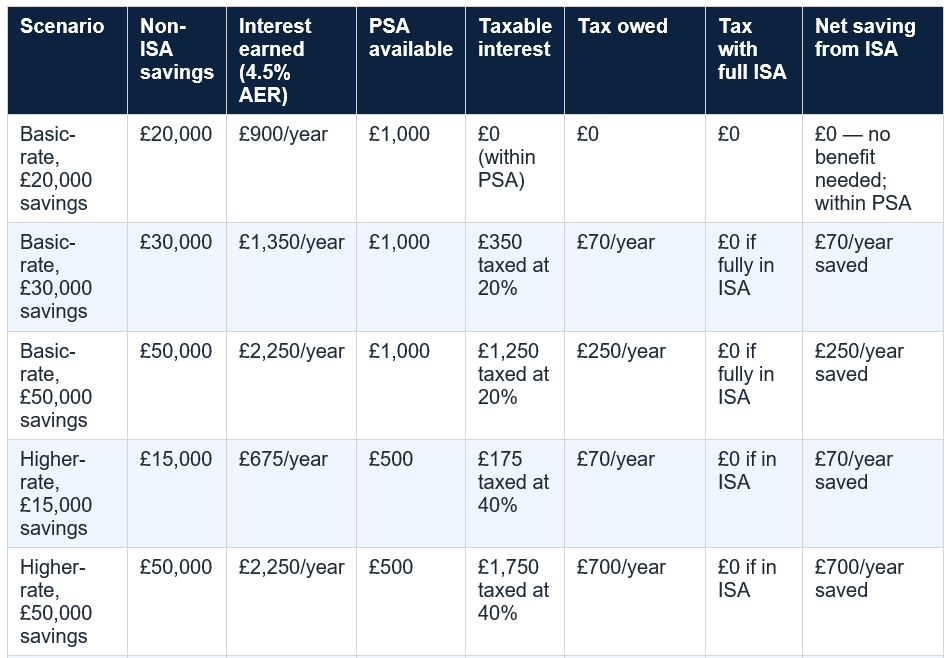
The solutions identified in this guide form a clear hierarchy. The Cash ISA is the fastest and most complete answer: interest inside an ISA is permanently and completely tax-free, at any amount, with no reporting and no HMRC interaction. At the £20,000 ISA allowance for 2026/27 — a limit that is expected to drop to £12,000 for under-65s from April 2027 — the current tax year provides the most generous ISA contribution window before the restriction takes effect.
Beyond the ISA, NS&I Premium Bonds offer up to £50,000 of tax-free prize returns. The Starting Rate for Savings can shelter up to £5,000 of interest for low-income savers. Spousal splitting and pension contributions can reduce or eliminate liability for those approaching or above the higher-rate threshold. The strategies are legal, widely available, and in the case of the ISA, permanent.
The savings interest tax trap catches people who do not act. It does not catch people who move their savings into tax-advantaged wrappers before the interest is earned. The ISA allowance resets on 6 April. The time to act is before the tax year ends — not after the P800 letter arrives.
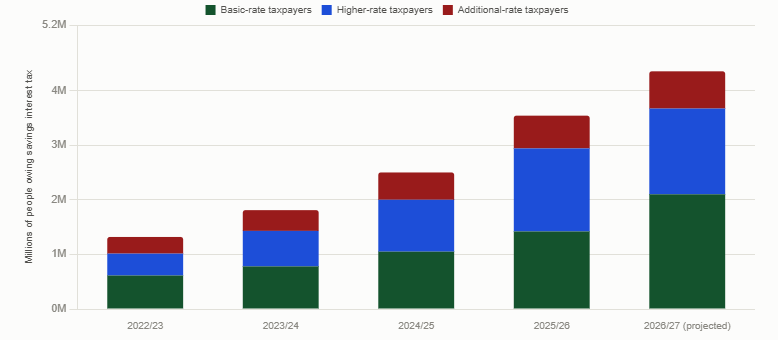
HMRC Freedom of Information figures analysed by savings app Spring show that 4.51 million people in the UK are expected to owe income tax on their savings interest in 2026/27. This is a 269% increase from 1.22 million in 2022/23, representing an additional 3.29 million people caught in the savings tax net in four years (GB News, August 2026; MoneyWeek, citing Paragon Bank FOI figures). The rise is driven by the combination of a frozen Personal Savings Allowance (unchanged at £1,000 for basic-rate and £500 for higher-rate since 2016) and savings account interest rates rising above 4%. Basic-rate taxpayer numbers increased from 613,000 to 1.42 million (132%); higher-rate numbers rose from 405,000 to 1.52 million (275%); additional-rate numbers are expected to rise from 301,000 to 682,000.
What is the Personal Savings Allowance in 2026/27?
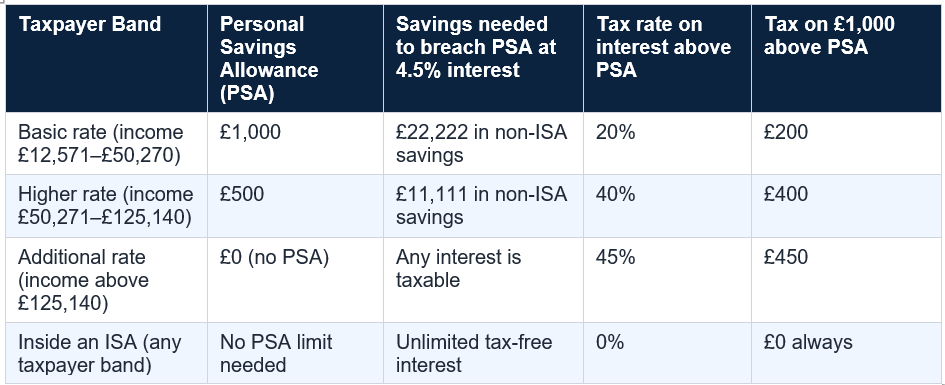
The Personal Savings Allowance (PSA) for 2026/27 is: £1,000 per year for basic-rate taxpayers (total income £12,571 to £50,270); £500 per year for higher-rate taxpayers (total income £50,271 to £125,140); and £0 (no PSA) for additional-rate taxpayers (income above £125,140). These figures have been unchanged since the PSA was introduced in April 2016. Interest earned inside an ISA is completely separate from the PSA, does not count toward it, and is tax-free regardless of amount. Interest above the PSA is taxed at the investor's marginal income tax rate: 20% for basic-rate, 40% for higher-rate, and 45% for additional-rate taxpayers. From April 2027, these rates will rise to 22%, 42%, and 47% respectively.
How can I avoid paying tax on savings interest?
The most effective legal strategies for avoiding or reducing savings interest tax in 2026/27 are: (1) Use your Cash ISA allowance (£20,000 per person in 2026/27; note this reduces to £12,000 for under-65s from April 2027). All interest inside a Cash ISA is permanently tax-free with no reporting required. (2) Use NS&I Premium Bonds — prizes are tax-free; up to £50,000 can be held per person. (3) Transfer savings to a lower-earning spouse or civil partner to use their PSA and potentially their Personal Allowance and Starting Rate for Savings. (4) Make pension contributions if savings interest is pushing your total income toward or above the £50,270 higher-rate threshold, reducing your taxable income and preserving the larger £1,000 PSA. (5) If your non-savings income is below £17,570, use the Starting Rate for Savings to shelter up to £5,000 of interest at 0%.
Does HMRC know about my savings interest?
Yes. Since 2016, all UK banks and building societies are legally required to report interest paid to account holders to HMRC each year under the Automatic Exchange of Information (AEOI) framework. HMRC receives this data automatically, compares it against your tax record, and either adjusts your PAYE tax code or issues a P800 Simple Assessment letter if it identifies a tax liability. For savings interest between £500 and £10,000, HMRC typically collects via tax code adjustment. Above £10,000, a Self Assessment return is required. Interest inside an ISA is not reported for tax purposes and is invisible to HMRC's savings interest assessment system. Ignoring HMRC letters about savings tax is not advisable: non-response is treated as careless behaviour and can attract higher penalties.
How much can I earn in savings interest before paying tax?
The answer depends on your income band and what allowances are available to you. In 2026/27: most basic-rate taxpayers can earn £1,000 in savings interest per year tax-free (the PSA); most higher-rate taxpayers can earn £500; additional-rate taxpayers receive no PSA. If your total non-savings income is below £17,570, the Starting Rate for Savings may allow up to £5,000 additional interest at 0% (reducing £1 for every £1 of income above £12,570). Interest inside an ISA is always tax-free at any amount and does not count toward these limits. At 4.5% AER: a basic-rate taxpayer breaches the £1,000 PSA with just £22,222 in non-ISA savings; a higher-rate taxpayer with £11,111 in non-ISA savings exhausts their £500 PSA. These are relatively modest savings balances, which is why 4.51 million people are now caught in the tax net.
What is the ISA allowance in 2026/27 and is it changing?
The ISA allowance for 2026/27 is £20,000 per person per tax year. This covers all types of ISA combined: Cash ISA, Stocks and Shares ISA, Innovative Finance ISA, and Lifetime ISA (with the LISA having its own £4,000 sub-limit within the £20,000 total). From 6 April 2027, the Cash ISA allowance for investors under 65 is expected to be reduced to £12,000 per year (down from £20,000). The full £20,000 remains available for the current 2026/27 tax year, ending 5 April 2027. Existing ISA funds — and all interest earned on them — remain sheltered indefinitely with no cap on total pot size. Unused ISA allowance cannot be carried forward between tax years; it resets on 6 April. Always verify current ISA limits at GOV.UK, as rules may change.
Table of Contents
- Why 4.51 Million People Are Caught in the Savings Tax Trap
- The Personal Savings Allowance: What It Is and Why It No Longer Does Much
- How HMRC Finds Out About Your Savings Interest
- The Savings Deposit That Triggers a Tax Bill at 4.5% Interest
- The Starting Rate for Savings: The Hidden Allowance Most People Miss
- Protection Strategy #1: Use Your Cash ISA Allowance Before Anything Else
- Protection Strategy #2: NS&I Premium Bonds for Tax-Free Returns
- Protection Strategy #3: Spousal or Partner Savings Splitting
- Protection Strategy #4: Pension Contributions to Reduce Your Tax Band
- Protection Strategy #5: Use the Personal Allowance for Interest Income
- Band Creep: How Savings Interest Can Push You into a Higher Tax Band
- What the April 2027 Rate Rise Means for Savers
- How HMRC Collects the Tax: Tax Codes, P800s, and Self Assessment
- Worked Examples: What the Tax Looks Like in Practice
- Conclusion: The ISA Is the Fastest and Most Complete Solution
- Frequently Asked Questions
People In The Tax Net 2022-2027
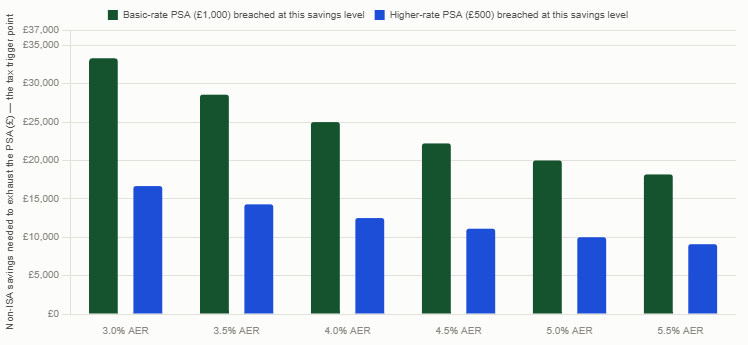
Savings Needed To Trigger Tax By Rate.
Why 4.51 Million People Are Caught in the Savings Tax Trap
In 2022/23, approximately 1.22 million people in the UK owed income tax on their savings interest. By 2026/27, that number is expected to reach 4.51 million — a 269 percent surge in four years, according to HMRC Freedom of Information figures analysed by savings app Spring and reported by GB News in August 2026. This is not because 3.29 million new people became wealthy. It is because three structural forces have collided to produce a perfect storm for ordinary savers.The first force is the Personal Savings Allowance (PSA), frozen at £1,000 for basic-rate taxpayers and £500 for higher-rate taxpayers since it was introduced in April 2016. A decade of no increases. The second force is savings account interest rates, which rose from near-zero in 2020–2021 to more than 5 percent at their peak in 2023–2024 and remain above 4 percent for easy-access accounts in August 2026. The third force is frozen income tax thresholds, extended to remain unchanged until 2031 under the Autumn Budget 2025 (Deloitte/Taxscape), which have been pushing more people into the higher-rate band where the PSA is halved from £1,000 to £500.
The arithmetic of the trap is simple and fast-moving. At 4.5 percent interest, a basic-rate taxpayer breaches their entire £1,000 PSA with just £22,222 in savings accounts outside an ISA. A higher-rate taxpayer breaches their £500 PSA with just £11,111. Many people who were comfortably within their allowance two years ago, on the same savings, are now receiving HMRC nudge letters because the interest on those savings has grown above the frozen threshold. This guide explains the trap, the available shelters, and the legal steps that eliminate or reduce the tax bill.
The Numbers: 4.51 million people expected to owe savings interest tax in 2026/27 (HMRC FOI / Spring / GB News August 2026). Up from 1.22 million in 2022/23 — a 269% surge. PSA frozen at £1,000 (basic) / £500 (higher) since 2016. At 4.5% interest, basic-rate taxpayer hits PSA with just £22,222 in non-ISA savings.
The Personal Savings Allowance: What It Is and Why It No Longer Does Much
The Personal Savings Allowance (PSA) was introduced on 6 April 2016 by then-Chancellor George Osborne as part of the Summer Budget 2015. At the same time, banks and building societies stopped deducting tax from savings interest at source, meaning all UK savings interest has been paid gross — without tax taken off at source — since then. Savers became responsible for their own savings tax liability. The PSA was designed to ensure most ordinary savers never had to worry about it.At its introduction, the PSA worked well for this purpose. Interest rates were near zero; most savers needed very large deposits to generate £1,000 in interest. Today, the same £1,000 PSA is confronted with a fundamentally different rate environment. At 4.5 percent, the threshold is hit with just £22,222 in non-ISA savings — an amount that many ordinary UK adults hold in ISA-adjacent savings pots without considering the tax consequences.
The PSA applies to interest from most UK savings products: bank and building society accounts (instant access and fixed term), credit union accounts, and peer-to-peer lending interest. It does not apply to ISAs, NS&I Premium Bonds prizes, or dividends from investments. ISA interest is completely separate from and does not reduce the PSA.
Derek Sprawling, Head of Money at Spring (GB News, August 2026): Higher rates have helped savers generate better returns on their savings, but they have also pushed millions beyond their tax-free Personal Savings Allowance. With the allowance frozen, more people are being dragged deeper into the tax net, including more than two million basic-rate taxpayers.
How HMRC Finds Out About Your Savings Interest
Many people are unaware that HMRC has detailed knowledge of every pound of interest their bank accounts generate. Since 2016, under the Automatic Exchange of Information (AEOI), all UK banks, building societies, and other financial institutions are legally required to report interest paid to account holders directly to HMRC every year. HMRC then cross-references this data against the income and tax band information held for each taxpayer.Davis LLP’s August 2026 guide describes the system precisely: ‘HMRC’s ability to monitor private financial affairs has reached a level of unprecedented technical sophistication.’ The SME Business Blog’s May 2026 savings tax warning guide notes that this digital data-sharing means HMRC typically knows about taxable savings interest before the affected taxpayer does, allowing automatic tax code adjustments and the issuance of Simple Assessment (P800) letters without any self-reporting from the saver.
What this means in practice:
- Ignoring HMRC letters about savings interest tax is not a viable strategy. HMRC treats non-response as careless behaviour and can apply higher penalties for later discovery.
- Even if you believe your interest is within your PSA, HMRC’s calculation may differ because of how it determines your tax band, which affects your PSA level.
- Savings interest inside an ISA is not reported for tax purposes and does not appear in HMRC’s savings interest data for tax assessment purposes. It is genuinely invisible to the savings tax system.
The Savings Deposit That Triggers a Tax Bill at 4.5% Interest
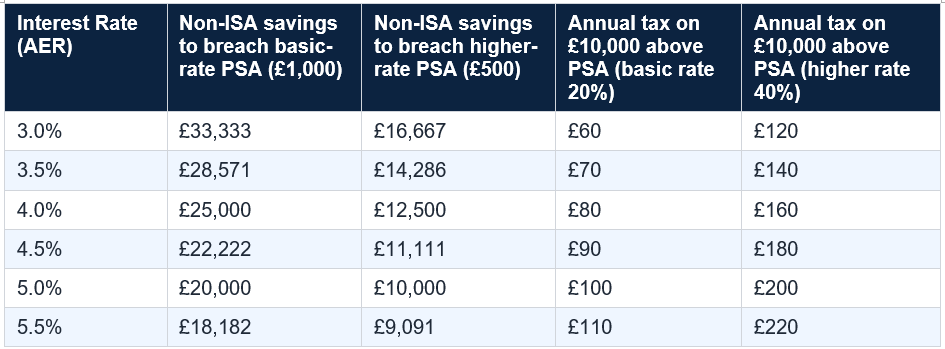
At current savings rates around 4 to 4.5 percent AER on easy-access accounts, the PSA threshold is reached quickly for non-ISA savers. The worked threshold calculation (based on Wealthvieu April 2026 and TaxFly August 2026 analyses):For higher-rate taxpayers, the threshold is particularly low. With £11,111 in non-ISA savings earning 4.5 percent AER, the entire £500 PSA is exhausted. Every additional pound of interest is taxed at 40 percent. A higher-rate taxpayer with £50,000 in a savings account at 4.5 percent earns £2,250 in interest, of which £1,750 is above the PSA and generates a tax bill of £700 per year (ukcalculator.com, May 2026).
The Starting Rate for Savings: The Hidden Allowance Most People Miss
There is a third savings interest allowance that is almost entirely unknown outside specialist tax circles and that can be genuinely valuable for people with low non-savings income. The Starting Rate for Savings is a band of up to £5,000 of savings interest taxed at 0 percent, available to people whose non-savings income (salary, pension, self-employment income) is below £17,570 per year.The mechanics:
- If your non-savings income is below the Personal Allowance of £12,570, the full £5,000 Starting Rate for Savings is available for savings interest, in addition to the £1,000 PSA. A person with no other income could receive up to £6,000 in savings interest entirely tax-free (£5,000 Starting Rate + £1,000 PSA) before any tax applies.
- For every £1 of non-savings income above £12,570 (above the Personal Allowance), the £5,000 Starting Rate for Savings reduces by £1. At £17,570 in non-savings income, the Starting Rate is reduced to zero.
- Between £12,570 and £17,570 of non-savings income, the Starting Rate is partially available: someone with non-savings income of £15,000 has used £2,430 of the £5,000 Starting Rate, leaving £2,570 available at 0 percent, plus the £1,000 PSA — totalling £3,570 of tax-free savings interest.
Who benefits most from the Starting Rate for Savings:
- Retirees on the State Pension only: the full new State Pension in 2026/27 is £12,547.60 per year — just £22.40 below the Personal Allowance. This leaves £4,977.40 of the Starting Rate for Savings available (reduced by the £22.40 that the State Pension exceeds the Personal Allowance at zero income), plus the £1,000 PSA. A State Pension-only retiree could earn approximately £5,977 in savings interest tax-free.
- Part-time workers with income below £17,570.
- People taking career breaks with minimal other income.
Protection Strategy #1: Use Your Cash ISA Allowance Before Anything Else
The Cash ISA is the most powerful and most widely available legal protection against savings interest tax. Interest earned inside a Cash ISA is completely tax-free: it does not count toward the PSA, does not push income into a higher tax band, and does not need to be reported to HMRC. It is, as income-tax-calculator.com’s June 2026 guide states, completely invisible to the savings tax system.The ISA allowance for 2026/27 is £20,000 per person per tax year. This can be split across a Cash ISA, a Stocks and Shares ISA, an Innovative Finance ISA, and a Lifetime ISA (up to £4,000 per year into the LISA within the £20,000 total). Unused allowance from the current tax year cannot be carried forward; it resets on 6 April. However, existing ISA funds — and the interest they earn — remain sheltered indefinitely. There is no cap on the total amount an ISA can hold or on the interest it can earn tax-free.
An important change coming from April 2027: InsightHQ’s July 2026 analysis notes that the Cash ISA allowance for under-65s will be reduced from £20,000 to £12,000 from 6 April 2027. The full £20,000 Cash ISA allowance remains available for the current 2026/27 tax year. This makes the current tax year an important window for maximising Cash ISA contributions before the allowance reduction.
The comparison between a Cash ISA and a non-ISA savings account at the same rate, for a basic-rate taxpayer with £40,000 in savings earning 4.5 percent:
- Non-ISA savings account: £1,800 interest, of which £800 is above the PSA and taxed at 20% — tax bill of £160 per year.
- Cash ISA: £1,800 interest, zero tax, zero reporting, zero HMRC engagement.
Watch Out: The £20,000 ISA allowance for under-65s is expected to be reduced to £12,000 from April 2027. The current 2026/27 tax year provides the last opportunity to contribute at the £20,000 level before this restriction takes effect for those under 65. Maximise your Cash ISA subscription before 5 April 2027. Always verify current rules and limits at GOV.UK before acting, as policy details may have changed after this article's publication.
Protection Strategy #2: NS&I Premium Bonds for Tax-Free Returns
National Savings and Investments (NS&I) Premium Bonds provide a second source of completely tax-free returns on cash savings. Premium Bonds do not pay interest; instead, each £1 bond is entered into a monthly prize draw. Prizes are entirely tax-free and do not count toward the PSA, do not affect income tax band calculations, and do not need to be reported to HMRC. They are invisible to the savings tax system in the same way as ISAs.Key features of Premium Bonds in 2026:
- Eligible investors: UK residents aged 16 or over can hold Premium Bonds. Parents and grandparents can buy Premium Bonds for children under 16.
- Maximum holding: £50,000 per person. This is substantially more than the £20,000 annual ISA allowance, making Premium Bonds particularly useful for savers who have already filled their ISA.
- Current prize rate: approximately 4.0 percent AER equivalent in August 2026 (verify the current rate at nsandi.com, as NS&I adjusts the prize rate periodically). This is below the best Cash ISA rates of above 4.5 percent available in August 2026, but the tax-free prize nature means the post-tax equivalent comparison depends on the individual’s tax rate.
- For an additional-rate taxpayer who receives no PSA, Premium Bonds paying an effective 4.0 percent prize rate are equivalent to a taxable account paying approximately 7.3 percent at 45 percent tax — a significant effective advantage.
- For a basic-rate taxpayer with savings already above the PSA threshold, Premium Bonds are equivalent to a taxable account paying approximately 5.0 percent at 20 percent tax — above current market easy-access savings rates.
Protection Strategy #3: Spousal or Partner Savings Splitting
Where one partner has little or no taxable income and the other partner is generating taxable savings interest, transferring savings to the lower-earning partner can materially reduce the household savings tax bill. Each person has their own PSA and their own ISA allowance. A transfer from an additional-rate taxpayer (PSA £0) to a basic-rate spouse (PSA £1,000) immediately shelters £1,000 of savings interest tax-free.For jointly held accounts, savings interest is split 50/50 between the account holders for tax purposes by default. If one partner is a lower-rate taxpayer, this default split is already partially beneficial. However, the split can only be changed to a different ratio than 50/50 where the beneficial ownership of the funds genuinely reflects that allocation.
Additional advantages of transferring to a lower-earning partner:
- Their unused Personal Allowance may shelter savings interest at 0 percent: a non-working partner with no other income can earn up to £12,570 in savings interest using their Personal Allowance alone, plus £1,000 from the PSA — totalling £13,570 of tax-free savings interest.
- The Starting Rate for Savings may apply to a lower-earning partner, potentially adding up to £5,000 of tax-free savings interest if their non-savings income is below £17,570.
- Each partner has their own £20,000 ISA allowance. A couple can move up to £40,000 per year into ISAs (2 x £20,000), permanently sheltering savings interest in two wrappers.
Protection Strategy #4: Pension Contributions to Reduce Your Tax Band
For people whose savings interest tips them from basic-rate into higher-rate tax, or whose total income (including savings interest) approaches or crosses the £50,270 higher-rate threshold, pension contributions provide a mechanism to reduce taxable income and preserve the larger £1,000 PSA.Pension contributions reduce your adjusted net income — the income figure used to determine your income tax band. A person with a salary of £49,000 and £2,000 in savings interest has total income of £51,000, which pushes them into the higher-rate band. Their PSA drops from £1,000 to £500, and their marginal tax rate on the excess interest rises from 20 percent to 40 percent. A pension contribution of £780 net (£1,000 gross after 20 percent relief) would reduce their adjusted net income back below £50,270, restoring the £1,000 PSA and reducing the savings interest tax rate from 40 percent to 20 percent on the relevant portion.
The annual pension contribution allowance for 2026/27 is £60,000 (gross), covering employee, employer, and relief contributions combined. This provides substantial scope for high earners to use pension contributions strategically to manage their tax band position. The tax relief on pension contributions — basic rate relief of 20 percent added to the pension automatically, with additional relief claimable via Self Assessment for higher-rate taxpayers — makes pension contributions one of the most tax-efficient savings vehicles available.
Protection Strategy #5: Use the Personal Allowance for Interest Income
If your non-savings income (salary, pension, self-employment income) does not use your entire Personal Allowance of £12,570, the unused portion can shelter savings interest at 0 percent. This is most relevant for:- People with part-time or reduced hours employment where income is below £12,570.
- Retirees whose only income is the State Pension: the full new State Pension in 2026/27 is £12,547.60 — just £22.40 below the Personal Allowance. A retiree with the full State Pension has £22.40 of unused Personal Allowance, then benefits from the nearly full £5,000 Starting Rate for Savings, then the £1,000 PSA — potentially sheltering up to £5,977 in savings interest tax-free.
- People between jobs or on career breaks with no employment income: their entire £12,570 Personal Allowance is available for savings interest, then the full £5,000 Starting Rate, then the £1,000 PSA — up to £18,570 of savings interest could be received tax-free in a single tax year without any ISA wrapper.
Band Creep: How Savings Interest Can Push You into a Higher Tax Band
One of the less obvious consequences of the savings interest tax trap is the band-crossing effect: savings interest can push a saver from basic-rate into higher-rate tax, not just generating tax at the higher rate on the interest itself but also halving the PSA from £1,000 to £500.A practical example (based on ukcalculator.com May 2026):
- James earns a salary of £49,000 and has £50,000 in savings earning 4.5% = £2,250 interest.
- Total income: £49,000 + £2,250 = £51,250. This is above the £50,270 higher-rate threshold.
- James is now a higher-rate taxpayer for the year. His PSA drops from £1,000 to £500.
- Taxable interest: £2,250 − £500 = £1,750 taxed at 40% = £700 tax on savings interest alone.
- If James had put £30,000 of his savings in an ISA, his non-ISA savings interest would be £900 (from the remaining £20,000), his total income would be £49,900 (below £50,270), he would remain a basic-rate taxpayer with a £1,000 PSA, and his savings tax bill would be £0.
What the April 2027 Rate Rise Means for Savers
The savings interest tax trap is set to become more expensive from April 2027. As announced in the Autumn Budget and confirmed by Alexander & Co’s April 2026 tax changes analysis, savings interest tax rates will rise by 2 percentage points across all income bands from 6 April 2027:- Basic rate on savings interest: rises from 20 percent to 22 percent.
- Higher rate on savings interest: rises from 40 percent to 42 percent.
- Additional rate on savings interest: rises from 45 percent to 47 percent.
These increases are not transformative in isolation. However, combined with the ongoing freeze in the PSA and income tax thresholds, they extend the trajectory of the savings tax trap: more people facing higher bills on the same savings balances. The ISA wrapper’s protection becomes more valuable with each passing year of this policy direction, because the savings interest sheltered inside an ISA is immune to rate rises regardless of future budget announcements.
13. How HMRC Collects the Tax: Tax Codes, P800s, and Self Assessment
For savers who do have a savings tax liability, HMRC collects it through one of three mechanisms:- PAYE tax code adjustment: for employees and pensioners with Pay As You Earn (PAYE) income, HMRC typically adjusts the tax code to collect savings interest tax through future pay or pension deductions. The adjustment appears in the following tax year and reduces the monthly take-home income rather than requiring a lump sum payment. HMRC usually adjusts the code for savings interest between £500 and £10,000.
- Simple Assessment (P800 letter): HMRC may send a P800 letter at the end of the tax year showing the interest it has recorded from banks and calculating the tax owed. The P800 allows payment online, by bank transfer, or by cheque. If HMRC’s calculation is correct and you pay by the specified date, no penalties apply.
- Self Assessment tax return: savers with savings interest above £10,000 in the tax year must register for and file a Self Assessment return. The deadline to notify HMRC of a new Self Assessment requirement is 5 October after the end of the relevant tax year. For 2026/27 (ending 5 April 2027), notifications must be received by 5 October 2027.
Worked Examples: What the Tax Looks Like in Practice
Conclusion
4.51 million people are expected to owe savings interest tax in 2026/27. The number was 1.22 million four years ago. The mechanism is not mysterious: the Personal Savings Allowance has been frozen at £1,000 since 2016; savings rates have risen above 4 percent; income tax thresholds are frozen until 2031; and HMRC now receives bank interest data automatically, catching out savers who did not know they had a liability before they knew they had received the interest.The solutions identified in this guide form a clear hierarchy. The Cash ISA is the fastest and most complete answer: interest inside an ISA is permanently and completely tax-free, at any amount, with no reporting and no HMRC interaction. At the £20,000 ISA allowance for 2026/27 — a limit that is expected to drop to £12,000 for under-65s from April 2027 — the current tax year provides the most generous ISA contribution window before the restriction takes effect.
Beyond the ISA, NS&I Premium Bonds offer up to £50,000 of tax-free prize returns. The Starting Rate for Savings can shelter up to £5,000 of interest for low-income savers. Spousal splitting and pension contributions can reduce or eliminate liability for those approaching or above the higher-rate threshold. The strategies are legal, widely available, and in the case of the ISA, permanent.
The savings interest tax trap catches people who do not act. It does not catch people who move their savings into tax-advantaged wrappers before the interest is earned. The ISA allowance resets on 6 April. The time to act is before the tax year ends — not after the P800 letter arrives.
Frequently Asked Questions
How many people are paying tax on savings interest in the UK?HMRC Freedom of Information figures analysed by savings app Spring show that 4.51 million people in the UK are expected to owe income tax on their savings interest in 2026/27. This is a 269% increase from 1.22 million in 2022/23, representing an additional 3.29 million people caught in the savings tax net in four years (GB News, August 2026; MoneyWeek, citing Paragon Bank FOI figures). The rise is driven by the combination of a frozen Personal Savings Allowance (unchanged at £1,000 for basic-rate and £500 for higher-rate since 2016) and savings account interest rates rising above 4%. Basic-rate taxpayer numbers increased from 613,000 to 1.42 million (132%); higher-rate numbers rose from 405,000 to 1.52 million (275%); additional-rate numbers are expected to rise from 301,000 to 682,000.
What is the Personal Savings Allowance in 2026/27?
The Personal Savings Allowance (PSA) for 2026/27 is: £1,000 per year for basic-rate taxpayers (total income £12,571 to £50,270); £500 per year for higher-rate taxpayers (total income £50,271 to £125,140); and £0 (no PSA) for additional-rate taxpayers (income above £125,140). These figures have been unchanged since the PSA was introduced in April 2016. Interest earned inside an ISA is completely separate from the PSA, does not count toward it, and is tax-free regardless of amount. Interest above the PSA is taxed at the investor's marginal income tax rate: 20% for basic-rate, 40% for higher-rate, and 45% for additional-rate taxpayers. From April 2027, these rates will rise to 22%, 42%, and 47% respectively.
How can I avoid paying tax on savings interest?
The most effective legal strategies for avoiding or reducing savings interest tax in 2026/27 are: (1) Use your Cash ISA allowance (£20,000 per person in 2026/27; note this reduces to £12,000 for under-65s from April 2027). All interest inside a Cash ISA is permanently tax-free with no reporting required. (2) Use NS&I Premium Bonds — prizes are tax-free; up to £50,000 can be held per person. (3) Transfer savings to a lower-earning spouse or civil partner to use their PSA and potentially their Personal Allowance and Starting Rate for Savings. (4) Make pension contributions if savings interest is pushing your total income toward or above the £50,270 higher-rate threshold, reducing your taxable income and preserving the larger £1,000 PSA. (5) If your non-savings income is below £17,570, use the Starting Rate for Savings to shelter up to £5,000 of interest at 0%.
Does HMRC know about my savings interest?
Yes. Since 2016, all UK banks and building societies are legally required to report interest paid to account holders to HMRC each year under the Automatic Exchange of Information (AEOI) framework. HMRC receives this data automatically, compares it against your tax record, and either adjusts your PAYE tax code or issues a P800 Simple Assessment letter if it identifies a tax liability. For savings interest between £500 and £10,000, HMRC typically collects via tax code adjustment. Above £10,000, a Self Assessment return is required. Interest inside an ISA is not reported for tax purposes and is invisible to HMRC's savings interest assessment system. Ignoring HMRC letters about savings tax is not advisable: non-response is treated as careless behaviour and can attract higher penalties.
How much can I earn in savings interest before paying tax?
The answer depends on your income band and what allowances are available to you. In 2026/27: most basic-rate taxpayers can earn £1,000 in savings interest per year tax-free (the PSA); most higher-rate taxpayers can earn £500; additional-rate taxpayers receive no PSA. If your total non-savings income is below £17,570, the Starting Rate for Savings may allow up to £5,000 additional interest at 0% (reducing £1 for every £1 of income above £12,570). Interest inside an ISA is always tax-free at any amount and does not count toward these limits. At 4.5% AER: a basic-rate taxpayer breaches the £1,000 PSA with just £22,222 in non-ISA savings; a higher-rate taxpayer with £11,111 in non-ISA savings exhausts their £500 PSA. These are relatively modest savings balances, which is why 4.51 million people are now caught in the tax net.
What is the ISA allowance in 2026/27 and is it changing?
The ISA allowance for 2026/27 is £20,000 per person per tax year. This covers all types of ISA combined: Cash ISA, Stocks and Shares ISA, Innovative Finance ISA, and Lifetime ISA (with the LISA having its own £4,000 sub-limit within the £20,000 total). From 6 April 2027, the Cash ISA allowance for investors under 65 is expected to be reduced to £12,000 per year (down from £20,000). The full £20,000 remains available for the current 2026/27 tax year, ending 5 April 2027. Existing ISA funds — and all interest earned on them — remain sheltered indefinitely with no cap on total pot size. Unused ISA allowance cannot be carried forward between tax years; it resets on 6 April. Always verify current ISA limits at GOV.UK, as rules may change.
0 Comments
Be the first to share your thoughts on this article.