

Taxes
How to Deduct Long-Term Care Costs on Your Taxes
A private nursing home room costs more than $10,000 a month. Medicare does not cover ongoing custodial care. And most Americans have no plan for it. The good news: the IRS provides meaningful tax deductions for long-term care insurance premiums — up to $6,200 per person in 2026 — and for the actual cost of qualified care itself. Self-employed individuals can deduct premiums without even itemizing. This guide explains every deduction pathway, every 2026 limit, and exactly which form to file.
Long-term care is the financial issue that most retirement plans fail to account for — and the one most likely to derail them. A private nursing home room costs more than $10,000 a month, or $120,000 a year. A semiprivate room runs over $9,000. Assisted living averages between $4,000 and $6,000 per month depending on location and level of care. These are not edge cases or worst-case scenarios; they are median costs from current survey data. And Medicare — the federal health insurance program that most Americans over 65 rely on — does not cover ongoing custodial care. It covers up to 100 days of skilled nursing facility care following a qualifying hospital stay, after which the full cost falls to the individual, their family, or Medicaid if assets have been spent down.
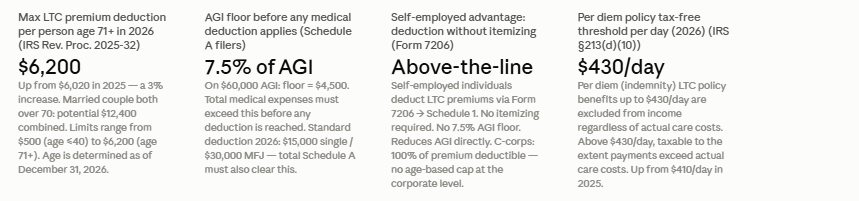
The IRS provides meaningful tax relief for long-term care costs through two overlapping mechanisms: deductions for qualified long-term care insurance premiums (subject to age-based limits that increase every year for inflation) and deductions for the actual cost of qualified long-term care services when received by someone who meets the IRS definition of chronically ill. For 2026, per IRS Revenue Procedure 2025-32 as reported by the American Association for Long-Term Care Insurance (AALTCI) in October 2025, the maximum deductible LTC premium for someone over age 70 is $6,200 — a 3% increase from the 2025 limit of $6,020. A married couple both over 70 could potentially deduct $12,400 in combined LTC premiums.
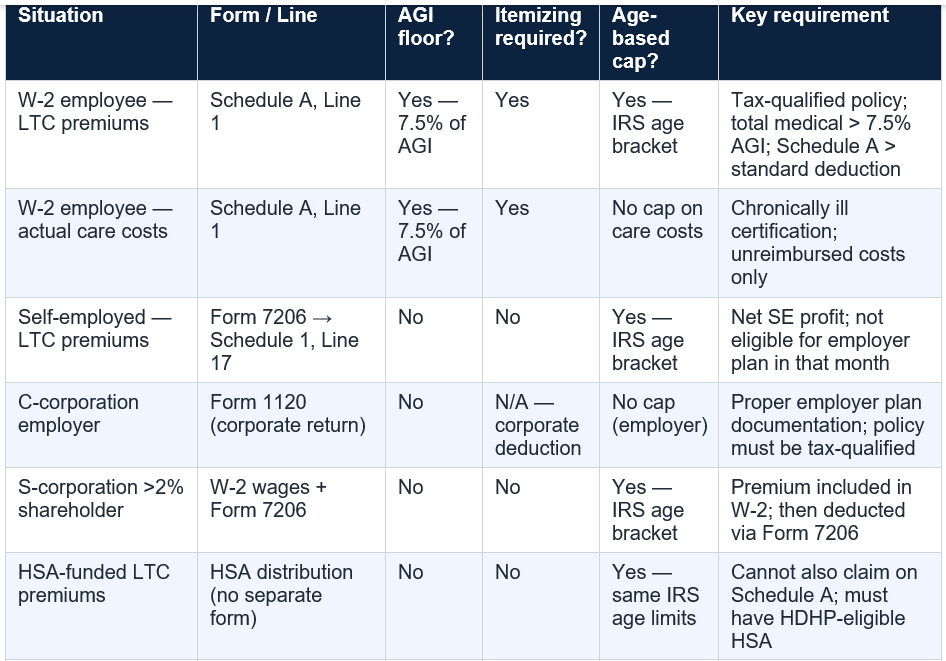
The deduction pathways differ significantly based on how you file. Standard itemizers must clear the 7.5% AGI medical expense floor before any deduction kicks in. Self-employed individuals can deduct LTC premiums above the line — without itemizing and without the 7.5% floor — through Form 7206. C-corporations face no age-based cap on LTC premium deductions at all. And HSA funds can be used to pay LTC premiums with a triple tax advantage. This guide walks through every pathway with the 2026 numbers.
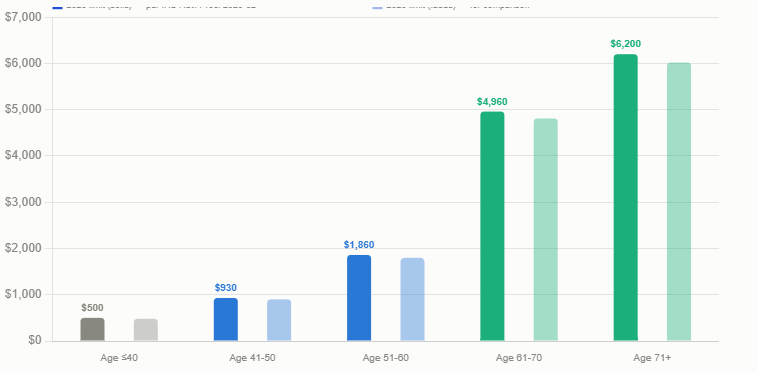
2026 LTC premium deduction limits (IRS Rev. Proc. 2025-32; AALTCI): age 40 or under $500; age 41-50 $930; age 51-60 $1,860; age 61-70 $4,960; age 71+ $6,200. 3% increase over 2025 limits (AALTCI October 2025). Married couple both over 70: potential $12,400 combined. 7.5% AGI floor applies for Schedule A filers. Standard deduction 2026: $15,000 single / $30,000 MFJ. Nursing home private room: $10,000+/month (GoodRx/Genworth 2025). Per diem benefit: $430/day excluded from income (2026). Self-employed: 100% of age-based eligible premium deductible without itemizing (Form 7206). C-corps: 100% of premium deductible as business expense.
The first category is LTC insurance premium deductions. If you own a tax-qualified long-term care insurance policy and pay the premiums yourself (not through a pre-tax employer plan), a portion of those premiums can be treated as a medical expense for federal income tax purposes. The deductible portion is capped by IRS age-based limits. These limits apply per insured person — so a couple each holding a policy gets two separate age-based caps. The premiums go into the same medical expense bucket as your other unreimbursed healthcare costs on Schedule A.
The second category is the actual cost of long-term care services themselves. When a person who meets the IRS definition of 'chronically ill' receives qualifying long-term care services — nursing home care, assisted living fees, home health aide services, memory care — those costs may be deductible as medical expenses. This category is potentially much larger than the premium deduction. At $10,000 per month for a nursing home, the annual cost of $120,000 vastly exceeds any premium deduction limit. But it also typically means you are already in care, which is why the planning value of the premium deduction (taken while healthy and paying premiums) is usually more important for most taxpayers.
These two categories are not mutually exclusive. If you are paying LTC insurance premiums while also paying out-of-pocket for some qualified care expenses (for yourself, a spouse, or a dependent parent), both amounts can count toward your total medical expense deduction on Schedule A, subject to the 7.5% AGI floor. The combined total is what matters for clearing the floor — which is why a year with both significant LTC premiums and substantial care costs is often the year the deduction first becomes meaningful. Not tax advice.
For the 2026 tax year, per IRS Revenue Procedure 2025-32 (announced by AALTCI in October 2025), the limits are:
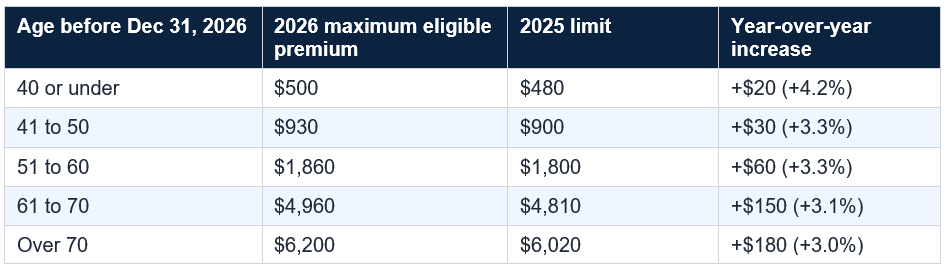
Source: IRS Revenue Procedure 2025-32; American Association for Long-Term Care Insurance (AALTCI), October 11, 2025; GoldenCareAgent.com; ElderLawAnswers.com (December 2025). These are per-person limits — each insured applies their own age bracket's ceiling.
The key operational rule: the amount you can include as a medical expense is the lesser of (a) the actual qualified premium amount stated by your insurance carrier for 2026 and (b) the IRS age-based limit for your age bracket. Insurance companies that offer tax-qualified LTC policies send policyholders an annual statement — often included with the premium renewal notice — specifying the qualified premium amount for the upcoming tax year. This is the number to use, not necessarily the total premium charged. If your actual premium is lower than the IRS cap, you can only deduct the actual premium. If it is higher, the IRS cap applies.
Only tax-qualified long-term care insurance policies generate a deductible premium. The policy must meet the requirements of the Health Insurance Portability and Accountability Act of 1996 (HIPAA). Most policies issued after January 1, 1997 are automatically tax-qualified — but hybrid policies that combine life insurance with an LTC benefit rider, which are increasingly popular, generally do NOT qualify for the LTC premium deduction. Jesse Slome, director emeritus of the AALTCI, stated in October 2025: 'Most of the linked benefit or hybrid life insurance policies, the ones more popular today, do not qualify for a possible tax benefit.' Verify your specific policy's tax-qualified status with your insurer before claiming the deduction. Not tax advice.
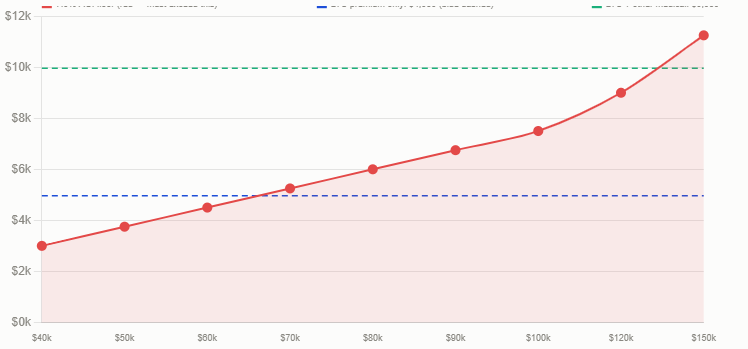
This threshold is the most important variable in determining whether the deduction delivers real tax savings — and it cuts two ways. For higher-income taxpayers, a larger 7.5% floor means more medical spending is needed before any deduction is reached. For lower-income retirees with significant medical costs, the 7.5% floor may be cleared more easily, making the deduction more accessible. The standard deduction for 2026 is $15,000 for single filers and $30,000 for married filing jointly (under OBBBA). The LTC deduction only helps if your total Schedule A deductions — medical, state and local taxes (capped at $10,000), mortgage interest, charitable contributions — exceed the standard deduction.
Example: Worked example: Schedule A filer, age 62, AGI $72,000 (from GoldenCareAgent.com 2026 Consumer Tax Guide). Total unreimbursed medical expenses incurred in 2026: $8,000. LTC insurance premiums paid 2026: $4,600. Age 62 falls in the 61-70 bracket. IRS limit for age 61-70: $4,960. Actual premium $4,600 < limit $4,960, so full $4,600 counts. Total medical expenses: $8,000 unreimbursed + $4,600 LTC premiums = $12,600. 7.5% AGI floor: $72,000 × 7.5% = $5,400. Deductible amount: $12,600 − $5,400 = $7,200. This $7,200 goes on Schedule A as the medical expense deduction. Tax savings at 22% bracket: $7,200 × 22% = $1,584 in reduced federal income tax. Note: deduction only helps if total Schedule
A (including this $7,200 plus state taxes, mortgage interest, etc.) exceeds $15,000 standard deduction (single) or $30,000 (MFJ). Not tax advice — consult a CPA.
The 7.5% floor creates a timing consideration that many taxpayers overlook. If your medical expenses are spread somewhat evenly across years, it may be worth front-loading elective medical expenses (dental work, vision care, non-urgent procedures) into a single year to exceed the floor and create a deductible amount. LTC premiums paid annually at year-end versus monthly also affect the timing of what counts in a given tax year. A CPA can help identify whether bunching medical expenses in a specific year creates a larger benefit than spreading them across multiple years.
Calculating your AGI floor and testing whether you can clear it. Step 1: Find your 2026 AGI from Line 11 of Form 1040. Step 2: Multiply AGI × 7.5% — this is your floor. Step 3: Add all unreimbursed medical expenses for 2026 (include LTC premiums up to your age limit, prescription costs, dental, vision, out-of-network copays, hearing aids, medical mileage at 21 cents per mile). Step 4: Subtract the floor from total medical expenses. If positive, that amount goes on Schedule A. Step 5: Compare your total Schedule A (medical + state/local taxes capped $10,000 + mortgage interest + charitable) to your standard deduction ($15,000 single / $30,000 MFJ). If total Schedule A exceeds the standard deduction, itemizing delivers more savings. Not tax advice.
Deductible long-term care service expenses include the full cost of nursing home or skilled nursing facility fees, assisted living facility charges when care is medically necessary, home health aide fees for medically necessary services, adult day care program fees, memory care and Alzheimer's care facility costs, and medically necessary personal care services. The IRS requires that the services be provided under a plan of care prescribed by a licensed health care practitioner. Not all costs at an assisted living facility necessarily qualify — only the portions attributable to qualified medical care rather than room and board or lifestyle amenities may be deductible.
If an LTC insurance policy reimburses some or all of the care costs, the reimbursed amounts must be subtracted from the medical expense total. Only unreimbursed costs qualify. This is why a year in which care costs exceed policy benefits is often the year with the largest potential deduction: the gap between the cost and the benefit generates a large unreimbursed medical expense that, once the AGI floor is cleared, becomes fully deductible.
Example: Worked example: nursing home care. Parent in nursing home in 2026. Monthly cost: $9,500. Annual total: $114,000. LTC insurance benefit received: $60,000. Unreimbursed cost: $54,000. Family member's AGI: $90,000 (if parent is their dependent). 7.5% floor: $90,000 × 7.5% = $6,750. Other medical expenses: $3,000. Total medical: $54,000 + $3,000 = $57,000. Deductible amount: $57,000 − $6,750 = $50,250. At 24% marginal rate: $50,250 × 24% = $12,060 in federal tax savings. Note: the parent must qualify as a tax dependent for the family member to deduct these costs. Dependency rules apply — consult a CPA. This is a simplified illustration. Not tax advice.
The chronically ill certification is the key document for LTC tax benefits. It determines whether an LTC policy is legally required to pay benefits, whether those benefits are tax-free when received, and whether care costs paid out of pocket qualify as medical expense deductions. Families whose parents are clearly in need of substantial ongoing assistance should ensure formal certification is obtained from a physician or other qualified practitioner and updated annually. Keep the certification in the same file as tax records for the years in which LTC deductions are claimed. Not tax advice.
'Above the line' means the deduction reduces adjusted gross income directly — not just taxable income — and does not require itemizing. The 7.5% AGI floor that applies to Schedule A filers does not apply here. The deduction takes effect whether or not you take the standard deduction. For someone who has been unable to clear the 7.5% AGI floor as an employee, switching to self-employment status on a relevant portion of income — for example, a retired professional who now earns consulting income — can unlock a deduction that was previously inaccessible.
The age-based limits still apply. A self-employed individual age 67 can deduct up to $4,960 in 2026 LTC premiums through Form 7206. The deduction is limited to the net profit of the business — you cannot create or increase a business loss by claiming more than the business earned. And the self-employed health insurance deduction (which includes LTC premiums) cannot exceed the net self-employment income reported on Schedule C or the relevant pass-through income. Two additional constraints: the deduction is not available for any month in which you (or your spouse) were eligible to participate in an employer-subsidised health plan, and the LTC premium deduction cannot generate a loss that exceeds business income.
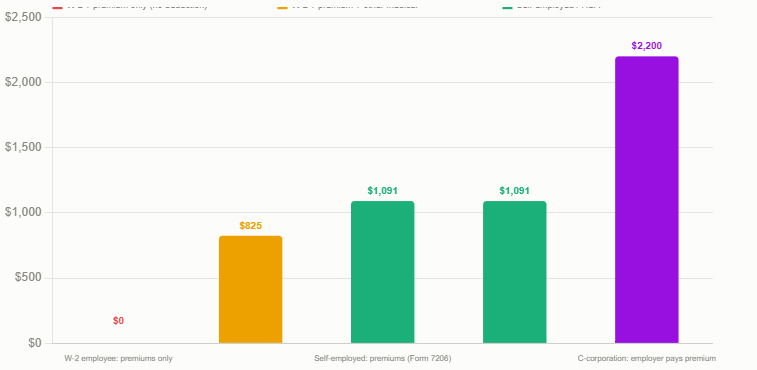
Example: Self-employed deduction, age 67. Net self-employment income 2026: $40,000. LTC insurance premiums paid 2026: $5,500. IRS age limit (61-70 bracket): $4,960. Eligible deduction: $4,960 (lesser of actual $5,500 and limit $4,960). Claimed on Form 7206, flowing to Schedule 1. Effect on AGI: AGI reduced by $4,960 before any itemized deductions are considered. Tax savings at 22% bracket: $4,960 × 22% = $1,091.20 in federal income tax. This deduction is available even if total Schedule A deductions do not exceed the standard deduction. Contrast with W-2 employee earning same income: that employee must itemize AND clear the 7.5% AGI floor to claim any LTC premium deduction. Not tax advice — consult a CPA.
The triple tax benefit of using HSA funds for LTC premiums: first, HSA contributions are made with pre-tax dollars (or are deductible if made directly). Second, the funds grow tax-free inside the account. Third, distributions from the HSA for qualified LTC insurance premiums — up to the age-based annual limit — are tax-free. LegalClarity.org's analysis of the HSA and LTC intersection explains it clearly: 'This is one of the few types of insurance premiums that HSA funds can cover.' The important constraint: premiums paid using HSA funds cannot also be claimed as a medical expense deduction on Schedule A. The HSA withdrawal already captured the tax benefit; claiming the same dollars again on Schedule A would be double-dipping, which the IRS prohibits.
For someone who has accumulated a substantial HSA balance and is approaching the age at which LTC coverage makes sense to purchase (commonly the mid-50s to mid-60s), using HSA funds to pay LTC premiums is an exceptionally efficient strategy. The funds were contributed pre-tax, grew tax-free, and are now being withdrawn tax-free to pay for coverage that protects a significant retirement asset. The 2026 HSA contribution limits are $4,400 for self-only coverage and $8,750 for family coverage, with a $1,000 catch-up contribution available for those aged 55 and older.
HSA strategy for LTC premiums. If you are over 55 with an HSA: (1) Maximise your HSA contribution in the years before Medicare eligibility (HSA contributions are no longer allowed once you enrol in Medicare Part A). (2) Allow the balance to grow tax-free — HSA funds can be invested in stocks and funds, not just held as cash. (3) After age 65 (or when you purchase LTC coverage), use HSA distributions to pay LTC premiums up to your age-based IRS limit tax-free. (4) Do not claim the same premium amount on Schedule A — the HSA withdrawal already provided the tax benefit. Not tax advice — consult a CPA or financial adviser.
Reimbursement policies pay actual documented care expenses up to a daily or monthly maximum. The benefits are not taxable income as long as they do not exceed actual care costs, and any excess is returned to the policyholder or applied to future care. These are straightforward from a tax perspective: benefits reimburse documented expenses, unreimbursed costs remain deductible, and benefits received are not income.
Per diem (indemnity) policies pay a fixed daily amount regardless of actual care costs — whether expenses were $50 or $500 that day, the policy pays a predetermined flat amount. This creates a potential taxable income situation when the daily benefit exceeds actual care costs. For 2026, per IRS Section 213(d)(10) as cited by LegalClarity.org and GotLTCi's 2026 updates, per diem LTC payments up to $430 per day are excluded from gross income regardless of actual expenses. Payments above $430 per day are taxable to the extent they exceed your actual long-term care costs.
In practice: a per diem policy paying $350 per day in 2026 generates no taxable income regardless of actual care costs — all payments are below the $430 threshold. A policy paying $500 per day when actual care costs are $480 per day: the $430 per day exclusion applies; the remaining $70 per day ($500 minus $430) would be taxable income. But since actual costs ($480) exceed the payment ($500)... no, in this case actual costs $480 are less than the payment, so the taxable amount is: payment $500 minus larger of $430 exclusion or actual costs $480 = $500 − $480 = $20/day taxable. This interplay requires careful tracking of daily benefit amounts versus daily actual costs.
Per diem policy holders should track both the daily benefit received and the actual daily care cost throughout the year to calculate the taxable portion accurately. Insurance companies providing per diem LTC benefits should issue a 1099-LTC form. LTC benefits (including per diem) that exceed the exclusion amount must be reported as other income on Form 1040. The $430/day threshold for 2026 is up from $410 in 2025 (consistent with annual indexing). Not tax advice.
For reimbursement policies, benefits are tax-free to the extent they cover actual, documented qualified long-term care expenses. If the policy reimburses $8,000 in care costs and the actual costs were $8,000, the benefit is entirely tax-free. If the policy pays more than actual documented costs — an unusual situation but possible — the excess may be taxable.
For per diem policies, the $430/day exclusion (2026) means that daily benefits at or below $430 are always tax-free. Above $430/day, only the amount that exceeds actual care costs is taxable. The key distinction is that per diem policies do not require documentation of actual expenses to receive benefits — the fixed payment is made regardless — which is why the IRS applies a different tax framework to protect revenue when benefits potentially exceed actual costs.
The practical implication for most policyholders: if your per diem benefit is set at or below $430 per day (approximately $13,000 per month), all benefits received are tax-free regardless of actual care costs. If your benefit exceeds this threshold and you are in a low-cost care setting, you will need to track actual daily costs and calculate the taxable excess. GotLTCi's 2026 reference guide summarises: 'Indemnity policies: Benefit payments above $430 per day that exceed the actual cost of care will be taxed as income.'

The tax deductions available in 2026 — up to $6,200 per person over age 70 for insurance premiums, and potentially tens of thousands in care cost deductions when care is actually received — are not a complete solution, but they are meaningful relief. A married couple both over 70 with $12,400 in combined LTC premiums and other significant medical costs can potentially generate a deduction that saves $2,700 or more in federal income tax at the 22% bracket. Self-employed individuals and business owners can do better still, accessing the above-the-line deduction or the corporate expense treatment that bypasses the AGI floor entirely.
The action steps are clear: verify your policy is tax-qualified before claiming any premium deduction; obtain the insurer's annual qualified premium statement and file it with your tax records; obtain and update the chronically ill certification annually when care is being received; use Form 7206 if you are self-employed; and consult a CPA who understands the interaction between LTC premium deductions, actual care cost deductions, the 7.5% AGI floor, the standard deduction threshold, and HSA strategy. The tax code in this area is detailed, but it rewards those who navigate it correctly. Not tax, financial, or legal advice.
The amount you can deduct depends on your age as of December 31, 2026, and is limited to the lesser of: (a) the actual qualified premium amount stated by your insurance company for 2026, and (b) the IRS age-based cap for your bracket. Per IRS Revenue Procedure 2025-32 (AALTCI October 2025), the 2026 caps are: age 40 or under $500; age 41-50 $930; age 51-60 $1,860; age 61-70 $4,960; age 71 and older $6,200. These limits increased 3% from 2025 levels. If you are a W-2 employee, this amount goes on Schedule A as a medical expense — but you only get a deduction if your total unreimbursed medical expenses (including the LTC premium up to your cap) exceed 7.5% of your AGI, and your total Schedule A exceeds the $15,000 single / $30,000 MFJ standard deduction. If you are self-employed, the eligible premium is deductible above the line through Form 7206 without the 7.5% floor or itemizing requirement. Not tax advice — consult a CPA.
Can I deduct nursing home or assisted living costs on my taxes?
Yes — if the person receiving care meets the IRS definition of chronically ill. A qualified long-term care service expense (nursing home fees, assisted living costs, home health aide costs, memory care fees) is deductible as a medical expense on Schedule A, subject to the 7.5% AGI floor. 'Chronically ill' means the person is unable to perform at least two of six activities of daily living (eating, bathing, continence, dressing, toileting, transferring) without substantial assistance expected to last at least 90 days, or requires substantial supervision due to severe cognitive impairment — and this must be certified by a licensed health care practitioner. Only unreimbursed costs qualify: amounts paid by insurance must be subtracted. If you are paying for a parent's care, the parent generally must qualify as your tax dependent for you to claim the deduction on your return. At nursing home costs of $9,000-$10,000/month, clearing the 7.5% AGI floor is usually straightforward. Not tax advice.
Do I need to itemize to deduct long-term care insurance premiums?
It depends on how you file. W-2 employees and retirees: yes, you must itemize on Schedule A. The LTC premium deduction (up to your age-based limit) goes into your total medical expenses, and only the amount exceeding 7.5% of AGI is deductible — and only when total Schedule A deductions exceed the $15,000 single / $30,000 MFJ 2026 standard deduction. Self-employed individuals (sole proprietors, partners, S-corp shareholders owning more than 2%): no — you can deduct qualifying LTC premiums above the line through Form 7206 flowing to Schedule 1 without itemizing and without the 7.5% AGI floor. This is the self-employed advantage. HSA account holders: LTC premiums up to the age-based limits paid from an HSA are tax-free distributions — no itemizing, no AGI floor — but the same amount cannot also be claimed on Schedule A. Not tax advice.
Can I use my HSA to pay long-term care insurance premiums?
Yes — long-term care insurance premiums are one of the few types of insurance premiums that can be paid using HSA funds on a tax-free basis, up to the same age-based annual limits that apply to the Schedule A deduction ($500 to $6,200 in 2026 depending on age). The triple tax benefit: HSA contributions go in pre-tax, grow tax-free, and come out tax-free when used for qualifying LTC premiums. The critical rule: if you pay LTC premiums using HSA funds, you cannot also claim those same dollars as a medical expense deduction on Schedule A — that would be double-counting the tax benefit. You must have an HSA-eligible high-deductible health plan to contribute to an HSA. HSA contributions are no longer allowed once you enrol in Medicare Part A. This makes the years between turning 55 and reaching Medicare eligibility at 65 a strategic window for accumulating HSA funds that can later be used for LTC premiums. Not tax advice.
Are long-term care insurance benefits I receive taxable income?
Generally no — but with specific conditions. For reimbursement policies: benefits received for actual qualified long-term care expenses are not taxable income, as long as they do not exceed actual documented care costs. For per diem (indemnity) policies: payments up to $430 per day in 2026 (per IRS Section 213(d)(10)) are excluded from income regardless of actual care costs. Payments above $430 per day are taxable to the extent they exceed actual care costs. For example: a per diem policy paying $500/day when your actual daily care cost is $450: the first $430 is tax-free. The remaining $70/day would normally be taxable, but since actual costs ($450) exceed the tax-free threshold ($430), the payment is compared to actual costs — $500 − $450 = $50/day taxable. In practice, many per diem policies are set at or below the $430/day threshold, making all benefits tax-free. Insurance companies issue 1099-LTC forms for benefits paid; the taxable portion must be reported as income. Not tax advice — consult a CPA.
Table of Contents
- Why the LTC Tax Deduction Matters More Than Ever in 2026
- The Two Categories of Deductible LTC Expenses
- Route A — Deducting LTC Insurance Premiums: The Age-Based IRS Limits
- The 7.5% AGI Floor: When the Deduction Actually Kicks In
- Route B — Deducting Actual Long-Term Care Service Costs
- Who Qualifies as 'Chronically Ill' Under IRS Rules
- The Self-Employed Advantage: Deducting Without Itemizing (Form 7206)
- Business Owner Strategies: C-Corps, S-Corps, and Partnership Rules
- HSA Funds and LTC Premiums: The Triple Tax Benefit
- Per Diem (Indemnity) Policies: The $430/Day Tax-Free Threshold
- LTC Benefits Received: Are They Taxable?
- Step-by-Step: How to Claim the Deduction on Your Tax Return
- Conclusion: Every Dollar of LTC Tax Relief Counts
- Frequently Asked Questions
2026 IRS premium limits by age — what you can deduct
The 7.5% AGI floor: when the deduction actually kicks in
Deduction routes: W-2 vs self-employed vs HSA vs business
Why the LTC Tax Deduction Matters More Than Ever in 2026
Long-term care is the financial issue that most retirement plans fail to account for — and the one most likely to derail them. A private nursing home room costs more than $10,000 a month, or $120,000 a year. A semiprivate room runs over $9,000. Assisted living averages between $4,000 and $6,000 per month depending on location and level of care. These are not edge cases or worst-case scenarios; they are median costs from current survey data. And Medicare — the federal health insurance program that most Americans over 65 rely on — does not cover ongoing custodial care. It covers up to 100 days of skilled nursing facility care following a qualifying hospital stay, after which the full cost falls to the individual, their family, or Medicaid if assets have been spent down.The IRS provides meaningful tax relief for long-term care costs through two overlapping mechanisms: deductions for qualified long-term care insurance premiums (subject to age-based limits that increase every year for inflation) and deductions for the actual cost of qualified long-term care services when received by someone who meets the IRS definition of chronically ill. For 2026, per IRS Revenue Procedure 2025-32 as reported by the American Association for Long-Term Care Insurance (AALTCI) in October 2025, the maximum deductible LTC premium for someone over age 70 is $6,200 — a 3% increase from the 2025 limit of $6,020. A married couple both over 70 could potentially deduct $12,400 in combined LTC premiums.
The deduction pathways differ significantly based on how you file. Standard itemizers must clear the 7.5% AGI medical expense floor before any deduction kicks in. Self-employed individuals can deduct LTC premiums above the line — without itemizing and without the 7.5% floor — through Form 7206. C-corporations face no age-based cap on LTC premium deductions at all. And HSA funds can be used to pay LTC premiums with a triple tax advantage. This guide walks through every pathway with the 2026 numbers.
2026 LTC premium deduction limits (IRS Rev. Proc. 2025-32; AALTCI): age 40 or under $500; age 41-50 $930; age 51-60 $1,860; age 61-70 $4,960; age 71+ $6,200. 3% increase over 2025 limits (AALTCI October 2025). Married couple both over 70: potential $12,400 combined. 7.5% AGI floor applies for Schedule A filers. Standard deduction 2026: $15,000 single / $30,000 MFJ. Nursing home private room: $10,000+/month (GoodRx/Genworth 2025). Per diem benefit: $430/day excluded from income (2026). Self-employed: 100% of age-based eligible premium deductible without itemizing (Form 7206). C-corps: 100% of premium deductible as business expense.
The Two Categories of Deductible LTC Expenses
Before examining each route in detail, it helps to understand the two distinct categories of long-term care tax deductions and how they interact.The first category is LTC insurance premium deductions. If you own a tax-qualified long-term care insurance policy and pay the premiums yourself (not through a pre-tax employer plan), a portion of those premiums can be treated as a medical expense for federal income tax purposes. The deductible portion is capped by IRS age-based limits. These limits apply per insured person — so a couple each holding a policy gets two separate age-based caps. The premiums go into the same medical expense bucket as your other unreimbursed healthcare costs on Schedule A.
The second category is the actual cost of long-term care services themselves. When a person who meets the IRS definition of 'chronically ill' receives qualifying long-term care services — nursing home care, assisted living fees, home health aide services, memory care — those costs may be deductible as medical expenses. This category is potentially much larger than the premium deduction. At $10,000 per month for a nursing home, the annual cost of $120,000 vastly exceeds any premium deduction limit. But it also typically means you are already in care, which is why the planning value of the premium deduction (taken while healthy and paying premiums) is usually more important for most taxpayers.
These two categories are not mutually exclusive. If you are paying LTC insurance premiums while also paying out-of-pocket for some qualified care expenses (for yourself, a spouse, or a dependent parent), both amounts can count toward your total medical expense deduction on Schedule A, subject to the 7.5% AGI floor. The combined total is what matters for clearing the floor — which is why a year with both significant LTC premiums and substantial care costs is often the year the deduction first becomes meaningful. Not tax advice.
Route A — Deducting LTC Insurance Premiums: The Age-Based IRS Limits
Qualified long-term care insurance premiums are treated as medical expenses under Internal Revenue Code Section 213(d)(10), but only up to an annual per-person ceiling that the IRS adjusts each year for inflation. The ceiling depends on the insured person's age as of December 31 of the tax year — not the policyholder's age if different. If you pay premiums for your spouse's policy, the limit that applies is your spouse's age, not yours.For the 2026 tax year, per IRS Revenue Procedure 2025-32 (announced by AALTCI in October 2025), the limits are:
Source: IRS Revenue Procedure 2025-32; American Association for Long-Term Care Insurance (AALTCI), October 11, 2025; GoldenCareAgent.com; ElderLawAnswers.com (December 2025). These are per-person limits — each insured applies their own age bracket's ceiling.
The key operational rule: the amount you can include as a medical expense is the lesser of (a) the actual qualified premium amount stated by your insurance carrier for 2026 and (b) the IRS age-based limit for your age bracket. Insurance companies that offer tax-qualified LTC policies send policyholders an annual statement — often included with the premium renewal notice — specifying the qualified premium amount for the upcoming tax year. This is the number to use, not necessarily the total premium charged. If your actual premium is lower than the IRS cap, you can only deduct the actual premium. If it is higher, the IRS cap applies.
Only tax-qualified long-term care insurance policies generate a deductible premium. The policy must meet the requirements of the Health Insurance Portability and Accountability Act of 1996 (HIPAA). Most policies issued after January 1, 1997 are automatically tax-qualified — but hybrid policies that combine life insurance with an LTC benefit rider, which are increasingly popular, generally do NOT qualify for the LTC premium deduction. Jesse Slome, director emeritus of the AALTCI, stated in October 2025: 'Most of the linked benefit or hybrid life insurance policies, the ones more popular today, do not qualify for a possible tax benefit.' Verify your specific policy's tax-qualified status with your insurer before claiming the deduction. Not tax advice.
The 7.5% AGI Floor: When the Deduction Actually Kicks In
For taxpayers who itemize deductions on Schedule A, the LTC insurance premium deduction does not operate in isolation. It combines with all other unreimbursed medical expenses, and the total must exceed 7.5% of your adjusted gross income (AGI) before any amount becomes deductible. Only the amount above the 7.5% floor can be claimed.This threshold is the most important variable in determining whether the deduction delivers real tax savings — and it cuts two ways. For higher-income taxpayers, a larger 7.5% floor means more medical spending is needed before any deduction is reached. For lower-income retirees with significant medical costs, the 7.5% floor may be cleared more easily, making the deduction more accessible. The standard deduction for 2026 is $15,000 for single filers and $30,000 for married filing jointly (under OBBBA). The LTC deduction only helps if your total Schedule A deductions — medical, state and local taxes (capped at $10,000), mortgage interest, charitable contributions — exceed the standard deduction.
Example: Worked example: Schedule A filer, age 62, AGI $72,000 (from GoldenCareAgent.com 2026 Consumer Tax Guide). Total unreimbursed medical expenses incurred in 2026: $8,000. LTC insurance premiums paid 2026: $4,600. Age 62 falls in the 61-70 bracket. IRS limit for age 61-70: $4,960. Actual premium $4,600 < limit $4,960, so full $4,600 counts. Total medical expenses: $8,000 unreimbursed + $4,600 LTC premiums = $12,600. 7.5% AGI floor: $72,000 × 7.5% = $5,400. Deductible amount: $12,600 − $5,400 = $7,200. This $7,200 goes on Schedule A as the medical expense deduction. Tax savings at 22% bracket: $7,200 × 22% = $1,584 in reduced federal income tax. Note: deduction only helps if total Schedule
A (including this $7,200 plus state taxes, mortgage interest, etc.) exceeds $15,000 standard deduction (single) or $30,000 (MFJ). Not tax advice — consult a CPA.
The 7.5% floor creates a timing consideration that many taxpayers overlook. If your medical expenses are spread somewhat evenly across years, it may be worth front-loading elective medical expenses (dental work, vision care, non-urgent procedures) into a single year to exceed the floor and create a deductible amount. LTC premiums paid annually at year-end versus monthly also affect the timing of what counts in a given tax year. A CPA can help identify whether bunching medical expenses in a specific year creates a larger benefit than spreading them across multiple years.
Calculating your AGI floor and testing whether you can clear it. Step 1: Find your 2026 AGI from Line 11 of Form 1040. Step 2: Multiply AGI × 7.5% — this is your floor. Step 3: Add all unreimbursed medical expenses for 2026 (include LTC premiums up to your age limit, prescription costs, dental, vision, out-of-network copays, hearing aids, medical mileage at 21 cents per mile). Step 4: Subtract the floor from total medical expenses. If positive, that amount goes on Schedule A. Step 5: Compare your total Schedule A (medical + state/local taxes capped $10,000 + mortgage interest + charitable) to your standard deduction ($15,000 single / $30,000 MFJ). If total Schedule A exceeds the standard deduction, itemizing delivers more savings. Not tax advice.
Route B — Deducting Actual Long-Term Care Service Costs
When someone who meets the IRS definition of chronically ill actually receives long-term care services, the unreimbursed costs of those services may be deducted as medical expenses on Schedule A — subject to the same 7.5% AGI floor. At nursing home costs of $10,000 or more per month, clearing the 7.5% floor is almost automatic for most income levels, which means the deduction tends to be very meaningful in years when a family member is in full-time care.Deductible long-term care service expenses include the full cost of nursing home or skilled nursing facility fees, assisted living facility charges when care is medically necessary, home health aide fees for medically necessary services, adult day care program fees, memory care and Alzheimer's care facility costs, and medically necessary personal care services. The IRS requires that the services be provided under a plan of care prescribed by a licensed health care practitioner. Not all costs at an assisted living facility necessarily qualify — only the portions attributable to qualified medical care rather than room and board or lifestyle amenities may be deductible.
If an LTC insurance policy reimburses some or all of the care costs, the reimbursed amounts must be subtracted from the medical expense total. Only unreimbursed costs qualify. This is why a year in which care costs exceed policy benefits is often the year with the largest potential deduction: the gap between the cost and the benefit generates a large unreimbursed medical expense that, once the AGI floor is cleared, becomes fully deductible.
Example: Worked example: nursing home care. Parent in nursing home in 2026. Monthly cost: $9,500. Annual total: $114,000. LTC insurance benefit received: $60,000. Unreimbursed cost: $54,000. Family member's AGI: $90,000 (if parent is their dependent). 7.5% floor: $90,000 × 7.5% = $6,750. Other medical expenses: $3,000. Total medical: $54,000 + $3,000 = $57,000. Deductible amount: $57,000 − $6,750 = $50,250. At 24% marginal rate: $50,250 × 24% = $12,060 in federal tax savings. Note: the parent must qualify as a tax dependent for the family member to deduct these costs. Dependency rules apply — consult a CPA. This is a simplified illustration. Not tax advice.
Who Qualifies as 'Chronically Ill' Under IRS Rules
The IRS definition of chronically ill is the gateway to most long-term care tax benefits — both for insurance premium deductions from a qualified policy and for service cost deductions. An individual is chronically ill under IRC Section 7702B(c)(2) if a licensed health care practitioner certifies that they meet one of two criteria:- ADL criterion: the individual is unable to perform at least two of six activities of daily living (ADLs) — eating, bathing, continence, dressing, toileting, and transferring (moving into and out of a bed or chair) — without substantial assistance from another person, and this condition is expected to last at least 90 days.
- Cognitive criterion: the individual requires substantial supervision to protect their health and safety due to severe cognitive impairment — including Alzheimer's disease, other forms of dementia, or brain injuries — that results in substantial functional limitation.
The chronically ill certification is the key document for LTC tax benefits. It determines whether an LTC policy is legally required to pay benefits, whether those benefits are tax-free when received, and whether care costs paid out of pocket qualify as medical expense deductions. Families whose parents are clearly in need of substantial ongoing assistance should ensure formal certification is obtained from a physician or other qualified practitioner and updated annually. Keep the certification in the same file as tax records for the years in which LTC deductions are claimed. Not tax advice.
The Self-Employed Advantage: Deducting Without Itemizing (Form 7206)
For self-employed taxpayers, the LTC premium deduction works through an entirely different — and substantially more advantageous — mechanism. Sole proprietors, general partners, and shareholders owning more than 2% of an S corporation can deduct qualified LTC insurance premiums as an above-the-line deduction through Form 7206 (Self-Employed Health Insurance Deduction), with the result flowing to Schedule 1 (Form 1040), Line 17.'Above the line' means the deduction reduces adjusted gross income directly — not just taxable income — and does not require itemizing. The 7.5% AGI floor that applies to Schedule A filers does not apply here. The deduction takes effect whether or not you take the standard deduction. For someone who has been unable to clear the 7.5% AGI floor as an employee, switching to self-employment status on a relevant portion of income — for example, a retired professional who now earns consulting income — can unlock a deduction that was previously inaccessible.
The age-based limits still apply. A self-employed individual age 67 can deduct up to $4,960 in 2026 LTC premiums through Form 7206. The deduction is limited to the net profit of the business — you cannot create or increase a business loss by claiming more than the business earned. And the self-employed health insurance deduction (which includes LTC premiums) cannot exceed the net self-employment income reported on Schedule C or the relevant pass-through income. Two additional constraints: the deduction is not available for any month in which you (or your spouse) were eligible to participate in an employer-subsidised health plan, and the LTC premium deduction cannot generate a loss that exceeds business income.
Example: Self-employed deduction, age 67. Net self-employment income 2026: $40,000. LTC insurance premiums paid 2026: $5,500. IRS age limit (61-70 bracket): $4,960. Eligible deduction: $4,960 (lesser of actual $5,500 and limit $4,960). Claimed on Form 7206, flowing to Schedule 1. Effect on AGI: AGI reduced by $4,960 before any itemized deductions are considered. Tax savings at 22% bracket: $4,960 × 22% = $1,091.20 in federal income tax. This deduction is available even if total Schedule A deductions do not exceed the standard deduction. Contrast with W-2 employee earning same income: that employee must itemize AND clear the 7.5% AGI floor to claim any LTC premium deduction. Not tax advice — consult a CPA.
Business Owner Strategies: C-Corps, S-Corps, and Partnership Rules
Business owners face a substantially more favourable LTC tax environment than individual taxpayers or employees. The structure of the business determines exactly how premiums are treated.- C-corporations may deduct 100% of LTC insurance premiums paid for employees as a business expense, with no age-based cap applying to the employer-level deduction. The premiums are also excluded from the employee's taxable income. This is the most tax-advantaged structure for LTC coverage: the premium is fully deductible by the corporation and not treated as taxable compensation to the employee. Business owners who operate as C-corporations and include LTC coverage as an employee benefit for themselves (as owner-employees) benefit from this structure.
- S-corporations: for shareholders owning more than 2% of the S-corp, LTC premiums paid by the corporation for the shareholder are treated as wages — added to the shareholder's W-2 as income — and then deductible by the shareholder using Form 7206. The age-based limits apply. The shareholder gets the above-the-line deduction without itemizing, but the amount included in wages increases self-employment income.
- Partnerships: partners can deduct LTC premiums similarly to sole proprietors, as part of the self-employed health insurance deduction on Schedule 1. The same age-based limits and net income constraints apply.
HSA Funds and LTC Premiums: The Triple Tax Benefit
Health Savings Accounts (HSAs) represent a unique opportunity for those with high-deductible health plans: LTC insurance premiums are one of the few types of insurance premiums that can be paid using tax-advantaged HSA funds, up to the same age-based limits that govern the Schedule A deduction.The triple tax benefit of using HSA funds for LTC premiums: first, HSA contributions are made with pre-tax dollars (or are deductible if made directly). Second, the funds grow tax-free inside the account. Third, distributions from the HSA for qualified LTC insurance premiums — up to the age-based annual limit — are tax-free. LegalClarity.org's analysis of the HSA and LTC intersection explains it clearly: 'This is one of the few types of insurance premiums that HSA funds can cover.' The important constraint: premiums paid using HSA funds cannot also be claimed as a medical expense deduction on Schedule A. The HSA withdrawal already captured the tax benefit; claiming the same dollars again on Schedule A would be double-dipping, which the IRS prohibits.
For someone who has accumulated a substantial HSA balance and is approaching the age at which LTC coverage makes sense to purchase (commonly the mid-50s to mid-60s), using HSA funds to pay LTC premiums is an exceptionally efficient strategy. The funds were contributed pre-tax, grew tax-free, and are now being withdrawn tax-free to pay for coverage that protects a significant retirement asset. The 2026 HSA contribution limits are $4,400 for self-only coverage and $8,750 for family coverage, with a $1,000 catch-up contribution available for those aged 55 and older.
HSA strategy for LTC premiums. If you are over 55 with an HSA: (1) Maximise your HSA contribution in the years before Medicare eligibility (HSA contributions are no longer allowed once you enrol in Medicare Part A). (2) Allow the balance to grow tax-free — HSA funds can be invested in stocks and funds, not just held as cash. (3) After age 65 (or when you purchase LTC coverage), use HSA distributions to pay LTC premiums up to your age-based IRS limit tax-free. (4) Do not claim the same premium amount on Schedule A — the HSA withdrawal already provided the tax benefit. Not tax advice — consult a CPA or financial adviser.
Per Diem (Indemnity) Policies: The $430/Day Tax-Free Threshold
Long-term care insurance policies come in two broad structures that are treated very differently for tax purposes: reimbursement policies and per diem (indemnity) policies.Reimbursement policies pay actual documented care expenses up to a daily or monthly maximum. The benefits are not taxable income as long as they do not exceed actual care costs, and any excess is returned to the policyholder or applied to future care. These are straightforward from a tax perspective: benefits reimburse documented expenses, unreimbursed costs remain deductible, and benefits received are not income.
Per diem (indemnity) policies pay a fixed daily amount regardless of actual care costs — whether expenses were $50 or $500 that day, the policy pays a predetermined flat amount. This creates a potential taxable income situation when the daily benefit exceeds actual care costs. For 2026, per IRS Section 213(d)(10) as cited by LegalClarity.org and GotLTCi's 2026 updates, per diem LTC payments up to $430 per day are excluded from gross income regardless of actual expenses. Payments above $430 per day are taxable to the extent they exceed your actual long-term care costs.
In practice: a per diem policy paying $350 per day in 2026 generates no taxable income regardless of actual care costs — all payments are below the $430 threshold. A policy paying $500 per day when actual care costs are $480 per day: the $430 per day exclusion applies; the remaining $70 per day ($500 minus $430) would be taxable income. But since actual costs ($480) exceed the payment ($500)... no, in this case actual costs $480 are less than the payment, so the taxable amount is: payment $500 minus larger of $430 exclusion or actual costs $480 = $500 − $480 = $20/day taxable. This interplay requires careful tracking of daily benefit amounts versus daily actual costs.
Per diem policy holders should track both the daily benefit received and the actual daily care cost throughout the year to calculate the taxable portion accurately. Insurance companies providing per diem LTC benefits should issue a 1099-LTC form. LTC benefits (including per diem) that exceed the exclusion amount must be reported as other income on Form 1040. The $430/day threshold for 2026 is up from $410 in 2025 (consistent with annual indexing). Not tax advice.
LTC Benefits Received: Are They Taxable?
Benefits received from a tax-qualified long-term care insurance policy are generally not counted as taxable income — but with two important caveats. The first is the $430/day threshold for per diem policies discussed above. The second is the coordination with actual care costs.For reimbursement policies, benefits are tax-free to the extent they cover actual, documented qualified long-term care expenses. If the policy reimburses $8,000 in care costs and the actual costs were $8,000, the benefit is entirely tax-free. If the policy pays more than actual documented costs — an unusual situation but possible — the excess may be taxable.
For per diem policies, the $430/day exclusion (2026) means that daily benefits at or below $430 are always tax-free. Above $430/day, only the amount that exceeds actual care costs is taxable. The key distinction is that per diem policies do not require documentation of actual expenses to receive benefits — the fixed payment is made regardless — which is why the IRS applies a different tax framework to protect revenue when benefits potentially exceed actual costs.
The practical implication for most policyholders: if your per diem benefit is set at or below $430 per day (approximately $13,000 per month), all benefits received are tax-free regardless of actual care costs. If your benefit exceeds this threshold and you are in a low-cost care setting, you will need to track actual daily costs and calculate the taxable excess. GotLTCi's 2026 reference guide summarises: 'Indemnity policies: Benefit payments above $430 per day that exceed the actual cost of care will be taxed as income.'
Step-by-Step: How to Claim the Deduction on Your Tax Return
The specific form and process for claiming LTC tax deductions depend on your filing situation. Here is the step-by-step process for each scenario.- Scenario 1 — W-2 employee who itemizes: (1) Gather documentation: your insurer's annual qualified premium statement for 2026; receipts or statements for all other unreimbursed medical expenses. (2) Calculate total qualifying medical expenses: eligible LTC premium (lesser of actual and age-based limit) plus all other unreimbursed medical costs. (3) Apply the 7.5% AGI floor: subtract 7.5% of Line 11 (AGI) from your total medical expenses. The remaining amount goes on Schedule A, Line 1. (4) Complete Schedule A in full (medical, state/local taxes capped $10k, mortgage interest, charitable). (5) Compare Schedule A total to your standard deduction. If Schedule A is larger, attach it to Form 1040 and enter it on Line 12. (6) Retain your insurer's qualified premium statement, any care provider invoices, and the chronically ill certification (if applicable) as documentation.
- Scenario 2 — Self-employed taxpayer: (1) Confirm you have net profit from self-employment and were not eligible for employer-sponsored health coverage for any month you are claiming. (2) Use Form 7206 (Self-Employed Health Insurance Deduction) to calculate the deductible LTC premium — limited to your age-based IRS limit and not to exceed net self-employment income. (3) Transfer the result to Schedule 1 (Form 1040), Line 17. (4) This reduces your AGI without itemizing. You may still itemize separately for other deductions if beneficial. (5) Retain the insurer's qualified premium statement and Schedule C documentation showing net self-employment income.
- Scenario 3 — C-corporation employer: (1) The corporation pays LTC premiums as a business expense and deducts them on the corporate return (Form 1120). (2) Premiums are excluded from employee W-2 wages. (3) No age-based cap applies at the corporate level. (4) Retain the policy document, premium invoices, and the plan documentation. Consult a CPA to ensure the LTC benefit plan is properly documented as an employer benefit plan.
- Scenario 4 — Paying care costs for a dependent parent: (1) Confirm the parent qualifies as your tax dependent (passes the qualifying relative test: you provide more than 50% of their support, they earn below the gross income threshold of $5,150 in 2026, and other requirements are met). (2) Gather documentation of all care costs paid: nursing home invoices, home health aide receipts, assisted living statements. (3) Subtract any amounts reimbursed by the parent's insurance. (4) Add unreimbursed care costs to your own medical expense total on Schedule A. (5) Apply 7.5% AGI floor to the combined total. (6) Retain the chronically ill certification for the parent, invoices for all care costs, and insurance reimbursement statements. Not tax advice.
Conclusion
Long-term care is one of the largest unplanned financial risks in retirement. At over $10,000 per month for a private nursing home room, a two-year stay costs more than $240,000. Three years costs more than $360,000. Medicare covers none of it after the initial skilled nursing period. Most families are not financially prepared for it.The tax deductions available in 2026 — up to $6,200 per person over age 70 for insurance premiums, and potentially tens of thousands in care cost deductions when care is actually received — are not a complete solution, but they are meaningful relief. A married couple both over 70 with $12,400 in combined LTC premiums and other significant medical costs can potentially generate a deduction that saves $2,700 or more in federal income tax at the 22% bracket. Self-employed individuals and business owners can do better still, accessing the above-the-line deduction or the corporate expense treatment that bypasses the AGI floor entirely.
The action steps are clear: verify your policy is tax-qualified before claiming any premium deduction; obtain the insurer's annual qualified premium statement and file it with your tax records; obtain and update the chronically ill certification annually when care is being received; use Form 7206 if you are self-employed; and consult a CPA who understands the interaction between LTC premium deductions, actual care cost deductions, the 7.5% AGI floor, the standard deduction threshold, and HSA strategy. The tax code in this area is detailed, but it rewards those who navigate it correctly. Not tax, financial, or legal advice.
Frequently Asked Questions
How much of my long-term care insurance premium can I deduct in 2026?The amount you can deduct depends on your age as of December 31, 2026, and is limited to the lesser of: (a) the actual qualified premium amount stated by your insurance company for 2026, and (b) the IRS age-based cap for your bracket. Per IRS Revenue Procedure 2025-32 (AALTCI October 2025), the 2026 caps are: age 40 or under $500; age 41-50 $930; age 51-60 $1,860; age 61-70 $4,960; age 71 and older $6,200. These limits increased 3% from 2025 levels. If you are a W-2 employee, this amount goes on Schedule A as a medical expense — but you only get a deduction if your total unreimbursed medical expenses (including the LTC premium up to your cap) exceed 7.5% of your AGI, and your total Schedule A exceeds the $15,000 single / $30,000 MFJ standard deduction. If you are self-employed, the eligible premium is deductible above the line through Form 7206 without the 7.5% floor or itemizing requirement. Not tax advice — consult a CPA.
Can I deduct nursing home or assisted living costs on my taxes?
Yes — if the person receiving care meets the IRS definition of chronically ill. A qualified long-term care service expense (nursing home fees, assisted living costs, home health aide costs, memory care fees) is deductible as a medical expense on Schedule A, subject to the 7.5% AGI floor. 'Chronically ill' means the person is unable to perform at least two of six activities of daily living (eating, bathing, continence, dressing, toileting, transferring) without substantial assistance expected to last at least 90 days, or requires substantial supervision due to severe cognitive impairment — and this must be certified by a licensed health care practitioner. Only unreimbursed costs qualify: amounts paid by insurance must be subtracted. If you are paying for a parent's care, the parent generally must qualify as your tax dependent for you to claim the deduction on your return. At nursing home costs of $9,000-$10,000/month, clearing the 7.5% AGI floor is usually straightforward. Not tax advice.
Do I need to itemize to deduct long-term care insurance premiums?
It depends on how you file. W-2 employees and retirees: yes, you must itemize on Schedule A. The LTC premium deduction (up to your age-based limit) goes into your total medical expenses, and only the amount exceeding 7.5% of AGI is deductible — and only when total Schedule A deductions exceed the $15,000 single / $30,000 MFJ 2026 standard deduction. Self-employed individuals (sole proprietors, partners, S-corp shareholders owning more than 2%): no — you can deduct qualifying LTC premiums above the line through Form 7206 flowing to Schedule 1 without itemizing and without the 7.5% AGI floor. This is the self-employed advantage. HSA account holders: LTC premiums up to the age-based limits paid from an HSA are tax-free distributions — no itemizing, no AGI floor — but the same amount cannot also be claimed on Schedule A. Not tax advice.
Can I use my HSA to pay long-term care insurance premiums?
Yes — long-term care insurance premiums are one of the few types of insurance premiums that can be paid using HSA funds on a tax-free basis, up to the same age-based annual limits that apply to the Schedule A deduction ($500 to $6,200 in 2026 depending on age). The triple tax benefit: HSA contributions go in pre-tax, grow tax-free, and come out tax-free when used for qualifying LTC premiums. The critical rule: if you pay LTC premiums using HSA funds, you cannot also claim those same dollars as a medical expense deduction on Schedule A — that would be double-counting the tax benefit. You must have an HSA-eligible high-deductible health plan to contribute to an HSA. HSA contributions are no longer allowed once you enrol in Medicare Part A. This makes the years between turning 55 and reaching Medicare eligibility at 65 a strategic window for accumulating HSA funds that can later be used for LTC premiums. Not tax advice.
Are long-term care insurance benefits I receive taxable income?
Generally no — but with specific conditions. For reimbursement policies: benefits received for actual qualified long-term care expenses are not taxable income, as long as they do not exceed actual documented care costs. For per diem (indemnity) policies: payments up to $430 per day in 2026 (per IRS Section 213(d)(10)) are excluded from income regardless of actual care costs. Payments above $430 per day are taxable to the extent they exceed actual care costs. For example: a per diem policy paying $500/day when your actual daily care cost is $450: the first $430 is tax-free. The remaining $70/day would normally be taxable, but since actual costs ($450) exceed the tax-free threshold ($430), the payment is compared to actual costs — $500 − $450 = $50/day taxable. In practice, many per diem policies are set at or below the $430/day threshold, making all benefits tax-free. Insurance companies issue 1099-LTC forms for benefits paid; the taxable portion must be reported as income. Not tax advice — consult a CPA.

0 Comments Comments