

Professional & Career Development
How to Get Into a Finance and Accounting Career 2026

The finance and accounting job market in 2026 has a talent crisis. Sixty-one per cent of hiring managers in finance and accounting say it is much harder to find skilled candidates than it was a year ago, according to Robert Half's February 2026 research. The Bureau of Labor Statistics projects 6% job growth for accountants through 2034. The global accounting services market is valued at $682 billion and growing. The door into this career has never been more open — this guide shows you how to walk through it.
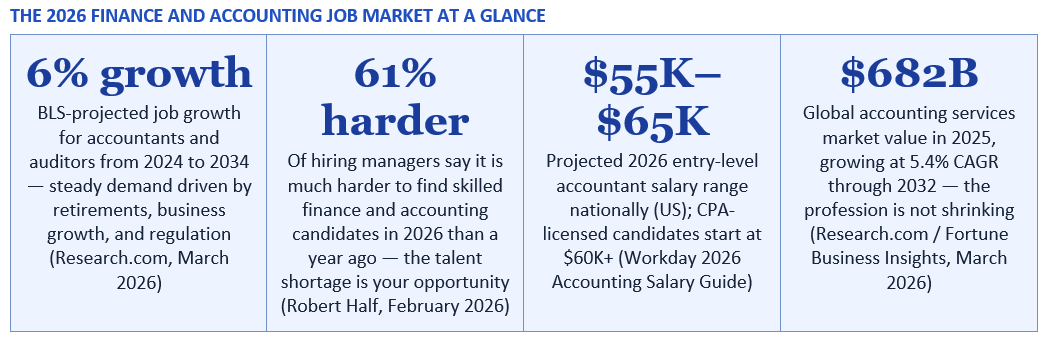
Finance and accounting is one of the few professional fields where the combination of structural demand, talent shortage, and genuine career longevity creates an unusually favourable environment for new entrants in 2026. The talent crisis is real and it is documented: a wave of retirements from experienced CPAs and senior finance professionals, combined with a sharp decline in the number of candidates pursuing CPA licensure, has produced a supply shortage that is driving salaries up and increasing employer competition for qualified candidates.
Workday's 2026 Accounting Salary Guide, published in December 2025, frames this clearly: 'A significant driver of this demand is a well-documented talent crisis, largely stemming from a wave of retirements and a sharp drop in the number of candidates pursuing the certified public accountant (CPA) license. This shortage is creating a highly competitive market for employers, driving up salaries and compensation packages for qualified accountants.' Robert Half's February 2026 data confirms: 83% of finance and accounting leaders feel confident about their business outlook for 2026, and 61% say finding skilled candidates is much harder than it was a year ago.
Beyond the current talent gap, finance and accounting careers offer structural characteristics that make them durable choices in an economy being reshaped by automation. While certain routine tasks — data entry, reconciliation, basic bookkeeping — are increasingly automated, the professional judgement required to interpret financial data, advise on strategy, ensure regulatory compliance, and communicate financial information to decision-makers is not automatable. Alliance Resource Group's 2026 Salary Guide outlook is direct on this point: 'Organizations are adopting tools like AI and expanding automation, but they still need experienced accountants to validate results, apply sound judgment and ensure accuracy.'
Finance and accounting leaders are directing their focus toward revenue-driving roles. Many seek candidates with specialised skills — especially in artificial intelligence — needed to guide strategic decision making. The future belongs to adaptable, tech-savvy, and purpose-driven professionals.
— ALLIANCE RESOURCE GROUP — FIVE CAREER INSIGHTS FROM THE 2026 SALARY GUIDE
Accounting is concerned with recording, classifying, and reporting financial transactions accurately and in compliance with regulatory standards. An accountant's work product is financial statements — the income statement, balance sheet, and cash flow statement — and the processes that ensure they are accurate. Accounting roles tend to be more structured, more rules-based, and more compliance-oriented. The bedrock skill is accuracy; the professional standard is Generally Accepted Accounting Principles (GAAP) in the US or International Financial Reporting Standards (IFRS) globally.
Finance is concerned with using financial information to make decisions — about investments, capital structure, risk management, and business strategy. A finance professional's work product is analysis and recommendations — financial models, valuations, forecasts, and strategic assessments. Finance roles tend to be more forward-looking, more analytical, and more directly connected to business strategy. The bedrock skill is analytical reasoning; the professional standard is applying financial theory to real-world decisions under uncertainty.
In practice, most organisations employ both functions, and many roles sit at the intersection. A Financial Planning and Analysis (FP&A) role, for example, combines accounting data with financial analysis and forecasting. A Controller role combines deep accounting knowledge with the financial oversight that feeds strategic decisions. For entry-level candidates, the distinction matters primarily in choosing where to focus your education and certifications — but building competence in both strengthens career flexibility significantly.
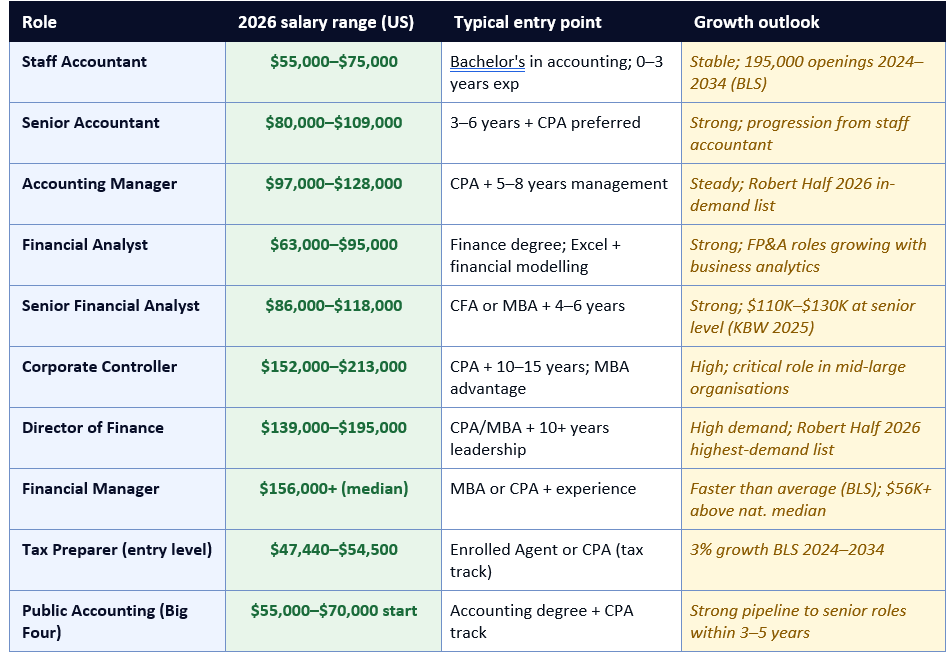
Sources: Robert Half 2026 Salary Guide (February 2026), Research.com (March 2026), KBW Financial (2025), BLS Occupational Outlook Handbook (2025), Workday 2026 Accounting Salary Guide.
Workday's 2026 salary guide maps the progression explicitly for accounting: entry-level at $55,000 to $65,000, senior accountant at $80,000 to $109,000, controller or assistant controller at $110,000 to $190,000+. The most important accelerant across all of these levels is the professional qualification — a CPA licence in the US adds a statistically significant salary premium at every career stage, as does ACCA or CIMA qualification in the UK and globally. The second most important accelerant is specialisation in an area of growing demand.
The specialisations that Robert Half's 2026 Salary Guide identifies as gaining traction in 2026 are: AI and automation-focused roles, where finance professionals who can implement and interpret AI-driven financial analysis tools command significant premiums; environmental, social, and governance (ESG) reporting, which is increasingly regulated and requires accounting expertise; forensic accounting (fraud investigation, litigation support), which has strong and growing demand; and international tax, which is complex, specialist, and highly compensated. Alliance Resource Group's 2026 outlook frames the long-term message well: 'The 2026 landscape rewards those who lead with both skill and self-awareness.
Professionals who combine technical excellence with curiosity, adaptability, and emotional intelligence will thrive in this next chapter.'
The path is clear: choose your entry route (degree, AAT, apprenticeship, or career change), build the core technical skills (accounting software, Excel, GAAP basics), target roles that train while you earn, and begin the professional qualification (CPA, ACCA, or CIMA) that will unlock the mid and senior career tiers. Add AI fluency, communication skills, and a network within the profession, and you are building a career that is resilient to automation, genuinely well-compensated, and available in virtually every industry and country on earth. The talent crisis will not last forever — but right now, qualified finance and accounting professionals are exactly what employers need, and the profession is ready to welcome anyone willing to do the work.
Robert Half — Data Reveals Which Finance and Accounting Roles Are in Highest Demand (February 2026) https://www.roberthalf.com/us/en/insights/research/data-reveals-which-finance-and-accounting-roles-are-in-highest-demand
Workday — The Ultimate 2026 Accounting Salary Guide (December 2025) https://blog.workday.com/en-us/ultimate-2026-accounting-salary-guide.html
Research.com — 2026 Most In-Demand Finance and Accounting Careers (March 2026) https://research.com/careers/most-in-demand-finance-and-accounting-careers
Research.com — 2026 Financial Accounting Careers: Guide to Career Paths, Options and Salary (March 2026) https://research.com/careers/financial-accounting-careers
Research.com — How to Become an Accountant with a Finance Degree: Education, Salary and Job Outlook 2026 (April 2026) https://research.com/advice/how-to-become-an-accountant-with-a-finance-degree-education-salary-and-job-outlook
Alliance Resource Group — Five Career Insights from the 2026 Salary Guide (October 2025) https://www.allianceresourcegroup.com/2025/10/23/five-career-insights-from-the-2026-salary-guide-how-finance-and-accounting-professionals-can-thrive-in-uncertain-times/
TABLE OF CONTENTS
- Why Finance and Accounting Is a Strong Career Choice in 2026
- Understanding the Landscape: Finance vs Accounting
- The Career Paths: Where Can a Finance and Accounting Career Take You?
- What Qualifications Do You Actually Need?
- The Certifications That Open Doors
- The Skills Employers Are Actively Hiring For in 2026
- How to Get Your First Role: The Entry-Level Playbook
- Building Your Finance and Accounting Career Beyond Entry Level
- Conclusion
- Frequently Asked Questions
- References and Further Reading
Why Finance and Accounting Is a Strong Career Choice in 2026
Finance and accounting is one of the few professional fields where the combination of structural demand, talent shortage, and genuine career longevity creates an unusually favourable environment for new entrants in 2026. The talent crisis is real and it is documented: a wave of retirements from experienced CPAs and senior finance professionals, combined with a sharp decline in the number of candidates pursuing CPA licensure, has produced a supply shortage that is driving salaries up and increasing employer competition for qualified candidates.Workday's 2026 Accounting Salary Guide, published in December 2025, frames this clearly: 'A significant driver of this demand is a well-documented talent crisis, largely stemming from a wave of retirements and a sharp drop in the number of candidates pursuing the certified public accountant (CPA) license. This shortage is creating a highly competitive market for employers, driving up salaries and compensation packages for qualified accountants.' Robert Half's February 2026 data confirms: 83% of finance and accounting leaders feel confident about their business outlook for 2026, and 61% say finding skilled candidates is much harder than it was a year ago.
Beyond the current talent gap, finance and accounting careers offer structural characteristics that make them durable choices in an economy being reshaped by automation. While certain routine tasks — data entry, reconciliation, basic bookkeeping — are increasingly automated, the professional judgement required to interpret financial data, advise on strategy, ensure regulatory compliance, and communicate financial information to decision-makers is not automatable. Alliance Resource Group's 2026 Salary Guide outlook is direct on this point: 'Organizations are adopting tools like AI and expanding automation, but they still need experienced accountants to validate results, apply sound judgment and ensure accuracy.'
Finance and accounting leaders are directing their focus toward revenue-driving roles. Many seek candidates with specialised skills — especially in artificial intelligence — needed to guide strategic decision making. The future belongs to adaptable, tech-savvy, and purpose-driven professionals.
— ALLIANCE RESOURCE GROUP — FIVE CAREER INSIGHTS FROM THE 2026 SALARY GUIDE
Understanding the Landscape: Finance vs Accounting
Finance and accounting are related disciplines that are often grouped together — by employers, by career guides, and by university departments — but they have distinct focuses, different career trajectories, and different skill emphases. Understanding the difference helps you target the right roles and develop the right skills from the start.Accounting is concerned with recording, classifying, and reporting financial transactions accurately and in compliance with regulatory standards. An accountant's work product is financial statements — the income statement, balance sheet, and cash flow statement — and the processes that ensure they are accurate. Accounting roles tend to be more structured, more rules-based, and more compliance-oriented. The bedrock skill is accuracy; the professional standard is Generally Accepted Accounting Principles (GAAP) in the US or International Financial Reporting Standards (IFRS) globally.
Finance is concerned with using financial information to make decisions — about investments, capital structure, risk management, and business strategy. A finance professional's work product is analysis and recommendations — financial models, valuations, forecasts, and strategic assessments. Finance roles tend to be more forward-looking, more analytical, and more directly connected to business strategy. The bedrock skill is analytical reasoning; the professional standard is applying financial theory to real-world decisions under uncertainty.
In practice, most organisations employ both functions, and many roles sit at the intersection. A Financial Planning and Analysis (FP&A) role, for example, combines accounting data with financial analysis and forecasting. A Controller role combines deep accounting knowledge with the financial oversight that feeds strategic decisions. For entry-level candidates, the distinction matters primarily in choosing where to focus your education and certifications — but building competence in both strengthens career flexibility significantly.
The Career Paths: Where Can a Finance and Accounting Career Take You?
The career paths within finance and accounting are broader and more varied than most people outside the profession realise. Research.com's March 2026 career guide notes: 'High-paying opportunities exist beyond traditional accounting, with financial managers, actuaries, and financial examiners showing faster-than-average growth. These specialized roles often require advanced education, certifications, or technical expertise, but they offer strong long-term prospects and salaries well above the national median.'Sources: Robert Half 2026 Salary Guide (February 2026), Research.com (March 2026), KBW Financial (2025), BLS Occupational Outlook Handbook (2025), Workday 2026 Accounting Salary Guide.
What Qualifications Do You Actually Need?
The qualification requirements for finance and accounting careers vary significantly by role, employer, and country — and the conventional wisdom that you need a specific accounting degree is less true than it once was, particularly for the analytical finance roles that are growing fastest.The degree route
A bachelor's degree in accounting, finance, economics, mathematics, or a related quantitative field is the standard foundation for most entry-level roles. Research.com's April 2026 guide confirms: 'Accounting professionals with finance degrees often earn between $55,000 and $85,000 annually, reflecting their dual expertise in financial analysis and accounting principles.' A finance degree is broadly acceptable for both finance and accounting roles at entry level, though the CPA licence (US) and equivalent qualifications (ACCA, CIMA in the UK and globally) will require additional study and examination regardless of undergraduate degree.Can you enter without a relevant degree?
Yes — though the path is longer and requires more deliberate credentialing. The most reliable non-degree entry routes are: completing the AAT (Association of Accounting Technicians) qualification in the UK, which provides a stepping stone to ACCA or CIMA without a degree; completing an accounting technician apprenticeship (UK) or an accounting associate degree plus industry certification (US); or building relevant experience through bookkeeping roles and progressing to accounting qualifications while working. Several of the Big Four accounting firms now accept A-levels or equivalent alongside school leaver programmes that include paid study toward professional qualifications, removing the degree requirement entirely for candidates who enter through that route.UK-specific routes
In the UK, the pathway to a professional accounting career frequently runs through ACCA, CIMA, or ICAEW (Institute of Chartered Accountants in England and Wales). All three accept degree holders in any subject, with exemptions available for relevant undergraduate modules. The AAT Level 4 qualification is widely accepted as an entry point to ACCA or CIMA and provides a clear non-degree route for career changers. UK employers in public practice increasingly offer apprenticeship routes to ACA or ACCA qualification, combining paid employment with funded study.The Certifications That Open Doors
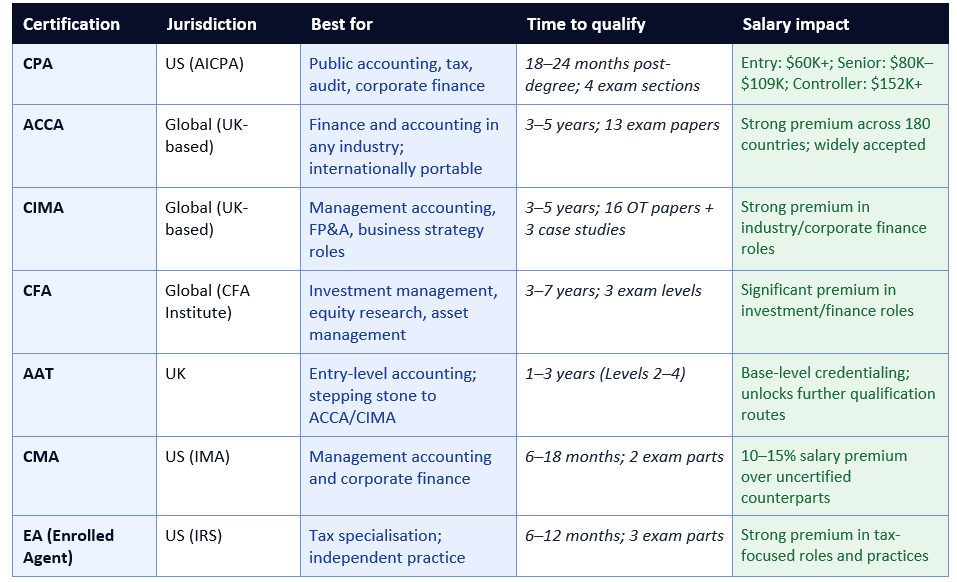
Professional certifications are the single most effective way to differentiate yourself in a competitive finance and accounting job market — and in 2026, the combination of the talent shortage and the growing complexity of financial regulation makes certified candidates significantly more attractive to employers than non-certified graduates with equivalent academic backgrounds.The Skills Employers Are Actively Hiring For in 2026
The skills profile that finance and accounting employers are hiring for in 2026 has shifted measurably from even three years ago. Technical accounting knowledge remains the foundation, but it is no longer sufficient on its own. Robert Half's 2026 Salary Guide identifies a clear hierarchy of demand: technical skills in AI tools and data analytics command the highest premiums, professional certifications remain the strongest credentialing signal, and soft skills — communication, adaptability, and strategic thinking — increasingly differentiate candidates at the mid and senior levels.The skills employers want in finance and accounting candidates — 2026
- Accounting software proficiency: QuickBooks, Xero (small business accounting), NetSuite and SAP (enterprise ERP), and Sage (UK-common) are the most frequently required software platforms at entry to mid-level. KBW Financial's 2025/2026 roles report confirms that staff accountant candidates should demonstrate 'proficiency in Excel and accounting software like QuickBooks or NetSuite.' QuickBooks and Xero certifications are free or very low-cost, can be completed in a day or two, and appear prominently in job requirements.
- Excel and data analysis: Advanced Excel (pivot tables, VLOOKUP/XLOOKUP, financial modelling, scenario analysis) remains the single most universally required technical skill in finance and accounting. SQL for database querying and Power BI for financial dashboards are increasingly listed as requirements or strong advantages at mid and senior level. Candidates who can build a clean three-statement financial model in Excel and present its outputs in a Power BI dashboard are demonstrably ahead of peers who cannot.
- AI fluency and automation tools: Robert Half's 2026 market analysis specifically identifies AI as a key differentiator: 'many seek candidates who have the specialised skills — especially in artificial intelligence — needed to guide strategic decision making and upgrade workflows.' In practice, this means familiarity with AI-assisted tools for audit, tax preparation, financial forecasting, and expense analysis. Candidates who understand how to use these tools to increase their own accuracy and efficiency, and who can explain the outputs rather than just generating them, are increasingly valued.
- Communication and presentation: The ability to translate financial information for non-financial stakeholders — presenting a budget variance analysis to operations teams, explaining a tax position to a board, or communicating cash flow risk to a management team — is consistently cited in senior-hiring research as the skill that most limits promotion from technical to leadership roles. Research.com's March 2026 careers guide notes that 'financial accountants offer crucial advice to key decision-makers' — that advisory function requires communication skills that are entirely distinct from technical accounting expertise.
- GAAP / IFRS knowledge: US employers hiring for accounting roles uniformly require a working understanding of Generally Accepted Accounting Principles (GAAP). International employers and globally operating companies increasingly require International Financial Reporting Standards (IFRS) knowledge as well. Both are studied as part of CPA, ACCA, CIMA, and most accounting degrees — but candidates who can demonstrate applied GAAP and IFRS knowledge through coursework, examination results, or practical experience are prioritised.
How to Get Your First Role: The Entry-Level Playbook
Getting the first finance or accounting role is, for most candidates, the hardest step in the career. Employers want experience; you need the role to get experience. The entry-level playbook for 2026 addresses this directly.Step 1: Target the right entry-level role for your background
The most accessible entry points into finance and accounting in 2026 are: accounts payable/receivable clerk (requires basic accounting knowledge, high volume of openings); bookkeeper (requires AAT Level 2 or equivalent; accessible without degree); tax preparer (seasonal but structured with clear training; good route into tax-specialised career); payroll administrator (consistent demand, accessible with payroll software knowledge); and junior financial analyst (requires Excel proficiency and financial analysis coursework). Research.com's March 2026 guide notes that bookkeeping and auditing clerks will still produce approximately 195,000 openings from 2024 to 2034 despite automation pressure — high-volume roles remain accessible.Step 2: Build your technical foundation before applying
Two to three months of deliberate skill-building before applying dramatically improves both the quality of your applications and your interview performance. The minimum technical foundation for most entry-level accounting roles in 2026 is: QuickBooks Online certification (free via Intuit; approximately 8 hours), Excel proficiency demonstrated through a financial modelling course (LinkedIn Learning or Coursera have current versions), and a working understanding of double-entry bookkeeping. For finance roles, add a financial modelling fundamentals course and familiarity with basic valuation concepts.Step 3: Target firms that train while you earn
Public accounting firms — including the Big Four (Deloitte, PwC, EY, KPMG) and mid-size regional firms — hire candidates without full CPA or ACCA qualifications and support them through professional exams while working. This is the most common route into the profession because it solves the experience problem: you accumulate professional experience while studying, the employer pays or subsidises exam fees, and you emerge with both a professional qualification and a track record of employer-verified experience. In the UK, apprenticeship routes at accounting firms — including at the Big Four — provide the same combination of paid employment and funded qualification study without a degree requirement.Step 4: Network within the profession
Finance and accounting professional networks are more accessible than most candidates realise. The AICPA (US), ACCA, CIMA, and ICAEW all run student and affiliate membership programmes that provide access to networking events, mentorship schemes, and job boards before qualification is complete. LinkedIn is the primary professional networking tool in the sector — a well-structured LinkedIn profile showing relevant coursework, certifications in progress, software proficiencies, and any relevant work experience (even bookkeeping for a family business or volunteer financial management) is a meaningful differentiator at entry level.Building Your Finance and Accounting Career Beyond Entry Level
The career trajectory in finance and accounting is unusually clear and well-defined compared with many professional fields. Entry-level roles provide the foundational experience; professional certification accelerates progression; specialisation in high-demand areas (tax, audit, FP&A, forensic accounting, treasury) produces significant salary premiums; and leadership roles (Controller, CFO, Director of Finance) represent the highest compensation tier.Workday's 2026 salary guide maps the progression explicitly for accounting: entry-level at $55,000 to $65,000, senior accountant at $80,000 to $109,000, controller or assistant controller at $110,000 to $190,000+. The most important accelerant across all of these levels is the professional qualification — a CPA licence in the US adds a statistically significant salary premium at every career stage, as does ACCA or CIMA qualification in the UK and globally. The second most important accelerant is specialisation in an area of growing demand.
The specialisations that Robert Half's 2026 Salary Guide identifies as gaining traction in 2026 are: AI and automation-focused roles, where finance professionals who can implement and interpret AI-driven financial analysis tools command significant premiums; environmental, social, and governance (ESG) reporting, which is increasingly regulated and requires accounting expertise; forensic accounting (fraud investigation, litigation support), which has strong and growing demand; and international tax, which is complex, specialist, and highly compensated. Alliance Resource Group's 2026 outlook frames the long-term message well: 'The 2026 landscape rewards those who lead with both skill and self-awareness.
Professionals who combine technical excellence with curiosity, adaptability, and emotional intelligence will thrive in this next chapter.'
CONCLUSION
Finance and accounting in 2026 is a profession facing a talent shortage, projecting 6% job growth through 2034, and paying entry-level salaries of $55,000 to $65,000 with clear progression to six-figure roles. The door into this career is genuinely open — not because the standards have dropped, but because the supply of qualified candidates has not kept pace with demand. Sixty-one per cent of hiring managers say finding skilled candidates is harder than ever. That is your opportunity.The path is clear: choose your entry route (degree, AAT, apprenticeship, or career change), build the core technical skills (accounting software, Excel, GAAP basics), target roles that train while you earn, and begin the professional qualification (CPA, ACCA, or CIMA) that will unlock the mid and senior career tiers. Add AI fluency, communication skills, and a network within the profession, and you are building a career that is resilient to automation, genuinely well-compensated, and available in virtually every industry and country on earth. The talent crisis will not last forever — but right now, qualified finance and accounting professionals are exactly what employers need, and the profession is ready to welcome anyone willing to do the work.
Frequently Asked Questions
Is accounting a good career in 2026?
Yes — accounting is one of the strongest career choices available in 2026 for three specific reasons: a documented talent shortage (61% of hiring managers say finding skilled candidates is harder than a year ago, per Robert Half's February 2026 data), steady job growth (BLS projects 6% growth from 2024 to 2034, producing tens of thousands of new openings annually), and strong compensation that scales consistently with experience and certification. The global accounting services market is valued at $682 billion and growing at 5.4% CAGR through 2032 (Research.com / Fortune Business Insights, March 2026). Automation is affecting the most routine tasks but is increasing demand for accountants who can validate, interpret, and act on automated outputs — making the profession more analytical and better compensated, not redundant.What is the starting salary for a finance and accounting career in 2026?
In the US, the 2026 entry-level accountant salary range is approximately $55,000 to $65,000 nationally, according to Workday's 2026 Accounting Salary Guide (December 2025). Candidates pursuing CPA licensure can expect starting salaries in the $60,000 range, with those who enter via the Big Four starting in a similar band with strong structured progression. Robert Half's February 2026 Salary Guide provides current market benchmarks by specific role: senior accountant $80,000–$109,000, accounting manager $97,000–$128,000, director of finance $139,000–$195,000, and corporate controller $152,000–$213,000. In the UK, entry-level accounting salaries typically range from £22,000 to £30,000, rising significantly with ACA, ACCA, or CIMA qualification to £35,000–£55,000+ at qualified level. Geographic variation is significant — major financial centres (New York, London, San Francisco) pay materially more than national averages.Do I need an accounting degree to become an accountant?
A relevant degree accelerates the path significantly but is not strictly required in all cases. In the US, CPA licensure requires 150 credit hours of education (typically a bachelor's plus additional coursework) — but the subject does not have to be accounting; a finance, economics, or business degree with accounting coursework is acceptable in most states. The ACCA and CIMA qualifications in the UK and globally accept candidates with degrees in any subject, with ACCA exempting relevant modules from accounting or finance degrees. The AAT (Association of Accounting Technicians) qualification in the UK is a non-degree entry route that progresses to ACCA or CIMA. Several Big Four accounting firms in the UK now offer school-leaver apprenticeship programmes that provide a paid route to ACA or ACCA qualification without any degree requirement. Career changers from unrelated backgrounds can enter via bookkeeping and accounts payable roles while studying toward a professional qualification.Which is better for a career in accounting — CPA, ACCA, or CIMA?
The choice depends primarily on your geography and career aspirations. The CPA (Certified Public Accountant) is the US standard and is required for public accounting practice in the US — if you intend to work in US public accounting, audit, or tax, the CPA is non-negotiable. ACCA (Association of Chartered Certified Accountants) is the most internationally portable qualification — recognised in approximately 180 countries — and is suited to candidates who want flexibility across industries and geographies, including audit, tax, and financial management. CIMA (Chartered Institute of Management Accountants) focuses on management accounting and business finance within organisations rather than public practice, and is stronger for candidates heading toward FP&A, CFO, or corporate finance roles in industry. All three provide strong salary premiums over uncertified counterparts and are examined in English at high professional standards. The 'best' qualification is the one most relevant to the role and geography you are targeting.What is the fastest way to get into finance and accounting with no experience?
The fastest practical route into finance and accounting from a standing start is a combination of: one free or low-cost accounting software certification (QuickBooks Online, Xero, or both — each takes one to two days and appears prominently in entry-level job postings); a bookkeeper or accounts payable clerk role (accessible with basic accounting software knowledge and attention to detail, no experience required by many employers); and simultaneous enrolment in an accounting technician qualification (AAT in the UK, or CMA/EA exam preparation in the US). This combination can produce an employed, credentialed position within two to four months. Alternatively, Big Four and mid-tier accounting firm apprenticeship or school-leaver programmes (UK) provide the fastest all-in-one route: employment, qualification funding, and structured career progression, with applications typically opening in autumn for the following year's intake.References
Robert Half — 2026 Finance and Accounting Salary Guide and Job Market Trends (February 2026) https://www.roberthalf.com/us/en/insights/salary-guide/finance-and-accountingRobert Half — Data Reveals Which Finance and Accounting Roles Are in Highest Demand (February 2026) https://www.roberthalf.com/us/en/insights/research/data-reveals-which-finance-and-accounting-roles-are-in-highest-demand
Workday — The Ultimate 2026 Accounting Salary Guide (December 2025) https://blog.workday.com/en-us/ultimate-2026-accounting-salary-guide.html
Research.com — 2026 Most In-Demand Finance and Accounting Careers (March 2026) https://research.com/careers/most-in-demand-finance-and-accounting-careers
Research.com — 2026 Financial Accounting Careers: Guide to Career Paths, Options and Salary (March 2026) https://research.com/careers/financial-accounting-careers
Research.com — How to Become an Accountant with a Finance Degree: Education, Salary and Job Outlook 2026 (April 2026) https://research.com/advice/how-to-become-an-accountant-with-a-finance-degree-education-salary-and-job-outlook
Alliance Resource Group — Five Career Insights from the 2026 Salary Guide (October 2025) https://www.allianceresourcegroup.com/2025/10/23/five-career-insights-from-the-2026-salary-guide-how-finance-and-accounting-professionals-can-thrive-in-uncertain-times/
Hello .! I came across a 178 awesome tool that I think you should dive into. This resource is packed with a lot of useful information that you might find valuable. It has everything you could possibly need, so be sure to give it a visit! <a href=https://greume.com/the-joy-of-games-from-board-games-to-online-adventures/>https://greume.com/the-joy-of-games-from-board-games-to-online-adventures/</a> Furthermore don't neglect, guys, which a person always may in this particular publication discover answers for the most the absolute tangled inquiries. The authors attempted to present all of the content via the extremely understandable method.