

Real Estate
How to Invest in Real Estate Before Housing Recovers: 6 Ways

Median existing-home price $417,500 (+1.3% year over year); sales pace 3.99 million (−2.2%); inventory 1.60 million, a 4.8-month supply (4.5 a year earlier); the 30-year mortgage rate reached 7.4% in mid-October, the highest since 2023. Forecasts (October): Fannie Mae home prices +0.6% in 2027, rates about 7.5%; MBA rates about 7.2%; Zillow prices +1.1% to September 2027. My arithmetic on a $417,500 property (20% down, $334,000 loan): principal and interest $2,276 a month at 7.24% vs $2,002 at 6.0%; breakeven rent about $3,431 a month (0.82% of the price) with assumed costs; at $3,000 rent the cash flow is about −$397 a month; a 1% price change moves the 20%-down owner’s equity by about 5%. Alternatives: top savings about 4.35% and 52-week T-bills about 4.46%; saving $83,500 at $1,000 a month in a 4.35% account takes about 6.2 years; refinancing from 7.24% to 6.0% would cut the payment about $274 a month, if rates fall and you qualify.
So how do you invest in real estate while you wait? This guide gives six ways, from buying shares of a real estate fund with a few dollars to buying a rental property, and it is honest about the math: at today’s rates a rental with a mortgage is hard to make pay, and I show the numbers. The aim is not to call the bottom, which cannot be done, but to put you in a sensible position whichever way housing goes.
The pressure is rates. According to Freddie Mac data reported by NAR, the 30-year fixed rate averaged 7.4% in the week ending October 15, up from 6.65% to 6.70% earlier this year and the highest since 2023, and pending sales were down 8.5% from a year earlier in September, per Zillow. Rising supply, flat prices and weak sales give buyers more negotiating room than in years, but financing is expensive. It is a slow market, not a falling one.
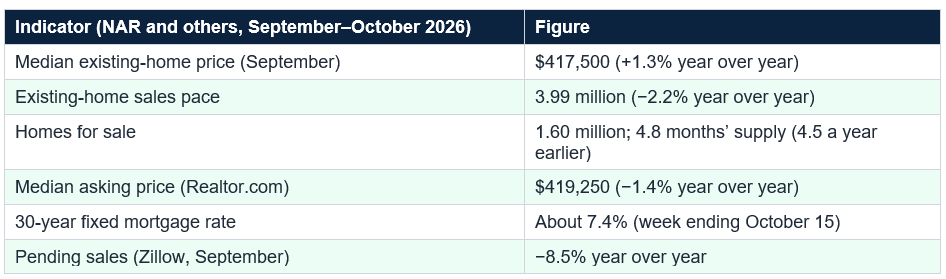
NAR, September 2026: median price $417,500 (+1.3%), sales pace 3.99 million (−2.2%), inventory 1.60 million (4.8 months). Freddie Mac: 30-year rate about 7.4% in mid-October, the highest since 2023. Fannie Mae (October): home prices +0.6% in 2027, rates about 7.5%.
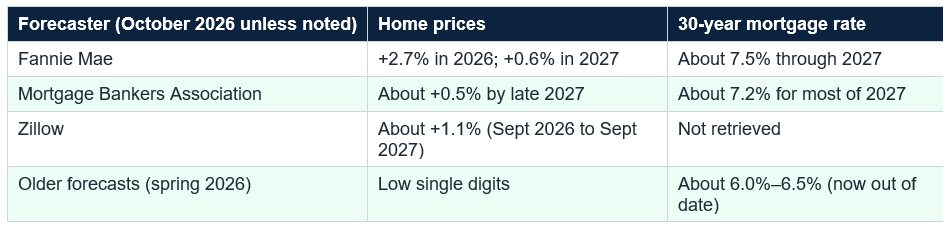
Be careful with older articles. In the spring, forecasters expected rates near 6.0% to 6.5% through 2027, and some pages still show those numbers; a few months of higher rates erased them, which shows how unreliable forecasts are. Plan for several outcomes: if rates fall meaningfully, demand could return and prices could rise, and if they stay near 7%, the market could stay stuck for a long time. A strategy that works only if the recovery comes soon is a gamble.
The trade-offs are real. REIT prices can be volatile and tend to be sensitive to interest rates, since high rates raise borrowing costs and make their income less attractive compared with bonds, and dividends are generally taxed as ordinary income (both general knowledge). I did not retrieve current REIT yields or performance, so I cannot say whether they are cheap or expensive now. A modest, regular amount is one way to start without betting on timing.
House hacking takes it a step further: buy a duplex, or a house with a room or accessory unit you can rent, live in one part and let tenants help pay the mortgage. It can turn a stretch into a manageable payment, but the same math applies: you must be able to afford the payment if the unit is empty. At today’s rates, buy only what you can afford without relying on the rent.
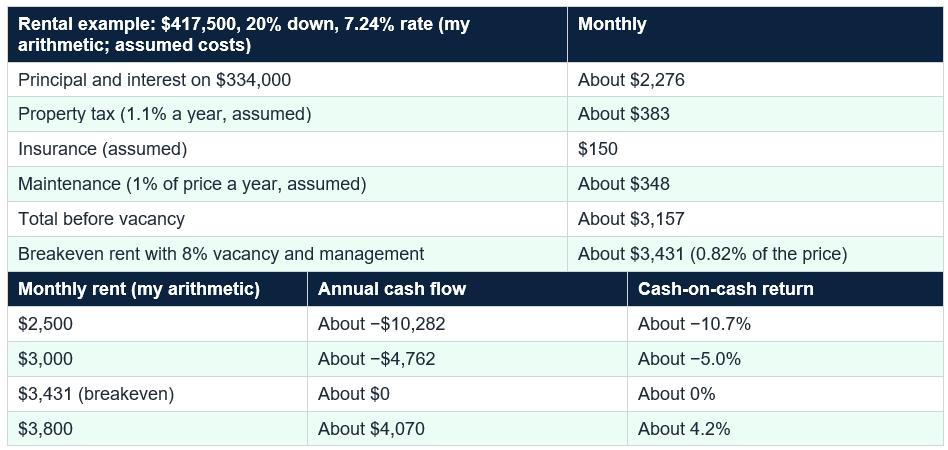
With an 8% allowance for vacancy and management, the rent needed just to break even is about $3,431 a month, or 0.82% of the price. At $3,000 the property would lose about $397 a month ($4,762 a year), at $2,500 about $857 a month, and only at about $3,800 would it earn about $4,070 a year. I did not retrieve local rents, so check yours. When the mortgage rate exceeds what the property earns, leverage works against you, and you count on price gains that forecasts say will be small.
Preparation includes more than the down payment. Build an emergency fund, since only 46% of Americans could cover three months of expenses, according to Bankrate, and property brings repairs and vacancies. Improve your credit score, pay down high-interest debt and work out what payment you can truly afford, with a margin. Wait with a plan rather than hope.
If you consider them, read the offering documents, understand the fees and the sponsor’s track record and invest only money you will not need for years. Promises of high, guaranteed returns are a red flag, and at today’s high rates, deals that depend on cheap financing or quick resale can be fragile. I did not retrieve data on how these have performed this year, so treat them as higher risk than REITs.
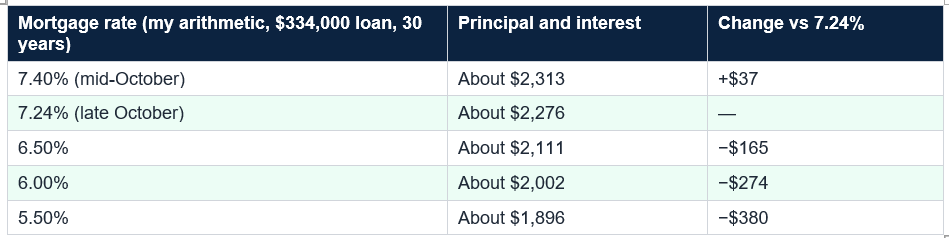
A common idea is to buy now and refinance if rates fall. It can work, but it is a bet: in my arithmetic, principal and interest on a $334,000 loan is about $2,276 a month at 7.24%, $2,111 at 6.5% and $2,002 at 6.0%, so refinancing from 7.24% to 6.0% would save about $274 a month, about $3,284 a year, less the cost of refinancing. But rates may not fall, and you must qualify, so buy what you can afford at today’s rate and treat a lower rate as a bonus.
Compare that with the cost of carrying the property: in my example the first year of mortgage interest alone is about $24,076, against price gains the forecasts put at a few thousand dollars, and even a 5% rise would add only about $20,875. Real estate can still be a good investment, since long-run returns include rent and principal paydown, but buying with heavy leverage at 7% and betting on a fast recovery is risky. Size your exposure so a flat or falling market does not hurt your finances.
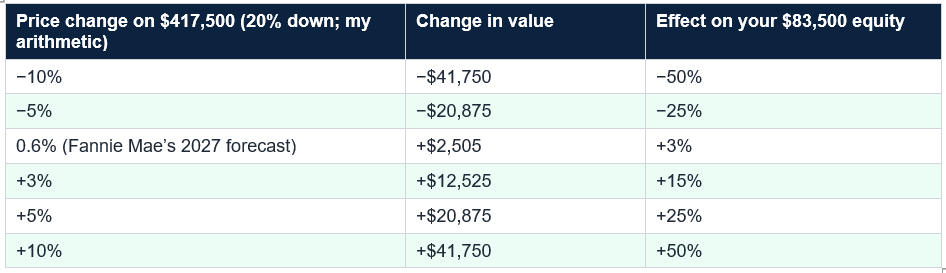
Leverage and interest rates can turn a hoped-for recovery into a loss. A price rise of a few percent may not cover a year of interest, taxes, insurance and repairs. Never invest money you may need soon, and make sure you could carry the property if it sat empty.
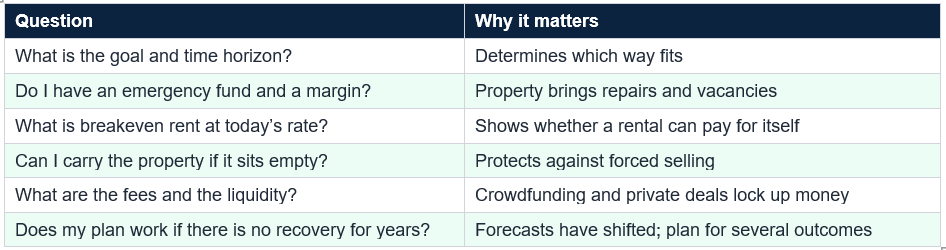
Run the breakeven-rent calculation for one property you are considering, using your local taxes and insurance, and compare it with realistic local rents. If it fails, start with a REIT fund or build your down payment.
Common mistakes include trying to time the recovery, buying a rental that loses money each month on the hope of price gains, using too much leverage, ignoring taxes, insurance and repairs, putting all your money into one property or market, buying illiquid private deals you do not understand and keeping no cash reserve. Also avoid relying on old forecasts: any plan that needs 6% mortgages may not arrive.
In my example, a $417,500 rental with a 7.24% mortgage needs about $3,431 a month in rent to break even, a 1% price change moves a 20%-down owner’s equity by about 5% and a refinance to 6.0% would save about $274 a month, if it happens. Plan for several outcomes, keep a cash cushion and never rely on a quick recovery.
Not clearly. The most recent forecasts I found, from October, expect little change: Fannie Mae sees home prices up just 0.6% in 2027 with 30-year mortgage rates averaging about 7.5%, and the Mortgage Bankers Association sees rates near 7.2%. Zillow forecasts prices up about 1.1% over the year to September 2027. Older forecasts expected rates near 6%, so forecasts have shifted and could shift again.
Is it a good time to buy a rental property?
It depends on the numbers, and at current mortgage rates the math is hard. In my illustration, a $417,500 property with 20% down at a 7.24% rate needs about $3,431 a month in rent just to break even after taxes, insurance, maintenance and an 8% vacancy and management allowance. If local rents are well below that, you would be relying on price gains, which forecasts say will be small.
What is the easiest way to invest in real estate?
Buying shares of a real estate investment trust (REIT) or a REIT index fund through a brokerage account. You can start with a small amount, it is liquid and you do not manage property. REIT prices can be volatile and are sensitive to interest rates, and I did not retrieve current REIT yields or performance. This is general education, not personal advice.
What is house hacking?
Buying a home you live in, often a duplex or a house with a rentable room or unit, and letting tenants help cover the mortgage. Owner-occupied loans can have smaller down payments than investment loans, which I note from general knowledge. It lowers the cost of getting started but still requires you to afford the payment if rents fall or the unit sits empty.
Should I wait for rates to fall before buying?
Waiting is a bet on rates, and nobody knows. If you buy now, you may be able to refinance if rates fall: in my illustration, moving from 7.24% to 6.0% on a $334,000 loan would cut the payment by about $274 a month. But refinancing is not guaranteed and costs money. The safest approach is to buy only what you can afford at today’s rate.
Table of Contents
- The Recovery Everyone Is Waiting For
- The Short Answer: Six Ways
- Where the Housing Market Stands
- What Forecasters Expect
- Way 1: REITs and REIT Funds
- Way 2: Buy a Home to Live In (or House Hack)
- Way 3: Rental Property, If the Math Works
- Way 4: Build Your Down Payment
- Way 5: Crowdfunding and Private Deals
- Way 6: Buy Smart and Plan the Refinance
- Leverage Cuts Both Ways
- A Simple Checklist
- Common Mistakes
- Conclusion
- Frequently Asked Questions
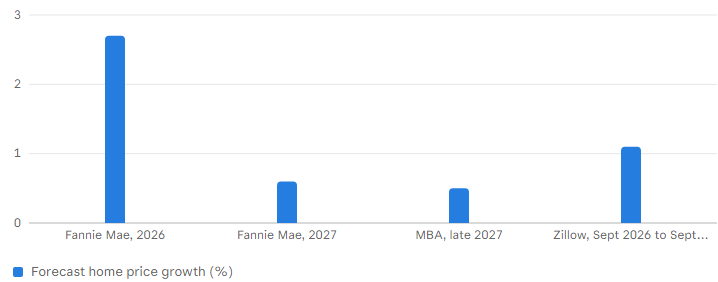
No snap-back in sight: forecast home price growth (%)
Forecast price growth (%) by Fannie Mae and MBA October 2026 forecasts and Zillow's September forecast, via Nora Real Estate (secondary source); older forecasts that expected rates near 6% are out of date
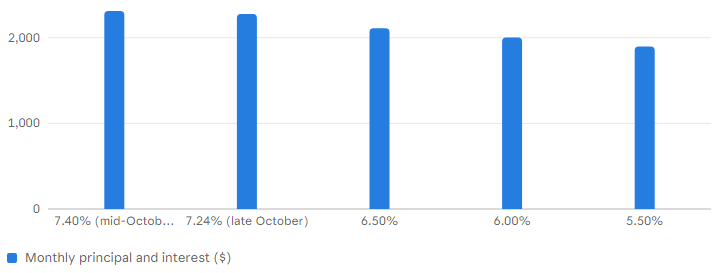
Why rates matter: monthly payment on a $334,000, 30-year loan ($)
Principal and interest ($ a month) by Author's arithmetic; the loan is 80% of a $417,500 home (the September median); principal and interest only; a refinance from 7.24% to 6.0% would save about $274 a month if rates fall and you qualify
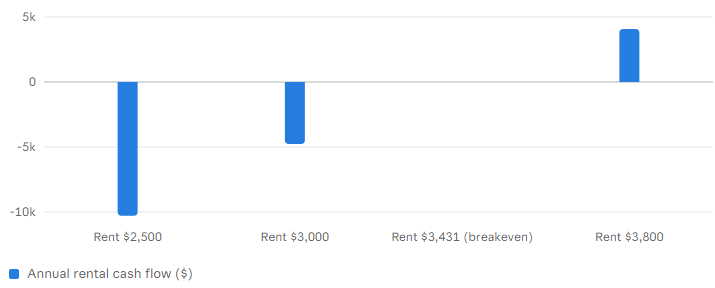
The rental math at 7.24%: annual cash flow on a $417,500 property by monthly rent ($)
Annual cash flow ($) by Author's hypothetical arithmetic: 20% down, $334,000 loan at 7.24%, assumed property tax 1.1%, insurance $150 a month, maintenance 1% a year, 8% vacancy and management; local rents not retrievedThe Recovery Everyone Is Waiting For
Every real estate investor dreams of buying just before the recovery: low prices, a market about to turn, the gains still ahead. The trouble is that nobody knows when a recovery will arrive, or whether it will look like the one in their head. Right now housing is stuck: the 30-year mortgage rate reached 7.4% in October, the highest since 2023, sales run near 4 million a year and the latest forecasts see prices barely rising in 2027. That is not a crash, but it is not a recovery either.So how do you invest in real estate while you wait? This guide gives six ways, from buying shares of a real estate fund with a few dollars to buying a rental property, and it is honest about the math: at today’s rates a rental with a mortgage is hard to make pay, and I show the numbers. The aim is not to call the bottom, which cannot be done, but to put you in a sensible position whichever way housing goes.
The Short Answer: Six Ways
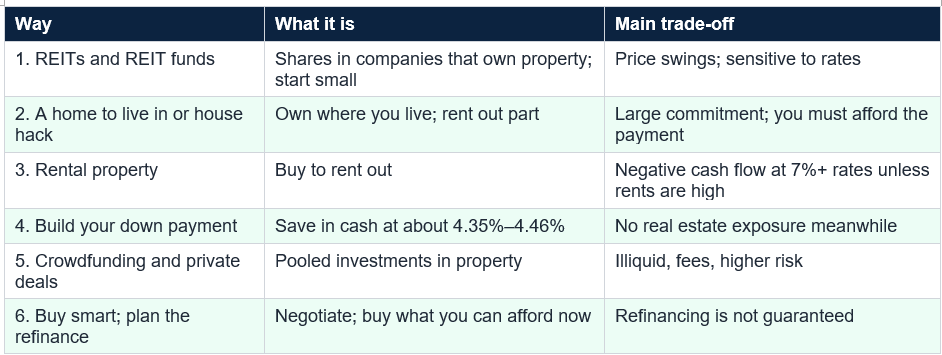
You can invest in real estate before a recovery by owning REIT shares or funds, buying a home you live in or house hacking, buying a rental only if the numbers work at today’s rates, building a down payment while you wait, using crowdfunding or private deals with care and buying smartly with a plan to refinance if rates fall. In my example, a $417,500 rental with a 7.24% mortgage needs about $3,431 a month in rent just to break even, a high bar, so for many people the lower-friction options come first.
Where the Housing Market Stands
The National Association of Realtors reported a median existing-home price of $417,500 in September, up 1.3% from a year earlier, while sales ran at an annual pace of 3.99 million, down 2.2%. Inventory reached 1.60 million homes, a 4.8-month supply versus 4.5 months a year ago, and one report noted inventory topped 1.6 million for the first time since November 2019. The median asking price, however, fell 1.4% year over year, according to Realtor.com.The pressure is rates. According to Freddie Mac data reported by NAR, the 30-year fixed rate averaged 7.4% in the week ending October 15, up from 6.65% to 6.70% earlier this year and the highest since 2023, and pending sales were down 8.5% from a year earlier in September, per Zillow. Rising supply, flat prices and weak sales give buyers more negotiating room than in years, but financing is expensive. It is a slow market, not a falling one.
NAR, September 2026: median price $417,500 (+1.3%), sales pace 3.99 million (−2.2%), inventory 1.60 million (4.8 months). Freddie Mac: 30-year rate about 7.4% in mid-October, the highest since 2023. Fannie Mae (October): home prices +0.6% in 2027, rates about 7.5%.
What Forecasters Expect
The latest forecasts are not encouraging for anyone waiting for a snap-back. Fannie Mae’s October outlook sees its home price index up 2.7% in 2026 and just 0.6% in 2027, with 30-year rates averaging about 7.5% in every quarter of 2027 and existing sales of about 4.06 million. The Mortgage Bankers Association expects rates around 7.2% for most of 2027 and price growth slowing to 0.5% by late 2027, and Zillow forecasts prices up about 1.1% in the year to September 2027.Be careful with older articles. In the spring, forecasters expected rates near 6.0% to 6.5% through 2027, and some pages still show those numbers; a few months of higher rates erased them, which shows how unreliable forecasts are. Plan for several outcomes: if rates fall meaningfully, demand could return and prices could rise, and if they stay near 7%, the market could stay stuck for a long time. A strategy that works only if the recovery comes soon is a gamble.
Way 1: REITs and REIT Funds
The simplest way to own real estate is through a real estate investment trust, a company that owns and often operates properties and generally passes most of its income to shareholders (general knowledge). You can buy REIT shares or a REIT index fund through any brokerage account, start small, sell when you like and avoid managing tenants, and REITs come in many types, including apartments, warehouses, offices, healthcare and data centers, so you can diversify.The trade-offs are real. REIT prices can be volatile and tend to be sensitive to interest rates, since high rates raise borrowing costs and make their income less attractive compared with bonds, and dividends are generally taxed as ordinary income (both general knowledge). I did not retrieve current REIT yields or performance, so I cannot say whether they are cheap or expensive now. A modest, regular amount is one way to start without betting on timing.
Way 2: Buy a Home to Live In (or House Hack)
For many people the best real estate investment is a home they live in: you pay the mortgage instead of rent, build equity and avoid the vacancy and tenant risks of a rental. In my general knowledge, owner-occupied loans can require smaller down payments than investment loans, for example 3.5% on certain government-backed loans, about $14,600 on a $417,500 home instead of $83,500 for 20% down, though the payment is higher and mortgage insurance applies.House hacking takes it a step further: buy a duplex, or a house with a room or accessory unit you can rent, live in one part and let tenants help pay the mortgage. It can turn a stretch into a manageable payment, but the same math applies: you must be able to afford the payment if the unit is empty. At today’s rates, buy only what you can afford without relying on the rent.
Way 3: Rental Property, If the Math Works
Buying a rental with a mortgage is the classic move and the hardest one at today’s rates. Take a property at the September median price of $417,500, with 20% down ($83,500) and a $334,000 loan at 7.24%, the late-October rate from earlier research: principal and interest is about $2,276 a month. Add assumed property tax of 1.1% a year (about $383 a month), insurance of $150 and maintenance of 1% of the price a year (about $348 a month), and the total is about $3,157 before vacancy.With an 8% allowance for vacancy and management, the rent needed just to break even is about $3,431 a month, or 0.82% of the price. At $3,000 the property would lose about $397 a month ($4,762 a year), at $2,500 about $857 a month, and only at about $3,800 would it earn about $4,070 a year. I did not retrieve local rents, so check yours. When the mortgage rate exceeds what the property earns, leverage works against you, and you count on price gains that forecasts say will be small.
Way 4: Build Your Down Payment
If the numbers do not work today, one honest strategy is to prepare. Top high-yield savings accounts pay about 4.35% and a 52-week Treasury bill about 4.46%, according to Bankrate and MyMoneyBlog, and in my arithmetic saving $1,000 a month at 4.35% would reach the $83,500 needed for 20% down on a $417,500 home in about 6.2 years, with a smaller target sooner. Cash also gives you flexibility if prices or rates move in your favor.Preparation includes more than the down payment. Build an emergency fund, since only 46% of Americans could cover three months of expenses, according to Bankrate, and property brings repairs and vacancies. Improve your credit score, pay down high-interest debt and work out what payment you can truly afford, with a margin. Wait with a plan rather than hope.
Way 5: Crowdfunding and Private Deals
Real estate crowdfunding platforms and private funds let investors pool money into properties or loans, sometimes with modest minimums, and are marketed as passive income. In my general knowledge, they often carry fees, limited liquidity, with money locked up for years, and less regulatory protection than public REITs, and returns depend on the sponsor’s skill and honesty.If you consider them, read the offering documents, understand the fees and the sponsor’s track record and invest only money you will not need for years. Promises of high, guaranteed returns are a red flag, and at today’s high rates, deals that depend on cheap financing or quick resale can be fragile. I did not retrieve data on how these have performed this year, so treat them as higher risk than REITs.
Way 6: Buy Smart and Plan the Refinance
If you decide to buy, you have more negotiating leverage than in years: inventory is 4.8 months’ supply, up from 4.5, and asking prices are down 1.4% from last year. Ask for seller credits, compare lenders and consider a rate buydown, in which you or the seller pay upfront to lower the rate. An adjustable-rate mortgage can start lower but can rise later, so choose one only if you could afford the higher payment.A common idea is to buy now and refinance if rates fall. It can work, but it is a bet: in my arithmetic, principal and interest on a $334,000 loan is about $2,276 a month at 7.24%, $2,111 at 6.5% and $2,002 at 6.0%, so refinancing from 7.24% to 6.0% would save about $274 a month, about $3,284 a year, less the cost of refinancing. But rates may not fall, and you must qualify, so buy what you can afford at today’s rate and treat a lower rate as a bonus.
Leverage Cuts Both Ways
A mortgage magnifies results in both directions. With 20% down on a $417,500 property, your equity is $83,500, so each 1% change in the price, about $4,175, changes your equity by about 5%: a 10% rise adds about 50%, but a 5% fall erases about 25% and a 10% fall about 50%. A 0.6% rise in 2027, as Fannie Mae forecasts, would mean a gain of only about $2,505, about 3% of your equity, before costs.Compare that with the cost of carrying the property: in my example the first year of mortgage interest alone is about $24,076, against price gains the forecasts put at a few thousand dollars, and even a 5% rise would add only about $20,875. Real estate can still be a good investment, since long-run returns include rent and principal paydown, but buying with heavy leverage at 7% and betting on a fast recovery is risky. Size your exposure so a flat or falling market does not hurt your finances.
Leverage and interest rates can turn a hoped-for recovery into a loss. A price rise of a few percent may not cover a year of interest, taxes, insurance and repairs. Never invest money you may need soon, and make sure you could carry the property if it sat empty.
A Simple Checklist
Before you put money into real estate, run through a short checklist. What is your goal and how long can you hold? Do you have an emergency fund? Which of the six ways fits your time and temperament? For a property, calculate breakeven rent with realistic costs and stress-test for vacancy and a drop in prices; for a fund or platform, know the fees and the liquidity. And write down what would make you sell or stop.Run the breakeven-rent calculation for one property you are considering, using your local taxes and insurance, and compare it with realistic local rents. If it fails, start with a REIT fund or build your down payment.
Common mistakes include trying to time the recovery, buying a rental that loses money each month on the hope of price gains, using too much leverage, ignoring taxes, insurance and repairs, putting all your money into one property or market, buying illiquid private deals you do not understand and keeping no cash reserve. Also avoid relying on old forecasts: any plan that needs 6% mortgages may not arrive.
Conclusion
Housing is not in recovery yet. The median existing-home price was $417,500 in September, sales ran at 3.99 million a year, inventory reached a 4.8-month supply and the 30-year mortgage rate hit about 7.4% in October, and Fannie Mae has prices up just 0.6% in 2027 with rates near 7.5%. That does not mean you cannot invest in real estate now; it means choosing ways that work at today’s rates: REIT funds, a home to live in or a house hack, a rental only if the breakeven rent works, a growing down payment, careful use of crowdfunding and smart buying with a plan you can afford.In my example, a $417,500 rental with a 7.24% mortgage needs about $3,431 a month in rent to break even, a 1% price change moves a 20%-down owner’s equity by about 5% and a refinance to 6.0% would save about $274 a month, if it happens. Plan for several outcomes, keep a cash cushion and never rely on a quick recovery.
Frequently Asked Questions
Is a housing recovery coming?Not clearly. The most recent forecasts I found, from October, expect little change: Fannie Mae sees home prices up just 0.6% in 2027 with 30-year mortgage rates averaging about 7.5%, and the Mortgage Bankers Association sees rates near 7.2%. Zillow forecasts prices up about 1.1% over the year to September 2027. Older forecasts expected rates near 6%, so forecasts have shifted and could shift again.
Is it a good time to buy a rental property?
It depends on the numbers, and at current mortgage rates the math is hard. In my illustration, a $417,500 property with 20% down at a 7.24% rate needs about $3,431 a month in rent just to break even after taxes, insurance, maintenance and an 8% vacancy and management allowance. If local rents are well below that, you would be relying on price gains, which forecasts say will be small.
What is the easiest way to invest in real estate?
Buying shares of a real estate investment trust (REIT) or a REIT index fund through a brokerage account. You can start with a small amount, it is liquid and you do not manage property. REIT prices can be volatile and are sensitive to interest rates, and I did not retrieve current REIT yields or performance. This is general education, not personal advice.
What is house hacking?
Buying a home you live in, often a duplex or a house with a rentable room or unit, and letting tenants help cover the mortgage. Owner-occupied loans can have smaller down payments than investment loans, which I note from general knowledge. It lowers the cost of getting started but still requires you to afford the payment if rents fall or the unit sits empty.
Should I wait for rates to fall before buying?
Waiting is a bet on rates, and nobody knows. If you buy now, you may be able to refinance if rates fall: in my illustration, moving from 7.24% to 6.0% on a $334,000 loan would cut the payment by about $274 a month. But refinancing is not guaranteed and costs money. The safest approach is to buy only what you can afford at today’s rate.
0 Comments
Be the first to share your thoughts on this article.