
Finance
How to Stop Inheritance From Tearing Siblings Apart
Siblings account for 44% of all estate case disputes. In 30% of those disputes, family members stop speaking to each other afterward. The Great Wealth Transfer has arrived — $84 trillion will pass from Baby Boomers to their heirs by 2045, and the peak decade of transfers is 2026 to 2036. Most of that conflict is preventable. Not with a better will. With a conversation that happens before the will is needed, while the people who matter are still in the room.
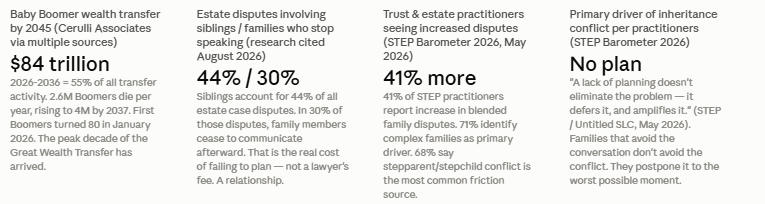
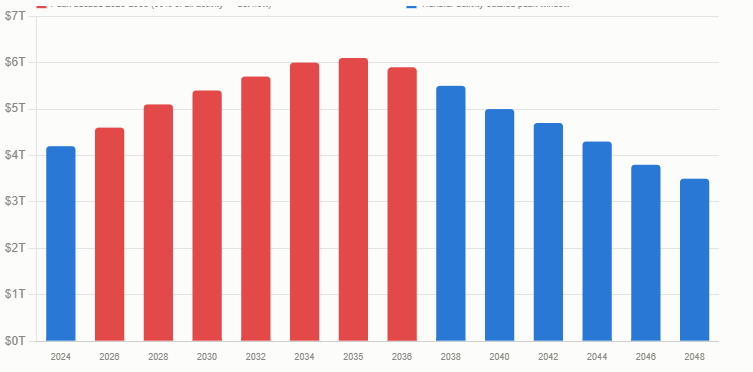
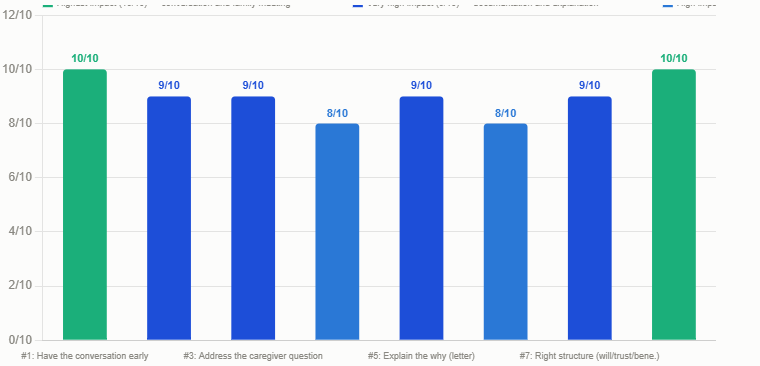
The largest intergenerational wealth transfer in human history is happening right now. Baby Boomers and the Silent Generation will bequeath approximately $84 trillion in assets through 2045, with the decade between 2026 and 2036 carrying approximately 55% of all transfer activity, according to Journey Advisory Group's May 2026 analysis of Cerulli Associates data. The first Baby Boomers turned 80 in January 2026. Approximately 2.6 million Boomers die each year today — a figure projected to approach 4 million annually by 2037.
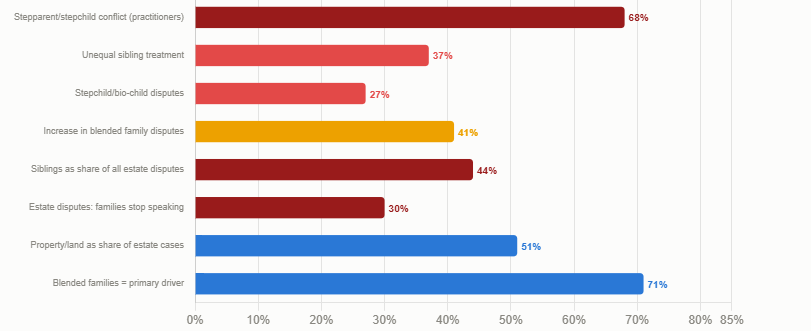
Most of the wealth involved in this transfer will arrive during one of the most emotionally disorienting experiences in a person's life: the loss of a parent. And the data on what happens to families in that context is sobering. Siblings account for 44% of all estate case disputes. In 30% of those disputes, family members stop communicating afterward. In the UK — where STEP's Barometer 2026 gathered data from 533 practitioners and more than 6,000 adults — 41% of trust and estate practitioners have seen an increase in family disputes, and 71% identify the complexity of modern blended families as the primary driver of legal and succession challenges.
The good news is that the research on what prevents these disputes is also clear. STEP's findings, Chesapeake Financial Planners' analysis published four days ago, and the estate litigation experience documented by Hackard Law and Beyond the Demure Heirloom all point to the same core prevention: communication — specific, documented, early, and ongoing. A lack of planning does not eliminate the problem, as STEP's May 2026 analysis states. It defers it and amplifies it. This guide covers eight specific strategies for ensuring that the wealth you spent a lifetime building becomes a gift rather than a grievance.
$84 trillion to transfer by 2045 (Cerulli Associates). 2026-2036 = 55% of all transfer activity (Journey Advisory Group May 2026). 2.6 million Boomers die per year, rising to 4 million by 2037 (SalesGlobe May 2026). Siblings = 44% of all estate disputes. 30% of disputants cease communication afterward. 41% of practitioners: increase in blended family conflicts (STEP Barometer 2026). 71% identify complex blended families as primary driver. 68% say step-parent/stepchild conflict is most common friction source. 37% cite unequal sibling treatment as cause. 30% of estate disputes involve property; land and property = 51% of cases.
Real estate — and particularly the family home — is the most conflict-prone asset in estate planning. Beyond the Demure Heirloom's August 2026 analysis notes that illiquid assets force siblings to either sell (which someone may resist), share ownership of something only one of them wants, or buy out the others (which requires one sibling to have the liquidity to do so). The family home carries additional emotional weight: it is the physical site of childhood memories, and the question of whether to sell it often functions as a referendum on whether the family chapter it represents is truly over.
Family businesses are the most legally and financially complex inheritance asset. They combine business valuation challenges (how do you value a closely held business fairly?), operational continuity questions (who runs it?), employment questions (does the child who works in the business get more equity than the one who does not?), and buyout mechanics (what happens to the sibling who wants out?). Without a formal succession plan — typically a separate document from the will — a family business in an estate is almost inevitably a source of dispute.
Personal property and sentimental items are the most emotionally volatile category, even when they have little monetary value. Who gets the dining room table, the jewellery, the grandmother's dishes, or the grandfather's tools can generate conflicts that far outlast and far exceed the financial value of the items in question. These items often serve as proxies for the larger emotional questions — who was loved most, who sacrificed most, who is carrying the family's history — and no legal document prevents the conflict if the items have not been specifically addressed.
The co-ownership trap: leaving the family home to multiple children equally, without specifying a buy-out mechanism, timeline for sale, or management rights, creates an immediate practical problem. One sibling may want to sell and needs the money. One sibling may want to keep it. One sibling may want to live in it while the others do not. Without a pre-agreed framework for resolving these differences, the property becomes the arena where the emotional conflict plays out — through lawyers, over months or years, at significant cost to all parties and the family relationship. Not legal advice.
STEP's Barometer 2026 identifies the communication gap as the primary driver of disputes — not the legal documents themselves. 'Blended families often operate on informal agreements and unspoken assumptions that were never formalised. When the moment arrives, those assumptions collide,' notes Untitled SLC's May 2026 analysis of the STEP findings. The same pattern applies to intact families: parents avoid discussing estate plans because they fear conflict, awkwardness, or the appearance of morbidity. The avoidance produces exactly the conflict they were hoping to prevent.
The conversation does not need to cover every provision in detail. It needs to accomplish three things: establish that a plan exists and has been professionally documented; communicate the general principles behind the plan (equal treatment, or unequal treatment with explained reasons); and create an opening for children to ask questions, express concerns, and feel that they were included in the process rather than subject to a decision made without them. The conversation itself — not the specific assets discussed — is the conflict-prevention mechanism.
Research on bequests and sibling rivalry consistently finds that the combination of shared family values and explicit communication has a measurable and significant impact on whether estate conflicts cause lasting damage to the family (Beyond the Demure Heirloom August 2026). Families that have talked about money, fairness, and expectations before the estate event are dramatically more likely to navigate it without permanent damage to sibling relationships. The conversation is the plan.
Specificity in estate documents serves several protective functions. It removes the interpretive space in which conflict grows. It demonstrates that the testator's decisions were deliberate and considered, not accidental or the product of external influence. It creates a legal record that reflects actual intent, which significantly reduces the grounds on which a will can be successfully challenged.
The updating obligation is equally important. Estate plans that were drafted when children were young, before second marriages, before one child became a caregiver, before one sibling's financial situation changed dramatically, or before any significant family event can create outcomes that bear no resemblance to what the parents would have wanted. Chesapeake Financial Planners' September 2026 analysis (published four days ago) states: 'Predictable communication and written decision rights head off most estate settlement disputes.' The 'written' element means documents that are current, reviewed, and not sitting in a drawer from 2005.
Estate document review checklist. (1) Confirm your will and all trust documents have been reviewed by an attorney within the last 3-5 years or following any major life change (death, divorce, new child, significant change in asset value). (2) Verify all beneficiary designations on life insurance policies, retirement accounts (IRAs, 401(k)s), and payable-on-death bank accounts are current and consistent with your overall estate plan. These designations override the will. (3) Confirm your durable power of attorney and healthcare proxy are in place and the named individuals are still appropriate. (4) If you have a trust, confirm assets have been properly titled into the trust. An unfunded trust protects nothing. Not legal advice — consult an estate planning attorney.
The Beyond the Demure Heirloom August 2026 analysis of caregiver compensation in estate planning states this clearly: 'There may not be an exchange of funds, but caregiving is a financial contribution. Significant costs were incurred by the child who has to care for the family's health and handle everything himself for a long time. It not only costs the caregiver — it teaches the family that showing up doesn't matter.'
The solutions available include a larger bequest to the primary caregiver sibling; a formal caregiver agreement executed while the parent is competent, establishing documented compensation for services provided; a specific cash bequest that acknowledges the contribution without requiring the other siblings to accept a reduced share; or simply an explanatory letter in the estate documents that acknowledges the caregiving contribution and explains how it was factored into (or deliberately excluded from) the distribution. The worst outcome is silence — a plan that makes no acknowledgment of a contribution that all the siblings know was made.
The caregiver compensation principle: the choice of whether to compensate a caregiving sibling more generously is an estate planning decision with no universally correct answer. Some parents choose equal distribution as a deliberate signal of equal love regardless of unequal contribution. Others increase the caregiving child's share. Either choice is defensible — but the choice needs to be explicit and explained, not implicit and unexplained. Unexplained unequal distribution is the most reliable way to produce lasting sibling resentment. Not legal advice.
Sentimental items — jewellery, furniture, art, family photographs, heirlooms, tools, vehicles, collections — are outside most standard estate plans. The will distributes 'all personal property equally,' which sounds fair until three siblings want the same thing and there is no mechanism for resolving the dispute. Estate attorneys consistently recommend addressing personal property through one of three mechanisms.
Beyond the Demure Heirloom's August 2026 analysis makes the timing point precisely: 'If you wait until after you have passed away to give the reason for your decisions, you will have combined the most emotional conversation your family will have with the most difficult financial decisions they will face.' The letter of explanation — a non-legally-binding document attached to but separate from the will — allows the person who made the decisions to speak in their own voice about why they made them.
The letter does not need to justify every decision. It needs to communicate that the decisions were made thoughtfully, with full awareness of the family dynamics involved, and with love for all the people affected. A parent who left more to one child than another because that child had faced greater financial hardship, or who left less to a child who had already received significant lifetime financial support, can say so. The explanation transforms an asymmetric distribution from an apparent insult into an act of considered equity.
Hackard Law's July 2026 estate conflict analysis notes that 'legal fairness can diverge significantly from how family members interpret moral or emotional fairness.' The letter of explanation bridges that gap — not by changing the legal outcome, but by providing the context that allows family members to understand and accept it, rather than contest it.
Naming the oldest child as executor by default, or naming all children as co-executors, are both common approaches that frequently generate conflict. The oldest child as sole executor can create perceptions of unfairness and amplify existing sibling dynamics. Co-executors must agree on every decision — which can be productive in harmonious families and paralysing in any others. Chesapeake Financial Planners' four-days-ago analysis notes that 'written decision rights head off most estate settlement disputes' — meaning the executor's authority and the decision-making process for disputed matters should be specified in the estate documents, not left to the parties to negotiate in grief.
An independent or professional executor — a bank trust department, an estate attorney, or a professional fiduciary — is often the best choice when the estate is large, when the family dynamics are complex or strained, or when one sibling would logically be both executor and primary beneficiary (a combination that creates inherent conflicts of interest). The professional executor has no emotional stake in the outcome, cannot be accused of preferential treatment, and brings expertise to the administrative tasks that often delay estate settlement and create additional family friction.
Executor appointment considerations. Ask these questions before naming an executor: (1) Does this person have the time, organisational skills, and financial literacy to manage the estate administration? (2) Will their appointment be perceived as fair by all beneficiaries, or will it create an immediate perception that the executor has more power than the others? (3) Are there any conflicts of interest between their role as executor and their interest as beneficiary? (4) Have you told this person you are naming them, and have they agreed? (5) Is a professional executor or co-executor appropriate given the estate's complexity? Not legal advice — consult an estate planning attorney.
A will controls the distribution of probate assets — assets that are owned in the decedent's name alone without a joint owner or beneficiary designation. It does not control retirement accounts (IRAs, 401(k)s), life insurance, jointly owned property with right of survivorship, or accounts with payable-on-death or transfer-on-death designations. These pass directly to the named beneficiary, regardless of what the will says. An estate plan in which the will and the beneficiary designations are inconsistent — naming one child as 40% beneficiary on a $500,000 IRA while the will divides everything equally — creates an unequal outcome that looks unintentional and may be bitterly contested.
A revocable living trust offers several conflict-prevention advantages over a simple will. Trust administration avoids probate — the court-supervised process that validates a will, during which disputes can be filed. The trust can specify detailed conditions and decision-making processes in advance. It can address the management of real estate and business interests in ways a will cannot. And because trust administration is private (unlike probate, which is a public court record), it reduces the external pressures that sometimes intensify family conflicts. Landmark Wealth Management's 2026 Great Wealth Transfer analysis notes the importance of reviewing trust structures given the OBBBA's permanent $15 million federal estate exemption — the new tax landscape changes which planning tools are most appropriate for each family's circumstances.
Beneficiary designation hygiene is arguably the most underappreciated element of conflict prevention. Outdated designations — a first spouse named as beneficiary of an IRA after divorce and remarriage; a deceased sibling named as contingent beneficiary; no secondary beneficiary named at all — create exactly the kind of ambiguous outcomes that family members interpret differently and attorneys litigate over.
The goal of a family meeting about estate planning is not to get everyone's approval for decisions the parents have already made. It is to give all family members the information they need to understand those decisions, an opportunity to ask questions or express concerns in a setting where the parents can respond, and a shared experience that makes the eventual estate event less of a shock and more of an execution of a known plan.
The mechanics matter. A family meeting held at a time of stress — when a parent is ill, when a sibling relationship is already strained, or when decisions need to be made quickly — is less productive than one held proactively. Many families engage a professional facilitator — an estate attorney, a family business consultant, or a therapist with experience in family wealth transitions — to keep the conversation focused and prevent it from deteriorating into pre-existing family conflicts. The cost of a professional facilitator is a fraction of the cost of estate litigation.
The Chesapeake Financial Planners September 2026 analysis (published four days ago) frames the timeline precisely: 'The first 90 days are about family process, not investing.' The implication: by the time the estate event occurs, the family process conversation should already have happened. The 90 days following a death should be spent implementing a known plan, not discovering one for the first time amid grief.
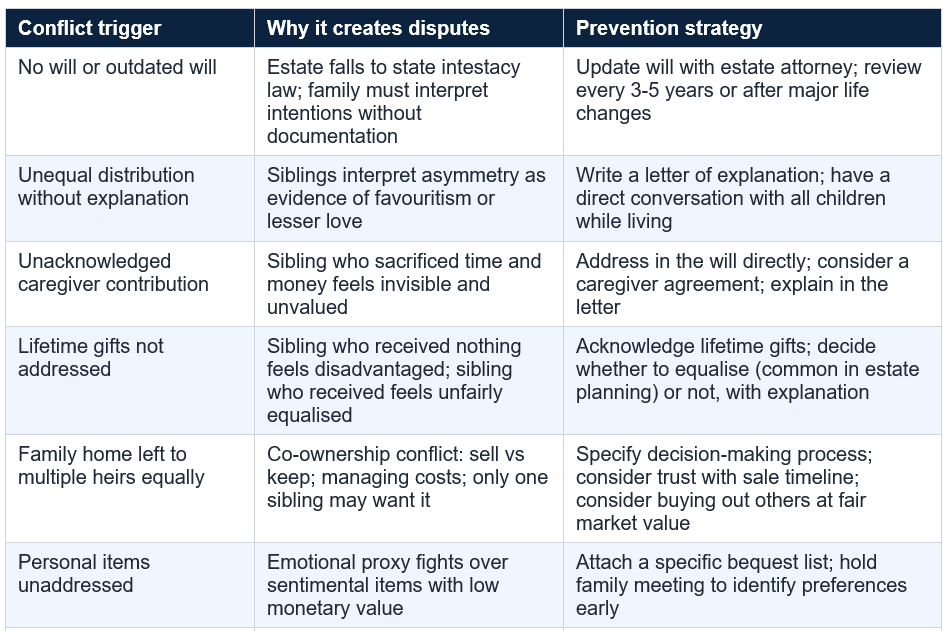
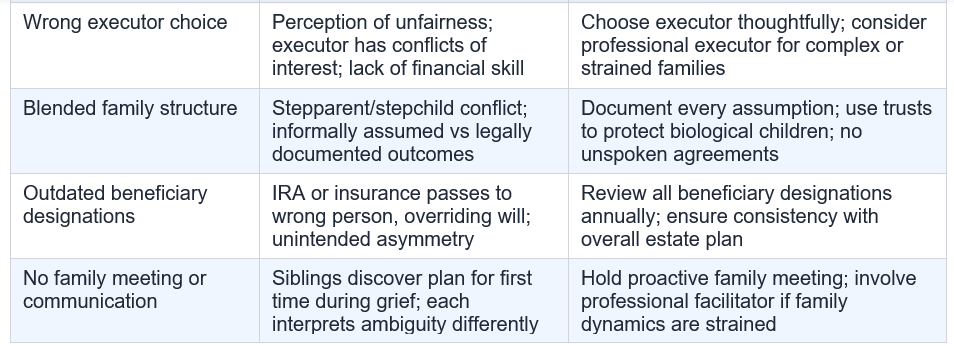
The $84 trillion Great Wealth Transfer that is peaking through 2036 will be remembered in millions of individual families not as a financial event but as a family event — the moment at which the relationships that were supposed to outlast the parents either survived or did not. In 30% of the disputes the research tracks, siblings stop communicating afterward. That is the actual cost of failing to plan. Not a lawyer's fee. Not a probate delay. A sibling relationship, ended.
The strategies in this guide — have the conversation, be specific and written, address the caregiver question, name the sentimental items, explain the why, appoint the right executor, get the legal structure right, and hold a family meeting — are all available to any family regardless of wealth level. They do not require extraordinary assets or complex legal instruments. They require the willingness to have the uncomfortable conversations while the people who matter are still alive to have them.
The conversation protects more than the assets. It protects what the assets were supposed to represent in the first place. Not legal, tax, or financial advice — consult qualified professionals for guidance on your specific family and estate situation.
More common than most families expect — and rising. STEP's Barometer 2026, published May 12, 2026 and based on research with 533 practitioners and over 6,000 adults across the UK, Singapore, and Australia, found that 41% of trust and estate practitioners have seen an increase in disputes, with 71% identifying complex blended families as the primary driver. In one study of estate case disputes, siblings accounted for 44% of all disputes, and in 30% of those disputes, the family members ceased to communicate afterward (Beyond the Demure Heirloom August 2026). Ameriprise research found that while only 15% of grown siblings report conflicts over money, nearly 70% of those conflicts are related to their parents (cited Denevan Falon Law November 2025). The Great Wealth Transfer — with $84 trillion set to pass from Baby Boomers and the Silent Generation through 2045 — is intensifying the scale of this problem as transfer volumes peak in the 2026-2036 window. Not every family will face a dispute, but the absence of a documented, communicated plan dramatically increases the risk.
What is the most common cause of sibling conflict over inheritance?
According to STEP's Barometer 2026, unequal treatment among siblings is cited by 37% of practitioners as a cause of disputes — second only to stepparent/stepchild conflict (68%). But estate conflict attorneys describe the underlying causes more precisely: inheritance disputes are rarely just about money. Hackard Law's July 2026 analysis identifies childhood favouritism, caregiving sacrifices that went unacknowledged, and lifetime gifts that created asymmetry as the most common emotional roots. Beyond the Demure Heirloom's August 2026 estate analysis found that illiquid assets — land, property, and closely held businesses — generate the most disputes (land/property = 51% of cases) because they cannot be divided cleanly. Personal and sentimental items are the most emotionally volatile. Denevan Falon Law's November 2025 analysis notes that inheritance amounts are perceived by many siblings as a final measure of parental affection — making the estate distribution a proxy for an emotional evaluation that the money itself cannot resolve.
Does a will prevent inheritance disputes?
A will reduces the risk of disputes but does not eliminate it. A will that is ambiguous, outdated, inconsistent with beneficiary designations on retirement accounts and life insurance, or that makes decisions without explanations can generate conflict even among families that appeared harmonious. STEP's Barometer 2026 makes the critical distinction: 'A lack of planning doesn't eliminate the problem — it defers it, and amplifies it.' The most effective conflict prevention combines a current, specific, professionally drafted will (or trust) with direct communication to the family about the plan's existence and principles, a letter of explanation for any decisions that might be perceived as unequal, and beneficiary designations that are consistent with the overall estate plan. Chesapeake Financial Planners' September 2026 analysis (4 days ago) adds: 'Predictable communication and written decision rights head off most estate settlement disputes.' Not legal advice — consult an estate planning attorney.
Should inheritance be split equally between siblings?
Equal distribution is the most common approach and the one most likely to feel intuitively fair — but it is not always the most equitable. Beyond the Demure Heirloom's August 2026 analysis identifies several legitimate reasons for unequal distribution: one sibling provided primary caregiving and absorbed significant financial and opportunity costs; one sibling received substantial lifetime financial support (loans that became gifts, business seed funding, down payments) that the others did not; one sibling has significantly greater financial need; or one sibling has a child with special needs whose long-term care requirements differ from others. The critical issue is not whether the distribution is equal but whether it is explained. An equal distribution that ignores the caregiving contribution can feel deeply unjust to the caregiver. An unequal distribution with a clear, compassionate explanation of the reasoning is far more likely to be accepted. The explanation — in a letter of intent, in a family conversation, or both — is the conflict-prevention mechanism, not the specific percentages. Not legal advice.
What is the best way to divide family heirlooms and personal property?
Personal and sentimental items are some of the most emotionally charged elements of any estate and among the most likely to generate disputes that outlast their monetary value. JDSupra/Offit Kurman's 2026 analysis quotes Benjamin Franklin on the certainty of family squabbles over personal property after a death. The three most effective approaches are: (1) A specific bequest list — a signed, dated document (attached to or referenced by the will in accordance with state law) that assigns specific items to specific people. This is the most direct method and eliminates interpretive ambiguity. (2) A family meeting or conversation held while parents are alive, during which children can identify items of particular meaning and parents can express preferences. This surfaces surprising clarity and often reveals that multiple siblings do not actually want the same item. (3) A predetermined distribution mechanism for unassigned items — a round-robin selection system, a lottery, or a structured auction at appraised values with the proceeds divided equally. Any mechanism is better than leaving it to 'mutual agreement' among grieving siblings with different memories of what their parent intended. Not legal advice.
Table of Contents
- The $84 Trillion Problem and Why It Is Peaking Now
- Why Inheritance Breaks Families Apart: The Real Causes of Conflict
- The Most Dangerous Assets: Property, Businesses, and Personal Items
- Strategy #1 — Have the Conversation Before You Need To
- Strategy #2 — Be Specific, Be Written, Be Updated
- Strategy #3 — Address the Caregiver Question Before It Becomes a Fight
- Strategy #4 — Name Who Gets the Sentimental Items
- Strategy #5 — Explain the 'Why' Behind Every Decision
- Strategy #6 — Appoint the Right Executor and Define Their Authority
- Strategy #7 — Get Your Structure Right: Will, Trust, Beneficiary Designations
- Strategy #8 — Hold a Family Meeting While Everyone Is Still Present
- Common Conflict Triggers at a Glance
- Conclusion: The Conversation Protects More Than the Assets
- Frequently Asked Questions
The Great Wealth Transfer: Scale, Timing, and Conflict.
What actually causes inheritance disputes
8 prevention strategies: from conversation to structure
The $84 Trillion Problem and Why It Is Peaking Now
The largest intergenerational wealth transfer in human history is happening right now. Baby Boomers and the Silent Generation will bequeath approximately $84 trillion in assets through 2045, with the decade between 2026 and 2036 carrying approximately 55% of all transfer activity, according to Journey Advisory Group's May 2026 analysis of Cerulli Associates data. The first Baby Boomers turned 80 in January 2026. Approximately 2.6 million Boomers die each year today — a figure projected to approach 4 million annually by 2037.Most of the wealth involved in this transfer will arrive during one of the most emotionally disorienting experiences in a person's life: the loss of a parent. And the data on what happens to families in that context is sobering. Siblings account for 44% of all estate case disputes. In 30% of those disputes, family members stop communicating afterward. In the UK — where STEP's Barometer 2026 gathered data from 533 practitioners and more than 6,000 adults — 41% of trust and estate practitioners have seen an increase in family disputes, and 71% identify the complexity of modern blended families as the primary driver of legal and succession challenges.
The good news is that the research on what prevents these disputes is also clear. STEP's findings, Chesapeake Financial Planners' analysis published four days ago, and the estate litigation experience documented by Hackard Law and Beyond the Demure Heirloom all point to the same core prevention: communication — specific, documented, early, and ongoing. A lack of planning does not eliminate the problem, as STEP's May 2026 analysis states. It defers it and amplifies it. This guide covers eight specific strategies for ensuring that the wealth you spent a lifetime building becomes a gift rather than a grievance.
$84 trillion to transfer by 2045 (Cerulli Associates). 2026-2036 = 55% of all transfer activity (Journey Advisory Group May 2026). 2.6 million Boomers die per year, rising to 4 million by 2037 (SalesGlobe May 2026). Siblings = 44% of all estate disputes. 30% of disputants cease communication afterward. 41% of practitioners: increase in blended family conflicts (STEP Barometer 2026). 71% identify complex blended families as primary driver. 68% say step-parent/stepchild conflict is most common friction source. 37% cite unequal sibling treatment as cause. 30% of estate disputes involve property; land and property = 51% of cases.
Why Inheritance Breaks Families Apart: The Real Causes of Conflict
Estate litigation attorneys consistently report that disputes over inheritances are rarely fundamentally about money. They are about the story the money tells. Hackard Law's July 2026 analysis of estate conflict describes it directly: 'In many respects, estate litigation is rarely just about a conflict that arose at the reading of a will — it's a reflection of unresolved family dynamics that have a fresh outlet in the estate process.' The specific emotional narratives that commonly surface include:- Childhood favouritism: a child who felt overshadowed by a sibling for decades may interpret a larger inheritance for that sibling as definitive confirmation of a lifetime of perceived unfairness. The legal document becomes evidence in an emotional case that began in childhood.
- Caregiving as unacknowledged labour: when one sibling has provided most of the care for an ageing parent — managing appointments, handling finances, living nearby for emergencies — they often carry a reasonable expectation that this contribution will be recognised in the estate. When it is not, the will communicates that showing up did not matter.
- Lifetime gifts creating silent asymmetry: if one child received significant financial support during the parents' lifetime — a down payment, business seed funding, tuition — and this is not mentioned in estate planning, it does not disappear. It creates resentment that is still there at the reading of the will, without any documented context to resolve it.
- Grief amplifying every tension: Denevan Falon Law's November 2025 analysis notes that families are neurologically primed to detect exclusion, and that the death of a parent activates deep anxiety about security and belonging. In this emotional context, an ambiguous clause in a will does not read as an oversight — it reads as a message.
- Blended family complexity: STEP's Barometer 2026 found that 68% of practitioners identify step-parent/stepchild conflict as the most common friction source, and 41% report increases in blended family disputes. Informal understandings about what a step-parent's assets will do after their death — when they have never been formally documented — are the most common source of this conflict.
The Most Dangerous Assets: Property, Businesses, and Personal Items
Before designing a plan to prevent conflict, it helps to know which asset types historically generate the most disputes. Three categories stand out.Real estate — and particularly the family home — is the most conflict-prone asset in estate planning. Beyond the Demure Heirloom's August 2026 analysis notes that illiquid assets force siblings to either sell (which someone may resist), share ownership of something only one of them wants, or buy out the others (which requires one sibling to have the liquidity to do so). The family home carries additional emotional weight: it is the physical site of childhood memories, and the question of whether to sell it often functions as a referendum on whether the family chapter it represents is truly over.
Family businesses are the most legally and financially complex inheritance asset. They combine business valuation challenges (how do you value a closely held business fairly?), operational continuity questions (who runs it?), employment questions (does the child who works in the business get more equity than the one who does not?), and buyout mechanics (what happens to the sibling who wants out?). Without a formal succession plan — typically a separate document from the will — a family business in an estate is almost inevitably a source of dispute.
Personal property and sentimental items are the most emotionally volatile category, even when they have little monetary value. Who gets the dining room table, the jewellery, the grandmother's dishes, or the grandfather's tools can generate conflicts that far outlast and far exceed the financial value of the items in question. These items often serve as proxies for the larger emotional questions — who was loved most, who sacrificed most, who is carrying the family's history — and no legal document prevents the conflict if the items have not been specifically addressed.
The co-ownership trap: leaving the family home to multiple children equally, without specifying a buy-out mechanism, timeline for sale, or management rights, creates an immediate practical problem. One sibling may want to sell and needs the money. One sibling may want to keep it. One sibling may want to live in it while the others do not. Without a pre-agreed framework for resolving these differences, the property becomes the arena where the emotional conflict plays out — through lawyers, over months or years, at significant cost to all parties and the family relationship. Not legal advice.
Strategy #1 — Have the Conversation Before You Need To
The single most powerful inheritance conflict prevention tool is also the one most consistently avoided: the direct conversation between parents and adult children about the estate plan, while the parents are alive and healthy and the conversation can be calm rather than grief-saturated.STEP's Barometer 2026 identifies the communication gap as the primary driver of disputes — not the legal documents themselves. 'Blended families often operate on informal agreements and unspoken assumptions that were never formalised. When the moment arrives, those assumptions collide,' notes Untitled SLC's May 2026 analysis of the STEP findings. The same pattern applies to intact families: parents avoid discussing estate plans because they fear conflict, awkwardness, or the appearance of morbidity. The avoidance produces exactly the conflict they were hoping to prevent.
The conversation does not need to cover every provision in detail. It needs to accomplish three things: establish that a plan exists and has been professionally documented; communicate the general principles behind the plan (equal treatment, or unequal treatment with explained reasons); and create an opening for children to ask questions, express concerns, and feel that they were included in the process rather than subject to a decision made without them. The conversation itself — not the specific assets discussed — is the conflict-prevention mechanism.
Research on bequests and sibling rivalry consistently finds that the combination of shared family values and explicit communication has a measurable and significant impact on whether estate conflicts cause lasting damage to the family (Beyond the Demure Heirloom August 2026). Families that have talked about money, fairness, and expectations before the estate event are dramatically more likely to navigate it without permanent damage to sibling relationships. The conversation is the plan.
Strategy #2 — Be Specific, Be Written, Be Updated
Ambiguity in a legal document is not neutrality. It is an invitation for each party to interpret the language in the way that best supports their preferred outcome. Every ambiguous clause in a will or trust instrument is a future argument between siblings, each of whom has a different memory of what their parent 'really meant.'Specificity in estate documents serves several protective functions. It removes the interpretive space in which conflict grows. It demonstrates that the testator's decisions were deliberate and considered, not accidental or the product of external influence. It creates a legal record that reflects actual intent, which significantly reduces the grounds on which a will can be successfully challenged.
The updating obligation is equally important. Estate plans that were drafted when children were young, before second marriages, before one child became a caregiver, before one sibling's financial situation changed dramatically, or before any significant family event can create outcomes that bear no resemblance to what the parents would have wanted. Chesapeake Financial Planners' September 2026 analysis (published four days ago) states: 'Predictable communication and written decision rights head off most estate settlement disputes.' The 'written' element means documents that are current, reviewed, and not sitting in a drawer from 2005.
Estate document review checklist. (1) Confirm your will and all trust documents have been reviewed by an attorney within the last 3-5 years or following any major life change (death, divorce, new child, significant change in asset value). (2) Verify all beneficiary designations on life insurance policies, retirement accounts (IRAs, 401(k)s), and payable-on-death bank accounts are current and consistent with your overall estate plan. These designations override the will. (3) Confirm your durable power of attorney and healthcare proxy are in place and the named individuals are still appropriate. (4) If you have a trust, confirm assets have been properly titled into the trust. An unfunded trust protects nothing. Not legal advice — consult an estate planning attorney.
Strategy #3 — Address the Caregiver Question Before It Becomes a Fight
In most multi-child families where a parent requires significant care in later life, the caregiving responsibilities do not distribute evenly. One child — often the one who lives nearest, the one who has a more flexible job, or the one with the strongest sense of filial obligation — absorbs a disproportionate share of time, logistical burden, financial cost, and opportunity cost. When that child receives the same inheritance as a sibling who contributed minimally to the parent's care, the unequal treatment registers as a profound injustice.The Beyond the Demure Heirloom August 2026 analysis of caregiver compensation in estate planning states this clearly: 'There may not be an exchange of funds, but caregiving is a financial contribution. Significant costs were incurred by the child who has to care for the family's health and handle everything himself for a long time. It not only costs the caregiver — it teaches the family that showing up doesn't matter.'
The solutions available include a larger bequest to the primary caregiver sibling; a formal caregiver agreement executed while the parent is competent, establishing documented compensation for services provided; a specific cash bequest that acknowledges the contribution without requiring the other siblings to accept a reduced share; or simply an explanatory letter in the estate documents that acknowledges the caregiving contribution and explains how it was factored into (or deliberately excluded from) the distribution. The worst outcome is silence — a plan that makes no acknowledgment of a contribution that all the siblings know was made.
The caregiver compensation principle: the choice of whether to compensate a caregiving sibling more generously is an estate planning decision with no universally correct answer. Some parents choose equal distribution as a deliberate signal of equal love regardless of unequal contribution. Others increase the caregiving child's share. Either choice is defensible — but the choice needs to be explicit and explained, not implicit and unexplained. Unexplained unequal distribution is the most reliable way to produce lasting sibling resentment. Not legal advice.
Strategy #4 — Name Who Gets the Sentimental Items
JDSupra's 2026 inheritance dispute analysis includes a piece by Offit Kurman that names the problem with characteristic directness: 'Benjamin Franklin famously said that the only two certainties in life are death and taxes. A close third would be family squabbles over who gets the personal property when someone dies.'Sentimental items — jewellery, furniture, art, family photographs, heirlooms, tools, vehicles, collections — are outside most standard estate plans. The will distributes 'all personal property equally,' which sounds fair until three siblings want the same thing and there is no mechanism for resolving the dispute. Estate attorneys consistently recommend addressing personal property through one of three mechanisms.
- A specific bequest list attached to the will: a signed, dated, and properly incorporated document that lists specific items and their intended recipients. Some states allow an informal memorandum referenced in the will to handle personal property without formal amendment. Verify local requirements with an estate attorney.
- A family meeting before the estate event: while parents are alive and healthy, a structured conversation (or several) in which each child has the opportunity to identify items that have particular meaning to them and the parents can express their preferences about who should receive them. This process often surfaces surprising clarity — the item everyone assumes a particular sibling wants may actually be wanted by someone different.
- A structured auction or lottery among the siblings: if specific bequests are not made, the estate plan can specify a mechanism for distributing personal property — a round-robin selection system, a sibling-conducted auction at appraised values with proceeds divided, or a lottery. Any mechanism is better than 'equally distributed by agreement' when the items are indivisible and emotionally charged.
Strategy #5 — Explain the 'Why' Behind Every Decision
The most important page in any estate plan is one that does not exist in most of them: the letter of explanation. When a parent leaves different amounts to different children, names one child as executor over another, excludes a family member from the will, or makes any decision that a reasonable observer might read as unfavourable treatment of one party — the absence of an explanation guarantees that each affected party will supply their own interpretation. And those interpretations are almost always more emotionally damaging than the actual reasons.Beyond the Demure Heirloom's August 2026 analysis makes the timing point precisely: 'If you wait until after you have passed away to give the reason for your decisions, you will have combined the most emotional conversation your family will have with the most difficult financial decisions they will face.' The letter of explanation — a non-legally-binding document attached to but separate from the will — allows the person who made the decisions to speak in their own voice about why they made them.
The letter does not need to justify every decision. It needs to communicate that the decisions were made thoughtfully, with full awareness of the family dynamics involved, and with love for all the people affected. A parent who left more to one child than another because that child had faced greater financial hardship, or who left less to a child who had already received significant lifetime financial support, can say so. The explanation transforms an asymmetric distribution from an apparent insult into an act of considered equity.
Hackard Law's July 2026 estate conflict analysis notes that 'legal fairness can diverge significantly from how family members interpret moral or emotional fairness.' The letter of explanation bridges that gap — not by changing the legal outcome, but by providing the context that allows family members to understand and accept it, rather than contest it.
Strategy #6 — Appoint the Right Executor and Define Their Authority
The executor (called a personal representative in some states) is the person responsible for administering the estate: gathering assets, paying debts and taxes, filing the final tax return, and distributing the remainder to beneficiaries. In most family estates, the executor is one of the adult children. The choice of which child — and how their authority is defined relative to their siblings — is one of the most consequential and least discussed decisions in estate planning.Naming the oldest child as executor by default, or naming all children as co-executors, are both common approaches that frequently generate conflict. The oldest child as sole executor can create perceptions of unfairness and amplify existing sibling dynamics. Co-executors must agree on every decision — which can be productive in harmonious families and paralysing in any others. Chesapeake Financial Planners' four-days-ago analysis notes that 'written decision rights head off most estate settlement disputes' — meaning the executor's authority and the decision-making process for disputed matters should be specified in the estate documents, not left to the parties to negotiate in grief.
An independent or professional executor — a bank trust department, an estate attorney, or a professional fiduciary — is often the best choice when the estate is large, when the family dynamics are complex or strained, or when one sibling would logically be both executor and primary beneficiary (a combination that creates inherent conflicts of interest). The professional executor has no emotional stake in the outcome, cannot be accused of preferential treatment, and brings expertise to the administrative tasks that often delay estate settlement and create additional family friction.
Executor appointment considerations. Ask these questions before naming an executor: (1) Does this person have the time, organisational skills, and financial literacy to manage the estate administration? (2) Will their appointment be perceived as fair by all beneficiaries, or will it create an immediate perception that the executor has more power than the others? (3) Are there any conflicts of interest between their role as executor and their interest as beneficiary? (4) Have you told this person you are naming them, and have they agreed? (5) Is a professional executor or co-executor appropriate given the estate's complexity? Not legal advice — consult an estate planning attorney.
Strategy #7 — Get Your Structure Right: Will, Trust, Beneficiary Designations
The choice of legal structure is as important as the content of the estate plan. The most common mistake in estate planning is relying solely on a will when other mechanisms would better serve the family's goals — and when the asset structure means that parts of the estate will not pass through the will at all.A will controls the distribution of probate assets — assets that are owned in the decedent's name alone without a joint owner or beneficiary designation. It does not control retirement accounts (IRAs, 401(k)s), life insurance, jointly owned property with right of survivorship, or accounts with payable-on-death or transfer-on-death designations. These pass directly to the named beneficiary, regardless of what the will says. An estate plan in which the will and the beneficiary designations are inconsistent — naming one child as 40% beneficiary on a $500,000 IRA while the will divides everything equally — creates an unequal outcome that looks unintentional and may be bitterly contested.
A revocable living trust offers several conflict-prevention advantages over a simple will. Trust administration avoids probate — the court-supervised process that validates a will, during which disputes can be filed. The trust can specify detailed conditions and decision-making processes in advance. It can address the management of real estate and business interests in ways a will cannot. And because trust administration is private (unlike probate, which is a public court record), it reduces the external pressures that sometimes intensify family conflicts. Landmark Wealth Management's 2026 Great Wealth Transfer analysis notes the importance of reviewing trust structures given the OBBBA's permanent $15 million federal estate exemption — the new tax landscape changes which planning tools are most appropriate for each family's circumstances.
Beneficiary designation hygiene is arguably the most underappreciated element of conflict prevention. Outdated designations — a first spouse named as beneficiary of an IRA after divorce and remarriage; a deceased sibling named as contingent beneficiary; no secondary beneficiary named at all — create exactly the kind of ambiguous outcomes that family members interpret differently and attorneys litigate over.
Strategy #8 — Hold a Family Meeting While Everyone Is Still Present
The family meeting — a structured, facilitated conversation among parents and adult children about estate plans, family values, and the intentions behind key decisions — is the most direct way to compress the communication gap that generates most inheritance conflict. It is also the most consistently avoided.The goal of a family meeting about estate planning is not to get everyone's approval for decisions the parents have already made. It is to give all family members the information they need to understand those decisions, an opportunity to ask questions or express concerns in a setting where the parents can respond, and a shared experience that makes the eventual estate event less of a shock and more of an execution of a known plan.
The mechanics matter. A family meeting held at a time of stress — when a parent is ill, when a sibling relationship is already strained, or when decisions need to be made quickly — is less productive than one held proactively. Many families engage a professional facilitator — an estate attorney, a family business consultant, or a therapist with experience in family wealth transitions — to keep the conversation focused and prevent it from deteriorating into pre-existing family conflicts. The cost of a professional facilitator is a fraction of the cost of estate litigation.
The Chesapeake Financial Planners September 2026 analysis (published four days ago) frames the timeline precisely: 'The first 90 days are about family process, not investing.' The implication: by the time the estate event occurs, the family process conversation should already have happened. The 90 days following a death should be spent implementing a known plan, not discovering one for the first time amid grief.
Conclusion
An inheritance dispute is never just about assets. It is about everything an asset represents: the love that was given, the labour that was contributed, the sacrifices that were made, the favouritism that was felt, and the fairness that was expected. The legal system can divide an estate. It cannot resolve any of those underlying questions, and it cannot repair the relationships that shatter in the process.The $84 trillion Great Wealth Transfer that is peaking through 2036 will be remembered in millions of individual families not as a financial event but as a family event — the moment at which the relationships that were supposed to outlast the parents either survived or did not. In 30% of the disputes the research tracks, siblings stop communicating afterward. That is the actual cost of failing to plan. Not a lawyer's fee. Not a probate delay. A sibling relationship, ended.
The strategies in this guide — have the conversation, be specific and written, address the caregiver question, name the sentimental items, explain the why, appoint the right executor, get the legal structure right, and hold a family meeting — are all available to any family regardless of wealth level. They do not require extraordinary assets or complex legal instruments. They require the willingness to have the uncomfortable conversations while the people who matter are still alive to have them.
The conversation protects more than the assets. It protects what the assets were supposed to represent in the first place. Not legal, tax, or financial advice — consult qualified professionals for guidance on your specific family and estate situation.
Frequently Asked Questions
How common are inheritance disputes between siblings?More common than most families expect — and rising. STEP's Barometer 2026, published May 12, 2026 and based on research with 533 practitioners and over 6,000 adults across the UK, Singapore, and Australia, found that 41% of trust and estate practitioners have seen an increase in disputes, with 71% identifying complex blended families as the primary driver. In one study of estate case disputes, siblings accounted for 44% of all disputes, and in 30% of those disputes, the family members ceased to communicate afterward (Beyond the Demure Heirloom August 2026). Ameriprise research found that while only 15% of grown siblings report conflicts over money, nearly 70% of those conflicts are related to their parents (cited Denevan Falon Law November 2025). The Great Wealth Transfer — with $84 trillion set to pass from Baby Boomers and the Silent Generation through 2045 — is intensifying the scale of this problem as transfer volumes peak in the 2026-2036 window. Not every family will face a dispute, but the absence of a documented, communicated plan dramatically increases the risk.
What is the most common cause of sibling conflict over inheritance?
According to STEP's Barometer 2026, unequal treatment among siblings is cited by 37% of practitioners as a cause of disputes — second only to stepparent/stepchild conflict (68%). But estate conflict attorneys describe the underlying causes more precisely: inheritance disputes are rarely just about money. Hackard Law's July 2026 analysis identifies childhood favouritism, caregiving sacrifices that went unacknowledged, and lifetime gifts that created asymmetry as the most common emotional roots. Beyond the Demure Heirloom's August 2026 estate analysis found that illiquid assets — land, property, and closely held businesses — generate the most disputes (land/property = 51% of cases) because they cannot be divided cleanly. Personal and sentimental items are the most emotionally volatile. Denevan Falon Law's November 2025 analysis notes that inheritance amounts are perceived by many siblings as a final measure of parental affection — making the estate distribution a proxy for an emotional evaluation that the money itself cannot resolve.
Does a will prevent inheritance disputes?
A will reduces the risk of disputes but does not eliminate it. A will that is ambiguous, outdated, inconsistent with beneficiary designations on retirement accounts and life insurance, or that makes decisions without explanations can generate conflict even among families that appeared harmonious. STEP's Barometer 2026 makes the critical distinction: 'A lack of planning doesn't eliminate the problem — it defers it, and amplifies it.' The most effective conflict prevention combines a current, specific, professionally drafted will (or trust) with direct communication to the family about the plan's existence and principles, a letter of explanation for any decisions that might be perceived as unequal, and beneficiary designations that are consistent with the overall estate plan. Chesapeake Financial Planners' September 2026 analysis (4 days ago) adds: 'Predictable communication and written decision rights head off most estate settlement disputes.' Not legal advice — consult an estate planning attorney.
Should inheritance be split equally between siblings?
Equal distribution is the most common approach and the one most likely to feel intuitively fair — but it is not always the most equitable. Beyond the Demure Heirloom's August 2026 analysis identifies several legitimate reasons for unequal distribution: one sibling provided primary caregiving and absorbed significant financial and opportunity costs; one sibling received substantial lifetime financial support (loans that became gifts, business seed funding, down payments) that the others did not; one sibling has significantly greater financial need; or one sibling has a child with special needs whose long-term care requirements differ from others. The critical issue is not whether the distribution is equal but whether it is explained. An equal distribution that ignores the caregiving contribution can feel deeply unjust to the caregiver. An unequal distribution with a clear, compassionate explanation of the reasoning is far more likely to be accepted. The explanation — in a letter of intent, in a family conversation, or both — is the conflict-prevention mechanism, not the specific percentages. Not legal advice.
What is the best way to divide family heirlooms and personal property?
Personal and sentimental items are some of the most emotionally charged elements of any estate and among the most likely to generate disputes that outlast their monetary value. JDSupra/Offit Kurman's 2026 analysis quotes Benjamin Franklin on the certainty of family squabbles over personal property after a death. The three most effective approaches are: (1) A specific bequest list — a signed, dated document (attached to or referenced by the will in accordance with state law) that assigns specific items to specific people. This is the most direct method and eliminates interpretive ambiguity. (2) A family meeting or conversation held while parents are alive, during which children can identify items of particular meaning and parents can express preferences. This surfaces surprising clarity and often reveals that multiple siblings do not actually want the same item. (3) A predetermined distribution mechanism for unassigned items — a round-robin selection system, a lottery, or a structured auction at appraised values with the proceeds divided equally. Any mechanism is better than leaving it to 'mutual agreement' among grieving siblings with different memories of what their parent intended. Not legal advice.

0 Comments Comments