

Hustle
How To Turn Your Side Hustle Into a Full-Time Career
65% of side hustlers would quit their day job if the income could support them. The average side hustle earns $885 per month — but the median is just $200. Less than 11% ever hit the $94,000 annual threshold that makes quitting feel safe. The gap between a promising side income and a sustainable career is real — but it is crossable with the right benchmarks, the right timing, and a transition plan that doesn't rely on hope. This guide provides both the framework and the specific numbers.

The data on that question is both encouraging and sobering. According to QuickBooks/Intuit's State of Side Hustles report published in July 2026, 47% of Americans earned extra income from a side hustle in 2025. Sixty-five percent say they would consider quitting their full-time job if their side hustle could support them, according to a Canva survey. The global gig economy is valued at $674 billion in 2026. But the median side hustle brings in just $200 per month. Only 1% of side hustlers earn more than $4,000 per month, according to a Self.inc survey. And less than 11% of side hustlers hit the $94,000 annual threshold that the average person says they would need to feel comfortable quitting their job.
The gap between wanting to make the switch and being ready to make it safely is the gap this guide addresses. The transition from side hustle to career is not a leap of faith — it is a series of measurable milestones, financial benchmarks, and structural decisions. The people who make it successfully do so because they built a parachute before they jumped. This guide tells you exactly what that parachute needs to contain.
47% of Americans earned from a side hustle in 2025 (QuickBooks/Intuit July 2026). 65% would quit if side hustle could support them (Canva). Average side hustle income $885/month — median just $200/month (Bankrate 2025). Only 1% earn $4,000+/month (Self.inc). <11% hit $94,000/year threshold needed to feel comfortable quitting (QuickBooks July 2026). Global gig economy $674B in 2026 (Business Research Insights). Gig/freelance economy $1.27 trillion in US in 2025; 64 million Americans freelancing = 38% of workforce (Upwork 2025). Average side hustler works 13 extra hours per week = 17 additional 40-hour working weeks per year (Penny Hoarder Feb 2026).
On the other hand, participation in side hustles is declining at the margin. Bankrate's data shows 27% of US adults had a side hustle in 2026, down from 36% the prior year — the lowest rate since 2017. The Penny Hoarder's February 2026 survey of 1,000 active side hustlers found that respondents had been at it for an average of 2.8 years, with a quarter running their side hustle for more than five years. They put in 13 extra hours per week on average — equivalent to 676 hours per year, or 17 full working weeks on top of their day job. The data also shows a meaningful gender gap: Bankrate found men averaged $1,195 per month from side hustles while women averaged $611 per month.
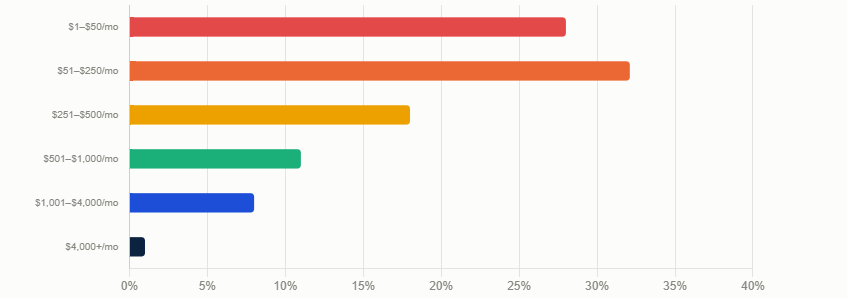
The income distribution tells a stark story. The most common earnings band, representing 32.1% of side hustlers, is $51 to $250 per month. Half of Side Hustle Nation survey respondents reported earning less than $100 per month — and 75% of those low earners spent only zero to five hours per week on their side hustle. The correlation is direct: modest time investment produces modest income, and most people in the early phase have not yet made the time commitment that produces a transition-ready income level. But Side Hustle Nation's data also shows that 36% of side hustlers who move past the startup phase earn over $1,000 per month — a meaningful milestone that represents the beginning of a real income trajectory.
The transition-ready side hustler is not typical — they are self-selected. The people who make it to full-time self-employment are the ones who treated their side hustle as a business from day one: tracked revenue, reinvested strategically, raised prices as demand grew, and made deliberate structural decisions rather than reacting to whatever came in. The 36% earning over $1,000 per month post-startup phase are building toward a career. The majority earning under $200 per month are building toward a hobby. Both are valid — but only one is on a trajectory toward a career transition.
The seven-question demand test, articulated in the mean.ceo startup guide published in June 2026, is the clearest framework for this phase. Are customers already paying, pre-ordering, renewing, or referring? Is there evidence of repeat business, not just first-time purchases? Are new clients finding you without heavy marketing effort — through referrals, search, or word of mouth? Is demand growing even without you actively pushing it? Has any client said they could not do without your product or service? Have you raised prices and retained customers? Is there a pipeline of future work that does not depend on any single client?
Validation is not about revenue size in this phase — it is about signal quality. A side hustle earning $800 per month from eight consistent clients who renew monthly is more transition-ready than one earning $2,000 from a single large project that may not recur. The recurring, predictable, organically growing revenue signal is the one that de-risks the eventual leap.
Validation checklist during Phase 1 (beancount.io March 2026 framework): Track every pound or dollar of revenue in a simple spreadsheet, separated by client and project type. Note which revenue is recurring versus one-off. Note where each client came from — referral, search, direct outreach, or platform. At the end of each month, ask: if I had no day job income tomorrow, is this business generating enough consistent demand to sustain my effort? The answer should be no for many months. That is expected. The point is to begin measuring the trajectory, not to panic about the current level.
The standard advice across multiple financial and career sources is six months of living expenses in accessible savings before resignation. This is not arbitrary — it reflects the realistic range of how long it takes most new full-time self-employed people to stabilise income, win new clients, and work through the administrative and marketing overhead that was previously handled in evenings and weekends but now expands to fill available time in both productive and unproductive ways. Six months gives a conservative runway; four months is a risk; twelve months is ideal for people with variable income streams or dependants.
The second financial preparation task is to fully understand the costs of employment that currently show up invisibly: health insurance, pension contributions, employer National Insurance (UK) or employer payroll taxes (US), paid holiday, sick pay, and professional development budget. These do not appear on a payslip as line items, but they represent real economic value that disappears on day one of self-employment. A salary of $70,000 per year may carry $15,000 to $20,000 in employer-side costs and benefits — meaning the self-employed equivalent gross revenue to maintain the same standard of living is $85,000 to $90,000, not $70,000.
Income replacement calculation (US example). Employed salary: $70,000/year ($5,833/month gross). Employer-matched 401k (3%): $2,100/year. Employer health insurance contribution: approx. $7,000/year (single coverage). Employer payroll taxes (Social Security + Medicare employer share): approx. $5,355/year. Paid holiday (15 days = 5.8% of salary): approx. $4,060/year. Total hidden employment value: approximately $18,515/year. Self-employment gross revenue required to match take-home: approximately $88,515/year before self-employment tax (15.3% on first $168,600) and income tax. True gross revenue target for parity: $95,000–$100,000/year. This is why the average side hustler needs $94,000/year to feel comfortable quitting — the number reflects real economic parity, not salary envy. Not financial advice — individual tax circumstances vary significantly.
The three-month requirement is as important as the 75% figure. One strong month is an anomaly. Two strong months might be seasonal. Three consecutive months at or above threshold is the minimum evidence that the income level is a floor, not a ceiling. This distinction matters more than most aspiring full-timers appreciate: the emotional pull of a great month is a terrible timing mechanism for a major life decision. The goal, as the nextmentors.com guide puts it, is to 'jump when the parachute is confirmed open — not to hope it opens on the way down.'
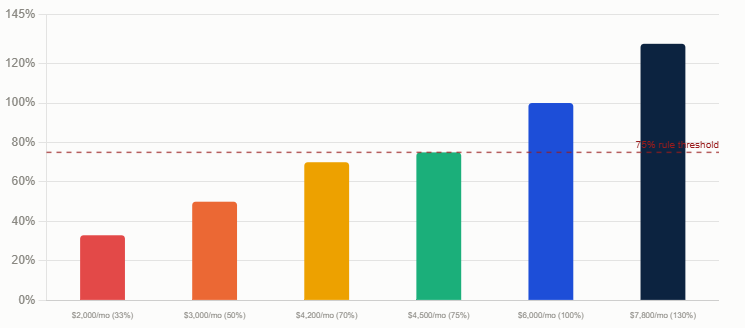
The Bright Coding guide published in August 2026 offers an alternative framing it calls the 'one third rule' — that the side hustle should cover at least a third of living expenses before going full-time, with the remaining two thirds coming from an emergency buffer while the business scales. In practice, this is a lower and earlier entry threshold than the 75% rule, and is more appropriate for people with larger emergency funds or more predictable income profiles. The table below illustrates where different income levels sit relative to a $6,000/month living expense baseline:
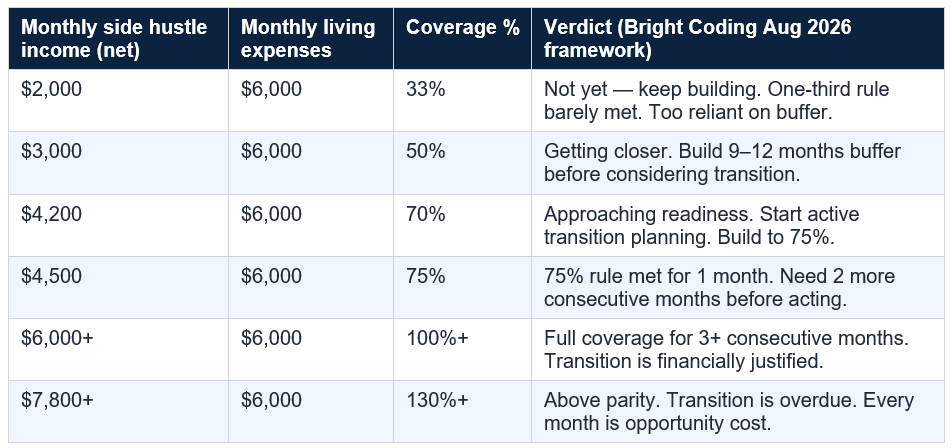
The 75% rule is the minimum, not the target. The transition made at 75% is survivable with a six-month buffer and strong demand signals. The transition made at 100%+ with six months of savings and a confirmed client pipeline is the one that sets the business up for its strongest possible start. Every month you transition earlier than the data supports is a month where the business's first challenge is financial survival rather than growth. Delay that challenge as long as the day job allows.
The infrastructure checklist for pre-transition completion includes: a dedicated business bank account (separates business and personal finances from day one, essential for tax); a simple accounting system (even a spreadsheet or basic software like Wave, which is free); a standard contract template for new clients (protects payment terms and scope); a pricing structure that reflects full-time rates rather than side-hustle rates (more on this in Section 9); a formal business registration if not already done (sole proprietorship or LLC in the US; sole trader or limited company in the UK); and a plan for health insurance or equivalent coverage that takes effect immediately on resignation.
The mean.ceo guide from June 2026 makes the infrastructure point with clarity drawn from the author's own founder experience: 'In my own founder life, the biggest changes were not glamour or freedom. They were speed of consequence, depth of responsibility, and the fact that every weak system becomes visible very fast.' The invoicing system that worked well when it was a monthly task becomes a critical cash flow mechanism when it runs the household. The pricing approach that felt acceptable at $50 per hour while employed becomes the ceiling on growth when there are no more off-peak hours to fill at below-market rates.
Pre-transition infrastructure actions (complete before resignation): 1) Open a dedicated business bank account (Chase Business, Starling for Business (UK), or similar). 2) Register the business formally — LLC or sole proprietor (US) / sole trader or Ltd (UK). Cost: $50–$500 depending on state/jurisdiction. 3) Create a standard client contract template (one-page is sufficient at the start; include payment terms, scope definition, and revision limits). 4) Set up a basic accounting system — track all income and expenses from day one of self-employment. 5) Confirm health insurance coverage with a start date aligned to last day of employment (US: ACA marketplace plans available within 60 days of losing employer coverage as a qualifying life event). 6) Notify accountant or tax adviser of the transition — estimated quarterly tax payments begin in the first year of self-employment.
In the United States, the self-employment tax alone adds 15.3% to the effective tax rate on the first $168,600 of net self-employment income (the combined employee and employer share of Social Security and Medicare). An employee whose effective tax rate was 22% effectively faces a 37.3% marginal rate on self-employed income — before state income tax. The deduction for 50% of self-employment tax, and the deduction for health insurance premiums, partially offset this; but the first self-employment tax bill is a genuine surprise for most new full-time freelancers who did not model it in advance.
The indirect costs include: professional subscriptions and software that the employer previously provided; a home office or coworking space; accountancy fees; professional indemnity insurance; the cost of unpaid time (pitching, proposals, administrative work, chasing invoices) that does not appear in hourly rate calculations; and the absence of paid holiday — 25 working days per year at a $75/hour rate represents $14,250 in unbilled time annually.
The Jobbers January 2026 guide on the freelance transition notes: 'Self-employment involves both higher taxes and the need to self-fund benefits previously provided by employers.' For US workers, ACA marketplace health insurance alone can cost $300–$800 per month for individual coverage depending on age, location, and plan tier. For a 35-year-old in a mid-cost city, a Silver plan might run $450–$600/month — $5,400–$7,200/year that the employer previously covered. This single cost line changes the income replacement calculation significantly and must be modelled before resignation, not discovered afterwards.
The guide's prescription is direct: 'If your service is booked solid at $50 an hour, you're not at capacity — you're underpriced. Raise rates on new clients by 15–25% and watch what happens. If new clients still sign, you have headroom. If they hesitate, you've learned where your ceiling is while your salary still protects you.' This is the single most powerful pre-transition test available to service-based side hustlers: a pricing experiment conducted while the financial safety net is still in place.
The rate trap also manifests in positioning. Many side hustlers position themselves as cheaper alternatives to established providers, using low prices to win early clients in a competitive market. This works in the side-hustle phase. In the career phase, it creates a cost structure that cannot support full-time income without volume that a solo operator cannot deliver. The transition to a career requires a deliberate repricing and repositioning — communicating higher rates through clearer value articulation, better case studies, more specific niche targeting, and client testimonials — ideally completed before resignation.
The income math at side-hustle rates versus career rates. Side-hustle rate: $50/hour at 20 billable hours per week = $52,000/year gross. Not sustainable as a primary income. Career rate: $85/hour at 30 billable hours per week (realistic with full-time availability and a client pipeline) = $132,600/year gross. After self-employment tax, health insurance, and business expenses: approximately $85,000–$95,000 net. This is the income target that makes the transition economically sound. The rate increase from $50 to $85 is the pre-transition work that makes the difference — and it should be tested on new clients while the day job still covers the gap. Not financial advice.
AI tools specifically accelerate three bottlenecks that historically slowed side hustlers: client communication and proposal writing (first-draft capability that previously required hours now takes minutes); content and marketing output (a solo creator can produce the output of a small team with AI drafting assistance); and business administration (AI-assisted accounting categorisation, invoice drafting, and email management reduce the administrative overhead that otherwise consumes unbillable hours).
The bizwhat.net September 2026 guide on transitioning AI income to a full-time business notes that the path from $0 to $10,000 per month typically takes 12–36 months, and that only approximately 10% of side hustlers reach the $10,000–$100,000 monthly range. AI accelerates the trajectory for those who use it systematically — reducing the time cost of output that would otherwise bottleneck growth — but does not change the fundamental economics of market validation, pricing, and client acquisition that determine whether a business is viable.
AI acceleration tactics for the transition phase: use AI to draft all client proposals and follow-up emails (saves 2–3 hours per week at the pitch stage); use AI to produce first drafts of all content marketing (blog posts, case studies, LinkedIn posts) that build audience without consuming prime working hours; use AI to categorise and track business expenses monthly (reduces accountancy prep time significantly); use AI for research on competitors, pricing benchmarks, and client industry trends (replaces paid research tools). The 13 extra hours per week the average side hustler already puts in (Penny Hoarder Feb 2026) go further when AI handles the first-draft layer of every output.
The transition to full-time self-employment can solve the time conflict of the side hustle phase — more hours available, no longer squeezing work into evenings and weekends — but it can also create a new form of overwork if boundaries are not explicitly designed in. Many new full-time freelancers and business owners find that the removal of the employment constraint simply causes the work to expand to fill all available time. The flexibility that was the primary motivation for the transition can become the mechanism by which work colonises personal time.
The structural protection against this is to design the business model deliberately before resignation. Not to build a business that requires 60-hour weeks to sustain $70,000 in revenue — because 60 hours of self-employed work is not the same as 40 hours of employment. It is a different kind of demanding, without the psychological separation that employment provides. The transition is worth making when the business model at full-time scale produces income that justifies the hours, risk, and loss of structural support — not simply when the income numbers clear a threshold.
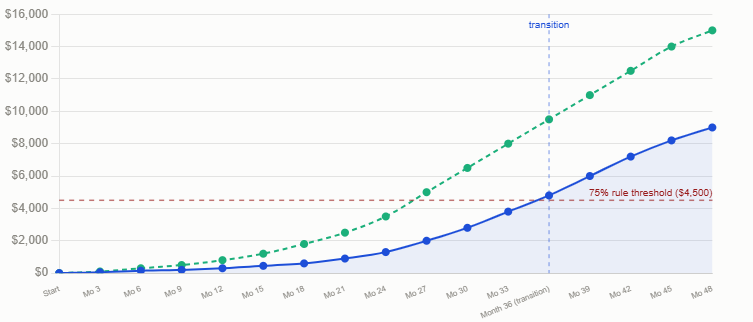
The more typical trajectory, based on Side Hustle Nation survey data from August 2026, involves an average income arc of roughly three years: year one at under $500 per month while testing and iterating; year two at $500–$2,000 per month with a validated product-market fit and growing referral base; year three at $2,000–$5,000+ per month with recurring clients, raised rates, and a client pipeline that no longer depends entirely on active outreach. The 36% who clear $1,000 per month post-startup phase are typically in year two or three of consistent effort.
A key inflection point noted across multiple sources is the transition from trading time for money (charging per hour or per project) to building recurring income (retainer clients, subscription products, ongoing service arrangements). The side hustler charging $75 per hour for one-off projects has a fundamentally different income stability profile from the one charging $2,500 per month on a retainer for the same work. The transition to recurring revenue is often what makes the income stable enough to pass the three-month consistency test.
Transition readiness progression — illustrative arc. Year 1 (side hustle phase): 3–8 hours/week effort; $100–$500/month; zero formal infrastructure; learning market fit. Year 2 (growth phase): 10–15 hours/week; $500–$2,500/month; first retainer clients; rates raised 15–25%; formal business account opened. Year 3 (transition-ready phase): 15–20 hours/week; $3,000–$6,000+/month; 75% salary rule met for 3 consecutive months; 6 months buffer saved; full infrastructure in place; resignation timing decided. Year 4 (full-time phase): full working hours; income at or above employed equivalent; business begins compounding. Sources: Side Hustle Nation Aug 2026; beancount.io March 2026; Bright Coding Aug 2026. Not financial advice — individual timelines vary significantly.
The framework described in this guide — validate demand, build the financial bridge, construct the infrastructure, pass the seven tests, price for career-level income, and design against burnout before you need to — is the framework that the 36% who make it to $1,000 per month and beyond are following, whether they name it explicitly or not. The 75% rule, the six-month buffer, the confirmed 60–90-day pipeline, the rate experiment while the safety net is still in place: these are not arbitrary thresholds. They are the parachute. They need to be assembled before the jump.
The business that earns $94,000 per year in recurring, growing revenue from a set of clients who cannot imagine using anyone else — that is a career. It looks nothing like the $200 median monthly side hustle. But it is built from exactly the same starting point, by exactly the same kind of person, executing consistently over a longer timeline than impatience would prefer. The jump is worth making when the parachute is confirmed open. Build the parachute first.
The most widely used benchmark is 75% of your current take-home salary for three consecutive months, net of business expenses — not gross revenue. This threshold is cited by multiple financial advisers and transition specialists, including nextmentors.com (August 2026) and beancount.io (March 2026). The FlexJobs/Remote.co Side Hustle and Financial Flexibility Report (February 2025) found 57% of workers held to exactly this threshold. Three months, not one, is essential — one strong month is an anomaly, three months is evidence. In parallel, you need six months of personal living expenses in accessible savings as a transition buffer. The QuickBooks/Intuit State of Side Hustles report (July 2026) found the average side hustler says they need $94,000 per year to feel comfortable quitting — which reflects the real economic parity calculation once you factor in employer benefits, health insurance, and self-employment taxes that disappear from the employer side and reappear as personal business costs.
How long does it typically take to turn a side hustle into a full-time career?
Based on Side Hustle Nation survey data (August 2026) and multiple transition guides published in 2025–2026, the realistic arc is approximately three years of consistent effort: year one of testing and iteration (under $500/month for most); year two of validated growth with first recurring clients ($500–$2,500/month); and year three at transition-ready income ($3,000–$6,000+/month). The bizwhat.net September 2026 guide found that getting from $0 to $10,000/month typically takes 12–36 months, and that only approximately 10% of side hustlers reach the $10,000–$100,000 monthly range that counts as fully sustainable career-level income. The key inflection point is moving from project-based to retainer-based work — recurring revenue creates the three-month consistency signal that validates readiness. The Penny Hoarder's February 2026 survey found the average active side hustler had been at it for 2.8 years, with a quarter running theirs for more than five years.
What financial preparation do I need before quitting my job for my side hustle?
Three financial preparations are required before resignation: First, the income threshold — 75% of take-home salary, net of business expenses, for three consecutive months. Second, a six-month emergency fund of personal living expenses in accessible savings, completely separate from business capital. Third, a full understanding of the hidden costs of employment that will become personal costs: health insurance (US: $300–$800/month for individual ACA coverage in 2026 per Jobbers Jan 2026), self-employment tax (15.3% on the first $168,600 of net self-employment income in the US), the absence of paid holidays (25 days at a $75/hour rate = $14,250 in unbilled time annually), and employer-side pension or 401k matching. Once these are modelled honestly, the gross revenue target for full-time self-employment is typically $15,000–$25,000 higher than the employed salary it is meant to replace.
What is the biggest mistake people make when transitioning from side hustle to career?
The most cited mistake across transition guides published in 2025–2026 is quitting based on one strong month of revenue, or on the emotional momentum of a breakthrough period, rather than on three consecutive months of consistent, confirmed-client-pipeline income. The damongo.com July 2026 guide identifies a closely related mistake: confusing 'genuine income pipeline' (signed contracts or confirmed retainers covering 60–90 days of future work) with 'false pipeline confidence' (several people who expressed interest but have not committed). These two states feel similar from the inside but have very different outcomes in month two of full-time self-employment. A third common mistake is failing to raise rates before resignation — going full-time at side-hustle pricing that was sustainable alongside a salary but cannot support full-time income without unmanageable volume. Bright Coding's August 2026 guide recommends testing a 15–25% rate increase on new clients while the safety net is still in place.
Does going full-time on a side hustle actually make you happier?
The data suggests it often does — with important caveats. The Hostinger January 2026 side hustle statistics guide reports that 51% of people believe gig workers are happier than office workers, and 63% believe the shared economy growth is driven by workers prioritising flexibility over conventional career paths. Among those who have already made the switch, 53% point to better flexibility and work-life balance as the primary driver of satisfaction (Hostinger Jan 2026). And a 2024 Quicken study found that 43% of Americans with side hustles earned more and worked fewer hours than in their equivalent traditional salaried role. However, the burnout data is significant: 67% of active side hustlers are experiencing burnout (SideHustles 2025 survey, cited Podbase May 2026). The distinction between a successfully designed full-time self-employment structure — with defined working hours, sufficient pricing, and recurring income stability — and a poorly designed one is substantial. The former genuinely improves work-life quality. The latter can be more exhausting than employment without the structural protections that employment provides.
Do I need to form a company before going full-time on my side hustle?
Formal business registration is advisable but not always required before resignation. In the US, you can begin as a sole proprietor without any formal registration and form an LLC later. However, the Jobbers January 2026 guide recommends forming an LLC before going full-time if you have any revenue or liability exposure, because it allows you to deduct setup costs, begin building business credit, open a dedicated business bank account, and establish professional credibility from day one. LLC formation costs typically $50–$500 depending on state. In the UK, operating as a sole trader requires only notification to HMRC within three months of starting self-employment; forming a limited company provides tax efficiency advantages (particularly the combination of salary and dividends) but adds administrative overhead. The practical advice: do not let business registration questions delay the transition if the income and financial buffer thresholds are met. Register the business in the first 30 days of full-time self-employment at the latest.
Table of Contents
- The Gap Between Dreaming and Doing
- The State of Side Hustles in 2026: What the Data Actually Shows
- Phase 1 — Validate Before You Invest: Proving the Idea Has Legs
- Phase 2 — Build the Financial Bridge: The Numbers You Need to Hit
- The 75% Rule: The Most Widely Used Transition Threshold
- Phase 3 — Build the Infrastructure: What Business Looks Like Full-Time
- The 7 Tests Before You Resign: A Pre-Departure Checklist
- The Hidden Costs of Going Full-Time: What Employees Don't See
- Pricing, Positioning, and the Rate Trap
- How to Use AI to Accelerate the Transition
- The Burnout Problem: How to Avoid Building a Prison You Can't Escape
- Real Case Benchmarks: What the Transition Actually Looks Like
- Conclusion: The Jump Is Calculated, Not Fearless
- Frequently Asked Questions
Income Distribution: Where Most Side Hustlers Actually Are
The 75% Rule: How Far You From Transition readiness?
The Typical Income Trajectory: Side Hustle To A Career.
The Gap Between Dreaming and Doing
The story is familiar. You start something on the side — a freelance project, a product, a service, a content channel — and it begins to earn. Not life-changing money at first, but real money, from real people who chose to pay for what you made. The income creeps upward. Your day job starts to feel like the thing you do in between the thing you actually want to do. Eventually the question becomes impossible to ignore: could this replace my salary?The data on that question is both encouraging and sobering. According to QuickBooks/Intuit's State of Side Hustles report published in July 2026, 47% of Americans earned extra income from a side hustle in 2025. Sixty-five percent say they would consider quitting their full-time job if their side hustle could support them, according to a Canva survey. The global gig economy is valued at $674 billion in 2026. But the median side hustle brings in just $200 per month. Only 1% of side hustlers earn more than $4,000 per month, according to a Self.inc survey. And less than 11% of side hustlers hit the $94,000 annual threshold that the average person says they would need to feel comfortable quitting their job.
The gap between wanting to make the switch and being ready to make it safely is the gap this guide addresses. The transition from side hustle to career is not a leap of faith — it is a series of measurable milestones, financial benchmarks, and structural decisions. The people who make it successfully do so because they built a parachute before they jumped. This guide tells you exactly what that parachute needs to contain.
47% of Americans earned from a side hustle in 2025 (QuickBooks/Intuit July 2026). 65% would quit if side hustle could support them (Canva). Average side hustle income $885/month — median just $200/month (Bankrate 2025). Only 1% earn $4,000+/month (Self.inc). <11% hit $94,000/year threshold needed to feel comfortable quitting (QuickBooks July 2026). Global gig economy $674B in 2026 (Business Research Insights). Gig/freelance economy $1.27 trillion in US in 2025; 64 million Americans freelancing = 38% of workforce (Upwork 2025). Average side hustler works 13 extra hours per week = 17 additional 40-hour working weeks per year (Penny Hoarder Feb 2026).
The State of Side Hustles in 2026: What the Data Actually Shows
The picture of side hustle participation in 2026 is more nuanced than headlines suggest. On one hand, the gig economy is enormous and growing: the US freelance economy alone reached $1.27 trillion in 2025, with 64 million Americans freelancing in some capacity — representing 38% of the total workforce, per Upwork's Freelance Forward Report cited by Jobbers in January 2026. Of those, 36% are full-time independent workers who have made the complete transition from traditional employment.On the other hand, participation in side hustles is declining at the margin. Bankrate's data shows 27% of US adults had a side hustle in 2026, down from 36% the prior year — the lowest rate since 2017. The Penny Hoarder's February 2026 survey of 1,000 active side hustlers found that respondents had been at it for an average of 2.8 years, with a quarter running their side hustle for more than five years. They put in 13 extra hours per week on average — equivalent to 676 hours per year, or 17 full working weeks on top of their day job. The data also shows a meaningful gender gap: Bankrate found men averaged $1,195 per month from side hustles while women averaged $611 per month.
The income distribution tells a stark story. The most common earnings band, representing 32.1% of side hustlers, is $51 to $250 per month. Half of Side Hustle Nation survey respondents reported earning less than $100 per month — and 75% of those low earners spent only zero to five hours per week on their side hustle. The correlation is direct: modest time investment produces modest income, and most people in the early phase have not yet made the time commitment that produces a transition-ready income level. But Side Hustle Nation's data also shows that 36% of side hustlers who move past the startup phase earn over $1,000 per month — a meaningful milestone that represents the beginning of a real income trajectory.
The transition-ready side hustler is not typical — they are self-selected. The people who make it to full-time self-employment are the ones who treated their side hustle as a business from day one: tracked revenue, reinvested strategically, raised prices as demand grew, and made deliberate structural decisions rather than reacting to whatever came in. The 36% earning over $1,000 per month post-startup phase are building toward a career. The majority earning under $200 per month are building toward a hobby. Both are valid — but only one is on a trajectory toward a career transition.
Phase 1 — Validate Before You Invest: Proving the Idea Has Legs
The first phase of turning a side hustle into a career is validation — confirming that people will pay for what you offer, repeatedly, in sufficient volume to sustain a business. This phase happens while you still have the security of your day job income, and it should be treated as a deliberate test rather than an optimistic ramp-up.The seven-question demand test, articulated in the mean.ceo startup guide published in June 2026, is the clearest framework for this phase. Are customers already paying, pre-ordering, renewing, or referring? Is there evidence of repeat business, not just first-time purchases? Are new clients finding you without heavy marketing effort — through referrals, search, or word of mouth? Is demand growing even without you actively pushing it? Has any client said they could not do without your product or service? Have you raised prices and retained customers? Is there a pipeline of future work that does not depend on any single client?
Validation is not about revenue size in this phase — it is about signal quality. A side hustle earning $800 per month from eight consistent clients who renew monthly is more transition-ready than one earning $2,000 from a single large project that may not recur. The recurring, predictable, organically growing revenue signal is the one that de-risks the eventual leap.
Validation checklist during Phase 1 (beancount.io March 2026 framework): Track every pound or dollar of revenue in a simple spreadsheet, separated by client and project type. Note which revenue is recurring versus one-off. Note where each client came from — referral, search, direct outreach, or platform. At the end of each month, ask: if I had no day job income tomorrow, is this business generating enough consistent demand to sustain my effort? The answer should be no for many months. That is expected. The point is to begin measuring the trajectory, not to panic about the current level.
Phase 2 — Build the Financial Bridge: The Numbers You Need to Hit
The financial bridge is the period between 'my side hustle is growing' and 'my side hustle can replace my salary.' Building it requires two things simultaneously: growing the side hustle income toward the transition threshold, and building the financial buffer that makes the transition survivable if income dips in the early full-time months.The standard advice across multiple financial and career sources is six months of living expenses in accessible savings before resignation. This is not arbitrary — it reflects the realistic range of how long it takes most new full-time self-employed people to stabilise income, win new clients, and work through the administrative and marketing overhead that was previously handled in evenings and weekends but now expands to fill available time in both productive and unproductive ways. Six months gives a conservative runway; four months is a risk; twelve months is ideal for people with variable income streams or dependants.
The second financial preparation task is to fully understand the costs of employment that currently show up invisibly: health insurance, pension contributions, employer National Insurance (UK) or employer payroll taxes (US), paid holiday, sick pay, and professional development budget. These do not appear on a payslip as line items, but they represent real economic value that disappears on day one of self-employment. A salary of $70,000 per year may carry $15,000 to $20,000 in employer-side costs and benefits — meaning the self-employed equivalent gross revenue to maintain the same standard of living is $85,000 to $90,000, not $70,000.
Income replacement calculation (US example). Employed salary: $70,000/year ($5,833/month gross). Employer-matched 401k (3%): $2,100/year. Employer health insurance contribution: approx. $7,000/year (single coverage). Employer payroll taxes (Social Security + Medicare employer share): approx. $5,355/year. Paid holiday (15 days = 5.8% of salary): approx. $4,060/year. Total hidden employment value: approximately $18,515/year. Self-employment gross revenue required to match take-home: approximately $88,515/year before self-employment tax (15.3% on first $168,600) and income tax. True gross revenue target for parity: $95,000–$100,000/year. This is why the average side hustler needs $94,000/year to feel comfortable quitting — the number reflects real economic parity, not salary envy. Not financial advice — individual tax circumstances vary significantly.
The 75% Rule: The Most Widely Used Transition Threshold
The most widely cited income benchmark for the side-hustle-to-career transition is what multiple sources call the 75% rule: the side hustle should consistently generate at least 75% of the current take-home pay for three or more consecutive months before the transition is safe to execute. This formulation comes from financial advisors and career transition specialists quoted in nextmentors.com's August 2026 guide, beancount.io's March 2026 guide, and the FlexJobs/Remote.co Side Hustle and Financial Flexibility Report from early 2025, which found 57% of workers held to this exact threshold before they would be willing to leave.The three-month requirement is as important as the 75% figure. One strong month is an anomaly. Two strong months might be seasonal. Three consecutive months at or above threshold is the minimum evidence that the income level is a floor, not a ceiling. This distinction matters more than most aspiring full-timers appreciate: the emotional pull of a great month is a terrible timing mechanism for a major life decision. The goal, as the nextmentors.com guide puts it, is to 'jump when the parachute is confirmed open — not to hope it opens on the way down.'
The Bright Coding guide published in August 2026 offers an alternative framing it calls the 'one third rule' — that the side hustle should cover at least a third of living expenses before going full-time, with the remaining two thirds coming from an emergency buffer while the business scales. In practice, this is a lower and earlier entry threshold than the 75% rule, and is more appropriate for people with larger emergency funds or more predictable income profiles. The table below illustrates where different income levels sit relative to a $6,000/month living expense baseline:
The 75% rule is the minimum, not the target. The transition made at 75% is survivable with a six-month buffer and strong demand signals. The transition made at 100%+ with six months of savings and a confirmed client pipeline is the one that sets the business up for its strongest possible start. Every month you transition earlier than the data supports is a month where the business's first challenge is financial survival rather than growth. Delay that challenge as long as the day job allows.
Phase 3 — Build the Infrastructure: What Business Looks Like Full-Time
Most side hustles operate with minimal formal infrastructure because they do not need it. Invoicing happens when it happens. Tax tracking is approximate. There is no business account, no formal contracts, no pricing structure — because the day job provides the financial safety net that makes informality survivable. Going full-time removes that safety net entirely, and the first month of full-time self-employment frequently reveals every structural weakness that the day job was quietly covering.The infrastructure checklist for pre-transition completion includes: a dedicated business bank account (separates business and personal finances from day one, essential for tax); a simple accounting system (even a spreadsheet or basic software like Wave, which is free); a standard contract template for new clients (protects payment terms and scope); a pricing structure that reflects full-time rates rather than side-hustle rates (more on this in Section 9); a formal business registration if not already done (sole proprietorship or LLC in the US; sole trader or limited company in the UK); and a plan for health insurance or equivalent coverage that takes effect immediately on resignation.
The mean.ceo guide from June 2026 makes the infrastructure point with clarity drawn from the author's own founder experience: 'In my own founder life, the biggest changes were not glamour or freedom. They were speed of consequence, depth of responsibility, and the fact that every weak system becomes visible very fast.' The invoicing system that worked well when it was a monthly task becomes a critical cash flow mechanism when it runs the household. The pricing approach that felt acceptable at $50 per hour while employed becomes the ceiling on growth when there are no more off-peak hours to fill at below-market rates.
Pre-transition infrastructure actions (complete before resignation): 1) Open a dedicated business bank account (Chase Business, Starling for Business (UK), or similar). 2) Register the business formally — LLC or sole proprietor (US) / sole trader or Ltd (UK). Cost: $50–$500 depending on state/jurisdiction. 3) Create a standard client contract template (one-page is sufficient at the start; include payment terms, scope definition, and revision limits). 4) Set up a basic accounting system — track all income and expenses from day one of self-employment. 5) Confirm health insurance coverage with a start date aligned to last day of employment (US: ACA marketplace plans available within 60 days of losing employer coverage as a qualifying life event). 6) Notify accountant or tax adviser of the transition — estimated quarterly tax payments begin in the first year of self-employment.
The 7 Tests Before You Resign: A Pre-Departure Checklist
The mean.ceo June 2026 guide distils the transition decision into seven tests, each addressing a different dimension of readiness. These are not aspirational — they are the conditions that separate a calculated transition from an emotional one.- Demand test: Are customers already paying, pre-ordering, renewing, or referring — without heavy promotional push on your part? Organic demand is the signal of a business, not just a project.
- Time conflict test: Is your job now actively blocking business growth? Are sales calls landing during office hours? Are customers waiting longer than they should because you cannot respond until evenings? When the day job is costing the business more than the day job is worth, the economics of staying have reversed.
- Income consistency test: Has the side hustle hit 75% of your take-home salary for three or more consecutive months, net of business expenses? Not gross revenue — net. One good month is noise. Three consecutive months is signal.
- Financial buffer test: Do you have six months of personal living expenses in accessible savings, separate from business capital? This buffer must be able to cover the scenario where the business earns nothing for six months — not the scenario where it continues at current levels.
- Pipeline test: Do you have confirmed, committed future work — signed contracts or verbally confirmed retainers covering the next 60–90 days — from at least two clients? The distinction between a genuine pipeline and 'a few people interested in my services' is the distinction between a funded transition and a dangerous one (damongo.com July 2026).
- Health and insurance test: Is health insurance (US) or equivalent coverage confirmed from day one of self-employment? This is the most commonly underestimated transition cost for US-based self-employed people. ACA marketplace plan costs in 2026 range from approximately $300–$500/month (Bronze) to $500–$800/month (Gold) for individuals.
- Mindset test: Have you run the transition scenario fully — income drops to zero for three months, major client cancels, unexpected business expense appears — and concluded you could handle it practically and emotionally? The business decisions made under financial pressure in the first year are the ones that most often derail transitions that were otherwise well-prepared.
The Hidden Costs of Going Full-Time: What Employees Don't See
The most common financial shock in the first year of full-time self-employment is not that revenue is lower than expected — it is that costs are higher. Specifically, costs that were previously absorbed by the employer and invisible on the payslip become line items in the self-employed budget.In the United States, the self-employment tax alone adds 15.3% to the effective tax rate on the first $168,600 of net self-employment income (the combined employee and employer share of Social Security and Medicare). An employee whose effective tax rate was 22% effectively faces a 37.3% marginal rate on self-employed income — before state income tax. The deduction for 50% of self-employment tax, and the deduction for health insurance premiums, partially offset this; but the first self-employment tax bill is a genuine surprise for most new full-time freelancers who did not model it in advance.
The indirect costs include: professional subscriptions and software that the employer previously provided; a home office or coworking space; accountancy fees; professional indemnity insurance; the cost of unpaid time (pitching, proposals, administrative work, chasing invoices) that does not appear in hourly rate calculations; and the absence of paid holiday — 25 working days per year at a $75/hour rate represents $14,250 in unbilled time annually.
The Jobbers January 2026 guide on the freelance transition notes: 'Self-employment involves both higher taxes and the need to self-fund benefits previously provided by employers.' For US workers, ACA marketplace health insurance alone can cost $300–$800 per month for individual coverage depending on age, location, and plan tier. For a 35-year-old in a mid-cost city, a Silver plan might run $450–$600/month — $5,400–$7,200/year that the employer previously covered. This single cost line changes the income replacement calculation significantly and must be modelled before resignation, not discovered afterwards.
Pricing, Positioning, and the Rate Trap
One of the most consistent patterns in the side-hustle-to-career transition is what the Bright Coding August 2026 guide calls the rate trap: the side hustler is fully booked at a rate that made sense as supplemental income but is inadequate as a primary income. The trap is often invisible until the transition is attempted, because at the side-hustle stage, the low rate is sustainable — the day job covers the gap.The guide's prescription is direct: 'If your service is booked solid at $50 an hour, you're not at capacity — you're underpriced. Raise rates on new clients by 15–25% and watch what happens. If new clients still sign, you have headroom. If they hesitate, you've learned where your ceiling is while your salary still protects you.' This is the single most powerful pre-transition test available to service-based side hustlers: a pricing experiment conducted while the financial safety net is still in place.
The rate trap also manifests in positioning. Many side hustlers position themselves as cheaper alternatives to established providers, using low prices to win early clients in a competitive market. This works in the side-hustle phase. In the career phase, it creates a cost structure that cannot support full-time income without volume that a solo operator cannot deliver. The transition to a career requires a deliberate repricing and repositioning — communicating higher rates through clearer value articulation, better case studies, more specific niche targeting, and client testimonials — ideally completed before resignation.
The income math at side-hustle rates versus career rates. Side-hustle rate: $50/hour at 20 billable hours per week = $52,000/year gross. Not sustainable as a primary income. Career rate: $85/hour at 30 billable hours per week (realistic with full-time availability and a client pipeline) = $132,600/year gross. After self-employment tax, health insurance, and business expenses: approximately $85,000–$95,000 net. This is the income target that makes the transition economically sound. The rate increase from $50 to $85 is the pre-transition work that makes the difference — and it should be tested on new clients while the day job still covers the gap. Not financial advice.
How to Use AI to Accelerate the Transition
The 2026 data on AI adoption among side hustlers is remarkable: 80% of people have used AI to support their side hustles, and 74% describe it as their 'secret growth weapon,' according to a Canva survey cited by OmniCalculator in June 2026. This is not a peripheral trend — it reflects a genuine shift in the productivity available to a solo operator that has changed the economics of the side-hustle-to-career transition.AI tools specifically accelerate three bottlenecks that historically slowed side hustlers: client communication and proposal writing (first-draft capability that previously required hours now takes minutes); content and marketing output (a solo creator can produce the output of a small team with AI drafting assistance); and business administration (AI-assisted accounting categorisation, invoice drafting, and email management reduce the administrative overhead that otherwise consumes unbillable hours).
The bizwhat.net September 2026 guide on transitioning AI income to a full-time business notes that the path from $0 to $10,000 per month typically takes 12–36 months, and that only approximately 10% of side hustlers reach the $10,000–$100,000 monthly range. AI accelerates the trajectory for those who use it systematically — reducing the time cost of output that would otherwise bottleneck growth — but does not change the fundamental economics of market validation, pricing, and client acquisition that determine whether a business is viable.
AI acceleration tactics for the transition phase: use AI to draft all client proposals and follow-up emails (saves 2–3 hours per week at the pitch stage); use AI to produce first drafts of all content marketing (blog posts, case studies, LinkedIn posts) that build audience without consuming prime working hours; use AI to categorise and track business expenses monthly (reduces accountancy prep time significantly); use AI for research on competitors, pricing benchmarks, and client industry trends (replaces paid research tools). The 13 extra hours per week the average side hustler already puts in (Penny Hoarder Feb 2026) go further when AI handles the first-draft layer of every output.
The Burnout Problem: How to Avoid Building a Prison You Can't Escape
The most underreported story in the side-hustle-to-career transition is burnout. A 2025 survey by SideHustles found that 67% of side hustlers are experiencing burnout — a figure that reflects the genuine cost of working 13 extra hours per week on top of full-time employment for an average of 2.8 years. The Penny Hoarder's February 2026 survey of 1,000 active side hustlers confirms the scale: most run more than one gig at a time and have been at it for years, not months.The transition to full-time self-employment can solve the time conflict of the side hustle phase — more hours available, no longer squeezing work into evenings and weekends — but it can also create a new form of overwork if boundaries are not explicitly designed in. Many new full-time freelancers and business owners find that the removal of the employment constraint simply causes the work to expand to fill all available time. The flexibility that was the primary motivation for the transition can become the mechanism by which work colonises personal time.
The structural protection against this is to design the business model deliberately before resignation. Not to build a business that requires 60-hour weeks to sustain $70,000 in revenue — because 60 hours of self-employed work is not the same as 40 hours of employment. It is a different kind of demanding, without the psychological separation that employment provides. The transition is worth making when the business model at full-time scale produces income that justifies the hours, risk, and loss of structural support — not simply when the income numbers clear a threshold.
- Define your working hours before you go full-time and protect them from client pressure from day one. A client who books a call at 7pm on a Sunday is not setting a precedent you want to sustain for years.
- Price high enough that the target income is achievable in a sustainable number of billable hours. If 30 billable hours per week at your rate produces your income target with buffer, do not accept business that requires 50 hours.
- Plan for paid holidays from the first month. The self-employed do not automatically take less time off — they take none unless they schedule and price for it.
- Build in a monthly revenue floor: the minimum income level below which you will take active corrective action (marketing, outreach, pricing review). Define this floor in advance; do not wait for financial pressure to prompt a response.
Real Case Benchmarks: What the Transition Actually Looks Like
The mean.ceo June 2026 guide profiles a real example worth examining: software engineer Michelle Yeung left a $250,000 role to build a matcha cafe in Manhattan, accepting a 'massive short-term pay cut in exchange for ownership, purpose, and direct control over her work.' This is an extreme version of the transition — high salary, high sacrifice, high-visibility industry — but it illustrates a pattern: the people who make the transition successfully do so not primarily because the income numbers cleared a threshold, but because the day job had become a constraint on a business that was genuinely ready to grow.The more typical trajectory, based on Side Hustle Nation survey data from August 2026, involves an average income arc of roughly three years: year one at under $500 per month while testing and iterating; year two at $500–$2,000 per month with a validated product-market fit and growing referral base; year three at $2,000–$5,000+ per month with recurring clients, raised rates, and a client pipeline that no longer depends entirely on active outreach. The 36% who clear $1,000 per month post-startup phase are typically in year two or three of consistent effort.
A key inflection point noted across multiple sources is the transition from trading time for money (charging per hour or per project) to building recurring income (retainer clients, subscription products, ongoing service arrangements). The side hustler charging $75 per hour for one-off projects has a fundamentally different income stability profile from the one charging $2,500 per month on a retainer for the same work. The transition to recurring revenue is often what makes the income stable enough to pass the three-month consistency test.
Transition readiness progression — illustrative arc. Year 1 (side hustle phase): 3–8 hours/week effort; $100–$500/month; zero formal infrastructure; learning market fit. Year 2 (growth phase): 10–15 hours/week; $500–$2,500/month; first retainer clients; rates raised 15–25%; formal business account opened. Year 3 (transition-ready phase): 15–20 hours/week; $3,000–$6,000+/month; 75% salary rule met for 3 consecutive months; 6 months buffer saved; full infrastructure in place; resignation timing decided. Year 4 (full-time phase): full working hours; income at or above employed equivalent; business begins compounding. Sources: Side Hustle Nation Aug 2026; beancount.io March 2026; Bright Coding Aug 2026. Not financial advice — individual timelines vary significantly.
Conclusion
The side hustle to career transition is one of the most significant financial and professional decisions most people make. The data from 2026 is clear on both the scale of the opportunity and the scale of the gap: 65% want to make the jump, but less than 11% are generating the income to make it safely. The difference between those two groups is not courage — it is preparation.The framework described in this guide — validate demand, build the financial bridge, construct the infrastructure, pass the seven tests, price for career-level income, and design against burnout before you need to — is the framework that the 36% who make it to $1,000 per month and beyond are following, whether they name it explicitly or not. The 75% rule, the six-month buffer, the confirmed 60–90-day pipeline, the rate experiment while the safety net is still in place: these are not arbitrary thresholds. They are the parachute. They need to be assembled before the jump.
The business that earns $94,000 per year in recurring, growing revenue from a set of clients who cannot imagine using anyone else — that is a career. It looks nothing like the $200 median monthly side hustle. But it is built from exactly the same starting point, by exactly the same kind of person, executing consistently over a longer timeline than impatience would prefer. The jump is worth making when the parachute is confirmed open. Build the parachute first.
Frequently Asked Questions
How much should my side hustle earn before I quit my job?The most widely used benchmark is 75% of your current take-home salary for three consecutive months, net of business expenses — not gross revenue. This threshold is cited by multiple financial advisers and transition specialists, including nextmentors.com (August 2026) and beancount.io (March 2026). The FlexJobs/Remote.co Side Hustle and Financial Flexibility Report (February 2025) found 57% of workers held to exactly this threshold. Three months, not one, is essential — one strong month is an anomaly, three months is evidence. In parallel, you need six months of personal living expenses in accessible savings as a transition buffer. The QuickBooks/Intuit State of Side Hustles report (July 2026) found the average side hustler says they need $94,000 per year to feel comfortable quitting — which reflects the real economic parity calculation once you factor in employer benefits, health insurance, and self-employment taxes that disappear from the employer side and reappear as personal business costs.
How long does it typically take to turn a side hustle into a full-time career?
Based on Side Hustle Nation survey data (August 2026) and multiple transition guides published in 2025–2026, the realistic arc is approximately three years of consistent effort: year one of testing and iteration (under $500/month for most); year two of validated growth with first recurring clients ($500–$2,500/month); and year three at transition-ready income ($3,000–$6,000+/month). The bizwhat.net September 2026 guide found that getting from $0 to $10,000/month typically takes 12–36 months, and that only approximately 10% of side hustlers reach the $10,000–$100,000 monthly range that counts as fully sustainable career-level income. The key inflection point is moving from project-based to retainer-based work — recurring revenue creates the three-month consistency signal that validates readiness. The Penny Hoarder's February 2026 survey found the average active side hustler had been at it for 2.8 years, with a quarter running theirs for more than five years.
What financial preparation do I need before quitting my job for my side hustle?
Three financial preparations are required before resignation: First, the income threshold — 75% of take-home salary, net of business expenses, for three consecutive months. Second, a six-month emergency fund of personal living expenses in accessible savings, completely separate from business capital. Third, a full understanding of the hidden costs of employment that will become personal costs: health insurance (US: $300–$800/month for individual ACA coverage in 2026 per Jobbers Jan 2026), self-employment tax (15.3% on the first $168,600 of net self-employment income in the US), the absence of paid holidays (25 days at a $75/hour rate = $14,250 in unbilled time annually), and employer-side pension or 401k matching. Once these are modelled honestly, the gross revenue target for full-time self-employment is typically $15,000–$25,000 higher than the employed salary it is meant to replace.
What is the biggest mistake people make when transitioning from side hustle to career?
The most cited mistake across transition guides published in 2025–2026 is quitting based on one strong month of revenue, or on the emotional momentum of a breakthrough period, rather than on three consecutive months of consistent, confirmed-client-pipeline income. The damongo.com July 2026 guide identifies a closely related mistake: confusing 'genuine income pipeline' (signed contracts or confirmed retainers covering 60–90 days of future work) with 'false pipeline confidence' (several people who expressed interest but have not committed). These two states feel similar from the inside but have very different outcomes in month two of full-time self-employment. A third common mistake is failing to raise rates before resignation — going full-time at side-hustle pricing that was sustainable alongside a salary but cannot support full-time income without unmanageable volume. Bright Coding's August 2026 guide recommends testing a 15–25% rate increase on new clients while the safety net is still in place.
Does going full-time on a side hustle actually make you happier?
The data suggests it often does — with important caveats. The Hostinger January 2026 side hustle statistics guide reports that 51% of people believe gig workers are happier than office workers, and 63% believe the shared economy growth is driven by workers prioritising flexibility over conventional career paths. Among those who have already made the switch, 53% point to better flexibility and work-life balance as the primary driver of satisfaction (Hostinger Jan 2026). And a 2024 Quicken study found that 43% of Americans with side hustles earned more and worked fewer hours than in their equivalent traditional salaried role. However, the burnout data is significant: 67% of active side hustlers are experiencing burnout (SideHustles 2025 survey, cited Podbase May 2026). The distinction between a successfully designed full-time self-employment structure — with defined working hours, sufficient pricing, and recurring income stability — and a poorly designed one is substantial. The former genuinely improves work-life quality. The latter can be more exhausting than employment without the structural protections that employment provides.
Do I need to form a company before going full-time on my side hustle?
Formal business registration is advisable but not always required before resignation. In the US, you can begin as a sole proprietor without any formal registration and form an LLC later. However, the Jobbers January 2026 guide recommends forming an LLC before going full-time if you have any revenue or liability exposure, because it allows you to deduct setup costs, begin building business credit, open a dedicated business bank account, and establish professional credibility from day one. LLC formation costs typically $50–$500 depending on state. In the UK, operating as a sole trader requires only notification to HMRC within three months of starting self-employment; forming a limited company provides tax efficiency advantages (particularly the combination of salary and dividends) but adds administrative overhead. The practical advice: do not let business registration questions delay the transition if the income and financial buffer thresholds are met. Register the business in the first 30 days of full-time self-employment at the latest.

0 Comments Comments