

Investing
Investing Moves to Make Before End of Year
December 31, 2026 is a hard cutoff for some of the most valuable financial moves of the year. The 401(k) contribution limit increased to $24,500 in 2026. The IRA limit hit $7,500 for the first time. The HSA self-only cap reached $4,400. The Saver's Credit disappears after this year, replaced by a Saver's Match in 2027. Capital losses must be harvested by December 31. Roth conversions must be executed before midnight. Tax-loss harvesting trades need to settle before year-end. Some of these deadlines are absolute — they cannot be extended. This guide identifies the highest-impact moves to make before December 31, 2026, ranked by urgency and potential value.
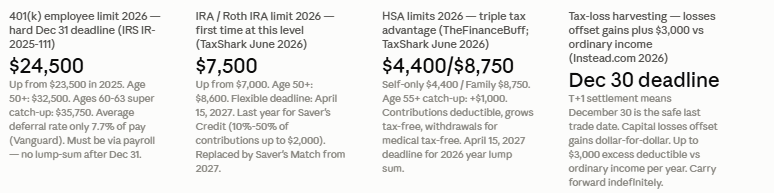
For 2026 specifically, the year-end stakes are higher than usual for two reasons. First, contribution limits increased across virtually every tax-advantaged account: the 401(k) limit rose to $24,500, the IRA limit hit $7,500 for the first time, and the HSA limits increased to $4,400 (self-only) and $8,750 (family). Second, the Saver's Credit — a direct tax credit worth up to $1,000 per person for lower and middle-income retirement account contributors — will be replaced by the Saver's Match beginning 2027 under SECURE 2.0. This is the last year to claim the Saver's Credit in its current form.
Abip CPAs & Advisors, whose year-end tax planning guide was published two weeks ago, states the urgency directly: 'Do not wait until the new year to discover opportunities you could have captured in 2026. The sooner you reach out, the more options you have.' WealthStack's May 2026 year-end checklist analysis confirms the long-term impact: 'People who complete their year-end financial checklist consistently, year after year, build dramatically more wealth than those who act sporadically.' This guide identifies the eight highest-impact moves, ranked by the combination of potential value and deadline urgency.
2026 limits: 401(k) $24,500 ($32,500 age 50+; $35,750 ages 60-63 super catch-up). IRA $7,500 ($8,600 age 50+). HSA $4,400 single / $8,750 family. FSA carryover: $680. Annual gift exclusion: $19,000/recipient ($38,000 married). Estate exemption: $15M/$30M (OBBBA permanent). QCD: $111,000/person/year. Saver's Credit: last year 2026. Average 401(k) deferral: only 7.7% of pay (Vanguard How America Saves). Capital losses offset gains dollar-for-dollar; $3,000 excess deductible against ordinary income; carry forward indefinitely. All December 31, 2026 deadlines are absolute — no extensions.
As TaxShark's June 2026 analysis notes: 'A higher limit is only useful if you act on it. Your employer's payroll system does not automatically raise your contribution percentage to hit the new cap. The consequence of ignoring the change is a smaller tax deduction and slower retirement growth. What you should do is log into your plan portal and recalculate your per-paycheck deferral so it lands near the new cap by year-end.'
The OBBBA, signed July 4, 2025, also made permanent several provisions that affect year-end planning. TCJA income tax brackets (10% to 37%) are now permanent — there is no rate reversion risk. The standard deduction ($16,100 single / $32,200 MFJ) remains elevated. The increased estate and gift tax exemptions ($15M per person / $30M per married couple) are permanent. 100% bonus depreciation was restored for qualifying business property placed in service after January 19, 2025. The Qualified Opportunity Zone programme was preserved. All of these affect year-end strategy decisions.
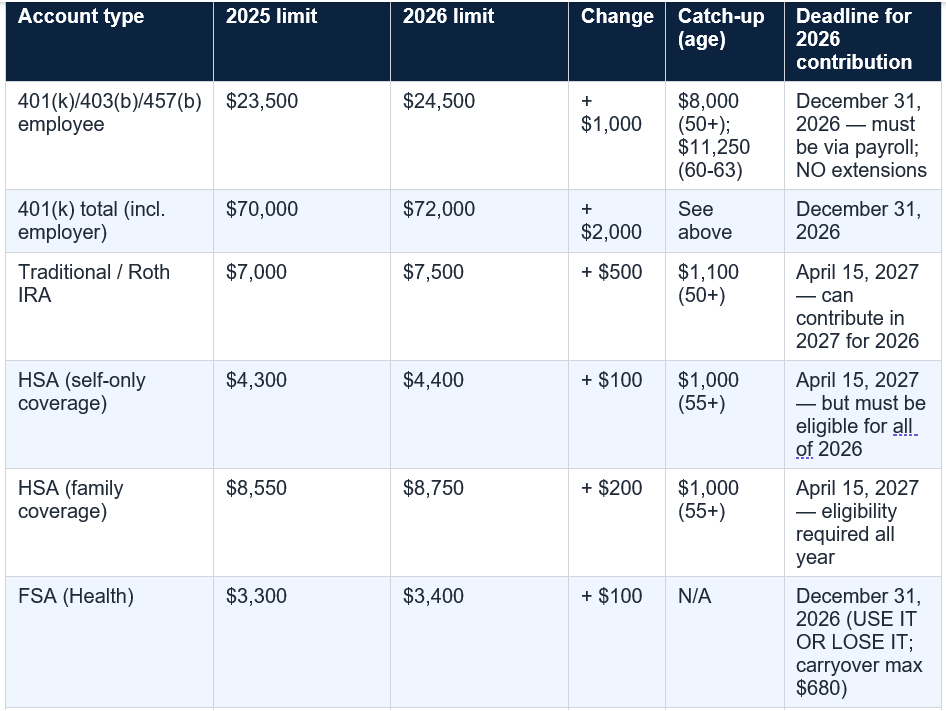
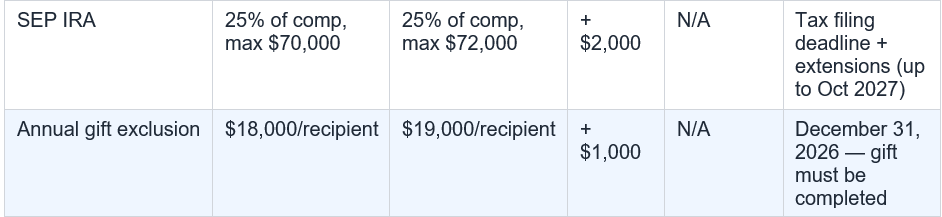
In 2026, with the limit at $24,500, an employee who spreads contributions evenly across 24 bimonthly paychecks needs to contribute $1,020.83 per paycheck. Across 26 biweekly paychecks, $942.31 per paycheck. If you started 2026 contributing at the 2025 rate (set up for $23,500) and did not adjust your withholding percentage when the new limit was announced, you may be on track to contribute only $23,500 — leaving $1,000 of tax-deferred space on the table. Log into your plan portal now and verify.
Vanguard's How America Saves report found the average 401(k) deferral rate sits around 7.7% of pay — well below the $24,500 limit for most American salaries. The gap between the average deferral and the maximum represents tens of thousands of dollars of potential tax-deferred compounding left unfunded annually. Each additional dollar contributed pre-tax reduces taxable income dollar-for-dollar. At the 22% bracket, $1,000 of additional 401(k) contribution reduces federal tax by $220. At 24%, by $240. At 32%, by $320.
401(k) contribution value in 2026. Annual contribution at limit: $24,500. Tax savings at 22% bracket: $5,390 federal income tax reduction. Tax savings at 24% bracket: $5,880. Tax savings at 32% bracket: $7,840. Over 25 years at 7% annual growth: $24,500 per year grows to approximately $1.6 million. Additionally: if your employer matches contributions and you are not contributing enough to capture the full match, you are declining free money. The most common employer match (50% of contributions up to 6% of salary) represents up to 3% of salary in additional free compensation. For a $100,000 salary: $3,000 of employer match forfeited per year if you do not contribute at least 6%. Source: High Earner Playbook April 2026; TaxShark June 2026. Not financial advice.
The payroll system lag: most employers require contribution changes to be submitted several weeks before the paycheck that reflects them. If you are reading this in October or November and your contributions are behind, contact your HR department immediately to confirm the cutoff date for submission changes that will affect December paychecks. Some plan administrators stop accepting changes for the final pay period in November. Do not assume December 30 is the effective deadline for payroll changes. Source: abip CPAs 2 weeks ago; Sherr Financial Associates December 2025.
CRITICAL — December 31 deadline, cannot extend. Log into your plan portal this week. Calculate where your 2026 contributions stand relative to the $24,500 limit. If you are behind, increase your deferral percentage immediately for remaining pay periods. Do not leave the employer match on the table. Check the payroll submission cutoff date with HR — it may be earlier than December 31. Not tax advice.
As Future Focused Wealth's checklist explains: 'Let's say you're in the 24% tax bracket and have $20,000 of headroom before hitting the next bracket. Converting $20K from your Traditional IRA into a Roth now means you'll pay $4,800 in tax — and never owe another dime on that money (or its growth) again.' This bracket-filling strategy — converting up to (but not past) the top of the current bracket — is the core of most Roth conversion planning, and 2026's permanent TCJA brackets make the current rate environment unusually predictable for this calculation.
The IRMAA two-year lookback is the most common planning mistake in Roth conversion execution. A conversion in 2026 that pushes MAGI above the IRMAA threshold ($109,000 single / $218,000 joint) will trigger Medicare surcharges in 2028. Planning to Wealth's year-end checklist emphasises: 'With the recent passing of the OBBBA, many traditional year-end planning items should be revisited and re-evaluated in light of the new changes.' Specifically, the OBBBA's $6,000/$12,000 senior deduction (ages 65+, phases out above $150,000 MAGI, effective 2025-2028) adds a phase-out calculation to every conversion decision for taxpayers over 65.
Roth conversion year-end checklist. Step 1: Estimate 2026 MAGI from all sources (wages, dividends, capital gains, RMDs, Social Security). Step 2: Identify bracket space remaining before the next bracket or IRMAA threshold. Step 3: Calculate the conversion amount that keeps MAGI below the critical threshold. Step 4: If 65+, check whether the conversion amount keeps MAGI below the $150,000 OBBBA senior deduction phase-out. Step 5: Confirm the conversion will be paid from taxable brokerage funds, not from the IRA itself. Step 6: Execute the conversion through your IRA custodian — allow processing time before December 31. Not tax advice — consult a qualified CPA.
The year-end urgency: all sales must be settled by December 31, 2026 to count as 2026 transactions. With T+1 settlement (trades settle one business day after execution), a trade executed December 30 settles December 31 — the last safe date in most years. Executing December 31 itself risks settlement on January 2, which would be a 2027 transaction. abip CPAs' two-weeks-ago year-end tax guide and Instead.com's 2026 harvesting guide both identify December 30 as the practical safe deadline for harvesting trades.
The wash-sale rule is the critical trap: if you sell a security at a loss and repurchase the same or substantially identical security within 30 calendar days before or after the sale (the 61-day window), the loss is disallowed. The wash-sale rule applies across all accounts in the household — your taxable account, your IRA, your 401(k), and your spouse's accounts. Instead.com's 2026 tax-loss harvesting guide warns: 'If you sell a stock at a loss in your taxable account and your spouse buys the same stock in their IRA within 30 days, the loss is disallowed. Coordinate across all household accounts when harvesting.'
The standard solution is to sell the losing position and immediately replace it with a similar (but not substantially identical) investment to maintain market exposure. For example: sell an S&P 500 index fund at a loss, immediately buy a total market fund that tracks the same broad market exposure but is not substantially identical. You stay invested in the same asset class, capture the tax loss, and comply with the wash-sale rule.
Tax-loss harvesting value illustration. Scenario: you have $15,000 of short-term capital gains from stock sales in 2026. You also hold positions with $15,000 of unrealised losses. By harvesting those losses before December 31: Net capital gains: $15,000 - $15,000 = $0. Tax on $15,000 of short-term gains at 22% bracket: $3,300 owed. Tax after harvesting: $0. Tax saved: $3,300. The harvested positions are reinvested in similar (but not identical) securities immediately, maintaining full market exposure. No money leaves the market; the tax savings are real and immediate. Note: this example uses simplified assumptions. Not tax advice — individual tax outcomes depend on the mix of short-term vs long-term gains, income level, and other factors. Consult a CPA.
Crypto tax-loss harvesting: the IRS treats cryptocurrency as property. Losses on crypto sales are deductible as capital losses — and cryptocurrency is NOT subject to the wash-sale rule under current IRS guidance (as of 2026). This means you can sell bitcoin or Ethereum at a loss and immediately repurchase without triggering the wash-sale rule. This can be a significant advantage for crypto holders with unrealised losses. However: wash-sale rule treatment of crypto is a legislative priority — Congress has proposed extending it to crypto in multiple bills. Do not assume this treatment will persist. Not tax advice — consult a CPA on your specific situation.
The year-end HSA opportunity has two distinct components. First, the December 31 issue: if your HSA is funded through payroll deductions, the same deadline dynamics as the 401(k) apply — you can only contribute what runs through payroll by December 31. Second, the April 15 extension: unlike 401(k) contributions, you can make a lump-sum HSA contribution for 2026 as late as April 15, 2027, as long as you were covered by an HSA-eligible High Deductible Health Plan (HDHP) throughout 2026.
Finhabits' year-end checklist flags the most common HSA oversight: 'Check whether your HSA balance is invested, not just sitting in cash.' Most HSA providers hold contributions in cash by default, earning minimal interest. Once the account balance exceeds the required minimum (typically $1,000 to $2,500 depending on the provider), the excess can be invested in funds similar to a brokerage account. Leaving HSA balances in cash is one of the most widespread and underappreciated missed opportunities in personal finance — particularly for individuals who are healthy and do not need to draw on the HSA in the near term.
The HSA retirement strategy: if you can afford to pay current medical expenses out-of-pocket without using HSA funds, your HSA becomes a powerful tax-advantaged investment account that grows indefinitely. After age 65, HSA withdrawals for non-medical expenses are simply taxed as ordinary income (like a traditional IRA) — no penalty. For medical expenses at any age, withdrawals remain completely tax-free. Keeping receipts for qualified medical expenses (there is no time limit on reimbursement) allows you to grow the HSA tax-free for decades and then reimburse yourself in retirement for expenses paid years earlier. This is the most advanced HSA strategy and requires careful record-keeping. Not tax advice.
To be specific about the rules: employers can offer a carryover of up to $680, OR a grace period of up to 2.5 months after year-end (through March 15, 2027) during which FSA funds can still be used — but not both options simultaneously. If your employer offers neither, then the use-it-or-lose-it rule is absolute: any FSA balance above zero that remains December 31 is forfeited.
Finhabits' checklist offers practical guidance on FSA spending: 'If you're tired of only using your FSA for allergy meds and Band-Aids, this could be a solid way to invest in your health.' Eligible FSA expenses include prescription eyeglasses and contact lenses, dental work (cleanings, fillings, orthodontics), physical therapy, prescription medications, medical devices (blood pressure monitors, CPAP supplies), menstrual care products, and many over-the-counter medications. Review your remaining FSA balance now and schedule any outstanding medical or dental appointments before December 31.
FSA year-end action steps: (1) Log into your FSA account and find your remaining balance. (2) Ask HR whether your plan offers a grace period or carryover, and the maximum carryover amount. (3) If your balance exceeds the carryover maximum and you have no grace period: schedule outstanding medical or dental appointments before December 31. (4) Order eligible over-the-counter products, prescription eyewear, or medical devices with the remaining balance. (5) If you have a large balance you cannot reasonably spend: note this for next year's FSA enrollment decision — only elect what you expect to use. Not tax advice.
The one exception: if this is your very first RMD (you turned 73 in 2026), you have until April 1, 2027 to take it. However, if you defer the first RMD to April 2027, you will owe two RMDs in 2027 — the deferred 2026 RMD plus the regular 2027 RMD. Two RMDs in a single year can push income into a higher bracket, trigger IRMAA Medicare surcharges, and increase Social Security taxability. For most people with moderate IRA balances, taking the first RMD in December 2026 rather than deferring to 2027 is the better strategy.
The QCD (Qualified Charitable Distribution) strategy is the most powerful tool for managing RMD tax impact. If you are 70½ or older and are charitably inclined, you can direct up to $111,000 of your RMD (per person, in 2026) directly from your IRA to a qualified charity. The QCD satisfies the RMD obligation while being excluded from your AGI entirely — reducing your taxable income, your Social Security provisional income, and your IRMAA MAGI simultaneously. The $111,000 limit is per person, so a married couple with IRAs can QCD $222,000 combined.
The QCD reporting trap: your IRA custodian will issue a Form 1099-R showing the full distribution as taxable. The QCD exclusion is claimed on your tax return (line 4b of Form 1040 with 'QCD' noted), not through any special form from the custodian. If you fail to mark it correctly or your CPA does not know about it, the IRS will tax the full distribution as ordinary income. Keep the acknowledgement letter from the charity and tell your CPA explicitly that you made a QCD. Source: McKay Wealth May 2026; MichaelRyanMoney July 2026. Not tax advice.
Charitable giving for 2026: for a donation to be deductible on your 2026 tax return, it must be completed (check dated or credit card charged) by December 31, 2026. A donation made January 1, 2027 is a 2027 deduction. Beginning in 2026, the OBBBA introduced a new floor: only charitable itemised deductions exceeding 0.5% of AGI qualify, per Grasso Advisors' December 2025 analysis. For most people using the standard deduction ($32,200 MFJ), this change does not matter — itemising provides no additional benefit anyway. For high-income taxpayers who itemise, the charitable bunching strategy (combining two or three years' worth of giving into a single year through a Donor Advised Fund) is the most efficient way to clear the 0.5% AGI floor and exceed the standard deduction. The annual gift tax exclusion increased to $19,000 per recipient in 2026 ($38,000 for married couples). Gifts completed by December 31 utilise the 2026 exclusion.
The Saver's Credit — 2026 is the LAST YEAR: the Saver's Credit is a tax credit of 10%, 20%, or 50% (depending on income) on up to $2,000 of retirement account contributions per person ($4,000 for married filing jointly). This credit is available to lower and middle-income taxpayers who contribute to a qualifying retirement account (401(k), IRA, Roth IRA, SIMPLE, SEP IRA). Beginning 2027, SECURE 2.0 replaces the Saver's Credit with the Saver's Match — a government matching contribution deposited directly into your retirement account. The mechanics and income limits differ from the credit. If you are eligible for the Saver's Credit in 2026 and have not yet contributed enough to claim it, contributing before December 31 (or by April 15, 2027 if contributing to an IRA) is the last opportunity to claim the credit in its current form.
Saver's Credit value 2026. Example: single filer with AGI of $22,000 in 2026. Saver's Credit rate: 50% (income below $23,500 single for top credit tier). Contribution: $2,000 to a Roth IRA. Credit: $2,000 x 50% = $1,000 direct tax reduction. Net cost of the $2,000 IRA contribution after the credit: $1,000. This is a 50% effective match from the federal government on the first $2,000 of retirement contributions. For married couples with AGI under $47,000: same 50% rate, up to $2,000 per person ($4,000 combined) = $2,000 combined credit. Source: IRS; TheFinanceBuff 2026 contribution limits guide. Not tax advice — income limits and credit rates vary. Verify eligibility at IRS.gov.
Morgan Stanley's 2026 year-end planning guide identifies portfolio review as a standard December move: 'The end of the year is a good time to revisit your investment strategy and asset allocation to help ensure your portfolio is still apportioned among stocks, fixed income, cash and other asset classes that align with your goals and risk tolerance.' Finhabits' checklist adds the specific actionability: 'Markets don't care about your target allocation. If stocks surged this year while bonds stayed flat, your careful 70/30 split might now be 80/20.'
Rebalancing in a taxable account creates taxable events (selling appreciated positions triggers capital gains). The tax-loss harvesting work from Move #3 can be coordinated with rebalancing: if rebalancing requires selling appreciated stock while you also hold positions with unrealised losses, harvesting the losses before or simultaneously with the rebalancing reduces the net tax impact of the whole operation. Tax-efficient rebalancing — doing the selling in tax-advantaged accounts (IRA, 401(k)) where no immediate tax is triggered — is the most straightforward approach when possible.
Additionally, year-end is the moment to check your emergency fund. Before optimising every tax-advantaged account to the maximum, ensure you have three to six months of essential expenses accessible in liquid savings. Locking every available dollar into retirement accounts while carrying high-interest credit card debt is counterproductive — the after-tax return on paying off a 20% credit card exceeds the return available in any diversified investment portfolio at any reasonable risk level.
Year-end portfolio action steps. (1) Log into every investment account and note the current asset allocation. (2) Compare to your target allocation — if any asset class has drifted more than 5 percentage points from target, plan a rebalance. (3) Coordinate rebalancing with tax-loss harvesting: sell losses first, then rebalance in tax-advantaged accounts where possible. (4) Confirm your emergency fund covers 3-6 months of expenses. (5) Pay off any high-interest debt before maximising discretionary investment contributions. (6) Review beneficiary designations on retirement accounts — these override your will and should be updated for any life changes (marriage, divorce, new children). Not financial advice.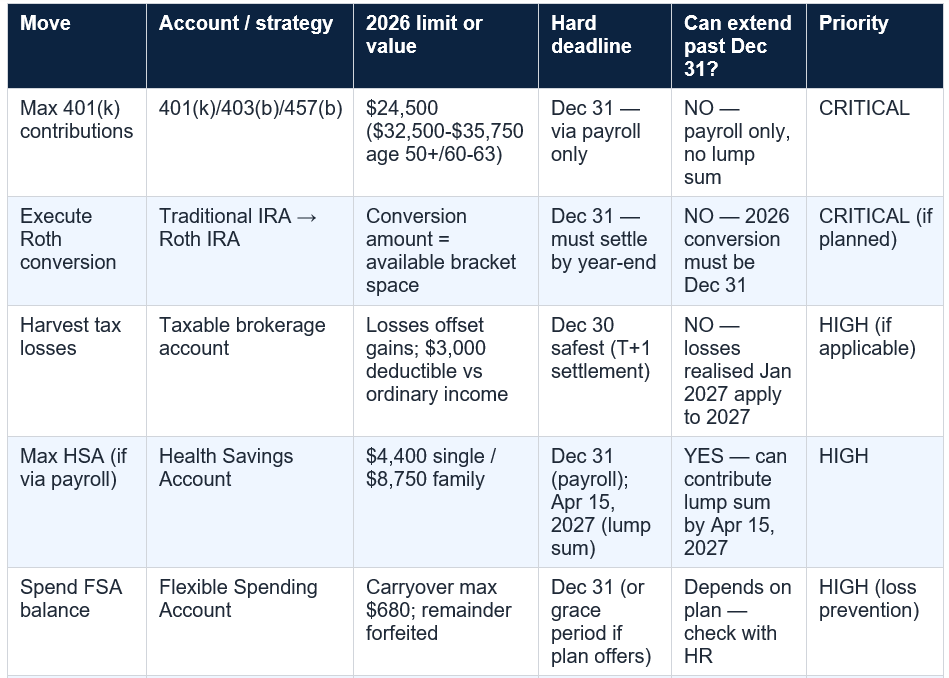
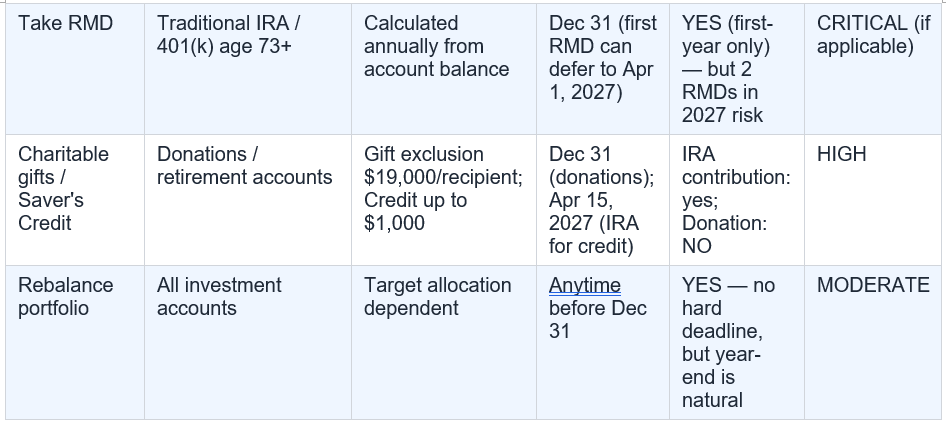
Source: IRS IR-2025-111; TaxShark June 2026; Morgan Stanley 2026 planning guide; Finhabits December 2025; abip CPAs 2 weeks ago; Instead.com 2026; Grasso Advisors December 2025. All figures reflect 2026 tax year under IRS Notice 2025-67 and OBBBA. Deadlines are federal — state rules may differ. Not tax advice. Consult a qualified CPA before any year-end tax decisions.
But the underlying principle applies universally: financial moves that can be made on December 30 cannot be made on January 1. The tax year is a fixed container. Every dollar of 401(k) space not used by December 31 is permanently forfeited. Every capital loss not harvested before settlement is a 2027 loss, not a 2026 one. Every Roth conversion not executed before December 31 is a 2027 taxable event that may occur in a less favourable income year, with less predictable bracket implications. As abip CPAs stated two weeks ago: 'The sooner you reach out, the more options you have.' The options available in September are more extensive than the options available in December.
The year 2026 specifically carries additional weight in that the Saver's Credit is available for the last time. SECURE 2.0's Saver's Match, which begins in 2027, is a different mechanism with different income limits and mechanics. If you have been eligible for the Saver's Credit and haven't acted, this is the year. The window closes at midnight, December 31, 2026. Not tax or financial advice — work with a qualified CPA and financial adviser to apply these strategies to your specific situation.
The 401(k), 403(b), governmental 457(b), and federal Thrift Savings Plan employee elective deferral limit for 2026 is $24,500, up from $23,500 in 2025, as announced by the IRS in IR-2025-111 (November 13, 2025). Workers aged 50 and older can contribute an additional $8,000 in catch-up contributions, for a total of $32,500. Workers aged 60 through 63 have a SECURE 2.0 'super catch-up' limit of $11,250, for a total of $35,750. The total Section 415(c) limit including employer contributions is $72,000. The critical deadline: 401(k) contributions must be made through payroll deductions by December 31, 2026. Unlike IRAs, there is no lump-sum catch-up after year-end. If your paycheck deferral percentage has not been adjusted to reach the new $24,500 limit, log into your plan portal immediately and increase it for remaining 2026 paychecks. The average 401(k) deferral rate is approximately 7.7% of pay (Vanguard How America Saves), well below what most earners need to reach the limit. Source: IRS.gov; TaxShark June 2026; Fox Business December 2025.
What is the IRA contribution limit for 2026?
The traditional IRA and Roth IRA contribution limit for 2026 is $7,500 per person, up from $7,000 in 2025 — the first time the limit has reached $7,500. Individuals aged 50 and older can contribute an additional $1,100, for a total of $8,600, according to Morgan Stanley's 2026 planning guide. The good news: unlike 401(k) contributions, IRA contributions do not need to be made by December 31. You have until April 15, 2027 (the tax filing deadline) to make IRA contributions for the 2026 tax year. For traditional IRA deductibility: if you or your spouse participates in a workplace retirement plan, deductibility phases out at certain income levels — check IRS.gov for current phase-out ranges. For Roth IRA contributions: income limits apply. Roth IRA contributions phase out for single filers with MAGI above $146,000 and for married filing jointly filers above $230,000 (approximate 2026 figures — verify at IRS.gov). For high earners above these limits, the backdoor Roth IRA strategy remains available. Not tax advice.
What is the HSA contribution limit for 2026?
The HSA contribution limit for 2026 is $4,400 for self-only coverage and $8,750 for family coverage, up from $4,300 and $8,550 in 2025. Individuals aged 55 and older can make an additional $1,000 catch-up contribution, bringing the limits to $5,400 (self-only) and $9,750 (family). Eligibility requires being covered by an HSA-eligible High Deductible Health Plan (HDHP) with no other disqualifying coverage — Medicare coverage disqualifies you. Unlike 401(k) contributions, HSA contributions can be made as a lump sum as late as April 15, 2027, for the 2026 tax year. The key year-end action: if your HSA balance exceeds the provider's minimum for investment, make sure the excess is invested — not sitting in cash. Many HSA holders leave balances in cash by default, missing tax-free growth. Source: IRS; TaxShark June 2026; TheFinanceBuff 1 week ago.
What is the Saver's Credit and why is 2026 the last year for it?
The Saver's Credit (officially the Retirement Savings Contributions Credit) is a non-refundable federal tax credit of 10%, 20%, or 50% on up to $2,000 of qualifying retirement account contributions per person — maximum credit $1,000 per person, $2,000 for married couples. The credit is available to lower and middle-income taxpayers who contribute to a 401(k), IRA, Roth IRA, SIMPLE IRA, SEP IRA, or 403(b). Beginning 2027, the SECURE 2.0 Act replaces the Saver's Credit with the Saver's Match — a federal matching contribution deposited directly into the taxpayer's retirement account rather than a reduction in tax owed. The Saver's Match has different income limits and mechanics than the credit. According to TheFinanceBuff's most recent (1 week ago) contribution limits guide: 'Contributions to retirement accounts will no longer qualify for the Saver's Credit after 2026.' 2026 is the last tax year for the credit in its current form. If you are within the income limits, contributing to a retirement account before April 15, 2027 can still qualify for the 2026 credit. Source: TheFinanceBuff (1 week ago); IRS.gov.
What investing moves have hard December 31 deadlines vs April 15 flexibility?
The most important distinction in year-end financial planning: some moves must be completed by December 31, while others can wait until April 15, 2027. HARD DECEMBER 31 DEADLINES (cannot extend): 401(k), 403(b), 457(b) salary deferrals must be made via payroll by December 31 — no lump-sum option exists after year-end; tax-loss harvesting sales must settle by December 31 (execute by December 30 for T+1 settlement); Roth conversions for the 2026 tax year must be executed by December 31; FSA balances above the carryover limit ($680 in 2026) are forfeited December 31 unless the plan offers a grace period; charitable donations must be made (check dated or credit card charged) by December 31; RMDs for those 73+ must be taken by December 31 (first-year RMD can defer to April 1, 2027, but creates two-RMD problem in 2027); annual gifts using the 2026 exclusion ($19,000/recipient) must be completed by December 31. CAN WAIT UNTIL APRIL 15, 2027: traditional IRA and Roth IRA contributions; HSA contributions (if eligible for all of 2026); SEP IRA contributions (can wait until October 2027 with extensions). Source: IRS; TaxShark June 2026; Sherr Financial Associates; abip CPAs 2 weeks ago. Not tax advice.
Table of Contents
- Why December 31 Is the Most Important Date in Your Financial Year
- The 2026 Limits: What Changed and Why It Matters
- Move #1 — Max Your 401(k) Before the Payroll Deadline
- Move #2 — Execute Your Roth Conversion Before December 31
- Move #3 — Harvest Tax Losses Before the Market Closes
- Move #4 — Max Your HSA: The Triple Tax Advantage Account
- Move #5 — Use Your FSA Balance Before You Lose It
- Move #6 — Take Your RMD If You Are 73 or Older
- Move #7 — Make Charitable Gifts and Claim the 2026 Saver's Credit
- Move #8 — Rebalance Your Portfolio and Check Your Asset Allocation
- Year-End Deadlines at a Glance: What Must Be Done by December 31
- Conclusion: The Window Closes at Midnight
- Frequently Asked Questions
Why December 31 Is the Most Important Date in Your Financial Year
April 15 is the tax deadline most people think about first. But for a significant number of the most valuable financial moves of the year, April 15 is irrelevant. Salary deferrals into a 401(k) must go through payroll — you cannot write a check in March to make up for contributions you did not make in December. Tax-loss harvesting trades must settle by December 31 — a loss realised in January 2027 offsets 2027 gains, not 2026 ones. Roth conversions must be executed before the year ends. RMDs must be distributed to qualifying accounts by December 31. FSA balances above the carryover limit are forfeited December 31 unless your plan offers a grace period.For 2026 specifically, the year-end stakes are higher than usual for two reasons. First, contribution limits increased across virtually every tax-advantaged account: the 401(k) limit rose to $24,500, the IRA limit hit $7,500 for the first time, and the HSA limits increased to $4,400 (self-only) and $8,750 (family). Second, the Saver's Credit — a direct tax credit worth up to $1,000 per person for lower and middle-income retirement account contributors — will be replaced by the Saver's Match beginning 2027 under SECURE 2.0. This is the last year to claim the Saver's Credit in its current form.
Abip CPAs & Advisors, whose year-end tax planning guide was published two weeks ago, states the urgency directly: 'Do not wait until the new year to discover opportunities you could have captured in 2026. The sooner you reach out, the more options you have.' WealthStack's May 2026 year-end checklist analysis confirms the long-term impact: 'People who complete their year-end financial checklist consistently, year after year, build dramatically more wealth than those who act sporadically.' This guide identifies the eight highest-impact moves, ranked by the combination of potential value and deadline urgency.
2026 limits: 401(k) $24,500 ($32,500 age 50+; $35,750 ages 60-63 super catch-up). IRA $7,500 ($8,600 age 50+). HSA $4,400 single / $8,750 family. FSA carryover: $680. Annual gift exclusion: $19,000/recipient ($38,000 married). Estate exemption: $15M/$30M (OBBBA permanent). QCD: $111,000/person/year. Saver's Credit: last year 2026. Average 401(k) deferral: only 7.7% of pay (Vanguard How America Saves). Capital losses offset gains dollar-for-dollar; $3,000 excess deductible against ordinary income; carry forward indefinitely. All December 31, 2026 deadlines are absolute — no extensions.
The 2026 Limits: What Changed and Why It Matters
Every year, the IRS adjusts retirement and health savings account limits for inflation. In 2026, the adjustments were meaningful across the board. The 401(k) employee elective deferral limit increased from $23,500 to $24,500 — a $1,000 increase. The IRA and Roth IRA limit increased from $7,000 to $7,500, the first time it has reached $7,500. The HSA self-only limit increased from $4,300 to $4,400, and the family limit increased from $8,550 to $8,750.As TaxShark's June 2026 analysis notes: 'A higher limit is only useful if you act on it. Your employer's payroll system does not automatically raise your contribution percentage to hit the new cap. The consequence of ignoring the change is a smaller tax deduction and slower retirement growth. What you should do is log into your plan portal and recalculate your per-paycheck deferral so it lands near the new cap by year-end.'
The OBBBA, signed July 4, 2025, also made permanent several provisions that affect year-end planning. TCJA income tax brackets (10% to 37%) are now permanent — there is no rate reversion risk. The standard deduction ($16,100 single / $32,200 MFJ) remains elevated. The increased estate and gift tax exemptions ($15M per person / $30M per married couple) are permanent. 100% bonus depreciation was restored for qualifying business property placed in service after January 19, 2025. The Qualified Opportunity Zone programme was preserved. All of these affect year-end strategy decisions.
Move #1 — Max Your 401(k) Before the Payroll Deadline
The 401(k) is the single highest-impact year-end move for most working Americans, for one specific reason: the $24,500 employee deferral limit is available only through payroll deductions made during the 2026 calendar year. Unlike an IRA, which can be funded with a lump-sum contribution as late as April 15, 2027, 401(k) contributions must flow through your employer's payroll system. If December 31 passes without enough payroll deductions to reach your target contribution, that opportunity is permanently closed. There is no lump-sum catch-up in January.In 2026, with the limit at $24,500, an employee who spreads contributions evenly across 24 bimonthly paychecks needs to contribute $1,020.83 per paycheck. Across 26 biweekly paychecks, $942.31 per paycheck. If you started 2026 contributing at the 2025 rate (set up for $23,500) and did not adjust your withholding percentage when the new limit was announced, you may be on track to contribute only $23,500 — leaving $1,000 of tax-deferred space on the table. Log into your plan portal now and verify.
Vanguard's How America Saves report found the average 401(k) deferral rate sits around 7.7% of pay — well below the $24,500 limit for most American salaries. The gap between the average deferral and the maximum represents tens of thousands of dollars of potential tax-deferred compounding left unfunded annually. Each additional dollar contributed pre-tax reduces taxable income dollar-for-dollar. At the 22% bracket, $1,000 of additional 401(k) contribution reduces federal tax by $220. At 24%, by $240. At 32%, by $320.
401(k) contribution value in 2026. Annual contribution at limit: $24,500. Tax savings at 22% bracket: $5,390 federal income tax reduction. Tax savings at 24% bracket: $5,880. Tax savings at 32% bracket: $7,840. Over 25 years at 7% annual growth: $24,500 per year grows to approximately $1.6 million. Additionally: if your employer matches contributions and you are not contributing enough to capture the full match, you are declining free money. The most common employer match (50% of contributions up to 6% of salary) represents up to 3% of salary in additional free compensation. For a $100,000 salary: $3,000 of employer match forfeited per year if you do not contribute at least 6%. Source: High Earner Playbook April 2026; TaxShark June 2026. Not financial advice.
The payroll system lag: most employers require contribution changes to be submitted several weeks before the paycheck that reflects them. If you are reading this in October or November and your contributions are behind, contact your HR department immediately to confirm the cutoff date for submission changes that will affect December paychecks. Some plan administrators stop accepting changes for the final pay period in November. Do not assume December 30 is the effective deadline for payroll changes. Source: abip CPAs 2 weeks ago; Sherr Financial Associates December 2025.
CRITICAL — December 31 deadline, cannot extend. Log into your plan portal this week. Calculate where your 2026 contributions stand relative to the $24,500 limit. If you are behind, increase your deferral percentage immediately for remaining pay periods. Do not leave the employer match on the table. Check the payroll submission cutoff date with HR — it may be earlier than December 31. Not tax advice.
Move #2 — Execute Your Roth Conversion Before December 31
A Roth conversion — transferring money from a traditional IRA or 401(k) to a Roth IRA — is a taxable event in the year it occurs. A conversion executed on December 30, 2026 is a 2026 taxable event; the same conversion executed on January 2, 2027 is a 2027 taxable event. For retirees and pre-retirees who identified a Roth conversion window in 2026, the execution deadline is December 31.As Future Focused Wealth's checklist explains: 'Let's say you're in the 24% tax bracket and have $20,000 of headroom before hitting the next bracket. Converting $20K from your Traditional IRA into a Roth now means you'll pay $4,800 in tax — and never owe another dime on that money (or its growth) again.' This bracket-filling strategy — converting up to (but not past) the top of the current bracket — is the core of most Roth conversion planning, and 2026's permanent TCJA brackets make the current rate environment unusually predictable for this calculation.
The IRMAA two-year lookback is the most common planning mistake in Roth conversion execution. A conversion in 2026 that pushes MAGI above the IRMAA threshold ($109,000 single / $218,000 joint) will trigger Medicare surcharges in 2028. Planning to Wealth's year-end checklist emphasises: 'With the recent passing of the OBBBA, many traditional year-end planning items should be revisited and re-evaluated in light of the new changes.' Specifically, the OBBBA's $6,000/$12,000 senior deduction (ages 65+, phases out above $150,000 MAGI, effective 2025-2028) adds a phase-out calculation to every conversion decision for taxpayers over 65.
Roth conversion year-end checklist. Step 1: Estimate 2026 MAGI from all sources (wages, dividends, capital gains, RMDs, Social Security). Step 2: Identify bracket space remaining before the next bracket or IRMAA threshold. Step 3: Calculate the conversion amount that keeps MAGI below the critical threshold. Step 4: If 65+, check whether the conversion amount keeps MAGI below the $150,000 OBBBA senior deduction phase-out. Step 5: Confirm the conversion will be paid from taxable brokerage funds, not from the IRA itself. Step 6: Execute the conversion through your IRA custodian — allow processing time before December 31. Not tax advice — consult a qualified CPA.
Move #3 — Harvest Tax Losses Before the Market Closes
Tax-loss harvesting is the strategy of selling investments that have declined in value below your purchase price, realising a capital loss that can offset capital gains or ordinary income. Capital losses first offset capital gains dollar-for-dollar with no limit. If losses exceed gains, up to $3,000 of the excess can be deducted against ordinary income per year (or $1,500 for married filing separately). Any remaining losses carry forward indefinitely to future years.The year-end urgency: all sales must be settled by December 31, 2026 to count as 2026 transactions. With T+1 settlement (trades settle one business day after execution), a trade executed December 30 settles December 31 — the last safe date in most years. Executing December 31 itself risks settlement on January 2, which would be a 2027 transaction. abip CPAs' two-weeks-ago year-end tax guide and Instead.com's 2026 harvesting guide both identify December 30 as the practical safe deadline for harvesting trades.
The wash-sale rule is the critical trap: if you sell a security at a loss and repurchase the same or substantially identical security within 30 calendar days before or after the sale (the 61-day window), the loss is disallowed. The wash-sale rule applies across all accounts in the household — your taxable account, your IRA, your 401(k), and your spouse's accounts. Instead.com's 2026 tax-loss harvesting guide warns: 'If you sell a stock at a loss in your taxable account and your spouse buys the same stock in their IRA within 30 days, the loss is disallowed. Coordinate across all household accounts when harvesting.'
The standard solution is to sell the losing position and immediately replace it with a similar (but not substantially identical) investment to maintain market exposure. For example: sell an S&P 500 index fund at a loss, immediately buy a total market fund that tracks the same broad market exposure but is not substantially identical. You stay invested in the same asset class, capture the tax loss, and comply with the wash-sale rule.
Tax-loss harvesting value illustration. Scenario: you have $15,000 of short-term capital gains from stock sales in 2026. You also hold positions with $15,000 of unrealised losses. By harvesting those losses before December 31: Net capital gains: $15,000 - $15,000 = $0. Tax on $15,000 of short-term gains at 22% bracket: $3,300 owed. Tax after harvesting: $0. Tax saved: $3,300. The harvested positions are reinvested in similar (but not identical) securities immediately, maintaining full market exposure. No money leaves the market; the tax savings are real and immediate. Note: this example uses simplified assumptions. Not tax advice — individual tax outcomes depend on the mix of short-term vs long-term gains, income level, and other factors. Consult a CPA.
Crypto tax-loss harvesting: the IRS treats cryptocurrency as property. Losses on crypto sales are deductible as capital losses — and cryptocurrency is NOT subject to the wash-sale rule under current IRS guidance (as of 2026). This means you can sell bitcoin or Ethereum at a loss and immediately repurchase without triggering the wash-sale rule. This can be a significant advantage for crypto holders with unrealised losses. However: wash-sale rule treatment of crypto is a legislative priority — Congress has proposed extending it to crypto in multiple bills. Do not assume this treatment will persist. Not tax advice — consult a CPA on your specific situation.
Move #4 — Max Your HSA: The Triple Tax Advantage Account
The Health Savings Account (HSA) is the only account in the US tax code that offers three simultaneous tax advantages: contributions are tax-deductible (or pre-tax through payroll), the money grows tax-free, and withdrawals for qualified medical expenses are completely tax-free. No other account combines all three. The 2026 HSA contribution limits are $4,400 for self-only coverage and $8,750 for family coverage, with an additional $1,000 catch-up contribution available to those 55 and older.The year-end HSA opportunity has two distinct components. First, the December 31 issue: if your HSA is funded through payroll deductions, the same deadline dynamics as the 401(k) apply — you can only contribute what runs through payroll by December 31. Second, the April 15 extension: unlike 401(k) contributions, you can make a lump-sum HSA contribution for 2026 as late as April 15, 2027, as long as you were covered by an HSA-eligible High Deductible Health Plan (HDHP) throughout 2026.
Finhabits' year-end checklist flags the most common HSA oversight: 'Check whether your HSA balance is invested, not just sitting in cash.' Most HSA providers hold contributions in cash by default, earning minimal interest. Once the account balance exceeds the required minimum (typically $1,000 to $2,500 depending on the provider), the excess can be invested in funds similar to a brokerage account. Leaving HSA balances in cash is one of the most widespread and underappreciated missed opportunities in personal finance — particularly for individuals who are healthy and do not need to draw on the HSA in the near term.
The HSA retirement strategy: if you can afford to pay current medical expenses out-of-pocket without using HSA funds, your HSA becomes a powerful tax-advantaged investment account that grows indefinitely. After age 65, HSA withdrawals for non-medical expenses are simply taxed as ordinary income (like a traditional IRA) — no penalty. For medical expenses at any age, withdrawals remain completely tax-free. Keeping receipts for qualified medical expenses (there is no time limit on reimbursement) allows you to grow the HSA tax-free for decades and then reimburse yourself in retirement for expenses paid years earlier. This is the most advanced HSA strategy and requires careful record-keeping. Not tax advice.
Move #5 — Use Your FSA Balance Before You Lose It
Flexible Spending Accounts (FSAs) are the one year-end financial task that is purely about loss prevention rather than optimisation. FSA funds that exceed the carryover maximum ($680 in 2026, up from $640 in 2025) are forfeited permanently on December 31 unless your employer's plan offers either a carryover or a grace period — but not both. You cannot carry over more than $680 regardless of how much is left in the account.To be specific about the rules: employers can offer a carryover of up to $680, OR a grace period of up to 2.5 months after year-end (through March 15, 2027) during which FSA funds can still be used — but not both options simultaneously. If your employer offers neither, then the use-it-or-lose-it rule is absolute: any FSA balance above zero that remains December 31 is forfeited.
Finhabits' checklist offers practical guidance on FSA spending: 'If you're tired of only using your FSA for allergy meds and Band-Aids, this could be a solid way to invest in your health.' Eligible FSA expenses include prescription eyeglasses and contact lenses, dental work (cleanings, fillings, orthodontics), physical therapy, prescription medications, medical devices (blood pressure monitors, CPAP supplies), menstrual care products, and many over-the-counter medications. Review your remaining FSA balance now and schedule any outstanding medical or dental appointments before December 31.
FSA year-end action steps: (1) Log into your FSA account and find your remaining balance. (2) Ask HR whether your plan offers a grace period or carryover, and the maximum carryover amount. (3) If your balance exceeds the carryover maximum and you have no grace period: schedule outstanding medical or dental appointments before December 31. (4) Order eligible over-the-counter products, prescription eyewear, or medical devices with the remaining balance. (5) If you have a large balance you cannot reasonably spend: note this for next year's FSA enrollment decision — only elect what you expect to use. Not tax advice.
Move #6 — Take Your RMD If You Are 73 or Older
If you turned 73 in 2026 or were already subject to Required Minimum Distributions, your 2026 RMD must be distributed from your traditional IRA, 401(k), or other qualified retirement accounts by December 31, 2026. Failing to take the full RMD triggers a penalty of 25% of the amount that should have been distributed but was not — reduced to 10% if corrected within two years under the SECURE 2.0 corrections provision, but still significant.The one exception: if this is your very first RMD (you turned 73 in 2026), you have until April 1, 2027 to take it. However, if you defer the first RMD to April 2027, you will owe two RMDs in 2027 — the deferred 2026 RMD plus the regular 2027 RMD. Two RMDs in a single year can push income into a higher bracket, trigger IRMAA Medicare surcharges, and increase Social Security taxability. For most people with moderate IRA balances, taking the first RMD in December 2026 rather than deferring to 2027 is the better strategy.
The QCD (Qualified Charitable Distribution) strategy is the most powerful tool for managing RMD tax impact. If you are 70½ or older and are charitably inclined, you can direct up to $111,000 of your RMD (per person, in 2026) directly from your IRA to a qualified charity. The QCD satisfies the RMD obligation while being excluded from your AGI entirely — reducing your taxable income, your Social Security provisional income, and your IRMAA MAGI simultaneously. The $111,000 limit is per person, so a married couple with IRAs can QCD $222,000 combined.
The QCD reporting trap: your IRA custodian will issue a Form 1099-R showing the full distribution as taxable. The QCD exclusion is claimed on your tax return (line 4b of Form 1040 with 'QCD' noted), not through any special form from the custodian. If you fail to mark it correctly or your CPA does not know about it, the IRS will tax the full distribution as ordinary income. Keep the acknowledgement letter from the charity and tell your CPA explicitly that you made a QCD. Source: McKay Wealth May 2026; MichaelRyanMoney July 2026. Not tax advice.
Move #7 — Make Charitable Gifts and Claim the 2026 Saver's Credit
Two distinct year-end moves fall into this section: charitable giving strategy and the Saver's Credit — and they share the December 31 hard deadline.Charitable giving for 2026: for a donation to be deductible on your 2026 tax return, it must be completed (check dated or credit card charged) by December 31, 2026. A donation made January 1, 2027 is a 2027 deduction. Beginning in 2026, the OBBBA introduced a new floor: only charitable itemised deductions exceeding 0.5% of AGI qualify, per Grasso Advisors' December 2025 analysis. For most people using the standard deduction ($32,200 MFJ), this change does not matter — itemising provides no additional benefit anyway. For high-income taxpayers who itemise, the charitable bunching strategy (combining two or three years' worth of giving into a single year through a Donor Advised Fund) is the most efficient way to clear the 0.5% AGI floor and exceed the standard deduction. The annual gift tax exclusion increased to $19,000 per recipient in 2026 ($38,000 for married couples). Gifts completed by December 31 utilise the 2026 exclusion.
The Saver's Credit — 2026 is the LAST YEAR: the Saver's Credit is a tax credit of 10%, 20%, or 50% (depending on income) on up to $2,000 of retirement account contributions per person ($4,000 for married filing jointly). This credit is available to lower and middle-income taxpayers who contribute to a qualifying retirement account (401(k), IRA, Roth IRA, SIMPLE, SEP IRA). Beginning 2027, SECURE 2.0 replaces the Saver's Credit with the Saver's Match — a government matching contribution deposited directly into your retirement account. The mechanics and income limits differ from the credit. If you are eligible for the Saver's Credit in 2026 and have not yet contributed enough to claim it, contributing before December 31 (or by April 15, 2027 if contributing to an IRA) is the last opportunity to claim the credit in its current form.
Saver's Credit value 2026. Example: single filer with AGI of $22,000 in 2026. Saver's Credit rate: 50% (income below $23,500 single for top credit tier). Contribution: $2,000 to a Roth IRA. Credit: $2,000 x 50% = $1,000 direct tax reduction. Net cost of the $2,000 IRA contribution after the credit: $1,000. This is a 50% effective match from the federal government on the first $2,000 of retirement contributions. For married couples with AGI under $47,000: same 50% rate, up to $2,000 per person ($4,000 combined) = $2,000 combined credit. Source: IRS; TheFinanceBuff 2026 contribution limits guide. Not tax advice — income limits and credit rates vary. Verify eligibility at IRS.gov.
Move #8 — Rebalance Your Portfolio and Check Your Asset Allocation
Year-end is the natural moment to examine whether your portfolio still reflects your intended asset allocation. Markets move. A portfolio that was 70% equities and 30% fixed income at the start of 2026 may now be 80/20 if equities outperformed significantly — as they have done in several recent years. Rebalancing returns the portfolio to its target allocation, which typically means selling some of what has grown and buying more of what has lagged.Morgan Stanley's 2026 year-end planning guide identifies portfolio review as a standard December move: 'The end of the year is a good time to revisit your investment strategy and asset allocation to help ensure your portfolio is still apportioned among stocks, fixed income, cash and other asset classes that align with your goals and risk tolerance.' Finhabits' checklist adds the specific actionability: 'Markets don't care about your target allocation. If stocks surged this year while bonds stayed flat, your careful 70/30 split might now be 80/20.'
Rebalancing in a taxable account creates taxable events (selling appreciated positions triggers capital gains). The tax-loss harvesting work from Move #3 can be coordinated with rebalancing: if rebalancing requires selling appreciated stock while you also hold positions with unrealised losses, harvesting the losses before or simultaneously with the rebalancing reduces the net tax impact of the whole operation. Tax-efficient rebalancing — doing the selling in tax-advantaged accounts (IRA, 401(k)) where no immediate tax is triggered — is the most straightforward approach when possible.
Additionally, year-end is the moment to check your emergency fund. Before optimising every tax-advantaged account to the maximum, ensure you have three to six months of essential expenses accessible in liquid savings. Locking every available dollar into retirement accounts while carrying high-interest credit card debt is counterproductive — the after-tax return on paying off a 20% credit card exceeds the return available in any diversified investment portfolio at any reasonable risk level.
Year-end portfolio action steps. (1) Log into every investment account and note the current asset allocation. (2) Compare to your target allocation — if any asset class has drifted more than 5 percentage points from target, plan a rebalance. (3) Coordinate rebalancing with tax-loss harvesting: sell losses first, then rebalance in tax-advantaged accounts where possible. (4) Confirm your emergency fund covers 3-6 months of expenses. (5) Pay off any high-interest debt before maximising discretionary investment contributions. (6) Review beneficiary designations on retirement accounts — these override your will and should be updated for any life changes (marriage, divorce, new children). Not financial advice.
Year-End Deadlines at a Glance: What Must Be Done by December 31
Source: IRS IR-2025-111; TaxShark June 2026; Morgan Stanley 2026 planning guide; Finhabits December 2025; abip CPAs 2 weeks ago; Instead.com 2026; Grasso Advisors December 2025. All figures reflect 2026 tax year under IRS Notice 2025-67 and OBBBA. Deadlines are federal — state rules may differ. Not tax advice. Consult a qualified CPA before any year-end tax decisions.
Conclusion
The eight moves in this guide cover the full spectrum of year-end financial action — from the non-negotiable (401(k) payroll deadline, RMD requirements, tax-loss harvesting settlement) to the highly valuable but slightly more flexible (HSA lump-sum, IRA contribution by April 15, portfolio rebalancing). Not every move applies to every reader. Someone who rents and contributes only to a Roth IRA has a different checklist than someone who owns a business, has a large traditional IRA subject to RMDs, and itemises charitable deductions.But the underlying principle applies universally: financial moves that can be made on December 30 cannot be made on January 1. The tax year is a fixed container. Every dollar of 401(k) space not used by December 31 is permanently forfeited. Every capital loss not harvested before settlement is a 2027 loss, not a 2026 one. Every Roth conversion not executed before December 31 is a 2027 taxable event that may occur in a less favourable income year, with less predictable bracket implications. As abip CPAs stated two weeks ago: 'The sooner you reach out, the more options you have.' The options available in September are more extensive than the options available in December.
The year 2026 specifically carries additional weight in that the Saver's Credit is available for the last time. SECURE 2.0's Saver's Match, which begins in 2027, is a different mechanism with different income limits and mechanics. If you have been eligible for the Saver's Credit and haven't acted, this is the year. The window closes at midnight, December 31, 2026. Not tax or financial advice — work with a qualified CPA and financial adviser to apply these strategies to your specific situation.
Frequently Asked Questions
What is the 401(k) contribution limit for 2026?The 401(k), 403(b), governmental 457(b), and federal Thrift Savings Plan employee elective deferral limit for 2026 is $24,500, up from $23,500 in 2025, as announced by the IRS in IR-2025-111 (November 13, 2025). Workers aged 50 and older can contribute an additional $8,000 in catch-up contributions, for a total of $32,500. Workers aged 60 through 63 have a SECURE 2.0 'super catch-up' limit of $11,250, for a total of $35,750. The total Section 415(c) limit including employer contributions is $72,000. The critical deadline: 401(k) contributions must be made through payroll deductions by December 31, 2026. Unlike IRAs, there is no lump-sum catch-up after year-end. If your paycheck deferral percentage has not been adjusted to reach the new $24,500 limit, log into your plan portal immediately and increase it for remaining 2026 paychecks. The average 401(k) deferral rate is approximately 7.7% of pay (Vanguard How America Saves), well below what most earners need to reach the limit. Source: IRS.gov; TaxShark June 2026; Fox Business December 2025.
What is the IRA contribution limit for 2026?
The traditional IRA and Roth IRA contribution limit for 2026 is $7,500 per person, up from $7,000 in 2025 — the first time the limit has reached $7,500. Individuals aged 50 and older can contribute an additional $1,100, for a total of $8,600, according to Morgan Stanley's 2026 planning guide. The good news: unlike 401(k) contributions, IRA contributions do not need to be made by December 31. You have until April 15, 2027 (the tax filing deadline) to make IRA contributions for the 2026 tax year. For traditional IRA deductibility: if you or your spouse participates in a workplace retirement plan, deductibility phases out at certain income levels — check IRS.gov for current phase-out ranges. For Roth IRA contributions: income limits apply. Roth IRA contributions phase out for single filers with MAGI above $146,000 and for married filing jointly filers above $230,000 (approximate 2026 figures — verify at IRS.gov). For high earners above these limits, the backdoor Roth IRA strategy remains available. Not tax advice.
What is the HSA contribution limit for 2026?
The HSA contribution limit for 2026 is $4,400 for self-only coverage and $8,750 for family coverage, up from $4,300 and $8,550 in 2025. Individuals aged 55 and older can make an additional $1,000 catch-up contribution, bringing the limits to $5,400 (self-only) and $9,750 (family). Eligibility requires being covered by an HSA-eligible High Deductible Health Plan (HDHP) with no other disqualifying coverage — Medicare coverage disqualifies you. Unlike 401(k) contributions, HSA contributions can be made as a lump sum as late as April 15, 2027, for the 2026 tax year. The key year-end action: if your HSA balance exceeds the provider's minimum for investment, make sure the excess is invested — not sitting in cash. Many HSA holders leave balances in cash by default, missing tax-free growth. Source: IRS; TaxShark June 2026; TheFinanceBuff 1 week ago.
What is the Saver's Credit and why is 2026 the last year for it?
The Saver's Credit (officially the Retirement Savings Contributions Credit) is a non-refundable federal tax credit of 10%, 20%, or 50% on up to $2,000 of qualifying retirement account contributions per person — maximum credit $1,000 per person, $2,000 for married couples. The credit is available to lower and middle-income taxpayers who contribute to a 401(k), IRA, Roth IRA, SIMPLE IRA, SEP IRA, or 403(b). Beginning 2027, the SECURE 2.0 Act replaces the Saver's Credit with the Saver's Match — a federal matching contribution deposited directly into the taxpayer's retirement account rather than a reduction in tax owed. The Saver's Match has different income limits and mechanics than the credit. According to TheFinanceBuff's most recent (1 week ago) contribution limits guide: 'Contributions to retirement accounts will no longer qualify for the Saver's Credit after 2026.' 2026 is the last tax year for the credit in its current form. If you are within the income limits, contributing to a retirement account before April 15, 2027 can still qualify for the 2026 credit. Source: TheFinanceBuff (1 week ago); IRS.gov.
What investing moves have hard December 31 deadlines vs April 15 flexibility?
The most important distinction in year-end financial planning: some moves must be completed by December 31, while others can wait until April 15, 2027. HARD DECEMBER 31 DEADLINES (cannot extend): 401(k), 403(b), 457(b) salary deferrals must be made via payroll by December 31 — no lump-sum option exists after year-end; tax-loss harvesting sales must settle by December 31 (execute by December 30 for T+1 settlement); Roth conversions for the 2026 tax year must be executed by December 31; FSA balances above the carryover limit ($680 in 2026) are forfeited December 31 unless the plan offers a grace period; charitable donations must be made (check dated or credit card charged) by December 31; RMDs for those 73+ must be taken by December 31 (first-year RMD can defer to April 1, 2027, but creates two-RMD problem in 2027); annual gifts using the 2026 exclusion ($19,000/recipient) must be completed by December 31. CAN WAIT UNTIL APRIL 15, 2027: traditional IRA and Roth IRA contributions; HSA contributions (if eligible for all of 2026); SEP IRA contributions (can wait until October 2027 with extensions). Source: IRS; TaxShark June 2026; Sherr Financial Associates; abip CPAs 2 weeks ago. Not tax advice.

0 Comments Comments