
Investing
Lowest Amount to Live Off a Fidelity Index Fund

Table of Contents
- The Question Every Index Fund Investor Eventually Asks
- The Core Calculation: How the Minimum Portfolio is Determined
- The Minimum Portfolio Calculator: From $500k to $2.5M by Lifestyle
- The Fidelity Funds: Which One to Use -- and Why It Matters for the Calculation
- How Long Each Portfolio Lasts: Historical Sustainability at Each Withdrawal Rate
- The Five Things That Determine Your Personal Minimum Number
- Conclusion: The Minimum Is a Number, Not a Mystery
- Frequently Asked Questions (FAQ)
- How much do I need invested in a Fidelity index fund to retire?
- What is the safe withdrawal rate for 2026?
- What is the difference between FZROX and FSKAX for retirement income?
- Can I live off the dividends of a Fidelity index fund?
- How long does it take to build a Fidelity index fund portfolio large enough to retire on?
- External References & Further Reading
The Question Every Index Fund Investor Eventually Asks
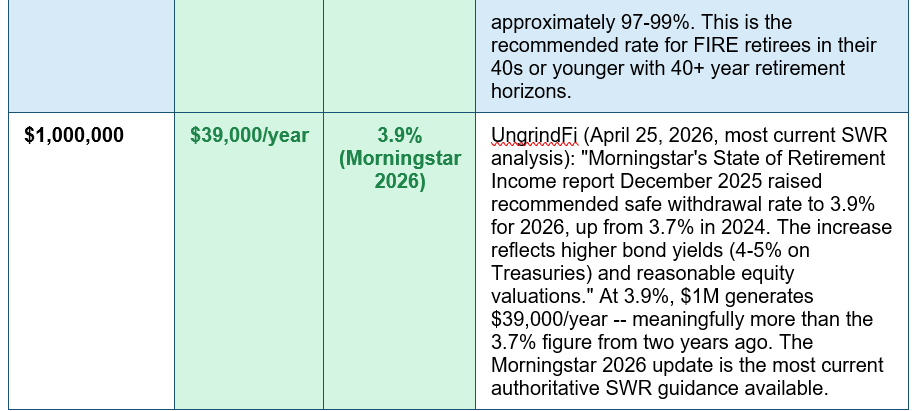
At some point in every investor's journey -- usually when the balance starts to look like something significant -- the question changes. It is no longer 'how do I build the portfolio?' It becomes: 'when is it big enough to live on?' For investors using Fidelity's index funds -- particularly the zero-expense-ratio FZROX (Fidelity ZERO Total Market Index Fund), the industry-standard FSKAX (Fidelity Total Market Index Fund), or the S&P 500 tracking FXAIX -- the answer to that question is a specific number, derived from specific math, updated by the most current withdrawal rate research available.The math begins with the safe withdrawal rate (SWR): the percentage of a portfolio that can be withdrawn annually, adjusted for inflation, without the portfolio running out of money over a defined retirement period. UngrindFi (April 25, 2026): 'Morningstar's State of Retirement Income report (December 2025) raised their recommended safe withdrawal rate to 3.9% for 2026, up from 3.7% in 2024. The increase reflects higher bond yields (4-5% on Treasuries) and reasonable equity valuations.' This is the most current authoritative SWR figure available. It means that in 2026, $1,000,000 invested in a Fidelity index fund can sustain $39,000 per year in withdrawals -- more than at any point since 2021.
The funds that make this calculation real: FZROX carries a 0.00% expense ratio as of February 1, 2026, with a $0 minimum investment and a 0.92% trailing twelve-month dividend yield. FSKAX charges 0.015% -- barely above zero -- and has returned 14.806% compound annualized total return with dividends reinvested from its 2011 inception to May 2026 (MyPlanIQ). FatFire Woman (July 1, 2026 -- most current): 'The best Fidelity funds for most investors are FXAIX, FSKAX, and FZROX.' This guide calculates the minimum portfolio needed to live off each fund, by lifestyle level, with the most current 2026 withdrawal rate data.
The Core Calculation: How the Minimum Portfolio is Determined
The mathematics of living off an index fund rests on two foundational relationships. The first is the safe withdrawal rate (SWR): the percentage of the portfolio withdrawn annually, adjusted for inflation. The second is its inverse: the portfolio multiplier, which tells you how many times your annual spending you must accumulate before withdrawals become sustainable.WeAreCalculator (1 month ago -- most current SWR explanation): 'The SWR is the hinge of all retirement math: invert it and you get your target portfolio size -- at 4%, you need 25x your annual spending; at 3.25%, about 31x. That inversion is exactly how the FIRE calculator derives your financial independence number.' Wealthvieu (FIRE Guide 2026, June 2026): 'FIRE Number = Annual Expenses x 25. For a 30-year retirement, the 4% rule has a historical success rate above 95% using a 60/40 stock/bond portfolio. For a 40-50 year early retirement, many FIRE practitioners use 3-3.5% to improve odds.'
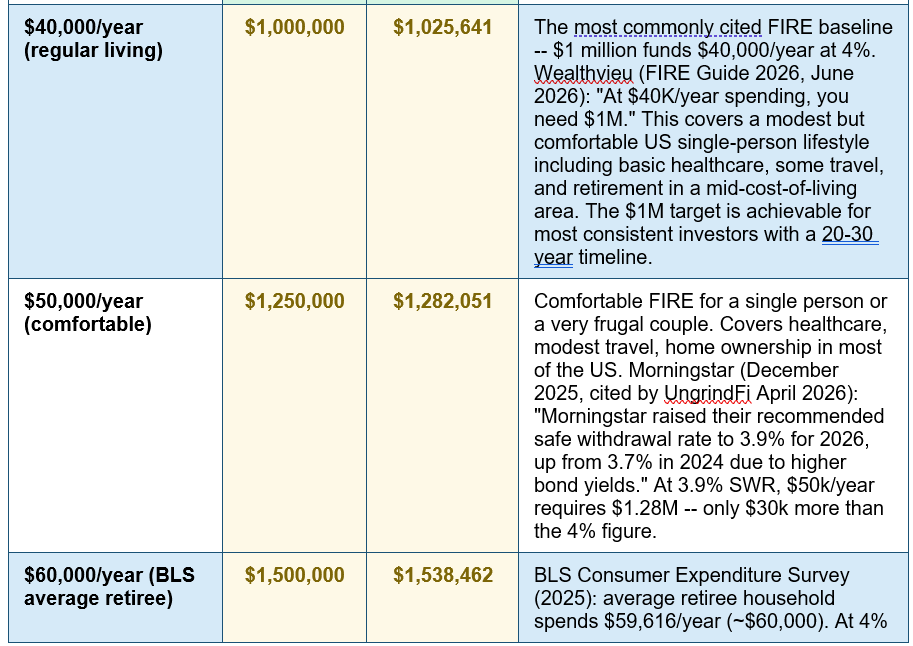
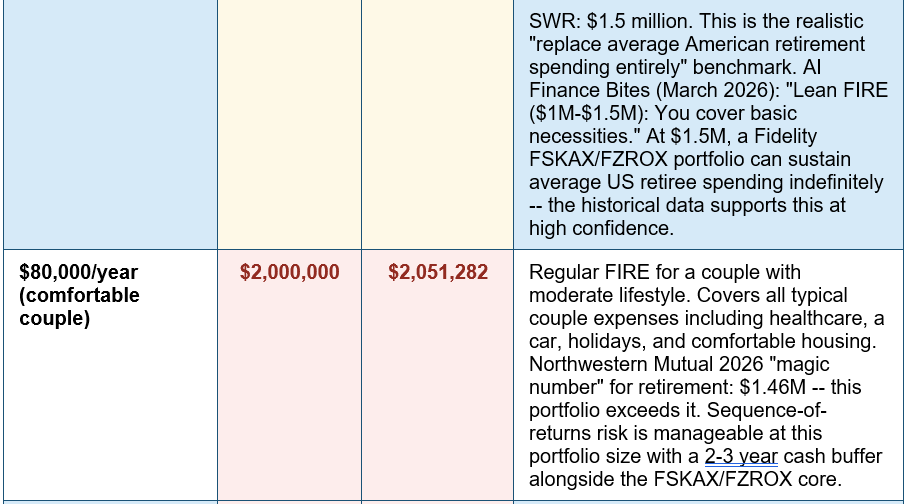
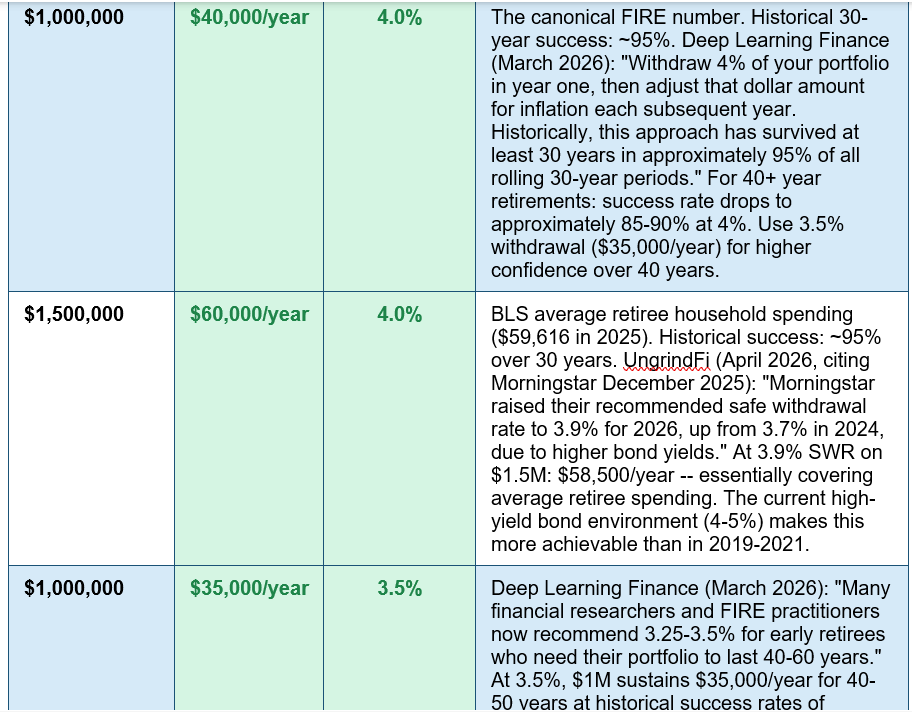
In 2026, the Morningstar-recommended 3.9% SWR means the portfolio multiplier is approximately 25.6 (1 ÷ 0.039). So: minimum portfolio = annual expenses x 25.6. For $40,000 in annual expenses: $40,000 x 25.6 = $1,025,641. The 4% rule gives $1,000,000 for the same spending. The difference between the 4% rule number and the Morningstar 3.9% number is modest -- approximately 2.6% more portfolio -- which is why most financial planning uses 4% as the practical working rate while understanding that 3.9% represents the 2026 research consensus.
The 2026 numbers for living off a Fidelity index fund: SWR: 3.9% (Morningstar Dec 2025). $1M generates $39,000/year. FZROX: 0% fee. FSKAX: 14.8% CAGR since 2011. $500k minimum for $20k/year. — UngrindFi (April 25, 2026, most current SWR): 'Morningstar raised recommended SWR to 3.9% for 2026, up from 3.7% in 2024. Higher bond yields 4-5% on Treasuries.' Fidelity (February 1, 2026): 'FZROX 0.00% expense ratio, no minimums.' MyPlanIQ (to May 8, 2026): 'FSKAX CAGR 14.806% since inception (dividends reinvested). Cumulative total return: 651.509%.' FatFire Woman (July 1, 2026, most current): 'FZROX -- 0% expense ratio, Literally free, $0 minimum.' PortfoliosLab (May 30, 2026): 'FSKAX TTM dividend yield 0.93%. FZROX 0.92%.'
The Minimum Portfolio Calculator: From $500k to $2.5M by Lifestyle
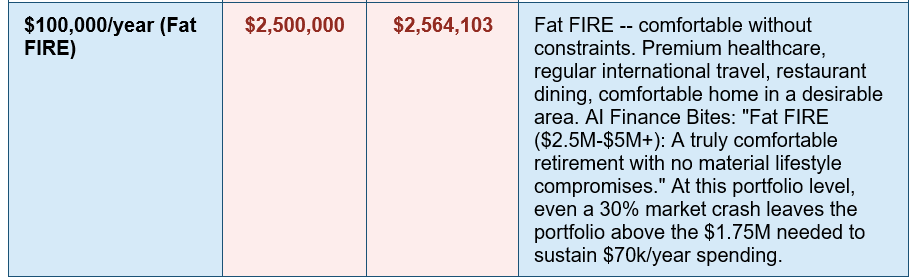
The following table maps each lifestyle spending level to the minimum portfolio required under the 4% rule and the updated Morningstar 3.9% SWR for 2026: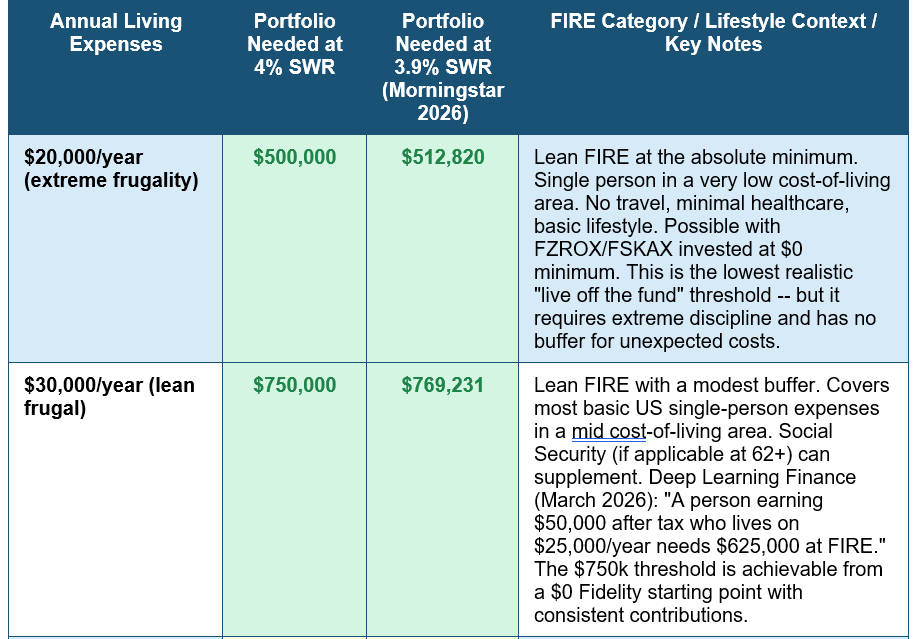
The Fidelity Funds: Which One to Use -- and Why It Matters for the Calculation
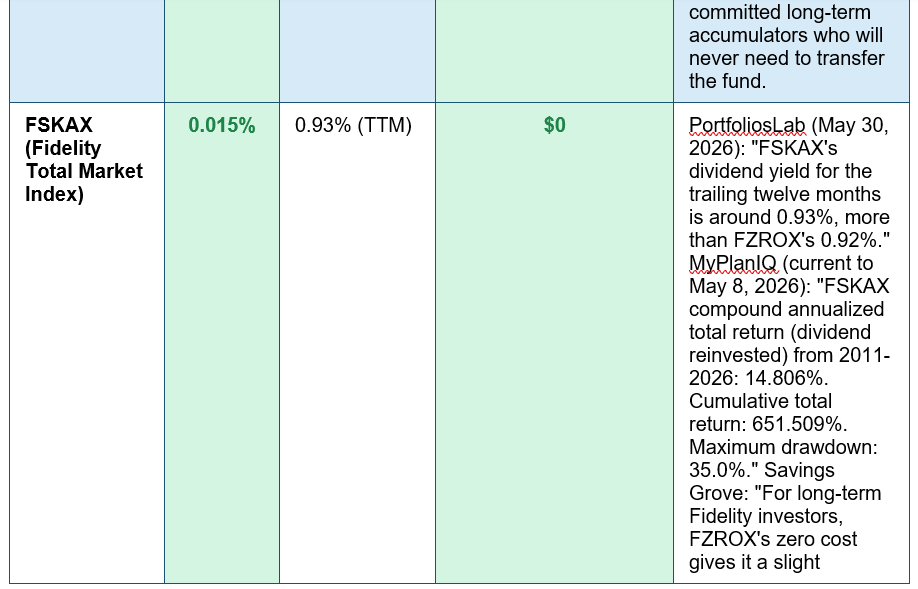
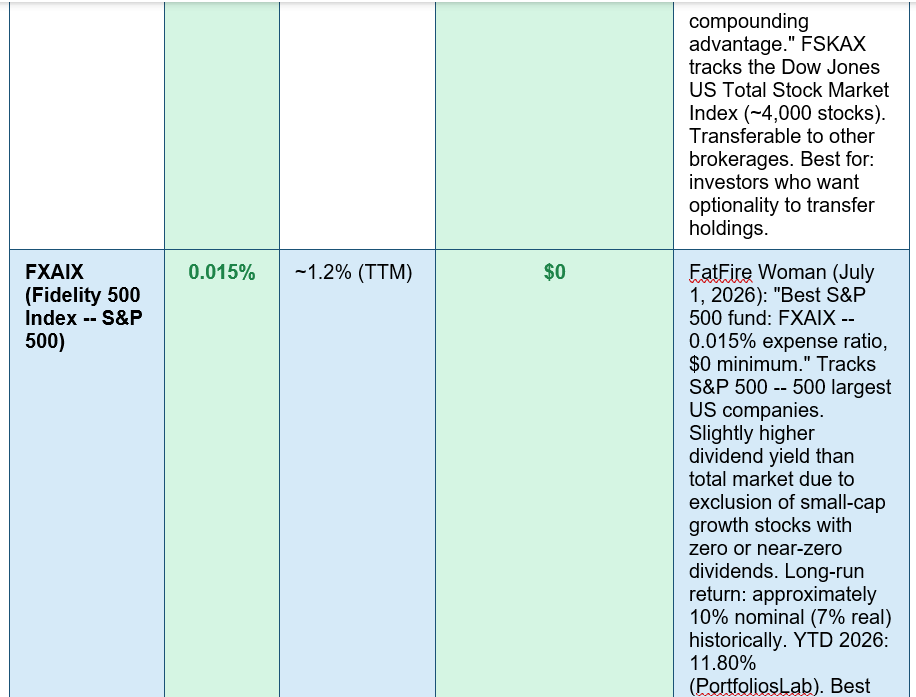
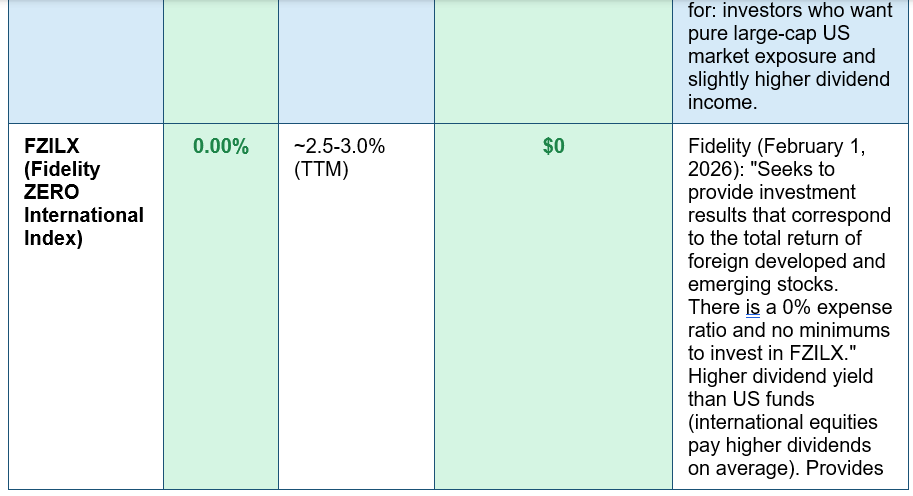
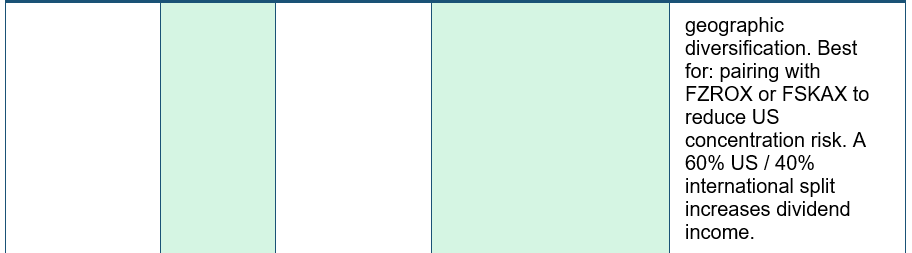
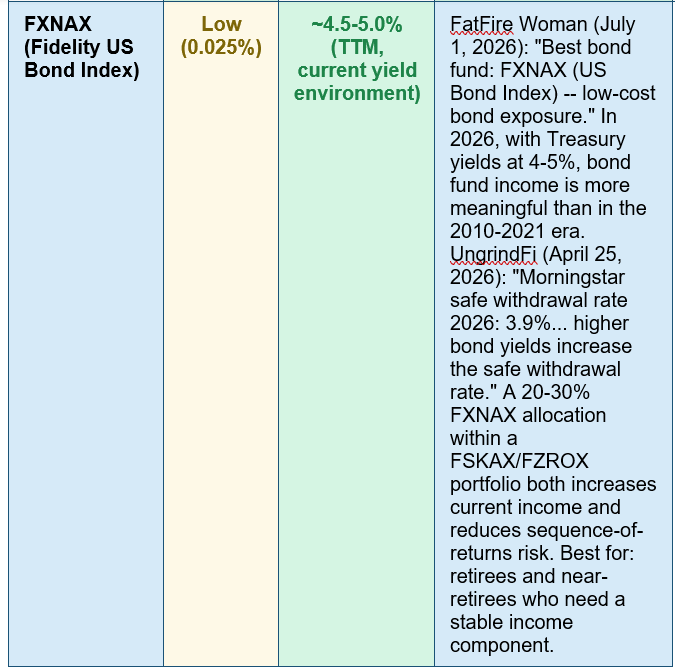
The choice of Fidelity fund affects the income strategy, the portability, and the expense drag on long-term compounding. The following table maps every major Fidelity index fund relevant to this question: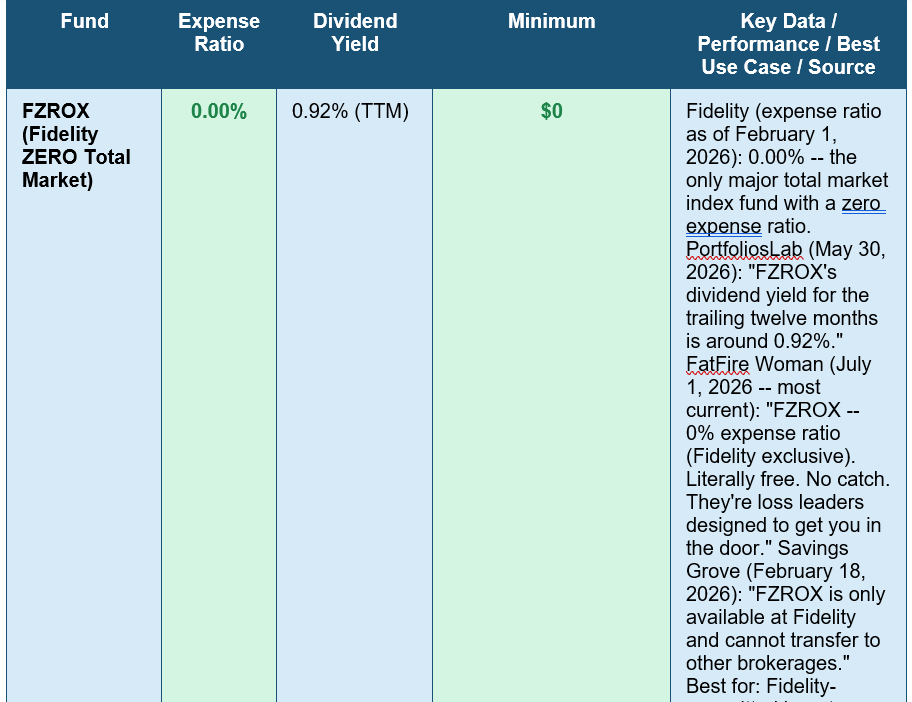
How Long Each Portfolio Lasts: Historical Sustainability at Each Withdrawal Rate
Historical data from the Trinity Study, Bengen (1994), and Morningstar's annual State of Retirement Income series provides the sustainability evidence for each portfolio-withdrawal combination: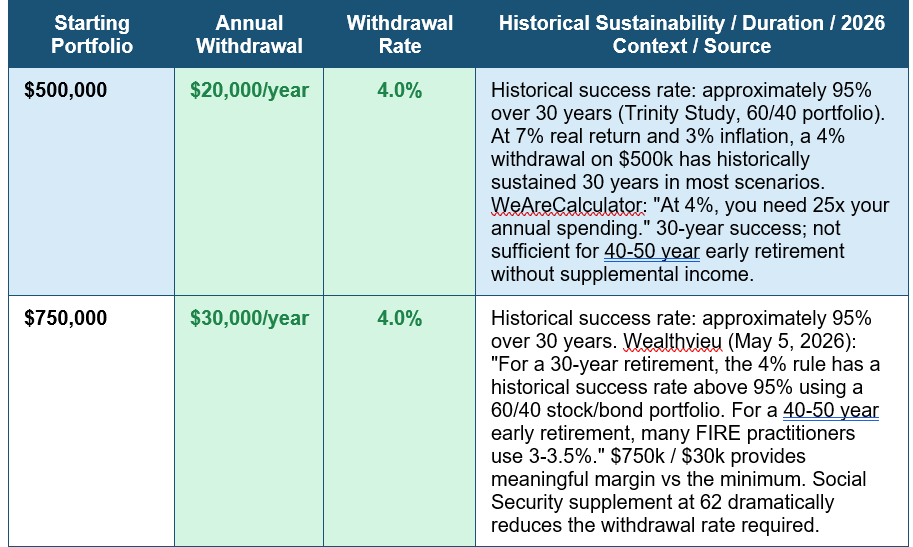
The Five Things That Determine Your Personal Minimum Number
1 YOUR RETIREMENT HORIZON -- THE MOST CRITICAL VARIABLE | 30 years vs 50 years requires different withdrawal rates and different portfolio sizes
The safe withdrawal rate research -- and therefore the minimum portfolio calculation -- is fundamentally about time horizon. Deep Learning Finance (March 22, 2026): 'Historically, [the 4% approach] has survived at least 30 years in approximately 95% of all rolling 30-year periods (using a 60/40 stock/bond allocation). Several factors have led prominent researchers and FIRE practitioners to argue that a 3.25-3.5% withdrawal rate is more appropriate in 2026 for early retirees who need their portfolio to last 40-60 years.' For a standard retiree at 65: 4% SWR, 25x annual expenses as the target. For an early retiree at 45: 3.5% SWR, approximately 28-29x annual expenses. For an early retiree at 35 targeting a 50+ year retirement: 3.25% SWR, approximately 31x annual expenses. The FIRE calculator from AI Finance Bites (March 7, 2026) makes the critical point: 'The 4% rule was created in the 1990s when bond yields were high. Today, with sticky inflation and lower projected bond returns, a 4% withdrawal rate has a failure rate of nearly 15% over a 30-year retirement. If you retire at 40, you need your money to last 50+ years.' UngrindFi (April 2026) provides the reassuring counter: Morningstar's 2026 update raises SWR to 3.9% due to higher bond yields. The current 4-5% Treasury yield environment makes the retirement math more favourable than it was in 2020-2022.2 SEQUENCE OF RETURNS RISK -- WHY THE FIRST 5-10 YEARS MATTER MOST | A bad sequence at the start can deplete a portfolio even if the lifetime average return is fine
WeAreCalculator (1 month ago -- most current SWR explanation): The reason a safe withdrawal rate is much lower than the market average return is sequence-of-returns risk. Stocks have averaged roughly 10% nominal (about 7% real) over the last century -- yet the safe withdrawal rate is 4%, not 7%. The gap exists because you do not earn the average; you earn a specific sequence, and withdrawals make the order matter. Consider two retirees with identical 30-year average returns. Retiree A hits a 40% crash in years 1-2; Retiree B hits the same crash in years 28-29. Retiree A is selling shares at depressed prices early on, permanently shrinking the base that later recovery compounds from. Retiree B rode the full compounding first. Same average, wildly different outcomes. FSKAX experienced a maximum drawdown of 35.0% between 2011 and 2026 (MyPlanIQ). The mitigation: a 2-3 year cash buffer at 4.5-5.0% APY provides the ability to fund living expenses without selling fund units during market corrections. This single structural decision -- maintaining a cash buffer alongside the FZROX/FSKAX core -- dramatically improves portfolio survival odds without requiring a larger total portfolio.3 DIVIDEND INCOME VS TOTAL RETURN -- TWO DIFFERENT STRATEGIES | FSKAX/FZROX yield 0.92-0.93%. At $1M invested, that is $9,200-$9,300/year in dividends.
There are two conceptually different strategies for living off a Fidelity index fund. The dividend-income strategy: live only off the dividends generated by the fund, never selling shares. The total-return strategy: live off a combination of dividends and capital appreciation, selling shares as needed per the SWR framework. FSKAX has a trailing twelve-month dividend yield of 0.93% (PortfoliosLab, May 30, 2026). On a $1,000,000 investment: $9,300/year in dividends. This is far too low to live on for most people. At $2,500,000: $23,250/year. Still below the lean FIRE threshold of $30,000. To generate $40,000/year in dividends alone from FSKAX/FZROX (at ~0.93% yield), you would need approximately $4.3 million -- more than 4x the portfolio needed under the total-return SWR framework. The dividend-only strategy requires a dramatically larger portfolio than the total-return SWR approach. Most financial planners recommend the total-return strategy: the SWR framework (4%/3.9% withdrawal including both dividends and share sales) is the mathematically superior approach for living off an index fund. The 0.93% dividend yield covers part of the withdrawal; the remaining amount comes from selling a small number of fund units each year. FZROX, White Coat Investor (February 17, 2026) notes, 'only pays a dividend once a year in December. That could be a potential downside if you rely on dividend income for your expenses.' This is the structural argument for holding both FZROX (0% fee) and FXNAX (bond index, 4-5% current yield) in a retirement portfolio -- FXNAX provides regular bond income that smooths the cash flow.4 TAX TREATMENT -- WHERE THE ACCOUNT TYPE CHANGES THE EFFECTIVE MINIMUM | A Roth IRA distribution is tax-free. A traditional 401(k) withdrawal is taxable income. The minimum portfolio differs.
The account type that holds the Fidelity index fund significantly affects the minimum portfolio needed to sustain a given lifestyle. Roth IRA: qualified distributions are entirely tax-free. A $40,000/year lifestyle from a Roth-held FZROX requires $40,000/year in portfolio withdrawals, with no tax obligation on the withdrawal. Traditional 401(k) or Traditional IRA: withdrawals are ordinary income and are taxable at the marginal rate. To net $40,000/year in after-tax spending from a traditional 401(k) in the 22% marginal tax bracket: you need to withdraw approximately $51,282 before tax ($51,282 x 78% = $39,999). This means the required portfolio is $1,282,050 (at 4% SWR) rather than $1,000,000 -- a 28.2% larger portfolio required for the same after-tax income. The tax efficiency ordering for living off a Fidelity index fund: (1) Roth IRA with FZROX or FSKAX -- tax-free growth and withdrawals; (2) HSA for healthcare expenses -- triple tax advantage; (3) Taxable brokerage with FSKAX or FZROX -- capital gains rates typically lower than ordinary income rates; (4) Traditional 401(k)/IRA -- most tax-costly for regular withdrawals. Wealthvieu (FIRE Guide 2026): 'A common strategy: live off taxable accounts in early retirement while doing Roth conversions, then access Roth money penalty-free.' The Roth conversion ladder -- converting traditional IRA funds to Roth during low-income years in early retirement at low marginal rates -- is the most sophisticated tax optimisation strategy for FZROX/FSKAX-based retirement.5 SUPPLEMENTAL INCOME -- HOW A SMALL SIDE INCOME TRANSFORMS THE MINIMUM | $10,000/year in part-time or passive income reduces the portfolio requirement by $250,000 at 4% SWR
UngrindFi (April 25, 2026): 'This is the core idea behind Barista FIRE: working part-time not because you have to, but because even $10,000-$15,000/year in earnings dramatically reduces the pressure on your portfolio. At a 3.9% withdrawal rate on $1 million, you need $39,000/year from your portfolio. If part-time work covers $12,000 of that, your effective withdrawal rate drops to 2.7% -- well below even the most conservative recommendations.' The arithmetic of supplemental income on the minimum portfolio is powerful: at 4% SWR, every $1,000 of annual supplemental income reduces the required portfolio by $25,000. Every $10,000 of supplemental income: reduces required portfolio by $250,000. Sources of supplemental income that reduce the minimum portfolio: Social Security (the most powerful supplement, worth $200,000-$500,000 in portfolio-equivalent value when it begins at 62-70); part-time work ($15,000-$30,000/year reduces the portfolio requirement by $375,000-$750,000 at 4% SWR); rental income; online content or business income; freelance consulting. Wealthvieu (June 3, 2026): 'Barista FIRE or Coast FIRE reduce sequence risk by keeping some income.' For investors who cannot reach the $1M mark but want to transition away from full-time employment, the Barista FIRE and Coast FIRE approaches demonstrate that supplemental income can make even a $600,000-$750,000 portfolio a viable platform for semi-retirement.FSKAX's actual historical performance: what $10,000 invested at inception became. MyPlanIQ (current to May 8, 2026): 'From 09/14/2011 to 05/08/2026, the compound annualized total return (dividend reinvested) of Fidelity Total Market Index Fund (FSKAX) is 14.806%. Its cumulative total return (dividend reinvested) is 651.509%.' A $10,000 investment in FSKAX at inception in September 2011, with all dividends reinvested, grew to approximately $75,150 by May 2026 -- a 651% total return over approximately 14.5 years. The maximum drawdown over this period was 35.0% -- meaning at the worst point (likely the COVID crash of March 2020), a $75,000 portfolio fell to approximately $48,750 before recovering. The 14.8% CAGR since 2011 is well above the 7% real return typically used in safe withdrawal rate calculations -- which is the conservative, long-run historical average. Using 14.8% to project future returns would be dangerously optimistic. Using 7% real return, which is the standard used in the Trinity Study and Morningstar's 2026 research, is the appropriate basis for minimum portfolio calculations. The 14.8% recent CAGR tells us that FSKAX has been a powerful wealth builder over the past 14 years. It does not tell us what it will earn over the next 30 years. The 4%/3.9% SWR is calibrated to survive the worst historical sequences, not the best.
FIVE MISTAKES THAT DESTROY THE 'LIVE OFF THE FUND' STRATEGY: (1) WITHDRAWING TOO MUCH IN THE FIRST FEW YEARS. Sequence-of-returns risk means that withdrawing 5-6% in the early years, even with the intention of pulling back later, can permanently deplete the portfolio before recovery occurs. Set the withdrawal rate at the outset and automate it at 3.9-4%. Do not increase it in bull market years. (2) HOLDING THE FUND IN THE WRONG ACCOUNT TYPE. FZROX in a taxable brokerage account means capital gains tax on every share sold. FZROX in a Roth IRA means zero tax on withdrawals. The same fund in the wrong account type can increase the effective withdrawal rate by 25-35%, requiring a correspondingly larger portfolio. (3) NOT MAINTAINING A CASH BUFFER. WeAreCalculator (1 month ago): selling depressed fund units during a market crash to fund withdrawals permanently shrinks the compounding base. A 2-3 year cash buffer (in HYSA at 4.5-5.0% APY) prevents this. A $60,000/year spender needs a $120,000-$180,000 cash buffer alongside the FSKAX/FZROX core. (4) CONCENTRATING ENTIRELY IN US STOCKS. FZROX and FSKAX are 100% US market. Pairing with FZILX (international, 0% fee) provides geographic diversification and increases the dividend yield component (international stocks typically pay 2-3% dividends vs 0.9% for US total market). A 70% US / 30% international split has historically improved risk-adjusted returns. (5) IGNORING INFLATION ADJUSTMENTS. The 4% rule requires increasing the withdrawal amount each year by the inflation rate. If you withdraw $40,000 in year one, you withdraw $41,200 in year two (at 3% inflation) and $42,436 in year three. Failing to adjust for inflation erodes purchasing power and is one of the most common mistakes made by new retirees living off index funds.
THE PORTFOLIO BUILDING PATH: HOW TO REACH YOUR FIDELITY INDEX FUND MINIMUM -- IN SIMPLE STEPS: (1) OPEN A FIDELITY ACCOUNT TODAY ($0 minimum): Go to fidelity.com. Open a Roth IRA (if eligible -- 2026 limit: $7,000) or a taxable brokerage account. No minimum. No account fee. (2) BUY FZROX OR FSKAX: Select FZROX (0.00% expense ratio, Fidelity-exclusive) for maximum cost efficiency, or FSKAX (0.015%, transferable) for portability. FatFire Woman (July 1, 2026): 'Every Fidelity index fund starts at $0. Vanguard Admiral Shares require $3,000.' (3) AUTOMATE MONTHLY CONTRIBUTIONS: The compound effect of monthly contributions is the primary driver of reaching the minimum. $500/month at 7% real return for 30 years grows to approximately $567,000. $1,000/month grows to approximately $1.134 million -- sufficient for $45,000/year at 4% SWR. (4) REINVEST ALL DIVIDENDS: FSKAX's 0.93% dividend yield (PortfoliosLab, May 30, 2026) reinvested automatically accelerates compounding. At $100,000 portfolio: $930/year reinvested. At $500,000: $4,650/year reinvested into the same fund. (5) CALCULATE YOUR NUMBER ANNUALLY: Annual expense x 25.6 (Morningstar 2026 multiplier) = current target portfolio. As lifestyle costs change and Social Security approaches, the target number shifts. Recalculate on January 1st every year.
YOUR MINIMUM FIDELITY INDEX FUND PORTFOLIO -- THE EXACT CALCULATION: STEP 1 -- CALCULATE YOUR ANNUAL LIVING EXPENSES: List all essential annual costs: housing, food, healthcare, transport, utilities, subscriptions, and a discretionary allowance. Be realistic -- underestimating creates the retirement gap. Use 2026 prices as the baseline. STEP 2 -- CHOOSE YOUR WITHDRAWAL RATE: Age 65+: use 4.0% (4% rule, 95% historical success over 30 years). Age 50-64: use 3.5% (improved survival odds over 40+ years). Age 40-49: use 3.25% (most conservative; 50+ year retirement horizon). 2026 Morningstar consensus: 3.9% for a standard retirement. STEP 3 -- CALCULATE THE MINIMUM PORTFOLIO: Minimum portfolio = Annual expenses ÷ Withdrawal rate. Examples: $40,000 ÷ 0.039 = $1,025,641. $60,000 ÷ 0.039 = $1,538,462. $30,000 ÷ 0.04 = $750,000. STEP 4 -- SUBTRACT SUPPLEMENTAL INCOME: Social Security benefit (check ssa.gov/myaccount) x 25 = the portfolio equivalent it replaces. If Social Security provides $18,000/year: subtract $450,000 from the portfolio target. STEP 5 -- ACCOUNT FOR TAX LOCATION: If withdrawals are from a Roth IRA (tax-free): use the gross annual spending figure. If from a traditional 401(k): add 15-30% to annual spending before calculating, to account for ordinary income taxes on withdrawals. FREE TOOLS: Fidelity Retirement Calculator fidelity.com | SEC compound interest calculator investor.gov | Wealthvieu FIRE calculator wealthvieu.com/retirement/fire.
Conclusion
The lowest amount you need to live off a Fidelity index fund is not a vague aspiration. It is a specific number, derived from specific math, updatable every year as the Morningstar SWR research evolves. In 2026, the Morningstar-recommended safe withdrawal rate of 3.9% means the multiplier is approximately 25.6x annual expenses. For $20,000/year in spending: $512,820. For $40,000/year: $1,025,641. For $60,000/year: $1,538,462. For $100,000/year: $2,564,103.The Fidelity funds that make this achievable from $0 are already available. FZROX carries a 0.00% expense ratio with no investment minimum, as confirmed by Fidelity's February 1, 2026 fact sheet. FSKAX has returned 14.806% compound annualized total return since inception with dividends reinvested (MyPlanIQ, through May 2026). FatFire Woman (July 1, 2026 -- most current): 'The best Fidelity funds for most investors are FXAIX, FSKAX, and FZROX. Fidelity actually has a weapon Vanguard doesn't: zero-expense-ratio funds like FZROX and FZILX. Literally free.'
The variable that matters most is not the specific fund chosen between FZROX and FSKAX -- their expense ratio difference is functionally negligible and their correlation is near-perfect (PortfoliosLab: correlation 1.00). The variables that matter are the retirement horizon (which sets the withdrawal rate), the account type (which determines the tax efficiency), the presence or absence of supplemental income (which reduces the portfolio requirement by $25,000 for every $1,000 of annual income), and the discipline to automate contributions and maintain the withdrawal rate once retirement begins. The minimum portfolio is a number. The path to it is monthly, automated, compounding -- one index fund contribution at a time.
Frequently Asked Questions (FAQ)
How much do I need invested in a Fidelity index fund to retire?The minimum amount needed depends on your annual living expenses and your planned withdrawal rate. The formula: minimum portfolio = annual expenses ÷ safe withdrawal rate. Using the 2026 Morningstar-recommended SWR of 3.9% (updated December 2025, cited by UngrindFi April 25, 2026 -- most current): at $30,000/year in spending, you need approximately $769,231. At $40,000/year: $1,025,641. At $60,000/year: $1,538,462. Using the traditional 4% rule (simpler and nearly identical): $30,000/year needs $750,000; $40,000/year needs $1,000,000; $60,000/year needs $1,500,000. Wealthvieu (FIRE Guide 2026, June 2026): 'Based on the Trinity Study's finding that a 4% annual withdrawal rate has historically survived 30-year retirement periods, your target nest egg is simply 25 times your annual expenses.' Fidelity's specific funds -- FZROX (0% expense ratio, $0 minimum) and FSKAX (0.015%, $0 minimum) -- are the primary vehicles. Both track the total US stock market with near-perfect correlation (PortfoliosLab: correlation 1.00) and are available to any investor with a Fidelity account. The minimum portfolio calculation does not change based on which Fidelity fund you use -- the expense ratio difference of 0.015% between FZROX and FSKAX produces approximately $150/year difference on a $1,000,000 portfolio, which is negligible in retirement planning terms.
What is the safe withdrawal rate for 2026?
UngrindFi (April 25, 2026 -- most current withdrawal rate analysis): 'Morningstar's State of Retirement Income report (December 2025) raised their recommended safe withdrawal rate to 3.9% for 2026, up from 3.7% in 2024. The increase reflects higher bond yields (4-5% on Treasuries) and reasonable equity valuations.' This is the most current authoritative SWR for 2026. Context: the traditional 4% rule (from Bengen 1994 and the Trinity Study 1998) suggests a 4.0% SWR is appropriate for a standard 30-year retirement. Morningstar's annual State of Retirement Income research updates this figure based on current bond yields, equity valuations, and inflation expectations. The 3.9% Morningstar figure is for a standard 30-year retirement. For longer retirements: Deep Learning Finance (March 22, 2026): 'Many financial researchers and FIRE practitioners now recommend 3.25-3.5% for early retirees who need their portfolio to last 40-60 years.' AI Finance Bites (March 7, 2026): 'A proper FIRE Calculator allows you to adjust this variable. The 4% rule has a failure rate of nearly 15% over a 30-year retirement with sticky inflation -- if you retire at 40, you need your money to last 50+ years.' Wealthvieu (May 5, 2026): 'With dynamic spending rules (guardrails), guaranteed income covering essential expenses, and willingness to adjust spending by 5-10% in down years, 4.5-5% becomes defensible.' For most investors using a Fidelity index fund for standard retirement (age 62-67): 3.9-4.0% is the 2026 evidence-based range. For early retirees (before 60): 3.25-3.5% is more appropriate.
What is the difference between FZROX and FSKAX for retirement income?
FZROX (Fidelity ZERO Total Market Index Fund) and FSKAX (Fidelity Total Market Index Fund) are functionally near-identical funds that differ primarily in expense ratio and portability. Savings Grove (February 18, 2026): 'FZROX and FSKAX both provide broad U.S. total market exposure through Fidelity, but FZROX has a 0.00% expense ratio versus FSKAX's 0.015%.' PortfoliosLab (May 30, 2026): 'The correlation between FSKAX and FZROX is 1.00 -- these two move nearly in lockstep.' For retirement income purposes: Dividend yield: FSKAX yields 0.93% trailing twelve-month versus FZROX's 0.92% (PortfoliosLab). On a $1,000,000 portfolio: the difference is approximately $100/year in dividend income. Negligible for planning purposes. Expense ratio: FZROX's 0.00% vs FSKAX's 0.015% saves $150/year on a $1,000,000 portfolio. Over 30 years, this compounds to a modest but real difference. Portability: FatFire Woman (July 1, 2026): 'FZROX is only available at Fidelity and cannot transfer to other brokerages.' FSKAX can transfer. If there is any chance of switching brokerages, FSKAX or FXAIX (or the ETF equivalents, which all brokerages accept) are more practical. Dividend frequency: White Coat Investor (February 17, 2026): FZROX pays dividends only once per year (December). FSKAX distributes quarterly. For retirement income that relies on dividend payments, FSKAX's quarterly distributions provide more regular cash flow than FZROX's annual payment. For most retirement investors: the difference between these funds is not material to the retirement outcome. Both are excellent. Choose FZROX if permanently committed to Fidelity; choose FSKAX if portability matters.
Can I live off the dividends of a Fidelity index fund?
Yes -- but you would need a much larger portfolio than the 4%/3.9% SWR approach requires. FSKAX and FZROX both yield approximately 0.92-0.93% in trailing twelve-month dividends (PortfoliosLab, May 30, 2026). To live off dividends alone at this yield: for $30,000/year in income: $30,000 ÷ 0.0093 = $3,225,807 required portfolio -- more than 4x the $750,000 needed under the 4% total-return SWR. For $40,000/year: $4,301,075 required. For $60,000/year: $6,451,613 required. The dividend-only strategy requires dramatically larger portfolios because total market US index funds are growth-oriented and pay modest dividends. Higher-dividend alternatives: FZILX (Fidelity ZERO International Index, 0% fee) yields approximately 2.5-3.0% in dividends -- meaningfully higher than the US total market. A blend of FSKAX (US, ~0.93% yield) and FZILX (international, ~2.5% yield) at 60/40 produces a blended yield of approximately 1.6%. At $1,500,000: $24,000/year in dividends -- still below a lean FIRE lifestyle without supplemental withdrawals. The practical recommendation: use the total-return SWR framework (4%/3.9% annual withdrawal including both dividends and periodic share sales), not a dividend-only approach, when living off Fidelity index funds. The dividends cover part of the withdrawal; the remainder comes from selling a small number of fund units annually. This is mathematically superior and produces a sustainable income from a smaller portfolio.
How long does it take to build a Fidelity index fund portfolio large enough to retire on?
The time required to build a Fidelity index fund portfolio to the minimum retirement threshold depends on three variables: the monthly contribution amount, the starting balance, and the assumed average annual return. Using 7% real annual return (the conservative long-run historical average used in the Trinity Study and Morningstar research): From $0, contributing $500/month: reaches $750,000 in approximately 32 years; $1,000,000 in approximately 36 years. From $0, contributing $1,000/month: reaches $750,000 in approximately 23 years; $1,000,000 in approximately 26 years. From $0, contributing $2,000/month: reaches $750,000 in approximately 16 years; $1,000,000 in approximately 19 years. From $100,000 starting balance, contributing $1,000/month: reaches $1,000,000 in approximately 20 years. From $250,000, contributing $1,000/month: reaches $1,000,000 in approximately 14 years. The starting balance has a powerful effect because it is already compounding at 7% without additional contributions. MyPlanIQ data shows FSKAX actually returned 14.806% CAGR from 2011-2026 -- using this figure would produce much faster timelines, but using historical highs for projection is financially dangerous. The 7% real return is the appropriate conservative projection. Deep Learning Finance (March 2026): 'A person earning $50,000 after tax who maintains a 50% savings rate ($25,000/year invested) and lives on $25,000/year needs a FIRE number of $625,000. At 7% average returns, starting from zero, that takes approximately 15 years.' The Fidelity-specific advantage: FZROX's 0% expense ratio means every dollar of return stays in the portfolio. At 7% gross return on $500,000, the difference between 0% and 1% management fees is $5,000/year -- compounded over 20 years, this is approximately $200,000 in additional wealth retained.

0 Comments Comments