

Real Estate
Midterm Election Results: What Could Change for Housing Now?

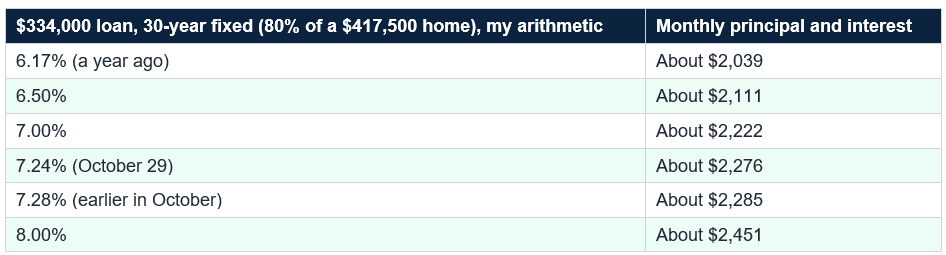
The market: 30-year mortgage rate 7.24% on Oct 29 (6.17% a year earlier) and 7.28% earlier in October, the highest since Nov 2023; median new-home price $410,700; a supply gap of about 4.7 million homes; Oxford expects affordability to erode until 2028; Fed held at 3.75%–4.00% with a December hike possible. The ballot: all 435 House seats and 35 Senate seats; governors in 36 states; six statewide housing measures; Florida property tax relief; California housing bonds; 37 competitive House races. Clever survey (Sept): 63% doubt the midterms will help housing; 49% expect worse affordability if Republicans keep control (31% if Democrats gain it). My arithmetic on a $334,000 loan (80% of $417,500) at 7.24%: payment about $2,276; a 0.25-point rate change is about $56–$57 a month; a point is about $222–$231; the move from 6.17% to 7.24% adds about $237 a month; a $10,000 down-payment grant saves about $68 a month; a 0.25-point mortgage-insurance cut about $70; a 0.25% property tax cut on $417,500 about $87.
The question for anyone planning to buy, sell or refinance is practical: will the results change anything for me, and how soon? The short version is that elections matter for housing policy over years and much less for mortgage rates over days. This guide lays out where housing stands, what is being decided, what different outcomes could mean and what you can do now, without pretending to know who wins.
That backdrop explains the politics. Meanwhile, the Fed raised its target by a quarter point on September 16, held on October 28 and markets saw nearly 75% odds of another hike by year-end, with the 10-year Treasury near 4.93% and inflation at 3.7%. Those forces, not the election, are the main drivers of what a buyer pays each month.
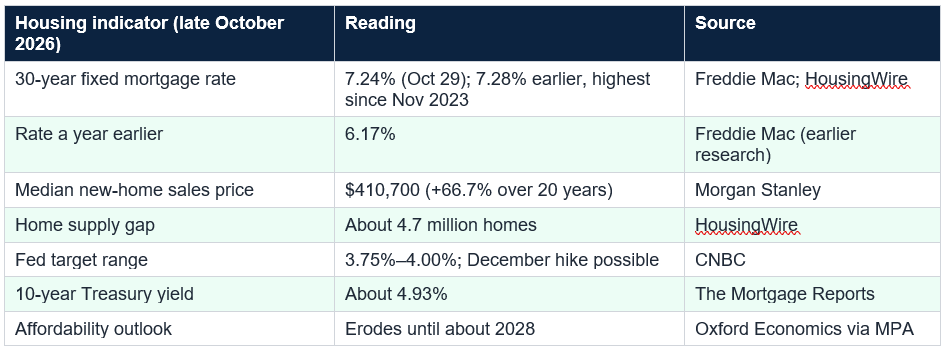
30-year mortgage rate 7.24% (6.17% a year ago); median new-home price $410,700; supply gap about 4.7 million homes; Fed at 3.75%–4.00%; Oxford expects affordability to erode until about 2028.
The federal backdrop is unusual: the 21st Century ROAD to Housing Act, a bipartisan package to boost supply by cutting regulatory barriers, encouraging construction, expanding housing finance and reforming federal programs, became law without President Trump’s signature. So the question after the election is less whether to act on housing than how: which programs get funded, which change and how fast, which depends on who controls the House and Senate in 2027.
Treat survey expectations as a mood, not a forecast: predictions about housing often track politics, and policy effects take time. What the numbers show is that housing costs are a bipartisan worry. Republicans have emphasized homeownership and housing costs, and Democrats, including Senate Minority Leader Chuck Schumer, have outlined proposals to expand down-payment assistance, lower mortgage insurance costs, encourage construction financing and make mortgages more portable or assumable.

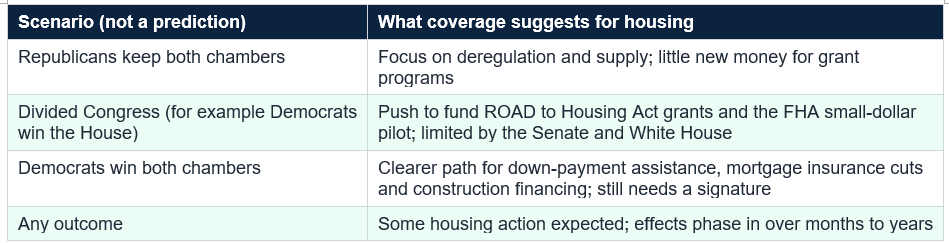
If Democrats win both chambers, down-payment assistance, lower mortgage insurance costs and construction financing, which they have proposed, would have a clearer path, though they would still need the president’s signature. Morgan Stanley noted in September that indicators then pointed to Democrats winning the House with Republicans keeping the Senate, and that a divided government could limit sweeping changes and reduce disruption for markets. Indicators can be wrong. In every case, Newsweek’s experts expect some action on housing.
The Fed is the nearer-term factor: it raised its target on September 16, held on October 28 and a December hike was seen as likely, with the 10-year Treasury near 4.93% and inflation at 3.7%. One broker quoted by Mortgage Professional America said in June he expected year-end rates to be higher than then, and nobody can promise otherwise. The prudent approach is a plan that works at today’s rate and survives a rate a point higher.
Property tax relief can be worth even more, depending on where you live: a 0.25% cut in the effective rate on a $417,500 home saves about $1,044 a year, or $87 a month, and at a 1% rate the tax is about $4,175 a year. These are my illustrations on one assumed home, not forecasts of any proposal. No single idea matches the effect of a point on the mortgage rate, though several together could matter, which is why rate moves, which the election does not control, dominate.
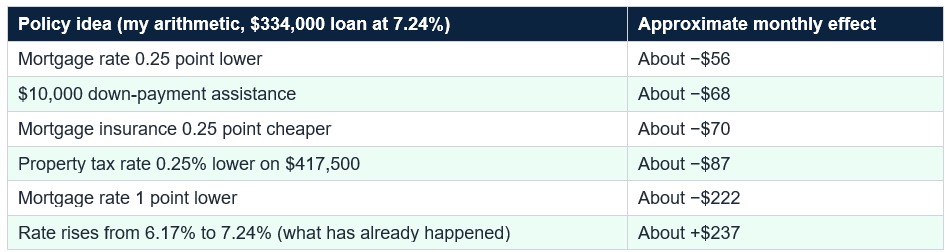
On a $334,000 loan at 7.24%: payment about $2,276 a month; a quarter-point rate cut saves about $56; $10,000 of down-payment help about $68; a quarter-point cut in mortgage insurance about $70; a 0.25% property tax cut on $417,500 about $87. The rise from 6.17% to 7.24% cost about $237 a month.
That is why Oxford Economics does not expect affordability to stabilize until about 2028. Whatever happens on November 3, do not expect a sudden drop in prices or payments in 2027. Watch funding decisions, permitting reforms and local zoning changes, which show whether supply is improving and matter more than election-night headlines.
Check your own state and county ballot for any property tax, housing bond or zoning measure; Ballotpedia lists measures and results and local election offices publish official counts. A property tax measure could change a homeowner’s bill, housing bonds and zoning changes can affect renters’ rents over time and buyers should put local property taxes in the monthly budget alongside the mortgage.
For everyone, keep an emergency fund, since Bankrate found only 46% of Americans could cover three months of expenses, watch the Fed’s December meeting and inflation data, which move rates more than votes do, and wait for official results before acting on any claim about what the outcome means. This is general information, not personal advice.
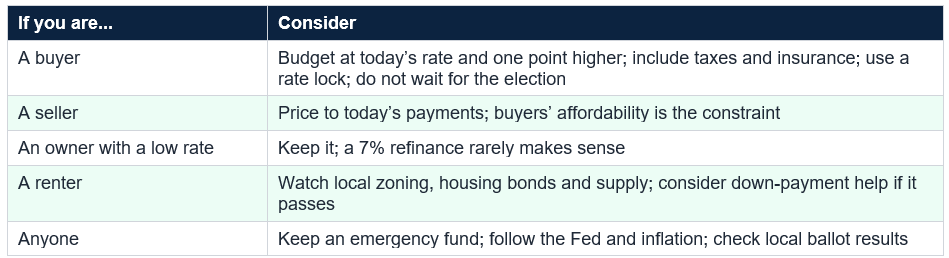
Before you make any housing decision this month, write down your monthly budget at 7.24% and at 8.24%. If both work, the election is not your problem. If only the first does, plan for a cushion. Common mistakes include assuming an election will lower mortgage rates, waiting indefinitely for policy relief, ignoring local ballot measures that affect property taxes, basing decisions on partisan predictions, forgetting taxes and insurance in the budget, stretching a budget that only works at a lower rate and acting on early, partial results. A calm, number-based plan beats a bet on who wins.
The practical response is the same whoever wins: build a budget that works at today’s rate and a point higher, check local ballot measures that affect property taxes and supply, keep an emergency fund and watch the Fed and inflation more than the headlines. In my illustrations, a quarter-point rate cut saves about $56 a month on a $334,000 loan and a point about $222, so the rate environment dominates the policy ideas. Wait for the official results, update your assumptions and decide on your own numbers.
Not directly, and not overnight. Mortgage rates follow Treasury yields, inflation expectations and Federal Reserve policy, and the Fed held at 3.75% to 4.00% on October 28 with a December hike possible. Election outcomes can shift expectations about spending, deficits and policy, which can nudge yields, but those effects are uncertain. The 30-year rate was about 7.24% on October 29 and 7.28% earlier in the month, the highest since November 2023.
What housing policy is already law?
The 21st Century ROAD to Housing Act, a bipartisan package aimed at increasing supply by cutting regulatory barriers, encouraging construction, expanding housing finance and reforming federal programs, became law without President Trump’s signature, according to Mortgage Professional America and Newsweek. What changes after the midterms is largely whether Congress funds and builds on it.
Which housing issues are on state ballots?
Mortgage Professional America reports that voters in 36 states are electing governors and deciding six statewide housing measures, with Florida property tax relief and California housing bonds among the headline items. Governor races in Colorado, Michigan, Massachusetts and Rhode Island also feature housing. Check your own state’s ballot and results, since local measures can affect property taxes and supply directly.
Should I wait for the election results to buy or sell a home?
Probably not for the election’s sake. Policy changes take months or years, and rates depend more on the Fed and inflation. Decide based on your budget, timeline and local market, and compare payments at today’s rate and at a rate a point higher. Oxford Economics expects affordability to keep eroding before stabilizing in 2028. This is general education, not personal advice.
Will a divided government help or hurt housing?
It could limit sweeping changes, which Morgan Stanley noted may reduce disruption for markets. For housing, a split Congress could slow new funding but also protect the bipartisan supply measures already passed. Experts quoted by Newsweek expect action on housing whoever wins, but different priorities: deregulation if Republicans keep control, funding for grant programs if Democrats gain it.
Table of Contents
- Housing on the Ballot
- The Short Answer
- Where Housing Stands Today
- What Is Actually Being Decided
- What Voters Expect
- Scenarios: What Each Outcome Could Mean
- Mortgage Rates: What the Election Can and Cannot Do
- The Policy Menu in Monthly Dollars
- Supply Is the Real Lever
- State and Local Measures
- What Buyers, Sellers, Owners and Renters Can Do
- Common Mistakes
- Conclusion
- Frequently Asked Questions
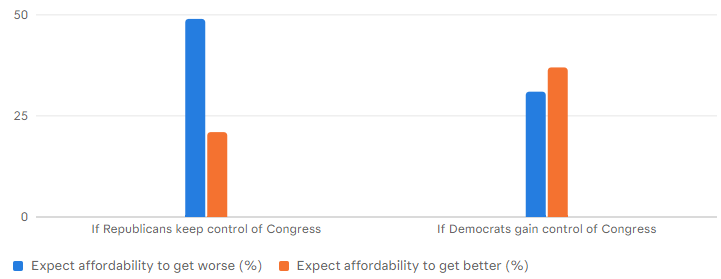
What voters expect: housing affordability by who controls Congress (%)
% of respondents by Clever Real Estate Housing Market + Midterm Elections Survey, September 2026; 63% overall doubt the midterms will help housing
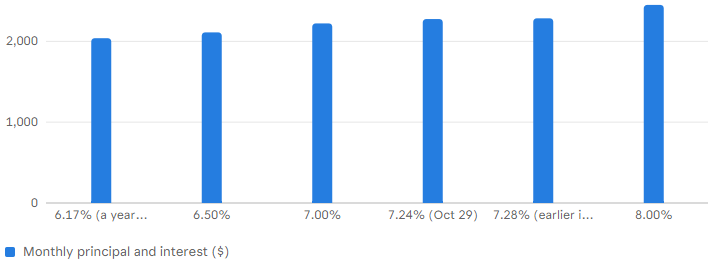
The rate matters more than the vote: payment on a $334,000 loan by mortgage rate ($ a month)
Dollars per month by Author's arithmetic: 30-year fixed, 80% of a $417,500 home; rates from Freddie Mac and HousingWire; principal and interest only
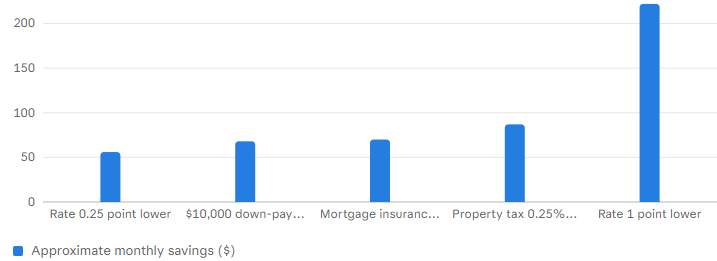
The policy menu in monthly dollars: what each idea could save on a $334,000 loan at 7.24% ($)
Dollars per month saved by Author's arithmetic on assumed figures, not forecasts of any proposal; mortgage insurance range 0.46%-1.5% of the loanHousing on the Ballot
Now the election is over and results are in and voters have spoken clealy what they want. We do know housing is a top voter concern: cost-of-living worries, including petrol prices, healthcare and housing, lead coverage of the campaign, and with 30-year mortgage rates stuck above 7%, affordability is on the ballot in a very direct way. Candidates in both parties have proposed fixes for homebuyers, builders and property owners.The question for anyone planning to buy, sell or refinance is practical: will the results change anything for me, and how soon? The short version is that elections matter for housing policy over years and much less for mortgage rates over days. This guide lays out where housing stands, what is being decided, what different outcomes could mean and what you can do now, without pretending to know who wins.
The Short Answer
The midterm results will shape which housing policies move in 2027 and beyond, but they will not by themselves lower or raise your mortgage rate. Rates depend mainly on Treasury yields, inflation and the Federal Reserve, which held at 3.75% to 4.00% on October 28 with a December hike possible. Policy ideas such as down-payment assistance, lower mortgage insurance costs and property tax relief are each worth roughly $55 to $90 a month in my illustrations, while a one-point rate change is worth over $220 a month, and the biggest lever, supply, takes years. Plan around today’s numbers, not the election.Where Housing Stands Today
Housing is expensive and rates are high. Freddie Mac’s survey put the 30-year fixed rate at 7.24% on October 29, up from 6.17% a year earlier, and HousingWire reported 7.28%, the highest since November 2023. Morgan Stanley cited a median new-home price of $410,700, up 66.7% over 20 years, HousingWire a supply gap of about 4.7 million homes, and Oxford Economics expects affordability to keep eroding before stabilizing in 2028, per Mortgage Professional America.That backdrop explains the politics. Meanwhile, the Fed raised its target by a quarter point on September 16, held on October 28 and markets saw nearly 75% odds of another hike by year-end, with the 10-year Treasury near 4.93% and inflation at 3.7%. Those forces, not the election, are the main drivers of what a buyer pays each month.
30-year mortgage rate 7.24% (6.17% a year ago); median new-home price $410,700; supply gap about 4.7 million homes; Fed at 3.75%–4.00%; Oxford expects affordability to erode until about 2028.
What Is Actually Being Decided
On November 3, all 435 House seats and 35 of the Senate’s 100 seats are up, with 218 needed for a House majority and 51 for the Senate, according to an Al Jazeera results tracker. Voters in 36 states also elect governors, and six statewide housing measures are on ballots, including Florida property tax relief and California housing bonds, per Mortgage Professional America. Housing features in governor races in Colorado, Michigan, Massachusetts and Rhode Island, and HousingWire counts 37 competitive House races.The federal backdrop is unusual: the 21st Century ROAD to Housing Act, a bipartisan package to boost supply by cutting regulatory barriers, encouraging construction, expanding housing finance and reforming federal programs, became law without President Trump’s signature. So the question after the election is less whether to act on housing than how: which programs get funded, which change and how fast, which depends on who controls the House and Senate in 2027.
What Voters Expect
Voters are skeptical. In Clever Real Estate’s September survey, 63% of Americans said they do not think the midterms will help housing. If Republicans keep control of Congress, 49% expected affordability to get worse and 21% better; if Democrats gain control, 31% expected worse and 37% better. The partisan split was sharp: only 45% of Republicans expected improvement if their party stays in control, against 67% of Democrats if theirs gains it, and 60% supported reducing property taxes.Treat survey expectations as a mood, not a forecast: predictions about housing often track politics, and policy effects take time. What the numbers show is that housing costs are a bipartisan worry. Republicans have emphasized homeownership and housing costs, and Democrats, including Senate Minority Leader Chuck Schumer, have outlined proposals to expand down-payment assistance, lower mortgage insurance costs, encourage construction financing and make mortgages more portable or assumable.
Scenarios: What Each Outcome Could Mean
Because I do not know the result, here are the main scenarios, discussed in coverage and not predictions. If Republicans keep both chambers, Newsweek reports the federal focus is likely to be deregulation to boost construction, with experts doubting significant new money for housing grant programs. If Democrats win the House but not the Senate, the same coverage expects them to push to fund the grant programs created under the ROAD to Housing Act, along with disaster-mitigation funding and the FHA’s small-dollar mortgage pilot, though the Senate and White House would limit what passes.If Democrats win both chambers, down-payment assistance, lower mortgage insurance costs and construction financing, which they have proposed, would have a clearer path, though they would still need the president’s signature. Morgan Stanley noted in September that indicators then pointed to Democrats winning the House with Republicans keeping the Senate, and that a divided government could limit sweeping changes and reduce disruption for markets. Indicators can be wrong. In every case, Newsweek’s experts expect some action on housing.
Mortgage Rates: What the Election Can and Cannot Do
The most common misconception is that an election changes mortgage rates. Rates are set by markets and follow Treasury yields, which respond to inflation, the Fed’s path and demand for bonds. In my general knowledge, not retrieved from the sources above, expectations about government borrowing can also move yields, so an election can influence rates indirectly, but the effect is uncertain, can run either way and is usually small next to inflation and the Fed.The Fed is the nearer-term factor: it raised its target on September 16, held on October 28 and a December hike was seen as likely, with the 10-year Treasury near 4.93% and inflation at 3.7%. One broker quoted by Mortgage Professional America said in June he expected year-end rates to be higher than then, and nobody can promise otherwise. The prudent approach is a plan that works at today’s rate and survives a rate a point higher.
The Policy Menu in Monthly Dollars
On a $334,000 loan at 7.24%, 80% of a $417,500 home, the payment is about $2,276 a month. A quarter-point drop in the rate would save about $56 a month and a full point about $222. A $10,000 down-payment grant would save about $68 a month. Mortgage insurance for buyers with less than 20% down ranges from about 0.46% to 1.5% of the loan a year, about $1,536 to $5,010 here, so a quarter-point cut saves about $835 a year, or $70 a month.Property tax relief can be worth even more, depending on where you live: a 0.25% cut in the effective rate on a $417,500 home saves about $1,044 a year, or $87 a month, and at a 1% rate the tax is about $4,175 a year. These are my illustrations on one assumed home, not forecasts of any proposal. No single idea matches the effect of a point on the mortgage rate, though several together could matter, which is why rate moves, which the election does not control, dominate.
On a $334,000 loan at 7.24%: payment about $2,276 a month; a quarter-point rate cut saves about $56; $10,000 of down-payment help about $68; a quarter-point cut in mortgage insurance about $70; a 0.25% property tax cut on $417,500 about $87. The rise from 6.17% to 7.24% cost about $237 a month.
Supply Is the Real Lever
Economists often say the long-run answer to housing costs is more homes. HousingWire cites a supply gap of about 4.7 million, and the bipartisan ROAD to Housing Act aims at supply by cutting regulatory barriers and encouraging construction; over the longer term, more supply can make the market less competitive and lower prices, as one analysis noted. But homebuilding is slow and depends on zoning, permitting, labor, materials and financing, much of it local, so federal policy and elections move it only gradually.That is why Oxford Economics does not expect affordability to stabilize until about 2028. Whatever happens on November 3, do not expect a sudden drop in prices or payments in 2027. Watch funding decisions, permitting reforms and local zoning changes, which show whether supply is improving and matter more than election-night headlines.
State and Local Measures
The results that affect you most directly could be local. Six statewide housing measures are on ballots, with Florida’s property tax relief the costliest test and California housing bonds another, and they can change your annual costs and local supply. With 60% of Americans in Clever’s survey supporting property tax cuts, relief proposals are popular, though they can also shift costs to other taxes or reduce local services, a general point rather than a retrieved finding.Check your own state and county ballot for any property tax, housing bond or zoning measure; Ballotpedia lists measures and results and local election offices publish official counts. A property tax measure could change a homeowner’s bill, housing bonds and zoning changes can affect renters’ rents over time and buyers should put local property taxes in the monthly budget alongside the mortgage.
What Buyers, Sellers, Owners and Renters Can Do
For buyers, run your budget at today’s rate and at a rate a point higher, include property taxes, insurance and mortgage insurance, and do not delay a purchase you can afford for an election that will not change your rate; a rate lock can protect you while you close. For sellers, buyers face the same payments, so realistic pricing matters more than the results. Owners with low rates have little reason to refinance at 7%, and renters should watch local supply and zoning measures.For everyone, keep an emergency fund, since Bankrate found only 46% of Americans could cover three months of expenses, watch the Fed’s December meeting and inflation data, which move rates more than votes do, and wait for official results before acting on any claim about what the outcome means. This is general information, not personal advice.
Before you make any housing decision this month, write down your monthly budget at 7.24% and at 8.24%. If both work, the election is not your problem. If only the first does, plan for a cushion. Common mistakes include assuming an election will lower mortgage rates, waiting indefinitely for policy relief, ignoring local ballot measures that affect property taxes, basing decisions on partisan predictions, forgetting taxes and insurance in the budget, stretching a budget that only works at a lower rate and acting on early, partial results. A calm, number-based plan beats a bet on who wins.
Conclusion
The midterm results matter for housing, but not in the way people often assume. They will shape which policies move forward in 2027, whether Congress funds the ROAD to Housing Act’s grant programs and whether down-payment assistance, mortgage insurance cuts or deregulation lead, but they will not by themselves change your mortgage rate, which follows the Fed, inflation and the Treasury market. With the 30-year rate at 7.24%, up from 6.17% a year ago, and Oxford expecting affordability to erode until about 2028, relief is likely to arrive slowly.The practical response is the same whoever wins: build a budget that works at today’s rate and a point higher, check local ballot measures that affect property taxes and supply, keep an emergency fund and watch the Fed and inflation more than the headlines. In my illustrations, a quarter-point rate cut saves about $56 a month on a $334,000 loan and a point about $222, so the rate environment dominates the policy ideas. Wait for the official results, update your assumptions and decide on your own numbers.
Frequently Asked Questions
Do midterm election results change mortgage rates?Not directly, and not overnight. Mortgage rates follow Treasury yields, inflation expectations and Federal Reserve policy, and the Fed held at 3.75% to 4.00% on October 28 with a December hike possible. Election outcomes can shift expectations about spending, deficits and policy, which can nudge yields, but those effects are uncertain. The 30-year rate was about 7.24% on October 29 and 7.28% earlier in the month, the highest since November 2023.
What housing policy is already law?
The 21st Century ROAD to Housing Act, a bipartisan package aimed at increasing supply by cutting regulatory barriers, encouraging construction, expanding housing finance and reforming federal programs, became law without President Trump’s signature, according to Mortgage Professional America and Newsweek. What changes after the midterms is largely whether Congress funds and builds on it.
Which housing issues are on state ballots?
Mortgage Professional America reports that voters in 36 states are electing governors and deciding six statewide housing measures, with Florida property tax relief and California housing bonds among the headline items. Governor races in Colorado, Michigan, Massachusetts and Rhode Island also feature housing. Check your own state’s ballot and results, since local measures can affect property taxes and supply directly.
Should I wait for the election results to buy or sell a home?
Probably not for the election’s sake. Policy changes take months or years, and rates depend more on the Fed and inflation. Decide based on your budget, timeline and local market, and compare payments at today’s rate and at a rate a point higher. Oxford Economics expects affordability to keep eroding before stabilizing in 2028. This is general education, not personal advice.
Will a divided government help or hurt housing?
It could limit sweeping changes, which Morgan Stanley noted may reduce disruption for markets. For housing, a split Congress could slow new funding but also protect the bipartisan supply measures already passed. Experts quoted by Newsweek expect action on housing whoever wins, but different priorities: deregulation if Republicans keep control, funding for grant programs if Democrats gain it.
0 Comments
Be the first to share your thoughts on this article.