

Real Estate
Mortgage Points vs. a Bigger Down Payment: Which Costs Less?

Freddie Mac 30-year 7.24% on Oct 29, 2026 (6.17% a year earlier; 15-year 6.60%); median existing home $417,500; one point costs 1% of the loan and typically cuts the rate 0.125%–0.25%; PMI costs 0.46%–1.5% of the loan a year and cancels at 80% loan-to-value on request (automatic at 78%). My arithmetic ($417,500 home, 10% down, $375,750 loan at 7.24%): payment $2,561 a month; one point ($3,758) cuts it about $63 and breaks even against an equal extra down payment after about 67 months; points are ahead by about $3,200 at 10 years and $13,600 at 30 years; at only 0.125% per point, break-even stretches to about 16.6 years. PMI twist: reaching 20% down (an extra $41,750) removes PMI of about $1,700–$5,600 a year and saves about $27,900 over 5 years, $51,000 over 10 and $83,000 over 30 versus staying at 10% down with PMI (assumed 0.7%).
The honest answer depends on three things: how long you will keep the loan, whether the extra down payment gets you across the 20% line and what happens to interest rates. With the average 30-year mortgage at 7.24%, up from 6.17% a year ago, the stakes are high. This guide walks through the math on a median-priced home, so you can see which choice costs less over time and when.
The direction of rates matters for points. The Fed held its target at 3.75% to 4.00% on October 28 and markets still see a possible December hike, while inflation was 3.7% in September. If rates fall, you may refinance, and points paid on the old loan are largely wasted. If rates rise, a locked, lower rate looks better. Nobody knows, which is why the break-even clock is the key number.
A bigger down payment works differently. Every extra dollar reduces the amount you borrow, so you stop paying interest on it, and the equity stays in the house. With less than 20% down on a conventional loan, lenders require private mortgage insurance, about 0.46% to 1.5% of the loan per year depending on credit and loan-to-value. You can ask to cancel it in writing when your balance reaches 80% of the original value, and the lender must cancel it automatically at 78%.
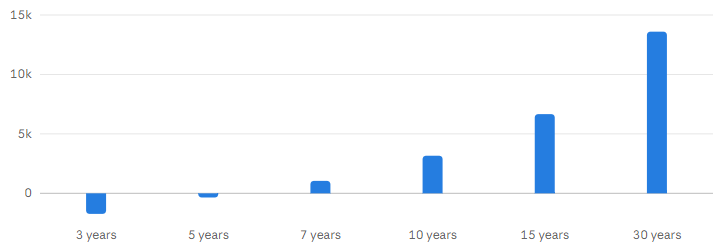
The result: for the first five and a half years, the extra down payment wins, with break-even at about 67 months. After three years points trail by about $1,700, and after five by about $350. By seven years points lead by about $1,050, by ten about $3,160 and by thirty about $13,600. Two points show the same break-even month with bigger gains later: about $6,300 at ten years and $27,000 at thirty. The payoff is real, but only for people who stay put.
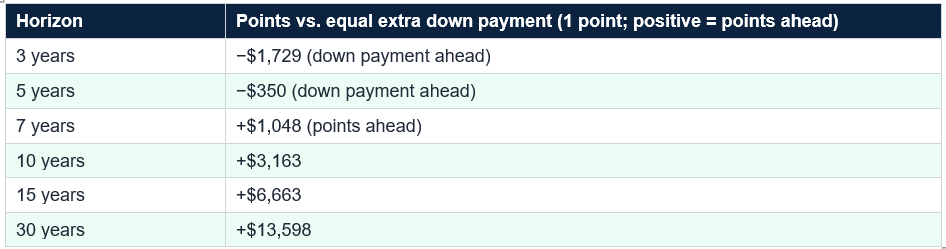
One point ($3,758) at 0.25% off breaks even against an equal extra down payment after about 67 months on a $375,750 loan at 7.24%. Points trail by about $1,729 at 3 years and lead by about $1,048 at 7, $3,163 at 10 and $13,598 at 30 years. At only 0.125% off, break-even stretches to about 199 months (16.6 years).
Pricing is the swing factor. If your lender cuts the rate by only 0.125% per point, break-even stretches to about 199 months, almost 17 years, and the 30-year advantage shrinks to about $2,200. Check the reduction on your Loan Estimate and ask what each additional point buys, because real pricing is often nonlinear beyond one or two points.
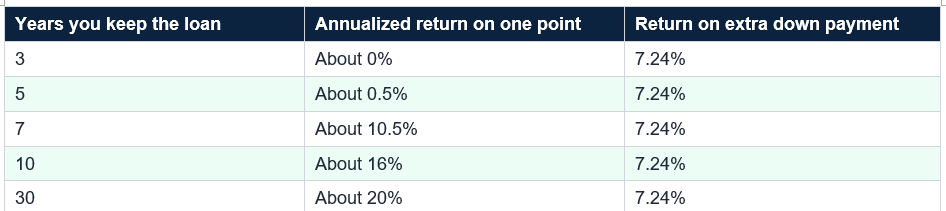
Cash elsewhere is the other benchmark: a 52-week Treasury bill yielded about 4.46% in October. Money used for points is gone, but a down payment is equity you can reach later through a sale, a refinance or a home equity loan. Both can beat the T-bill if you hold long enough, with very different liquidity.
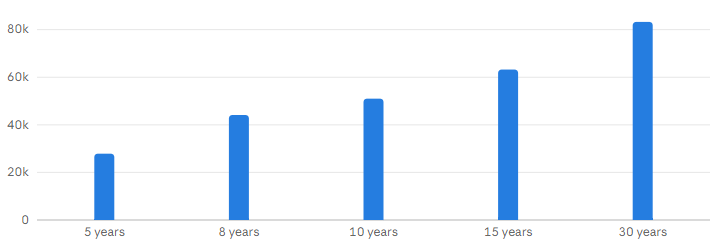
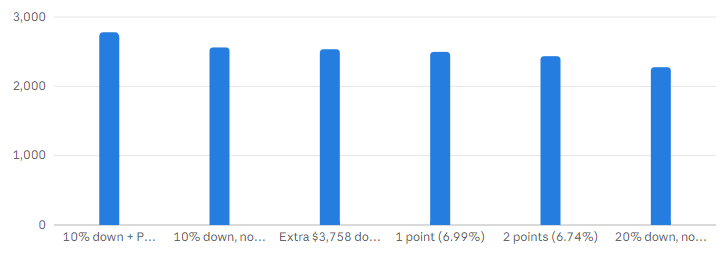
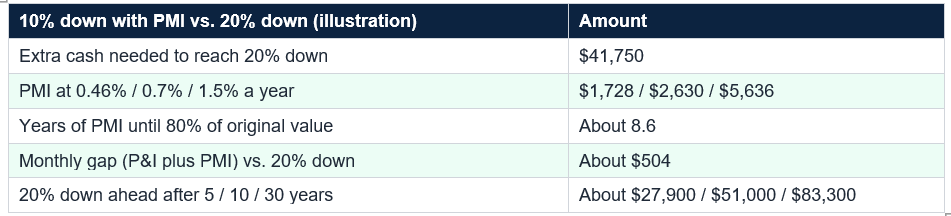
The monthly gap is large: about $2,780 with PMI at 10% down versus about $2,276 at 20% down, about $504 a month. Adding upfront cash, payments and the remaining balance, 20% down comes out about $27,900 ahead after five years, $51,000 after ten and $83,000 after thirty. In the first year alone, the extra $41,750 saves about $3,000 in mortgage interest, versus about $1,860 at a 4.46% T-bill yield. Points cannot compete with eliminating PMI, which is why 20% down is the most important threshold in this decision.
Reaching 20% down means putting a lot more cash into the house and leaving less in the bank. Keep an emergency fund of three to six months of expenses after closing; a house can swallow savings you need for repairs and surprises.
There are also alternatives. Sellers sometimes pay points or closing costs as a concession, which makes the choice free. Some lenders offer credits in exchange for a higher rate, the opposite of points, which can suit buyers expecting to refinance soon. Temporary buydowns cut the rate for the first year or two. And FHA loans work differently, with mortgage insurance that often lasts for the life of the loan, so check the rules before comparing. Check each option with your lender.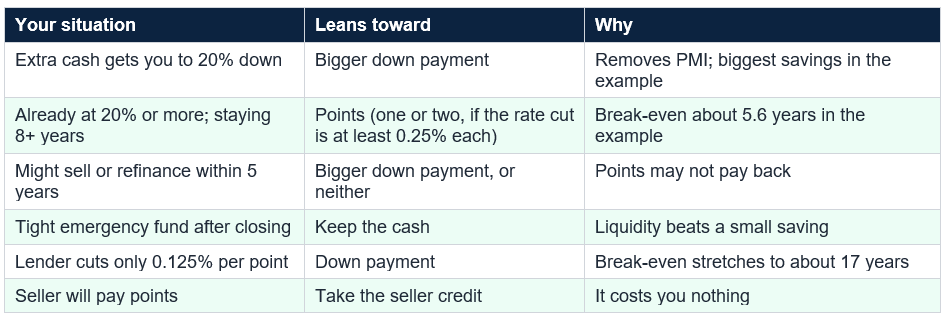
Ask your lender: What is the rate with 0, 1 and 2 points? What is the PMI cost at each down payment? What is the rate difference between 10%, 15% and 20% down? Can the seller or builder pay points? Are there lender credits for a higher rate? What are the break-even months for each option?
The practical rule is simple. If extra cash gets you to 20% down, do that. If you are already there and will keep the loan for the long haul, consider a point or two, if the rate cut is real. If you might move or refinance soon, keep your cash. Compare written Loan Estimates, keep an emergency fund and let the break-even clock decide. This is general education, not personalized advice, and a qualified mortgage professional can help you run your own numbers.
They are worth it if you keep the loan long enough to recoup the upfront cost, typically 4 to 7 years according to lenders’ guides. In my illustration on a $375,750 loan at 7.24%, one point costing $3,758 and cutting the rate by 0.25% breaks even against an equal extra down payment after about 67 months. If you may sell or refinance before then, points can lose money.
How much does one mortgage point cost and save?
One point costs 1% of the loan amount and typically lowers the rate by about 0.125% to 0.25%, depending on the lender and market. The exact reduction should be on your Loan Estimate. At 0.25% per point, one point on a $375,750 loan saves about $63 a month versus no points, my arithmetic, but at 0.125% it saves only about half as much and takes far longer to pay back.
Is a bigger down payment better than buying points?
Often, when the extra cash pushes you to a 20% down payment and eliminates private mortgage insurance, which costs 0.46% to 1.5% of the loan a year. If you already put at least 20% down, points can win over a long holding period. A bigger down payment also never gets wasted if you refinance, because the equity stays in the home.
When does PMI go away?
For conventional loans, you can ask your lender to cancel PMI in writing when your balance reaches 80% of the home’s original value, and the lender must cancel automatically at 78%, or at the loan’s midpoint, if you are current on payments. FHA loans work differently, with mortgage insurance that often lasts for the life of the loan.
Can I deduct points or PMI on my taxes?
Possibly. Mortgage points may be deductible in the year paid or spread over the loan, depending on your circumstances, and one source says PMI premiums are deductible as mortgage interest for the 2026 tax year if you itemize. Rules are detailed, so check with a tax professional. This is general education, not tax advice.
Table of Contents
- Two Ways to Spend the Same Cash
- The Short Answer
- Where Mortgage Rates Stand Today
- How Points, Down Payments and PMI Work
- The Example: A $417,500 Home
- Head to Head: One Point vs. an Equal Extra Down Payment
- The Return View
- The PMI Twist: Crossing 20% Down
- Factors the Break-Even Math Misses
- A Decision Guide by Situation
- What to Ask Your Lender
- Conclusion
- Frequently Asked Questions
One mortgage point vs. an equal extra down payment: who is ahead over time ($)
Advantage of points ($) by Author's illustration: $375,750 loan at 7.24%; 1 point = $3,758 for 0.25% off; break-even about 67 months
The PMI twist: how much ahead 20% down is vs. 10% down with PMI ($)
Advantage of 20% down ($) by Author's illustration: extra $41,750 down; PMI assumed at 0.7% until 80% of original value (about 8.6 years)
Monthly cost of each choice on a $417,500 home ($)
Monthly payment ($) by Author's arithmetic at 7.24% base rate (Freddie Mac, Oct 29, 2026); principal and interest plus PMI where shown
Two Ways to Spend the Same Cash
You have scraped together the cash for a house, and the closing statement has a tempting question on it. Should the next few thousand dollars go into a bigger down payment, or into mortgage points that buy a lower interest rate? Both lower your monthly payment, both feel responsible and lenders and agents will happily tell you either is a great idea.The honest answer depends on three things: how long you will keep the loan, whether the extra down payment gets you across the 20% line and what happens to interest rates. With the average 30-year mortgage at 7.24%, up from 6.17% a year ago, the stakes are high. This guide walks through the math on a median-priced home, so you can see which choice costs less over time and when.
The Short Answer
If the extra cash would push your down payment to 20% and eliminate private mortgage insurance, the bigger down payment usually wins by a wide margin. If you are already at 20% or more, points can beat extra principal, but only if you keep the loan beyond a break-even point of roughly five and a half years in my example, and only if the lender gives a meaningful rate cut for each point. If you might sell or refinance within five years, the bigger down payment, or neither, is the safer choice.Where Mortgage Rates Stand Today
Freddie Mac’s weekly survey put the 30-year fixed rate at 7.24% on October 29, down from 7.32% a week earlier but well above 6.17% a year ago. The 15-year averaged 6.60%. One caveat matters here: the survey covers conventional purchase loans for borrowers who put 20% down and have excellent credit, so buyers with smaller down payments often see higher rates.The direction of rates matters for points. The Fed held its target at 3.75% to 4.00% on October 28 and markets still see a possible December hike, while inflation was 3.7% in September. If rates fall, you may refinance, and points paid on the old loan are largely wasted. If rates rise, a locked, lower rate looks better. Nobody knows, which is why the break-even clock is the key number.
How Points, Down Payments and PMI Work
A discount point costs 1% of your loan amount and typically lowers your rate by about 0.125% to 0.25%, according to lender guides. On a $300,000 loan, one point costs $3,000. Sources suggest break-even usually takes four to seven years, and more than two points often stretches it to eight to ten. A point is prepaid interest: it is gone once paid, whatever happens to the house.A bigger down payment works differently. Every extra dollar reduces the amount you borrow, so you stop paying interest on it, and the equity stays in the house. With less than 20% down on a conventional loan, lenders require private mortgage insurance, about 0.46% to 1.5% of the loan per year depending on credit and loan-to-value. You can ask to cancel it in writing when your balance reaches 80% of the original value, and the lender must cancel it automatically at 78%.
The Example: A $417,500 Home
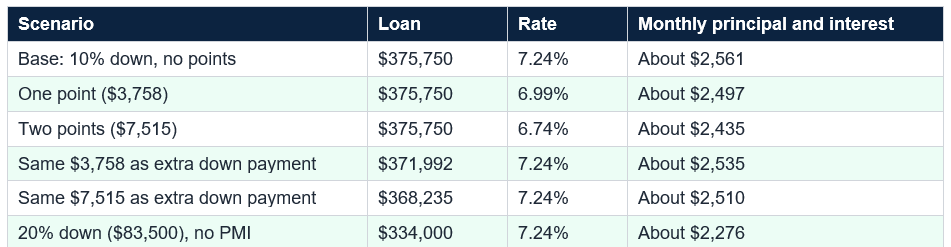
The median existing home price was $417,500 in September, according to the National Association of Realtors. Suppose you buy at that price with 10% down, $41,750, leaving a loan of $375,750. At 7.24%, the monthly principal and interest payment is about $2,561. For simplicity I use the national average rate in every scenario, although real rates for lower down payments are often higher, and I assume one point cuts the rate by 0.25%.
Head to Head: One Point vs. an Equal Extra Down Payment
Take the same $3,758. Option A puts it into the down payment; option B spends it on one point. B lowers the payment by about $63 a month versus the base, while A lowers it by about $26, so B saves about $38 a month more. But A leaves you with a smaller loan, which matters if you sell. To compare fairly, I add the upfront cash, all payments and the remaining loan balance at each horizon; lower is better.The result: for the first five and a half years, the extra down payment wins, with break-even at about 67 months. After three years points trail by about $1,700, and after five by about $350. By seven years points lead by about $1,050, by ten about $3,160 and by thirty about $13,600. Two points show the same break-even month with bigger gains later: about $6,300 at ten years and $27,000 at thirty. The payoff is real, but only for people who stay put.
One point ($3,758) at 0.25% off breaks even against an equal extra down payment after about 67 months on a $375,750 loan at 7.24%. Points trail by about $1,729 at 3 years and lead by about $1,048 at 7, $3,163 at 10 and $13,598 at 30 years. At only 0.125% off, break-even stretches to about 199 months (16.6 years).
Pricing is the swing factor. If your lender cuts the rate by only 0.125% per point, break-even stretches to about 199 months, almost 17 years, and the 30-year advantage shrinks to about $2,200. Check the reduction on your Loan Estimate and ask what each additional point buys, because real pricing is often nonlinear beyond one or two points.
The Return View
Another way to see it is as a return on your cash. An extra dollar of down payment effectively earns the mortgage rate, 7.24% here, guaranteed, because you stop paying interest on it. A point earns nothing if you leave early and a lot if you stay: in my illustration, an annualized return of about 0% over three years, 0.5% over five, 10.5% over seven, 16% over ten and 20% over thirty. It crosses the 7.24% hurdle at about 5.6 years, the break-even.Cash elsewhere is the other benchmark: a 52-week Treasury bill yielded about 4.46% in October. Money used for points is gone, but a down payment is equity you can reach later through a sale, a refinance or a home equity loan. Both can beat the T-bill if you hold long enough, with very different liquidity.
The PMI Twist: Crossing 20% Down
Everything changes when the extra cash gets you to 20% down. Moving from 10% to 20% on the same house means an extra $41,750, which lowers the loan from $375,750 to $334,000 and eliminates PMI. At 0.46% to 1.5% a year, PMI on $375,750 is about $1,730 to $5,640; at an assumed 0.7% it is about $2,630, or $219 a month. In my illustration it would take about 8.6 years of payments to reach 80% of the original value and cancel it.The monthly gap is large: about $2,780 with PMI at 10% down versus about $2,276 at 20% down, about $504 a month. Adding upfront cash, payments and the remaining balance, 20% down comes out about $27,900 ahead after five years, $51,000 after ten and $83,000 after thirty. In the first year alone, the extra $41,750 saves about $3,000 in mortgage interest, versus about $1,860 at a 4.46% T-bill yield. Points cannot compete with eliminating PMI, which is why 20% down is the most important threshold in this decision.
Reaching 20% down means putting a lot more cash into the house and leaving less in the bank. Keep an emergency fund of three to six months of expenses after closing; a house can swallow savings you need for repairs and surprises.
Factors the Break-Even Math Misses
Several real-world factors can change the answer. Liquidity: cash in the down payment is hard to get back, so do not drain your reserves. Refinancing: if rates fall and you refinance within a few years, points on the old loan are wasted, while extra down payment lowers the new loan too. Moving: many borrowers sell or refinance well before the loan ends, which hurts points. Taxes: points may be deductible in the year paid or over the loan, depending on your circumstances, and one source says PMI premiums are deductible for 2026 if you itemize, though both depend on your situation.There are also alternatives. Sellers sometimes pay points or closing costs as a concession, which makes the choice free. Some lenders offer credits in exchange for a higher rate, the opposite of points, which can suit buyers expecting to refinance soon. Temporary buydowns cut the rate for the first year or two. And FHA loans work differently, with mortgage insurance that often lasts for the life of the loan, so check the rules before comparing. Check each option with your lender.
A Decision Guide by Situation
What to Ask Your Lender
Get the numbers in writing. Ask for Loan Estimates with zero, one and two points and check the rate reduction for each. Ask for a scenario with a larger down payment and what it does to your rate and PMI, how long until PMI cancels and what it costs at your credit score. Then do the break-even math yourself: divide the cost of the points by the monthly saving and compare it with how long you expect to keep the loan.Ask your lender: What is the rate with 0, 1 and 2 points? What is the PMI cost at each down payment? What is the rate difference between 10%, 15% and 20% down? Can the seller or builder pay points? Are there lender credits for a higher rate? What are the break-even months for each option?
Conclusion
So, which costs you less over time? In my illustration on a $417,500 home at 7.24%, one point cuts the payment by about $63 a month and breaks even against an equal extra down payment after about 67 months, so it wins if you stay beyond five and a half years, by about $3,200 at ten years and $13,600 at thirty. But a smaller rate cut stretches break-even to almost 17 years, and the move that beats both is crossing 20% down: eliminating PMI of about $2,630 a year saved about $51,000 over ten years in my example.The practical rule is simple. If extra cash gets you to 20% down, do that. If you are already there and will keep the loan for the long haul, consider a point or two, if the rate cut is real. If you might move or refinance soon, keep your cash. Compare written Loan Estimates, keep an emergency fund and let the break-even clock decide. This is general education, not personalized advice, and a qualified mortgage professional can help you run your own numbers.
Frequently Asked Questions
Are mortgage points worth it?They are worth it if you keep the loan long enough to recoup the upfront cost, typically 4 to 7 years according to lenders’ guides. In my illustration on a $375,750 loan at 7.24%, one point costing $3,758 and cutting the rate by 0.25% breaks even against an equal extra down payment after about 67 months. If you may sell or refinance before then, points can lose money.
How much does one mortgage point cost and save?
One point costs 1% of the loan amount and typically lowers the rate by about 0.125% to 0.25%, depending on the lender and market. The exact reduction should be on your Loan Estimate. At 0.25% per point, one point on a $375,750 loan saves about $63 a month versus no points, my arithmetic, but at 0.125% it saves only about half as much and takes far longer to pay back.
Is a bigger down payment better than buying points?
Often, when the extra cash pushes you to a 20% down payment and eliminates private mortgage insurance, which costs 0.46% to 1.5% of the loan a year. If you already put at least 20% down, points can win over a long holding period. A bigger down payment also never gets wasted if you refinance, because the equity stays in the home.
When does PMI go away?
For conventional loans, you can ask your lender to cancel PMI in writing when your balance reaches 80% of the home’s original value, and the lender must cancel automatically at 78%, or at the loan’s midpoint, if you are current on payments. FHA loans work differently, with mortgage insurance that often lasts for the life of the loan.
Can I deduct points or PMI on my taxes?
Possibly. Mortgage points may be deductible in the year paid or spread over the loan, depending on your circumstances, and one source says PMI premiums are deductible as mortgage interest for the 2026 tax year if you itemize. Rules are detailed, so check with a tax professional. This is general education, not tax advice.
0 Comments
Be the first to share your thoughts on this article.