
Professional & Career Development
Really Really Unhinged Productivity Hacks That Actually Work

Watching baby animal videos is backed by Hiroshima University. Pizza outperformed a cash bonus by 6.7%. Your houseplant is more productive than your to-do list app. These hacks are completely unhinged and completely real.
The productivity industry has a problem. It keeps giving you the same ten tips, dressed in different fonts and sold in different apps. Wake up at 5am. Use the Pomodoro Technique. Eat the frog. Clear your inbox to zero. And none of it is working well enough, or you would not be reading another productivity article. This one is different. These are the hacks the research actually found — not the sensible ones that consultants package into frameworks, but the legitimately weird ones that emerge when scientists study human performance without any prior agenda about what should help. Baby animals. Pizza. Daydreaming on purpose. The sound of a coffee shop played through your headphones while you sit alone in your kitchen. A potted plant that cannot even move. These are all backed by genuine research. They are also completely unhinged. Both things are true simultaneously. That combination is the entire point.
Inc.com’s guide to unconventional productivity, contributed by Andy Molinsky, Professor of Management and Psychology at Brandeis University, puts the underlying principle plainly: ‘Find out what works for you (even if it’s weird) and go with it.’ This article is about finding out what the science says works — even when the science is absurd. Especially then, actually.
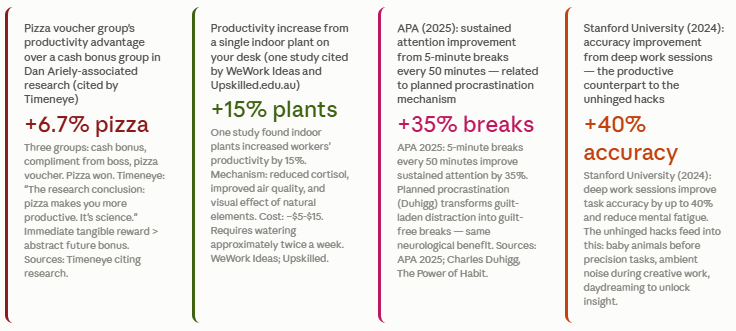
Stanford University (2024): deep work improves task accuracy by up to 40%. APA (2025): 5-minute breaks every 50 minutes improve sustained attention by 35%. Pizza group outperformed cash bonus group by 6.7% (research cited by Timeneye). Plants: 15% productivity increase (WeWork Ideas).
What all of these have in common is that they were not designed to produce productivity tips. They were designed to understand specific psychological mechanisms. The productivity applications emerged from the findings rather than being reverse-engineered from a desired conclusion. That is why they are credible. And that is why they are weird. Science does not edit its findings to match cultural expectations about how serious professionals should behave. The ten hacks in this article are the result.
Hiroshima University research: participants shown cute baby animal images performed better on precision tasks. GreenLit Content 2024: 'Cute content stimulates a nurturing instinct that narrows focus and heightens caution.' WeWork: cute animals help employees feel happier and more engaged. DeskTime: help people pay more attention on tasks requiring careful handling.
Before any task requiring precision or attention to detail, spend 90-120 seconds watching baby animal content. Then close it and go straight to the task. GreenLit Content 2024: 'A minute or two of concentrated cuteness could be the productivity kickstart you need.'
Research dividing workers into bonus/compliment/pizza groups: pizza group outperformed by 6.7% in immediate productivity (Timeneye, citing research associated with Dan Ariely's work on reward systems). Timeneye: 'The research conclusion: pizza makes you more productive. It's science.'
Before a task you've been avoiding, pre-commit to a specific, tangible food reward (a meal you actually love, a treat, a coffee from somewhere nice) for when you finish. Write it down. Make it concrete. The brain's reward system responds to real, sensory, immediate pleasures far more powerfully than abstract future positives.
A Nobel Prize-winning economist ran this study. The pizza won. | Rating: 🤩 8/10 Unhinged. This research exists. A Nobel-recognised economist contributed to it. Please use it irresponsibly.
2011 study (Psychological Science): doodling keeps the brain active during dull tasks. Timeneye: doodling lights up brain areas not normally used, helping analyse problems differently. WeWork Ideas: scribbling improves recall. Upskilled: taking notes by hand improves retention vs typing.
Keep a dedicated doodle pad next to your keyboard specifically for meetings and long calls. Do not try to draw anything coherent — abstract shapes, patterns, spirals. The content is irrelevant. The neural engagement is the point.
One study: indoor plants increased workers' productivity by 15% (WeWork Ideas; Upskilled.edu.au). Luxafor: plants improve air quality, reduce stress, and enhance creativity. Mechanism: reduced cortisol from natural visual elements and improved micro-environment.
Buy one low-maintenance plant: pothos, snake plant, ZZ plant, or spider plant. Place it at or near your eye line when working. Water it when you remember. That is the entire hack. Total cost: approximately $5-$15. Productivity improvement: potentially 15%.
Charles Duhigg, The Power of Habit: schedule tempting non-work tasks into the workday. Fast Company/WeWork Ideas: planned procrastination transforms into guilt-free recharging breaks. APA 2025: 5-minute breaks every 50 minutes improve sustained attention by 35%.
At the start of each work block, write down the most tempting distractions you'll want to indulge. Assign each one a specific time slot later in the day. At that time, do it fully and without guilt. The key: 'at 3pm I will look at Reddit for 10 minutes' beats 'I must not look at Reddit' every time.
The thing you’ve been fighting all your life turns out to be your brain asking for a scheduled break. | Rating: 8/10 Unhinged. The productivity hack is doing the thing you were going to do anyway but writing it in your calendar first. Transcendently stupid. Completely effective.
Psychological Science journal: daydreaming triggers 'creative incubation.' The default mode network makes associative connections during unfocused thought that focused analytical thinking does not access. Mind-wandering activates the neural systems behind creative insight.
When stuck on a creative or strategic problem, set a 10-minute timer. Put the problem down completely. Do something physically simple — walk, make tea, look out the window. Do not try to think about the problem. Come back after the timer. The default mode network has been working while you were 'doing nothing.'
Staring out of the window with a blank expression is scientifically classifiable as deep work. | Rating: 7/10 Unhinged. Staring into the middle distance is now in your productivity arsenal. Tell your manager it's cognitive incubation. Maintain the same blank expression throughout.
Research cited by GreenLit Content 2024: moderate ambient noise (~70 decibels, coffee shop level) is ideal for stimulating creativity. Complete silence can feel pressurising; loud noise fractures attention. The coffee shop hum is the documented Goldilocks zone for creative cognitive work.
Download Coffitivity (free), use Noisli, or search 'coffee shop ambience' on YouTube. Set at a comfortable background level — you should hear it but not notice it. Use specifically for creative work, writing, or complex problem-solving. Turn it off for deep focused analysis.
The sound of other people's productivity is itself a productivity drug. | Rating: 7/10 Unhinged. You are legally allowed to recreate the sound of a coffee shop from inside your bedroom in order to do better work. This is the era we live in.
Upskilled.edu.au: computer time announcements 'actually work' as a time-awareness tool. Addresses time blindness — the failure mode where hours pass without temporal awareness. Creates hourly checkpoints for accountability. Companion from Techwell.com: saying 'next' to yourself during email prevents vortex paralysis.
Mac: System Preferences → Date & Time → Clock → 'Announce the time.' Windows: Cortana hourly alarm. Phone: set hourly repeating alarm with a gentle sound. When the hour announces, take 30 seconds to answer: 'What have I actually done this hour? What do I do next?' Do not snooze it.
Weaponise your calendar. Make time itself accountable to you. | Rating: 🕛 5/10 Unhinged. The least unhinged entry but possibly the highest actual ROI. Your computer will tell you the time and somehow this changes everything.
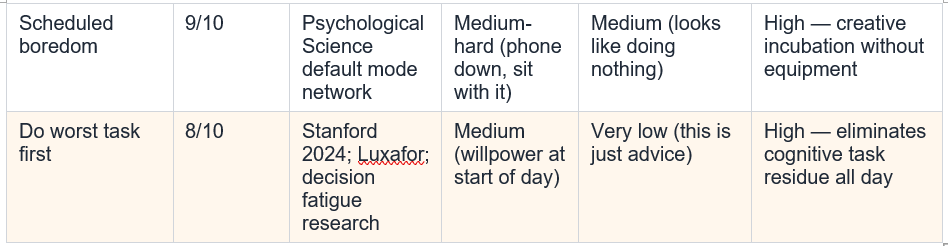
The default mode network — the neural system active during boredom and mind-wandering — is the same system behind creative incubation (Psychological Science research on daydreaming). Boredom initiates the shift into creative default mode processing. Every transitional phone-scroll eliminates a potential creative incubation window.
One day this week: leave your phone in your bag or pocket during every transitional moment — queues, lifts, waiting rooms, walks of under 5 minutes. Note what thoughts appear. They will not be transcendent immediately. Persist for one week and observe the shift.
Your phone is a boredom-cancelling machine. Boredom was doing your best thinking. | Rating: 9/10 Unhinged. The hack is not doing something. In 2026 this is the most radical productivity intervention available.
Stanford University (2024): deep work sessions improve task accuracy by up to 40%. Luxafor: tackling challenging tasks early 'eliminates the mental burden of looming deadlines.' Task residue research: incomplete aversive tasks generate constant background cognitive load. Decision fatigue research: prefrontal resources are highest first thing.
Tonight, write down the single task you most want to avoid tomorrow. Make it the first thing you open tomorrow morning, before email, before social media, before coffee if you can manage it. Set a 25-minute timer. Start it. Not because it will be easy. Because the cognitive relief of having it done carries through the entire rest of the day.
The thing you have been avoiding is the reason you feel exhausted by noon. | Rating: 8/10 Unhinged. Eating the metaphorical frog is, technically, not eating a frog. But you already knew that. Do it anyway.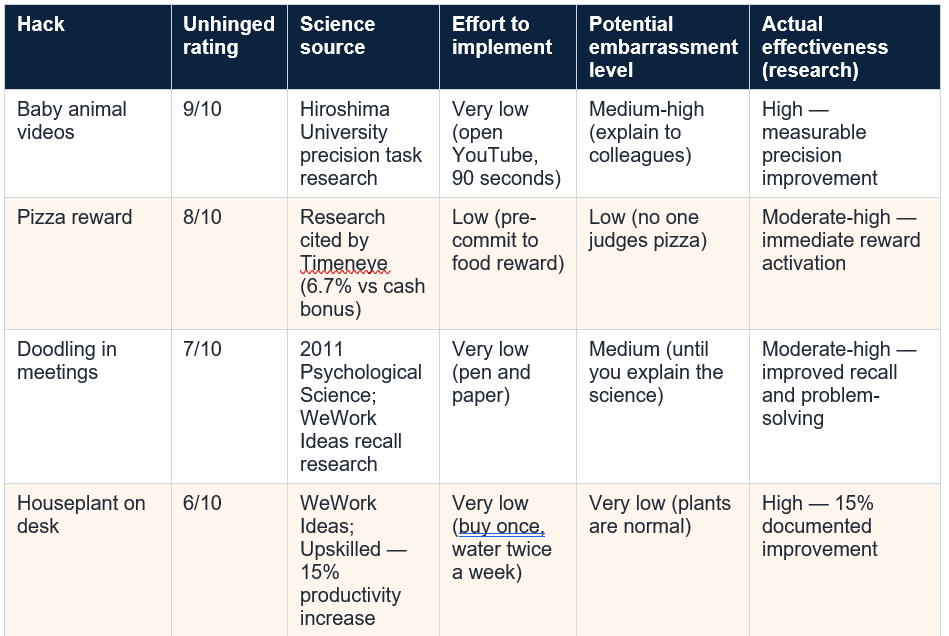
The underlying principle that runs through all ten hacks is the same one that Andy Molinsky articulated at Brandeis: find out what works for you — even if it is weird — and go with it. The research has done the finding. The weird part is now documented. All that remains is using it without worrying about whether it looks dignified.
Yes, with specific conditions. Researchers at Hiroshima University showed participants images including cute baby animals, then had them perform a precision task (similar to the Operations board game). The group who saw the baby animal images performed better. GreenLit Content's 2024 summary of the research identified the mechanism: cute content stimulates a nurturing instinct that narrows focus and heightens caution — a cognitive mode that carries into subsequent tasks. WeWork Ideas and DeskTime both corroborate the finding. The specific application: use before precision or detail-oriented tasks, not as a general day-long distraction. Two minutes of baby animals, then close it and go to the task. DeskTime: 'help people pay more attention on tasks that require careful handling.' Sources: Hiroshima University; GreenLit Content 2024; WeWork Ideas; DeskTime.
What is 'creative incubation' and how do I use it?
Creative incubation is the term used in Psychological Science research to describe what happens during daydreaming: the brain's default mode network makes associative connections between concepts that focused, task-directed attention does not produce. It is the neural explanation for why insights arrive in the shower, on walks, and in the moments before sleep. The practical application: when you are genuinely stuck on a creative or strategic problem, deliberately stepping away from it — not for a distraction, but for a period of unfocused mind-wandering — allows the default mode network to continue working on it. Set a 10-minute timer. Put the problem down completely. Walk, look out the window, or sit quietly without looking at your phone. Return after the timer. The same mechanism that makes scheduled boredom productive is the one behind creative incubation — the brain does its associative best work when the focused analytical system steps back. Source: Psychological Science research on daydreaming; Timeneye.
Why did pizza outperform a cash bonus in the productivity study?
The research, cited by Timeneye and associated with Dan Ariely's work on reward and motivation, found that workers promised a pizza voucher were 6.7% more productive than those promised a cash bonus. The psychological mechanism relates to the tangibility and immediacy of food as a reward versus the abstraction of future monetary compensation. A cash bonus is a number on a future payslip — real but distant and abstract. Pizza is sensory, present, specific, and activates the brain's reward systems through multiple channels simultaneously. The immediacy also matters: the reward arrives the same day as the performance, creating a tighter feedback loop between behaviour and consequence. The practical application: for tasks you are avoiding, pre-commit to a specific, tangible, immediately appealing reward for completion. It does not have to be food. It has to be concrete, sensory, and genuinely appealing to you. Sources: Timeneye (citing research); Dan Ariely's work on reward systems.
How much does ambient noise actually help, and what volume?
Research cited by GreenLit Content (2024) suggests that moderate ambient noise — approximately 70 decibels, equivalent to the background hum of a busy coffee shop — is the Goldilocks zone for creative work. Below this level (complete silence), many people experience the absence of ambient stimulation as pressurising rather than focusing. Above this level (loud music, open-plan office chatter), attention is fractured by the competing content. The ~70dB coffee shop hum provides enough low-level auditory stimulation to engage the brain's ambient processing without occupying the cognitive systems needed for the actual work. Apps like Coffitivity, Noisli, and ambient YouTube streams provide this specific acoustic profile for free. Note: this research specifically applies to creative and generative work. For deep analytical or mathematical work, lower ambient noise levels may be preferable. GreenLit Content 2024: 'Studies suggest moderate ambient noise (about the volume of a coffee shop) is ideal for stimulating creativity.' Source: GreenLit Content 2024.
What is planned procrastination and how do I implement it?
Planned procrastination, as described by Charles Duhigg in The Power of Habit (and reported by WeWork Ideas citing Fast Company), involves deliberately scheduling the activities you are most tempted to procrastinate with — social media, YouTube, personal messages — into specific time slots in your workday. The mechanism: the psychological cost of resisting a temptation actively consumes willpower and cognitive resources that could be spent on work. When the same activity is scheduled, the resistance cost disappears, and it becomes a guilt-free break that recharges rather than drains. Fast Company editor Anisa Purbasari Horton reported on her own experiment: 'I was surprised by how much more on the ball I was with my work when I didn't feel bad about procrastinating. I realized I wasn't scheduling procrastination — I was scheduling breaks.' APA's 2025 research finding that 5-minute breaks every 50 minutes improve sustained attention by 35% provides the supporting science: structured breaks are productivity-positive; guilt-laden resistance is productivity-negative. Sources: Charles Duhigg (The Power of Habit); WeWork Ideas / Fast Company; APA 2025.
The productivity industry has a problem. It keeps giving you the same ten tips, dressed in different fonts and sold in different apps. Wake up at 5am. Use the Pomodoro Technique. Eat the frog. Clear your inbox to zero. And none of it is working well enough, or you would not be reading another productivity article. This one is different. These are the hacks the research actually found — not the sensible ones that consultants package into frameworks, but the legitimately weird ones that emerge when scientists study human performance without any prior agenda about what should help. Baby animals. Pizza. Daydreaming on purpose. The sound of a coffee shop played through your headphones while you sit alone in your kitchen. A potted plant that cannot even move. These are all backed by genuine research. They are also completely unhinged. Both things are true simultaneously. That combination is the entire point.
Table of Contents
- Why Normal Productivity Advice Has Stopped Working
- The Research That Started All This
- Hack 1 Watching Baby Animal Videos Is an Actual Productivity Hack
- Hack 2 Pizza Beats a Pay Rise for Immediate Productivity (Yes, Really)
- Hack 3 Doodling in Meetings Is Brain Optimisation, Not Boredom
- Hack 4 A Houseplant on Your Desk Increases Productivity by 15 Per Cent
- Hack 5 Planned Procrastination Is a Legitimate Productivity Method
- Hack 6 Daydreaming Is Called ‘Creative Incubation’ and You Should Do It on Purpose
- Hack 7 Work in a Coffee Shop (or Play Coffee Shop Sounds With Nothing in Your Cup)
- Hack 8 Set Your Computer to Announce the Time Every Hour
- Hack 9 Boredom Is a Productivity Superpower You Keep Eliminating
- Hack 10 Do Your Worst Task First (Even Though Your Brain Hates This)
- The Unhinged Productivity Leaderboard
- Conclusion: The Science Doesn’t Care That It’s Embarrassing
- Frequently Asked Questions
Why Normal Productivity Advice Has Stopped Working
The problem with conventional productivity advice is not that it is wrong. Most of it is fine. Time-blocking is fine. The Pomodoro Technique is fine. Getting up earlier is, for some people, fine. The problem is that it is all deeply familiar, which means your brain has already filed it under ‘things I know I should do and am not doing’ — a folder from which very little action ever emerges. There is a second, more interesting problem: the mainstream productivity canon largely ignores the research that does not fit its narrative. The productivity industry is, at its core, a morality play about discipline and effort. Hacks involving pizza, baby animals, and deliberate daydreaming do not fit the narrative. They are embarrassing to include in a framework that is supposed to be about serious professional development. And yet the research is real, the effect sizes are documented, and they work.Inc.com’s guide to unconventional productivity, contributed by Andy Molinsky, Professor of Management and Psychology at Brandeis University, puts the underlying principle plainly: ‘Find out what works for you (even if it’s weird) and go with it.’ This article is about finding out what the science says works — even when the science is absurd. Especially then, actually.
Stanford University (2024): deep work improves task accuracy by up to 40%. APA (2025): 5-minute breaks every 50 minutes improve sustained attention by 35%. Pizza group outperformed cash bonus group by 6.7% (research cited by Timeneye). Plants: 15% productivity increase (WeWork Ideas).
The Research That Started All This
The body of genuinely weird productivity research is larger than you might expect, mostly because it tends not to get promoted by productivity coaches. Hiroshima University ran a study on precision task performance and baby animal images. Dan Ariely’s research into reward systems and motivation produced the pizza study. Dohigg’s work on habit formation led to the planned procrastination framework. A 2011 study in Psychological Science documented doodling’s effect on recall. A separate set of research in the same journal established that daydreaming triggers creative incubation. Researchers found that moderate ambient noise — specifically the coffee shop level — is the documented sweet spot for creative work. A study found indoor plants improve productivity by 15 per cent.What all of these have in common is that they were not designed to produce productivity tips. They were designed to understand specific psychological mechanisms. The productivity applications emerged from the findings rather than being reverse-engineered from a desired conclusion. That is why they are credible. And that is why they are weird. Science does not edit its findings to match cultural expectations about how serious professionals should behave. The ten hacks in this article are the result.
Hack 1 Watching Baby Animal Videos Is an Actual Productivity Hack
You have been watching kitten videos for years thinking it was the opposite of productivity. Turns out the entire time you were accidentally participating in legitimate brain science. Researchers at Hiroshima University ran an experiment in which participants were shown images of cute baby animals and then asked to perform a precision task similar to the Operations board game — the one where you have to extract tiny pieces without triggering the buzzer. The baby animal group performed significantly better than those who had not been given a dose of cuteness before the task. GreenLit Content’s 2024 analysis of the research explains the mechanism: ‘Cute content may stimulate a nurturing instinct that narrows our focus and heightens our caution.’ Essentially, the baby animal visual triggers a carefulness response in the brain — the same cognitive mode you enter when you are looking after something fragile and precious. That careful, attentive mental state then carries over into the next thing you do. WeWork Ideas corroborates it: ‘Research finds that looking at cute animals can help employees feel happier and more engaged.’ DeskTime adds that cute animals specifically ‘help people to pay more attention when completing tasks that require careful handling.’ The practical upshot is one of the most genuinely delightful facts in productivity research: before a task requiring precision, attention to detail, or careful execution, spend two minutes on baby animal content. You are not wasting time. You are calibrating your brain.’Hiroshima University research: participants shown cute baby animal images performed better on precision tasks. GreenLit Content 2024: 'Cute content stimulates a nurturing instinct that narrows focus and heightens caution.' WeWork: cute animals help employees feel happier and more engaged. DeskTime: help people pay more attention on tasks requiring careful handling.
Before any task requiring precision or attention to detail, spend 90-120 seconds watching baby animal content. Then close it and go straight to the task. GreenLit Content 2024: 'A minute or two of concentrated cuteness could be the productivity kickstart you need.'
Hack 2 Pizza Beats a Pay Rise for Immediate Productivity (Yes, Really)
This study should be framed in every HR department in the world. Researchers divided workers into three groups and promised each a different reward for their productivity: the first group was promised a cash bonus, the second group a compliment from their manager, and the third group a voucher for free pizza. According to Timeneye’s analysis, the pizza group outperformed by 6.7% in immediate productivity. For one day, at least, pizza beat cash. The research behind this is associated with Dan Ariely’s work on motivation and reward systems, and it touches on something genuinely interesting about human psychology: the tangibility and immediacy of food as a reward activates different motivational circuits than abstract future compensation. A cash bonus is a number on a future payslip. Pizza is real, it is present, it smells amazing, and it is arriving at lunchtime. Timeneye’s report on the study is unambiguous: ‘The research conclusion: pizza makes you more productive. It’s science.’ Before a particularly brutal work session or a project you have been avoiding, pre-commit to a specific food reward that you genuinely want. It does not have to be pizza — it has to be something concrete, immediate, and genuinely appealing to your brain’s reward system. The abstract promise of a good feeling when you finish is far less motivating than a specific, tangible, delicious reward waiting at the end.Research dividing workers into bonus/compliment/pizza groups: pizza group outperformed by 6.7% in immediate productivity (Timeneye, citing research associated with Dan Ariely's work on reward systems). Timeneye: 'The research conclusion: pizza makes you more productive. It's science.'
Before a task you've been avoiding, pre-commit to a specific, tangible food reward (a meal you actually love, a treat, a coffee from somewhere nice) for when you finish. Write it down. Make it concrete. The brain's reward system responds to real, sensory, immediate pleasures far more powerfully than abstract future positives.
A Nobel Prize-winning economist ran this study. The pizza won. | Rating: 🤩 8/10 Unhinged. This research exists. A Nobel-recognised economist contributed to it. Please use it irresponsibly.
Hack 3 Doodling in Meetings Is Brain Optimisation, Not Boredom
If you have ever been reprimanded — by a teacher, a manager, a disapproving meeting participant — for doodling instead of paying attention, you were the victim of an injustice that the science has since corrected. A 2011 study published in Psychological Science found that doodling is a fast, simple way to keep the brain active during dull or repetitive tasks. Timeneye’s analysis adds the mechanism: doodling lights up areas of the brain you do not normally use during focused listening, which helps you analyse problems differently and find solutions from a new angle. WeWork Ideas corroborates the memory dimension: ‘Scribbling can help with recall, according to research. While some may see doodling as a sign of not paying attention, the act could actually improve your ability to remember.’ The cognitive mechanism is that passive listening without any motor engagement allows the brain to drift more easily into complete disengagement than doodling does. The slight motor activity of doodling keeps enough of the brain’s processing load occupied to prevent full wandering while leaving the listening and comprehension systems fully available. It is the neural equivalent of keeping an engine idling instead of letting it stall. Upskilled’s guide adds the companion finding: taking notes by hand (the pen-on-paper motor engagement) helps retain information better than typing, for the same engagement reasons. During any meeting or presentation where you are receiving rather than presenting, doodle. It is not a guilty secret. It is calibrated neural maintenance.2011 study (Psychological Science): doodling keeps the brain active during dull tasks. Timeneye: doodling lights up brain areas not normally used, helping analyse problems differently. WeWork Ideas: scribbling improves recall. Upskilled: taking notes by hand improves retention vs typing.
Keep a dedicated doodle pad next to your keyboard specifically for meetings and long calls. Do not try to draw anything coherent — abstract shapes, patterns, spirals. The content is irrelevant. The neural engagement is the point.
Hack 4 A Houseplant on Your Desk Increases Productivity by 15 Per Cent
A study cited by both WeWork Ideas and Upskilled.edu.au found that indoor plants increased workers’ productivity by 15 per cent. Not by making the environment prettier in some vague, difficult-to-measure way. By fifteen measurable percentage points. Luxafor’s productivity guide explains the mechanism: ‘Studies suggest that plants can improve air quality, reduce stress, and even enhance creativity.’ The combination of reduced cortisol (the stress hormone that degrades cognitive performance), slightly improved air quality, and the visual effect of natural elements on the brain’s stress response systems adds up to a meaningful productivity improvement from something that costs approximately the price of a takeaway coffee and requires watering approximately twice a week. The key is choosing the right plant. You are not looking for a high-maintenance commitment that will stress you out when it starts looking sad. You are looking for something that thrives on neglect: a pothos, a snake plant, a ZZ plant, or a spider plant. All of these can survive extended periods of forgetting, partial shade, and irregular watering. They exist precisely to be present on desks without demanding anything in return. Upskilled’s guide is characteristically direct: ‘The science backs up their claims.’ A 15% productivity improvement from a single pot plant on your desk is, calorie-for-calorie, a better return on investment than most productivity apps, task management systems, or consultants.One study: indoor plants increased workers' productivity by 15% (WeWork Ideas; Upskilled.edu.au). Luxafor: plants improve air quality, reduce stress, and enhance creativity. Mechanism: reduced cortisol from natural visual elements and improved micro-environment.
Buy one low-maintenance plant: pothos, snake plant, ZZ plant, or spider plant. Place it at or near your eye line when working. Water it when you remember. That is the entire hack. Total cost: approximately $5-$15. Productivity improvement: potentially 15%.
Hack 5 Planned Procrastination Is a Legitimate Productivity Method
Charles Duhigg, author of The Power of Habit, proposed an idea that at first sounds like a note from a productivity coach who has given up: schedule the non-work tasks you are most tempted by into your workday. Not grudgingly. Deliberately. With calendar appointments. WeWork Ideas reported on Fast Company editor Anisa Purbasari Horton’s experiment implementing Duhigg’s suggestion, and her report is worth reading in full: ‘I was surprised by how much more on the ball I was with my work when I didn’t feel bad about procrastinating. In fact, I realised that I wasn’t scheduling procrastination, I was scheduling breaks — guilt-free, mentally recharging breaks.’ The mechanism is the psychology of forbidden fruit: when something is banned, the mental effort of resisting it actively consumes the cognitive resources you need for the work you are supposed to be doing. Every minute spent resisting the temptation to check social media is a minute of willpower spent, with corresponding cognitive depletion. When the same activity is scheduled, the resistance cost disappears entirely — and the activity itself becomes a genuine break rather than a guilt-laden deviation from the plan. APA’s 2025 research found that taking 5-minute breaks every 50 minutes improves sustained attention by 35%. The planned procrastination concept is a more psychologically sophisticated version of the same principle: not fighting human nature, but scheduling it.Charles Duhigg, The Power of Habit: schedule tempting non-work tasks into the workday. Fast Company/WeWork Ideas: planned procrastination transforms into guilt-free recharging breaks. APA 2025: 5-minute breaks every 50 minutes improve sustained attention by 35%.
At the start of each work block, write down the most tempting distractions you'll want to indulge. Assign each one a specific time slot later in the day. At that time, do it fully and without guilt. The key: 'at 3pm I will look at Reddit for 10 minutes' beats 'I must not look at Reddit' every time.
The thing you’ve been fighting all your life turns out to be your brain asking for a scheduled break. | Rating: 8/10 Unhinged. The productivity hack is doing the thing you were going to do anyway but writing it in your calendar first. Transcendently stupid. Completely effective.
Hack 6 Daydreaming Is Called ‘Creative Incubation’ and You Should Do It on Purpose
Research published in Psychological Science established that mind-wandering — the act of letting your attention drift away from the task at hand into associative, undirected thinking — triggers what researchers call ‘creative incubation.’ The term sounds like something that happens in a laboratory. What it describes is what happens when you stop forcing yourself to think directly at a problem and instead allow your brain’s default mode network to work on it sideways. Timeneye’s analysis of the research notes: ‘According to research in the journal Psychological Science, daydreaming triggers creative incubation.’ The reason this works is neurological. The default mode network — the brain system that activates during unfocused thought, daydreaming, and mind-wandering — makes associative connections between concepts that the focused, task-directed attention system does not. When you are staring directly at a problem, you are using the analytical brain. When you let your mind wander, the connective, associative brain gets its turn. Many of history’s most celebrated creative insights arrived during states of unfocused reverie: in the shower, on a walk, in the moment before sleep. This is not a coincidence. It is the default mode network doing its best work on the problem you set down. The implication: when you are genuinely stuck, staring harder at the problem is almost always the wrong response. Getting up, looking out of the window, and thinking about nothing in particular gives the right part of your brain its turn. Not as a reward for working. As the actual work.Psychological Science journal: daydreaming triggers 'creative incubation.' The default mode network makes associative connections during unfocused thought that focused analytical thinking does not access. Mind-wandering activates the neural systems behind creative insight.
When stuck on a creative or strategic problem, set a 10-minute timer. Put the problem down completely. Do something physically simple — walk, make tea, look out the window. Do not try to think about the problem. Come back after the timer. The default mode network has been working while you were 'doing nothing.'
Staring out of the window with a blank expression is scientifically classifiable as deep work. | Rating: 7/10 Unhinged. Staring into the middle distance is now in your productivity arsenal. Tell your manager it's cognitive incubation. Maintain the same blank expression throughout.
Hack 7 Work in a Coffee Shop (or Play Coffee Shop Sounds With Nothing in Your Cup)
Research cited by GreenLit Content found that moderate ambient noise — approximately the volume of a bustling coffee shop, around 70 decibels — is the Goldilocks zone for creative work. Not complete silence, which can feel pressurising and depriving. Not loud noise, which fractures attention. The specific hum of a coffee shop — background conversation, espresso machine, ambient movement — provides just enough auditory stimulation to engage the parts of the brain that benefit from low-level environmental input without overwhelming the cognitive systems you need for the actual work. GreenLit Content’s 2024 summary is direct: ‘Studies suggest moderate ambient noise (about the volume of a coffee shop) is ideal for stimulating creativity.’ The practical implication is slightly unhinged: if you cannot physically go to a coffee shop, you can reproduce the effect with ambient noise apps, YouTube coffee shop ambience streams, or websites specifically designed to generate coffee shop audio environments. You are not simulating a social environment for comfort. You are calibrating the acoustic conditions of your workspace to the neurocognitive optimum for creative output based on peer-reviewed research. Apps like Coffitivity, Noisli, or ambient YouTube streams provide the specific frequency profile for free. The moderately absurd conclusion: silence may actually be the worst working environment for many creative and cognitive tasks, and the background noise of strangers ordering lattes is the scientifically indicated alternative.Research cited by GreenLit Content 2024: moderate ambient noise (~70 decibels, coffee shop level) is ideal for stimulating creativity. Complete silence can feel pressurising; loud noise fractures attention. The coffee shop hum is the documented Goldilocks zone for creative cognitive work.
Download Coffitivity (free), use Noisli, or search 'coffee shop ambience' on YouTube. Set at a comfortable background level — you should hear it but not notice it. Use specifically for creative work, writing, or complex problem-solving. Turn it off for deep focused analysis.
The sound of other people's productivity is itself a productivity drug. | Rating: 7/10 Unhinged. You are legally allowed to recreate the sound of a coffee shop from inside your bedroom in order to do better work. This is the era we live in.
Hack 8 Set Your Computer to Announce the Time Every Hour
Upskilled.edu.au’s guide to productivity hacks you probably haven’t heard of yet includes one that sounds so simple it is almost insulting and yet — characteristically for this genre — actually works: set your computer or phone to audibly announce the time every hour. ‘And it actually works,’ the guide notes with admirable brevity. The mechanism is what productivity researchers call time-awareness: the failure mode it addresses is time blindness, the phenomenon in which you sit down to work at 9am and look up to discover it is 2pm and you have been deep in one thing for five hours without moving, drinking water, or attending the meeting you were supposed to give at 1pm. Regular time announcements create consistent temporal checkpoints that prevent this. They serve as interruption-free micro-reminders that time is passing, that the day is progressing, and that the hourly audit question — ‘what have I actually done this hour?’ — is now being triggered automatically. The beauty of this hack is its complete lack of gamification, subscription fee, or learning curve. On a Mac: System Preferences → Date & Time → Clock → Announce the Time. On Windows: set an hourly alarm with a pleasant chime. On your phone: hourly alert. Total setup time: under two minutes. Techwell.com offers a companion verbal trick for email specifically: repeatedly saying ‘next’ to yourself while processing messages keeps you moving through them without getting pulled into any one conversation. Simple verbal cues are underrated temporal anchors.Upskilled.edu.au: computer time announcements 'actually work' as a time-awareness tool. Addresses time blindness — the failure mode where hours pass without temporal awareness. Creates hourly checkpoints for accountability. Companion from Techwell.com: saying 'next' to yourself during email prevents vortex paralysis.
Mac: System Preferences → Date & Time → Clock → 'Announce the time.' Windows: Cortana hourly alarm. Phone: set hourly repeating alarm with a gentle sound. When the hour announces, take 30 seconds to answer: 'What have I actually done this hour? What do I do next?' Do not snooze it.
Weaponise your calendar. Make time itself accountable to you. | Rating: 🕛 5/10 Unhinged. The least unhinged entry but possibly the highest actual ROI. Your computer will tell you the time and somehow this changes everything.
Hack 9 Boredom Is a Productivity Superpower You Keep Eliminating
Here is the hack that modern phone design has spent approximately one trillion dollars actively preventing: the experience of genuine boredom is one of the most reliable triggers for creative and innovative thinking that the human brain produces. When there is nothing to engage with, the brain manufactures engagement — through imagination, problem-solving, future planning, and the kind of free-associative creative thought that spawned most interesting ideas in human history. Every time you reach for your phone during a transitional moment — the lift, the queue, the five minutes before the meeting starts — you are replacing what would have been a creative incubation period with scrolling. Timeneye’s research roundup connects this to the daydreaming research: the same default mode network activity that triggers creative incubation is the neural process that boredom activates. The boredom — the mild discomfort of having nothing to engage with — is what initiates the shift into creative default mode processing. The practical hack is uncomfortable in direct proportion to how long you have been using your phone as a boredom replacement: leave your phone in your pocket during transitional moments. Queue without it. Walk without it. Sit in waiting rooms with it face-down. The boredom you experience during those moments is not dead time. It is your best creative thinking engine, running warm-up cycles on whatever problem is currently parked in the back of your mind. The insights that emerge in the shower happen in the shower because the shower is the last uninterrupted boredom zone most people still regularly experience. Give yourself more of them on purpose.The default mode network — the neural system active during boredom and mind-wandering — is the same system behind creative incubation (Psychological Science research on daydreaming). Boredom initiates the shift into creative default mode processing. Every transitional phone-scroll eliminates a potential creative incubation window.
One day this week: leave your phone in your bag or pocket during every transitional moment — queues, lifts, waiting rooms, walks of under 5 minutes. Note what thoughts appear. They will not be transcendent immediately. Persist for one week and observe the shift.
Your phone is a boredom-cancelling machine. Boredom was doing your best thinking. | Rating: 9/10 Unhinged. The hack is not doing something. In 2026 this is the most radical productivity intervention available.
Hack 10 Do Your Worst Task First (Even Though Your Brain Hates This)
The research on decision fatigue — the well-documented phenomenon in which the quality of human decision-making degrades with each successive decision made throughout the day — reveals the mechanism behind a productivity principle that Stanford University’s 2024 research and productivity literature consistently endorses: tackle the most cognitively demanding or emotionally aversive task first, when your prefrontal cortex is fresh and your willpower reserves are full. Luxafor’s productivity guide addresses it directly: ‘When you get the most challenging tasks out of the way early, you eliminate the mental burden of looming deadlines and avoid procrastination.’ The additional mechanism is task residue: research shows that unstarted aversive tasks generate a constant low-level cognitive load as the brain keeps returning to them, even when you are doing something else. Every hour you spend not doing the thing you are avoiding costs you a fraction of your cognitive capacity for everything else you try to do. Starting the dreaded task first eliminates this background processing cost from the moment it is completed. The Inc.com guide from Brandeis Professor Andy Molinsky notes the flip side: ‘Know when you’re not at your productive best — and have the discipline to pull the plug. You start to write that report, it’s just not clicking. You could try to power through, but in most cases that’s the worst thing you can do.’ The nuance: eat the frog first, but know when the frog needs to be postponed to a completely different day rather than forced through unproductively.Stanford University (2024): deep work sessions improve task accuracy by up to 40%. Luxafor: tackling challenging tasks early 'eliminates the mental burden of looming deadlines.' Task residue research: incomplete aversive tasks generate constant background cognitive load. Decision fatigue research: prefrontal resources are highest first thing.
Tonight, write down the single task you most want to avoid tomorrow. Make it the first thing you open tomorrow morning, before email, before social media, before coffee if you can manage it. Set a 25-minute timer. Start it. Not because it will be easy. Because the cognitive relief of having it done carries through the entire rest of the day.
The thing you have been avoiding is the reason you feel exhausted by noon. | Rating: 8/10 Unhinged. Eating the metaphorical frog is, technically, not eating a frog. But you already knew that. Do it anyway.
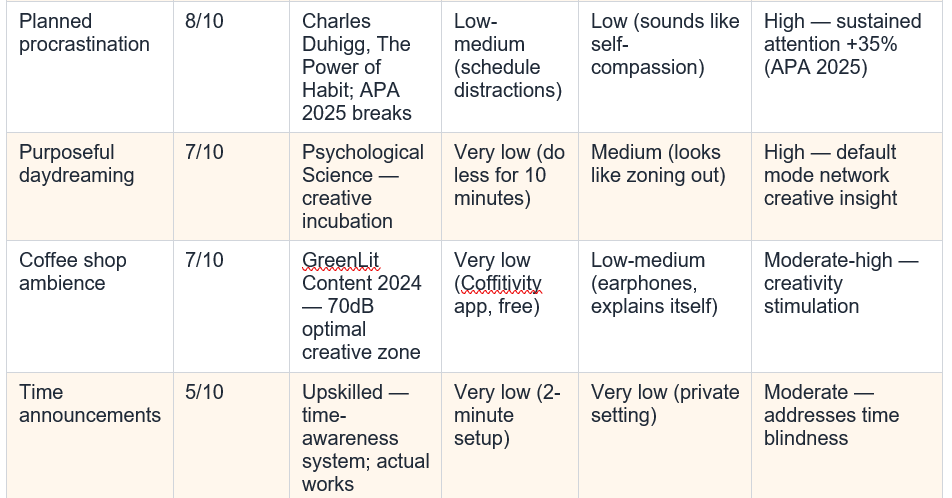
The Unhinged Productivity Leaderboard
Conclusion
The productivity industry would like you to believe that peak performance is a function of discipline, systems, and enough cold plunge pools. The actual research suggests it is also a function of baby animals, carbohydrates, indoor flora, deliberate idleness, and the sound of strangers ordering coffee. These things are embarrassing to admit. The science does not care. A 6.7% productivity improvement from a pizza voucher is still a 6.7% productivity improvement. A 15% increase from a houseplant is still 15%. Hiroshima University did not publish their cute animal findings on the condition that you only use them if your productivity situation is sufficiently serious.The underlying principle that runs through all ten hacks is the same one that Andy Molinsky articulated at Brandeis: find out what works for you — even if it is weird — and go with it. The research has done the finding. The weird part is now documented. All that remains is using it without worrying about whether it looks dignified.
Frequently Asked Questions
Is watching baby animal videos really a documented productivity hack?Yes, with specific conditions. Researchers at Hiroshima University showed participants images including cute baby animals, then had them perform a precision task (similar to the Operations board game). The group who saw the baby animal images performed better. GreenLit Content's 2024 summary of the research identified the mechanism: cute content stimulates a nurturing instinct that narrows focus and heightens caution — a cognitive mode that carries into subsequent tasks. WeWork Ideas and DeskTime both corroborate the finding. The specific application: use before precision or detail-oriented tasks, not as a general day-long distraction. Two minutes of baby animals, then close it and go to the task. DeskTime: 'help people pay more attention on tasks that require careful handling.' Sources: Hiroshima University; GreenLit Content 2024; WeWork Ideas; DeskTime.
What is 'creative incubation' and how do I use it?
Creative incubation is the term used in Psychological Science research to describe what happens during daydreaming: the brain's default mode network makes associative connections between concepts that focused, task-directed attention does not produce. It is the neural explanation for why insights arrive in the shower, on walks, and in the moments before sleep. The practical application: when you are genuinely stuck on a creative or strategic problem, deliberately stepping away from it — not for a distraction, but for a period of unfocused mind-wandering — allows the default mode network to continue working on it. Set a 10-minute timer. Put the problem down completely. Walk, look out the window, or sit quietly without looking at your phone. Return after the timer. The same mechanism that makes scheduled boredom productive is the one behind creative incubation — the brain does its associative best work when the focused analytical system steps back. Source: Psychological Science research on daydreaming; Timeneye.
Why did pizza outperform a cash bonus in the productivity study?
The research, cited by Timeneye and associated with Dan Ariely's work on reward and motivation, found that workers promised a pizza voucher were 6.7% more productive than those promised a cash bonus. The psychological mechanism relates to the tangibility and immediacy of food as a reward versus the abstraction of future monetary compensation. A cash bonus is a number on a future payslip — real but distant and abstract. Pizza is sensory, present, specific, and activates the brain's reward systems through multiple channels simultaneously. The immediacy also matters: the reward arrives the same day as the performance, creating a tighter feedback loop between behaviour and consequence. The practical application: for tasks you are avoiding, pre-commit to a specific, tangible, immediately appealing reward for completion. It does not have to be food. It has to be concrete, sensory, and genuinely appealing to you. Sources: Timeneye (citing research); Dan Ariely's work on reward systems.
How much does ambient noise actually help, and what volume?
Research cited by GreenLit Content (2024) suggests that moderate ambient noise — approximately 70 decibels, equivalent to the background hum of a busy coffee shop — is the Goldilocks zone for creative work. Below this level (complete silence), many people experience the absence of ambient stimulation as pressurising rather than focusing. Above this level (loud music, open-plan office chatter), attention is fractured by the competing content. The ~70dB coffee shop hum provides enough low-level auditory stimulation to engage the brain's ambient processing without occupying the cognitive systems needed for the actual work. Apps like Coffitivity, Noisli, and ambient YouTube streams provide this specific acoustic profile for free. Note: this research specifically applies to creative and generative work. For deep analytical or mathematical work, lower ambient noise levels may be preferable. GreenLit Content 2024: 'Studies suggest moderate ambient noise (about the volume of a coffee shop) is ideal for stimulating creativity.' Source: GreenLit Content 2024.
What is planned procrastination and how do I implement it?
Planned procrastination, as described by Charles Duhigg in The Power of Habit (and reported by WeWork Ideas citing Fast Company), involves deliberately scheduling the activities you are most tempted to procrastinate with — social media, YouTube, personal messages — into specific time slots in your workday. The mechanism: the psychological cost of resisting a temptation actively consumes willpower and cognitive resources that could be spent on work. When the same activity is scheduled, the resistance cost disappears, and it becomes a guilt-free break that recharges rather than drains. Fast Company editor Anisa Purbasari Horton reported on her own experiment: 'I was surprised by how much more on the ball I was with my work when I didn't feel bad about procrastinating. I realized I wasn't scheduling procrastination — I was scheduling breaks.' APA's 2025 research finding that 5-minute breaks every 50 minutes improve sustained attention by 35% provides the supporting science: structured breaks are productivity-positive; guilt-laden resistance is productivity-negative. Sources: Charles Duhigg (The Power of Habit); WeWork Ideas / Fast Company; APA 2025.
0 Comments
Be the first to share your thoughts on this article.