

Food
Salmonella Egg Recall: Impact on Your Shopping
Table of Contents
- A Recall That Reaches 19 Million Eggs and 17 States
- What Is Salmonella and Why Are Eggs a Common Carrier?
- The 2026 Salmonella Egg Recall: Complete Fact Sheet
- The Impact on Your Shopping: What Has Changed at Stores
- 5 Ways the Egg Recall Is Affecting Shoppers Right Now
- Exactly How to Check Whether Your Eggs Are Recalled
- Salmonella Symptoms: When to Seek Medical Care
- Seek Medical Care Immediately If:
- Conclusion
- Frequently Asked Questions (FAQ)

A Recall That Reaches 19 Million Eggs and 17 States
On July 22, 2026, the US Food and Drug Administration posted a voluntary recall notice from Midwest Poultry Services, L.P. covering 1,589,577 dozen shell eggs -- more than 19 million individual eggs -- due to possible Salmonella Enteritidis contamination. It is one of the largest single egg recalls in recent US food safety history, affecting both white shell and brown cage-free eggs sold under some of the most widely recognised grocery brand names in America: Kroger, Simple Truth, Brookshire's, Country Morning, and Cal-Maine Sunups.The recall is connected to an active FDA and CDC multistate outbreak investigation. FDA (July 2026): a total of 98 people infected with the outbreak strain of Salmonella Enteritidis have been reported from 17 states. Illnesses started as early as November 21, 2025, and continued through June 30, 2026. There have been 26 hospitalisations. No deaths have been reported. Of those whose exposure history was documented, 91% reported eating eggs before becoming ill.
For shoppers, the recall raises immediate practical questions: are the eggs in your refrigerator affected? What should you do with them? Can you get a refund? Are other eggs at the store safe to buy? What are the symptoms of Salmonella infection, and what should you do if you think you have been affected? This guide answers all of those questions, drawing on the most current official guidance from the FDA, CDC, and major retailers as of 29 July 2026. It also places this recall in broader context -- the impact on consumer trust, the state of egg safety in the US, and what every shopper should know about protecting their household from foodborne illness, both now and for any future recall.
What Is Salmonella and Why Are Eggs a Common Carrier?
Salmonella is a genus of bacteria that is one of the leading causes of foodborne illness in the United States. The CDC estimates that Salmonella causes approximately 1.35 million infections, 26,500 hospitalisations, and 420 deaths in the US every year across all food sources -- making it the foodborne pathogen responsible for the most hospitalisations of any single organism. Shell eggs are one of the most common vehicles for Salmonella Enteritidis specifically, which is the strain involved in the current July 2026 outbreak.Eggs become contaminated with Salmonella in two primary ways. First, internal contamination: a hen infected with Salmonella Enteritidis can pass the bacteria directly into the egg before the shell forms, meaning the bacteria is inside the egg before it is laid. This is why thoroughly cooking eggs -- to an internal temperature of 160°F (71°C) for scrambled or fried eggs with fully set yolks -- is essential, since cooking kills the bacteria. Second, external contamination: Salmonella bacteria from the environment, equipment, or the hen's intestinal tract can contaminate the outer surface of the eggshell. Cracks in the shell or improper handling can allow surface bacteria to enter the egg.
FDA (July 2026 recall notice): 'Salmonella is an organism which can cause serious and sometimes fatal infections in young children, frail or elderly people, and others with weakened immune systems. Healthy persons infected with Salmonella often experience fever, diarrhea (which may be bloody), nausea, vomiting and abdominal pain. In rare circumstances, infection with Salmonella can result in the organism getting into the bloodstream and producing more severe illnesses such as arterial infections (i.e., infected aneurysms), endocarditis and arthritis.' Illness typically begins 12 to 72 hours after consuming contaminated food and lasts four to seven days. Most healthy adults recover without treatment, but hospitalisation may be necessary for severe cases or vulnerable individuals.
The 2026 Salmonella egg recall at a glance: 19 million+ eggs recalled. 98 sick in 17 states. 26 hospitalised. Brands: Kroger, Simple Truth, Brookshire's, Country Morning, Cal-Maine Sunups. — FDA Outbreak Investigation (July 2026): '98 people infected with outbreak strain of Salmonella from 17 states. 26 hospitalisations, no deaths. 91% of those with information available reported eating eggs before becoming ill.' TODAY (July 27, 2026 -- most current): 'The massive egg recall includes 1,589,577 dozen eggs -- more than 19 million eggs in total -- produced in Texas by Midwest Poultry Services L.P. Recall notice posted by FDA on July 22, 2026.' CDC (July 2026): 'Recalled eggs sold under Kroger, Simple Truth, Brookshire's, Cal-Maine and Country Morning brand names.'
The 2026 Salmonella Egg Recall: Complete Fact Sheet
The following table sets out every confirmed detail of the July 2026 egg recall, sourced directly from the FDA, CDC, and most current news reports: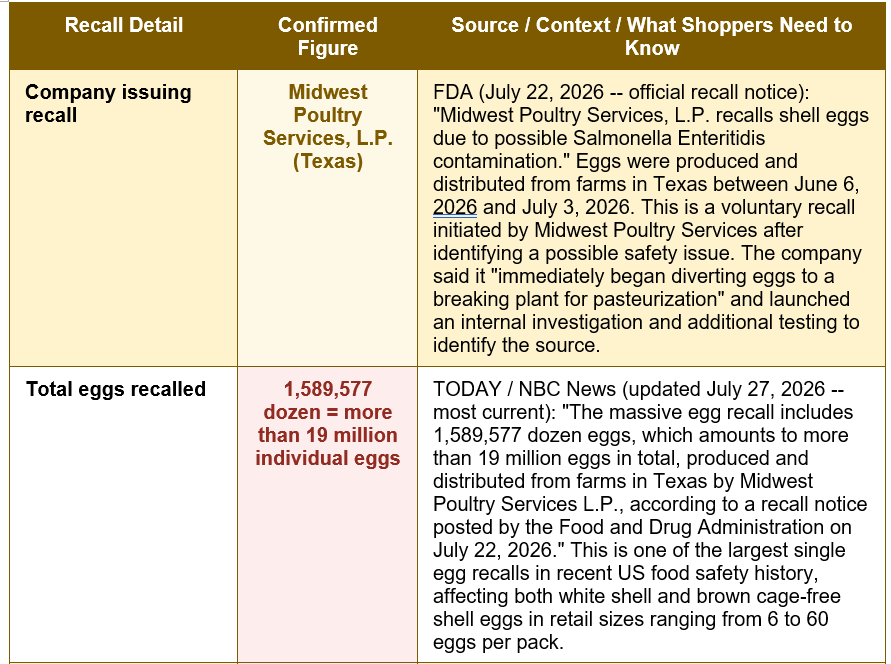
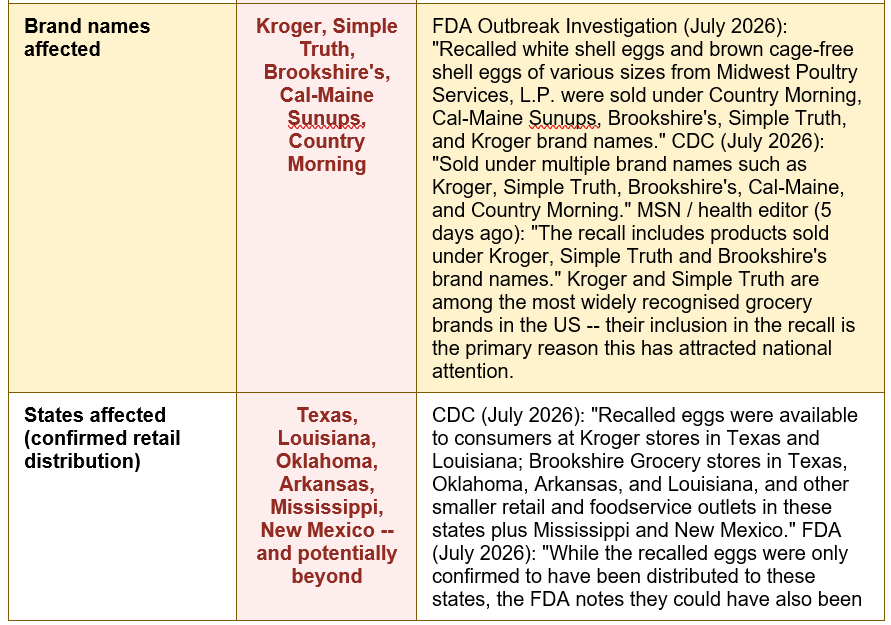
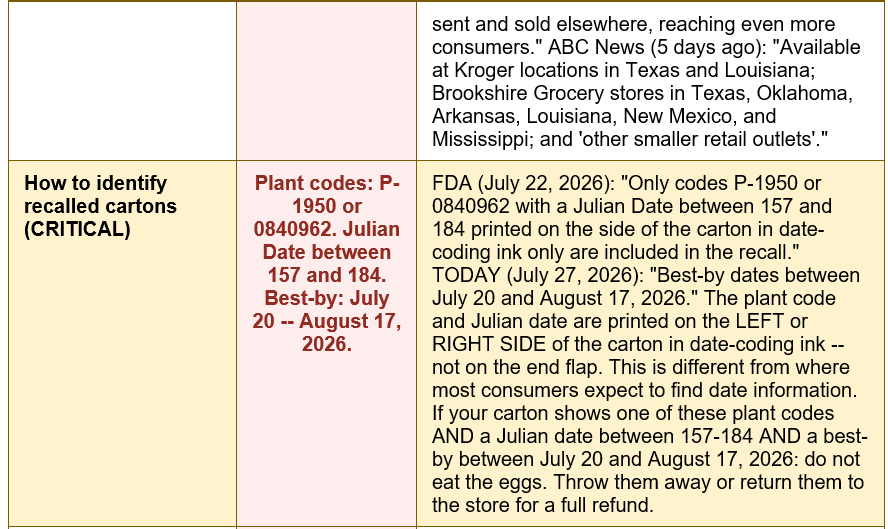
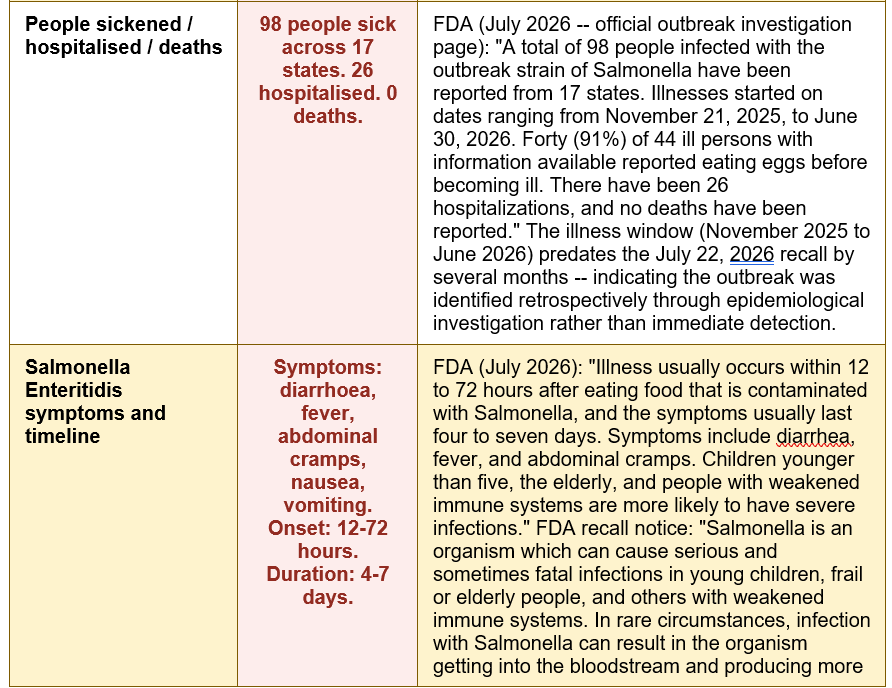

The Impact on Your Shopping: What Has Changed at Stores
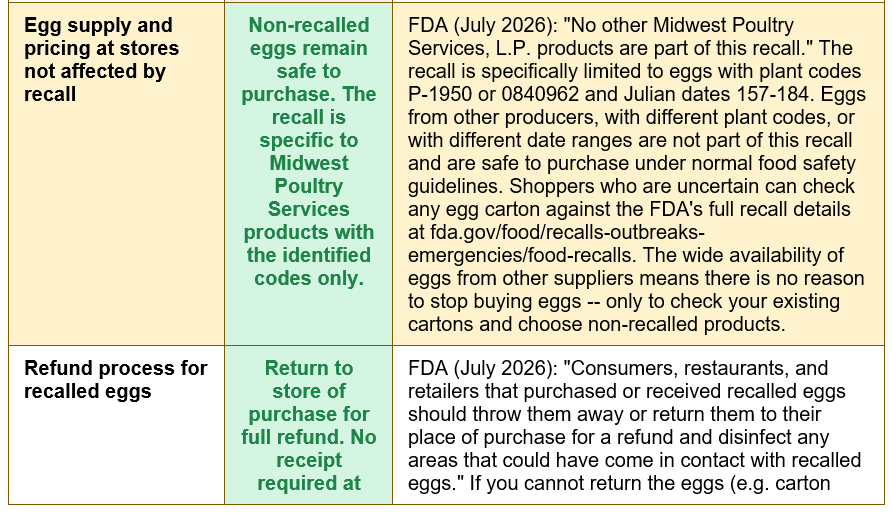
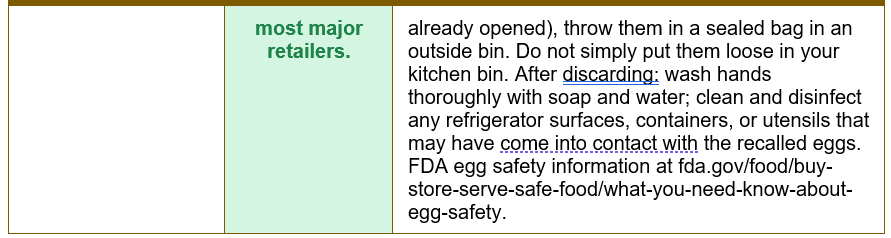
The following table maps the direct impact of the recall on shoppers by retailer and region, and explains exactly what to do in each scenario: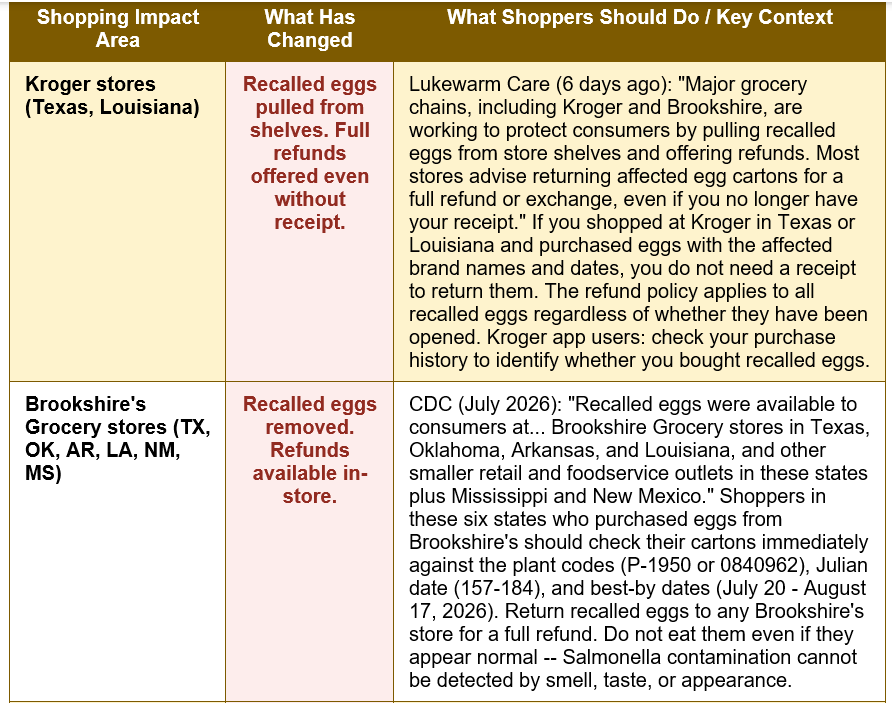
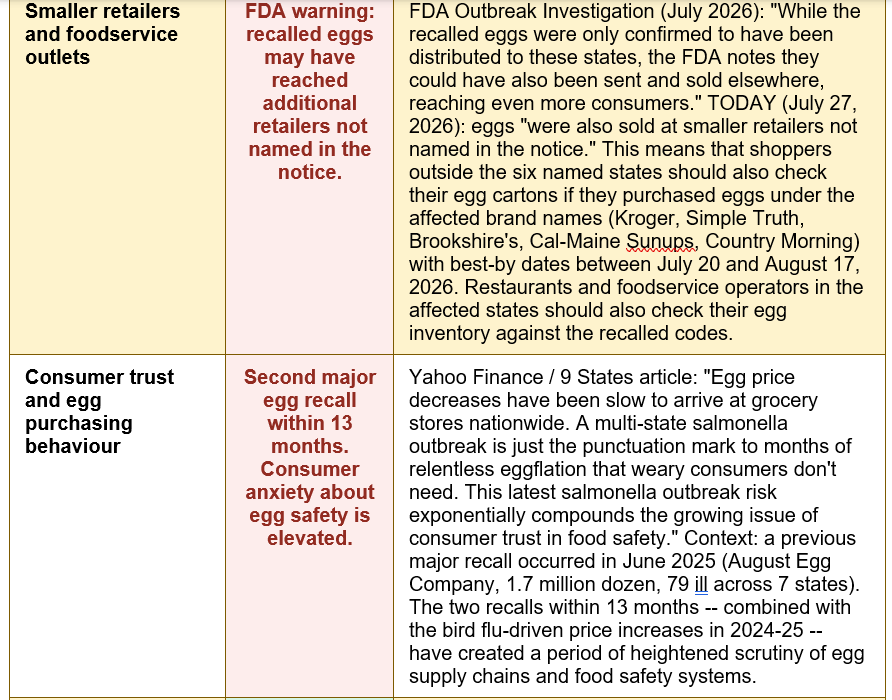
5 Ways the Egg Recall Is Affecting Shoppers Right Now
IMPACT #1: SHELF GAPS AND TEMPORARY SHORTAGES AT AFFECTED STORES | Recalled eggs removed -- but non-recalled eggs remain available
The immediate visible impact of the recall for shoppers at Kroger and Brookshire's stores in the affected states is the removal of recalled egg products from shelves. Lukewarm Care (6 days ago): 'Major grocery chains, including Kroger and Brookshire, are working to protect consumers by pulling recalled eggs from store shelves and offering refunds.' The removal of approximately 1.6 million dozen eggs from retail channels represents a significant volume -- but because the recall is limited to specific plant codes from a single producer, eggs from other suppliers remain available and unaffected. Shoppers who arrive at their usual store and find the familiar Kroger or Simple Truth egg brand absent should not be alarmed by an apparent shortage -- it reflects the recall removal, not a supply problem. Other egg brands and own-label products from different suppliers with different plant codes are safe to purchase. The FDA is clear: no other Midwest Poultry Services products are part of this recall, and eggs from other producers are unaffected.IMPACT #2: REFUND PROCESS AND CONSUMER RIGHTS | No receipt required -- full refunds available for returned recalled eggs
Shoppers who purchased recalled eggs have a clear consumer right to a full refund. FDA (July 2026): 'Consumers, restaurants, and retailers that purchased or received recalled eggs should throw them away or return them to their place of purchase for a refund and disinfect any areas that could have come in contact with recalled eggs.' Lukewarm Care (6 days ago): 'Most stores advise returning affected egg cartons for a full refund or exchange, even if you no longer have your receipt.' The refund process is straightforward: bring the recalled egg carton (or the remaining eggs) to the customer service desk at Kroger or Brookshire's. The store will process a full refund to your original payment method. If you paid by loyalty card (Kroger Plus card, for example), the refund can be verified against your purchase history even without a receipt. If the eggs are already partially or fully consumed: you are still entitled to a partial refund on the remaining quantity. Bring what you have. If you cannot return to the store at all -- for example, if you have already discarded the eggs -- retain the carton (plant code side) and contact the store's customer service line. Kroger customer service: 1-800-KRO-GERS. Do not eat any portion of the recalled eggs even if they look, smell, and taste normal. Salmonella contamination is undetectable by sensory inspection.IMPACT #3: FOOD SAFETY AT HOME -- CROSS-CONTAMINATION RISK AFTER PURCHASE | Your fridge and kitchen surfaces may need disinfecting
One of the less-discussed but important impacts of the egg recall is the potential for cross-contamination in your own home. If you have stored, handled, or cracked recalled eggs in your kitchen, any surface or utensil that contacted them may carry Salmonella bacteria. FDA (July 2026): 'Disinfect any areas that could have come in contact with recalled eggs.' This includes the refrigerator shelf or drawer where the eggs were stored; any bowl, container, or surface used to crack the eggs; hands and wrists after handling the shells; and any utensils (whisks, forks, spatulas) used with the raw eggs. Cleaning protocol: wash surfaces and utensils with hot soapy water, then disinfect with a bleach solution (1 tablespoon of unscented chlorine bleach per gallon of water) or a commercial kitchen disinfectant. Wash hands with soap and warm water for at least 20 seconds after handling raw eggs and before touching other foods or surfaces. CDC (July 2026): 'Wash items and surfaces that may have touched the recalled shell eggs using hot' water and soap, and then sanitise. For the refrigerator: remove all items from the egg drawer or shelf, wash with warm soapy water, and wipe with a disinfectant solution. Allow to air dry before replacing food items.IMPACT #4: IMPACT ON CONSUMER CONFIDENCE AND PURCHASING DECISIONS | The second major egg recall in 13 months raises broader food safety questions
The July 2026 Midwest Poultry Services recall follows a similarly large recall in June 2025: the August Egg Company of Hilmar, California, recalled 1.7 million dozen brown cage-free and certified organic eggs linked to 79 Salmonella infections across 7 states and 21 hospitalisations. Yahoo Finance: 'A multi-state salmonella outbreak is just the punctuation mark to months of relentless eggflation that weary consumers don't need. This latest salmonella outbreak risk exponentially compounds the growing issue of consumer trust in food safety.' For shoppers, two large Salmonella egg recalls within 13 months -- combined with the bird flu outbreaks that drove egg prices to record highs in 2024-25 -- have created a period of sustained anxiety around egg purchasing. The broader data on Salmonella in eggs: Salmonella Enteritidis is detected at a rate of approximately 1 in 20,000 eggs in the US commercial supply, according to the FDA's own modelling. The absolute risk of any individual egg being contaminated is very low -- but the consequences of consuming contaminated raw or undercooked eggs are significant, particularly for vulnerable groups. The key practical response: cook eggs thoroughly (firm yolks and whites), refrigerate eggs at 40°F (4°C) or below, and always check the FDA recall database when large egg recalls are announced.IMPACT #5: BROADER FOOD SAFETY SYSTEM CONTEXT -- HOW RECALLS ARE TRIGGERED AND WHAT THEY MEAN | Why this recall happened months after the illness window closed
One of the most important things shoppers should understand about this recall is the timeline: illnesses started as early as November 21, 2025, and the most recent illness in the current investigation was recorded on June 30, 2026 -- yet the recall was not announced until July 22, 2026. This seven-month gap between the first illness and the public recall is not unusual in food safety investigations. FDA and CDC epidemiologists must collect illness data, identify a common exposure, conduct laboratory testing to match outbreak strains with product samples, trace the supply chain back to a specific producer, and verify the findings before a recall can be issued. FDA (July 2026): 'Laboratory, epidemiological, and traceback data from this investigation have determined that shell eggs recalled by Midwest Poultry Services, L.P. are a likely source of illnesses in this outbreak. As part of this investigation, FDA conducted a traceback investigation based on where ill people reported purchasing or eating eggs during the timeframe of interest.' Midwest Poultry Services noted at the time of the recall that it 'is not aware of any specific illnesses linked to its products' -- a standard statement reflecting the probabilistic nature of epidemiological investigation rather than a denial of responsibility. The company cooperated with the recall immediately. Lukewarm Care (6 days ago): 'Following the recall announcement, Midwest Poultry Services halted distribution of the affected eggs and began cooperating with food safety authorities. The company stated that consumer safety remains a priority.'SECOND MAJOR EGG RECALL IN 13 MONTHS -- THE PATTERN SHOPPERS SHOULD KNOW: The July 2026 Midwest Poultry Services recall is the second major Salmonella egg recall since June 2025. The August Egg Company recall (June 6, 2025): 1.7 million dozen brown cage-free and certified organic eggs; 79 Salmonella infections across 7 states; 21 hospitalisations; 9 states affected including California, Nevada, Arizona, Washington, Wyoming, New Mexico, Nebraska, Indiana, and Illinois; sold at Save Mart, FoodMaxx, Lucky, Smart & Final, Safeway, Raleys, Food 4 Less, Ralphs, and Walmart. Both recalls demonstrate a consistent pattern: large commercial egg producers, multiple brand names from a single source, major supermarket chains affected, and Salmonella Enteritidis as the causative strain. For shoppers, the practical lesson is not to avoid eggs -- Salmonella risk in the commercial egg supply is very low on a per-egg basis -- but to build a habit of checking the FDA recall database (fda.gov/food/recalls-outbreaks-emergencies/food-recalls) whenever a major food recall is announced, particularly for high-frequency staple items like eggs.
Exactly How to Check Whether Your Eggs Are Recalled
The FDA has provided specific and unambiguous identification criteria for the recalled eggs. Here is the step-by-step process to check any egg carton in your home:- Step 1 -- Find the plant code: Look on the LEFT or RIGHT SIDE of the egg carton (not the end flap or top). Look for a code printed in date-coding ink (a small, smudged-looking number, different from the main label printing). The recalled plant codes are P-1950 and 0840962. If your carton does not show either of these codes, it is NOT part of this recall.
- Step 2 -- Check the Julian Date: Next to or near the plant code, find the Julian Date (a three-digit number representing the day of the year the eggs were packed, from 001 to 365). Only Julian dates between 157 and 184 are included in this recall. Julian date 157 corresponds to June 6, 2026. Julian date 184 corresponds to July 3, 2026. If the Julian date on your carton is outside this range, it is NOT part of this recall.
- Step 3 -- Check the best-by date: Confirm that the best-by or sell-by date on your carton falls between July 20, 2026 and August 17, 2026. This is a cross-check -- if the plant code and Julian date match but the best-by date is outside this range, contact the FDA for clarification.
- Step 4 -- Check the brand name: The recall covers eggs sold under: Kroger, Simple Truth, Brookshire's, Cal-Maine Sunups, and Country Morning brand names. If your carton has a different brand name AND a different plant code, it is not part of this recall.
- Step 5 -- If ALL criteria match: Do NOT eat the eggs. Do not cook them. Do not give them to pets. Place them in a sealed plastic bag and dispose of them in an outside bin, OR return them to the store of purchase for a full refund (no receipt required at major retailers). After disposal: wash hands with soap and water; disinfect any refrigerator surfaces or kitchen surfaces that contacted the eggs.
- Step 6 -- If you are unsure: Call the FDA at 1-888-SAFE-FOOD (1-888-723-3366) or check the official recall notice at fda.gov/safety/recalls-market-withdrawals-safety-alerts. The FDA maintains an updated list of affected egg lots.
Salmonella Symptoms: When to Seek Medical Care
FDA (July 2026): illness usually occurs within 12 to 72 hours after eating food contaminated with Salmonella, and symptoms usually last four to seven days. Symptoms include diarrhoea (which may be bloody), fever, abdominal cramps, nausea, and vomiting.Seek Medical Care Immediately If:
- You have a high fever (above 102°F / 38.9°C) that does not improve within 24 hours.
- You have diarrhoea that is severe, lasts more than three days, or contains blood.
- You are experiencing severe vomiting that prevents you from keeping any liquids down (risk of dehydration).
- Signs of dehydration appear: little or no urination, very dry mouth and throat, dizziness when standing.
- You are in a high-risk group: children under five, adults over 65, pregnant women, or anyone with a weakened immune system (including those undergoing chemotherapy, taking immunosuppressant medications, or living with HIV/AIDS or diabetes). These groups face a higher risk of severe illness and complications.
FDA (July 2026): 'Consumers who have symptoms of a Salmonella infection should contact their health care provider to report their symptoms and receive care.' When you contact your healthcare provider, tell them: that you may have consumed recalled eggs, the brand name and dates on the carton, and the specific symptoms and when they started. This information helps public health authorities track the outbreak and assists your doctor in reaching an appropriate diagnosis quickly.
FIVE THINGS SHOPPERS ARE GETTING WRONG ABOUT THE EGG RECALL: (1) ASSUMING YOU'RE SAFE BECAUSE YOU COOKED THE EGGS. Cooking eggs thoroughly (firm yolks, firm whites, internal temperature 160°F) does kill Salmonella. However, cross-contamination from the raw egg shell or raw egg liquid to other foods, surfaces, or your hands is a separate risk. If you cracked recalled eggs over a bowl, the bowl, your hands, and any surfaces the raw egg touched may still be contaminated. Disinfect all surfaces that contacted recalled eggs. (2) THINKING ONLY THE NAMED STATES ARE AT RISK. FDA (July 2026): recalled eggs 'could have also been sent and sold elsewhere, reaching even more consumers.' If you purchased eggs under the brand names Kroger, Simple Truth, Brookshire's, Cal-Maine Sunups, or Country Morning with best-by dates July 20 - August 17, 2026 and plant codes P-1950 or 0840962, check the carton regardless of which state you are in. (3) ASSUMING ALL EGGS AT AFFECTED STORES ARE RECALLED. The recall is specific to Midwest Poultry Services products with codes P-1950 or 0840962 and Julian dates 157-184. All other eggs at Kroger and Brookshire's with different plant codes are unaffected and safe to purchase under normal food safety precautions. (4) WAITING FOR SYMPTOMS TO APPEAR BEFORE CHECKING YOUR CARTON. Salmonella illness starts 12-72 hours after consumption. Check your egg carton NOW against the recall criteria -- do not wait to see if you feel unwell. If your eggs match the recalled codes, discard or return them immediately. (5) DISCARDING THE CARTON BEFORE RETURNING FOR A REFUND. If you want a refund, keep the carton (or at least the side panel with the plant code and Julian date). This is the evidence the retailer needs to process the refund. Most major retailers will accept the carton side panel alone even if the carton itself is damaged.
COMPLETE FOOD SAFETY CHECKLIST FOR THE 2026 EGG RECALL: CHECK YOUR FRIDGE NOW: (1) Take out any egg cartons currently in your refrigerator. (2) Check the LEFT or RIGHT SIDE of the carton for plant codes P-1950 or 0840962. (3) If either code is present: check Julian date (must be between 157 and 184) and best-by date (July 20 - August 17, 2026). (4) If ALL three criteria match: do NOT eat the eggs. Seal and discard OR return to store for refund. (5) Disinfect your refrigerator egg drawer/shelf and any surfaces that contacted the eggs. (6) Wash hands for 20 seconds with soap after handling recalled eggs. IF YOU PURCHASED RECALLED EGGS: (7) Return to Kroger or Brookshire's for a full refund -- no receipt needed. Bring the carton or the side panel with plant code visible. (8) Call Kroger: 1-800-KRO-GERS. Call Brookshire's: via brookshires.com customer service page. (9) If already consumed and you feel unwell: contact your healthcare provider. Tell them you may have consumed recalled eggs and describe your symptoms. IF YOU HAVE SYMPTOMS: (10) Diarrhoea, fever, abdominal cramps within 12-72 hours of eating eggs: contact your doctor. (11) Emergency: high fever, bloody diarrhoea, severe dehydration, or you are in a high-risk group -- seek emergency care immediately or call 911. OFFICIAL RESOURCES: FDA recall database: fda.gov/food/recalls-outbreaks-emergencies/food-recalls | CDC Salmonella outbreak page: cdc.gov/salmonella | FDA Food Safety info: 1-888-SAFE-FOOD (1-888-723-3366) | CDC INFO line: 1-800-232-4636.
Conclusion
The July 2026 Salmonella egg recall is one of the largest in recent US food safety history -- 19 million eggs, five major brand names, 98 people sick across 17 states, 26 hospitalisations. Announced on July 22, 2026 by the FDA following a multistate outbreak investigation by the FDA and CDC, it affects eggs produced by Midwest Poultry Services, L.P. in Texas and sold through Kroger and Brookshire's stores across six states, with the possibility of wider distribution.For shoppers, the practical response is clear and specific: check your egg cartons for plant codes P-1950 or 0840962, Julian dates between 157 and 184, and best-by dates between July 20 and August 17, 2026. If all three criteria match, do not eat the eggs -- return them to the store for a full refund (no receipt required) or discard them safely. Disinfect any surfaces that may have contacted the recalled eggs. If you have symptoms of Salmonella infection (diarrhoea, fever, abdominal cramps within 12-72 hours of consuming eggs), contact your healthcare provider.
The broader context is one of heightened vigilance. This is the second major Salmonella egg recall in 13 months, following the August Egg Company recall of June 2025. The food safety system is working -- these recalls reflect the FDA and CDC's ability to identify and remove contaminated products from the supply chain -- but they also highlight that no large-scale food production system is free from risk. Building the habit of checking the FDA recall database periodically, cooking eggs to a safe internal temperature, and practising good kitchen hygiene with raw eggs is the most effective long-term protection available to every household.
Frequently Asked Questions (FAQ)
Which egg brands are recalled in July 2026?The July 2026 egg recall covers eggs produced by Midwest Poultry Services, L.P. of Texas, sold under the following brand names: Kroger, Simple Truth, Brookshire's, Cal-Maine Sunups, and Country Morning. FDA (July 2026): 'Recalled white shell eggs and brown cage-free shell eggs of various sizes from Midwest Poultry Services, L.P. were sold under Country Morning, Cal-Maine Sunups, Brookshire's, Simple Truth, and Kroger brand names.' TODAY (July 27, 2026): the recall 'includes products sold under Kroger, Simple Truth and Brookshire's brand names.' However, the brand name alone is not sufficient to identify whether your specific carton is recalled -- you must also confirm the plant code (P-1950 or 0840962), Julian date (157-184), and best-by date (July 20 - August 17, 2026). Eggs sold under these brand names but with different plant codes or dates are NOT part of this recall. Conversely, eggs under these brand names with matching codes and dates ARE recalled regardless of where you purchased them. The recall covers both white shell eggs and brown cage-free shell eggs in all sizes from 6 to 60 eggs per pack.
What should I do if I ate recalled eggs?
If you consumed recalled eggs, monitor yourself carefully for Salmonella symptoms: diarrhoea, fever, abdominal cramps, nausea, and vomiting. FDA (July 2026): 'Illness usually occurs within 12 to 72 hours after eating food that is contaminated with Salmonella, and the symptoms usually last four to seven days.' Most healthy adults recover without medical treatment. However: contact your healthcare provider if symptoms are severe, if you have a high fever above 102°F (38.9°C), if you have bloody diarrhoea, or if symptoms last more than three days. Seek emergency care or call 911 if you experience signs of dehydration (very little urination, extremely dry mouth, dizziness when standing) or if you are in a high-risk group (children under five, adults over 65, pregnant women, or people with weakened immune systems). FDA (July 2026): 'Consumers who have symptoms of a Salmonella infection should contact their health care provider to report their symptoms and receive care.' When you contact your doctor, tell them you may have consumed recalled eggs -- this context helps them reach the correct diagnosis more quickly. You can also report your illness to your local health department, which helps public health officials track the outbreak.
Are eggs safe to buy at the grocery store right now?
Yes -- eggs from producers other than Midwest Poultry Services, and with different plant codes, are not affected by this recall and are safe to purchase under standard food safety guidelines. FDA (July 2026): 'No other Midwest Poultry Services, L.P. products are part of this recall.' The recall is specifically limited to eggs with plant codes P-1950 or 0840962 and Julian dates between 157 and 184. Eggs at Kroger, Brookshire's, and other stores from different suppliers with different plant codes are unaffected. The wide commercial egg supply comes from thousands of different farms and producers across the US -- a recall from one producer does not contaminate or affect the wider supply chain. Shoppers can purchase any eggs whose carton does not show the recalled plant codes and dates. Standard food safety practice for all eggs, regardless of recall status: refrigerate at 40°F (4°C) or below; cook until both yolk and white are firm; wash hands before and after handling raw eggs; clean surfaces and utensils that contact raw eggs. The CDC estimates that only about 1 in 20,000 commercial eggs carry Salmonella -- the risk per egg is very low, but increases with raw or undercooked preparation.
How do I get a refund for recalled eggs?
Return the recalled egg carton (or the remaining eggs still in the carton) to the store where you purchased them. You do not need a receipt. Lukewarm Care (6 days ago): 'Most stores advise returning affected egg cartons for a full refund or exchange, even if you no longer have your receipt.' The refund is processed at the customer service desk or returns counter. The retailer will refund the full purchase price to your original payment method (cash, card, or store credit). If you paid with a loyalty card (such as the Kroger Plus card), your purchase history serves as the receipt even if you do not have a printed receipt. If you have already consumed some or all of the eggs: bring the carton panel showing the plant code and bring as many remaining eggs as you have. Most retailers will offer a partial refund based on the number of eggs remaining. If you cannot return to the store: call Kroger customer service at 1-800-KRO-GERS or contact Brookshire's via their website. If you experience difficulty obtaining a refund: contact the FDA at 1-888-SAFE-FOOD. After receiving the refund, discard the remaining recalled eggs safely (sealed bag in an outside bin) and disinfect any kitchen surfaces that may have contacted them.
How can I stay informed about food recalls in the future?
The most reliable way to stay informed about food recalls is to sign up for automatic recall alerts from the FDA and USDA. FDA email alerts: visit fda.gov/safety/recalls-market-withdrawals-safety-alerts and scroll to 'Get Email Alerts for Recalls' to register. USDA FSIS alerts: visit fsis.usda.gov/recalls and sign up for email notifications for meat, poultry, and egg product recalls. CDC food safety updates: follow cdc.gov/foodsafety for outbreak investigations as they develop. Additionally: check your grocery store's app or loyalty account -- major retailers including Kroger use their loyalty programmes to directly notify customers when they have purchased recalled products. Kroger has an active policy of using purchase data to send targeted recall notifications to customers who bought affected items. Turn on notifications from your grocery app to receive these alerts automatically. The FDA also maintains a searchable online database of all current recalls at fda.gov/food/recalls-outbreaks-emergencies/food-recalls -- bookmarking this page and checking it periodically when you hear about a food safety concern is a reliable practice. For general food safety information and guidance on egg handling, refrigeration, and cooking: fda.gov/food/buy-store-serve-safe-food/what-you-need-know-about-egg-safety.

0 Comments Comments