

Finance
Talk to Your Kids About Your Will: 6 Awkward-Free Ways

Table of Contents
- The Conversation That Most Families Never Have
- Why It’s So Hard to Start
- The Cost of Staying Silent
- Before You Talk: What to Sort Out First
- Way 1: Frame It as a Gift, Not a Morbid Duty
- Way 2: Start With a News Story or Life Event, Not a Lecture
- Way 3: Give Them Advance Notice — Never Ambush
- Way 4: Choose the Right Setting and the Right Moment
- Way 5: Lead With the ‘Why’, Not the ‘What’
- Way 6: Use a Professional to Hold the Space
- What to Actually Tell Your Kids (The Content Checklist)
- How to Handle the Hard Moments
- Unequal Distributions: The Most Difficult Conversation
- Make It a Habit, Not a One-Off
- Conclusion: This Conversation Is a Loving Act
- Frequently Asked Questions
The Conversation That Most Families Never Have
There is a conversation that most families know they should have but almost none of them do. It involves a will, a set of instructions for what happens when you are gone, a power of attorney, some beneficiary designations, and the names of people you have trusted with significant roles in your death and in your life. It is not a comfortable conversation. It brushes up against mortality and money in the same sentence, which are two of the subjects humans have always found hardest to discuss openly.The statistics are quietly alarming. According to the Trust & Will 2026 Estate Planning Report, 56 percent of US adults still have no estate planning documents. In the UK, multiple legal surveys consistently find that approximately 60 percent of people do not have a valid will. And perhaps most telling of all: Fidelity’s 2025 Family and Finance Study found that 97 percent of families agree these conversations are important — yet nearly half have never had one.
This article is not another lecture about why you need a will. You know why you need a will. It is a practical guide to the harder question: how do you actually talk to your children about it? How do you bring up the subject without making everyone at the table feel as though death has just joined them for Sunday lunch? Here are six specific, evidence-backed ways to have this conversation with less awkwardness and more impact.
Why It’s So Hard to Start
The resistance to this conversation is real, documented, and deeply human. Understanding what is actually making it hard helps you plan around the obstacles rather than simply steeling yourself against them.- Mortality discomfort: talking about a will means talking about death. Most people prefer not to. The conversation forces an acknowledgement that you will die — and that your children will have to manage the aftermath.
- Money privacy: a significant number of parents simply do not discuss money with their children. Fidelity’s 2025 study found that 35 percent of parents actively do not want their children to know what they will inherit. The financial details feel deeply private.
- Fear of conflict: 35 percent of families already report estate-related conflicts (Trust & Will 2026). Parents who anticipate disagreements between children about distributions may avoid the conversation to avoid surfacing those disagreements prematurely.
- Complexity overwhelm: wills, trusts, powers of attorney, probate, beneficiary designations — the legal language feels inaccessible and the decisions feel vast. Starting the conversation feels like committing to explaining everything.
- Perceived morbidity: the worry that raising the subject will make children think their parent is planning to die soon, or is ill, or is being morbid for morbid’s sake.
The Cost of Staying Silent
The consequences of not having this conversation are not abstract. They are specific, documented, and financially and emotionally costly:- Documents that cannot be found: the Polaris Law Group’s 2026 analysis describes a reality that plays out in thousands of families each year: estate planning documents sit in locations children cannot access. The will is in a home safe with a combination that was never shared. The trust is in a solicitor’s office the family does not know the name of. When the time comes, grieving adult children scramble to locate paperwork while simultaneously managing loss.
- Family conflict over unspoken intentions: the Trust & Will 2026 report found that at least 35 percent of families report personal or known estate-related conflicts. These conflicts are almost always made worse by the absence of prior conversation. When children are left to guess what a parent wanted, and when different children guess differently, the disagreement is about the parent’s wishes — not just the money.
- Executors who do not know their role: being named as executor without prior knowledge or preparation is a significant burden. The Sachetta wealth management guide notes that the gap in most estate plans is not the absence of a will but the absence of communication that keeps the plan coordinated and communicated.
- Children who make decisions based on wrong assumptions: Fidelity’s guidance notes that when communication is lacking, some surviving spouses think honouring their loved one means keeping investments exactly as they were at the time of death — leading to outdated portfolios and missed opportunities.
Before You Talk: What to Sort Out First
Before you sit down with your children, there are two things to establish that will make the conversation both easier and more useful:Talk to your partner or spouse first
Kiplinger’s 2026 estate planning guide is explicit on this point: get on the same page with your partner before discussing the plan with anyone else. Presenting a unified, agreed position to your children prevents them from being placed in the uncomfortable position of witnessing a disagreement or sensing ambiguity about decisions that should be settled.Know what you want to share before you start
You do not need to share every figure and every detail. The Trust & Will guide and the Sachetta wealth management framework both suggest a helpful framing: the goal of the conversation is ‘no surprises,’ not a legal seminar or a dollar-by-dollar review. Decide in advance: which decisions are you sharing (the existence and location of documents, who holds key roles, the broad principles of distribution)? Which details do you prefer to keep private (specific account balances, exact monetary values)? Knowing your own boundaries before you start makes the conversation feel more manageable rather than potentially open-ended.Why It Works: Prepare a simple one-page document summary before the conversation: who the executor is, where the will is stored, who holds power of attorney, and who to call (your solicitor/attorney and financial adviser). This piece of paper alone prevents the most common post-death practical chaos.
Way 1: Frame It as a Gift, Not a Morbid Duty
The single most powerful reframe available to anyone having this conversation is also the most accurate one: talking about your will is one of the most loving things you can do for your children. It is not a conversation about death. It is a conversation about clarity, about protection, and about preventing the people you love most from having to make difficult decisions in a state of grief without any guidance.The framing you choose at the opening of the conversation sets its emotional temperature. Two contrasting openers:
What to Say: Avoid: ‘We need to talk about what happens when we die.’ (Immediate emotional shutdown.)
What to Say: Instead: ‘We want to make sure that if anything ever happened, you wouldn’t have to guess what we wanted. This is our way of making things easier for you.’
The Kiplinger guide describes it precisely: talking with family about estate planning is one of the most loving conversations you can have. It allows you to be open with your wishes and reduces future misunderstandings and stress. It also ensures your wishes — and theirs — are known and respected. The GoodTrust 2026 framework suggests opening with a declaration of intent: ‘I’m doing this because I love you — and because I believe you deserve clarity, not confusion.’
Why It Works: Lead with love, not logistics. The conversation starts with your relationship to your children, not with the paperwork. When children understand that the conversation exists to protect and care for them, the defensiveness that often greets estate planning discussions tends to dissolve.
Way 2: Start With a News Story or Life Event, Not a Lecture
The most effective way to open a conversation about estate planning without it feeling like a lecture or an announcement is to use an external event as a natural on-ramp. Kiplinger’s January 2026 guide offers a specific example: in August 2025, Chase Bank announced it was phasing out safe-deposit boxes at all locations nationwide. A question like ‘Did you see that Chase is closing all its safe-deposit boxes? It made me think — where do you know to find our important documents?’ opens the estate planning conversation through a news event rather than a direct announcement.Other natural conversation starters that have been used effectively:
- A family friend’s death or illness: ‘I heard that [friend’s name]’s family had a really difficult time sorting things out after he passed. It made me want to make sure we have everything organised so you’d never have to deal with that.’
- Your own milestone birthday or anniversary: ‘I’ve been thinking lately, now that I’m turning 60, that I want to make sure you know where everything is and what our plans are.’
- A life event for one of your children (marriage, birth of a grandchild, house purchase): ‘With the baby coming, it feels like a good time for us all to make sure we have our affairs properly in order.’
- Your own estate planning update: ‘We just reviewed our will with our solicitor and wanted to make sure you knew what we’d decided and where everything is stored.’
What to Say: Try this: ‘Something happened recently that made me think about this — and I realised I’d never actually told you some important things about our plans. Can we talk about it now while everything’s fine and there’s no rush?’
Way 3: Give Them Advance Notice — Never Ambush
The worst version of this conversation happens when parents drop it unexpectedly — at Christmas dinner, at the end of a family gathering, or in the middle of a phone call that started about something else entirely. When children are ambushed by a subject as emotionally loaded as their parents’ mortality and estate plans, they tend to react defensively, dismiss the subject to deal with the emotion, or become anxious and upset in a way that derails the conversation entirely.The solution is advance notice. A brief, warm message sent a few days before:
What to Say: 'We’d love to have a proper conversation about some important family business when we see you next weekend. Nothing urgent, nothing to worry about — we just want to make sure you know where everything is and what we’ve planned. Is there a good time to talk?’
This advance notice does three things: it gives children time to emotionally prepare for the subject; it removes the shock response that can derail the conversation; and it signals that the conversation is considered and planned, not reactive or alarming. The Austin Estate Planning Law Firm’s 2026 analysis emphasises exactly this: ‘You set the pace. You set the tone. You don’t need to cover everything at once.’
Why It Works: Advance notice also allows children to prepare their own questions, which makes the conversation more of a dialogue and less of a one-way delivery of information. A prepared child is a more engaged, less reactive conversation partner.
Way 4: Choose the Right Setting and the Right Moment
The setting of this conversation matters more than most people anticipate. The Polaris Law Group’s 2026 guide on estate planning conversations is explicit: Thanksgiving dinner is not the right venue. Neither is a phone call, a text thread, or a rushed conversation at the end of a family event. Estate planning conversations require a setting that communicates their importance while keeping the atmosphere relaxed.Characteristics of the right setting:
- Private and calm: a home environment, away from restaurants and public spaces where others might overhear or where the family feels on display.
- Not emotionally charged: avoid holiday gatherings, birthdays, anniversaries, and any time when there is already heightened family emotion. A quiet weekend afternoon is significantly better than Christmas Eve.
- Sufficient time: plan for at least an hour and resist the temptation to rush. Estate planning conversations that feel rushed feel alarming. Conversations with adequate time feel considered and thorough.
- Away from distraction: phones down, television off. This conversation deserves the kind of attention that signals its importance to your children.
Way 5: Lead With the ‘Why’, Not the ‘What’
Most estate planning conversations begin with what: what is in the will, what the distribution is, what the executor is required to do. The most effective ones begin with why: why you have made the decisions you have made, what values guided them, what you hope the outcome will be for your family.The Saving Advice guide and the American Bar Association both suggest sharing the reasoning behind key decisions. Explaining your ‘why’ helps children understand your choices rather than question them later. This is particularly important when decisions might otherwise feel surprising or unfair — an unequal distribution between children, a significant bequest to a charity, the appointment of one sibling as executor over others.
The ‘why’ also allows the conversation to be about values and legacy rather than just assets and logistics. Questions that open this dimension:
- 'What are the things we’ve tried hardest to teach you and your siblings about money and how to handle it responsibly?’
- 'What do we most want our lives to have meant to you?’
- 'What causes or people do we most want to support, and why does that feel important to us?’
What to Say: Try this: ‘Before we get into the practical details, we want to talk about why we’ve made the decisions we have. The most important thing to us is that you understand our thinking, so that if anything doesn’t seem what you expected, you know it came from a considered place, not a careless one.’
Way 6: Use a Professional to Hold the Space
The presence of a professional — an estate planning solicitor, attorney, or financial adviser — in the estate planning conversation changes its dynamic in ways that most families underestimate. It is not about having someone to explain the legal documents (though that is useful). It is about having a neutral, experienced third party whose presence professionalises the conversation, reduces the chance of it becoming a family argument, and provides a resource for questions that parents may not know how to answer.The Saving Advice guide recommends scheduling a family meeting with a neutral mediator or financial adviser present to keep emotions balanced and facts clear. The Goff Legal analysis suggests that having a professional in the room allows them to explain wills, trusts, and powers of attorney in plain English — removing the obligation on parents to play expert on topics that can feel complicated even to those who have signed the documents.
The Fidelity family guide notes that three-quarters of millionaires want to spend more time discussing finances with their adult children, and about half want their advisers to support those conversations. If your family’s estate planning discussion might trigger strong emotions — because of complex family dynamics, unequal distributions, or prior financial tension — a professional’s presence is not just helpful, it is sometimes essential.
Why It Works: Consider hosting the estate planning conversation at your solicitor’s or financial adviser’s office. This changes the psychological frame from a family dinner that has taken an uncomfortable turn to a professional meeting with a clear purpose. Many families find this context significantly reduces the emotional charge of the conversation.
What to Actually Tell Your Kids (The Content Checklist)
Once the conversation is happening, the following are the essential elements to cover. You do not need to cover all of them in a single sitting; the conversation can unfold across multiple occasions. But each item below represents information that your children need in order to be prepared: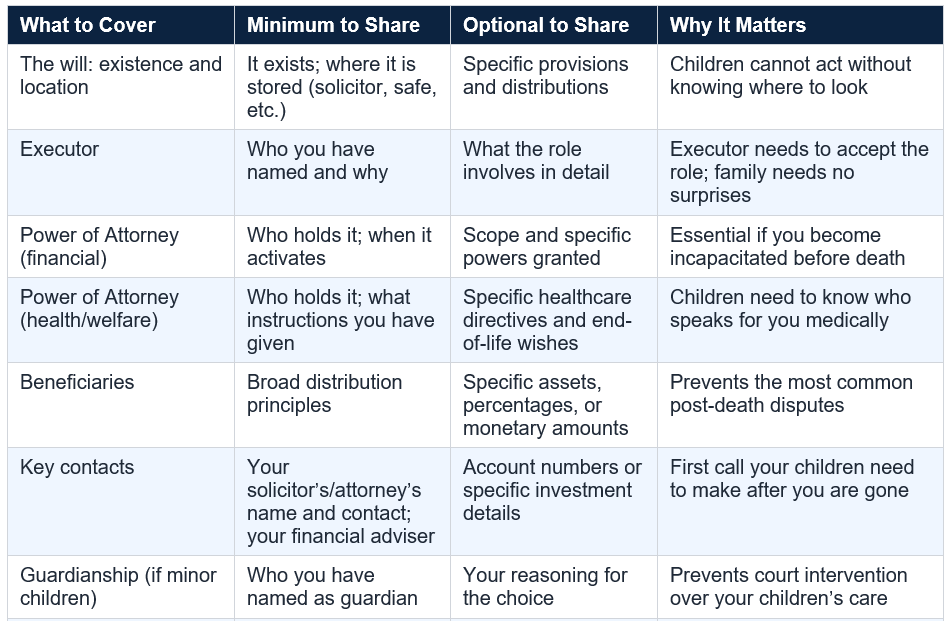

How to Handle the Hard Moments
Even the best-prepared estate planning conversation will have difficult moments. Planning for them reduces the chance they derail the discussion entirely:When a child gets emotional
Acknowledge it rather than redirecting: ‘This is heavy. It’s okay to feel that way. We’re bringing this up precisely because we want to make things easier for you — not harder.’ If emotions are running high, suggest taking a break and returning to the conversation later. Austin Estate Planning Law Firm’s 2026 guide is clear: if the conversation becomes overwhelming, take a pause. Progress over perfection.When a child asks something you’re not ready to answer
It is entirely acceptable to say: ‘That’s a fair question and I’d like to think about the best way to answer it. Can we come back to that?’ You are not required to answer every question in the first conversation. The conversation is a process, not a disclosure event.When siblings react differently to the same information
Expect it. Different children have different relationships with money, different levels of emotional readiness for these topics, and different feelings about the dynamics of your family. Individual follow-up conversations after a group meeting allow each child to process their reactions privately with you.Unequal Distributions: The Most Difficult Conversation
If your estate plan includes unequal distributions between children — whether because of different financial circumstances, different contributions to your care, a loan that was never repaid, or simply a considered judgement about need — the conversation about this requires particular care.The CNBC guide (November 2025) is direct: generally, advisers recommend that parents at least tell their children how assets are going to be divided. Discovering an unexpected or apparently unfair distribution after a parent’s death, with no prior explanation, is one of the most reliably damaging outcomes in family estate management. Even if the decision seems obvious to the parents, it may not to the children.
The approach that most frequently preserves family relationships around unequal distributions:
- Tell each child individually, before the group conversation, what they will receive and why. This allows the emotional reaction to happen in a private, one-to-one context rather than in front of siblings.
- Frame the decision in terms of fairness of need rather than fairness of amounts. A parent who gives more to the child who is less financially established is not showing favouritism; they are demonstrating care for the child who needs more help.
- Allow children to express their feelings about the decision and acknowledge them without changing the decision: ‘I understand this feels unequal. It is unequal in amount. Our hope is that it’s equal in care.’
Make It a Habit, Not a One-Off
The most important insight in the current estate planning research is that this conversation is not an event — it is a practice. Polaris Law Group’s 2026 guide recommends making estate planning updates annual, perhaps around tax season or a birthday, normalising the discussion as routine family business rather than a rare, ominous event. The Trust & Will framework suggests reviewing your plan every few years or after major life changes: remarriage, births, new property, significant changes in wealth.The families who handle estate transitions most smoothly are those for whom the topic is not a shock. They have heard their parents refer to the will, the solicitor, the executor, and the general distribution plan in passing for years. When the time comes, there is no information gap to close under pressure. The conversation has already been had, many times, in small pieces, in ordinary moments.
Building this habit is simpler than it sounds. The Sachetta wealth management guide suggests that small steps build trust and momentum, and the deeper conversations can come later when the time feels right. You do not need to start with the full content checklist. You can start with just one piece: ‘By the way, our will is kept with our solicitor at [name]. Her number is [number]. If anything ever happened, that’s the first call to make.’
Conclusion
Fifty-six percent of US adults do not have a will. In the UK, sixty percent do not. And ninety-seven percent of families think this conversation is important but half have never had it. The gap between knowing and doing is one of the most consequential in personal finance.The six ways in this article are not hacks or shortcuts. They are the practical application of a single underlying principle: this conversation is not about death. It is about care. It is about looking your children in the eye and saying, with specificity and love: I have thought about what happens after I am gone, and I have made sure you will not be left guessing. I have made sure you know where to look, who to call, and what I wanted. That is the gift.
The awkwardness is real. The mortality discomfort is real. The money privacy instinct is real. But 42 percent of people say they would not know what to do if a family member died today — and every one of those people has parents or relatives who could have had this conversation and chose not to. The relief that your children will feel when this conversation is behind them, and the chaos they will be spared when it matters most, are worth every minute of the awkwardness you will feel in having it.
Frequently Asked Questions
When is the right time to talk to my kids about my will?The right time is when you are calm, healthy, and unhurried — not in the midst of a crisis, an illness, or a family conflict. The Polaris Law Group’s 2026 guide advises avoiding emotionally charged occasions like holidays. A quiet weekend, a relaxed family visit, or a planned conversation at your financial adviser’s office are all appropriate settings. There is no perfect time, but there are clearly bad ones — and waiting until health declines or an emergency strikes makes everything significantly harder for everyone.
Do I need to tell my children exactly how much they will inherit?
No. The goal of the conversation is ‘no surprises,’ not a complete financial disclosure. You do not need to share specific account balances, exact percentages, or the total value of your estate unless you choose to. The minimum useful information is the broad principle of distribution (equal between children, or the general approach), the existence and location of the will, and who holds key roles (executor, power of attorney). Fidelity’s 2025 study found 35% of parents specifically do not want children to know the amount. That is a legitimate boundary.
How do I bring up my will without making my children think I’m dying?
Use an external event or life milestone as a natural on-ramp rather than a cold announcement. A news story, a family friend’s difficult experience, a milestone birthday, or a recent update to your estate plan are all effective ways to make the conversation feel timely and contextual rather than alarming. You can also state directly: ‘I’m not going anywhere, but I realised you don’t know where our important documents are — and I’d like to change that.’
Should I talk to all my children together or separately?
Both approaches have merits. A group conversation ensures all children hear identical information simultaneously, preventing misunderstandings. Individual conversations allow each child’s emotional reaction to be handled privately. For families with complex dynamics or unequal distributions, the recommended approach is individual conversations first, followed by a group meeting to share the essentials. The Snyder Law PC guide and several estate planning authorities suggest this two-stage approach as the most likely to preserve family relationships.
What if my children don’t want to have this conversation?
Start smaller than you think you need to. Do not begin with the full estate planning conversation. Begin with a single practical piece of information: where the will is stored, or who the executor is. The Austin Estate Planning guide for 2026 notes that children who resist these conversations often do so out of their own discomfort with parental mortality, not genuine disinterest. A gentle, patient approach that starts with logistics rather than existential topics is usually the most effective way through resistance.
Do I need a solicitor or attorney present for this conversation?
No — but having one present can be very helpful, particularly for complex family situations. A professional provides a neutral presence that reduces the chance the conversation becomes a family dispute, and can explain legal concepts in plain English without requiring parents to play expert. Many families find that having the conversation at their solicitor’s or financial adviser’s office changes the psychological frame from a difficult family discussion to a purposeful professional meeting, which reduces emotional charge significantly.
How often should I update this conversation with my children?
Estate planning conversations should be revisited after any major life change: a marriage, a divorce, a birth, a significant change in wealth, a house purchase, or any event that affects your estate plan. The Polaris Law Group recommends making estate plan reviews annual, perhaps around tax season or your birthday, to normalise the discussion as routine family business. Even a brief annual conversation — ‘We reviewed our plan this year and nothing has changed’ — keeps the channel open and prevents the information from becoming stale or the conversation from reverting to being taboo.
0 Comments
Be the first to share your thoughts on this article.