

Emotional Development
The Psychology of People Who Never Chase and Always Attract

Attachment research, Cialdini’s scarcity principle, and clinical psychology all point to the same truth: the most magnetic people are not the ones working hardest to be liked. Here is the complete psychological portrait.
There is a particular kind of person you have probably noticed at some point in your life. They are not the loudest in the room. They are not the most outwardly impressive. They do not appear to be working for your attention. And yet your attention finds them anyway. Something about the way they carry themselves — their ease, their calm, their lack of apparent need — creates a gravitational pull that no amount of strategic effort from others quite replicates. This phenomenon has a precise psychological explanation. It sits at the intersection of attachment theory, the psychology of self-worth, Robert Cialdini’s well-documented scarcity principle, and the neuroscience of what the human social brain reads as valuable, safe, and worth pursuing. This article breaks down the eight psychological traits that define people who attract without chasing — grounded in peer-reviewed research, clinical psychology, and behavioural science. This is not a dating tactics guide. It is a psychological portrait of the internal architecture that creates genuine, effortless magnetism.
The people who attract without chasing share a cluster of psychological qualities that are internally generated rather than externally directed. They are not performing confidence; they have developed it through genuine self-acceptance. They are not strategically withholding attention; they simply have a full enough life that their attention has real value because it is not automatically available to everyone. They are not coldly indifferent; they are warmly interested in people while being genuinely unbothered by any particular response. Dr Prerna Kohli, a clinical psychologist, describes the core quality: ‘When you’re genuinely comfortable with who you are, confidence, warmth, authenticity and ease follow naturally — and that is what people find truly attractive.’ What follows is a psychological breakdown of the eight traits that produce this quality.
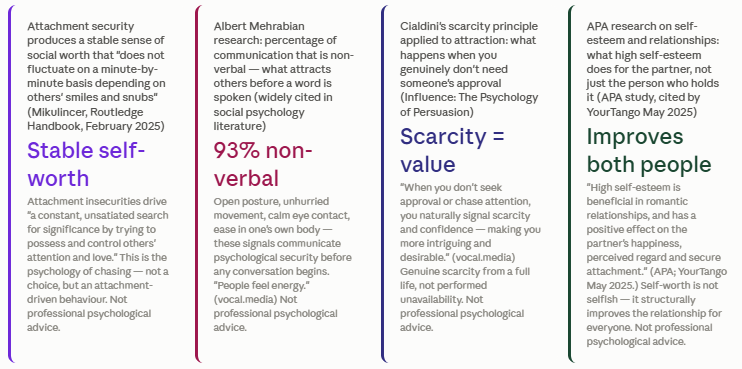
Attachment security = authentic, stable sense of social worth that does not fluctuate with others' responses (Mikulincer 2025). Confidence and warmth increase perceived attractiveness independently of conventional looks (Dr Prerna Kohli; APA research). 93% of communication is non-verbal (Mehrabian). Scarcity naturally signals confidence and desirability (Cialdini; vocal.media).
The APA research on self-esteem and attraction, cited by YourTango in May 2025, found that high self-esteem is beneficial in romantic relationships and has a positive effect on the partner’s happiness and secure attachment. Self-worth, in other words, is not merely a personal benefit — it structurally improves the relational experience for both people. Robert Cialdini’s scarcity principle, from Influence: The Psychology of Persuasion, adds the social-psychological mechanism: people assign greater value to what is perceived as rare or hard to obtain. Applied to personal magnetism, this translates directly: someone who does not need any particular person’s approval automatically conveys rarity of attention. And research by Albert Mehrabian found that 93% of communication is non-verbal, meaning this internal psychology is being broadcast through presence, posture, and manner before a single word is spoken.
Mikulincer (2025): Secure attachment fosters 'an authentic and stable sense of social worth that does not fluctuate on a minute-by-minute basis depending on others' smiles and snubs.' Attachment insecurities drive 'a constant, unsatiated search for significance by trying to possess and control others' attention and love.' The difference between these two states is the core psychological distinction between someone who chases and someone who attracts.
APA research: 'High self-esteem is beneficial in romantic relationships, and has a positive effect on the partner's happiness, perceived regard and secure attachment between the partners.' Self-perceived attractiveness significantly predicted higher self-esteem (APA; YourTango May 2025). Dr Prerna Kohli: 'Confidence comes from self-acceptance — research finds that confidence and warmth increase perceived attractiveness independently of conventional looks.' (DrPrernaKohli.in).
Albert Mehrabian: up to 93% of communication is non-verbal (widely cited in social psychology literature). BeFreed.ai November 2025: 'Attraction is not just about looks — it's about projecting health, competence, and emotional stability.' Confidence and warmth increase perceived attractiveness independently of conventional looks (DrPrernaKohli.in).
Thais Gibson / Personal Development School (April 2026): 'Anxious Attachment often experiences chemistry as urgency and emotional intensity. Unpredictability increases attraction through dopamine and cortisol spikes. Healing your Attachment Style helps you choose healthier partners.' Emotional stability identified as a core component of secure attachment and attraction (Bowlby; Mikulincer 2025).
Dr Prerna Kohli: 'Confidence comes from self-acceptance — being genuinely at ease with who you are.' vocal.media: 'Growth and peace of mind are magnetic.' The scarcity principle reinforces this: a person with a genuinely full life naturally has limited availability — not as a tactic but as a natural consequence of real investment in their own growth.
Dr Prerna Kohli: 'People who accept themselves stop performing for approval, and that self-assurance is deeply attractive.' BeFreed.ai November 2025: 'Direct approaches actually display confidence and boldness — qualities that create genuine intrigue. Women rarely resent honest expressions of interest — they remember bold approaches favourably because they show authentic confidence.
APA: 'High self-esteem is beneficial in romantic relationships, and has a positive effect on the partner's happiness, perceived regard and secure attachment between the partners.' (YourTango May 2025.) Cialdini's reciprocity principle: when someone is genuinely valuable and not needy, others naturally want to reciprocate attention (BeFreed.ai November 2025).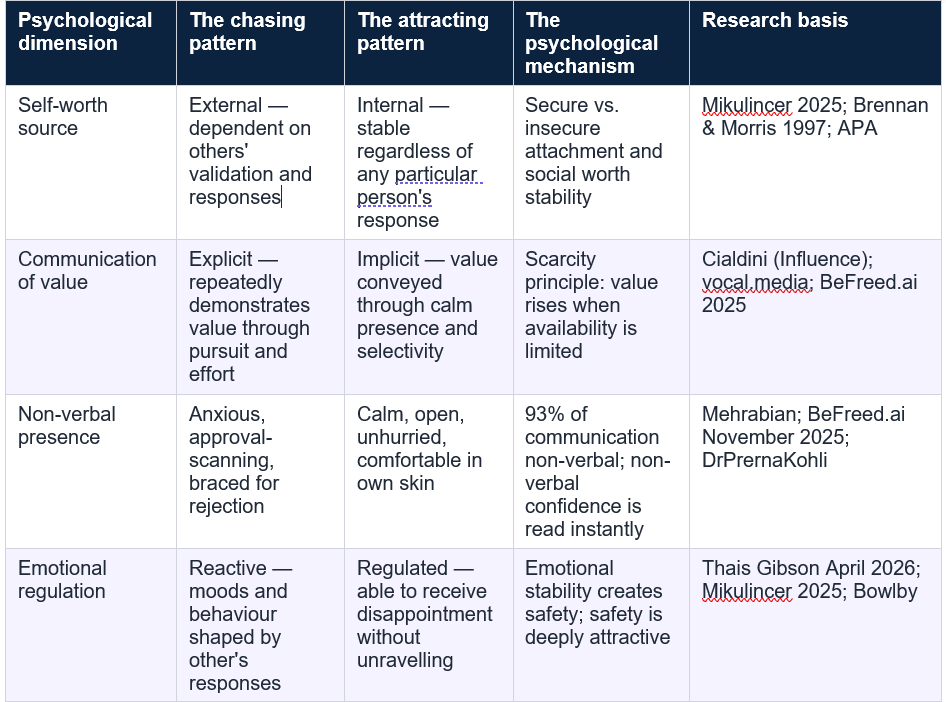
Vocal.media’s psychology guide captures the essential principle without sentimentality: ‘Instead of chasing attraction, become someone worth being attracted to. It’s about becoming someone who naturally attracts connection through the way they exist, not the way they chase.’ Self-worth above validation-seeking. Confidence above performance. A secure base above a constant search for significance. These are not romantic strategies. They are psychological states — and the good news from attachment research is that they are developable. Attachment styles can shift. Self-worth can be cultivated. Emotional regulation is a learnable skill. The person you are reading about in this article is not a fixed type. It is a direction. Not professional psychological advice. If patterns of anxious attachment, low self-worth, or relationship difficulties are causing distress, working with a qualified therapist or psychologist can be genuinely transformative.
The psychology distinguishes clearly between authentic non-chasing and strategic game-playing. Authentic non-chasing comes from a genuine internal state — secure attachment, real self-worth, and a full life — that produces natural selectivity and ease. Strategic game-playing (deliberately ignoring messages to 'play it cool', manufactured unavailability, calculated indifference) is a performance that most people can detect and that the research suggests is counterproductive. Cialdini's scarcity principle applies to genuine value, not performed scarcity. Vocal.media's psychology guide makes this distinction: 'It's about becoming someone who naturally attracts connection through the way they exist, not the way they chase.' The BeFreed.ai November 2025 science of attraction research similarly distinguishes between authentic confidence and tactics, noting that genuine directness and authentic presence are what create real intrigue.
Can someone change from a chasing pattern to an attracting one?
Yes — attachment research consistently shows that attachment styles are not fixed. They develop through early experience but can shift through later secure relationships, therapeutic work, and deliberate self-development. Thais Gibson's April 2026 work on attachment science notes that 'healing your attachment style helps you choose healthier partners' — and the same healing shifts the non-chasing pattern from the inside. The starting point identified by most clinical psychologists, including Dr Prerna Kohli, is self-acceptance: 'Confidence comes from self-acceptance — being genuinely at ease with who you are. If low self-worth gets in the way, working with a psychologist can help you develop a kinder, steadier relationship with yourself.' The path from anxious chasing to genuine magnetism typically runs through understanding one's attachment style, developing genuine self-worth, building a full and purposeful life, and improving emotional regulation. Sources: Thais Gibson April 2026; DrPrernaKohli.in.
Why does chasing someone often push them further away?
The psychological mechanism is the inverse of the scarcity principle. Chasing communicates abundance: I am freely available to you at any time. This signals low value (from the social-psychological frame of scarcity), high need (which creates emotional pressure rather than attraction), and low self-worth (which the research consistently identifies as unattractive rather than sympathetic). Above The Middle's Joe Gibson (October 2024) specifically identifies anxious chasing as psychologically unattractive — it signals low self-worth and emotional insecurity. The social psychology of the Personality and Social Psychology Review finding cited by YourTango is relevant: 'Humans are biased toward pro-relationship decisions' — people want to close the gap to someone they find valuable. Chasing eliminates the gap rather than creating value. The person worth pursuing is the one who is clearly oriented toward their own life and can take or leave any particular interaction — not because they are cold, but because they are genuinely full. Sources: Above The Middle October 2024; YourTango May 2025; Cialdini; vocal.media.
Is this psychology different for different genders?
The underlying psychological mechanisms — attachment security, scarcity, self-worth, non-verbal presence, emotional regulation — apply across genders, though the specific expression varies. Brennan and Morris (1997) found a gender difference in the components of self-esteem associated with secure attachment: women's security was associated solely with self-liking, while men's security was associated with both self-liking and self-competence. The APA research cited by YourTango found that women's romantic self-confidence had a greater effect on their self-esteem than men's. BeFreed.ai's November 2025 research noted that 'the research consistently shows that people respond to indicators of confidence, composure, and that calm, collected presence' — applied broadly. Thais Gibson's April 2026 attachment podcast notes that each attachment style experiences attraction differently, regardless of gender. The core principle — that secure, purposeful, emotionally regulated people attract more than anxiously pursuing ones — appears across genders in the research literature. Sources: Brennan & Morris 1997; YourTango; BeFreed.ai.
What is the relationship between attachment style and attraction?
Attachment style fundamentally shapes both who a person is attracted to and how they are perceived by others. Thais Gibson's April 2026 analysis found that anxious attachment experiences chemistry as 'urgency and emotional intensity,' that unpredictability increases attraction for anxiously attached people through dopamine and cortisol spikes, and that avoidant attachment drives patterns where protecting independence is the key motivation. Bowlby's original attachment theory, developed through subsequent research including the 2025 Mikulincer work, suggests that secure attachment is the style most naturally associated with genuine magnetism: it produces the emotional stability, genuine self-worth, and consistent presence that others find deeply attractive. The research by Brennan and Morris (1997) found that security is associated with self-liking — which is the self-acceptance that Dr Prerna Kohli and vocal.media identify as the core of genuine attractiveness. Someone who genuinely likes themselves does not need to chase. Sources: Thais Gibson April 2026; Mikulincer 2025; Brennan & Morris 1997.
There is a particular kind of person you have probably noticed at some point in your life. They are not the loudest in the room. They are not the most outwardly impressive. They do not appear to be working for your attention. And yet your attention finds them anyway. Something about the way they carry themselves — their ease, their calm, their lack of apparent need — creates a gravitational pull that no amount of strategic effort from others quite replicates. This phenomenon has a precise psychological explanation. It sits at the intersection of attachment theory, the psychology of self-worth, Robert Cialdini’s well-documented scarcity principle, and the neuroscience of what the human social brain reads as valuable, safe, and worth pursuing. This article breaks down the eight psychological traits that define people who attract without chasing — grounded in peer-reviewed research, clinical psychology, and behavioural science. This is not a dating tactics guide. It is a psychological portrait of the internal architecture that creates genuine, effortless magnetism.
Table of Contents
- The Internal Architecture of Effortless Magnetism
- What the Research Actually Shows
- Trait 1 Secure Attachment: The Foundation of Genuine Magnetism
- Trait 2 Self-Worth Over Approval-Seeking: The Non-Negotiable Core
- Trait 3 The Scarcity Principle: Why Selectivity Is Magnetic
- Trait 4 Confident Non-Verbal Presence: The Body Speaks First
- Trait 5 Emotional Regulation: Calm Is the Most Underrated Attractive Quality
- Trait 6 Purposeful Living: Having a Life That Is Already Full
- Trait 7 Authenticity Over Performance: Dropping the Mask
- Trait 8 Calibrated Warmth: The Balance That Completes the Picture
- The Chase vs. Attract Comparison
- Conclusion: Becoming the Person You Would Want to Meet
- Frequently Asked Questions
The Internal Architecture of Effortless Magnetism
The popular idea that attraction is something you do to others — a set of behaviours you perform, a script you follow, a strategy you execute — is directly contradicted by the psychological research. What the evidence consistently shows is that attraction, at its most durable and genuine, is something you become capable of radiating because of the internal architecture you have built within yourself. It is less about what you do and more about the psychological state from which you operate.The people who attract without chasing share a cluster of psychological qualities that are internally generated rather than externally directed. They are not performing confidence; they have developed it through genuine self-acceptance. They are not strategically withholding attention; they simply have a full enough life that their attention has real value because it is not automatically available to everyone. They are not coldly indifferent; they are warmly interested in people while being genuinely unbothered by any particular response. Dr Prerna Kohli, a clinical psychologist, describes the core quality: ‘When you’re genuinely comfortable with who you are, confidence, warmth, authenticity and ease follow naturally — and that is what people find truly attractive.’ What follows is a psychological breakdown of the eight traits that produce this quality.
Attachment security = authentic, stable sense of social worth that does not fluctuate with others' responses (Mikulincer 2025). Confidence and warmth increase perceived attractiveness independently of conventional looks (Dr Prerna Kohli; APA research). 93% of communication is non-verbal (Mehrabian). Scarcity naturally signals confidence and desirability (Cialdini; vocal.media).
What the Research Actually Shows
Psychological science has been studying the architecture of attraction for decades, and the research converges on a set of findings that are counterintuitive to how most people approach the problem. The most comprehensive recent contribution is the 2025 academic work by Arie W. Mikulincer, published in the Routledge International Handbook of Human Significance and Mattering, which analysed attachment security dynamics and their relationship to how people seek significance and connection. The finding: security dynamics play the defining role in shaping whether a person’s quest for significance is ‘authentic and stable’ or a ‘constant, unsatiated search’ driven by insecurity.The APA research on self-esteem and attraction, cited by YourTango in May 2025, found that high self-esteem is beneficial in romantic relationships and has a positive effect on the partner’s happiness and secure attachment. Self-worth, in other words, is not merely a personal benefit — it structurally improves the relational experience for both people. Robert Cialdini’s scarcity principle, from Influence: The Psychology of Persuasion, adds the social-psychological mechanism: people assign greater value to what is perceived as rare or hard to obtain. Applied to personal magnetism, this translates directly: someone who does not need any particular person’s approval automatically conveys rarity of attention. And research by Albert Mehrabian found that 93% of communication is non-verbal, meaning this internal psychology is being broadcast through presence, posture, and manner before a single word is spoken.
Mikulincer (2025): Secure attachment fosters 'an authentic and stable sense of social worth that does not fluctuate on a minute-by-minute basis depending on others' smiles and snubs.' Attachment insecurities drive 'a constant, unsatiated search for significance by trying to possess and control others' attention and love.' The difference between these two states is the core psychological distinction between someone who chases and someone who attracts.
Trait 1: Secure Attachment: The Foundation of Genuine Magnetism
The most psychologically sophisticated framework for understanding why some people attract without chasing comes from attachment theory, originally proposed by John Bowlby and extensively developed through decades of empirical research. At the core of the theory is a deceptively simple observation: people are powerfully drawn to those who exhibit secure attachment — the quality of being emotionally stable, self-assured, and consistent without requiring constant reassurance from others. The research is compelling. A 2025 academic contribution to the Routledge International Handbook of Human Significance and Mattering (Arie W. Mikulincer) found that attachment security fosters ‘a felt presence of an authentic and stable sense of social worth that does not fluctuate on a minute-by-minute basis depending on others’ smiles and snubs.’ This is the internal architecture of someone who never chases: a stable sense of self-worth that is genuinely unshaken by whether a particular person responds or not. The contrast is instructive. Attachment insecurities, the same research found, contribute to ‘a constant, unsatiated search for significance by trying to possess and control either social resources — others’ attention and love — or personal resources like power, status, and money.’ That frantic search for significance is the psychological engine of chasing behaviour. The securely attached person has already found their significance from within. Vocal.media’s psychology guide articulates the outcome: secure attachment creates ‘a sense of emotional safety that people instinctively find appealing.’ Safety is magnetic.Trait 2 Self-Worth Over Approval-Seeking: The Non-Negotiable Core
The single quality that most reliably distinguishes those who attract from those who chase is the relationship between self-worth and approval. Dr Prerna Kohli, a clinical psychologist, puts it with elegant simplicity: ‘People who accept themselves stop performing for approval, and that self-assurance is deeply attractive. When you’re genuinely comfortable with who you are, confidence, warmth, authenticity and ease follow naturally — and that is what people find truly attractive.’ The American Psychological Association’s research supports this structure. An APA study found that high self-esteem is not just individually beneficial in romantic relationships — it has a positive effect on the partner’s happiness, perceived regard, and secure attachment between the partners. Self-worth is not merely attractive to the person who holds it; it creates better outcomes for everyone in the relationship. The approval-seeking pattern works in the opposite direction. YourTango’s May 2025 analysis notes that the truly magnetic person ‘does not attach her sense of self-worth to that attention.’ They enjoy the attention they receive — there is nothing ascetic about this psychology — but the attention is a pleasant addition, not a psychological requirement. The mechanism is powerful because it is perceptible. People can feel the difference between someone who needs them to respond a certain way and someone who is simply, genuinely present. Neediness is as detectable as confidence, and it is read with precisely the opposite valence.APA research: 'High self-esteem is beneficial in romantic relationships, and has a positive effect on the partner's happiness, perceived regard and secure attachment between the partners.' Self-perceived attractiveness significantly predicted higher self-esteem (APA; YourTango May 2025). Dr Prerna Kohli: 'Confidence comes from self-acceptance — research finds that confidence and warmth increase perceived attractiveness independently of conventional looks.' (DrPrernaKohli.in).
Trait 3 The Scarcity Principle: Why Selectivity Is Magnetic
One of the most well-documented principles in social psychology is Robert Cialdini’s scarcity principle, developed in Influence: The Psychology of Persuasion and widely applied across consumer behaviour, marketing, and interpersonal dynamics: people assign greater value to things that are rare, hard to obtain, or potentially unavailable. Applied to human attraction, the principle is neither manipulative nor calculated — it is a description of what happens when someone naturally has a full, purposeful life and does not orbit their entire existence around any particular person’s response. Vocal.media’s psychology guide notes: ‘When you don’t seek approval or chase attention, you naturally signal scarcity and confidence — making you more intriguing and desirable.’ The word ‘naturally’ matters. Performed scarcity — deliberately ignoring messages or manufacturing unavailability as a tactic — is transparently manipulative and psychologically hollow. Genuine scarcity comes from having real standards, real commitments, and a genuine life that does not expand to accommodate any particular person’s expectations on demand. The BeFreed.ai November 2025 exploration of the science of magnetic attraction puts it precisely: ‘Scarcity creates curiosity, intrigue and ultimately, desire. This principle taps into deep, subconscious human behaviour.’ The personality and social psychology research cited by YourTango found that ‘humans are biased toward pro-relationship decisions’ — meaning people tend to want to bridge the gap to someone they find valuable. Genuine scarcity from living fully creates that gap without engineering it.Trait 4 Confident Non-Verbal Presence: The Body Speaks First
Long before words are exchanged, attraction is forming — or not — through non-verbal signals. Research by Albert Mehrabian found that up to 93% of communication is non-verbal, encompassing body language, tone of voice, and facial expression. In the context of attraction, this means that how a person carries themselves communicates volumes before they say anything at all. Open posture, unhurried movement, sustained eye contact, and a calm, unhurried manner all signal what confident non-verbal presence conveys: that this person is at ease with themselves. They are not scanning the room for approval. They are not bracing for rejection. They are simply present. Vocal.media’s psychology analysis notes that open posture signals confidence and that people ‘feel energy’ — a somewhat informal framing of the well-documented psychological phenomenon that non-verbal confidence cues are both consciously and unconsciously read by others. The BeFreed.ai November 2025 science of magnetic attraction research is more precise: ‘The research consistently shows that people respond to indicators of confidence and composure — that calm, collected presence. Attraction is not just about looks — it’s about projecting health, competence, and emotional stability.’ The non-verbal component matters because it is the hardest to fake authentically and the most immediate signal of how someone actually relates to themselves. Not through telling others, but through the thousand small physical messages transmitted in every moment of presence.Albert Mehrabian: up to 93% of communication is non-verbal (widely cited in social psychology literature). BeFreed.ai November 2025: 'Attraction is not just about looks — it's about projecting health, competence, and emotional stability.' Confidence and warmth increase perceived attractiveness independently of conventional looks (DrPrernaKohli.in).
Trait 5 Emotional Regulation: Calm Is the Most Underrated Attractive Quality
Few things communicate psychological security more powerfully than the ability to remain emotionally regulated under pressure. When someone is not reactive — when they can receive disappointment, frustration, or uncertainty without unravelling into anxiety or aggression — they demonstrate the kind of emotional resilience that is deeply appealing to others and profoundly rare. Thais Gibson’s April 2026 analysis of what attracts each attachment style reveals the biological dimension: ‘Unpredictability can increase attraction through dopamine and cortisol spikes’ — meaning anxious attachment experiences chemistry as urgency and intensity. By contrast, someone who is emotionally regulated does not produce the dopamine-spike attraction of anxiety and uncertainty. What they produce instead is something deeper and more durable: safety. The distinction is important. Short-term attraction is often driven by emotional volatility — the hot-and-cold dynamic that keeps the anxiously attached person in a state of hopeful anxiety. Long-term, sustainable attraction — the kind that endures through genuine relationship — is built on emotional safety. Emotional regulation is the quality that produces that safety. It communicates: I will not explode. I will not withdraw. I will not make you responsible for managing my emotional state. These are rare and valuable psychological qualities that people feel rather than calculate, and which create the conditions for genuine, lasting connection.Thais Gibson / Personal Development School (April 2026): 'Anxious Attachment often experiences chemistry as urgency and emotional intensity. Unpredictability increases attraction through dopamine and cortisol spikes. Healing your Attachment Style helps you choose healthier partners.' Emotional stability identified as a core component of secure attachment and attraction (Bowlby; Mikulincer 2025).
Trait 6 Purposeful Living: Having a Life That Is Already Full
People who never chase tend to share a quality that is not always identified as a component of attraction but is in fact one of its most powerful contributors: they have a life with genuine direction, real commitments, and meaningful activities that they would pursue regardless of any particular person’s interest in them. Purpose is magnetic not because it is a dating strategy but because it creates the psychological architecture from which the other attractive qualities emerge. Dr Prerna Kohli’s analysis is precise: ‘The most attractive quality of all, confidence, doesn’t come from changing how you look; it comes from self-acceptance — being genuinely at ease with who you are.’ Being at ease with who you are is almost impossible without knowing who you are — and knowing who you are requires having invested in your own growth, values, and direction. Vocal.media’s psychology guide names it directly among the attractive qualities: ‘Growth and peace of mind are magnetic.’ The person who is absorbed in meaningful work, genuine hobbies, and a social life they have built from authentic interest communicates through their entire manner that they are not desperate for any external addition to feel complete. This is precisely what generates the kind of interest and pursuit that chasing never does: someone who already has a full life is interesting to enter, while someone who is waiting to be completed is a burden to approach.Dr Prerna Kohli: 'Confidence comes from self-acceptance — being genuinely at ease with who you are.' vocal.media: 'Growth and peace of mind are magnetic.' The scarcity principle reinforces this: a person with a genuinely full life naturally has limited availability — not as a tactic but as a natural consequence of real investment in their own growth.
Trait 7 Authenticity Over Performance: Dropping the Mask
One of the most psychologically transparent things a person can do is perform for approval — adjusting their personality, opinions, and behaviour in real time to match what they believe the other person wants to see. This performance is both exhausting and obvious. The person on the receiving end can generally feel, even if they cannot articulate it, that they are encountering a constructed version of someone rather than the person themselves. Authentic attraction, by contrast, is built on the experience of meeting someone who is genuinely themselves — who does not shift their personality depending on who is in the room. Dr Prerna Kohli is direct: ‘People who accept themselves stop performing for approval, and that self-assurance is deeply attractive.’ Authenticity is not the same as radical candour or the refusal of social awareness. It is the quality of not needing to be fundamentally different from who you actually are in order to feel acceptable. The BeFreed.ai November 2025 science of magnetic attraction research aligns with this precisely: the genuine expression of direct, honest interest is remembered favourably. It is the performed, tactical version of interest — the calculated non-interest designed to produce interest in return — that falls apart under scrutiny. Authenticity requires the courage of being fully oneself, without guarantee of response. It is this quality — the willingness to be genuinely present without knowing the outcome — that people experience as magnetic.Dr Prerna Kohli: 'People who accept themselves stop performing for approval, and that self-assurance is deeply attractive.' BeFreed.ai November 2025: 'Direct approaches actually display confidence and boldness — qualities that create genuine intrigue. Women rarely resent honest expressions of interest — they remember bold approaches favourably because they show authentic confidence.
Trait 8 Calibrated Warmth: The Balance That Completes the Picture
The psychology of non-chasing is sometimes misread as cold distance — as if the answer to desperate seeking were emotional unavailability. This is a significant misreading of the research. The person who attracts without chasing is not cold. They are warm — genuinely interested in people, capable of real connection, and expressive of authentic care. What distinguishes their warmth from the warmth of someone who chases is that it is not conditional, not performed, and not deployed as a strategy to secure a particular response. Calibrated warmth is the quality of offering genuine interest and care without making that offer dependent on reciprocation. The APA research cited by YourTango puts it precisely: high self-esteem is beneficial in romantic relationships not only for the individual but for the partner’s happiness and for perceived regard — meaning warmth and care, expressed from a position of genuine security, improves the relationship experience for everyone in it. BeFreed.ai’s November 2025 analysis adds the crucial counterbalance: the reciprocity principle — when someone is genuinely valuable and not needy, others naturally want to reciprocate attention. Warmth without desperation, genuine care without conditions, presence without pursuit: these are the qualities that complete the psychological portrait of someone who never chases but consistently attracts.APA: 'High self-esteem is beneficial in romantic relationships, and has a positive effect on the partner's happiness, perceived regard and secure attachment between the partners.' (YourTango May 2025.) Cialdini's reciprocity principle: when someone is genuinely valuable and not needy, others naturally want to reciprocate attention (BeFreed.ai November 2025).
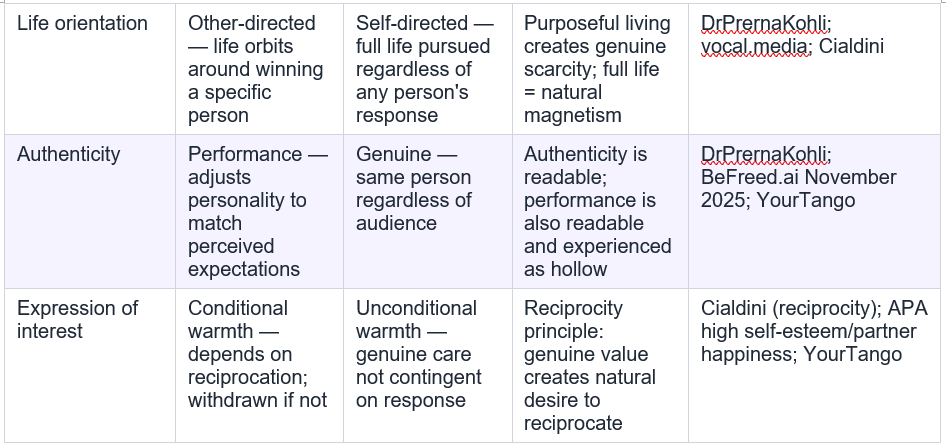
The Chase vs. Attract Comparison
Conclusion
The psychology of people who never chase and always attract is not a mystery, and it is not a trick. It is the natural, outward expression of a set of internal qualities — secure attachment, genuine self-worth, authentic presence, emotional regulation, purposeful living — that have been built, gradually, from the inside out. The research from Mikulincer (2025), Brennan and Morris (1997), the APA studies, Dr Prerna Kohli’s clinical observations, and Cialdini’s well-documented scarcity principle all point toward the same architecture.Vocal.media’s psychology guide captures the essential principle without sentimentality: ‘Instead of chasing attraction, become someone worth being attracted to. It’s about becoming someone who naturally attracts connection through the way they exist, not the way they chase.’ Self-worth above validation-seeking. Confidence above performance. A secure base above a constant search for significance. These are not romantic strategies. They are psychological states — and the good news from attachment research is that they are developable. Attachment styles can shift. Self-worth can be cultivated. Emotional regulation is a learnable skill. The person you are reading about in this article is not a fixed type. It is a direction. Not professional psychological advice. If patterns of anxious attachment, low self-worth, or relationship difficulties are causing distress, working with a qualified therapist or psychologist can be genuinely transformative.
Frequently Asked Questions
Is not chasing someone manipulative or a tactic?The psychology distinguishes clearly between authentic non-chasing and strategic game-playing. Authentic non-chasing comes from a genuine internal state — secure attachment, real self-worth, and a full life — that produces natural selectivity and ease. Strategic game-playing (deliberately ignoring messages to 'play it cool', manufactured unavailability, calculated indifference) is a performance that most people can detect and that the research suggests is counterproductive. Cialdini's scarcity principle applies to genuine value, not performed scarcity. Vocal.media's psychology guide makes this distinction: 'It's about becoming someone who naturally attracts connection through the way they exist, not the way they chase.' The BeFreed.ai November 2025 science of attraction research similarly distinguishes between authentic confidence and tactics, noting that genuine directness and authentic presence are what create real intrigue.
Can someone change from a chasing pattern to an attracting one?
Yes — attachment research consistently shows that attachment styles are not fixed. They develop through early experience but can shift through later secure relationships, therapeutic work, and deliberate self-development. Thais Gibson's April 2026 work on attachment science notes that 'healing your attachment style helps you choose healthier partners' — and the same healing shifts the non-chasing pattern from the inside. The starting point identified by most clinical psychologists, including Dr Prerna Kohli, is self-acceptance: 'Confidence comes from self-acceptance — being genuinely at ease with who you are. If low self-worth gets in the way, working with a psychologist can help you develop a kinder, steadier relationship with yourself.' The path from anxious chasing to genuine magnetism typically runs through understanding one's attachment style, developing genuine self-worth, building a full and purposeful life, and improving emotional regulation. Sources: Thais Gibson April 2026; DrPrernaKohli.in.
Why does chasing someone often push them further away?
The psychological mechanism is the inverse of the scarcity principle. Chasing communicates abundance: I am freely available to you at any time. This signals low value (from the social-psychological frame of scarcity), high need (which creates emotional pressure rather than attraction), and low self-worth (which the research consistently identifies as unattractive rather than sympathetic). Above The Middle's Joe Gibson (October 2024) specifically identifies anxious chasing as psychologically unattractive — it signals low self-worth and emotional insecurity. The social psychology of the Personality and Social Psychology Review finding cited by YourTango is relevant: 'Humans are biased toward pro-relationship decisions' — people want to close the gap to someone they find valuable. Chasing eliminates the gap rather than creating value. The person worth pursuing is the one who is clearly oriented toward their own life and can take or leave any particular interaction — not because they are cold, but because they are genuinely full. Sources: Above The Middle October 2024; YourTango May 2025; Cialdini; vocal.media.
Is this psychology different for different genders?
The underlying psychological mechanisms — attachment security, scarcity, self-worth, non-verbal presence, emotional regulation — apply across genders, though the specific expression varies. Brennan and Morris (1997) found a gender difference in the components of self-esteem associated with secure attachment: women's security was associated solely with self-liking, while men's security was associated with both self-liking and self-competence. The APA research cited by YourTango found that women's romantic self-confidence had a greater effect on their self-esteem than men's. BeFreed.ai's November 2025 research noted that 'the research consistently shows that people respond to indicators of confidence, composure, and that calm, collected presence' — applied broadly. Thais Gibson's April 2026 attachment podcast notes that each attachment style experiences attraction differently, regardless of gender. The core principle — that secure, purposeful, emotionally regulated people attract more than anxiously pursuing ones — appears across genders in the research literature. Sources: Brennan & Morris 1997; YourTango; BeFreed.ai.
What is the relationship between attachment style and attraction?
Attachment style fundamentally shapes both who a person is attracted to and how they are perceived by others. Thais Gibson's April 2026 analysis found that anxious attachment experiences chemistry as 'urgency and emotional intensity,' that unpredictability increases attraction for anxiously attached people through dopamine and cortisol spikes, and that avoidant attachment drives patterns where protecting independence is the key motivation. Bowlby's original attachment theory, developed through subsequent research including the 2025 Mikulincer work, suggests that secure attachment is the style most naturally associated with genuine magnetism: it produces the emotional stability, genuine self-worth, and consistent presence that others find deeply attractive. The research by Brennan and Morris (1997) found that security is associated with self-liking — which is the self-acceptance that Dr Prerna Kohli and vocal.media identify as the core of genuine attractiveness. Someone who genuinely likes themselves does not need to chase. Sources: Thais Gibson April 2026; Mikulincer 2025; Brennan & Morris 1997.
0 Comments
Be the first to share your thoughts on this article.