

Finance
The Rise of Crypto Casinos: 2026 Complete Guide

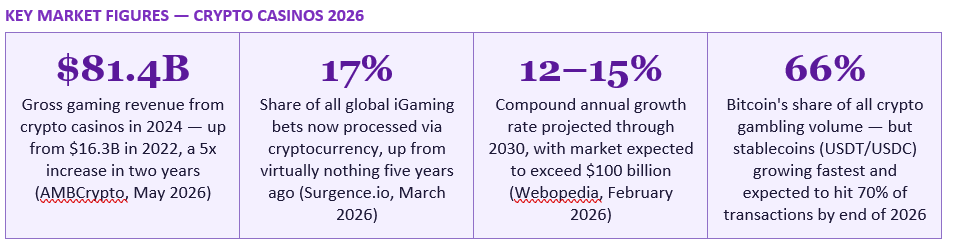
Crypto casinos generated $81.4 billion in gross gaming revenue in 2024 — up from $16.3 billion in 2022. They now account for 17% of all global iGaming bets. Bitcoin dominates at 66% of volume, but stablecoins are taking over. Regulation is tightening. And the platforms that survive will look very different from the offshore operations of five years ago. This is the complete, data-led, and honest guide to the crypto casino market in 2026.
What distinguishes the most innovative crypto casinos from traditional online gambling is not just the payment method but the underlying architecture. Blockchain-native casinos use smart contracts — self-executing code deployed on a distributed ledger — to manage game logic, prize distributions, and player funds. Because smart contract code is publicly auditable on the blockchain, the randomness and fairness of game outcomes can in principle be verified independently by any player, eliminating the need to trust the operator's assurances about fairness. This is the concept of 'provably fair' gaming, which is examined in detail in Section 5.
The operational model of most crypto casinos in 2026 occupies a middle ground between pure decentralisation and traditional casino operation. Most licensed crypto casinos hold a gambling licence from an offshore jurisdiction — most commonly Curacao, Anjouan, Malta, or the Isle of Man — operate a central game server, accept multiple cryptocurrencies and some fiat currencies, and use blockchain primarily for payment processing and, in some cases, game outcome verification. The fully decentralised, on-chain casino model remains a relatively small share of total crypto gambling volume but is growing rapidly through DeFi protocols and GambleFi platforms.
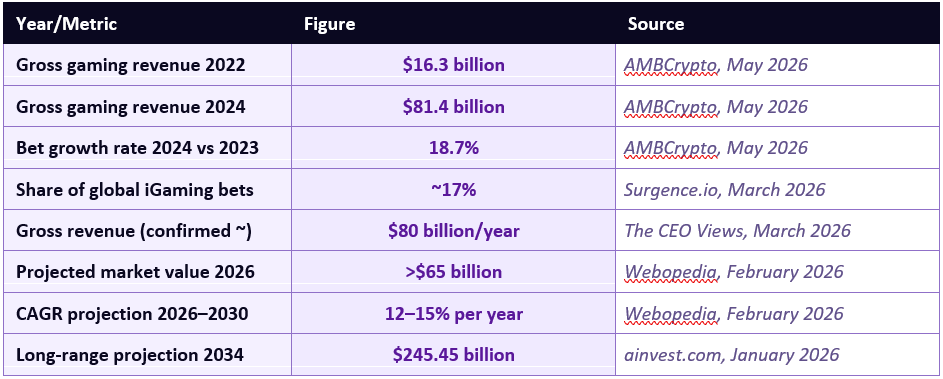
Crypto casinos generated $81.4 billion in gross gaming revenue in 2024, up from about $16.3 billion in 2022. That's a fivefold increase in two years for a sector that, a decade ago, barely existed.
— AMBCRYPTO — INSIDE THE CRYPTO CASINO SURGE: BIG NUMBERS, BIGGER RISKS (MAY 2026)
Crypto casinos now account for approximately 17% of all global iGaming bets, according to Surgence.io's March 2026 industry report — up from virtually nothing five years ago. SOFTSWISS, which processes transactions across more than 500 operator brands, confirms that crypto accounts for around 15% of all iGaming payments globally. The value of crypto bets grew 18.7% in 2024 compared with 2023 — a rate that, as AMBCrypto notes, 'outpaces most corners of the broader gambling industry.'
Forward projections are aggressive. Webopedia's February 2026 analysis projects the crypto gambling market valuation will surpass $65 billion by 2026, growing at a 12% to 15% compound annual growth rate. Ainvest.com's January 2026 research projects the offshore crypto gambling market reaching $245.45 billion by 2034. Blockonomi's statistics report projects transaction volumes exceeding $10 billion by 2026, with average user deposit amounts increasing by 30%.
In traditional online gambling, a player asking 'was this game fair?' has no independent means of verification. They must trust the operator's RNG, which is tested and certified by independent auditors (eCOGRA, iTech Labs) but whose outputs are not visible to the player in real time. The audit process provides reasonable assurance of fairness for licensed operators, but it cannot provide the player with direct, verifiable proof of any individual game outcome.
Provably fair systems change this fundamentally. By using cryptographic commitment schemes based on SHA-256 or similar hashing algorithms, a provably fair casino creates a public, auditable record of every game outcome that any player can independently verify. The mathematics are not complex: a good cryptographic hash function is one-way (you cannot derive the input from the output) and deterministic (the same input always produces the same output). The combination of server seed, client seed, and nonce produces a specific, reproducible outcome that was committed to before the round began.
Salon Privé Magazine's February 2026 analysis identifies transparency as having 'moved from a marketing claim to an operational requirement' in the crypto casino sector: 'Provably fair games, public transaction histories, and smart contract audits are now central to how crypto casinos establish credibility.' The practical adoption of provably fair systems is now widespread among the leading platforms, and independent verification tools allow players to check any historical round outcome.
Bitcoin dominated crypto gambling from the sector's earliest days and continues to hold the largest share of total volume. Surgence.io's March 2026 industry report confirms that Bitcoin accounts for approximately 66% of all crypto gambling volume, followed by Ethereum at 9% and Litecoin at 6%. This dominance reflects Bitcoin's status as the most widely held and most liquid cryptocurrency, and its deep integration with the offshore gambling ecosystem's existing payment infrastructure.
However, the fastest-growing payment category is stablecoins — and this shift has profound implications for the sector. AMBCrypto's May 2026 analysis notes that 'altcoins commanded nearly half of all crypto gambling volume in 2024, up from just 26.8% the year before, as stablecoins like USDT and USDC captured a growing share of bets.' Some industry forecasts project stablecoins to exceed 70% of crypto-betting transactions by the end of 2026.
The rationale for the stablecoin shift is straightforward: Bitcoin's price volatility creates a secondary financial exposure for gamblers that is separate from the gambling outcome itself. A player who deposits 0.1 Bitcoin when BTC is trading at $60,000, plays for two hours, and withdraws 0.1 Bitcoin when BTC has fallen to $55,000 has 'broken even' on their gambling but lost $500 to currency movement. Stablecoins eliminate this exposure, allowing players to focus on the gambling activity without managing cryptocurrency risk simultaneously.
Webopedia's February 2026 analysis identifies stablecoin adoption as 'one of the most prominent blockchain casino trends heading into 2026' and notes that 'the rationale is straightforward: stablecoins reduce exposure to the price volatility inherent in assets like Bitcoin and Ether.'
Mobile is the dominant channel: Blockonomi's statistics report projects that mobile betting will account for 80% of all crypto gambling activity by 2026, with ainvest.com's January 2026 analysis confirming that 60% of players currently use smartphones or tablets for gambling. The mobile-first design of leading platforms, combined with the increasing simplicity of cryptocurrency wallet management through custodial mobile wallets and integrated exchange connections, has dramatically lowered the technical barrier to entry.
Geographically, Webopedia identifies Asia-Pacific as one of the fastest-growing user bases 'due to high mobile internet penetration and a youth demographic predisposed to digital gambling and Web3 technologies.' Latin America has also emerged as a significant growth market — Brazil's regulated iGaming market launched under a new framework in January 2025, and ZyCrypto's April 2026 analysis notes its maturation as a driver of regional crypto casino growth. The US market is complex: while some states have legalised online gambling, banking restrictions have pushed players toward crypto-based alternatives. Europe's growth is increasingly shaped by MiCA regulation, which provides a pathway for compliant operators to serve EU players.
The growth of influencer-marketed crypto casinos has been particularly pronounced among 18 to 35-year-old demographics. Surgence.io's March 2026 report notes that Stake.com built its growth partly through partnerships with streaming platforms and influencers, and that RealBet — a newer platform backed by a high-profile athlete with hundreds of millions of social media followers — is attempting to replicate that model on a larger scale. The influencer marketing channel raises specific concerns about problem gambling promotion to young audiences.
The competitive dynamics of the market are intensifying. As ZyCrypto's April 2026 analysis notes, 'legacy online gaming operators outside the US have responded with selective cryptocurrency integration' — meaning traditional licensed casinos are beginning to add crypto payment options rather than building blockchain-native products. This convergence will likely intensify competition and may gradually reduce the differentiation advantage currently enjoyed by pure-play crypto casinos.
But the risks are equally real and should not be minimised by the growth narrative. Regulatory fragmentation leaves most players with limited recourse if an operator fails or behaves fraudulently. Cryptocurrency volatility adds a financial exposure layer on top of gambling risk. And the frictionless, 24/7 nature of crypto casino deposits creates a particularly high-risk environment for problem gambling. The sector is entering a maturation phase in 2026 where regulation, compliance, and player protection will distinguish the platforms that survive long-term from those that will not. For anyone observing this market — as an investor, a researcher, or a potential player — understanding both the genuine innovation and the genuine risk is the only honest starting point.
Webopedia — Predicting the Future of Crypto Gambling in 2026 (February 2026) https://www.webopedia.com/crypto-gambling/casinos/guides/crypto-gambling-trends/
Surgence.io — Crypto Casino Industry Report 2026: GambleFi and Market Trends (March 2026) https://surgence.io/blog/crypto-casino
Salon Privé Magazine — Three Key Trends Shaping Crypto Casinos in 2026 (February 2026) https://www.salonprivemag.com/three-key-trends-shaping-crypto-casinos-in-2026/
The CEO Views — Crypto Casinos in 2026: Regulation, Adoption, or Total Disruption? (March 2026) https://theceoviews.com/crypto-casinos-in-2026-regulation-adoption-or-total-disruption/
ZyCrypto — Inside the Global Crypto Casino Market in 2026: Licensing, Demand, and Geographies (April 2026) https://zycrypto.com/inside-the-global-crypto-casino-market-in-2026-licensing-demand-and-emerging-geographies/
ainvest.com — The Rise of Bitcoin Casinos in 2026: A New Frontier for Crypto Adoption (January 2026) https://www.ainvest.com/news/rise-bitcoin-casinos-2026-frontier-crypto-adoption-revenue-growth-2601/
Blockonomi — Crypto Gambling Market Statistics Report (2025 with 2026 projections) https://blockonomi.com/crypto-gambling-stats/
National Council on Problem Gambling (US) — Free 24/7 Helpline https://www.ncpgambling.org
GambleAware (UK) — Free Gambling Support and Advice https://www.gambleaware.org
TABLE OF CONTENTS
- What Is a Crypto Casino?
- The Numbers: How Big Has This Market Become?
- Why Crypto Casinos Grew So Fast: Six Structural Advantages
- How Crypto Casinos Actually Work: Technology Explained
- Provably Fair Gaming: The Transparency Breakthrough
- The Payment Layer: Bitcoin, Ethereum, and the Stablecoin Takeover
- Who Is Playing: The Crypto Gambler Profile in 2026
- The Key Players: Stake.com and the Major Platforms
- The Regulatory Landscape: MiCA, FATF, and the Licensing Race
- The Risks You Must Understand Before Playing
- What Comes Next: AI, VR, and the GambleFi Frontier
- Conclusion
- Frequently Asked Questions
- References
What Is a Crypto Casino?
A crypto casino is an online gambling platform that accepts cryptocurrency — Bitcoin, Ethereum, stablecoins, and other digital assets — as its primary or exclusive payment method. The term covers a wide spectrum of operations, from fully decentralised platforms governed by smart contracts on a blockchain with no central operator, to traditional online casinos that have simply added cryptocurrency payment rails alongside conventional methods.What distinguishes the most innovative crypto casinos from traditional online gambling is not just the payment method but the underlying architecture. Blockchain-native casinos use smart contracts — self-executing code deployed on a distributed ledger — to manage game logic, prize distributions, and player funds. Because smart contract code is publicly auditable on the blockchain, the randomness and fairness of game outcomes can in principle be verified independently by any player, eliminating the need to trust the operator's assurances about fairness. This is the concept of 'provably fair' gaming, which is examined in detail in Section 5.
The operational model of most crypto casinos in 2026 occupies a middle ground between pure decentralisation and traditional casino operation. Most licensed crypto casinos hold a gambling licence from an offshore jurisdiction — most commonly Curacao, Anjouan, Malta, or the Isle of Man — operate a central game server, accept multiple cryptocurrencies and some fiat currencies, and use blockchain primarily for payment processing and, in some cases, game outcome verification. The fully decentralised, on-chain casino model remains a relatively small share of total crypto gambling volume but is growing rapidly through DeFi protocols and GambleFi platforms.
Crypto casinos generated $81.4 billion in gross gaming revenue in 2024, up from about $16.3 billion in 2022. That's a fivefold increase in two years for a sector that, a decade ago, barely existed.
— AMBCRYPTO — INSIDE THE CRYPTO CASINO SURGE: BIG NUMBERS, BIGGER RISKS (MAY 2026)
The Numbers: How Big Has This Market Become?
The scale of the crypto casino market in 2026 is difficult to overstate — and the speed of its growth even more so. AMBCrypto's May 2026 analysis documents gross gaming revenue of $81.4 billion in 2024, up from approximately $16.3 billion in 2022. This fivefold increase in two years represents one of the fastest wealth-generation events in the history of the broader gambling industry.Crypto casinos now account for approximately 17% of all global iGaming bets, according to Surgence.io's March 2026 industry report — up from virtually nothing five years ago. SOFTSWISS, which processes transactions across more than 500 operator brands, confirms that crypto accounts for around 15% of all iGaming payments globally. The value of crypto bets grew 18.7% in 2024 compared with 2023 — a rate that, as AMBCrypto notes, 'outpaces most corners of the broader gambling industry.'
Forward projections are aggressive. Webopedia's February 2026 analysis projects the crypto gambling market valuation will surpass $65 billion by 2026, growing at a 12% to 15% compound annual growth rate. Ainvest.com's January 2026 research projects the offshore crypto gambling market reaching $245.45 billion by 2034. Blockonomi's statistics report projects transaction volumes exceeding $10 billion by 2026, with average user deposit amounts increasing by 30%.
Why Crypto Casinos Grew So Fast: Six Structural Advantages
The explosive growth of crypto casinos is not accidental. Several structural features of cryptocurrency-based gambling give these platforms genuine advantages over traditional licensed online casinos — advantages that are difficult for fiat-based operators to replicate in the short term.Six structural advantages of crypto casinos over traditional online gambling
- Frictionless cross-border payments: Traditional online casinos face significant friction from banking restrictions — many major US and EU financial institutions block gambling transactions. Cryptocurrency bypasses the banking layer entirely. A player in any country can deposit Bitcoin, Ethereum, or USDT directly to a crypto casino wallet within minutes, without needing a bank to approve or process the transaction. This accessibility in markets with banking restrictions is a primary driver of the global growth.
- Reduced fraud compared with traditional payment rails: Cryptocurrency transactions are irreversible and do not carry chargeback risk — unlike credit card payments, which expose operators to chargeback fraud. Blockonomi's statistics report notes a 60% reduction in fraud compared with traditional online casinos. This benefits operators by reducing operational costs and enables faster, lower-friction deposit processing for players.
- Provably fair games: The ability to cryptographically verify the fairness of game outcomes — impossible with traditional casino software — is a genuinely novel consumer benefit. Players who trust the mathematics of the blockchain rather than the assurances of a central operator represent a distinct market segment that no traditional casino can serve.
- Near-instant withdrawals: Traditional online casinos commonly impose withdrawal processing times of three to ten business days, with bank transfer delays adding further time. Crypto withdrawals are typically settled on-chain within minutes to an hour, depending on network congestion and confirmation requirements. Salon Privé Magazine's February 2026 analysis identifies 'near-instant withdrawals, settled on-chain' as now 'viewed as a baseline expectation rather than a premium feature.'
- Anonymity and privacy: Many crypto casino platforms require minimal KYC (Know Your Customer) documentation compared with licensed fiat casinos, which are required by anti-money laundering regulations to collect identity documents for all account holders. This lower barrier to entry attracts players who prefer privacy, though it is increasingly under regulatory pressure.
- Token-based loyalty and ownership economics: Leading platforms including Stake.com have introduced platform-native tokens that give holders economic participation in the platform's revenue through rakeback schemes, staking rewards, and governance rights. This tokenised loyalty model — where the most active players are also partial economic stakeholders — creates engagement and retention dynamics that no traditional loyalty points programme can match.
How Crypto Casinos Actually Work: Technology Explained
The technology stack of a modern crypto casino varies significantly depending on whether the platform is centrally operated (like most licensed offshore casinos) or fully decentralised (like GambleFi protocols). Understanding the distinction matters for evaluating the real claims platforms make about fairness and transparency.Centralised crypto casinos
Most crypto casinos — including the largest platforms by revenue — are centrally operated businesses that use cryptocurrency for payments but run their game software on traditional servers. The operator determines game outcomes using a centralised random number generator (RNG), manages player accounts centrally, and controls deposits and withdrawals from a central treasury wallet. The main advantage of crypto over fiat in this model is frictionless payment processing. Players interact with the casino in the same way they would with a traditional online casino, except deposits and withdrawals are made in cryptocurrency. Licensing from jurisdictions like Curacao provides a baseline of operator accountability, though enforcement mechanisms are weak compared with UKGC or MGA licences.Provably fair and hybrid casinos
Provably fair casinos use a cryptographic commitment scheme to demonstrate that game outcomes are not manipulated after bets are placed. The standard implementation works as follows: before a game begins, the casino generates a 'server seed' and commits to it by publishing a cryptographic hash (a one-way fingerprint). The player contributes their own 'client seed.' Game outcomes are determined by combining both seeds and a nonce (a counter). After the game, the casino reveals the original server seed, allowing the player to independently verify that the outcome was determined before the bet was placed and matches the committed seed. This system makes outcome manipulation technically infeasible — the casino cannot change the server seed retroactively without invalidating the hash they committed to before the round.Smart contract / DeFi casinos
Fully on-chain casinos deploy all game logic as smart contracts on a public blockchain — most commonly Ethereum, Polygon, or a dedicated gaming Layer 2 chain. There is no central server: game execution, random number generation, and prize distribution are handled entirely by immutable code that any user can inspect. The challenge is practical: on-chain random number generation requires trusted randomness sources (oracles like Chainlink VRF), and gas fees on proof-of-work chains can make small bets economically irrational. Layer 2 solutions are addressing the cost problem, but true smart contract casinos remain a minority of total crypto gambling volume in 2026.Provably Fair Gaming: The Transparency Breakthrough
Provably fair is the single concept in crypto gambling that represents a genuine and novel advance over traditional online casino technology — and understanding it clearly matters both for evaluating platforms and for assessing the sector's real innovation claims.In traditional online gambling, a player asking 'was this game fair?' has no independent means of verification. They must trust the operator's RNG, which is tested and certified by independent auditors (eCOGRA, iTech Labs) but whose outputs are not visible to the player in real time. The audit process provides reasonable assurance of fairness for licensed operators, but it cannot provide the player with direct, verifiable proof of any individual game outcome.
Provably fair systems change this fundamentally. By using cryptographic commitment schemes based on SHA-256 or similar hashing algorithms, a provably fair casino creates a public, auditable record of every game outcome that any player can independently verify. The mathematics are not complex: a good cryptographic hash function is one-way (you cannot derive the input from the output) and deterministic (the same input always produces the same output). The combination of server seed, client seed, and nonce produces a specific, reproducible outcome that was committed to before the round began.
Salon Privé Magazine's February 2026 analysis identifies transparency as having 'moved from a marketing claim to an operational requirement' in the crypto casino sector: 'Provably fair games, public transaction histories, and smart contract audits are now central to how crypto casinos establish credibility.' The practical adoption of provably fair systems is now widespread among the leading platforms, and independent verification tools allow players to check any historical round outcome.
The Payment Layer: Bitcoin, Ethereum, and the Stablecoin Takeover
The payment currency composition of crypto gambling has undergone a significant structural shift between 2022 and 2026 — and understanding this shift is essential for understanding where the market is heading.Bitcoin dominated crypto gambling from the sector's earliest days and continues to hold the largest share of total volume. Surgence.io's March 2026 industry report confirms that Bitcoin accounts for approximately 66% of all crypto gambling volume, followed by Ethereum at 9% and Litecoin at 6%. This dominance reflects Bitcoin's status as the most widely held and most liquid cryptocurrency, and its deep integration with the offshore gambling ecosystem's existing payment infrastructure.
However, the fastest-growing payment category is stablecoins — and this shift has profound implications for the sector. AMBCrypto's May 2026 analysis notes that 'altcoins commanded nearly half of all crypto gambling volume in 2024, up from just 26.8% the year before, as stablecoins like USDT and USDC captured a growing share of bets.' Some industry forecasts project stablecoins to exceed 70% of crypto-betting transactions by the end of 2026.
The rationale for the stablecoin shift is straightforward: Bitcoin's price volatility creates a secondary financial exposure for gamblers that is separate from the gambling outcome itself. A player who deposits 0.1 Bitcoin when BTC is trading at $60,000, plays for two hours, and withdraws 0.1 Bitcoin when BTC has fallen to $55,000 has 'broken even' on their gambling but lost $500 to currency movement. Stablecoins eliminate this exposure, allowing players to focus on the gambling activity without managing cryptocurrency risk simultaneously.
Webopedia's February 2026 analysis identifies stablecoin adoption as 'one of the most prominent blockchain casino trends heading into 2026' and notes that 'the rationale is straightforward: stablecoins reduce exposure to the price volatility inherent in assets like Bitcoin and Ether.'
Who Is Playing: The Crypto Gambler Profile in 2026
The user base of crypto casinos has evolved significantly from the early days, when participation was almost exclusively limited to cryptocurrency early adopters who were already comfortable with private key management and digital wallets. By 2026, the demographic has broadened substantially — though it remains concentrated in specific age groups and geographies.Mobile is the dominant channel: Blockonomi's statistics report projects that mobile betting will account for 80% of all crypto gambling activity by 2026, with ainvest.com's January 2026 analysis confirming that 60% of players currently use smartphones or tablets for gambling. The mobile-first design of leading platforms, combined with the increasing simplicity of cryptocurrency wallet management through custodial mobile wallets and integrated exchange connections, has dramatically lowered the technical barrier to entry.
Geographically, Webopedia identifies Asia-Pacific as one of the fastest-growing user bases 'due to high mobile internet penetration and a youth demographic predisposed to digital gambling and Web3 technologies.' Latin America has also emerged as a significant growth market — Brazil's regulated iGaming market launched under a new framework in January 2025, and ZyCrypto's April 2026 analysis notes its maturation as a driver of regional crypto casino growth. The US market is complex: while some states have legalised online gambling, banking restrictions have pushed players toward crypto-based alternatives. Europe's growth is increasingly shaped by MiCA regulation, which provides a pathway for compliant operators to serve EU players.
The growth of influencer-marketed crypto casinos has been particularly pronounced among 18 to 35-year-old demographics. Surgence.io's March 2026 report notes that Stake.com built its growth partly through partnerships with streaming platforms and influencers, and that RealBet — a newer platform backed by a high-profile athlete with hundreds of millions of social media followers — is attempting to replicate that model on a larger scale. The influencer marketing channel raises specific concerns about problem gambling promotion to young audiences.
The Key Players: Stake.com and the Major Platforms
The crypto casino market is dominated by a small number of large platforms that have achieved scale through a combination of early mover advantage, aggressive marketing, and product breadth. Understanding the key players provides context for the market dynamics.Stake.com — the market leader
Stake.com is widely cited as the world's largest crypto casino by volume and one of the highest-revenue online gambling platforms overall. Ainvest.com's January 2026 research reports Stake.com's revenue at $4.7 billion — a figure that positions it in the global top tier of online gambling operators. The platform operates over 10,000 games, supports 12 or more cryptocurrencies, and has built what Surgence.io describes as a 'token-integrated loyalty system' through its $STAKE token, which gives holders higher rakeback percentages and exclusive VIP perks. Stake's growth has been driven partly by major influencer and ambassador partnerships, and it operates with a Curacao licence — the most common licensing regime among large crypto casinos.Other significant platforms
Rollbit, BC.Game, Roobet, and Cloudbet are among the other major platforms that have established significant market share. The market also includes DeFi-native gambling protocols — including Azuro, Betswirl, and various prediction market platforms — that operate without a central operator, using smart contracts for all game execution and prize distribution. These decentralised platforms collectively represent a small but growing share of total volume and are particularly popular among crypto-native users who prioritise non-custodial, trustless operation.The competitive dynamics of the market are intensifying. As ZyCrypto's April 2026 analysis notes, 'legacy online gaming operators outside the US have responded with selective cryptocurrency integration' — meaning traditional licensed casinos are beginning to add crypto payment options rather than building blockchain-native products. This convergence will likely intensify competition and may gradually reduce the differentiation advantage currently enjoyed by pure-play crypto casinos.
The Regulatory Landscape: MiCA, FATF, and the Licensing Race
The regulatory environment for crypto casinos in 2026 is simultaneously the sector's most significant challenge and its most important legitimising force. As The CEO Views' March 2026 analysis notes: 'By 2026, it has become clear that there is still no unified approach to regulating crypto casinos. The situation remains uneven across regions.'European Union: MiCA framework
The EU's Markets in Crypto-Assets (MiCA) regulation — which entered full effect in 2024 — does not directly regulate gambling but significantly affects the cryptocurrency service providers that crypto casinos depend on. MiCA requires cryptocurrency service providers operating in the EU to comply with mandatory transparency, AML/KYC, and customer protection standards. Stablecoin issuers (USDT, USDC) operating in the EU must maintain 1:1 reserve backing and comply with e-money regulations. The practical effect for crypto casinos is that EU-facing platforms must use MiCA-compliant payment rails, which effectively requires AML/KYC compliance for EU player deposits — narrowing the anonymity advantage that many offshore platforms previously offered.FATF Travel Rule
The Financial Action Task Force's Travel Rule — requiring Virtual Asset Service Providers (VASPs) to exchange customer information for crypto transfers above a threshold — has increased compliance costs for offshore operators who process deposits and withdrawals through regulated exchanges. As ainvest.com notes, this 'has increased compliance costs for offshore operators' but also 'attract[ed] institutional investors' who require regulated counterparties.Licensing regimes: Curacao, Anjouan, Malta, Isle of Man
Most legitimate crypto casino operators hold a licence from one of four main offshore gaming jurisdictions. Curacao is the most common — inexpensive, fast to obtain, and historically lightly regulated. In 2023, Curacao began a significant reform of its licensing regime (GCB — Gaming Control Board), moving toward stricter operator requirements. Anjouan has emerged as a cheaper alternative. Malta (MGA) and Isle of Man provide the most rigorous regulatory frameworks and are increasingly required by payment processors and banking partners as minimum standards for financial services relationships. ZyCrypto's April 2026 analysis describes the 'licensing race' as 'forcing platforms to professionalize,' with compliance now functioning as a 'competitive advantage rather than a burden' for platforms that achieve it.The Risks You Must Understand Before Playing
This section is mandatory reading for anyone considering using a crypto casino. The risks are specific, serious, and in some cases structurally different from those of traditional online gambling.The critical risks of crypto casino gambling in 2026
- Regulatory and legal risk: Crypto gambling is illegal or unregulated in many jurisdictions, including most US states, many EU member states (where national gambling laws restrict unlicensed online casinos), and numerous other countries. Using a VPN to bypass geographic restrictions may violate the platform's terms of service and local laws, and typically voids any ability to seek redress if problems arise. Always check the legal status of online gambling in your jurisdiction before depositing.
- Platform insolvency and exit risk: Unlike deposits at FDIC-insured banks or funds at regulated fiat casinos held in ring-fenced player accounts, funds deposited at crypto casinos are held by the platform operator — often offshore, with limited regulatory oversight. If the platform becomes insolvent, is hacked, or exits fraudulently, player funds may be unrecoverable. There is no government-backed compensation scheme equivalent to the FDIC for crypto casino deposits.
- Cryptocurrency volatility: Depositing and withdrawing in Bitcoin, Ethereum, or other volatile cryptocurrencies means the fiat value of your balance can change dramatically between deposit and withdrawal, independent of gambling outcomes. A $1,000 deposit that doubles to $2,000 in gambling winnings may be worth $1,600 by the time it is withdrawn if Bitcoin falls 20% during the session.
- Smart contract exploits: On-chain casino smart contracts have been exploited in multiple high-profile incidents, with attackers draining player funds by exploiting code vulnerabilities. Smart contract code audits reduce but do not eliminate this risk.
- Problem gambling: The 24/7 availability, frictionless deposits, and gamified token mechanics of crypto casinos create a particularly high-risk environment for problem gambling. The near-elimination of friction in the deposit process — no bank approval, no processing delay, no face-to-face verification — removes the natural pause points that sometimes interrupt problematic gambling behaviour. Seek help if gambling is causing financial or personal harm: ncpgambling.org (US), gambleaware.org (UK).
- Insufficient KYC and player protection: The reduced KYC requirements of many offshore crypto casinos mean they lack the responsible gambling tools required of regulated fiat casinos — deposit limits, self-exclusion programmes, affordability checks. Players seeking self-exclusion may find these tools absent or easy to circumvent.
What Comes Next: AI, VR, and the GambleFi Frontier
The crypto casino market of 2026 is not at a stable equilibrium. Several technology and regulatory developments will reshape the sector significantly over the next two to three years.Artificial intelligence and personalisation
Ainvest.com's January 2026 analysis identifies AI integration as a key driver of the next growth phase: 'AI/VR integration' alongside blockchain is driving the projected $245.45 billion market by 2034. AI is being deployed across personalised game recommendation engines, fraud detection, dynamic odds adjustment for sports betting, and — controversially — personalisation algorithms designed to maximise player engagement. The ethics of AI optimisation in gambling contexts deserves regulatory attention that most jurisdictions have not yet applied.Virtual Reality casinos
Blockonomi's statistics report projects that VR casinos will capture 20% of crypto bets by 2026, with fully immersive casino environments where players interact with each other and with games in virtual space. The technical infrastructure for this (standalone VR headsets, low-latency streaming) has matured enough to make this plausible at a niche scale, though mass adoption at 20% remains ambitious. The social casino environment — where crypto holders gather in virtual spaces built on NFT-owned virtual real estate — represents the most experimental frontier of the GambleFi concept.GambleFi and tokenised ownership
GambleFi — the convergence of decentralised finance (DeFi) protocols with gambling mechanics — represents the most structurally novel development in the sector. Platforms like Azuro enable prediction market-style betting through fully decentralised smart contracts, with liquidity provided by yield-seeking DeFi participants rather than a central bookmaker. Players who provide liquidity earn a share of the house edge rather than paying it. This economic model — which makes gamblers and liquidity providers economically symmetric — has no equivalent in traditional gambling and represents a genuinely new model for how gambling markets can be structured.Institutional investment and mainstream integration
Ainvest.com notes that '$4.59 billion in Q3 2025 crypto startup funding highlights sector appeal, with BlackRock and Fidelity entering as spot Bitcoin and Ethereum ETFs normalise digital assets in institutional portfolios.' As cryptocurrency becomes a mainstream asset class rather than a fringe one, the stigma associated with crypto casino investment is likely to diminish, increasing the availability of institutional capital for licensed, compliant operators. This may accelerate the consolidation of the sector around a smaller number of well-capitalised, regulated platforms.CONCLUSION
The rise of crypto casinos is one of the most significant structural shifts in the global gambling industry in a generation. From virtually nothing five years ago to $81.4 billion in gross gaming revenue in 2024 — a fivefold increase in two years — the sector has grown at a pace that no traditional gambling market segment has matched. The structural advantages are real: frictionless cross-border payments, provably fair game verification, near-instant withdrawals, and token-based ownership economics offer genuine innovations that traditional casinos cannot easily replicate.But the risks are equally real and should not be minimised by the growth narrative. Regulatory fragmentation leaves most players with limited recourse if an operator fails or behaves fraudulently. Cryptocurrency volatility adds a financial exposure layer on top of gambling risk. And the frictionless, 24/7 nature of crypto casino deposits creates a particularly high-risk environment for problem gambling. The sector is entering a maturation phase in 2026 where regulation, compliance, and player protection will distinguish the platforms that survive long-term from those that will not. For anyone observing this market — as an investor, a researcher, or a potential player — understanding both the genuine innovation and the genuine risk is the only honest starting point.
Frequently Asked Questions
Are crypto casinos legal?
The legal status of crypto casinos varies significantly by jurisdiction and is not a settled question in most markets. In the United States, online gambling laws are set at the state level — a handful of states (New Jersey, Pennsylvania, Michigan, Delaware, Connecticut) have legalised online casino gambling, while most have not. Most US-facing crypto casinos operate offshore and accept US players in a legal grey zone that carries regulatory risk for both operator and player. In the European Union, gambling is regulated at the national level: some EU member states have licensing regimes that allow online casinos (Malta, UK pre-Brexit, Germany under GlüStV 2021), while others prohibit unlicensed online gambling. Crypto does not change the applicable gambling law — operating or playing at an unlicensed casino is illegal in jurisdictions that prohibit unlicensed gambling, regardless of the payment method. Always check local laws before depositing.What is provably fair gaming and does it guarantee honesty?
Provably fair is a cryptographic system used by some crypto casinos to allow players to independently verify that game outcomes were not manipulated after bets were placed. It works by having the casino commit to a 'server seed' before a game begins, publishing a cryptographic hash of that seed. The player contributes a 'client seed.' After the game, the casino reveals the original server seed, allowing the player to verify the outcome independently. This makes retroactive cheating mathematically infeasible — the casino cannot change the server seed without invalidating the hash. However, provably fair does not guarantee that the house edge is fair or that the casino will pay out winnings — it only verifies that individual game outcomes were not manipulated after bets were placed. A provably fair casino can still have an unfair house edge, and a provably fair outcome is irrelevant if the operator refuses to process withdrawals.What cryptocurrencies do crypto casinos accept?
Most large crypto casinos accept Bitcoin (66% of all crypto gambling volume), Ethereum, Litecoin, and a range of altcoins. The fastest-growing payment method is stablecoins — USDT (Tether) and USDC — which are projected to account for over 70% of crypto-betting transactions by the end of 2026, according to AMBCrypto's May 2026 analysis. Stablecoins are attractive because they eliminate the cryptocurrency price volatility that creates a separate financial exposure for gamblers using Bitcoin or Ethereum. Many platforms also issue their own platform-native tokens (Stake's $STAKE token being the most prominent example) that provide loyalty rewards and staking benefits.How are crypto casinos regulated in 2026?
Most large crypto casinos hold licences from offshore gambling jurisdictions — primarily Curacao (most common, currently under regulatory reform), Anjouan (cheaper alternative), Malta (MGA — most rigorous), or the Isle of Man. These licences provide a baseline of accountability but enforcement mechanisms are weaker than those of national regulators like the UK Gambling Commission. In the European Union, the MiCA framework requires crypto service providers to comply with AML/KYC and transparency standards, which affects the payment rails crypto casinos can use for EU players. The FATF Travel Rule requires VASPs to exchange customer information for crypto transfers above thresholds. The regulatory landscape is tightening but remains fragmented — there is no unified international framework for crypto gambling regulation as of 2026.What are the biggest risks of using a crypto casino?
The primary risks are: (1) Regulatory and legal risk — using unlicensed offshore platforms may be illegal in your jurisdiction and voids recourse options; (2) Platform insolvency or exit risk — there is no equivalent of FDIC insurance for crypto casino deposits, and offshore operators have failed or exit-scammed with player funds; (3) Cryptocurrency volatility — depositing and withdrawing in volatile cryptocurrencies creates price exposure independent of gambling; (4) Smart contract exploits — on-chain casino contracts have been hacked; (5) Problem gambling — the frictionless, 24/7 deposit process and gamified token mechanics create high-risk conditions for gambling addiction. Anyone experiencing gambling-related harm should contact the National Council on Problem Gambling (ncpgambling.org or 1-800-GAMBLER in the US) or GambleAware (gambleaware.org or 0808 8020 133 in the UK).What is GambleFi and how does it differ from a regular crypto casino?
GambleFi refers to gambling applications built entirely using decentralised finance (DeFi) protocols — smart contracts deployed on public blockchains with no central operator. Unlike a regular crypto casino (which accepts crypto for payments but operates game logic on a central server), a GambleFi protocol runs all game logic, random number generation, and prize distribution through immutable on-chain code. Platforms like Azuro enable prediction market-style betting with liquidity provided by DeFi participants who earn a share of the house edge rather than paying it. The advantages are maximum transparency and trustlessness; the challenges include smart contract exploit risk, gas fee costs for individual bets, and the complexity of on-chain random number generation. GambleFi remains a small but growing share of total crypto gambling volume in 2026.References
AMBCrypto — Inside the Crypto Casino Surge: Big Numbers, Bigger Risks (May 2026) https://ambcrypto.com/inside-the-crypto-casino-surge-big-numbers-bigger-risks/Webopedia — Predicting the Future of Crypto Gambling in 2026 (February 2026) https://www.webopedia.com/crypto-gambling/casinos/guides/crypto-gambling-trends/
Surgence.io — Crypto Casino Industry Report 2026: GambleFi and Market Trends (March 2026) https://surgence.io/blog/crypto-casino
Salon Privé Magazine — Three Key Trends Shaping Crypto Casinos in 2026 (February 2026) https://www.salonprivemag.com/three-key-trends-shaping-crypto-casinos-in-2026/
The CEO Views — Crypto Casinos in 2026: Regulation, Adoption, or Total Disruption? (March 2026) https://theceoviews.com/crypto-casinos-in-2026-regulation-adoption-or-total-disruption/
ZyCrypto — Inside the Global Crypto Casino Market in 2026: Licensing, Demand, and Geographies (April 2026) https://zycrypto.com/inside-the-global-crypto-casino-market-in-2026-licensing-demand-and-emerging-geographies/
ainvest.com — The Rise of Bitcoin Casinos in 2026: A New Frontier for Crypto Adoption (January 2026) https://www.ainvest.com/news/rise-bitcoin-casinos-2026-frontier-crypto-adoption-revenue-growth-2601/
Blockonomi — Crypto Gambling Market Statistics Report (2025 with 2026 projections) https://blockonomi.com/crypto-gambling-stats/
National Council on Problem Gambling (US) — Free 24/7 Helpline https://www.ncpgambling.org
GambleAware (UK) — Free Gambling Support and Advice https://www.gambleaware.org
0 Comments
Be the first to share your thoughts on this article.