

Retirement
The Tax Benefits of a SIPP: The Complete Guide

A basic-rate taxpayer contributes £80 and the government adds £20. A higher-rate taxpayer contributes £60 and ends up with £100 working for them. An additional-rate taxpayer contributes £55 for the same £100. That is before tax-free growth, a 25% tax-free lump sum at retirement, and — until April 2027 — an IHT-free death benefit. The SIPP is the most tax-efficient savings vehicle available to a UK private investor. Here is the full picture for 2026/27.

As Wealthvieu’s March 2026 guide puts it: ‘The tax relief on SIPP contributions is one of the most powerful wealth-building tools available in the UK. Every £80 a basic-rate taxpayer contributes becomes £100 inside the pension, with HMRC automatically adding the 20% top-up. Higher and additional rate taxpayers can claim even more through Self Assessment — effectively turning a £55–£60 personal cost into £100 of pension savings.’
Despite this, the SIPP’s tax benefits are frequently misunderstood — in particular, the difference between the basic-rate top-up (which is automatic) and the higher and additional rate relief (which must be actively claimed through Self Assessment). This guide sets out every significant tax benefit of a SIPP for the 2026/27 tax year, with worked examples at each tax rate, and covers the key upcoming change that all SIPP holders should know about.
SIPP annual allowance 2026/27: £60,000 gross (or 100% of earnings, whichever is lower). Basic-rate relief: £80 in → £100 gross in SIPP (HMRC adds £20 automatically). Higher-rate: effective cost of £100 gross contribution = £60. Additional-rate: effective cost of £100 gross contribution = £55. Tax-free lump sum cap (LSA): £268,275 across all pensions. Carry forward: up to £180,000 from prior 3 years. Pension access age: 55 now; rising to 57 from April 2028.
The mechanics of relief at source:
For higher and additional rate taxpayers, the basic-rate relief is added automatically in the same way. The additional relief available above 20 percent — the extra 20 percent for a 40 percent taxpayer, or the extra 25 percent for a 45 percent taxpayer — must be claimed separately through the annual Self Assessment tax return, or by contacting HMRC to adjust the tax code.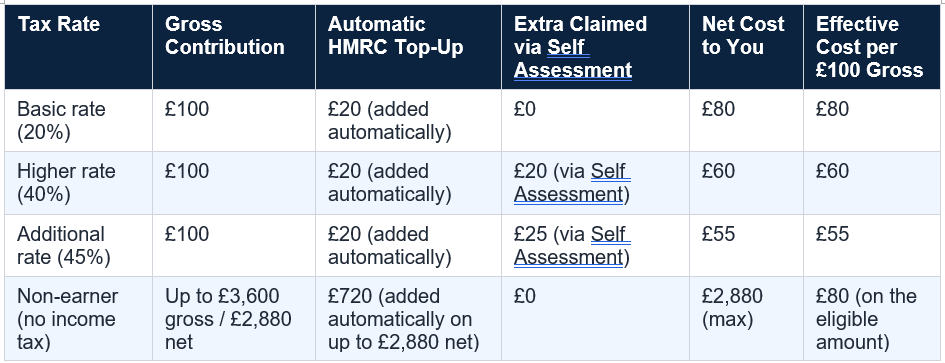
The difference between a basic-rate and higher-rate taxpayer’s net cost is stark: for the same £100 in the pension, a higher-rate taxpayer pays £60 against a basic-rate taxpayer’s £80. A £60,000 gross annual contribution costs a higher-rate taxpayer £36,000 net after claiming the additional 20 percent relief. The government contributes £24,000. For additional-rate taxpayers, the government’s contribution rises to £27,000 on the same £60,000 gross contribution.
The Campaign for a Million’s April 2026 guide to the annual allowance makes the compounding point explicit: ‘The 40% tax relief is not just a one-off saving on the contribution. It means you are starting your compounding journey with 67% more capital than you paid for. A 40% taxpayer who contributes £60,000 net over 10 years has £100,000 working in their SIPP rather than £60,000 — a difference that, at moderate investment growth, is worth hundreds of thousands of pounds in additional final pot value after 20 years.’
Higher-rate taxpayers who do not file a Self Assessment return (or do not include their pension contributions on it) are leaving money on the table. HMRC does not proactively refund the additional 20% — it must be claimed. If you are a 40% taxpayer contributing to a SIPP and have not claimed the additional relief in previous years, you can generally amend returns going back four tax years.
The compounding effect of tax-free growth over a long investment horizon is substantial. A £100,000 investment earning 7 percent per year, fully taxed at 20 percent on gains each year, grows to approximately £289,000 over 20 years. The same £100,000 inside a SIPP growing at 7 percent per year, untaxed, grows to approximately £387,000 — a difference of nearly £100,000 from the same starting investment, with the same gross return, simply because of the tax wrapper.
The tax-free growth benefit is not just about returns — it is about the compounding of those returns. Every pound not paid in CGT or income tax in year one stays invested and earns returns in years two through twenty. The later years of a long investment horizon are where the tax-free growth benefit is most dramatic, because the untaxed compounding has had the most time to accumulate.
This tax-free cash represents a significant benefit at the point of retirement. On a £500,000 SIPP, the first £125,000 taken can be completely free of income tax. On a SIPP worth up to approximately £1.07 million, the full £268,275 can be taken tax-free (25% of £1,073,100 = £268,275). Above this pot size, the 25% tax-free entitlement is capped at £268,275.
The PCLS does not trigger the Money Purchase Annual Allowance (MPAA). Taking tax-free cash alone — without also taking taxable income — does not reduce the future annual allowance to £10,000. This is an important distinction for those approaching retirement who may still want to make pension contributions after taking the tax-free cash.
Withdrawing the 25% PCLS and holding it in a savings account removes it from the pension wrapper and makes it immediately part of your estate for IHT purposes. Until April 2027, funds remaining inside the SIPP wrapper are outside the estate. RetirementExpert.co.uk (May 2026) advises: 'Don't take PCLS unless you have a specific use for it. Taking £100,000 of tax-free cash and parking it in a savings account converts an IHT-friendly wrapper into a fully taxable asset.' This consideration changes somewhat from April 2027 when pension IHT treatment narrows.
Carry forward allows unused annual allowance from the previous three tax years to be added to the current year’s £60,000, provided the individual was a registered pension scheme member in those years. For 2026/27, the three carry-forward years are 2023/24 (£60,000 allowance), 2024/25 (£60,000), and 2025/26 (£60,000). If all three years were fully unused, a total of £180,000 can be carried forward, enabling a maximum gross contribution in 2026/27 of £240,000 — subject to the individual having sufficient relevant UK earnings to cover the gross contribution.
The abolition of the LTA removes what was, for high earners and prolific savers, a significant disincentive to pension saving. It is now possible for a SIPP pot to grow to any size without a specific tax penalty triggered by the size of the pot itself. The Gilt-Edge.uk SIPP guide (July 2026) summarises the post-LTA landscape: ‘The combination of up to 45% tax relief, a £60,000 annual allowance, no lifetime cap, and full investment control makes SIPPs the default choice for anyone wanting to go beyond their workplace pension. The case has only strengthened in 2026/27.’
The practical implication is that high earners and business owners can now accumulate pension wealth without the LTA acting as a ceiling on the value of the SIPP strategy. The remaining caps are the annual allowance (£60,000), the tapered annual allowance for very high earners, and the Lump Sum Allowance of £268,275 for the 25% tax-free cash. None of these constrain the total pot size — only the pace of contribution and the tax-free withdrawal amount.
Current rules (until 5 April 2027):
Death before 75 (current rules): 100% of SIPP passed to beneficiaries free of IHT and free of Income Tax. Death after 75 (current rules): 100% passed IHT-free; beneficiaries pay income tax on withdrawals at their marginal rate. From April 2027: pension IHT treatment changes significantly; detail still being finalised at time of writing.
From April 2027, SIPPs will no longer sit fully outside the IHT estate. SIPP holders who have incorporated pension wealth into their IHT planning need to review their estate plan before this change takes effect. Life insurance written in trust is increasingly being recommended as a compensating mechanism for estates that previously relied on pension IHT exemption as part of their overall plan.
Despite this reduction, even the minimum £10,000 tapered allowance generates meaningful tax relief for additional-rate taxpayers: a £10,000 gross contribution costs approximately £5,500 net — a £4,500 saving. And the carry-forward rules apply to the tapered allowance as well: if the tapered allowance in previous years produced unused capacity (because the individual was not then subject to full taper), that unused capacity can be carried forward.
The interaction between the tapered annual allowance, carry forward, and adjusted income is complex. An individual whose income fluctuates around the £260,000 threshold may have different allowances in different years, requiring careful calculation to avoid the Annual Allowance Charge (which claws back the tax relief on excess contributions at the marginal rate). Always seek specialist advice before making large contributions if your income is near or above the taper threshold.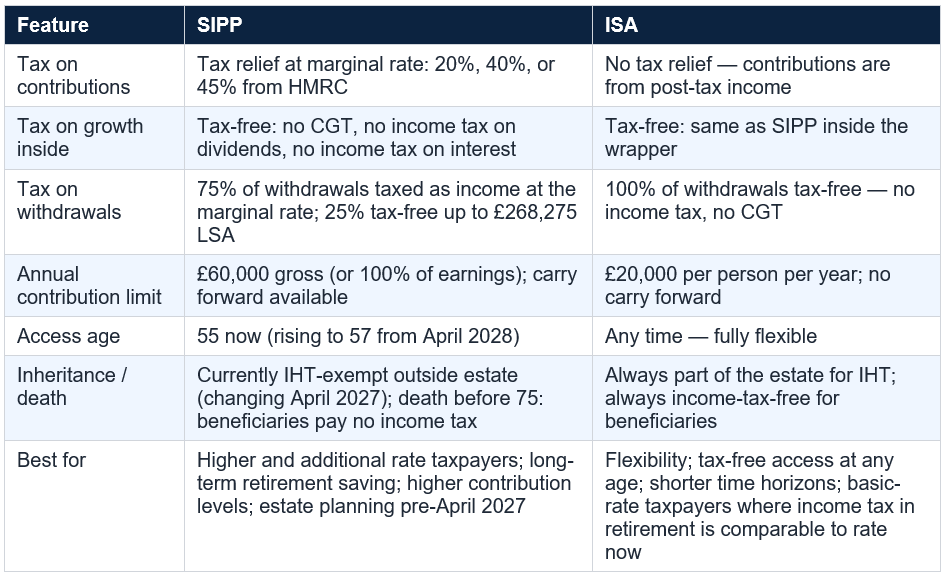
The general rule: SIPP wins for higher and additional rate taxpayers, especially for long-term retirement saving, because the upfront tax relief more than compensates for the 75% taxable income on withdrawal. ISA wins for basic-rate taxpayers where the upfront relief (20%) is similar to the income tax likely to be paid on SIPP withdrawals in retirement (20%), and where flexibility of access is important.
For a higher-rate taxpayer making regular contributions over a career, the combination of the 40 percent upfront relief, compounding tax-free growth, and the 25 percent tax-free lump sum at retirement produces a dramatically better outcome than any equivalent after-tax savings vehicle. As the Gilt-Edge.uk SIPP guide (July 2026) states: ‘SIPPs are the most flexible retirement savings tool available in the UK. The combination of up to 45% tax relief, a £60,000 annual allowance, no lifetime cap, and full investment control makes them the default choice for anyone wanting to go beyond their workplace pension.’
The rules are complex, the April 2027 change is material, and the interaction between carry forward, the taper, and the MPAA requires care. But the fundamental proposition is simple: the UK government subsidises pension saving at the taxpayer’s own marginal rate. Using a SIPP is the most straightforward available way to put that subsidy to work.
When you contribute to a SIPP, your provider claims basic-rate tax relief (20%) from HMRC on your behalf through the 'relief at source' mechanism. You pay in your net contribution; HMRC typically tops it up within 6–8 weeks. For a basic-rate taxpayer, every £800 contributed becomes £1,000 in the SIPP. If you are a higher-rate (40%) taxpayer, you claim the additional 20% through your annual Self Assessment tax return — so an £800 net contribution ultimately costs you £600 after claiming the full relief. An additional-rate (45%) taxpayer claims the additional 25% through Self Assessment, making the effective net cost £550 per £1,000 gross contribution. The basic-rate relief is automatic; the higher and additional rate relief must be actively claimed.
What is the SIPP annual allowance for 2026/27?
The annual allowance for pension contributions in 2026/27 is £60,000 gross, as confirmed by GOV.UK. This is the maximum amount that can be contributed to all your pensions combined — including your own contributions, the HMRC basic-rate top-up, and any employer contributions — and still attract full tax relief. Separately, personal contributions are also capped at 100% of your relevant UK earnings for the year. If your salary is £45,000, your personal contribution limit is £45,000, even though the annual allowance is £60,000. Non-earners can contribute up to £2,880 net (£3,600 gross) regardless of the earnings limit. The Money Purchase Annual Allowance (£10,000) applies if you have started taking flexible income from a pension.
What is the carry-forward rule and how much can I contribute?
Carry forward allows you to use unused annual allowance from the previous three tax years, provided you were a member of a registered pension scheme in those years. In 2026/27, you can carry forward from 2023/24, 2024/25, and 2025/26. If your annual allowance was £60,000 in each of those years and you made no contributions, you have £180,000 of carry-forward allowance. Combined with the current year's £60,000, a single gross contribution of up to £240,000 is theoretically possible in 2026/27 — subject to your earnings being sufficient to cover the gross contribution amount. Carry forward must be used in chronological order from the earliest year first. The carry-forward rules are particularly valuable for business owners and the self-employed who have had a strong income year and wish to make a large tax-relieved contribution.
How does the 25% tax-free lump sum work?
When you access your pension at or after the minimum access age (currently 55, rising to 57 from April 2028), you can take up to 25% of your pension pot as a Pension Commencement Lump Sum (PCLS), completely free of income tax. For 2026/27, the total tax-free cash across all your pensions is capped at £268,275 by the Lump Sum Allowance (LSA). The Lifetime Allowance was abolished from 6 April 2024, so there is no longer a ceiling on total pension pot size — only on the tax-free cash amount. Taking the PCLS alone (without taking taxable drawdown income at the same time) does not trigger the Money Purchase Annual Allowance, so it does not reduce your future pension contribution limit. Once you withdraw the PCLS and hold it outside the pension (e.g. in a savings account), it becomes part of your estate for IHT purposes.
What happens to a SIPP when you die?
Under current rules (before 6 April 2027): if you die before age 75, your nominated beneficiaries can inherit the entire remaining SIPP completely free of Income Tax and Inheritance Tax. If you die at or after age 75, the SIPP passes to beneficiaries free of IHT, but beneficiaries pay income tax at their marginal rate on all withdrawals. From April 2027 (following the Autumn Budget 2024 announcement): unused defined contribution pension pots, including SIPPs, will be brought inside the estate for IHT purposes on death. The details of exactly how this will operate are still being finalised, but the direction is clear: the previous IHT exemption for pension wealth will narrow significantly. Income tax treatment on beneficiary withdrawals after age 75 is expected to remain unchanged. Estate plans that rely on pension IHT exemption should be reviewed urgently before April 2027.
Is a SIPP better than an ISA for saving for retirement?
For most higher-rate and additional-rate taxpayers saving for retirement, a SIPP is significantly more tax-efficient than an ISA. The key reason is the upfront tax relief: a higher-rate taxpayer puts £60 into a SIPP and gets £100 working for them; the same £60 in an ISA remains £60. Both grow tax-free inside the wrapper. The SIPP's disadvantage is that 75% of withdrawals are taxed as income in retirement (at whatever rate applies then), while ISA withdrawals are always tax-free. However, for higher-rate taxpayers who expect to pay a lower tax rate in retirement than during accumulation, the SIPP still wins. The ISA is superior for basic-rate taxpayers if their tax rate in retirement is similar to their rate during accumulation (both approximately 20%), because the ISA's completely tax-free withdrawal advantage offsets the SIPP's upfront relief advantage. ISAs also win on flexibility — they can be accessed at any age without penalty.
Table of Contents
- The Most Tax-Efficient Savings Vehicle Available
- Tax Benefit #1: Tax Relief at Your Marginal Rate — How It Works
- The Three Tiers of Relief: Basic, Higher, and Additional Rate
- Tax Benefit #2: Tax-Free Growth Inside the SIPP
- Tax Benefit #3: The 25% Tax-Free Lump Sum at Retirement
- Tax Benefit #4: The £60,000 Annual Allowance and Carry Forward
- Tax Benefit #5: No Lifetime Allowance Since April 2024
- Tax Benefit #6: Non-Earner Contributions — The £2,880 Rule
- Tax Benefit #7: Death Benefits and SIPP Inheritance (Pre- and Post-April 2027)
- The Tapered Annual Allowance: A Tax Benefit With a Ceiling
- SIPPs vs ISAs: The Tax Comparison
- SIPP Tax Benefits for the Self-Employed
- What to Watch Out For
- Conclusion: The SIPP Is the Tax System Working in Your Favour
- Frequently Asked Questions
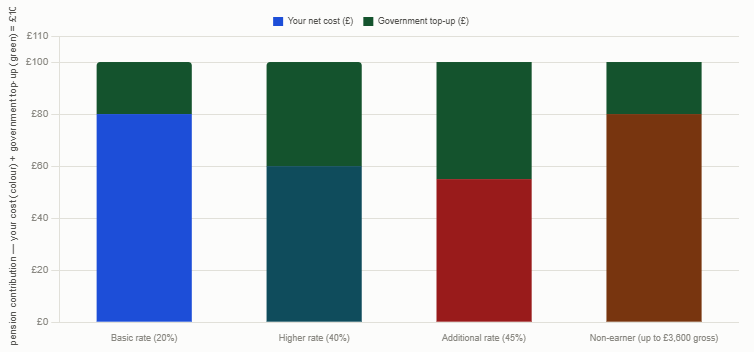
What £100 Gross in Your SIPP actually Cost You
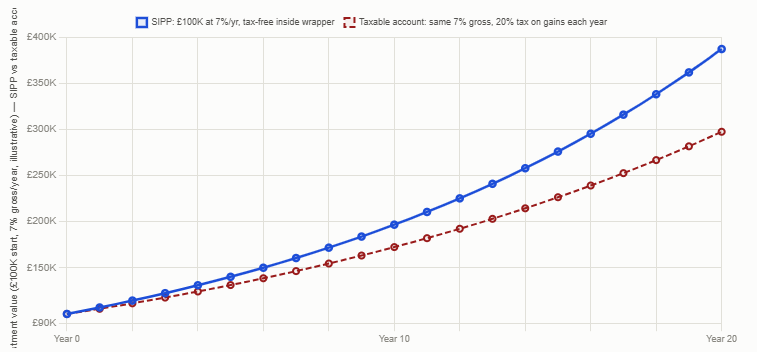
Tax Free Growth: SIPP vs Taxable Account (20 Years)
The Most Tax-Efficient Savings Vehicle Available
A Self-Invested Personal Pension (SIPP) is, by most measures, the single most tax-efficient savings vehicle available to a UK private investor. It offers tax relief on contributions at the marginal rate, tax-free growth on investments held inside it, a 25% tax-free lump sum at retirement, a large and flexible annual contribution limit, the ability to carry forward unused allowances from previous years, and — until legislation changes in April 2027 — a death benefit that sits outside the estate for Inheritance Tax purposes.As Wealthvieu’s March 2026 guide puts it: ‘The tax relief on SIPP contributions is one of the most powerful wealth-building tools available in the UK. Every £80 a basic-rate taxpayer contributes becomes £100 inside the pension, with HMRC automatically adding the 20% top-up. Higher and additional rate taxpayers can claim even more through Self Assessment — effectively turning a £55–£60 personal cost into £100 of pension savings.’
Despite this, the SIPP’s tax benefits are frequently misunderstood — in particular, the difference between the basic-rate top-up (which is automatic) and the higher and additional rate relief (which must be actively claimed through Self Assessment). This guide sets out every significant tax benefit of a SIPP for the 2026/27 tax year, with worked examples at each tax rate, and covers the key upcoming change that all SIPP holders should know about.
SIPP annual allowance 2026/27: £60,000 gross (or 100% of earnings, whichever is lower). Basic-rate relief: £80 in → £100 gross in SIPP (HMRC adds £20 automatically). Higher-rate: effective cost of £100 gross contribution = £60. Additional-rate: effective cost of £100 gross contribution = £55. Tax-free lump sum cap (LSA): £268,275 across all pensions. Carry forward: up to £180,000 from prior 3 years. Pension access age: 55 now; rising to 57 from April 2028.
Tax Benefit #1: Tax Relief at Your Marginal Rate — How It Works
The foundational tax benefit of any pension, including a SIPP, is tax relief on contributions. When you contribute to a SIPP, the government adds an amount equal to the basic rate of income tax on top of your contribution — automatically, without you filing a form. This mechanism is called ‘relief at source.’The mechanics of relief at source:
- You pay your net contribution into the SIPP from your after-tax income.
- The SIPP provider claims the basic-rate tax relief (20%) directly from HMRC on your behalf.
- HMRC pays the relief directly to the SIPP account, typically within 6 to 8 weeks of the contribution.
- The gross contribution (net + basic-rate relief) is what counts toward your annual allowance.
For higher and additional rate taxpayers, the basic-rate relief is added automatically in the same way. The additional relief available above 20 percent — the extra 20 percent for a 40 percent taxpayer, or the extra 25 percent for a 45 percent taxpayer — must be claimed separately through the annual Self Assessment tax return, or by contacting HMRC to adjust the tax code.
The Three Tiers of Relief: Basic, Higher, and Additional Rate
The difference between a basic-rate and higher-rate taxpayer’s net cost is stark: for the same £100 in the pension, a higher-rate taxpayer pays £60 against a basic-rate taxpayer’s £80. A £60,000 gross annual contribution costs a higher-rate taxpayer £36,000 net after claiming the additional 20 percent relief. The government contributes £24,000. For additional-rate taxpayers, the government’s contribution rises to £27,000 on the same £60,000 gross contribution.
The Campaign for a Million’s April 2026 guide to the annual allowance makes the compounding point explicit: ‘The 40% tax relief is not just a one-off saving on the contribution. It means you are starting your compounding journey with 67% more capital than you paid for. A 40% taxpayer who contributes £60,000 net over 10 years has £100,000 working in their SIPP rather than £60,000 — a difference that, at moderate investment growth, is worth hundreds of thousands of pounds in additional final pot value after 20 years.’
Higher-rate taxpayers who do not file a Self Assessment return (or do not include their pension contributions on it) are leaving money on the table. HMRC does not proactively refund the additional 20% — it must be claimed. If you are a 40% taxpayer contributing to a SIPP and have not claimed the additional relief in previous years, you can generally amend returns going back four tax years.
Tax Benefit #2: Tax-Free Growth Inside the SIPP
Once money is inside a SIPP, it grows in a highly tax-advantaged environment. Investments held inside the SIPP wrapper are not subject to:- Income Tax on dividends received.
- Capital Gains Tax (CGT) on any gains realised by selling investments within the SIPP.
- Income Tax on interest earned on bonds or cash held inside the SIPP.
The compounding effect of tax-free growth over a long investment horizon is substantial. A £100,000 investment earning 7 percent per year, fully taxed at 20 percent on gains each year, grows to approximately £289,000 over 20 years. The same £100,000 inside a SIPP growing at 7 percent per year, untaxed, grows to approximately £387,000 — a difference of nearly £100,000 from the same starting investment, with the same gross return, simply because of the tax wrapper.
The tax-free growth benefit is not just about returns — it is about the compounding of those returns. Every pound not paid in CGT or income tax in year one stays invested and earns returns in years two through twenty. The later years of a long investment horizon are where the tax-free growth benefit is most dramatic, because the untaxed compounding has had the most time to accumulate.
Tax Benefit #3: The 25% Tax-Free Lump Sum at Retirement
At retirement, SIPP holders can take up to 25 percent of their pension pot as a Pension Commencement Lump Sum (PCLS) — entirely free of income tax. For 2026/27, the maximum PCLS across all pensions combined is capped at £268,275 by the Lump Sum Allowance (LSA), which was introduced when the Lifetime Allowance was abolished on 6 April 2024.This tax-free cash represents a significant benefit at the point of retirement. On a £500,000 SIPP, the first £125,000 taken can be completely free of income tax. On a SIPP worth up to approximately £1.07 million, the full £268,275 can be taken tax-free (25% of £1,073,100 = £268,275). Above this pot size, the 25% tax-free entitlement is capped at £268,275.
The PCLS does not trigger the Money Purchase Annual Allowance (MPAA). Taking tax-free cash alone — without also taking taxable income — does not reduce the future annual allowance to £10,000. This is an important distinction for those approaching retirement who may still want to make pension contributions after taking the tax-free cash.
Withdrawing the 25% PCLS and holding it in a savings account removes it from the pension wrapper and makes it immediately part of your estate for IHT purposes. Until April 2027, funds remaining inside the SIPP wrapper are outside the estate. RetirementExpert.co.uk (May 2026) advises: 'Don't take PCLS unless you have a specific use for it. Taking £100,000 of tax-free cash and parking it in a savings account converts an IHT-friendly wrapper into a fully taxable asset.' This consideration changes somewhat from April 2027 when pension IHT treatment narrows.
Tax Benefit #4: The £60,000 Annual Allowance and Carry Forward
The annual allowance — the maximum gross amount that can be contributed to all your pensions combined in a single tax year and receive tax relief — is £60,000 for 2026/27, confirmed by GOV.UK. This includes contributions from the individual, the SIPP provider’s basic-rate top-up, and any employer contributions. The personal contribution alone is also capped at 100 percent of relevant UK earnings in the tax year.Carry forward allows unused annual allowance from the previous three tax years to be added to the current year’s £60,000, provided the individual was a registered pension scheme member in those years. For 2026/27, the three carry-forward years are 2023/24 (£60,000 allowance), 2024/25 (£60,000), and 2025/26 (£60,000). If all three years were fully unused, a total of £180,000 can be carried forward, enabling a maximum gross contribution in 2026/27 of £240,000 — subject to the individual having sufficient relevant UK earnings to cover the gross contribution.
Tax Benefit #5: No Lifetime Allowance Since April 2024
The Lifetime Allowance (LTA) — the total cap on how much could accumulate across all pension savings and still receive favourable tax treatment — was abolished from 6 April 2024. Prior to abolition, the LTA stood at £1,073,100. Any pension wealth above this level was subject to a Lifetime Allowance Excess Charge of 55 percent on lump sum withdrawals or 25 percent on funds taken as income.The abolition of the LTA removes what was, for high earners and prolific savers, a significant disincentive to pension saving. It is now possible for a SIPP pot to grow to any size without a specific tax penalty triggered by the size of the pot itself. The Gilt-Edge.uk SIPP guide (July 2026) summarises the post-LTA landscape: ‘The combination of up to 45% tax relief, a £60,000 annual allowance, no lifetime cap, and full investment control makes SIPPs the default choice for anyone wanting to go beyond their workplace pension. The case has only strengthened in 2026/27.’
The practical implication is that high earners and business owners can now accumulate pension wealth without the LTA acting as a ceiling on the value of the SIPP strategy. The remaining caps are the annual allowance (£60,000), the tapered annual allowance for very high earners, and the Lump Sum Allowance of £268,275 for the 25% tax-free cash. None of these constrain the total pot size — only the pace of contribution and the tax-free withdrawal amount.
Tax Benefit #6: Non-Earner Contributions — The £2,880 Rule
A frequently overlooked SIPP benefit is the ability for individuals with little or no relevant UK earnings to still make pension contributions and receive basic-rate tax relief. Under current rules:- Individuals with no relevant UK earnings (non-earners, children, full-time carers, retirees who have not yet taken all their pension benefits) can contribute up to £2,880 net per year to a SIPP.
- HMRC automatically adds 20% basic-rate relief, bringing the gross contribution to £3,600.
- This benefit is available regardless of whether the individual actually pays income tax — they receive the 20% top-up even if they are a non-taxpayer.
- Spouses or civil partners who are not working (e.g. on a career break for childcare) and who would otherwise miss decades of pension growth.
- Children — a SIPP can be opened for a child, with parents or grandparents contributing up to £2,880 net (£3,600 gross) per year. Money invested in a child’s SIPP from birth to age 18 at modest returns can compound significantly by the time the child reaches retirement.
- Early retirees — individuals who have retired but have not yet taken all their pension benefits can continue making contributions up to £3,600 gross if they have no earned income, receiving the basic-rate top-up as a bonus.
Tax Benefit #7: Death Benefits and SIPP Inheritance (Pre- and Post-April 2027)
One of the most significant, and most changed, aspects of SIPP tax planning concerns what happens to the fund when the SIPP holder dies. The rules currently in place — and the changes coming from April 2027 — are both essential knowledge for anyone using a SIPP as part of an estate plan.Current rules (until 5 April 2027):
- Death before age 75: the entire remaining SIPP passes to nominated beneficiaries completely free of Income Tax and free of Inheritance Tax. The beneficiaries can take the money as a lump sum or in drawdown, and pay no income tax on withdrawals. This is arguably the most powerful single wealth-transfer feature in the UK tax code.
- Death at or after age 75: the remaining SIPP passes to nominated beneficiaries outside the deceased's estate (IHT-exempt) but the beneficiaries pay income tax at their marginal rate on all withdrawals. A basic-rate beneficiary pays 20%; an additional-rate beneficiary pays 45%.
- Unused defined contribution pension pots will be brought inside the estate for IHT purposes on death. The detailed mechanics are still being finalised, but the IHT exemption on pension wealth narrows significantly.
- The income tax position on withdrawals by beneficiaries (after-age-75 death) is expected to remain: beneficiaries pay income tax at their marginal rate.
Death before 75 (current rules): 100% of SIPP passed to beneficiaries free of IHT and free of Income Tax. Death after 75 (current rules): 100% passed IHT-free; beneficiaries pay income tax on withdrawals at their marginal rate. From April 2027: pension IHT treatment changes significantly; detail still being finalised at time of writing.
From April 2027, SIPPs will no longer sit fully outside the IHT estate. SIPP holders who have incorporated pension wealth into their IHT planning need to review their estate plan before this change takes effect. Life insurance written in trust is increasingly being recommended as a compensating mechanism for estates that previously relied on pension IHT exemption as part of their overall plan.
The Tapered Annual Allowance: A Tax Benefit With a Ceiling
For very high earners, the annual allowance of £60,000 is gradually reduced by the Tapered Annual Allowance (TAA). The taper applies when:- Threshold income exceeds £200,000 (broadly, income from all sources including pension contributions).
- Adjusted income exceeds £260,000 (threshold income plus employer pension contributions).
Despite this reduction, even the minimum £10,000 tapered allowance generates meaningful tax relief for additional-rate taxpayers: a £10,000 gross contribution costs approximately £5,500 net — a £4,500 saving. And the carry-forward rules apply to the tapered allowance as well: if the tapered allowance in previous years produced unused capacity (because the individual was not then subject to full taper), that unused capacity can be carried forward.
The interaction between the tapered annual allowance, carry forward, and adjusted income is complex. An individual whose income fluctuates around the £260,000 threshold may have different allowances in different years, requiring careful calculation to avoid the Annual Allowance Charge (which claws back the tax relief on excess contributions at the marginal rate). Always seek specialist advice before making large contributions if your income is near or above the taper threshold.
SIPPs vs ISAs: The Tax Comparison
The general rule: SIPP wins for higher and additional rate taxpayers, especially for long-term retirement saving, because the upfront tax relief more than compensates for the 75% taxable income on withdrawal. ISA wins for basic-rate taxpayers where the upfront relief (20%) is similar to the income tax likely to be paid on SIPP withdrawals in retirement (20%), and where flexibility of access is important.
SIPP Tax Benefits for the Self-Employed
The SIPP is the default retirement savings vehicle for the self-employed. Unlike employees, self-employed workers are not auto-enrolled into a workplace pension and have no employer contributions to capture. However, the SIPP’s tax benefits are fully available to the self-employed and, in some important respects, work particularly well for those with variable income:- Tax relief at the marginal rate: a self-employed higher-rate taxpayer contributing £10,000 gross to a SIPP pays approximately £6,000 net. The £4,000 in relief directly reduces the income tax due on Self Assessment.
- Flexibility of contributions: a SIPP imposes no minimum contribution and no fixed payment schedule. A profitable quarter produces a large contribution; a lean quarter produces a small one. This flexibility suits the irregular income of self-employment.
- Carry forward for exceptional years: self-employed individuals who have had strong business years can carry forward up to £180,000 in unused allowances (2026/27), enabling a very large tax-relieved contribution in a single year. This is particularly powerful for business owners approaching a business sale or dividend extraction event.
- Corporation tax relief for company directors: a limited company can make employer contributions to a director’s SIPP as a business expense, attracting corporation tax relief (currently 25% for most companies). This means the pension contribution reduces the corporation tax bill as well as being shielded from income tax and National Insurance.
What to Watch Out For
The SIPP’s tax benefits are powerful but come with conditions that must be respected:- The annual allowance charge: contributions above the annual allowance (including carry-forward) trigger a charge that claws back the tax relief at the marginal rate. This makes it very expensive to accidentally over-contribute.
- The Money Purchase Annual Allowance (MPAA): taking taxable income from a drawdown pension or UFPLS permanently reduces the future annual allowance for defined contribution pensions to £10,000. Carefully sequence which pension income you take first.
- Pension access age: SIPP funds cannot be accessed before age 55 (rising to 57 from April 2028) without severe early access penalties (55% unauthorised payment charge plus scheme sanction charge in most cases). Plan for the lock-in.
- The April 2027 IHT change: the IHT treatment of pension death benefits changes significantly from 6 April 2027. Any estate plan that relies on pension IHT exemption should be reviewed before this date.
- Claiming higher-rate relief: basic-rate relief is automatic; higher and additional rate relief is not. File a Self Assessment return, or contact HMRC to amend your tax code. Missing this step means paying more than necessary for every contribution.
- Platform and fund charges: the SIPP’s tax advantages can be partially eroded by high charges. On a £200,000 SIPP, a 1% difference in total annual charge (platform plus fund) costs £2,000/year. Over 30 years, this is £60,000 before returns (PensionEstimate.uk). Use a low-cost platform and check all charges before opening.
Conclusion
The SIPP accumulates seven distinct tax advantages, each of which has real, quantifiable value. Tax relief on contributions at the marginal rate. Tax-free growth on investments. A 25 percent tax-free lump sum at retirement, capped at £268,275. A £60,000 annual allowance with three-year carry forward. No lifetime cap on pot size since April 2024. Basic-rate top-up even for non-earners. And, until April 2027, a death benefit that sits outside the estate for IHT purposes.For a higher-rate taxpayer making regular contributions over a career, the combination of the 40 percent upfront relief, compounding tax-free growth, and the 25 percent tax-free lump sum at retirement produces a dramatically better outcome than any equivalent after-tax savings vehicle. As the Gilt-Edge.uk SIPP guide (July 2026) states: ‘SIPPs are the most flexible retirement savings tool available in the UK. The combination of up to 45% tax relief, a £60,000 annual allowance, no lifetime cap, and full investment control makes them the default choice for anyone wanting to go beyond their workplace pension.’
The rules are complex, the April 2027 change is material, and the interaction between carry forward, the taper, and the MPAA requires care. But the fundamental proposition is simple: the UK government subsidises pension saving at the taxpayer’s own marginal rate. Using a SIPP is the most straightforward available way to put that subsidy to work.
Frequently Asked Questions
How does SIPP tax relief work in practice?When you contribute to a SIPP, your provider claims basic-rate tax relief (20%) from HMRC on your behalf through the 'relief at source' mechanism. You pay in your net contribution; HMRC typically tops it up within 6–8 weeks. For a basic-rate taxpayer, every £800 contributed becomes £1,000 in the SIPP. If you are a higher-rate (40%) taxpayer, you claim the additional 20% through your annual Self Assessment tax return — so an £800 net contribution ultimately costs you £600 after claiming the full relief. An additional-rate (45%) taxpayer claims the additional 25% through Self Assessment, making the effective net cost £550 per £1,000 gross contribution. The basic-rate relief is automatic; the higher and additional rate relief must be actively claimed.
What is the SIPP annual allowance for 2026/27?
The annual allowance for pension contributions in 2026/27 is £60,000 gross, as confirmed by GOV.UK. This is the maximum amount that can be contributed to all your pensions combined — including your own contributions, the HMRC basic-rate top-up, and any employer contributions — and still attract full tax relief. Separately, personal contributions are also capped at 100% of your relevant UK earnings for the year. If your salary is £45,000, your personal contribution limit is £45,000, even though the annual allowance is £60,000. Non-earners can contribute up to £2,880 net (£3,600 gross) regardless of the earnings limit. The Money Purchase Annual Allowance (£10,000) applies if you have started taking flexible income from a pension.
What is the carry-forward rule and how much can I contribute?
Carry forward allows you to use unused annual allowance from the previous three tax years, provided you were a member of a registered pension scheme in those years. In 2026/27, you can carry forward from 2023/24, 2024/25, and 2025/26. If your annual allowance was £60,000 in each of those years and you made no contributions, you have £180,000 of carry-forward allowance. Combined with the current year's £60,000, a single gross contribution of up to £240,000 is theoretically possible in 2026/27 — subject to your earnings being sufficient to cover the gross contribution amount. Carry forward must be used in chronological order from the earliest year first. The carry-forward rules are particularly valuable for business owners and the self-employed who have had a strong income year and wish to make a large tax-relieved contribution.
How does the 25% tax-free lump sum work?
When you access your pension at or after the minimum access age (currently 55, rising to 57 from April 2028), you can take up to 25% of your pension pot as a Pension Commencement Lump Sum (PCLS), completely free of income tax. For 2026/27, the total tax-free cash across all your pensions is capped at £268,275 by the Lump Sum Allowance (LSA). The Lifetime Allowance was abolished from 6 April 2024, so there is no longer a ceiling on total pension pot size — only on the tax-free cash amount. Taking the PCLS alone (without taking taxable drawdown income at the same time) does not trigger the Money Purchase Annual Allowance, so it does not reduce your future pension contribution limit. Once you withdraw the PCLS and hold it outside the pension (e.g. in a savings account), it becomes part of your estate for IHT purposes.
What happens to a SIPP when you die?
Under current rules (before 6 April 2027): if you die before age 75, your nominated beneficiaries can inherit the entire remaining SIPP completely free of Income Tax and Inheritance Tax. If you die at or after age 75, the SIPP passes to beneficiaries free of IHT, but beneficiaries pay income tax at their marginal rate on all withdrawals. From April 2027 (following the Autumn Budget 2024 announcement): unused defined contribution pension pots, including SIPPs, will be brought inside the estate for IHT purposes on death. The details of exactly how this will operate are still being finalised, but the direction is clear: the previous IHT exemption for pension wealth will narrow significantly. Income tax treatment on beneficiary withdrawals after age 75 is expected to remain unchanged. Estate plans that rely on pension IHT exemption should be reviewed urgently before April 2027.
Is a SIPP better than an ISA for saving for retirement?
For most higher-rate and additional-rate taxpayers saving for retirement, a SIPP is significantly more tax-efficient than an ISA. The key reason is the upfront tax relief: a higher-rate taxpayer puts £60 into a SIPP and gets £100 working for them; the same £60 in an ISA remains £60. Both grow tax-free inside the wrapper. The SIPP's disadvantage is that 75% of withdrawals are taxed as income in retirement (at whatever rate applies then), while ISA withdrawals are always tax-free. However, for higher-rate taxpayers who expect to pay a lower tax rate in retirement than during accumulation, the SIPP still wins. The ISA is superior for basic-rate taxpayers if their tax rate in retirement is similar to their rate during accumulation (both approximately 20%), because the ISA's completely tax-free withdrawal advantage offsets the SIPP's upfront relief advantage. ISAs also win on flexibility — they can be accessed at any age without penalty.
0 Comments
Be the first to share your thoughts on this article.