

Financial Literacy
Things Americans Overpay For (And How to Negotiate Them)

Table of Contents
- You Are Probably Paying Too Much for Things You Use Every Day
- The Data: How Much Americans Are Overpaying
- What You Can Negotiate and How Much You Can Save
- Car Insurance: The Biggest Negotiable Bill Most Americans Pay
- Medical Bills: The Category Most Americans Never Think to Negotiate
- Cable and Internet: The Annual Ritual That Pays Off Every Time
- Credit Cards: The One-Call Refund That Almost Always Works
- Gym Memberships and Subscriptions: The Annual Review That Pays Itself
- Rent: The Negotiation Nobody Tries and Everybody Should
- When They Say No: The Escalation That Works
- Conclusion
- Frequently Asked Questions (FAQ)
- External References & Further Reading
You Are Probably Paying Too Much for Things You Use Every Day
A new analysis by the Vanderbilt Policy Accelerator, obtained exclusively by the Associated Press in April 2026, found that Americans are overcharged by approximately $150 billion annually just on their insurance bills for homes, autos, and businesses. For every dollar collected in premiums, insurers paid out only 62 cents in claims in 2024 — down from an average of 80 cents in the 1980s and 1990s. That gap did not happen by accident. It happened, in large part, because most Americans accept the number on the bill and move on.The same dynamic applies across almost every major recurring expense in American household budgets. Between 49% and 80% of medical bills contain at least one billing error, according to healthcare researchers — generating an estimated $88 billion in incorrect charges annually. Cable and internet providers routinely raise rates mid-contract and on renewal, counting on the inertia of customers who have been set up on autopay for years. Credit card companies charge late fees and interest that they will waive in a single phone call for customers who ask. Gym memberships lock in rates that can be reduced or removed with the right conversation. Even rent — in many markets — can be negotiated at lease renewal.
Consumer finance expert Andrea Woroch, speaking to GOBankingRates and subsequently cited on Nasdaq in October 2025, stated directly: 'Consumers could easily save a thousand dollars or more' by reviewing bills, looking for discounts, and negotiating. The problem is not access — most of these conversations take less than 15 minutes and require no special skills beyond persistence. The problem is awareness. Most Americans do not know they can negotiate. This guide covers every major category where overpayment is documented, what the realistic savings are, the specific scripts that work, and how to handle the calls that feel uncomfortable — because the discomfort of a five-minute conversation is a trivially small price to pay for an extra thousand dollars a year.
The Data: How Much Americans Are Overpaying
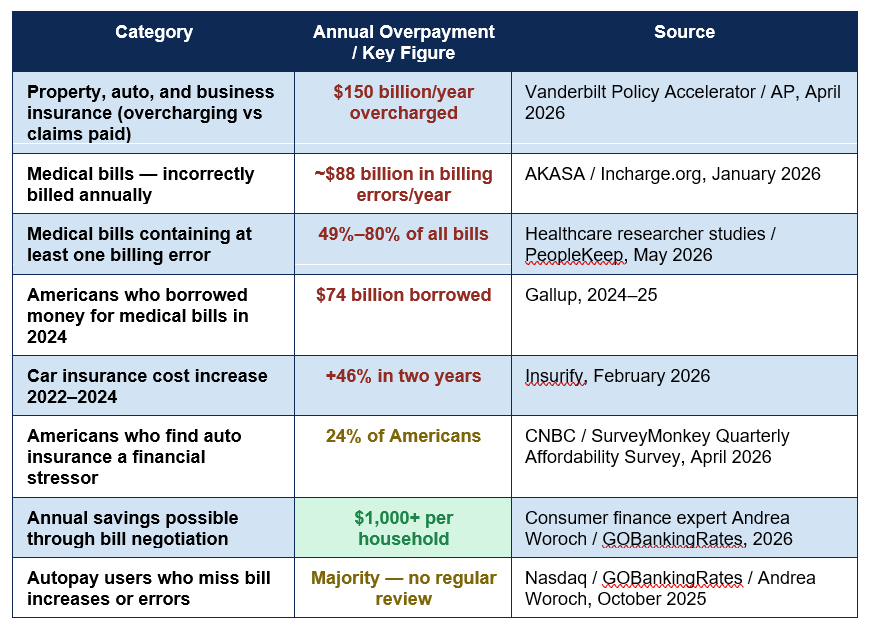
The autopay trap: Most bill increases go unnoticed on autopay — Andrea Woroch's core finding is that autopay — while convenient — removes the natural review trigger that would otherwise cause consumers to notice rate increases, missed discounts, or billing errors; she recommends reviewing every bill at minimum annually, and ideally at each billing cycle (GOBankingRates, October 2025)
What You Can Negotiate and How Much You Can Save
The table below maps every major negotiable expense category to difficulty level, realistic savings, and the best approach: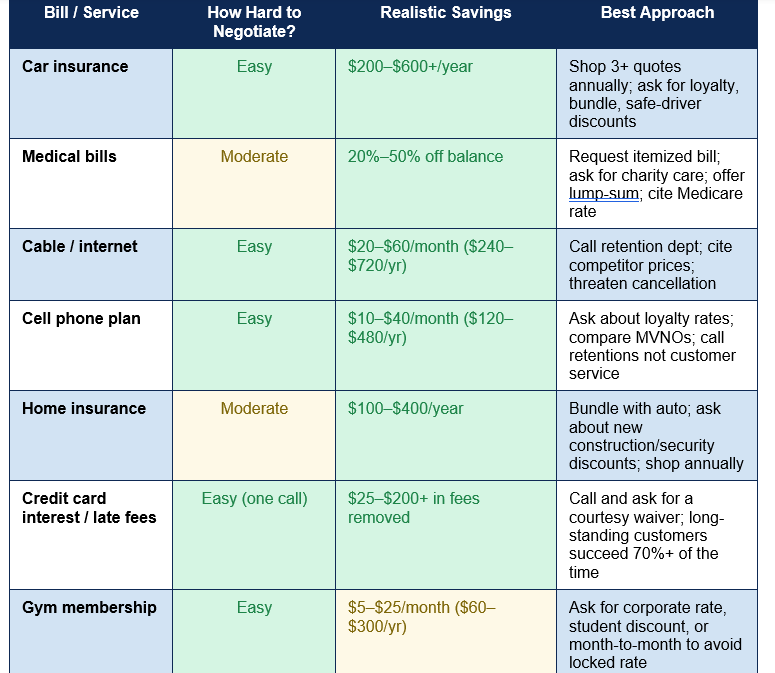

Car Insurance: The Biggest Negotiable Bill Most Americans Pay
Car insurance is the most widely cited category where Americans are systematically overpaying — and the one with the clearest path to savings. The average full-coverage car insurance premium was $2,144 per year as of Insurify's February 2026 report, following a 6% drop in 2025 that came after a 46% increase between 2022 and 2024. In some states, rates remain extremely high: New York averages over $4,000 per year for full coverage, while Idaho averages $1,443. The spread between what drivers pay at different insurers for the same driver profile can be hundreds of dollars annually — sometimes for identical coverage.The mechanics of negotiation in car insurance are primarily about shopping, not arguing. Insurance companies use different algorithms and risk models to price the same driver, which is why the same person can receive quotes ranging from $1,200 to $2,400 from different insurers. The single most impactful action is requesting quotes from at least three competing insurers every 12 months — even if you are happy with your current provider — because loyalty does not reward you financially in the insurance market. Loyalty typically costs you money, as insurers give their best rates to new customers.
When you have a competing quote, call your current insurer and say so. Retention departments have far more authority to reduce premiums than standard customer service representatives — ask specifically to be transferred to the retention or cancellation team before making your case. Beyond shopping, discounts that many insured drivers never claim include: bundling home and auto policies (typically 10-25% off), safe driver programs (telematics-based monitoring from GEICO, State Farm, and others), low-mileage discounts (for drivers under 7,500 miles annually), paperless billing discounts, and professional or employer association rates.
SCRIPT: "Hi, I've been a customer for [X] years and I just received a quote from [Competitor] for $[amount] less for the same coverage. I'd like to stay with you — can you match it or explain what discounts I might be missing? If not, I'll need to switch."
The $150 billion overcharging finding: The Vanderbilt Policy Accelerator's April 2026 analysis found that the declining loss ratio — insurers paying out 62 cents per dollar of premiums in 2024, versus 80 cents in the 1980s — represents a structural shift in insurer profitability that is not being passed back to policyholders. The analysis proposes federal guardrails to address this. Until those exist, the only protection available to individual consumers is shopping and switching.
Medical Bills: The Category Most Americans Never Think to Negotiate
Medical billing in the United States operates on a system that is fundamentally unlike any other consumer billing system: providers publish list prices (the 'chargemaster') that are almost never what anyone actually pays. Medicare and Medicaid pay a fraction of those rates, set by the government. Insurance companies pay a negotiated rate that is typically 20-60% below list price. Uninsured and underinsured patients are often billed the full list price — which is effectively an opening bid in a negotiation, not a final price.Healthcare researchers estimate that between 49% and 80% of medical bills contain at least one billing error, generating approximately $88 billion in incorrect charges annually according to AKASA data cited in January 2026. The most common errors include duplicate charges, charges for services not received, upcoding (billing for a more expensive procedure than was performed), and unbundled charges where a single procedure is split into multiple line items. You will never find these errors if you do not request an itemized bill — which you are legally entitled to request, and which most providers will not send you automatically.
Beyond billing errors, most nonprofit hospitals — and many for-profit ones — have charity care or financial hardship programs that cover households earning up to 400% of the federal poverty level. According to Dollar For, 52% of patients did not receive information about financial assistance from their hospital, despite potentially qualifying. These programs can reduce or eliminate bills entirely for eligible patients who ask. The average silver plan ACA deductible was nearly $5,000 in 2025, meaning millions of middle-income Americans face substantial out-of-pocket costs that they may be able to reduce significantly by applying for these programs.
- Request an itemized bill immediately: Call the hospital or provider billing department and ask specifically for a 'detailed itemized statement showing CPT codes and charges.' Compare it against your Explanation of Benefits (EOB) from your insurer to identify any discrepancies.
- Check for charity care eligibility: Search the hospital's website for '501(r) Financial Assistance Policy' or call their billing department and ask directly: 'Do you have a financial assistance program, and do I qualify?' Many patients earning under $60,000-$80,000 per year qualify for significant reductions.
- Negotiate the balance directly: Offer a lump-sum payment at a discount — hospitals prefer receiving some money immediately over chasing the full balance over months. A typical starting offer is 50% of the stated balance for immediate payment. Most billing departments have authority to accept significantly reduced settlements.
SCRIPT: "I've reviewed my itemized bill and I'd like to discuss the balance. I can pay $[X] today as a full and final payment if that works for your department. I'm not in a position to pay the full amount, but I want to resolve this promptly."
The Medicare benchmark strategy: Ask what Medicare would pay for the same procedure — Medicare pays approximately 40-60% of list price for most procedures, and this is a matter of public record — use the CMS National Provider Identifier database or search '[procedure] Medicare reimbursement rate' to find the number before your call. Asking a billing department to bill you at Medicare rates is a recognized negotiation strategy that has worked for many patients.
Cable and Internet: The Annual Ritual That Pays Off Every Time
Cable and internet bills are arguably the most reliably negotiable recurring expense in American household budgets, and the negotiation dynamic is the most predictable: introductory rates expire, bills rise, and providers have substantial retention budgets because acquiring a new customer costs them significantly more than retaining an existing one. The average cable-plus-internet package in the United States has been rising steadily, with the FCC's 2025 Broadband Data collection showing the average household paying more than $100 per month for broadband service alone in high-cost markets.The key insight is that you are almost certainly paying more than a new customer would pay for the same service. Cable and internet providers routinely offer new-customer promotions at 40-60% below their standard rates, then move existing customers onto full-price plans at the end of the promotional period — often with minimal notification. Calling to complain and threatening to cancel typically produces an offer of a retention deal that partially bridges the gap between your current rate and the promotional rate.
The effectiveness of this approach is well-documented. CNBC Select's February 2026 guide to bill negotiation services explicitly lists cable and internet as one of the categories where services like Rocket Money and BillCutterz achieve the most consistent success — typically saving customers $20 to $60 per month, or $240 to $720 per year. Doing it yourself takes 15 minutes and requires no payment to a third party (bill negotiation services typically take 35-50% of first-year savings).
SCRIPT: "I've been a customer for [X] years and I've noticed my bill has gone up significantly. I've been looking at [Competitor/streaming alternative] and I'm seriously considering switching unless we can get my rate back to something reasonable. What can you do for me today?"
Credit Cards: The One-Call Refund That Almost Always Works
Credit card late fees, over-limit fees, and annual interest charges are negotiable with a success rate that most consumers would find surprising. Consumer finance expert Andrea Woroch told GOBankingRates that she has personally negotiated the removal of late fees and cancellation charges from her credit card bills — noting that for customers with good standing, these requests are frequently honored with a single phone call.The success rate on first-time late fee waiver requests for customers with good payment history is consistently reported at 70% or higher across consumer finance literature. The logic is straightforward: credit card companies do not want to lose a customer who has been reliable for years over a $35 late fee. The cost of acquiring a new customer — through marketing, sign-up bonuses, and processing — far exceeds what they would lose by waiving a single fee. The same logic applies to annual fee negotiations, particularly for premium cards where the fee has increased: asking for a retention offer, a statement credit, or a temporary waiver frequently produces a positive response.
For interest rate negotiations, long-standing customers with good credit can sometimes secure a permanent or temporary APR reduction by calling and explaining they are considering a balance transfer to a competing card offering 0%. This is particularly effective in 2026, when many issuers are competing aggressively for balance transfer customers and retention departments have been given authority to match or beat competitor APR offers.
SCRIPT: "Hi, I've been a customer for [X] years and I have always paid on time. I missed [last month's] payment — it was a one-time mistake. I'd like to request a courtesy waiver of the late fee. Is that something you can do for me?"
Gym Memberships and Subscriptions: The Annual Review That Pays Itself
Gym memberships represent one of the most straightforward and most consistently successful bill negotiations available to American consumers. The fitness industry is intensely competitive, with new gyms, boutique studios, and digital fitness platforms all competing for the same customers. Gyms — particularly large chains — have significant flexibility on price, particularly at the end of the month when sales representatives are working against quotas.Three negotiation strategies work reliably for gym memberships. First, ask about corporate or employer rates: many employers negotiate discounts with local gyms as a wellness benefit that employees are never told about. Second, ask for a month-to-month contract rather than an annual commitment — the rate may be slightly higher, but it avoids paying for months you are not using and provides leverage to negotiate at renewal. Third, time your negotiation: gyms are most motivated to offer discounts in January (New Year's rush competitors), summer (when attendance drops), and end-of-quarter.
Subscription creep — the gradual accumulation of streaming services, app subscriptions, and digital products — is an equally significant source of household overpayment. The average American household subscribes to 12 paid digital services according to a 2025 Parks Associates survey, at a combined cost of approximately $100-$150 per month. Most people significantly underestimate how many subscriptions they are paying for. A quarterly subscription audit — using your bank statement or a tool like Rocket Money or Truebill — consistently reveals services people forgot they signed up for and have not used in months.
The autopay review rule: Consumer finance expert Andrea Woroch's most actionable piece of general advice for avoiding overpayment is to review every bill at least annually, even if you are on autopay. For most households, a single annual bill review — covering insurance, cable, phone, subscriptions, and any service you have been paying for more than 12 months — takes two to three hours and consistently identifies hundreds of dollars in unnecessary or negotiable charges. Set a calendar reminder for the same week each year.
Rent: The Negotiation Nobody Tries and Everybody Should
Rent is the largest single monthly expense for most American households, and it is negotiable more often than tenants realise. Landlords — particularly individual property owners and smaller management companies — face real costs when a unit is vacant: the typical cost of apartment turnover for a landlord in the US market is $1,000 to $3,000, covering cleaning, repairs, advertising, and the loss of income during the vacancy period. A tenant who has paid on time and maintained the property is genuinely valuable to a landlord, and that value can be converted into a negotiated rent increase or even a rent reduction at lease renewal.The most effective approach is to prepare before the renewal conversation: research current market rates for comparable units in your area using Zillow, Apartments.com, or Rent.com; document your on-time payment history; and make the case as a business transaction rather than a personal request. Offering to sign a longer lease (18 months rather than 12) is a negotiating chip that many landlords find valuable, as it guarantees income and eliminates their turnover risk for an additional six months.
In markets where rents are flat or declining — or where comparable units are available at lower rates nearby — presenting this data specifically during the renewal negotiation is the strongest possible approach. Landlords who know you have done your research and have options are significantly more likely to offer concessions than those who believe you have not compared alternatives.
When They Say No: The Escalation That Works
The first person you speak to in any bill negotiation typically has limited authority. This is not a reason to give up — it is a reason to escalate. Ask to speak with the retention department, the billing supervisor, or the customer loyalty team. These are the people with actual authority to offer discounts, credits, or rate reductions. The key escalation phrases are: 'Can I speak with someone in your retention department?' and 'Is there a supervisor available who has authority to review my rate?'If escalation within the company fails, use the competition. A credible threat of cancellation — backed by an actual competing quote — is the most powerful tool in any bill negotiation. 'I have a quote from [Competitor] for $[X] less' changes the dynamic of every conversation. The key is having done the research first, so the threat is not hypothetical.
For medical bills specifically, if negotiation with the billing department fails, ask for a referral to the hospital's financial counselor or patient advocate. These roles exist specifically to help patients navigate payment assistance programs and negotiate settlements. Many hospitals also have established relationships with nonprofit patient advocate organisations that can negotiate on your behalf at no cost.
Conclusion
Americans are being overcharged on a scale that is simultaneously enormous and highly personal: $150 billion annually on insurance, $88 billion in medical billing errors, and hundreds of dollars per household on cable, phone, credit card fees, gym memberships, and subscriptions that silently escalate year after year while set to autopay. None of this is hidden. The pricing strategies are well-understood, the negotiation routes are well-documented, and the success rates are high. What is missing, for most households, is the awareness that negotiation is both possible and normal.The cultural discomfort around negotiating bills in the United States is itself part of the cost. Most Americans operate in a retail economy where prices are fixed and asking for a discount feels awkward or unusual. In every category described in this guide, however, the industries on the other side of the bill understand that prices are negotiable — insurance companies, hospitals, cable providers, credit card issuers, gyms, and landlords all have retention budgets, hardship programs, discount frameworks, and authority to reduce what they charge. They simply do not volunteer this information.
The practical prescription is straightforward: schedule one annual bill review, have a copy of a competing quote before every negotiation call, ask for the retention department rather than customer service, and do not accept the first no. The median outcome of a household that applies this discipline consistently is not a few dollars saved — it is a thousand dollars or more returned to the budget each year, from conversations that require no special skills, no confrontation, and no more than a few hours of total time. That is, on a dollar-per-hour basis, among the highest-return financial activities available to most Americans.
Frequently Asked Questions (FAQ)
Is it really possible to negotiate regular household bills in the US?
Yes — more reliably than most people assume. Consumer finance experts consistently identify car insurance, medical bills, cable and internet, cell phone plans, credit card fees, and gym memberships as categories where negotiation works regularly. The underlying logic is the same across all of them: companies have acquisition costs for new customers that far exceed the concessions they make to retain existing ones. A well-prepared call to the right department — specifically the retention team rather than general customer service — routinely produces discounts, credits, or rate reductions. Consumer finance expert Andrea Woroch documented $1,000 or more in annual savings as readily achievable through these conversations.How do I negotiate a lower car insurance premium?
Get quotes from at least three competing insurers before calling your current provider. When you call, ask specifically to be transferred to the retention or cancellation department — these teams have authority to reduce premiums that general customer service does not. Present the competing quote directly and ask whether your current insurer can match it or explain what discounts you qualify for that you are not currently receiving. Common discounts that many insured drivers miss include bundling home and auto (10-25% off), safe driver or telematics programs, low-mileage discounts, paperless billing discounts, and employer or professional association rates. Insurify data from early 2026 projects a 1% average increase in car insurance costs nationally — shopping annually is the most reliable way to avoid paying above-market rates.Can I really negotiate a hospital or medical bill?
Yes — and the system is specifically designed with negotiation built in. Hospital 'chargemaster' list prices are not the rate anyone with insurance actually pays, and they are not the rate you are required to pay either. Start by requesting a detailed itemized bill and comparing it to your Explanation of Benefits for errors — research suggests 49% to 80% of bills contain at least one billing error. Ask the billing department whether you qualify for a financial hardship or charity care programme — many hospitals extend these to households earning up to 400% of the federal poverty level. If you are able to pay a lump sum, offer 40-60% of the balance for immediate full and final settlement — many billing departments have authority to accept this.What should I do if the company says no to my request?
Ask to speak with a supervisor or specifically request the retention department. The first representative you speak to is typically a customer service agent with limited authority to offer discounts. Retention teams exist specifically to prevent customers from leaving and have real budget to offer concessions. If you have a competing quote, this is the moment to present it clearly: 'I have a quote from [Company] for $X less for equivalent coverage. I'd prefer to stay with you — is there anything the retention team can do to match it?' If the answer is still no after speaking to retention, the threat of cancellation — and following through with it — is your final leverage. Many companies will make a counteroffer during the cancellation process itself.Should I use a bill negotiation service or do it myself?
For most households and most categories, doing it yourself is more financially advantageous than using a third-party bill negotiation service. Services like Rocket Money, BillCutterz, and similar providers typically charge 35-50% of the first year's savings for successful negotiations — meaning if they save you $600 on cable, you pay them $210-$300. The calls themselves are not complicated and typically take 15-30 minutes each. However, for households who genuinely do not have the time, find the calls stressful, or are dealing with a complex medical bill requiring significant back-and-forth with a billing department, a bill negotiation service or a nonprofit patient advocate can be worth the fee. Medical billing advocates in particular can be valuable for large or complicated hospital bills, as they understand billing codes and have established relationships with billing departments.External References
The following authoritative sources were used in researching this article and are recommended for further reading:1. AP / News4Jax — Americans Overcharged $150 Billion Annually on Insurance (Vanderbilt Policy Accelerator, April 2026)
https://www.news4jax.com/business/2026/04/30/youre-probably-paying-more-for-insurance-lately-a-new-study-suggests-federal-action-to-cut-costs/
2. Insurify — Car Insurance Report: Rates and Trends 2026 (February 2026)
https://insurify.com/car-insurance/report/
3. Nasdaq / GOBankingRates — Finance Expert: You Could Be Overpaying Hundreds in 2026
https://www.nasdaq.com/articles/im-finance-expert-if-you-dont-negotiate-your-bills-you-could-be-overpaying-hundreds-2026
4. PeopleKeep — The Secret to Negotiating Lower Medical Bills (Updated May 2026)
https://www.peoplekeep.com/blog/the-secret-to-negotiating-lower-medical-bills
5. Slate — Hospital Bills Are Open to Negotiation. Here's How. (April 2026)
https://slate.com/technology/2026/04/hospital-bill-insurance-negotiation-how-to.html
6. CNBC — 24% of Americans Say Auto Insurance Is a Financial Stressor (April 2026)
https://www.cnbc.com/select/how-to-lower-your-auto-insurance-costs/
7. CNBC Select — Best Bill Negotiation Services of 2026 (February 2026)
https://www.cnbc.com/select/best-bill-negotiation-services/
8. InCharge.org — How to Negotiate Medical Bills (Updated June 2026)
https://www.incharge.org/understanding-debt/can-you-negotiate-medical-debt/
0 Comments
Be the first to share your thoughts on this article.