
Finance
UK Inflation Hits 3.3%: Fuel Spike, Iran War & Your Bills
Table of Contents
- The Number Nobody Wanted to See
- What the ONS Data Actually Shows
- The Engine: Fuel Prices and the Iran War
- The Cascade: How Fuel Inflation Spreads Across the CPI Basket
- What It Means for Your Household Bills Right Now
- The Bank of England’s Impossible Position
- The Outlook: Could Inflation Hit 4%?
- What the Government Is Doing — and Whether It’s Enough
- Practical Steps to Protect Your Household Budget
- Conclusion: A Supply Shock, Not a Spending Problem
- Frequently Asked Questions
- External References
The Number Nobody Wanted to See
The direction of travel had been good for months. UK inflation — the annual rate at which consumer prices increase — had fallen from its painful peak of 11.1 percent in October 2022 to 3 percent by February 2026. The Bank of England had begun cutting interest rates. Mortgage holders were cautiously optimistic. The Treasury had started talking about fiscal headroom. The worst of the cost of living crisis, most economists agreed, appeared to be behind us.Then, on 22 April 2026, the Office for National Statistics published its Consumer Prices Index reading for March 2026. The headline number was 3.3 percent — up from 3 percent the previous month, and the highest since December 2025. The cause was immediate and unmistakable: fuel prices, driven up by the war between Israel and the United States and Iran, which began on 28 February 2026 and sent energy markets into a sustained shock that is still reverberating through household budgets across Britain.
This article explains exactly what happened, what the numbers mean for families and businesses, what the Bank of England may do next, and how high inflation is likely to go if the Middle East conflict continues. It also provides practical steps that households can take now to limit the financial impact of price rises over which they have no control.
ONS chief economist Grant Fitzner, 22 April 2026: "The rise in inflation was largely due to increased fuel prices, which saw their largest increase for over three years. Airfares were another upward driver this month, alongside rising food prices. The only significant offset came from clothing costs, where prices rose by less than this time last year."
What the ONS Data Actually Shows
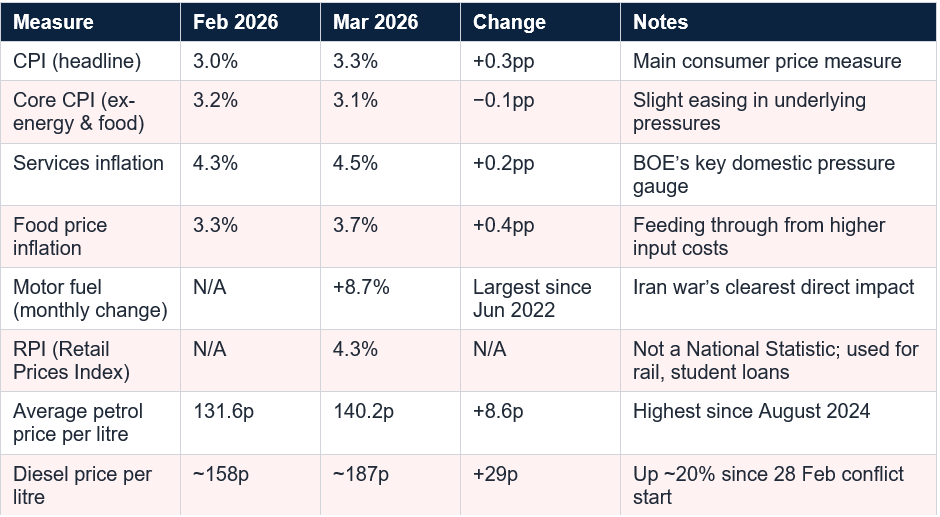
Several important details sit within these headline figures. Core inflation — which strips out the volatile energy and food components — actually edged down slightly, from 3.2 percent to 3.1 percent. This suggests that the underlying domestic price pressures, the ones driven by wage costs and consumer demand, are not accelerating. The inflation surge is almost entirely an external supply shock from energy prices, not a homegrown overheating of the economy.
Services inflation — which the Bank of England watches most closely when setting interest rates, because services prices reflect domestic labour costs more directly than goods prices — ticked up to 4.5 percent in March from 4.3 percent in February. This is more concerning for the Monetary Policy Committee, as it suggests some pass-through of higher energy costs into service sector pricing.
The Engine: Fuel Prices and the Iran War
To understand the 3.3 percent CPI figure, you need to understand what happened to global energy markets after 28 February 2026. When Israeli and US forces launched military strikes against Iran on that date, and Iran responded with strikes against regional US military bases and energy infrastructure, the Strait of Hormuz — the narrow sea lane through which roughly 20 percent of the world’s oil and natural gas transits — saw a dramatic collapse in shipping traffic.The House of Commons Library briefing on the Middle East conflict and the UK economy, published in April 2026, reported that the International Energy Agency estimated around 20 million barrels of oil per day had been affected by the drop in shipping through the Strait by mid-March, with oil production cut by at least 10 million barrels per day in Gulf countries — approximately 10 percent of global production. UK wholesale natural gas prices rose by roughly 75 percent between late February and 23 March 2026.
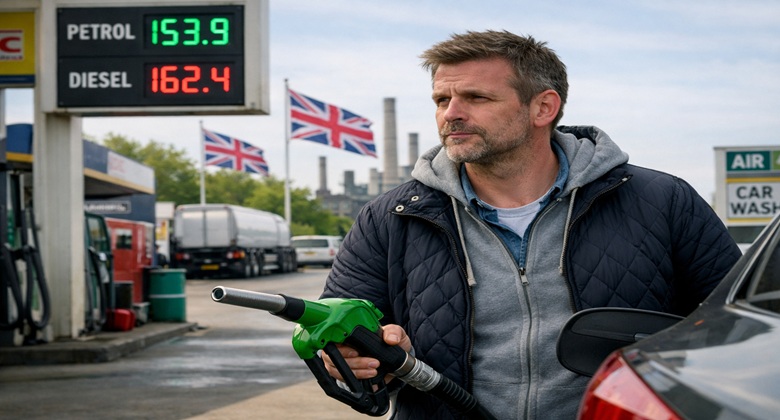
The impact on petrol and diesel at UK forecourts was direct and rapid. Petrol prices rose by 8.6 pence per litre between February and March, reaching 140.2 pence per litre — the highest since August 2024. Diesel, even more exposed to global crude disruptions because of its use in freight and heating, rose by approximately 29 pence per litre, a 20 percent increase, between the conflict’s start and 23 March. By 31 March, diesel prices in some parts of England had almost reached £2.00 per litre.
Sanjay Raja, chief UK economist at Deutsche Bank: "With the repercussions of the Iran conflict reaching the UK’s shores, pump prices and heating oil prices are likely to see a big increase to end the quarter. The UK is a net importer of energy and is particularly vulnerable to global energy price shocks like the one caused by the conflict in the Middle East."
The Cascade: How Fuel Inflation Spreads Across the CPI Basket
Energy price shocks do not stay in the energy category. They cascade through the economy because virtually everything — food, goods, services, travel — has some relationship to energy costs. The March 2026 CPI data is showing the early stages of this cascade, but economists warn that the full effect will take months to appear in the data.Food and Groceries
Food price inflation rose to 3.7 percent in March from 3.3 percent in February. This is the beginning of an energy cost pass-through that will accelerate. Higher diesel prices raise the cost of every lorry delivery to every supermarket in the country. Higher fertiliser prices — and the House of Commons Library noted that the Persian Gulf is an important hub for fertiliser production, with prices rising alongside energy costs — raise the cost of UK and imported agricultural production. The average grocery bill is already 39.2 percent higher than January 2021, according to SalaryWise.co.uk’s UK cost of living tracker. Food inflation that was decelerating is now re-accelerating.Airfares and Travel
Airfares were identified as a secondary upward driver in the March data by the ONS. Jet fuel is a petroleum product, and its price moves with crude oil. Airlines pass fuel cost increases through to ticket prices relatively quickly — typically within one to two months of a sustained fuel price rise. Higher airfare inflation adds directly to the CPI for the nearly half of UK households that fly at least once per year.Manufacturing and Business Costs
The ONS’s producer price data showed that the monthly cost of both raw materials for businesses and goods leaving factories rose substantially in March, driven by higher crude oil and petrol prices. When manufacturers’ input costs rise, those costs typically pass through to retail prices within three to six months, meaning the CPI impact of the March energy spike will continue to feed through well into the summer.Energy Bills: The July Price Cap Risk
The most consequential delayed impact is on household energy bills. The Ofgem price cap for a typical dual-fuel household currently stands at £1,641 per year. This cap will be reviewed and reset in July 2026. With UK wholesale natural gas prices having risen roughly 75 percent since late February, most energy market analysts expect a significant increase in the July cap. Mike Ambery of Standard Life noted: “Energy prices have continued to rise into April, and their impact on the UK energy price cap, due to be updated in July, as well as on everyday costs like transport, food and other essentials, is still working its way through.”What It Means for Your Household Bills Right Now
The 3.3 percent CPI headline is an annual figure — prices on average are 3.3 percent higher than they were a year ago. But for households feeling the March increase specifically, the relevant number is the month-on-month change driven by fuel: an 8.7 percent jump in motor fuel costs in a single month, the sharpest since June 2022.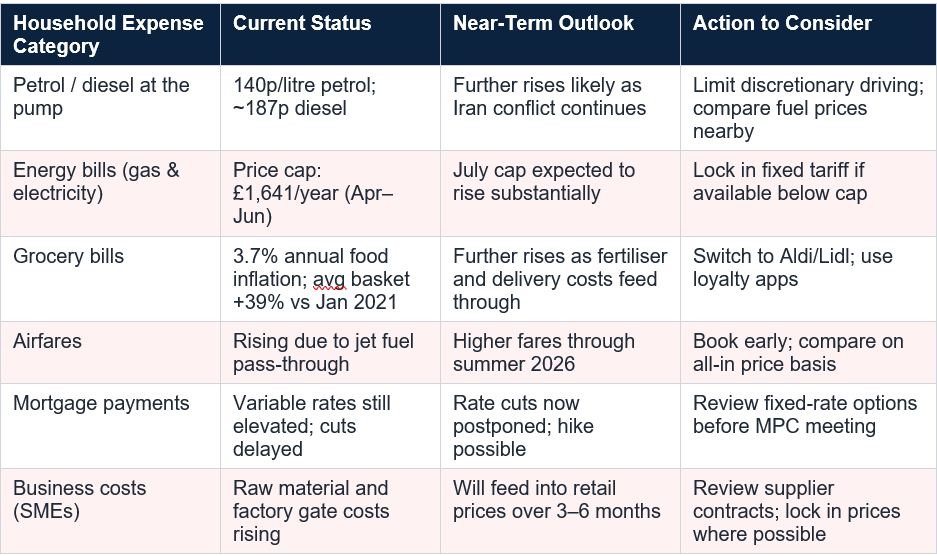
The Bank of England’s Impossible Position
The Bank of England’s Monetary Policy Committee is scheduled to meet on 30 April 2026 — just days after the March CPI data publication. The decision it faces is genuinely difficult, and the economic community is divided on the right call.Before the Iran war began, the path had been clear: inflation was falling toward the 2 percent target, and the Bank had been cutting its base rate from 5.25 percent at the peak of the cost of living crisis toward a projected 3.5 percent. A 3.75 percent rate was in place as of early March. Rate cuts were expected through spring and summer 2026. Mortgage holders, businesses with variable rate debt, and savers were all calibrating their expectations around a continued rate reduction path.
The 3.3 percent March CPI number has disrupted that trajectory. Financial markets are now pricing in at least one rate rise later in 2026, although the majority of economists polled by Reuters expect the Bank to hold rates unchanged at the 30 April meeting, buying time to assess whether the conflict de-escalates.
The deeper question is whether raising rates is even the right tool for this problem. Lindsay James, investment strategist at Quilter, made the case against intervention: “A rise in rates risks misdiagnosing the problem. This inflationary pulse is being driven by supply disruption, not excess demand. Higher interest rates will do nothing to increase the flow of oil or other goods from the Middle East.”
The risk of raising rates unnecessarily in this environment is stagflation — the combination of slow growth and high inflation that is the hardest economic condition to manage with monetary policy, because the usual remedy for inflation (higher rates) makes slow growth worse, and the usual remedy for slow growth (lower rates) makes inflation worse. The IMF has warned that the UK faces one of the sharpest growth slowdowns among G7 economies in 2026, alongside one of the highest inflation rates.
Anna Leach, chief economist, Institute of Directors: "As inflation has come in in line with revised expectations, and given yesterday’s labour market data which showed a fall in vacancies and further downward progress in wage growth, interest rates should hold at next week’s MPC meeting."
The Outlook: Could Inflation Hit 4%?
The uncomfortable answer to this question is: yes, if the Iran war continues and energy markets do not normalise significantly before summer.The Bank of England said in March 2026 that it expected CPI to be between 3 and 3.5 percent in the second and third quarters of 2026. That projection was based on the assumption of some continued disruption to energy markets. The March data at 3.3 percent is already approaching the upper end of that range, and the energy price pass-through into food, services, and manufactured goods is still working through the supply chain.
CNBC reported that the “extended ceasefire won’t prevent a painful period of accelerating inflation with skyrocketing energy costs and food prices likely to lift the headline rate above 4 percent by the autumn.” Deutsche Bank’s Sanjay Raja and other forecasters have similarly flagged the risk of a 4 percent print by summer, particularly if the July energy price cap rises substantially as expected.
The good news in the March data — and it is real, if limited — is that core inflation edged down to 3.1 percent, and wage growth data published the previous day showed continued moderation. This suggests the economy is not experiencing the kind of second-round inflationary spiral — where workers demand higher wages to cover higher prices, forcing businesses to raise prices further — that would make the inflation surge much harder to resolve. If the Iran conflict de-escalates and energy prices fall back toward pre-war levels, the inflation picture could improve relatively quickly. But the ceasefire agreed in early April 2026 has remained fragile, and peace talks have been repeatedly delayed.
What the Government Is Doing — and Whether It’s Enough
Chancellor Rachel Reeves commented on the inflation data on the day of publication, acknowledging the external origin of the pressure while committing to government action. “The war in the Middle East is not our war, but it will have an impact on our country,” she said. “Every choice I make will be about keeping costs down for families and businesses and building a stronger, more resilient economy.”Prior to the conflict, the government had announced energy bill support measures in the spring 2026 Budget that were expected to help offset the Ofgem price cap increase due in April. Economists had believed those measures would push inflation down close to 2 percent from April onwards. The Iran war has effectively cancelled that expected relief: the energy support partially offsets the new price rises, but the net effect is still a significant household cost increase.
The UK government’s main tools for managing an externally driven energy inflation shock are limited. The Warm Home Discount, energy bill support schemes, and targeted cost of living payments can help the most vulnerable households. But for the broad middle of the income distribution — households that are not eligible for targeted support but are genuinely feeling the squeeze of higher fuel, food, and energy costs — the options are limited to budgeting, substitution, and waiting for the external shock to pass.
Practical Steps to Protect Your Household Budget
Energy: Act Before the July Price Cap Review
The July 2026 Ofgem price cap review is the single largest near-term risk to household energy costs. If you are currently on a standard variable tariff, it may be worth checking whether any fixed-rate tariffs are available below the current or projected cap level. Energy comparison sites including Uswitch and MoneySavingExpert’s Cheap Energy Club are the fastest way to check. A fixed tariff that locks in today’s rates provides certainty if the July cap rises substantially.Fuel: Manage Costs at the Pump
- Use PetrolPrices.com or GasBuddy to find the cheapest station near you before filling up. Prices vary by up to 10p per litre within a few miles.
- Supermarket forecourts (Asda, Sainsbury’s, Tesco) are consistently among the cheapest in most areas.
- If your vehicle is petrol and you have a diesel car too, this is a good period to minimise diesel use given its sharper price rise.
- Consider reducing discretionary driving for the next few months. Combining errands reduces fill-up frequency and cost.
Groceries: The Rules Don’t Change
Food inflation of 3.7 percent and rising means this is not the time to relax grocery discipline. The practical guidance from cost of living analysis is consistent: switch the majority of your shop to Aldi or Lidl (15 to 25 percent cheaper than mid-range supermarkets on a comparable basket), use loyalty card prices at Tesco and Sainsbury’s for branded items where the discount is significant, and use the Trolley.co.uk price comparison app before shopping.Mortgages and Savings: Recalibrate for Delayed Cuts
The delayed rate cut trajectory means variable and tracker mortgage holders should review their options carefully. If rates are expected to hold or even rise, fixing now — even at a rate marginally above a variable rate — provides certainty for a period when the economic outlook is unusually uncertain. Conversely, savers benefit from a higher-for-longer rate environment: ensure savings are in the highest-available easy-access account or cash ISA at current rates, as these will reflect the Bank of England’s maintained 3.75 percent base rate.Conclusion
The UK’s 3.3 percent CPI reading for March 2026 is genuinely bad news for households that were expecting a continued improvement in their real living standards through 2026. The progress made in bringing inflation down from its 2022 peak of 11.1 percent has not been reversed — but it has been meaningfully interrupted by an external shock that the UK government, the Bank of England, and ordinary households did not create and cannot fully control.The critical distinction in this inflation episode is the one that Lindsay James of Quilter made: this is a supply disruption, not an excess demand problem. Higher interest rates cannot put more oil tankers through the Strait of Hormuz. They cannot lower fuel prices at the pump. The Bank of England’s tools are imperfect for this situation, and the risk of a policy mistake — either raising rates unnecessarily and tipping a fragile economy toward recession, or keeping them too low and allowing inflation to become more entrenched — is real.
For households, the message is to plan around the near-term uncertainty rather than wait for it to resolve. The July energy price cap is coming. Fuel prices may remain elevated through summer. Food inflation will continue to feed through. The households that act now — checking energy tariffs, managing fuel costs, and tightening grocery budgets — will be in a better position than those who wait to see how the conflict unfolds. The conflict may end quickly and energy prices may normalise. But budgeting for the scenario where they do not is simply good financial planning.
Frequently Asked Questions
What is CPI and why is 3.3% significant?
CPI stands for Consumer Prices Index, the main measure of UK inflation used by the Bank of England and the government. It measures the annual percentage change in a basket of goods and services representative of what UK households buy. At 3.3% in March 2026, it means prices on average are 3.3% higher than they were a year earlier. The significance is that it reverses the trend toward the Bank of England’s 2% target, was driven by the sharpest monthly fuel price rise since June 2022, and may force a rethink of monetary policy at the April 30 MPC meeting.Why did UK inflation rise to 3.3% in March 2026?
The primary cause was an 8.7% monthly jump in motor fuel prices, the largest single monthly rise since June 2022, directly caused by the disruption to global oil and gas flows through the Strait of Hormuz following the US and Israel’s military conflict with Iran beginning 28 February 2026. Secondary drivers included rising airfares (jet fuel pass-through) and accelerating food prices as higher energy and fertiliser costs fed through the supply chain.How much have UK petrol and diesel prices risen?
Between the start of the Iran conflict on 28 February and 23 March 2026, petrol prices rose by 8.6p per litre to 140.2p, the highest since August 2024. Diesel rose by approximately 29p per litre, a 20% increase. By 31 March, diesel prices in some areas were approaching £2.00 per litre. These increases directly drove the March CPI increase.Will UK energy bills rise in July 2026?
This is the most significant near-term cost risk for households. The Ofgem price cap is reviewed quarterly, and the July review will reflect the wholesale gas price rises that occurred from late February onwards. UK wholesale natural gas prices rose by roughly 75% between late February and 23 March 2026. Most market analysts and economists expect a meaningful increase in the July price cap. Households on standard variable tariffs should check whether fixed-rate tariffs are available below the expected new cap level.Will the Bank of England raise interest rates in response?
As of the April 30 Monetary Policy Committee meeting, most economists polled by Reuters expected the Bank to hold rates at 3.75% rather than raise them, choosing to “look through” the external supply shock. However, financial markets are pricing in at least one rate rise later in 2026. The Bank faces the difficult situation of an inflation rate above its 2% target driven entirely by external energy disruption, where higher rates would do nothing to reduce fuel prices but would make mortgages and business borrowing more expensive.What is core inflation and what does it tell us?
Core inflation strips out the volatile energy and food components of the CPI to give a cleaner picture of underlying domestic price pressures. In March 2026, core CPI fell slightly to 3.1% from 3.2% in February. This is an important signal: it suggests that domestic demand pressures are not accelerating, and that the inflation surge is almost entirely an external energy shock rather than a homegrown overheating. If core inflation were rising alongside headline inflation, the case for rate hikes would be much stronger.How does UK food inflation connect to the Iran war?
The connection operates through two channels. First, higher diesel prices increase the cost of all lorry deliveries to all supermarkets and food distribution centres in the UK. Second, the Persian Gulf is a major hub for fertiliser production; the disruption to that region has raised agricultural input costs, which will feed through to UK food prices over the coming months. Food inflation was already 3.7% in March 2026 and is expected to rise further through the summer.What should I do about my mortgage given the inflation news?
If you are on a variable or tracker mortgage, the delay in Bank of England rate cuts means you will likely be on a higher rate for longer than previously expected. Review whether fixing your rate now makes sense for your circumstances. If you are on a fixed rate approaching renewal, seek independent mortgage broker advice before the April 30 MPC meeting. For those on fixed rates with time remaining, no immediate action is needed — but note that the improvement in rates many were expecting may not materialise on the previously anticipated timetable.External References
ONS — Consumer Price Inflation, UK: March 2026 (Office for National Statistics), CNBC — UK Inflation Jumps to 3.3% in March as Fuel Prices Surge Amid Iran War (22 April 2026), Euronews — UK Inflation Hits 3.3% as Iran War Drives Energy Costs Higher (22 April 2026), LBC — UK Inflation Accelerates After Iran War Drives Sharp Rise in Fuel Prices (22 April 2026), House of Commons Library — Inflation in the UK: Economic Indicators (Updated April 2026), House of Commons Library — Middle East Conflict and the UK Economy (April 2026), Financial Planning Today — CPI Spikes to 3.3% as Fuel Costs Soar (22 April 2026), The British Eye — UK Inflation Hits 3.3% as Fuel Prices Surge (22 April 2026), SalaryWise.co.uk — UK Cost of Living Tracker April 2026, MoneyHelper (UK Government-backed) — How to Save Money on Household Bills,

0 Comments Comments