

Taxes
UK Inheritance Law: Heirs May Not Get What Wills Say

Key Statistics: From 6 April 2027: unused pension pots brought into estate for IHT; effective combined tax rate on pension inherited by adult child could reach 67% (IHT 40% + income tax up to 45%); in some cases effective marginal rate could reach 90%. From 6 April 2026: BPR and APR capped at £1 million per person combined (£2 million for couples); value above cap taxed at 20% effective rate. AIM shares: previously 100% IHT exempt after 2 years; from 2026, relief halved, creating potential 20% IHT charge. Nil-rate band frozen at £325,000 until 2031; residence nil-rate band £175,000. OBR: IHT receipts to rise from £9 billion (2025/26) to £14.5 billion (2030/31). Treasury: 10,500 more estates to pay IHT from 2027 as result of pension changes; 38,500 to pay average £34,000 more. Non-dom rule: IHT exposure now linked to years of UK residence since April 2025. Richard Nelson LLP example: family with no current IHT faces £240,000 liability from April 2027 because pension is added to estate.
A will tells the world who should receive your assets when you die. For generations, most UK families assumed that a properly drafted will, combined with sensible estate planning, was sufficient to ensure that wealth passed to the next generation broadly as intended. That assumption is no longer safe.
A package of inheritance tax (IHT) reforms introduced between 2024 and 2027 has fundamentally changed what heirs receive — often dramatically less than the will states — without requiring any change to the will itself. The will may be legally valid. The gifts may be clearly expressed. But the tax regime that sits between the estate and the beneficiary has been restructured in ways that can dramatically reduce, and in extreme cases almost eliminate, what heirs actually receive from specific asset types.
The three most significant changes are: the inclusion of pension pots in taxable estates from April 2027; the capping of Business Property Relief (BPR) and Agricultural Property Relief (APR) from April 2026; and the continued freeze of the nil-rate band until 2031. Each of these reforms operates independently of the will. A will cannot opt out of them. And many families who believe their estate is efficiently structured have not yet reviewed their plans in light of these changes.
Eddison Cogan Lawyers’ January 2026 analysis describes the effect precisely: wills and financial plans made under the old rules may no longer work as intended. A family with no IHT bill today could face a £240,000 tax liability from April 2027 — simply because the pension is now counted alongside the rest of the estate. Nothing about their circumstances will have changed, other than the law.
Richard Nelson LLP, July 2026: A family with no IHT bill today could face a £240,000 tax liability from April 2027 simply because the pension is now counted alongside the rest of the estate. Nothing about their circumstances will have changed other than the law. The change in the IHT calculation is only part of the picture. How a will is drafted determines who bears the cost of that tax — and that is where many families could be caught out.
Under the rules that applied until 6 April 2027, a pension pot was not part of the taxable estate. It sat outside the estate and could be inherited by nominated beneficiaries — typically free of IHT. Children inheriting a parent’s pension could receive the full fund value without any inheritance tax liability, though income tax applied on withdrawals if the original pension holder died aged 75 or over.
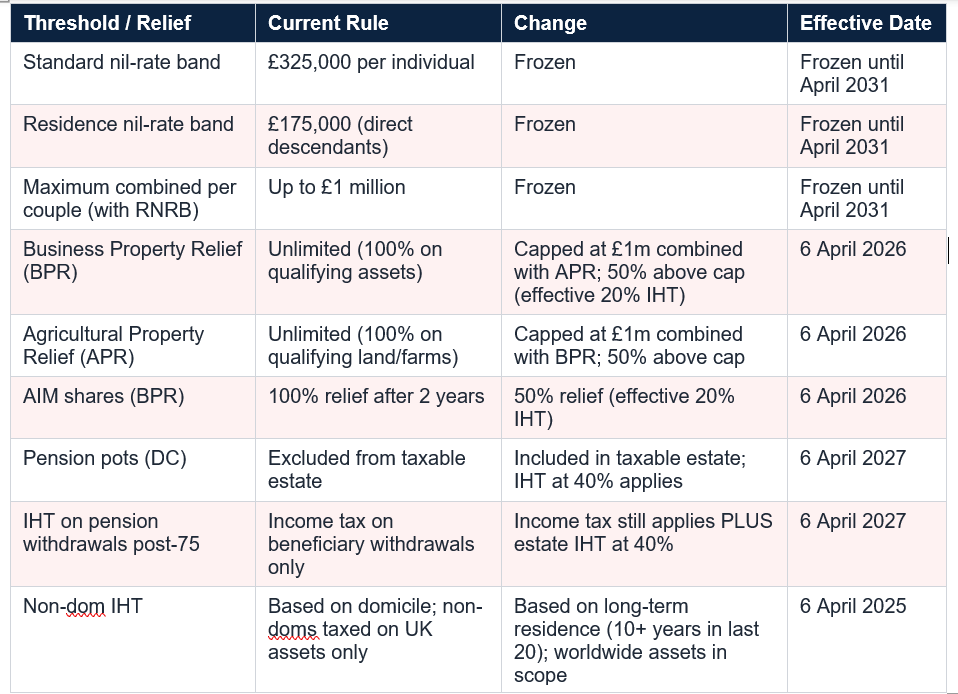
From 6 April 2027, this changes entirely. Unused pension funds and death benefits payable from a pension will be included in the deceased’s estate for IHT purposes. The pension’s value is added to the estate alongside property, savings, investments, and other assets. If the combined value exceeds the available nil-rate band (£325,000 per individual; £500,000 including the residence nil-rate band where applicable), IHT at 40 percent applies to the excess.
Critically, the pension’s inclusion in the IHT-liable estate does not remove the income tax charge on withdrawal. A beneficiary who inherits the pension after April 2027 and the original holder died aged 75 or over will face two separate tax charges: 40 percent IHT on the pension’s inclusion in the estate, and then income tax (at their marginal rate, up to 45 percent) when they draw funds from the inherited pension.
Rest Less, June 2026: Children who inherit their parents’ pension savings could face paying ‘death tax’ of nearly 70%. From April 2027, pensions will be brought into scope for inheritance tax, meaning the pot is taxed at 40% as part of the estate. If the original holder died aged 75 or over, beneficiaries then also pay income tax on withdrawals.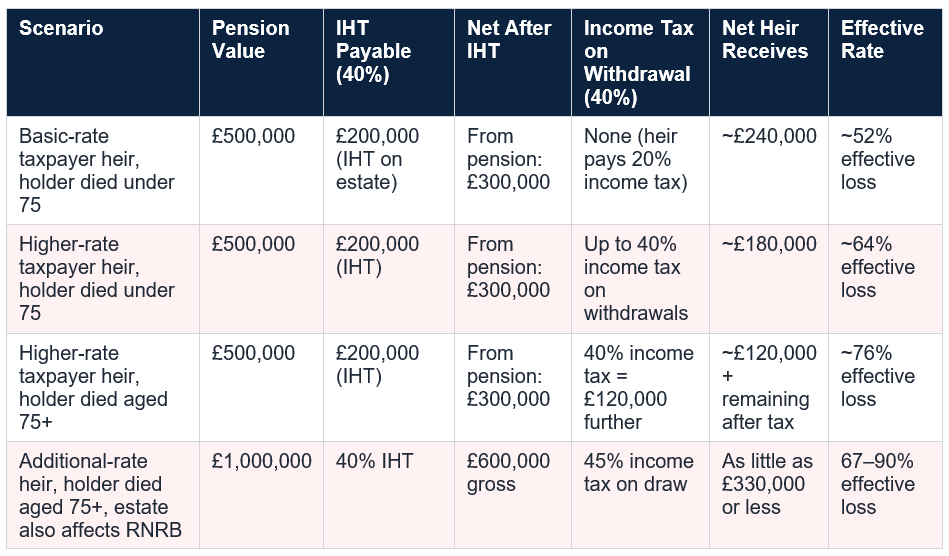
Avrio Wealth’s analysis is stark: a pension worth £1 million left to an adult child could incur a combined effective tax rate of around 67 percent, leaving the beneficiary with only £330,000 after both taxes. In certain circumstances — such as where the death benefits reduce personal allowances or remove eligibility for the residence nil-rate band — the effective marginal tax rate could rise as high as 90 percent. For most clients, the idea that heirs might receive just 10 percent of the pension fund’s value will come as a shock.
Under the old rules, these pecuniary legacies were funded from the estate, and the estate typically did not include the pension. Under the new rules, the pension’s inclusion in the estate may create a significant IHT liability that has to be paid before those legacy amounts are distributed. Who pays the IHT? The answer depends on how the will is drafted — and most wills written before the April 2027 change was announced will not have been drafted with this tax liability in mind.
Richard Nelson LLP identifies this as the central planning failure: many wills include gifts of a specific sum. The way IHT is funded can directly affect what beneficiaries actually receive. A will that leaves fixed sums to specific beneficiaries may, after the pension’s IHT liability is accounted for, leave the residuary beneficiary — typically a spouse or a child — with significantly less than intended, because the fixed gifts take priority over the residue and the IHT bill reduces what remains.
The practical consequence: anyone who made a will before the pension IHT change was announced in the Autumn 2024 Budget should have their will reviewed by a solicitor before April 2027. Not because the will is legally invalid. Because the arithmetic of what beneficiaries receive under the will may be fundamentally different under the new tax regime from what was intended when the will was drafted.
From April 2026, 100 percent relief is capped at £1 million per person across both BPR and APR combined. Married couples and civil partners may effectively combine their allowances to pass up to £2 million in qualifying assets tax-free on the second death. Above the cap, relief is reduced from 100 percent to 50 percent, creating an effective IHT rate of 20 percent on the excess value (40 percent IHT on 50 percent of the value).
For a £5 million family business, for example, the first £1 million receives 100 percent relief (no IHT). The remaining £4 million receives 50 percent relief, leaving £2 million exposed to IHT at 40 percent: a £800,000 tax bill. Heirs of that business will receive less than they would have under pre-April 2026 rules, even if the will states the business passes to them in full.
GLP Solicitors’ April 2026 analysis confirms: from 6 April 2026, unlimited inheritance tax relief for qualifying business and agricultural assets has ended. Without planning, heirs may need to sell assets, borrow funds, or restructure ownership to pay inheritance tax.
Both the nil-rate band and the RNRB have been frozen since 2009 and 2017 respectively. They will remain frozen until April 2031. This freeze is a silent tax increase. As property values, pension pots, investment portfolios, and other assets grow with inflation and economic activity, a fixed threshold captures an ever-larger share of estates that would not have been caught when the threshold was set.
The OBR calculates that IHT receipts will rise from £9 billion in 2025/26 to £14.5 billion by 2030/31. A significant portion of this increase is not driven by any new explicit tax rate increase. It is driven by the freeze: the same threshold capturing more estates as asset values rise. Heirs of families who believed their estates to be comfortably below the IHT threshold may find that by 2029 or 2030, the estate value has grown above it, particularly where property values and pension pots have continued to appreciate.
From April 2025, IHT exposure is determined by whether someone is a long-term UK resident. A person who has lived in the UK for 10 or more years out of the last 20 is treated as a long-term resident and subject to UK IHT on their worldwide assets. A person who leaves the UK after being a long-term resident remains subject to UK IHT on worldwide assets for a period determined by how many years they were a UK resident, under a sliding scale.
For the heirs of internationally mobile individuals — those who split time between the UK and other countries, or who moved to or from the UK in later life — this change can result in UK IHT being charged on assets, including overseas property and investments, that would previously have been outside the UK IHT net entirely. The will may say these assets pass to specific heirs. A UK IHT charge on those assets will reduce what the heirs receive, regardless of the will’s terms.
From April 2026, this relief has been halved. AIM shares now receive 50 percent relief rather than 100 percent, creating an effective IHT rate of 20 percent (40 percent IHT on 50 percent of the value) on qualifying AIM shares held at death. Apex Accountants’ analysis notes that starting in 2026, the IHT savings from AIM shares will be halved, and careful timing and risk assessment are essential.
For heirs expecting to inherit an AIM portfolio that the will treats as a significant bequest, the halved relief means a 20 percent IHT charge now applies to assets that previously passed free of IHT. The bequest is still valid. The will is still legally effective. But the heir receives the AIM portfolio net of a 20 percent IHT charge, not free of IHT.
10. Who Is Most Affected by These Changes?
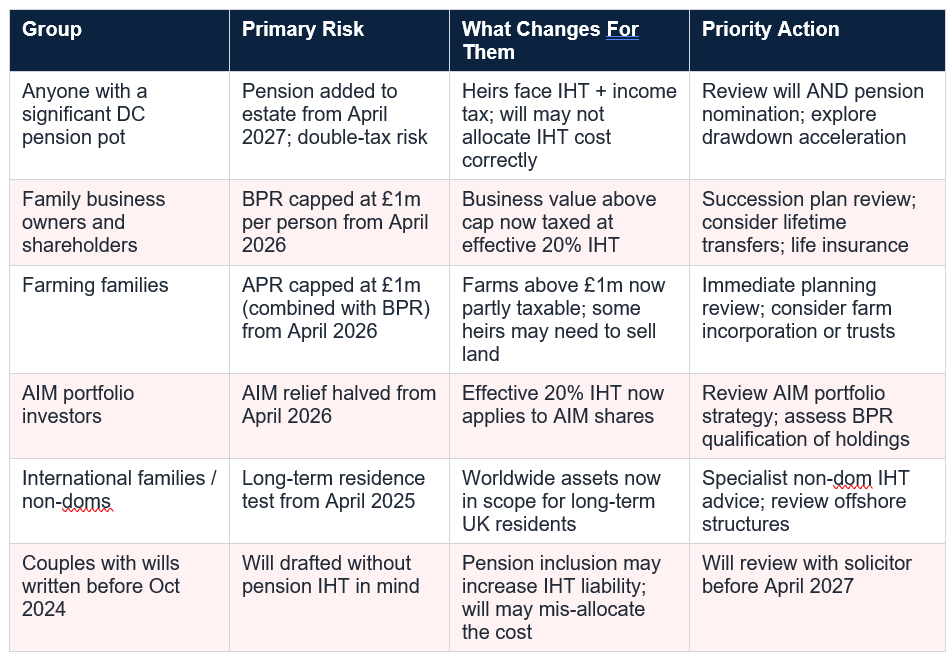

The pension change is the most dramatic. A family whose IHT plan depended on the pension sitting outside the taxable estate and passing tax-free to children faces a fundamental change from April 2027. The pension will be in the estate. IHT will apply. Income tax may apply on withdrawal. The combined effective rate could be 67 percent or more. And a will drafted before October 2024 — when most families were still unaware of this change — may not allocate the resulting IHT cost in a way that reflects the family’s actual intentions.
The Office for Budget Responsibility’s forecast says it all: IHT receipts are projected to grow from £9 billion to £14.5 billion by 2030/31. That additional £5.5 billion per year is money that will not reach heirs. It will reach HMRC. The difference between the families who are surprised by this and the families who are not is, in most cases, one conversation with a qualified solicitor or estate planning adviser.
The biggest change is the inclusion of unused defined contribution pension pots in the taxable estate for IHT purposes from 6 April 2027. Under current rules (2026/27), pension pots are excluded from the estate and can pass to heirs free of IHT. From 6 April 2027, unused pension funds are added to the taxable estate. If the estate (including the pension) exceeds the nil-rate band, IHT at 40% applies. If the original holder died aged 75 or over, income tax also applies on withdrawals, potentially creating a combined effective tax rate of 67% or more on the pension.
Can a will override the new inheritance tax rules?
No. A will determines who inherits your assets. The IHT rules determine how much of those assets survive the tax charge before reaching the heirs. No provision in a will can exempt assets from IHT if the law requires them to be taxed. What a will can do is allocate the IHT burden between beneficiaries in different ways — which is why wills drafted before the pension IHT change was announced in October 2024 may now produce unintended outcomes and should be reviewed.
What happened to Business Property Relief in 2026?
From 6 April 2026, BPR is capped at £1 million per person combined with Agricultural Property Relief (APR). Previously, unlimited 100% relief could pass a trading business of any value free of IHT. Now, only the first £1 million attracts 100% relief; value above the cap attracts 50% relief, creating an effective 20% IHT rate on the excess. Married couples may effectively share allowances to pass up to £2 million in qualifying assets tax-free on the second death.
How much will a pension of £500,000 be taxed under the 2027 rules?
If the pension is included in an estate that exceeds the nil-rate band, 40% IHT applies to the pension’s value as part of the taxable excess. On £500,000 above the nil-rate band, that is £200,000 IHT, leaving £300,000. If the original holder died aged 75 or over, beneficiaries then pay income tax on withdrawals from the remaining £300,000 at their marginal rate. For a higher-rate taxpayer, this means a further 40% (approximately £120,000), leaving around £180,000 — 64% below the original £500,000 value.
What is the nil-rate band and why is its freeze significant?
The nil-rate band is the threshold below which no IHT is payable on an estate. It is currently £325,000 per individual, plus a residence nil-rate band of £175,000 (when a main home passes to direct descendants), giving a potential maximum of £500,000 per person and £1 million for couples. It has been frozen since 2009 and will remain frozen until April 2031. As property values and other assets grow, more estates exceed this frozen threshold, increasing IHT receipts without any formal rate change. The OBR projects IHT receipts to rise from £9 billion (2025/26) to £14.5 billion by 2030/31.
Do AIM shares still avoid inheritance tax?
Not fully. From April 2026, Business Property Relief on AIM shares has been halved from 100% to 50%. This creates an effective IHT rate of 20% on qualifying AIM shares held at death (40% IHT on 50% of the value). Before April 2026, AIM shares that had been held for two years or more were fully exempt from IHT. The halved relief makes AIM portfolios less attractive as an IHT planning tool and requires careful assessment of whether the remaining 50% relief still justifies the investment strategy.
Should I review my will before April 2027?
Yes, if your estate includes a significant pension pot, or if your estate value (including the pension) could exceed the nil-rate band from April 2027. Richard Nelson LLP specifically recommends reviewing wills made before October 2024 because they were drafted in a world where pensions were outside the taxable estate. Solicitors point out that wills with pecuniary legacies (fixed cash gifts to specific beneficiaries) may now have unintended consequences when an IHT liability from the pension is added to the estate. A review with a qualified solicitor is the most effective action.
Table of Contents
- When a Will Is No Longer Enough
- Why Heirs Are Getting Less: The Three-Layer Reform
- Change 1: Pensions Enter the Estate (April 2027)
- The Combined Tax Hit: How Much Will Heirs Actually Receive?
- The Will Problem: Why Old Wills Now Work Against Families
- Change 2: Business and Farm Relief Capped (April 2026)
- Change 3: The Nil-Rate Band Freeze and Its Hidden Cost
- Change 4: Non-Domicile Rules Overhauled (April 2025)
- Change 5: AIM Shares — The Relief That Halved
- Who Is Most Affected by These Changes?
- The Key IHT Numbers at a Glance
- What You Should Do Now: Practical Planning Steps
- Conclusion: The Estate Plan That Made Sense Before May Not Any More
- Frequently Asked Questions
When a Will Is No Longer Enough
A will tells the world who should receive your assets when you die. For generations, most UK families assumed that a properly drafted will, combined with sensible estate planning, was sufficient to ensure that wealth passed to the next generation broadly as intended. That assumption is no longer safe.A package of inheritance tax (IHT) reforms introduced between 2024 and 2027 has fundamentally changed what heirs receive — often dramatically less than the will states — without requiring any change to the will itself. The will may be legally valid. The gifts may be clearly expressed. But the tax regime that sits between the estate and the beneficiary has been restructured in ways that can dramatically reduce, and in extreme cases almost eliminate, what heirs actually receive from specific asset types.
The three most significant changes are: the inclusion of pension pots in taxable estates from April 2027; the capping of Business Property Relief (BPR) and Agricultural Property Relief (APR) from April 2026; and the continued freeze of the nil-rate band until 2031. Each of these reforms operates independently of the will. A will cannot opt out of them. And many families who believe their estate is efficiently structured have not yet reviewed their plans in light of these changes.
Why Heirs Are Getting Less: The Three-Layer Reform
The reforms collectively represent the most significant restructuring of UK inheritance tax in decades. The Office for Budget Responsibility forecasts that IHT receipts will rise from £9 billion in 2025/26 to £14.5 billion by 2030/31 — a 60 percent increase — driven almost entirely by these changes operating alongside frozen thresholds and rising asset values.Eddison Cogan Lawyers’ January 2026 analysis describes the effect precisely: wills and financial plans made under the old rules may no longer work as intended. A family with no IHT bill today could face a £240,000 tax liability from April 2027 — simply because the pension is now counted alongside the rest of the estate. Nothing about their circumstances will have changed, other than the law.
Richard Nelson LLP, July 2026: A family with no IHT bill today could face a £240,000 tax liability from April 2027 simply because the pension is now counted alongside the rest of the estate. Nothing about their circumstances will have changed other than the law. The change in the IHT calculation is only part of the picture. How a will is drafted determines who bears the cost of that tax — and that is where many families could be caught out.
Change 1: Pensions Enter the Estate (April 2027)
The most consequential of all the IHT reforms is the inclusion of unused defined contribution pension pots in the taxable estate for deaths occurring on or after 6 April 2027. This reverses a rule that had been in place since 2015 and that had made pensions one of the most tax-efficient tools for passing wealth to the next generation.Under the rules that applied until 6 April 2027, a pension pot was not part of the taxable estate. It sat outside the estate and could be inherited by nominated beneficiaries — typically free of IHT. Children inheriting a parent’s pension could receive the full fund value without any inheritance tax liability, though income tax applied on withdrawals if the original pension holder died aged 75 or over.
From 6 April 2027, this changes entirely. Unused pension funds and death benefits payable from a pension will be included in the deceased’s estate for IHT purposes. The pension’s value is added to the estate alongside property, savings, investments, and other assets. If the combined value exceeds the available nil-rate band (£325,000 per individual; £500,000 including the residence nil-rate band where applicable), IHT at 40 percent applies to the excess.
Critically, the pension’s inclusion in the IHT-liable estate does not remove the income tax charge on withdrawal. A beneficiary who inherits the pension after April 2027 and the original holder died aged 75 or over will face two separate tax charges: 40 percent IHT on the pension’s inclusion in the estate, and then income tax (at their marginal rate, up to 45 percent) when they draw funds from the inherited pension.
Rest Less, June 2026: Children who inherit their parents’ pension savings could face paying ‘death tax’ of nearly 70%. From April 2027, pensions will be brought into scope for inheritance tax, meaning the pot is taxed at 40% as part of the estate. If the original holder died aged 75 or over, beneficiaries then also pay income tax on withdrawals.
The Combined Tax Hit: How Much Will Heirs Actually Receive?
Avrio Wealth’s analysis is stark: a pension worth £1 million left to an adult child could incur a combined effective tax rate of around 67 percent, leaving the beneficiary with only £330,000 after both taxes. In certain circumstances — such as where the death benefits reduce personal allowances or remove eligibility for the residence nil-rate band — the effective marginal tax rate could rise as high as 90 percent. For most clients, the idea that heirs might receive just 10 percent of the pension fund’s value will come as a shock.
The Will Problem: Why Old Wills Now Work Against Families
The inclusion of pension wealth in estates from April 2027 creates a specific and underappreciated problem for existing wills. Many wills include gifts of a specific cash sum: £50,000 to my nephew, £100,000 to my grandchild, £10,000 to my chosen charity. These are called pecuniary legacies.Under the old rules, these pecuniary legacies were funded from the estate, and the estate typically did not include the pension. Under the new rules, the pension’s inclusion in the estate may create a significant IHT liability that has to be paid before those legacy amounts are distributed. Who pays the IHT? The answer depends on how the will is drafted — and most wills written before the April 2027 change was announced will not have been drafted with this tax liability in mind.
Richard Nelson LLP identifies this as the central planning failure: many wills include gifts of a specific sum. The way IHT is funded can directly affect what beneficiaries actually receive. A will that leaves fixed sums to specific beneficiaries may, after the pension’s IHT liability is accounted for, leave the residuary beneficiary — typically a spouse or a child — with significantly less than intended, because the fixed gifts take priority over the residue and the IHT bill reduces what remains.
The practical consequence: anyone who made a will before the pension IHT change was announced in the Autumn 2024 Budget should have their will reviewed by a solicitor before April 2027. Not because the will is legally invalid. Because the arithmetic of what beneficiaries receive under the will may be fundamentally different under the new tax regime from what was intended when the will was drafted.
Change 2: Business and Farm Relief Capped (April 2026)
From 6 April 2026, Business Property Relief (BPR) and Agricultural Property Relief (APR) are no longer unlimited. These reliefs had been one of the most significant IHT planning tools for family businesses and farms for decades: a trading business or qualifying agricultural property could pass to the next generation entirely free of IHT, regardless of its value.From April 2026, 100 percent relief is capped at £1 million per person across both BPR and APR combined. Married couples and civil partners may effectively combine their allowances to pass up to £2 million in qualifying assets tax-free on the second death. Above the cap, relief is reduced from 100 percent to 50 percent, creating an effective IHT rate of 20 percent on the excess value (40 percent IHT on 50 percent of the value).
For a £5 million family business, for example, the first £1 million receives 100 percent relief (no IHT). The remaining £4 million receives 50 percent relief, leaving £2 million exposed to IHT at 40 percent: a £800,000 tax bill. Heirs of that business will receive less than they would have under pre-April 2026 rules, even if the will states the business passes to them in full.
GLP Solicitors’ April 2026 analysis confirms: from 6 April 2026, unlimited inheritance tax relief for qualifying business and agricultural assets has ended. Without planning, heirs may need to sell assets, borrow funds, or restructure ownership to pay inheritance tax.
Change 3: The Nil-Rate Band Freeze and Its Hidden Cost
The standard IHT nil-rate band — the threshold below which no IHT is charged on an estate — is £325,000 per individual. The residence nil-rate band (RNRB), which provides an additional £175,000 allowance when a main residence is left to direct descendants, brings the combined threshold to £500,000 per individual. Married couples and civil partners can transfer unused allowances, giving a combined maximum of £1 million.Both the nil-rate band and the RNRB have been frozen since 2009 and 2017 respectively. They will remain frozen until April 2031. This freeze is a silent tax increase. As property values, pension pots, investment portfolios, and other assets grow with inflation and economic activity, a fixed threshold captures an ever-larger share of estates that would not have been caught when the threshold was set.
The OBR calculates that IHT receipts will rise from £9 billion in 2025/26 to £14.5 billion by 2030/31. A significant portion of this increase is not driven by any new explicit tax rate increase. It is driven by the freeze: the same threshold capturing more estates as asset values rise. Heirs of families who believed their estates to be comfortably below the IHT threshold may find that by 2029 or 2030, the estate value has grown above it, particularly where property values and pension pots have continued to appreciate.
Change 4: Non-Domicile Rules Overhauled (April 2025)
From 6 April 2025, the UK’s non-domicile IHT rules were replaced with a residence-based system. Under the old rules, a person’s IHT exposure depended on their domicile status — a complex legal concept linked to their intentions about where they intended to live permanently. Non-domiciled individuals were only subject to UK IHT on UK-sited assets, regardless of how long they had lived in the UK.From April 2025, IHT exposure is determined by whether someone is a long-term UK resident. A person who has lived in the UK for 10 or more years out of the last 20 is treated as a long-term resident and subject to UK IHT on their worldwide assets. A person who leaves the UK after being a long-term resident remains subject to UK IHT on worldwide assets for a period determined by how many years they were a UK resident, under a sliding scale.
For the heirs of internationally mobile individuals — those who split time between the UK and other countries, or who moved to or from the UK in later life — this change can result in UK IHT being charged on assets, including overseas property and investments, that would previously have been outside the UK IHT net entirely. The will may say these assets pass to specific heirs. A UK IHT charge on those assets will reduce what the heirs receive, regardless of the will’s terms.
Change 5: AIM Shares — The Relief That Halved
AIM (Alternative Investment Market) shares in qualifying companies had been a widely used IHT planning tool. After holding qualifying AIM shares for two years, they became fully exempt from IHT under Business Property Relief at 100 percent. This made AIM portfolios attractive to investors who wanted to reduce their IHT exposure while maintaining a portfolio of liquid, listed investments.From April 2026, this relief has been halved. AIM shares now receive 50 percent relief rather than 100 percent, creating an effective IHT rate of 20 percent (40 percent IHT on 50 percent of the value) on qualifying AIM shares held at death. Apex Accountants’ analysis notes that starting in 2026, the IHT savings from AIM shares will be halved, and careful timing and risk assessment are essential.
For heirs expecting to inherit an AIM portfolio that the will treats as a significant bequest, the halved relief means a 20 percent IHT charge now applies to assets that previously passed free of IHT. The bequest is still valid. The will is still legally effective. But the heir receives the AIM portfolio net of a 20 percent IHT charge, not free of IHT.
10. Who Is Most Affected by These Changes?
The Key IHT Numbers at a Glance
What You Should Do Now: Practical Planning Steps
The reforms are significant but not irresolvable with proper planning. These are the specific actions that estate planning solicitors and advisers consistently recommend in the light of the April 2025 to 2027 reforms:- Review your will before April 2027: any will drafted before October 2024 (when the pension IHT change was announced in the Autumn Budget) was drafted in a world where pensions were outside the taxable estate. If your estate includes a significant pension pot, your will may need redrafting to ensure the IHT cost is allocated correctly between beneficiaries.
- Update your pension nomination form: your pension nomination form tells the scheme trustees who you want to receive the pension. Nominations do not affect IHT treatment from April 2027 — the pot will be included in your estate regardless of who you nominate. But the nomination remains important for who receives the pension and should be reviewed alongside your will.
- Consider accelerating pension drawdown: PocketWise’s April 2026 analysis recommends keeping ISA and other non-pension assets as long as possible, because they do not generate an income tax bill on withdrawal. Drawing down the pension during your lifetime, particularly if you have other income to meet living costs, reduces the pension pot that will be subject to IHT on death. This is a significant shift from the pre-2027 strategy of preserving the pension for heirs.
- Model the April 2027 impact on your specific estate: the Treasury estimates that 10,500 more estates will face an IHT bill from 2027 as a result of the pension change alone, with 38,500 estates paying an average of £34,000 more. Running a specific numerical projection on your own estate, with a qualified adviser, is the only way to know whether you are in this group.
- Review business succession plans if you own a qualifying business: the BPR cap at £1 million means that a business worth more than this will have an IHT liability on death that did not previously exist. Lifetime transfers, business restructuring, or life insurance written in trust to cover the potential liability are all options that require professional advice.
- Review farming succession: APR is now capped at £1 million combined with BPR. Farming families who had assumed farmland would pass free of IHT need to review their plans in light of the new effective 20 percent rate on agricultural property above the cap.
Conclusion
The title of this article is deliberately provocative: under new UK inheritance law, heirs may not receive the assets no matter what the will says. This is not hyperbole. A will is a legally binding document. But the will operates within a tax regime that determines how much of the estate reaches the beneficiaries before the IHT bill is paid. When that tax regime changes — as it has, dramatically, between 2025 and 2027 — the will may accurately describe who inherits but not accurately predict how much they receive.The pension change is the most dramatic. A family whose IHT plan depended on the pension sitting outside the taxable estate and passing tax-free to children faces a fundamental change from April 2027. The pension will be in the estate. IHT will apply. Income tax may apply on withdrawal. The combined effective rate could be 67 percent or more. And a will drafted before October 2024 — when most families were still unaware of this change — may not allocate the resulting IHT cost in a way that reflects the family’s actual intentions.
The Office for Budget Responsibility’s forecast says it all: IHT receipts are projected to grow from £9 billion to £14.5 billion by 2030/31. That additional £5.5 billion per year is money that will not reach heirs. It will reach HMRC. The difference between the families who are surprised by this and the families who are not is, in most cases, one conversation with a qualified solicitor or estate planning adviser.
Frequently Asked Questions
What is the biggest UK inheritance law change affecting heirs from 2027?The biggest change is the inclusion of unused defined contribution pension pots in the taxable estate for IHT purposes from 6 April 2027. Under current rules (2026/27), pension pots are excluded from the estate and can pass to heirs free of IHT. From 6 April 2027, unused pension funds are added to the taxable estate. If the estate (including the pension) exceeds the nil-rate band, IHT at 40% applies. If the original holder died aged 75 or over, income tax also applies on withdrawals, potentially creating a combined effective tax rate of 67% or more on the pension.
Can a will override the new inheritance tax rules?
No. A will determines who inherits your assets. The IHT rules determine how much of those assets survive the tax charge before reaching the heirs. No provision in a will can exempt assets from IHT if the law requires them to be taxed. What a will can do is allocate the IHT burden between beneficiaries in different ways — which is why wills drafted before the pension IHT change was announced in October 2024 may now produce unintended outcomes and should be reviewed.
What happened to Business Property Relief in 2026?
From 6 April 2026, BPR is capped at £1 million per person combined with Agricultural Property Relief (APR). Previously, unlimited 100% relief could pass a trading business of any value free of IHT. Now, only the first £1 million attracts 100% relief; value above the cap attracts 50% relief, creating an effective 20% IHT rate on the excess. Married couples may effectively share allowances to pass up to £2 million in qualifying assets tax-free on the second death.
How much will a pension of £500,000 be taxed under the 2027 rules?
If the pension is included in an estate that exceeds the nil-rate band, 40% IHT applies to the pension’s value as part of the taxable excess. On £500,000 above the nil-rate band, that is £200,000 IHT, leaving £300,000. If the original holder died aged 75 or over, beneficiaries then pay income tax on withdrawals from the remaining £300,000 at their marginal rate. For a higher-rate taxpayer, this means a further 40% (approximately £120,000), leaving around £180,000 — 64% below the original £500,000 value.
What is the nil-rate band and why is its freeze significant?
The nil-rate band is the threshold below which no IHT is payable on an estate. It is currently £325,000 per individual, plus a residence nil-rate band of £175,000 (when a main home passes to direct descendants), giving a potential maximum of £500,000 per person and £1 million for couples. It has been frozen since 2009 and will remain frozen until April 2031. As property values and other assets grow, more estates exceed this frozen threshold, increasing IHT receipts without any formal rate change. The OBR projects IHT receipts to rise from £9 billion (2025/26) to £14.5 billion by 2030/31.
Do AIM shares still avoid inheritance tax?
Not fully. From April 2026, Business Property Relief on AIM shares has been halved from 100% to 50%. This creates an effective IHT rate of 20% on qualifying AIM shares held at death (40% IHT on 50% of the value). Before April 2026, AIM shares that had been held for two years or more were fully exempt from IHT. The halved relief makes AIM portfolios less attractive as an IHT planning tool and requires careful assessment of whether the remaining 50% relief still justifies the investment strategy.
Should I review my will before April 2027?
Yes, if your estate includes a significant pension pot, or if your estate value (including the pension) could exceed the nil-rate band from April 2027. Richard Nelson LLP specifically recommends reviewing wills made before October 2024 because they were drafted in a world where pensions were outside the taxable estate. Solicitors point out that wills with pecuniary legacies (fixed cash gifts to specific beneficiaries) may now have unintended consequences when an IHT liability from the pension is added to the estate. A review with a qualified solicitor is the most effective action.
0 Comments
Be the first to share your thoughts on this article.